Dante Alighieri Street from the Brignardello Portico

Via Dante Alighieri a Lavagna vista dal tetto del Porticato Brignardello

Dante Alighieri Street from the Brignardello Portico.
In Lavagna, Liguria, Italy, on the Italian Riviera, Dante Alighieri Street can be seen from an unusual viewpoint: the terrace above the Brignardello Portico, beside the Basilica of Santo Stefano. I really enjoy taking photographs in this part of the old town, where historic architecture, the square and the surrounding streets come together to create views I never tire of exploring.
I have photographed the basilica’s churchyard many times. Its broad open space, monumental staircase and traditional decorative pebble pavement make it an endlessly interesting subject. The Brignardello Portico has its own special charm, with its columns and elegant covered walkway bordering the square. This time, however, I decided to look beyond these familiar features and focus on the street running through the area: Dante Alighieri Street.
What makes this photograph different is the position from which I took it. From the terrace above the portico, the street can be viewed from above, giving it a very different appearance from the one you experience while walking along it. The perspective changes the relationship between the buildings, making it easier to appreciate the lines of the street and how it fits into the surrounding townscape. It is a viewpoint that can easily be overlooked when simply crossing the square.
The Brignardello Portico was built in the late nineteenth century at the initiative of Nicola Brignardello, a benefactor who provided funds for a portico with an elevated terrace for public use. Completed between 1894 and 1898, it has become one of the distinctive landmarks of this part of Lavagna.
One of the things I enjoy most about photography is the opportunity to return to a familiar place and discover something new. You do not always need to travel to another city or venture far away. Sometimes, climbing a few steps, moving a short distance or looking at a street from a different height is enough to create a completely new image.
In this photograph, Dante Alighieri Street takes centre stage, while the nearby basilica and portico remain part of the wider setting. It is another way of telling the story of Lavagna, through an everyday street seen from a less familiar position.

Do you know this elevated viewpoint above the Brignardello Portico, or have you always seen Dante Alighieri Street from street level? Add a comment or go to the bottom of the site to read what other visitors have written.

Dante Alighieri Street in Lavagna viewed from the terrace above the Brignardello Portico, near the Basilica of Santo Stefano

Photo taken with a Canon EOS M100 camera and Canon EF-M 11-22 lens.

Add one  comment to this article or read  here what other visitors have written.
 
Adv
 
Disclamer

The rights on images, videos, choruses, text and all other material on the LUCADEA.com website are governed as per  Copyright page.


This page has been viewed 0 times today.
This month it has been viewed 0 times.
In total it has been viewed 0 times.
 

A Stone Lion in Front of Lavagna Basilica

Un leone della Basilica di Lavagna

A Stone Lion in Front of Lavagna Basilica.
In front of the Basilica of Santo Stefano in Lavagna, Liguria, two stone lions seem to guard the entrance to the church. This morning, I finally decided to take a photographic walk through this town on the Italian Riviera, known for its historical connection with the Fieschi family and its traditional slate industry. Among the pictures I took, this one featuring the lion in the foreground is particularly appealing to me.
I like the way the sculpture dominates the composition, while the basilica remains in the background and provides the setting. The stone lion has a strong presence, almost as if it had always been there, watching everyone entering and leaving the church. In a photograph like this, an architectural detail can become more interesting than the entire building, especially when the framing creates a contrast between the foreground and the background.
The Basilica of Santo Stefano is one of the most recognisable religious buildings in Lavagna, a town in the Metropolitan City of Genoa, Liguria, Italy. Its history is closely connected with the local community and the Fieschi family, one of the most influential families in medieval Ligurian history. Lavagna is also known for slate, a stone that has played an important role in the local economy and identity for centuries, particularly in construction and traditional crafts.
I photographed several views of the basilica, but this particular image stands out because the lion in the foreground gives the composition its character. It reminds me of a photograph I took in front of San Lorenzo Cathedral in Genoa, where I also used a sculpture in the foreground to frame the building behind it. I enjoy this approach because it allows me to tell the story of a place through a single detail without losing the architectural context that makes it recognisable.
During a photographic walk, these are often the details that catch my attention. I might arrive at a church intending to photograph its façade, only to notice a statue, a doorway or a decorative feature that changes the direction of the shot. In Lavagna, the stone lion became the main subject of the photograph, while the basilica preserves the memory of the place I visited.
I find that looking at familiar buildings from a different angle can reveal details that might otherwise go unnoticed. A sculpture that seems secondary when viewed from a distance can become the focus of an image and give the whole scene a different character.

Do you prefer photographs showing an entire building, or images that tell the story of a place through a detail like this stone lion? Add a comment or go to the bottom of the site to read what other visitors have written.

Stone lion in the foreground of the Basilica of Santo Stefano in Lavagna, on the Ligurian Riviera in northwestern Italy

Photo taken with a Canon EOS M100 camera and Canon EF-S 10-18 lens.

Add one  comment to this article or read  here what other visitors have written.
 
Adv
 
Disclamer

The rights on images, videos, choruses, text and all other material on the LUCADEA.com website are governed as per  Copyright page.


This page has been viewed 0 times today.
This month it has been viewed 0 times.
In total it has been viewed 0 times.
 

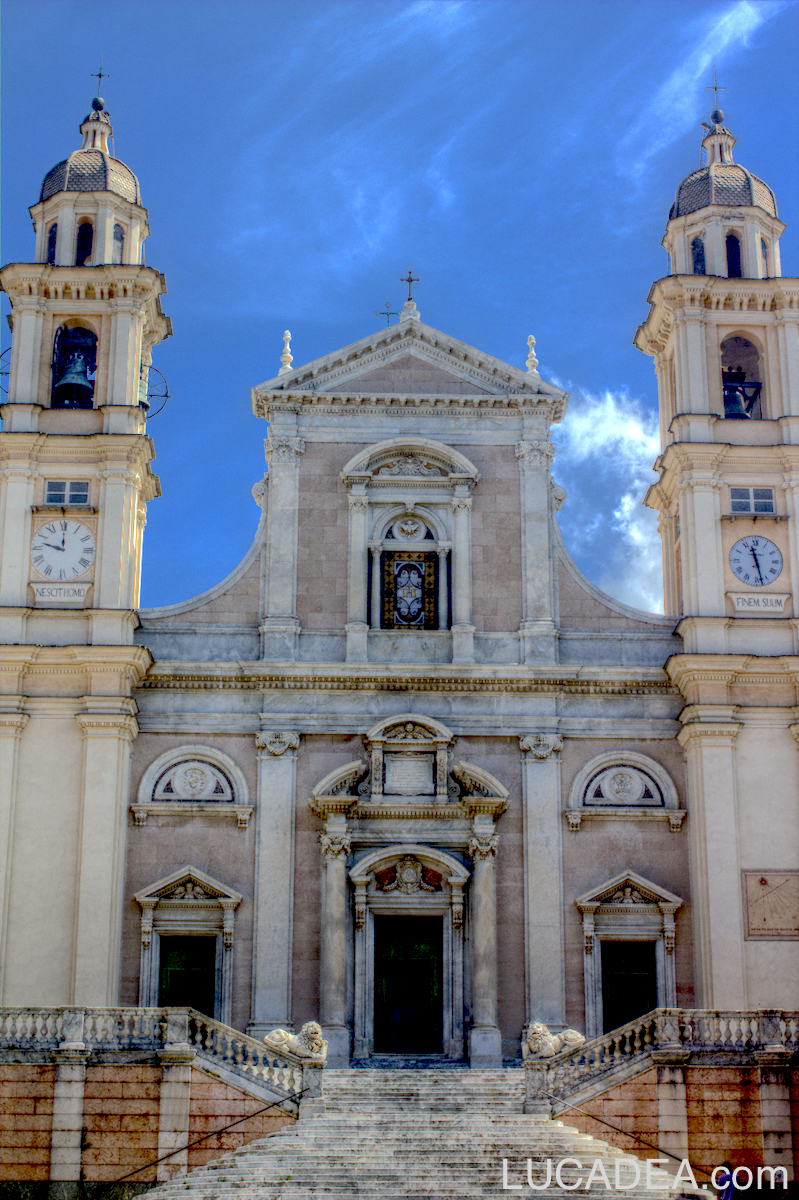
Santo Stefano Basilica in Lavagna

Basilica di Santo Stefano a Lavagna con la grande scalinata e i leoni davanti alla facciata

Santo Stefano Basilica in Lavagna.
Among the most beautiful churches in the Tigullio area, Santo Stefano Basilica is one of the buildings that most often catches my eye when I walk through the historic center of Lavagna. Its façade, broad staircase and central position make it a natural subject for photography, especially when the church can be framed together with the streets and buildings around it.
I am in Lavagna, Liguria, Italy, in the Metropolitan City of Genoa, and this time I stopped in front of the basilica to look more closely at some of its details. The photograph came from one of those walks without a precise plan, when a familiar building suddenly looks slightly different and becomes worth photographing again.
The basilica dominates the main square of the old town and immediately stands out because of the large staircase leading towards the entrance. On either side are the characteristic stone lions, an architectural detail that makes the façade particularly recognizable and one that I always find interesting to include in the frame.
Through the camera, what I like most is the relationship between the size of the church and the much smaller streets surrounding it. The basilica feels imposing, yet it is also a natural part of Lavagna’s urban fabric. Moving only a few steps can completely change the perspective and reveal another view of the same building.
The present church was built in the seventeenth century, between 1650 and 1668, and was consecrated in 1703. A small historical detail I find interesting is that Pope Benedict XV raised it to the status of minor basilica in 1921. These details help explain the importance of the building in Lavagna’s history without taking attention away from the photograph itself.
If you are wondering what to see in Lavagna, Santo Stefano Basilica is naturally one of the places that belongs on a walk through the historic center. But what interests me here is not writing a guide to the church. I prefer to show how the building appears to someone simply walking through these streets. It is almost impossible to cross the center without eventually finding the basilica in front of you.
I have photographed Lavagna several times, and Santo Stefano appears in more than one of my images. I particularly remember another photograph showing the main old-town alley with the basilica visible in the background. It is a very different composition, but it belongs to the same small visual story I have been building around Lavagna. I like it when photographs taken at different moments can complement each other.
Santo Stefano Basilica is also a good example of the way religious architecture and everyday life remain closely connected in Ligurian historic towns. You do not need to search for a special viewpoint. Simply walking through the old streets is often enough for the building to gradually appear between the surrounding houses.
That is what this photograph brings back to me. A familiar place does not have to be seen for the first time to become interesting again. Sometimes all it takes is a different angle, a few extra seconds of observation and a little more attention to details that may have been overlooked many times before.
For me, Santo Stefano remains one of the churches in the Tigullio that I most enjoy photographing. Whenever I return to Lavagna, it is very easy for this building to catch my attention once again.

Is there a church in the Tigullio area that you particularly enjoy photographing? Add a comment or go to the bottom of the site to read what other visitors have written.

Santo Stefano Basilica in Lavagna with its large staircase and stone lions in front of the façade

Lavagna Carruggio between shops and history

Carruggio di Lavagna con persone tra negozi e palazzi storici nel centro della Liguria

Lavagna Carruggio between shops and history.
Walking through the center of Lavagna, I finally filled a small gap in my photographic archive: an image of the Carruggio, one of the most characteristic streets of the town. The scene shows a lively everyday moment, with people walking between shops and the shadows of the surrounding buildings creating a welcoming atmosphere.
I took this photograph on June 27, 2016, during a day when some errands brought me through this part of town. As often happens, even an ordinary moment can become the perfect opportunity to stop for a few seconds and look at a familiar place from a different perspective.
The Carruggio of Lavagna is one of those streets where daily life, local businesses and historic architecture come together. The word “carruggio”, typical of Ligurian tradition, generally refers to a narrow street or alley, often surrounded by close buildings and characterized by a more intimate atmosphere.
The photograph was taken in Lavagna, Liguria, Italy, along the main street of the historic center, with the Basilica of Santo Stefano visible at the end of the street. I decided to dedicate a separate post to the basilica because each place deserves its own story.
If you are visiting Lavagna and wondering what places are worth seeing, the Carruggio is interesting not only because of its appearance but because it shows everyday life in the town. Walking through it means seeing shops, local activity and architectural details that continue to be part of the community.
One interesting fact is that many Ligurian carruggi developed from medieval town structures, with narrow streets designed to provide protection from the sun and wind while adapting to the shape of the settlements.
I enjoy photographing these places because they are not just backgrounds, but spaces where small stories happen every day. Like other posts on my photoblog dedicated to Ligurian villages and less obvious corners, this image comes from observing ordinary moments.
Sometimes a simple walk for an errand can lead to a photograph that was missing from your collection. That day, the Carruggio of Lavagna was simply a street full of life, and that is exactly what I wanted to preserve.

Have you ever rediscovered a place you already knew just by looking at it with different eyes? Add a comment or go to the bottom of the site to read what other visitors have written.

Carruggio di Lavagna con persone tra negozi e palazzi storici nel centro della Liguria

🏠
  • Italiano