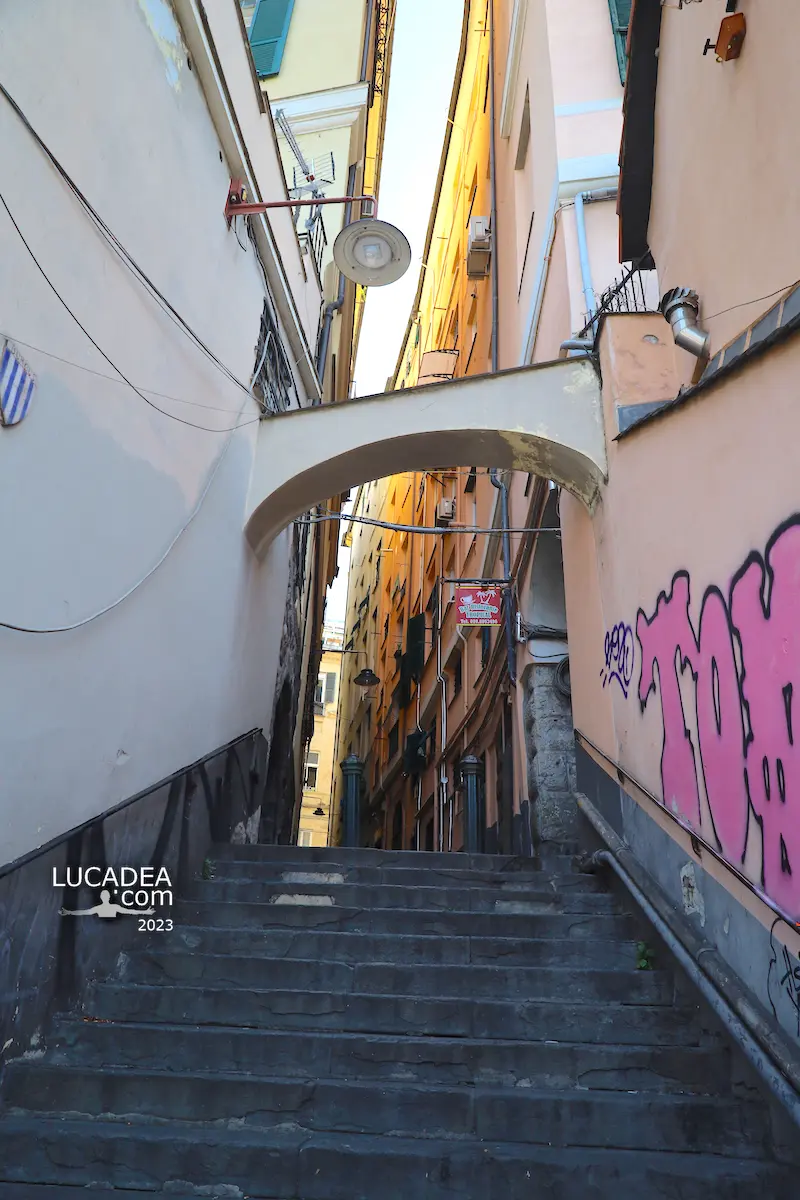
Campo Alley, a lane in Genoa’s old town

Vico del Campo: un vicolo di ingresso al centro storico di Genova

Campo Alley, a lane in Genoa’s old town.
Whenever I walk through the historic center of Genoa, Liguria, Italy, I usually carry my camera because I know that sooner or later some small detail will make me stop. This time it was Campo Alley, a narrow passage connecting Sottoripa street with the well-known Campo street.
This is exactly the kind of view I enjoy photographing in Genoa. Not necessarily the most famous monument or the most recognizable panorama, but an everyday passage, an arch, a facade or a street that reveals something about the unusual structure of the old town. Here, the main subject is the supporting arch spanning the lane, becoming almost a natural frame for anyone walking underneath it.
Campo Alley is in a particularly interesting part of Genoa’s historic center, close to the old port and to the network of streets running along the waterfront. Sottoripa street is one of the city’s historic routes and provides an immediate transition into the dense maze of Genoese lanes. A few steps down one of the side streets and the atmosphere changes completely.
If you are wondering what to see in Genoa’s old town, I think these less obvious passages are worth noticing as well. The historic center is so intricate that you can spend hours walking without following a fixed itinerary. That possibility of getting slightly lost is one of the things that makes it so rewarding to photograph.
The supporting arch visible in the photograph also has a practical purpose. These arches, often found in the narrow lanes of Ligurian historic centers, connect and reinforce buildings on opposite sides of the street, helping to stabilize the structures. At the same time, they have become distinctive elements of the urban landscape and immediately give a narrow Genoese lane its characteristic appearance.
I wanted to capture this particular detail because it represents the Genoa I most enjoy photographing. It is a dense city, built within limited space, where buildings stand so close to one another that streets, arches and houses can almost seem like parts of one continuous structure.
From this lane you can reach the famous Campo street. The street became known well beyond Genoa through the work of singer-songwriter Fabrizio De André, but even before reaching it, this small passage already offers an interesting glimpse of the city. It shows how, in Genoa’s old town, turning a corner can completely change the image in front of you.
I also like the fact that this photograph does not need to show everything. There is no large square and no open panorama, only a small section of the urban fabric. For me, that is enough. When I walk through the old lanes with my camera, these are exactly the situations I am looking for.
Campo Alley belongs to the kind of Genoa that reveals itself slowly. A doorway, a sign, a window, a staircase or an arch can become the reason to stop. I have found the same feeling in other photographs I have published on the blog about the old lanes of Genoa, including the arches and passageways around Sarzano, Campo Pisano and some of the oldest parts of the city.
Its connection with Sottoripa street is also significant. From a street close to the harbor and the sea, you can move within a few meters into a narrow and enclosed lane where the perception of space is completely different. It is one of Genoa’s most distinctive contrasts: the sea is nearby, but inside the old lanes it can almost disappear from sight.
Every time I return to the city, I realize that this way of photographing Genoa never gets tiring. In fact, the more familiar I become with the city, the more I want to look for details that I may have simply walked past without noticing in the past.

When you walk through Genoa’s old town, do you also stop to look at these small architectural details? Add a comment or go to the bottom of the site to read what other visitors have written.
Photos taken with a Canon EOS RP camera and Canon RF 24-50 lens.

Here is exactly where I took the photo:

Add one  comment to this article or read  here what other visitors have written.
 
Adv
 
Disclamer

The rights on images, videos, choruses, text and all other material on the LUCADEA.com website are governed as per  Copyright page.


This page has been viewed 1 times today.
This month it has been viewed 1 times.
In total it has been viewed 1 times.
 

A seaside creuza in Bogliasco

Creuza sul mare a Bogliasco con piccolo ponte verso una villa affacciata sulla costa ligure

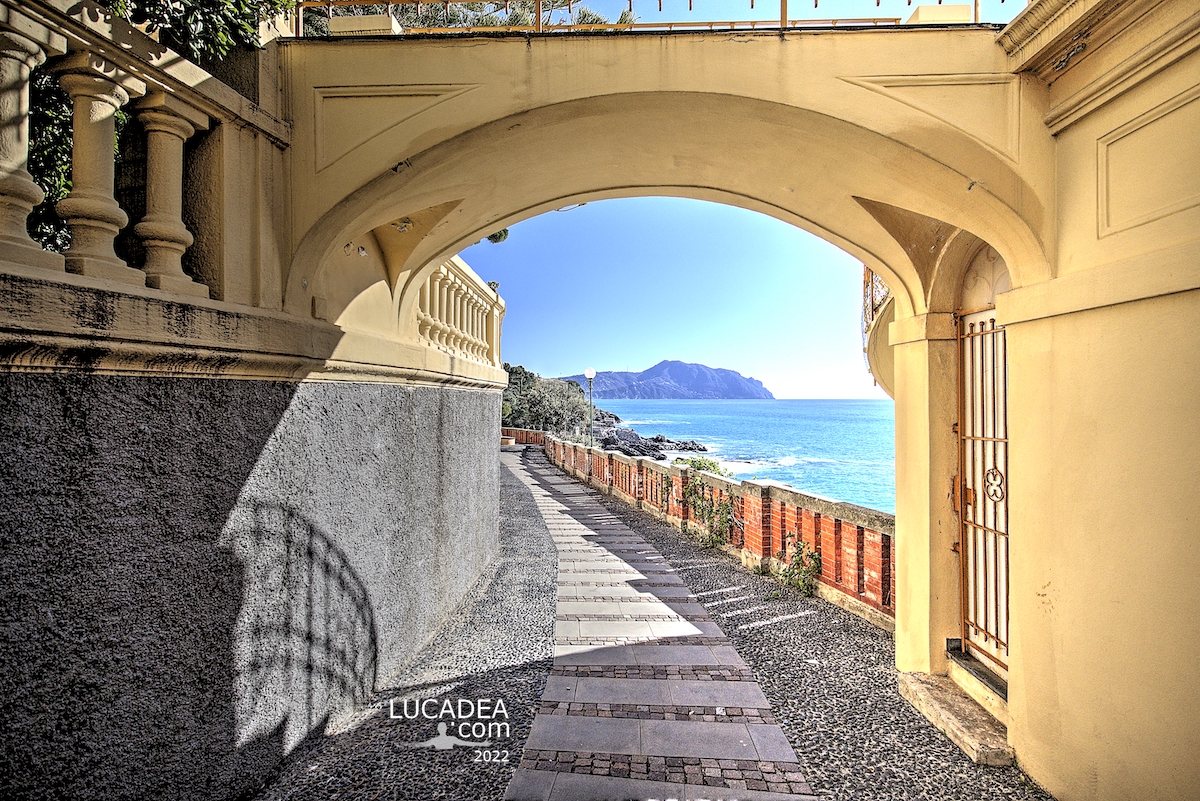
A seaside creuza in Bogliasco.
While walking east of the small harbor in Bogliasco, Liguria, Italy, I stopped to photograph this typical Ligurian creuza running close to the sea and connecting the coastal houses with the road. It is one of those corners of Bogliasco that immediately shows how closely the village is tied to the landscape between the hills and the water.
I took this photograph quite some time ago during a walk along this path. What caught my attention was the small bridge, almost suspended between the villa overlooking the sea and the route leading back toward the road. It is a simple detail, but I think it says a lot about the way Bogliasco has adapted to a landscape where space is limited and the coast drops quickly toward the water.
When I think about what to see in Bogliasco, I do not think only of the harbor or the beach. I am also interested in the quieter passages found just a few steps away from the places most people recognize. A seaside creuza is already a distinctive feature, but here the bridge and the villa make the scene even more unusual.
Creuze are among the features I immediately associate with Ligurian seaside villages. They are often narrow, steep paths that developed to connect houses, farmland and the sea. Their paving can vary from one place to another, but they generally retain an intimate character that separates them from ordinary roads.
In Bogliasco, this relationship with the sea is particularly clear. The village lies along the coast east of Genoa, where built-up areas and the shoreline are often very close together. Because of this, even a simple pedestrian path can become an interesting viewpoint.
There is no major monument in this photograph. The subject is the relationship between the different elements: the creuza, the little bridge, the villa and the sea just beyond them. I wanted to capture this detail because it seemed representative of a part of Liguria where houses appear to make use of every possible opening toward the water.
There is also a small linguistic curiosity connected with the word creuza. The term is strongly associated with Ligurian and Genoese culture and traditionally refers to a path or lane, often narrow and steep, shaped by the local terrain. It is therefore more than simply another word for alleyway: it describes a particular type of route deeply connected with the landscape.
Photographing these places also requires some attention to perspective. A narrow creuza can look completely different depending on where you stand. In this image, I was especially interested in the little bridge because it creates continuity between the different parts of the scene and makes the relationship between the villa and the path easier to read.
If you are wondering where Bogliasco is or what to see near Genoa, the village is one of those places where it is worth looking beyond the main streets. A side path can quickly reveal quieter corners and architectural details that sometimes tell the everyday story of a place better than a panoramic view.
This is also the kind of photograph I like to place alongside my other stories about villages along the Ligurian coast. In several posts I have focused on small architectural details: an archway, a staircase, an old lane or a path leading toward the sea. They are different subjects, but they all belong to the same landscape.
Seen through this creuza, Bogliasco feels more interesting to me than it would through a simple photograph of the harbor. Part of its identity lies in the succession of paths, houses, bridges and small passages following a coastline that leaves little room for large, straight routes.
Looking at this photograph again today, I like the fact that it does not necessarily show the most famous side of Bogliasco. Instead, it preserves a small fragment of the village, one of those places you can discover simply by walking without having planned to find it.

Have you ever walked along a creuza in Bogliasco or in another Ligurian seaside village? Add a comment or go to the bottom of the site to read what other visitors have written.

Seaside creuza in Bogliasco with a small bridge leading toward a villa overlooking the Ligurian coast

Photo taken with a Canon EOS M100 camera and Canon EF-M 11-22 lens.

To see all the photos I took in the village, click here:
foto gallery

And here are some videos I’ve made:

Videos recorded with Gopro Hero 10 Black.

Add one  comment to this article or read  here what other visitors have written.
 
Adv
 
Disclamer

The rights on images, videos, choruses, text and all other material on the LUCADEA.com website are governed as per  Copyright page.

This page has been viewed 1 times today.
This month it has been viewed 1 times.
In total it has been viewed 1 times.
 

Portofino harbor on March 14, 2021

Porticciolo di Portofino in Liguria, fotografato il 14 marzo 2021 dopo un percorso a piedi da Santa Margherita Ligure

Portofino harbor on March 14, 2021.
After a long trail starting in Santa Margherita Ligure, crossing the slopes of Monte di Portofino, descending to San Fruttuoso and finally reaching Portofino, I arrived at the small harbor that has become one of the most recognizable views of the Ligurian coast.
Portofino is one of those places in Liguria that can be recognized instantly, even after seeing countless photographs of it. The colorful buildings around the water, the boats and the small sheltered inlet create a scene that has become part of the visual identity of the Italian Riviera. This time, though, I did not simply arrive there to photograph a famous place. I had reached it on foot, after a fairly demanding walk.
The trail I followed started in Santa Margherita Ligure, climbed towards Monte di Portofino, descended to San Fruttuoso and then continued towards Portofino. It is a fairly long route, but with some training it is manageable and offers the chance to move through very different landscapes without straying far from the coast.
What I enjoy about this kind of walk is the way the landscape changes along the route. You begin in a seaside town, enter the vegetation of the promontory, reach San Fruttuoso and then continue towards the coast until Portofino appears. The final destination therefore feels different from simply arriving by road or boat: it becomes the reward at the end of the walk.
I took this photograph on March 14, 2021, during that day. Once I reached Portofino, I naturally could not miss the opportunity to photograph the harbor. I wanted to capture one of the village’s most familiar views with my camera, but this time the image also carried the very recent memory of the trail I had just completed.
The small harbor is the visual center of Portofino. The buildings following the curve of the bay and the boats moored along the waterfront make the village immediately recognizable. If you are wondering what to see in Portofino, this is naturally one of the places that deserves attention.
One small historical detail I find interesting is that Portofino began as a fishing village, and its natural harbor played an important role in shaping its history and appearance. Today the waterfront is strongly associated with the international fame of the destination, but its origins remain closely connected with life on the sea.
After so many hours of walking, photographing the harbor felt almost like putting a final mark on the day. I did not need to search for an extremely unusual composition. The place itself was already there, with the distinctive shape that makes Portofino so easy to recognize.
I also like remembering that photographs such as this one contain more than what appears inside the frame. Behind this image there is a long walk, the effort of the climb, the descent towards San Fruttuoso and finally the arrival in Portofino. None of that can be seen directly in the photograph, but it remains part of the memory attached to it.
If you are looking for a walking route from Santa Margherita Ligure or wondering what to see around Monte di Portofino, this trail offers a particularly varied combination of walking and coastal scenery. For me, however, it remains primarily the memory of a day when Portofino harbor became the final stop after a long hike.
This photograph also fits naturally with the other Ligurian places I have shared on the blog. I enjoy returning to familiar parts of the region with a camera, because arriving from a different direction or after a different experience can make even a well-known view feel slightly new.
That is probably what makes this particular photograph meaningful to me. Portofino is certainly a famous destination, but my memory of this view is connected less with its fame and more with the walk that brought me there.
If you are visiting Portofino, the harbor is one of those views that is difficult to overlook. For me, on March 14, 2021, it was also the perfect ending to a long day on the trails.

What would be the first photograph you would take after reaching Portofino? Add a comment or go to the bottom of the site to read what other visitors have written.

Portofino harbor in Liguria, photographed on March 14, 2021 after a hike from Santa Margherita Ligure

Photo taken with a Canon EOS M100 camera and Tamron 16-300 lens.

To see all (or many of) the photos I took in Portofino, click here:
foto gallery

Camogli harbor seen from Recco

Il porticciolo di Camogli visto da Recco con il teleobiettivo

Camogli harbor seen from Recco.
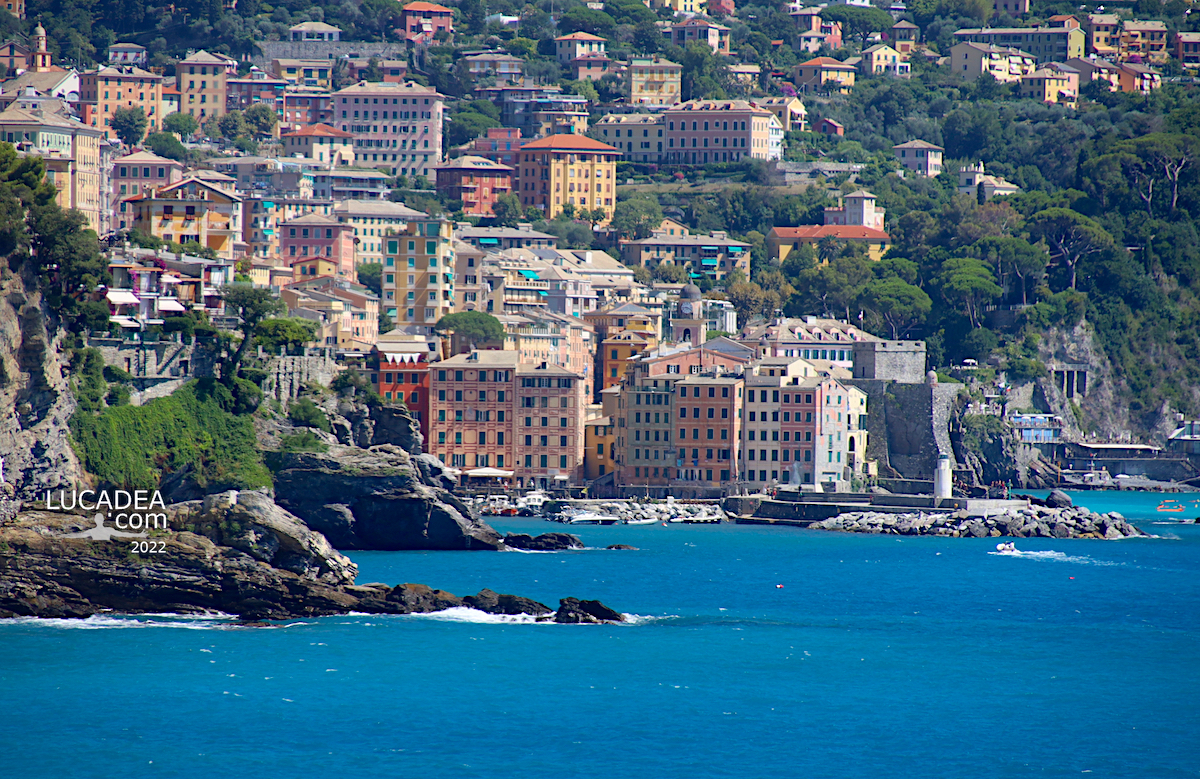
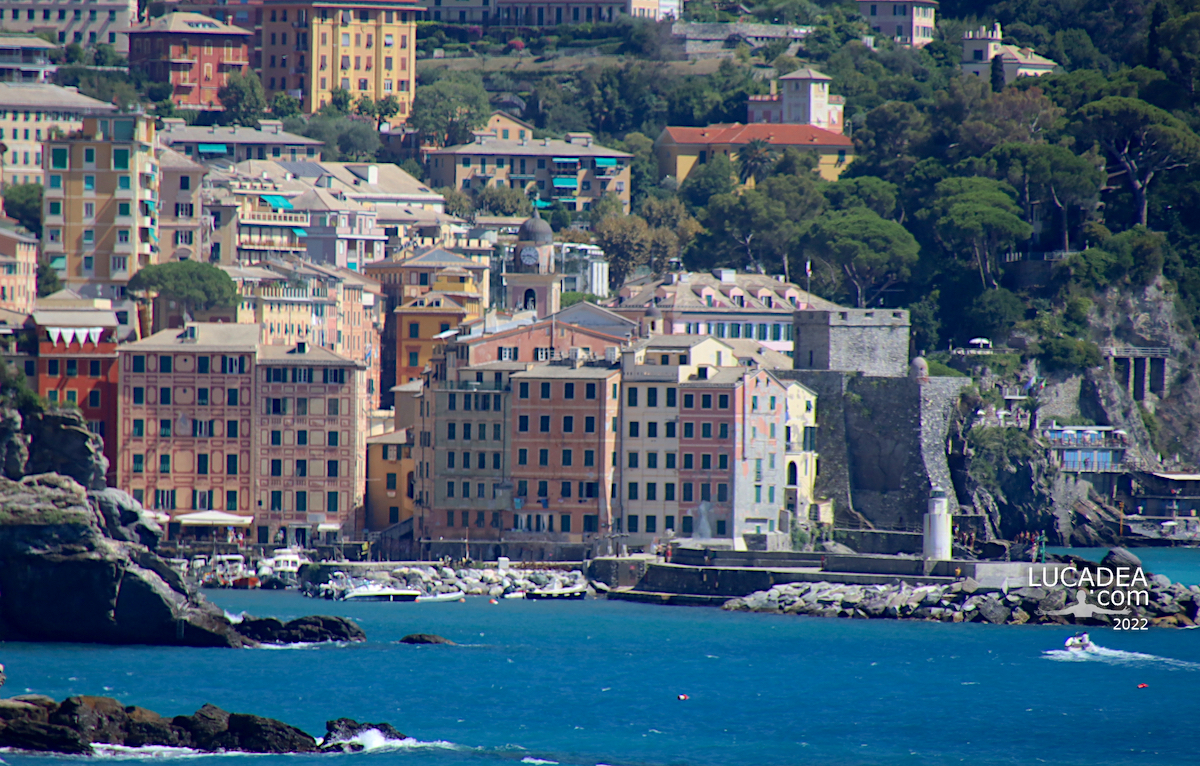
From Recco, I photographed Camogli harbor with a powerful telephoto lens, looking for a different perspective on the Ligurian coast. What interests me about seeing Camogli from Recco is precisely this distance: instead of standing beside the colorful houses and the small harbor, I could observe the village from farther away and use the lens to bring the scene closer.
Some time ago I was in Recco and took the opportunity to photograph Camogli from there. It was not the usual viewpoint I would have chosen while visiting either of the two towns, and that distance made me stop and look for a composition I would not normally have had.
A telephoto lens can completely change the way a familiar place looks. From a distance, it brings apparently small elements much closer while also compressing the sense of depth in the landscape. In this case, Camogli harbor emerges from the wider view and becomes the natural point towards which the eye is drawn.
The photograph was taken in summer, and the sky was not particularly clear. The distance between Recco and Camogli, together with the haze in the atmosphere, made the images slightly soft and less defined than I would normally prefer. I do not necessarily see that as a flaw, though. It is part of the actual conditions in which I took the photograph and therefore part of the story of the image.
If you are wondering what to see in Camogli, the harbor and the colorful buildings overlooking the sea are naturally among the village’s most recognizable features. Photographing it from Recco completely changes that familiar view. I was not looking for a close-up of a facade or a perspective from the waterfront. I wanted to show how Camogli looks when viewed from another point along the coast.
Recco, Liguria, Italy, is only a short distance from Camogli, and that proximity creates interesting views across the coastline. The photograph came from exactly that possibility: being in one place and paying attention to what lies a little farther away, even when it is not the main subject of the day.
The harbor is one of the features that most strongly identifies Camogli. The village has a long connection with the sea and fishing, while today the small harbor remains one of its most recognizable views. Seen from a distance, however, many of the small details disappear and the harbor becomes almost a graphic element within the shape of the coastline.
That unusual perspective is what I like most about this photograph. If I had been standing in Camogli, I would probably have photographed the harbor from close by, looking for boats, houses and small details along the waterfront. From Recco, I had to do exactly the opposite: move away from the subject and use a telephoto lens to bring it back into the frame.
I also find the relationship between technique and place interesting in this kind of photograph. I did not need to find an especially dramatic viewpoint. I simply needed a sufficiently powerful lens and a reason to look carefully at what was in front of me. The telephoto lens turned a distant view into an image where the harbor became clearly recognizable.
The summer haze is naturally still visible. The photographs do not have the sharpness they might have had on a particularly clear day, but I prefer keeping them because they document the real conditions at the time. A personal photograph does not always have to be technically perfect to remain interesting.
I also like comparing this image with other photographs I have published of the Ligurian coast. Changing your viewpoint can completely alter the appearance of a familiar place. That is one reason I continue photographing places I may have already seen many times: moving just a few kilometers can be enough to find a new perspective.
This time the subject was Camogli, but the photograph was made in Recco. The small harbor, seen through a telephoto lens, becomes the result of two places connected by distance.

Have you ever tried photographing Camogli from Recco, or used a telephoto lens to find an unusual view of a place you already know? Add a comment or go to the bottom of the site to read what other visitors have written.

Camogli harbor seen from Recco with a telephoto lens, between the sea and Ligurian coast in summer haze

Camogli harbor seen from Recco with a telephoto lens, between the sea and Ligurian coast in summer haze

Camogli harbor seen from Recco with a telephoto lens, between the sea and Ligurian coast in summer haze

Photos taken with a Canon EOS RP camera and a Tamron 16-300 lens.

Here are a couple of videos of the Camogli small harbor that I filmed on a different day:


Video recorded with the GoPro Hero 10 Black.

Here is where Camogli is located:

The prayer to Madonna du Ma in Framura

Preghiera alla Madonna du Ma vicino al porticciolo di Framura, scritta in genovese e italiano

The prayer to Madonna du Ma in Framura.
Near the small harbor of Framura, I found this prayer dedicated to the Madonna del Mare, written both in Genoese and Italian, and I felt it deserved to be photographed and remembered. It is one of those small details that can reveal something about Framura and its maritime traditions more clearly than a wide landscape.
Framura is in Liguria, in the Province of La Spezia, Italy, along the Riviera di Levante, and the sea is an obvious part of the identity of the village. Here, the Madonna del Mare, known in Genoese as “a Madonna du Ma”, is connected with the devotion of people whose lives have traditionally been closely tied to the coast, the sea and the hope of returning safely home.
The photograph I took shows the text of the prayer displayed near the harbor. It is not a spectacular image in the conventional sense, but that is exactly why I wanted to include it in the blog. Photographing a place also means noticing the small traces left by the people who have lived there, especially when those details are directly connected with local history and traditions.
If you are wondering what to see in Framura, beyond the coves, seaside path and clear waters I have already photographed in other posts, these small details are worth noticing too. The prayer is displayed close to the harbor, near the statue of Madonna du Ma that I previously photographed and wrote about on the blog.
The tradition of asking the Madonna or the saints for protection is particularly strong in communities connected with the sea. For people going out on the water, returning safely was never something to take for granted, while a good catch could be an important part of everyday life. A prayer therefore became a simple way of expressing hope, protection and gratitude.
The small detail that caught my attention most in this photograph is the presence of the prayer in two languages. The Genoese version preserves a connection with the local language, while the Italian version makes its meaning accessible to people coming from elsewhere. It is a simple way of keeping local tradition understandable without losing its original cultural character.
Genoese, of course, is not only a language associated with the city of Genoa. Its varieties and expressions have historically been used in several parts of Liguria, particularly in communities where the sea and maritime trade played an important role. In this case, just a few lines of text are enough to connect the prayer with the culture of the region.
I had already written about Madonna du Ma in an earlier post, when I photographed the statue standing on the large rock above Framura’s harbor. You can find that story in my article about Madonna du Ma in Framura. I like keeping these internal connections because the photographs become more meaningful when viewed as different parts of the same place and story.
This image almost completes the photograph of the statue. First there is the Madonna standing above the small harbor, and then there is the prayer that gives a little more context to her presence. They are very different photographs, but they belong to the same visual story.
This is also one of the things I enjoy most about photography: the most interesting subject is not always the biggest or most impressive view. Sometimes a written message, a statue or a small sign left by a local community can reveal something that would otherwise remain unnoticed.
The sea is still the main presence in Framura. The coastal path, coves, harbor and rocks create the setting for many small reminders of how closely local life has been connected with the shoreline. This prayer is one of those traces that can easily be missed if you only concentrate on the landscape.
For me, it was therefore worth photographing and adding to the blog, especially because it connects naturally with the other images I have taken during my visits to Framura. It is a quieter photograph than the usual sea views, but perhaps that makes it even more useful for understanding another, more intimate side of the village.

Have you ever stopped to read the prayer to Madonna du Ma while visiting Framura’s harbor? Add a comment or go to the bottom of the site to read what other visitors have written.

Prayer to Madonna du Ma near Framura harbor, displayed in both Genoese and Italian

Photo taken with Canon EOS M100 and lens Tamron 16-300.

Where is Framura:

The small harbor of Framura

Piccolo porticciolo di Framura al mattino, punto di partenza della passeggiata sulla costa verso Levanto

The small harbor of Framura.
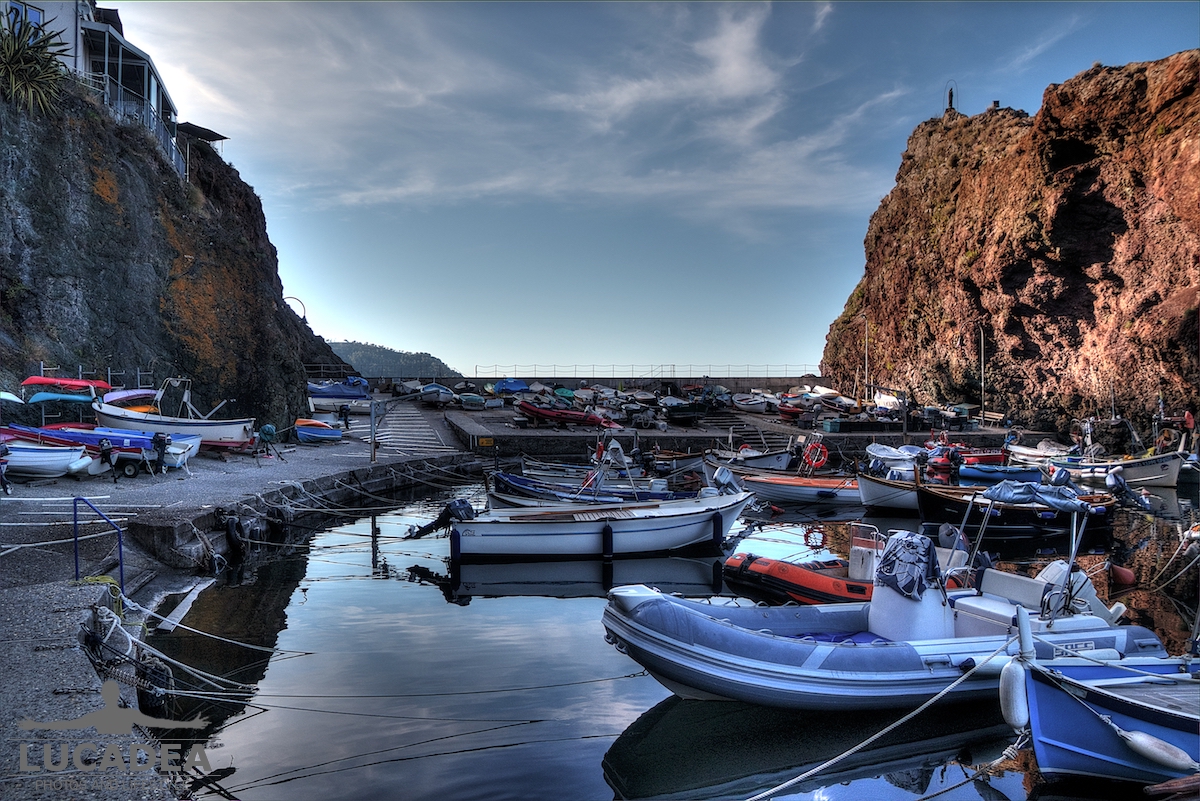
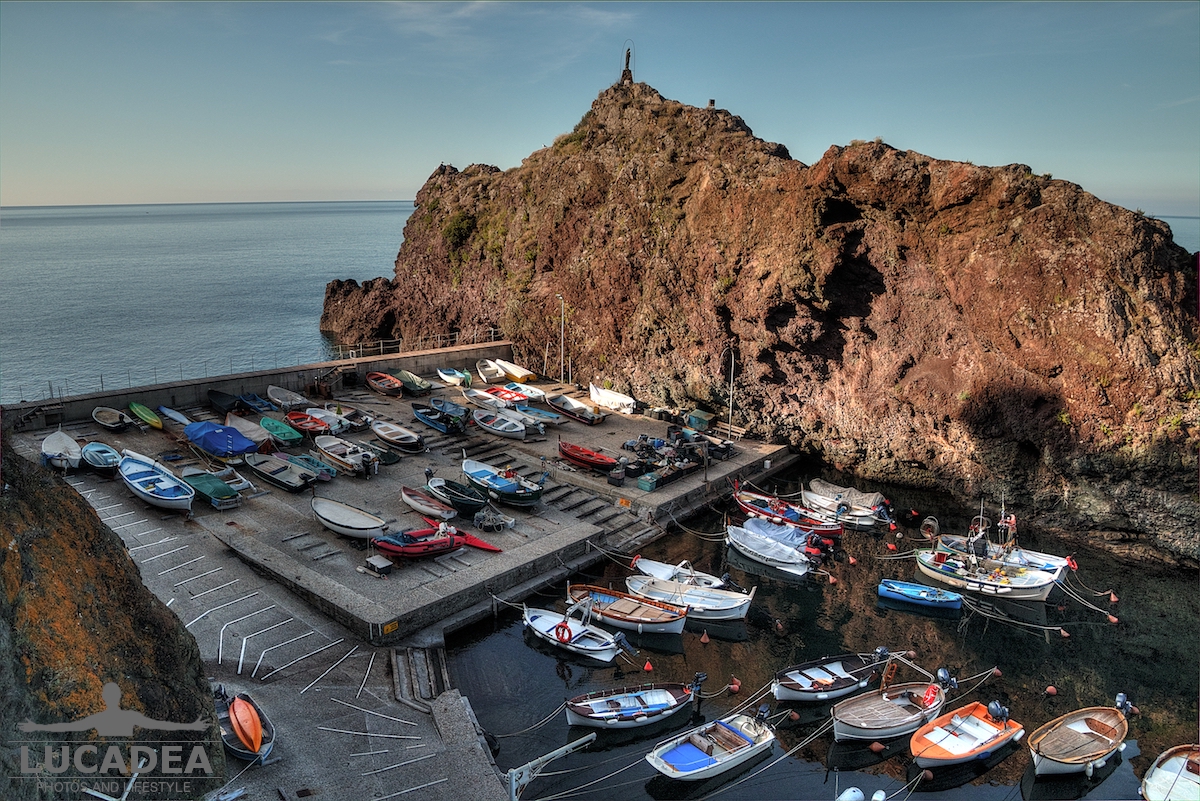
I started my walk from here early in the morning, following the coastal cycle and pedestrian path towards Levanto while the little harbor was still quiet and almost empty. It is one of those places along the Ligurian Riviera di Levante that I already know quite well, yet it still manages to offer a slightly different view whenever I return.
Framura is in Liguria, in the Province of La Spezia, Italy, not far from the Cinque Terre, and its small harbor is one of my favorite starting points when I want to explore this stretch of coast on foot. The compact village and rocky shoreline keep the sea present almost everywhere, even when you are simply standing at the beginning of the route.
That morning, Levanto was my destination, but before setting off I wanted to spend a few minutes looking at the harbor. I took this photograph to preserve the quiet atmosphere of the beginning of the day. There was no need to look for anything particularly unusual. The small harbor, the boats and the coastline were already enough to create the scene I wanted to capture.
If you are wondering what to see in Framura, the harbor is certainly worth including in a walk around the village. From here, you can continue along the coast and reach the route leading towards Bonassola and Levanto. It is a good way of experiencing this part of the Riviera di Levante rather than simply looking at it from one viewpoint.
What I like most is the relationship between the harbor and the surrounding landscape. This is not a large marina filled with boats and facilities, but a smaller space gathered between the rocks and the sea. That is also why it can feel completely different in the early morning compared with the more crowded coastal destinations nearby.
The route towards Levanto was one of the reasons I had decided to come to Framura for a longer walk. The cycle and pedestrian path partly follows the old railway line and passes through some of the most interesting sections of this coastline. The conversion of the former railway route created a new way of experiencing the landscape on foot or by bicycle.
There is a small piece of local history behind the route that I find particularly interesting. The railway once connected the coastal communities along this part of Liguria, while today sections of its former path can be explored at a much slower pace, with the sea, tunnels and cliffs becoming part of the walk.
This photograph therefore belongs to the very beginning of my outing, before the walk itself became the main experience. I like photographing these preliminary moments too, when a place is not yet simply a stop on the way somewhere else, but something to observe without rushing.
Framura is also a place I have photographed several times for the blog from different perspectives. I have already shared its clear waters, the small coves along the seaside path and Madonna du Ma standing on the large rock above the harbor. This image naturally continues those stories and adds another small piece to my personal photographic collection of Framura.
Looking at the photograph now, what I remember most is the quietness of that moment. Starting early can make a familiar place feel different without requiring dramatic scenery or unusual conditions. Sometimes a nearly empty little harbor is enough to make a photograph worth keeping.
The walk to Levanto then gave me the chance to continue following the coast and experience Framura from another perspective. But before setting off, this small harbor definitely deserved its own photograph.

Have you ever started the walk towards Levanto from Framura’s little harbor? Add a comment or go to the bottom of the site to read what other visitors have written.

Small Framura harbor in the morning, marking the start of the coastal path towards Levanto in Liguria

Small Framura harbor in the morning, marking the start of the coastal path towards Levanto in Liguria

Photos taken with a Canon EOS M100 camera and a Tamron 16-300 lens.

Where the Framura small harbor is located:

Colombo Square and the harbor in Camogli

Piazza Cristoforo Colombo a Camogli con i grandi palazzi liguri di fronte al porticciolo

Colombo Square and the harbor in Camogli.
Every time I return to Camogli, I end up taking far more photographs than I can publish at once, and this image spent more than six months waiting in my archive. The small square facing the harbor, surrounded by tall buildings, is one of those views I naturally find myself photographing whenever I come back.
What stands out in the photograph is the relationship between the open space of the square and the buildings around it. Colombo Square faces directly toward the small harbor and offers one of those views where the character of Camogli becomes immediately recognizable. The sea is important, but so are the tall façades rising behind the square, which look very different from the smaller houses usually associated with Ligurian villages.
When I think about what to see in Camogli, the harbor is obviously one of the first places that comes to mind, but I also like looking at what happens immediately behind it. Here the urban character is particularly strong. The buildings are tall, close together and oriented toward the sea, creating a setting quite different from the low, compact houses found in many other coastal villages.
I took this photograph myself more than six months ago and, as often happens when I visit Camogli, it was part of a larger collection of images from the same visit. I like returning to photographs after some time has passed. An image that seemed like just one of many when I took it can sometimes become more interesting when I look at it again without the distractions of the original moment.
This is Camogli, in Liguria, in the province of Genoa, Italy, and just a few steps away from the harbor you can see how closely the town is connected to the sea. The square works almost like a small observation point: the water is in front, the buildings rise behind it and the space between them creates a very distinctive urban setting.
The tall buildings of Camogli are one of the features that most strongly define the appearance of the town. Their narrow and relatively high façades, often painted in different colors and placed closely beside one another, make efficient use of the limited space between the mountain and the sea. This vertical character is one of the reasons Camogli looks so different from the more familiar image of a small Ligurian house.
One interesting detail is connected to Camogli’s long relationship with the sea. The town developed as a maritime community, and the concentration of buildings reflects the need to organize a settlement within a narrow coastal area. From Colombo Square, the buildings can almost appear as a continuous wall rising behind the harbor, emphasizing just how compact the town is.
I was not trying to create a particularly elaborate composition when I took the picture. I simply wanted to capture the atmosphere of the square and the way the buildings fill the space around the harbor. This is one of those places I have photographed many times, yet it continues to offer different perspectives depending on where I happen to be standing.
Looking at the photograph again after more than six months, I am glad I kept it and finally decided to publish it on the blog. Camogli is one of those places where every visit can easily produce another collection of images. This photograph naturally joins the other pictures I have already shared on the site from the village and its waterfront.
If you are visiting Camogli and wondering what to see, the harbor is an obvious starting point, but I think the surrounding squares and buildings deserve the same attention. The character of the town becomes particularly clear in the relationship between its architecture and the sea. You do not necessarily need to search for a spectacular viewpoint; sometimes an ordinary square offers a more personal way of seeing the place.
That is one of the reasons I keep photographing Camogli whenever I return. The images slowly accumulate, some remaining in my archive for months before I decide to share them. This photograph belongs exactly to that group: an everyday view of the village that stayed with me long enough for me to eventually bring it back into the blog.

Do you have a square or a view in Camogli that you photograph every time you return? Add a comment or go to the bottom of the site to read what other visitors have written.

Colombo Square in Camogli with tall Ligurian buildings overlooking the small harbor

Photo taken with a Canon EOS M100 camera and a Canon EF-S 10-18 lens.

If you would like to see all the photos taken in this beautiful seaside town, click here:
foto gallery

Nyhavn, Copenhagen’s colorful harbor

Nyhavn a Copenaghen con case colorate, canale e antiche barche in legno ormeggiate

Nyhavn, Copenhagen’s colorful harbor.
Among the places to see in Copenhagen, Denmark, Nyhavn is certainly one of the most recognizable views of the Danish capital. Walking along the canal, I found a scene made of colorful buildings, traditional wooden boats and a lively atmosphere that perfectly represents one of the city’s most photographed landmarks.
I captured this photograph during my visit to Copenhagen, trying to preserve not only the famous side of Nyhavn but also the balance between history and everyday life that makes this place so unique. The colorful facades reflected on the water immediately catch the eye, but the old wooden boats moored along the canal are what truly bring back the maritime character of this historic harbor.
Nyhavn, which literally means “New Harbor”, was created in the 17th century as an important commercial and maritime area of the city. In the past, ships from different parts of the world arrived here, bringing sailors, merchants and workers who made the harbor an active part of Copenhagen’s daily life. Today, the atmosphere has completely changed, and the historic buildings along the canal are mostly home to restaurants, cafés and small bistros.
Walking through Nyhavn means experiencing a fascinating contrast between past and present. On one side there are outdoor tables, visitors and many sightseeing boats moving along the canal; on the other side, the historic buildings and traditional vessels preserve the memory of the old harbor. During busy periods, the constant movement of people and boats can almost remind you of the busiest areas of Venice.
Copenhagen, in the Capital Region of Denmark, is a city where historic architecture, canals and modern design naturally coexist. Nyhavn represents this identity perfectly: a place originally created for maritime trade that has become one of the most loved areas for walking and photographing the city.
A small historical curiosity is that writer Hans Christian Andersen lived in several houses overlooking the canal, including number 20, where he wrote some of his early works.
This photograph connects with my way of telling stories through small details. Just like other harbors and coastal villages I have photographed, Nyhavn is interesting not only because of its fame, but because of the traces of everyday life that remain visible. Sometimes an old wooden boat, a reflection on the water or a simple architectural detail can tell more than the most famous view.
If you are visiting Copenhagen and wondering what to see, a walk through Nyhavn is certainly one of the best ways to experience the atmosphere of the city.

What famous place have you visited where a small detail impressed you more than the main attraction? Add a comment or go to the bottom of the site to read what other visitors have written.

Nyhavn in Copenhagen with colorful houses, canal and traditional wooden boats along the harbor

Nyhavn in Copenhagen with colorful houses, canal and traditional wooden boats along the harbor

Photos taken with a Canon EOS M100 camera and a Tamron 16-300 lens.

Click here to see all the photos of the Danish city of Copenhagen:
foto gallery

Here is where the port is located:

Nyhavn was built by King Christian V of Denmark between 1670 and 1673, excavated by Swedish prisoners of war from the Dano-Swedish War of 1658–1660. It served as a gateway from the sea to the old city center at Kongens Nytorv (King’s Square), where ships handled cargo and fishermen’s catches. It was famous for beer, sailors, and prostitution. The Danish author Hans Christian Andersen lived in Nyhavn for about 18 years.
Read more on Wikipedia

Boat sheds along Nervi seaside promenade

Vecchie rimesse delle barche sulla passeggiata Anita Garibaldi a Nervi vicino al mare di Genova

Boat sheds along Nervi seaside promenade.
Among the things to see in Genoa Nervi, Liguria, Italy, there are also the small details that reveal the history of this seaside neighborhood, such as the old boat sheds along the Anita Garibaldi promenade. Walking beside the sea, I found this simple and authentic scene where the former fishermen’s spaces still preserve the atmosphere of a life closely connected to the coast.
Genoa Nervi is one of those places where the rhythm of the city seems to slow down and leave room for the feeling of a traditional seaside village. Although it is part of the city of Genoa, it still keeps a distinctive character made of narrow streets, houses overlooking the coast, a small harbor and the beautiful seaside promenade dedicated to Anita Garibaldi. Along this path, these old boat sheds caught my attention more than the larger views.
I wanted to capture this image with my camera because it represented the strong connection between Nervi and the sea. These structures were not simply practical spaces, but traces of the fishermen’s daily life. For generations, they were used to store boats and working equipment connected to the activities of the coast. Today, they probably have a different purpose, perhaps as storage or service spaces, but they still attract the attention of people walking along the promenade.
Boat sheds are a characteristic element of many Ligurian coastal villages. Even when they no longer serve their original function, they preserve a historical value because they tell the story of a direct relationship between local communities and the sea, made of work, traditions and everyday gestures.
Nervi, a district of Genoa located in Liguria, Italy, is also known for its scenic seaside promenade, one of the most appreciated coastal walks in the city. The route offers views of the sea, the harbor and many corners where architecture and nature meet.
This photograph connects with another story I previously shared about Nervi’s small harbor, a place that together with these old boat sheds helps create the portrait of a neighborhood where maritime heritage is still visible. I enjoy photographing these less obvious elements because they often reveal the true identity of a place better than the most famous landmarks.
This image does not show a famous monument, but a quiet presence that continues to belong to Nervi’s landscape and memory.

Have you ever photographed a simple detail that revealed a hidden story about a place? Add a comment or go to the bottom of the site to read what other visitors have written.

Old boat sheds along Anita Garibaldi promenade in Nervi near the Ligurian Sea in Genoa

Photo taken with Canon EOS M100 and lens Tamron 16-300.

Saint Helena square in Genoa’s historic center

Piazza Sant'Elena nel centro storico di Genova vicino al fronte a mare e ai caruggi

Saint Helena square in Genoa’s historic center.
Walking through the oldest part of Genoa, Liguria, Italy, it is possible to discover hidden corners that tell centuries of history and everyday life. One of these places is Saint Helena square, a small square located in the waterfront side of the historic center, the area facing Antonio Gramsci street and once representing one of the main connections between the old city and the harbor.
This photograph comes from my desire to show these lesser-known but fascinating places. The small squares of Genoa’s historic center are often true gateways into the caruggi, the narrow alleys that cross the heart of the old city. From Saint Helena square, for example, it is possible to enter some of the most characteristic areas of the historic center, including nearby Pré street, a road historically connected with trade, craftsmen, and Genoa’s popular life.
For centuries, these streets were important routes: goods, sailors, merchants, and local residents passed through here on their way to and from the harbor. The relationship between Genoa and the sea has always been extremely strong, and even today walking through these streets you can feel the connection between the old city and its maritime history.
Saint Helena square also preserves a memory of more recent times. This square was once home to the famous market known as Shangai, a place remembered by many Genoese people and closely linked to the daily life of the neighborhood. As often happens in Genoa’s historic alleys, even a small urban space can preserve stories, memories, and traditions worth remembering.
I enjoy photographing these corners because they represent a different side of Genoa compared with its most famous monuments. This is a city made of small squares, old entrances, narrow streets, and unexpected views. Often, the most authentic places are discovered simply by walking without a precise destination.
Saint Helena square is therefore a small but important piece of the large mosaic of Genoa’s historic center, a place where the past and the present still meet between the sea and the old alleys.

Do you know this area of Genoa’s historic center, or have you ever walked through the alleys near Pré street? Add a comment or go to the bottom of the site to read what other visitors have written.

Saint Helena square in Genoa historic center near the waterfront and the old alleys

Photo taken with camera Canon EOS M100 and lens Canon EF-S 10-18.

Here is where the square is located:

Piazza Sant’Elena: this was once the site of the famous “Shanghai” market, which sprang up in the post-war period.
It featured stalls selling souvenirs and clothing imported from the United States.
Newer generations never saw it, but all other Genoese remember that market well—it was always bustling with crowds.
Read more at dearmissfletcher.wordpress.com

🏠
  • Italiano