Bún Thịt Nướng, a Delicious Vietnamese Dish

Bun thit nuong, altro piatto vietnamita

Bún thịt nướng, a delicious Vietnamese dish.
Among the many Asian specialities I enjoy discovering and, of course, photographing, Vietnamese food certainly deserves a place. This particular dish is called bún thịt nướng and is made with rice vermicelli, grilled pork, fresh vegetables and aromatic herbs, usually served with a flavourful sauce. It is an inviting combination of ingredients, textures and tastes that makes for a very interesting meal.
I enjoy photographing the dishes I come across while travelling or eating out. By now, anyone who follows these pages probably knows that very well! However, I don’t always stop at looking at food through my camera lens. This time, after taking a few photographs, I also tried the bún thịt nướng, and I have to say it was pretty good.
The first thing that surprised me was the temperature. I had expected a hot dish, perhaps with freshly prepared noodles and steaming grilled meat, but it was served cold or at room temperature. This is actually quite common for this Vietnamese speciality. The ingredients are arranged together in a bowl, but the rice noodles and vegetables are not served piping hot. The pork, on the other hand, is grilled before being added, creating a pleasant contrast between its rich flavour and the freshness of the other ingredients.
Bún thịt nướng is one of the best-known dishes in Vietnamese cuisine. Its name describes its main ingredients: bún refers to rice vermicelli, while thịt nướng means grilled meat. Pork is traditionally used and is often marinated before cooking with ingredients such as fish sauce, sugar, garlic and other seasonings. Grilling gives the meat a slightly caramelised surface and an intense aroma that works beautifully with the mild flavour of the noodles.
The bowl often includes lettuce, cucumber, carrots, bean sprouts and fresh herbs such as mint and coriander. It is usually served with nước chấm, a Vietnamese dipping sauce made with fish sauce, lime or vinegar, sugar and water, sometimes with chilli and garlic added. Depending on the recipe, chopped peanuts and crispy fried onions may also be included, adding extra texture and making the dish even more interesting.
The version I tried also came with a peanut sauce, which gave the dish a creamy, slightly sweet flavour. This is one of the things I appreciate about Vietnamese cooking: its ability to combine very different ingredients without making the result feel too heavy. The grilled pork has a strong flavour, the noodles are delicate, the vegetables add freshness and the sauces bring everything together.
I have to admit, though, that I am not particularly keen on very spicy food. Whenever I have a choice, I prefer not to add too much chilli or extra seasoning, even though I know that doing so means missing out on some of the characteristic flavours of Asian cuisine. Many dishes are already full of aromas and carefully balanced seasonings, and tasting them in their most authentic form would probably reveal flavours that I sometimes choose to leave aside. But what can I do? Everyone has their own preferences!
Even so, bún thịt nướng left me with a very good impression. It is a colourful and satisfying dish, particularly suitable for anyone looking for something different from the usual pasta dishes or hot meals. My initial surprise at finding it cold soon disappeared, and I especially enjoyed the contrast between the grilled pork, the rice noodles and the fresh ingredients.

And what about you? Have you already tried bún thịt nướng? Do you prefer the traditional version, with all its herbs and sauces, or do you also tend to go easy on the spices? Add a comment or go to the bottom of the site to read what other visitors have written.

Vietnamese bún thịt nướng with rice noodles, grilled pork, fresh vegetables and peanut sauce

Vietnamese bún thịt nướng with rice noodles, grilled pork, fresh vegetables and peanut sauce

Vietnamese bún thịt nướng with rice noodles, grilled pork, fresh vegetables and peanut sauce

Photos taken with a Canon EOS M100 camera and Canon EF-M 22 lens.

Add one  comment to this article or read  here what other visitors have written.
 
Adv
 
Disclamer

The rights on images, videos, choruses, text and all other material on the LUCADEA.com website are governed as per  Copyright page.


This page has been viewed 0 times today.
This month it has been viewed 0 times.
In total it has been viewed 0 times.
 

Glass Noodles in Vietnam with Vegetables and Seafood

Glass noodles in Vietnam

Glass Noodles in Vietnam with Vegetables and Seafood.
Some of my favourite dishes in Asian cuisine are undoubtedly those made with noodles. I enjoy the wide variety available, their different textures and the many ways they can be combined with vegetables, meat, fish or seafood. During a trip to Vietnam, I tried this dish made with glass noodles, named for their distinctive transparent appearance.
Glass noodles have a texture and look that make them easy to distinguish from ordinary pasta. Once cooked, they become glossy and almost see-through, which explains their name. They are popular in several Asian cuisines and can be prepared with a wide range of ingredients and seasonings, depending on the country and recipe. They are often made from starches such as mung bean, sweet potato or other tubers, although the exact ingredients vary from one type of noodle to another.
The dish in this photograph was served with vegetables and seafood. It sounds like a promising combination: the soft, slightly chewy noodles work well with fresh vegetables and the savoury flavours of ingredients from the sea. This is exactly the kind of food I enjoy trying when travelling in Asia. It offers a chance to discover familiar ingredients prepared in different ways and to get a little closer to local food traditions.
There was, however, one small detail that becomes quite obvious when you look at the photograph: there was very little seafood! The noodles and vegetables filled most of the plate, while the seafood seemed to be hiding among the other ingredients. Sometimes a menu description creates the impression that a particular ingredient will be served in generous quantities, only for the finished dish to turn out rather differently. It is not necessarily a major problem, but when you choose a meal specifically because it contains seafood, you naturally hope to find a more satisfying portion.
Despite this small disappointment, I still love glass noodles and the many variations available in Asian restaurants. They are versatile, pair easily with different ingredients and can form the basis of both simple meals and more elaborate dishes. Their delicate appearance also makes them interesting to photograph, especially when they are mixed with colourful vegetables and other toppings.
For me, food is an important part of travelling. Trying local dishes is a way to explore a destination beyond its famous sights, even when a meal does not completely live up to expectations. Every new dish becomes part of the travel experience, and sometimes the little surprises are what make a food memory particularly memorable.

Have you ever tried glass noodles? Do you prefer them with vegetables, meat, or a generous helping of fish and seafood? Add a comment or go to the bottom of the site to read what other visitors have written.

A Vietnamese dish of transparent glass noodles with vegetables and a small amount of seafood, photographed during a trip

Photo taken with a Canon EOS M100 camera and Canon EF-M 22 lens.

Add one  comment to this article or read  here what other visitors have written.
 
Adv
 
Disclamer

The rights on images, videos, choruses, text and all other material on the LUCADEA.com website are governed as per  Copyright page.


This page has been viewed 0 times today.
This month it has been viewed 0 times.
In total it has been viewed 0 times.
 

The dragon at Chùa Nam Sơn Temple in Da Nang

Drago decorativo del tempio Chùa Nam Sơn a Da Nang in Vietnam con colori vivaci e motivi tradizionali orientali

The dragon at Chùa Nam Sơn Temple in Da Nang.
Through my lens, I captured a fascinating detail from Vietnam: the dragon at Chùa Nam Sơn Temple, one of the most interesting things to see in Vietnam for those who appreciate traditional architecture and symbolic decorations. The golden figure surrounded by stylized clouds creates a powerful composition filled with colors, shapes and cultural meanings.
Looking closely at this photograph, I am drawn to the incredible precision of the decoration. The curved body of the dragon, the painted details and the geometric patterns behind it create a sense of movement that almost makes the sculpture appear alive. This is not simply an ornamental element; it is a small visual story built through craftsmanship and tradition.
I took this photograph at Chùa Nam Sơn Temple in Da Nang, Vietnam, a place where religious architecture, artistic details and local culture come together. The temple is known for its colorful spaces and decorative elements, making it an interesting place to explore for visitors who want to discover a different side of Da Nang beyond its beaches and modern areas.
The dragon has an important role in Vietnamese culture and is often connected with strength, protection, prosperity and harmony. One fascinating detail is that dragons in East Asian traditions are frequently linked to water and balance, which explains their presence in many temples and important buildings.
If you are visiting Da Nang, Chùa Nam Sơn Temple is a place worth seeing in Vietnam because its beauty is found not only in the overall architecture but also in the smaller details that reveal local beliefs and artistic traditions. The dragon shown in this image represents exactly this kind of discovery: a detail that invites you to stop, observe and understand the meaning behind the decoration.
This photograph connects naturally with other stories from my photo blog about Asian temples and traditional places, where I often focus on small architectural elements that preserve the identity of a culture. Sometimes a single sculpture or painted surface can tell a story as effectively as an entire building.
When I look at this image again, I see the dragon as a symbol of energy and imagination. The combination of golden tones, bright colors and elaborate patterns creates a unique visual experience, showing how art and spirituality can exist together in the same space.
For anyone searching for what to see in Da Nang, this temple offers a chance to discover a quieter and more symbolic side of the city. Photographing details like this allows me to remember not only what a place looks like, but also the atmosphere it creates.

Which detail of this Vietnamese dragon decoration would you like to explore more closely? Add a comment or go to the bottom of the site to read what other visitors have written.

Drago decorativo del tempio Chùa Nam Sơn a Da Nang in Vietnam con colori vivaci e motivi tradizionali orientali

Drago decorativo del tempio Chùa Nam Sơn a Da Nang in Vietnam con colori vivaci e motivi tradizionali orientali

Canon EOS RP and Canon RF 28 lens.

To see all the photos taken in the pagoda, click here:
foto gallery

A Small Bell on the Roof of Tu Duc Tomb

Campana della tomba di Tu Duc a Hue

A Small Bell on the Roof of Tu Duc Tomb.
In Huế, Vietnam, among the decorated rooftops of Emperor Tự Đức’s tomb, I stopped to look at a small detail that immediately sparked my imagination: a bell, or perhaps a little ornamental chime, placed right at the tip of a roof corner. It is exactly the kind of detail I enjoy looking for when photographing traditional Asian architecture, because even the smallest element can seem to hold a mysterious story.
I love photographing the details of roofs on Asian temples and historic buildings. Their curved lines, intricate ornaments and upward-pointing corners seem to create a connection between the architecture and the sky. There is something almost magical about them. You can look at a whole building and admire its beauty, but sometimes it is a tiny feature at the edge of a roof that captures your attention and stays in your mind long after you have moved on.
This little bell made me imagine something mystical. I pictured it ringing softly whenever a soul passed by, as if its delicate sound could announce the arrival of a spirit or accompany it on its journey. Of course, this is only my own fantasy. Still, when visiting a place with such a rich past, it is easy to let your imagination wander and give an ordinary object a meaning of its own.
The Tomb of Tự Đức is located in Huế, in central Vietnam, and forms part of the city’s UNESCO-listed complex of monuments. Emperor Tự Đức ruled during the nineteenth century, and his tomb is admired for the harmony between its architecture and the surrounding landscape. Yet, when I look at this photograph, the historical background becomes less important than the little object perched on the roof’s edge.
Perhaps the bell once had a symbolic purpose; perhaps it was simply decorative. I have no evidence that it was intended to ring for passing spirits, and I would not want to present an imaginative thought as a historical fact. What I like is the possibility that certain architectural details can preserve a little mystery, even when we examine them closely through a camera lens.
For me, this is one of the pleasures of travel photography. Not every detail needs an explanation, and not every question needs an answer. Sometimes it is enough to notice something unusual, take a photograph and allow the imagination to do the rest. This small bell at Tu Duc Tomb gave me just that: a moment of curiosity, wonder and quiet reflection.

What about you? Would you see this little bell as a simple ornament, or would you also enjoy imagining that it might ring to announce the passing of souls? Add a comment or go to the bottom of the site to read what other visitors have written.

Small decorative bell on the corner of a traditional roof at Emperor Tu Duc’s tomb in Huế, Vietnam

Photo taken with a Canon EOS M100 camera and Tamron 16-300 lens.

Here are all the other photos I took at this monument:
foto gallery

Here’s where the tomb is:

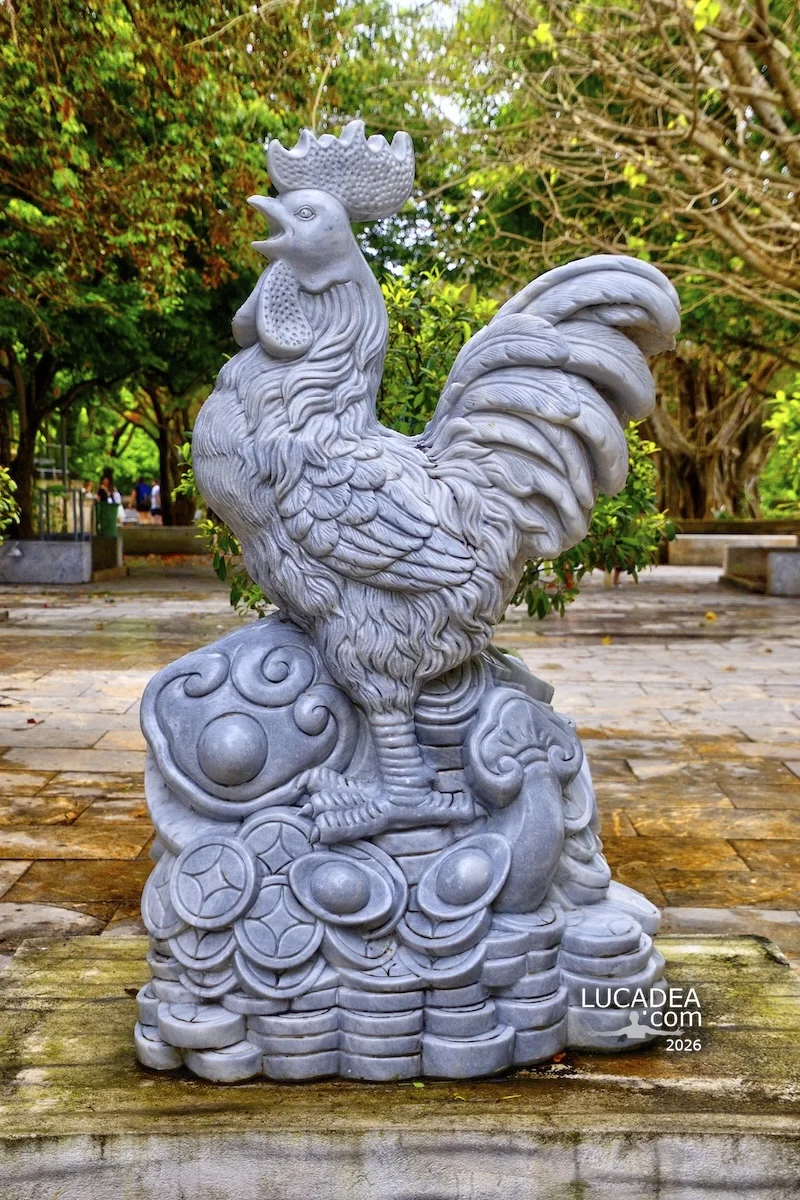
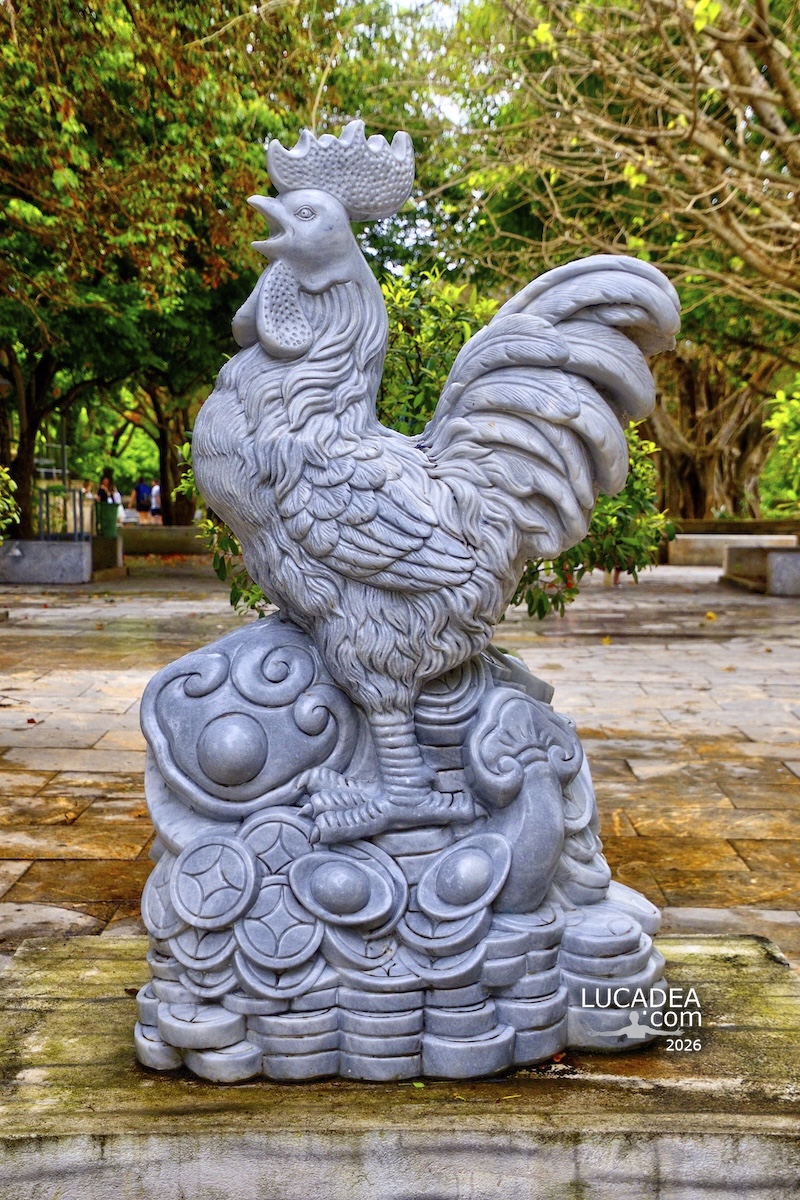
Da Nang, stone rooster at Linh Ung Pagoda

Statua del gallo a Linh Ung Pagoda a Da Nang in Vietnam con base decorata e contesto naturale del tempio buddhista

Da Nang, stone rooster at Linh Ung Pagoda.
The stone rooster at Linh Ung Pagoda Da Nang immediately stands out as a quiet but powerful detail within the temple complex, and the stone rooster at Linh Ung Pagoda Da Nang feels like one of those small elements that carries symbolic weight beyond its size. The stone rooster at Linh Ung Pagoda Da Nang sits on an ornate base, surrounded by greenery and the calm atmosphere of the sacred site.
I am in Da Nang, Vietnam, inside the Linh Ung Pagoda area, a place where religious architecture blends naturally with landscape and open space. The stone rooster at Linh Ung Pagoda Da Nang appears almost unexpectedly among the larger structures, yet it contributes to the visual and symbolic rhythm of the temple.
In Vietnamese and broader Asian tradition, the rooster is often associated with vigilance, protection, and the transition between darkness and light. This makes its presence in a spiritual context particularly meaningful, even when it is not the central monument of the site.
If you are visiting Da Nang, Vietnam, Linh Ung Pagoda is widely known for its monumental statues and panoramic views over the coastline, but details like this stone rooster reveal a more intimate layer of the place, where craftsmanship and symbolism coexist in quieter forms.
I have already mentioned similar observations in other travel stories on this site about Southeast Asian temples, where small sculptural elements often carry as much meaning as the main structures.
Standing here for a moment, I watch how the stone rooster at Linh Ung Pagoda Da Nang interacts with the surrounding space, not by dominating it, but by completing it in a subtle way. It makes me think about how many visitors might pass without noticing it at all.

Have you ever discovered a place’s meaning through a single small detail rather than its main landmark? Add a comment or go to the bottom of the site to read what other visitors have written.

Statua del gallo a Linh Ung Pagoda a Da Nang in Vietnam con base decorata e contesto naturale del tempio buddhista

Photo taken with Canon EOS R50 V and Tamron 16-300 lens.

To see all the photos I took in the pagoda, click here:
foto gallery

Where is the pagoda located:

Dream Beaches: Cu Lao Cham in Vietnam

Spiagge da sogno: Cu Lao Cham in Vietnam

Dream Beaches: Cu Lao Cham in Vietnam.
When I think about Vietnam, I often remember its lively cities, colourful markets, green landscapes and busy streets. Yet the country also has some wonderful beaches, and the Cham Islands, known locally as Cu Lao Cham, were a particularly pleasant discovery during my travels. The clear water and beautiful coastal scenery made this place feel like a little tropical paradise.
The Cham Islands lie off the central Vietnamese coast, roughly twenty kilometres from the mainland and not far from the historic town of Hoi An. Many travellers visit Hoi An for its old streets, traditional architecture and colourful lanterns, but a trip out to the islands offers a completely different experience. Instead of exploring narrow lanes and bustling markets, you can spend time beside the sea, enjoy the tropical surroundings and appreciate a much quieter side of the region.
What impressed me most during my visit was the clarity of the water. In other parts of Vietnam, I had sometimes found the sea less transparent, with a greenish or cloudy appearance. I have often wondered how much rainfall, river water and sediment carried down from the mainland might contribute to these differences. In reality, seawater clarity depends on several factors, including currents, weather, waves, seasonal conditions and the shape of the seabed. The appearance of the sea can change considerably from one location to another, and even from one day to the next.
At Cu Lao Cham, however, I remember being struck by the beautiful colours of the water. In some places, it looked remarkably clear, shifting between pale green, turquoise and deeper blue. Combined with the sandy shoreline and tropical vegetation, it created exactly the kind of scene that makes you want to stop, look around and take photographs.
This is one of the things I enjoy most about travelling: discovering a place that adds a new perspective to a country I thought I already understood. Vietnam is often associated with its cities, cultural heritage and spectacular countryside, but its islands deserve attention too. A visit to the Cham Islands can provide a welcome change of pace after exploring Hoi An, with time for swimming, relaxing on the beach and simply enjoying the coastal scenery.
The islands are also part of a protected marine area, recognised for their coastal and marine biodiversity. Their natural beauty is a reminder that these environments need care. Avoiding litter, respecting marine life and following local guidance are simple ways to help preserve the beaches and surrounding waters.
Looking back at the photographs from my trip, I still think the title “Dream Beaches” is well deserved. The clear water and peaceful scenery made Cu Lao Cham one of those places that stay in your memory long after the journey has ended.

Had you heard of the Cham Islands near Hoi An, and would you visit them to experience these beautiful Vietnamese beaches? Add an comment or go to the bottom of the site to read what other visitors have written.

Dream beach on the Cham Islands in Vietnam, featuring a sandy shore, tropical greenery and clear turquoise seawater

Photo taken with a Canon EOS M100 camera and Canon EF-M 22 lens.

Here’s where the islands and the beach are:

Bún Thang, Vietnamese Noodle Soup with Meat and Eggs

Bun ngang in Vietnam

Bún Thang, Vietnamese Noodle Soup with Meat and Eggs.
Vietnamese cuisine offers a wonderful variety of dishes built around fresh ingredients, fragrant broths and carefully balanced flavours. During my travels, I had the chance to try several local specialities, and Bún thang was one of the dishes that caught my attention. It is a Vietnamese noodle soup made with rice noodles, broth, meat and eggs, combining simple ingredients in a surprisingly delicate way.
There are actually several dishes in the photograph, and I believe I have already written separate posts about some of the others. The bowl I chose for myself is the one in the foreground. My memory of the meal is not detailed enough to describe every ingredient with complete certainty, but I remember a bowl of rice noodles in broth, served with slices of meat and strips of egg prepared like a thin omelette.
One ingredient was described to me as Vietnamese mortadella. This was most likely giò lụa, a traditional Vietnamese pork sausage with a smooth texture, often served sliced in soups and other dishes. Along with the noodles and egg, it gave the soup a mixture of textures and flavours without making it feel too heavy.
Bún thang is particularly associated with Hanoi, the capital of Vietnam. The traditional preparation is known for its careful presentation, with ingredients finely sliced and arranged neatly over the noodles. Depending on the recipe, these can include shredded chicken, thin strips of omelette, giò lụa and other garnishes. A well-prepared broth is essential, bringing all the different elements together and giving the soup its delicate flavour.
What I find interesting about dishes like this is the way familiar ingredients can become something distinctive through preparation and presentation. The rice noodles provide a soft base, the meat adds substance, and the egg contributes a gentle flavour and a different texture. The hot broth brings everything together, making the dish comforting without overwhelming the individual ingredients.
When travelling, I do not always know the exact name of every ingredient or the precise method used by the cook. Sometimes what remains is the overall impression: the aroma of the broth, the appearance of the bowl and the pleasure of tasting something unfamiliar. Food is a wonderful way to discover a country’s culture, and even a single meal can introduce us to ingredients and traditions we might never encounter at home.
For anyone interested in trying a home-style version of Bún thang, a simple starting point would be rice noodles, chicken broth, cooked shredded chicken, a thin omelette cut into strips and sliced giò lụa, if available. Cook the noodles according to the packet instructions, heat the broth, prepare and slice the omelette, then arrange the ingredients in bowls and pour the hot broth over them. Fresh herbs and suitable Vietnamese seasonings can be added to bring the dish closer to the version you want to recreate. This is a simplified approach rather than a claim to reproduce every detail of the traditional Hanoi recipe.
As far as I remember, I enjoyed the Bún thang I tried. It may not have been the most memorable meal of the trip, but it was an interesting introduction to another part of Vietnamese food culture. Looking back at the photograph brings that experience to mind and gives me an opportunity to share it with readers who enjoy discovering dishes from around the world.
In my other food and travel posts, I like to record these small discoveries alongside photographs of places, streets and everyday life. A bowl of noodles might seem like a modest subject, but it can open the door to a much wider story about local ingredients and culinary traditions.

Have you ever tried Bún thang or another Vietnamese noodle soup with meat and eggs? I would love to hear what you thought of it and which Vietnamese dishes you would recommend to someone exploring this cuisine for the first time. Add an comment or go to the bottom of the site to read what other visitors have written.

Bún thang Vietnamese noodle soup in the foreground, with rice noodles, savoury broth, sliced meat and thin strips of omelette

Bún thang Vietnamese noodle soup in the foreground, with rice noodles, savoury broth, sliced meat and thin strips of omelette

Photos taken with a Canon EOS M100 camera and a Canon EF-M 22 lens.

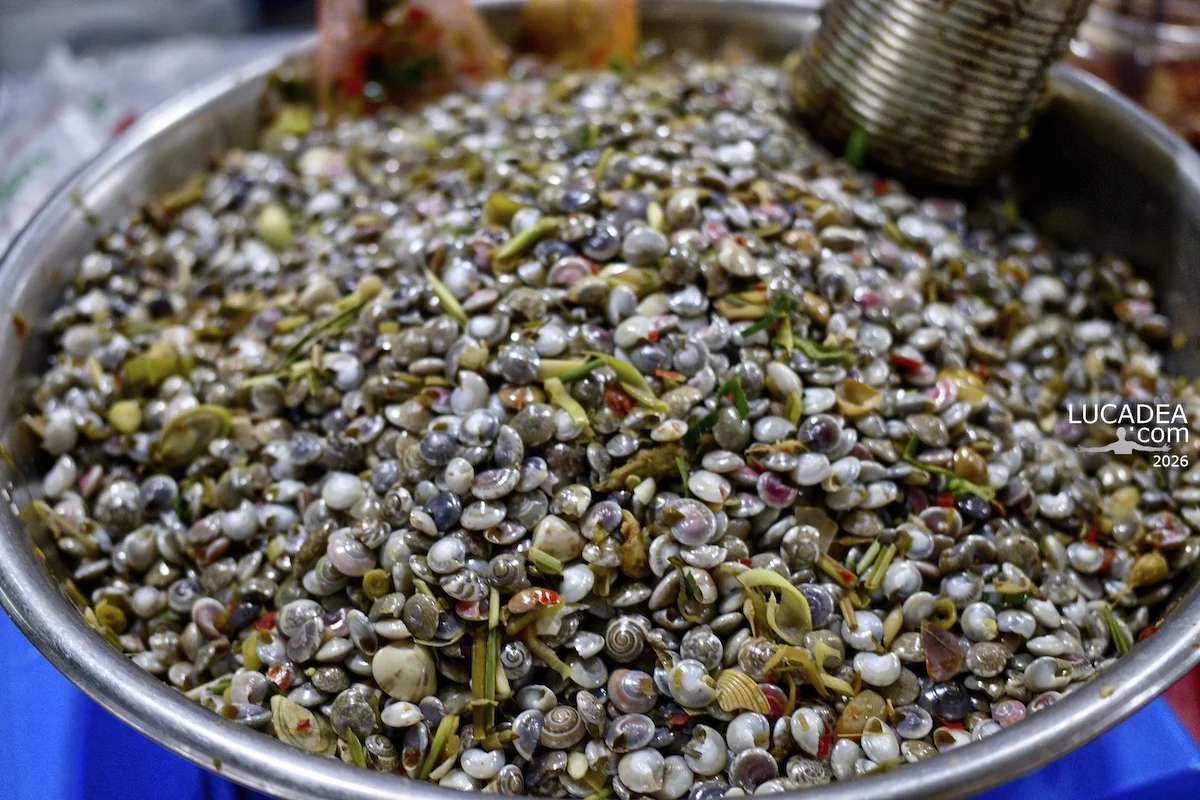
Small seafood at a Da Nang market stall

Piccoli frutti di mare in un mercato di Da Nang con conchiglie miste, erbe e colori naturali tipici della cucina vietnamita

Small seafood at a Da Nang market stall.
As I stepped closer to the stall in Da Nang, the small seafood immediately drew me in, a perfect glimpse of what to eat in Da Nang without needing any explanation. These tiny shells, part of the everyday seafood Vietnam culture, tell a story that goes far beyond food.
There was a natural chaos in the pile, a mix of shapes, textures, and subtle colors, all glistening under the market lights. If you are visiting Da Nang, this is one of the most interesting places to understand local life, because food here isn’t just prepared, it’s displayed in its raw, honest form. Wondering what to eat in Vietnam often starts exactly here, in places like this.
I was in Da Nang, central Vietnam, Vietnam, surrounded by the sounds of vendors and the constant movement of people passing by. It reminded me of another market scene I once shared on the site, but this felt more intimate, more focused on detail.
One interesting detail is that these tiny shellfish are often quickly stir-fried with lemongrass and chili, becoming a popular street food dish across the region. It’s a simple preparation that highlights the freshness of the ingredients.
I leaned in closer with my camera, trying to capture not just the image but the texture and density of the moment. It wasn’t about composition alone, but about preserving a feeling.
A place worth seeing in Da Nang is not always a landmark, sometimes it’s a market stall that quietly reveals the soul of the city.

Have you ever been fascinated by something so simple yet so rich in meaning? Add a comment or go to the bottom of the site to read what other visitors have written.

Piccoli frutti di mare in un mercato di Da Nang con conchiglie miste, erbe e colori naturali tipici della cucina vietnamita

Photo taken with Canon EOS R50 V and lens Canon RF 28.

Bún Ngan: Hanoi’s Vietnamese Duck Noodle Soup

Bun Ngan Hanoi

Bún ngan is a traditional duck noodle soup associated with Hanoi, the capital of Vietnam. I photographed this Vietnamese dish during a visit to the city several months ago, but I still have a few questions about its exact ingredients. What I feel fairly confident about is the duck broth, which gives this local speciality much of its distinctive character.
The name bún ngan refers to a noodle dish prepared with ngan, a type of duck commonly eaten in northern Vietnam. It is a familiar choice in Hanoi, where small restaurants and casual food stalls serve it as part of everyday life. The basic combination is straightforward: duck meat, noodles and a flavourful broth. Depending on the restaurant and the particular recipe, the bowl may also include vegetables, fresh herbs and other toppings.
While looking for more information about the dish, I found descriptions mentioning bamboo shoots, spring onions and coriander. Rice vermicelli is often used, although some versions feature glass noodles instead. The broth is generally prepared by cooking the duck and using its flavour to create a warm, savoury soup. However, I cannot say with certainty which ingredients were included in the bowl shown in my photograph. Rather than guessing, I prefer to keep the description honest and leave the finer details open until I can confirm them.
Hanoi has a rich everyday food culture, and its cuisine goes far beyond internationally famous dishes such as pho. Many local specialities are less familiar to visitors but offer a fascinating glimpse into the way people eat in the Vietnamese capital. Bún ngan is one of those dishes: comforting, filling and built around a combination of noodles, duck and broth that can vary from one establishment to another.
One interesting detail is that bún ngan is enjoyed throughout the year and can be eaten for breakfast or lunch. It is not simply a dish prepared for tourists who want to try something unusual; it is part of the regular food scene in Hanoi. In a city where meals are often enjoyed in small neighbourhood eateries, a bowl of hot duck noodle soup can be a satisfying way to take a break from exploring the busy streets.
Unfortunately, I did not collect enough information about the recipe when I took this picture. I plan to ask Dao to comment on the dish and help me identify its ingredients more accurately. That is one of the enjoyable parts of documenting food while travelling: the photograph preserves the memory, while conversations with people who know the local cuisine can reveal the story behind it.

Have you ever tried bún ngan in Hanoi, or is this Vietnamese duck noodle soup new to you? Add a comment or go to the bottom of the site to read what other visitors have written.

Bún ngan, a Vietnamese duck noodle soup photographed in Hanoi, the capital of Vietnam

Photo taken with a Canon EOS M100 camera and Canon EF-M 22 lens.

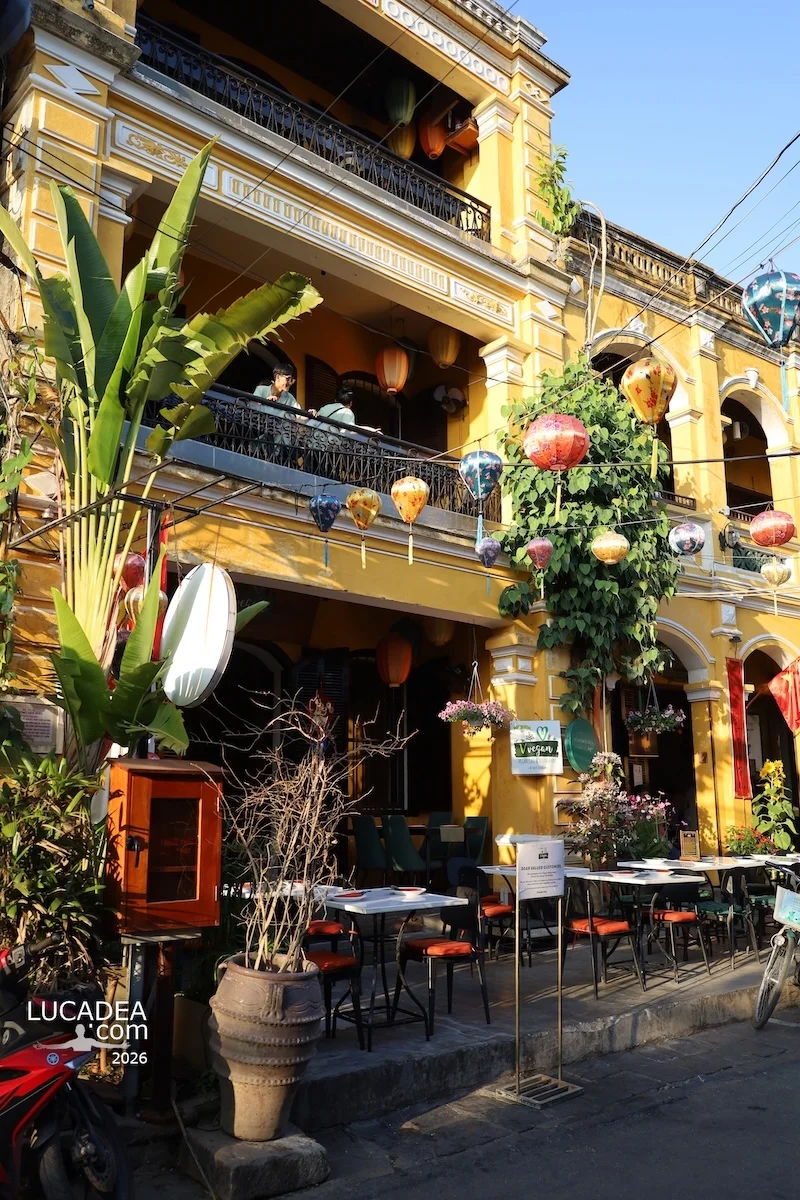
The yellow house with lanterns in Hoi An

Casa gialla a Hoi An con lanterne e piante sospese, edificio tradizionale trasformato in café nel centro storico vietnamita

The yellow house with lanterns in Hoi An.
The yellow house with lanterns in Hoi An immediately draws my attention as I walk through the old streets, where every building seems layered with color, plants, and soft light. The yellow house with lanterns in Hoi An, Vietnam, stands out not because it breaks the rhythm of the town, but because it fits so naturally into it.
As I move closer, the yellow house with lanterns in Hoi An reveals itself as more than just a house. Like many buildings in the historic center, it has been transformed into a café or a small multi-level restaurant, blending daily life with architectural heritage in a seamless way.
I stop for a moment and observe the hanging plants, the lanterns swaying gently, and the worn yellow paint reflecting the humid light of central Vietnam. In Hoi An Ancient Town, Vietnam, this combination of nature and architecture is not decorative but essential to the identity of the place.
If you are visiting Hoi An in central Vietnam, you will quickly notice how many of these old merchant houses have been adapted over time while still preserving their original wooden structure. One of the most interesting aspects of Hoi An is how it maintains its historic atmosphere while remaining fully alive and functional.
There is a quiet connection here with other travel memories I have shared on the site, such as the elegant seafront buildings in Rapallo, where architecture feels more formal and structured. In Hoi An, everything is more organic, more layered, and more visually dense.
A small historical detail often mentioned is that many of these houses were originally part of a busy trading port network, which explains their narrow shape and deep interior layout, still visible today.

The yellow house with lanterns in Hoi An stays with me as a place where architecture and daily life merge without boundaries. What would it feel like to sit inside that light and watch the street go by? Add a comment or go to the bottom of the site to read what other visitors have written.

Casa gialla a Hoi An con lanterne e piante sospese, edificio tradizionale trasformato in café nel centro storico vietnamita

Photo taken with Canon EOS RP and lens Canon RF 28.

Click here to see all the photos of the town:
foto gallery

The former Champa port city, located on the Thu Bon estuary, was an important center of Vietnamese trade during the 16th and 17th centuries, when Japanese and Chinese from various provinces, as well as Dutch and Indians, settled there. During this period of trade with China, the city was called Hai Pho (City on the Sea) in Vietnamese.
Continue and learn more at Wikipedia

The yellow house with lanterns in Hoi An – La casa gialla con lanterne nel cuore di Hoi An – La casa amarilla con faroles en Hoi An – A casa amarela com lanternas em Hoi An – Das gelbe Haus mit Laternen in Hoi An – Ngôi nhà vàng với đèn lồng ở Hội An – 会安带灯笼的黄色房子 – ホイアンの提灯がある黄色い家

The text of this post was written with the help of ChatGPT, a language model from OpenAI.

🏠
  • Italiano