The Columns of San Lorenzo in Milan

Colonne di San Lorenzo a Milano, antiche colonne romane davanti alla basilica nel centro storico della città

The Columns of San Lorenzo in Milan.
While walking through Milan without a particular destination, we came across this group of columns, a place I mostly knew because of its reputation for nightlife. The Columns of San Lorenzo are one of the city’s best-known meeting places, especially for younger people, but looking at them more carefully reveals a much older story behind the lively atmosphere.
The photograph came from that moment, when an unplanned walk brought us to this particular corner of the city. I wanted to capture the columns and the surrounding space with my camera, keeping the feeling of standing in front of something that belongs to several very different periods of history.
When thinking about what to see in Milan, it is easy to focus on the Duomo, Sforza Castle and the city’s other famous landmarks. The Columns of San Lorenzo offer a completely different way of looking at Milan because the past and present occupy almost exactly the same space here. You can look at the people and buildings around you, then turn your attention to the columns and suddenly find yourself looking at part of Roman Milan.
The columns stand in front of the Basilica of San Lorenzo Maggiore, south of the historic center. There are sixteen Roman columns, probably taken from an earlier public building and reused during the construction of the basilica. Their survival makes this one of the most significant visible reminders of ancient Mediolanum in modern Milan.
That contrast is what caught my attention. On one side are the remains of Roman Mediolanum; on the other is modern Milan, with traffic, apartments, bars and people gathering there, particularly in the evening. The columns are not separated from everyday city life. People walk around them, meet there and pass through the same space every day.
I find it especially interesting that a place mainly known today as a meeting point for young people can also be an important archaeological site. You do not necessarily need to enter a museum to encounter Milan’s history. Here, the history is right beside the street, surrounded by a city that continues to change.
One small historical detail is that the Roman columns were transported and reused in the construction of the Basilica of San Lorenzo, helping create the architectural setting that survives today. Reusing Roman architectural elements in later buildings was common in many Italian cities, but here the result remains particularly visible.
For me, the photograph began with the simple surprise of finding such a historic place during an ordinary walk. We had not planned to come here, and perhaps that is one reason I like the image. Some photographs are created while deliberately looking for a subject; others happen when something unexpectedly interrupts the rhythm of a walk.
The Columns of San Lorenzo are therefore a good example of how Milan can preserve its history in places that now have a completely different everyday role. During the day they can be appreciated primarily as a monument and archaeological reminder; later in the evening, the same area becomes one of the city’s popular gathering places.
This kind of discovery connects naturally with the other photographs I have taken in Milan, where I often come across architectural details and historic places while moving through the city without following a fixed itinerary. That is one of the reasons I enjoy photographing cities: you do not always need to know beforehand what you are going to find.
In this image, I simply wanted to preserve a small fragment of a Milan where distant periods exist side by side. The columns are ancient, the surrounding city is modern, and the people who gather around them belong entirely to the present. Everything occupies the same space without needing to be separated.
If you are visiting Milan and wondering what to see beyond its most famous landmarks, this is certainly one of those places where it is worth stopping for a few minutes and looking more closely.

Have you ever discovered a historic place almost by accident while simply walking through a city? Add a comment or go to the bottom of the site to read what other visitors have written.
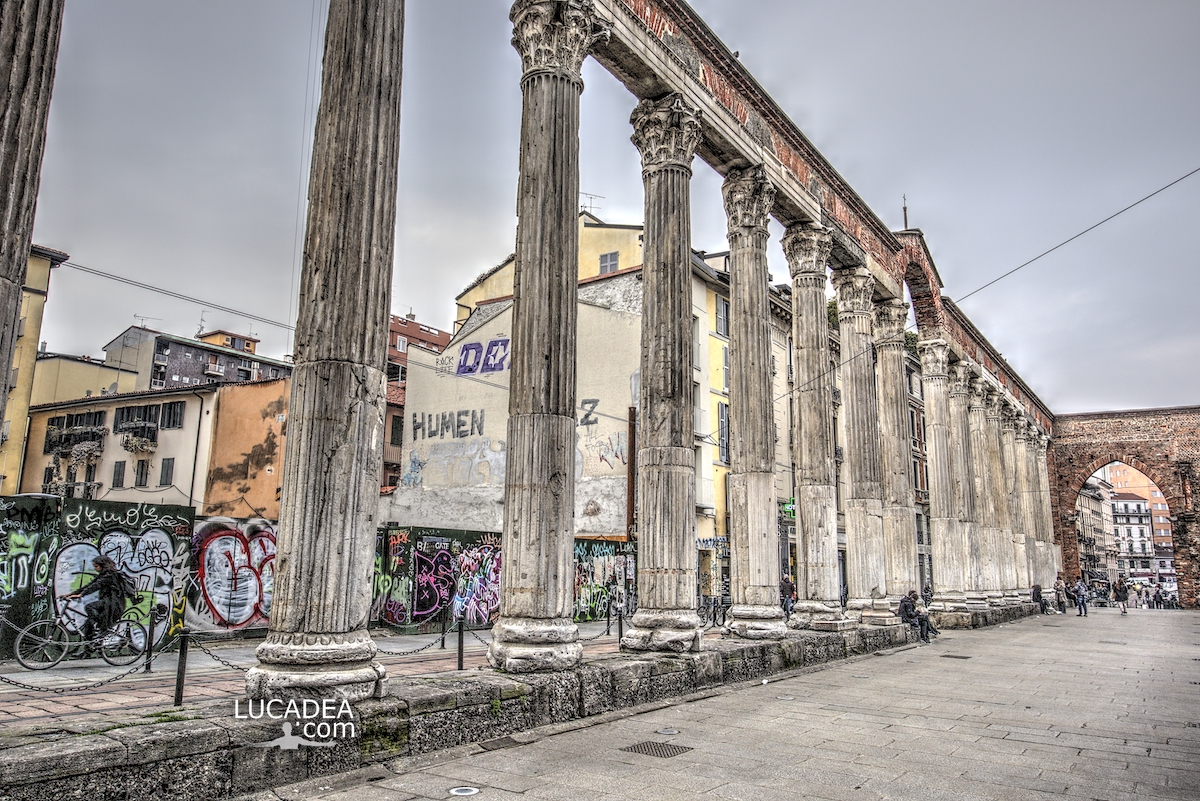
Columns of San Lorenzo in Milan, ancient Roman columns standing in front of the basilica in the city center

Photo taken with a Canon EOS M100 camera and a Canon EF-M 11-22 lens.

To see all the photos I took in Milan, click here:

Here is where the area is located:

Add one  comment to this article or read  here what other visitors have written.
 
Adv
 
Disclamer

The rights on images, videos, choruses, text and all other material on the LUCADEA.com website are governed as per  Copyright page.


This page has been viewed 1 times today.
This month it has been viewed 1 times.
In total it has been viewed 1 times.
 

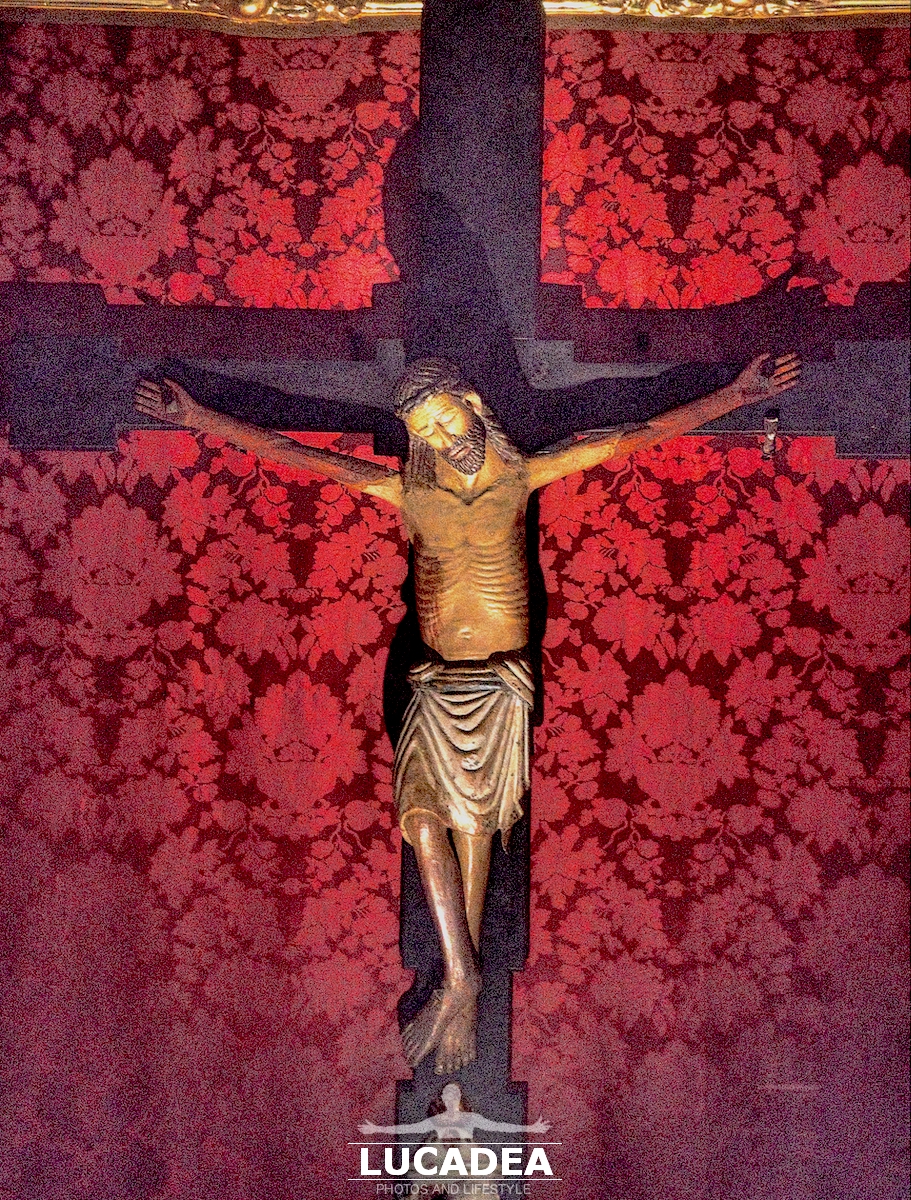
The Christ in Santa Maria di Nazareth church

La statua del Cristo nella chiesa di Santa Maria di Nazareth

The Christ in Santa Maria di Nazareth church.
In the left aisle of the Basilica of Santa Maria di Nazareth in Sestri Levante, I photographed the Holy Christ kept in its chapel, one of the religious symbols most closely connected with my town. The statue stands inside a small chapel at the beginning of the streets that start climbing towards the Sestri Levante peninsula, making it a quieter subject than the famous views usually associated with the town.
This is a photograph of a place I know well and have passed many times. The Basilica of Santa Maria di Nazareth, also known locally as the “white” church, has a distinctive position in Sestri Levante. Leaving the area around the Bay of Silence behind, the streets begin to climb towards the peninsula and the character of the town gradually changes.
For this image, I wanted to use my camera to capture a detail inside the basilica rather than photograph the building as a whole. The Holy Christ is kept in the chapel on the left side of the church and has been an object of devotion for the local community for centuries.
If you are wondering what to see in Sestri Levante, your attention will naturally be drawn to the two bays, the sea and the streets of the peninsula. Yet the religious buildings in the historic center reveal another side of the town. Santa Maria di Nazareth is one of those places that can easily be encountered while walking through Sestri Levante and that deserves a closer look beyond its exterior.
Sestri Levante, Liguria, Italy, is known especially for its coastline and its distinctive peninsula, but the town also has a long religious and cultural history. The basilica occupies a central position in the historic fabric of the town. Its pale facade is easy to recognize from outside, while the interior offers a much more intimate setting. That contrast made me pay particular attention to some of the details kept inside.
The Holy Christ is connected to a deeply rooted religious tradition in Sestri Levante. According to local tradition, a miracle is associated with the Crucifix, helping to strengthen its veneration over the centuries. It is a story belonging to the religious memory of the town and gives the statue a significance that goes beyond its artistic appearance.
I do not want to turn this photograph into a long historical account. What interests me more is the relationship between the image and the place. A religious statue can be an artistic subject, but for many people it is also connected with personal memories and with the shared history of the community.
That is what caught my attention here. The statue has been known by generations of local residents and remains part of the town’s religious tradition. For someone visiting Sestri Levante for the first time, it may be a less obvious detail than the sea or the famous bays, but for people who know the town it represents something familiar.
I also like including photographs like this because they show Sestri Levante from a different perspective. I have already shared images of the peninsula, the bays and the coastline, but this photograph shifts the focus towards the religious heritage of the town and towards a detail that belongs to the local community.
The Basilica of Santa Maria di Nazareth is also part of the historical development of the town. Its position between the central streets and the roads climbing towards the peninsula makes it feel almost like a natural transition between two very recognizable parts of Sestri Levante. One side leads through the town, while the other begins the ascent towards the peninsula and its views.
This photograph of the Holy Christ appeals to me precisely because it does not try to show everything. It is a more intimate image, centered on a single subject carrying a story that is especially familiar to local people. That is also why I wanted to keep it: it is a small fragment of my town, far from the more immediate images usually associated with Sestri Levante.
When I photograph places I know well, I sometimes realize that there are details I have seen many times without really stopping to look at them. The Holy Christ is one of those details. Taking the photograph gave me the opportunity to observe it more carefully and to share another part of the town that might otherwise remain unnoticed.
It also fits naturally with the other photographs of Sestri Levante I have shared on the blog. Together, these images create a broader view of a place that is not only about the sea and its famous landscapes, but also about churches, streets, memories and details that belong to everyday life.

Have you ever heard the story of the Holy Christ kept inside the Basilica of Santa Maria di Nazareth? Add a comment or go to the bottom of the site to read what other visitors have written.

Photos taken with Canon EOS M100 and lens Tamron 16-300.

Add one  comment to this article or read  here what other visitors have written.
 
Adv
 
Disclamer

The rights on images, videos, choruses, text and all other material on the LUCADEA.com website are governed as per  Copyright page.

This page has been viewed 0 times today.
This month it has been viewed 0 times.
In total it has been viewed 0 times.
 

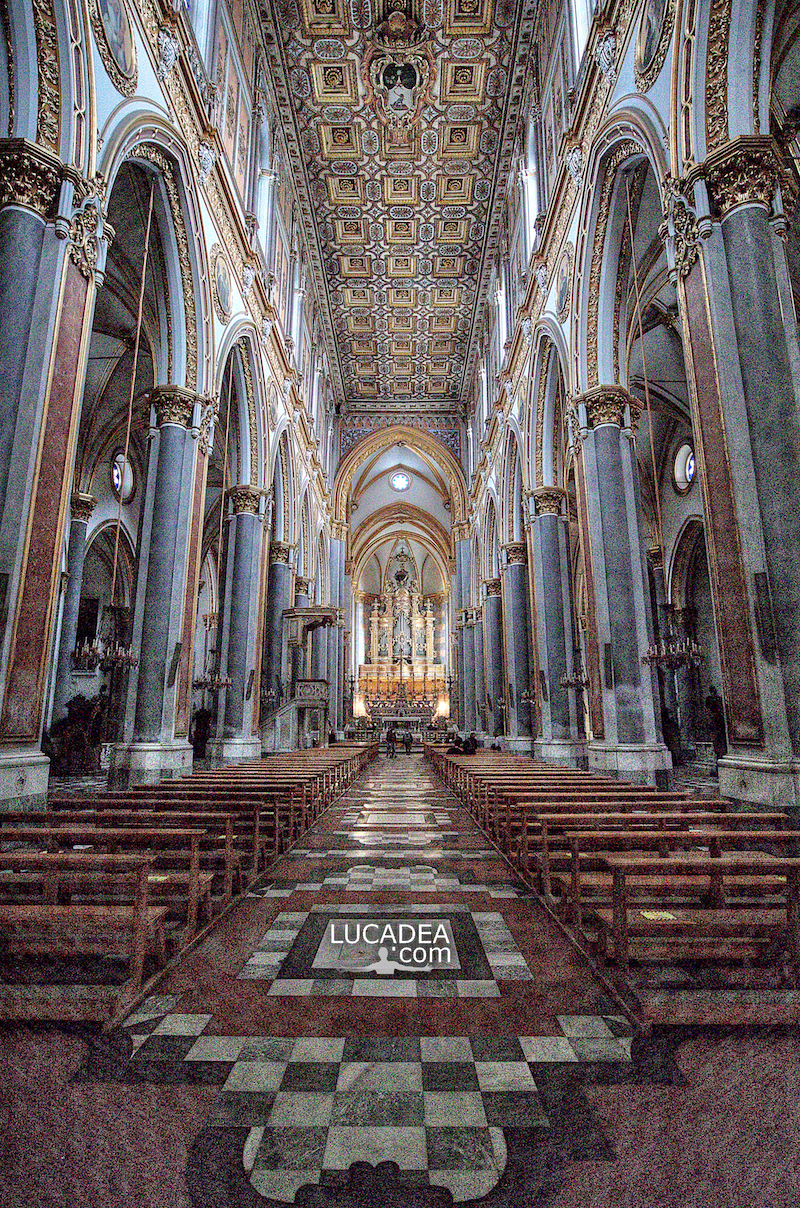
Inside the Basilica of San Domenico Maggiore

Navata centrale della Basilica di San Domenico Maggiore a Napoli, con altari e decorazioni dell’interno storico

Inside the Basilica of San Domenico Maggiore.
While wandering through the narrow streets of Naples, I came across this important basilica almost by chance and decided to step inside. The central nave of San Domenico Maggiore immediately changed the atmosphere of the walk, replacing the movement of the historic streets with a deep architectural space filled with details that invited me to slow down and look more carefully.
This photograph came from that unexpected stop. I had not planned a visit to the church, but finding it during my walk made me curious enough to enter. Once inside, I took my camera out and chose to photograph the central nave, trying to preserve that first impression rather than simply recording the building as an architectural subject.
When searching for things to see in Naples, it is easy to think first of the streets, squares, historic buildings and views that make the city so recognizable. San Domenico Maggiore offers another way of seeing Naples, through its churches and interiors and through the layers of history that are still present inside them. For me, this is one of the pleasures of photographing a city: sometimes the most interesting frame appears after leaving the obvious route for a few minutes.
The basilica stands in the historic centre of Naples, in Campania, Italy, in the area of Piazza San Domenico Maggiore. Its position is part of what makes the place so interesting. The surrounding streets are among the most characteristic parts of the old city, and the transition from the lively urban setting outside to the interior of the church happens within only a few steps.
Looking at the central nave through the camera, I was interested in the way the architecture guides the eye into the depth of the building. Columns, altars, decorations and architectural lines create a strong perspective, while the many individual details prevent the scene from becoming too simple or purely geometric. I wanted the photograph to retain that sense of looking forward while still allowing the eye to stop on the smaller elements along the way.
San Domenico Maggiore has a long connection with the Dominican Order and has played an important role in the religious and cultural history of Naples. The complex has medieval origins and was modified over the centuries. One of its better-known historical connections is with Thomas Aquinas, who studied and taught within the Dominican tradition and is associated with the complex. The basilica and convent were also connected with intellectual and religious life in Naples over a long period.
That history adds meaning to the photograph, but I did not want the historical background to become more important than the image itself. What interested me was the experience of arriving there after walking through the narrow streets. Naples often creates these sudden changes in perspective: outside there is traffic, conversation and constant movement; inside a historic church, attention naturally shifts toward architecture, artworks and small details.
If you are visiting Naples and looking for places worth seeing in the historic centre, San Domenico Maggiore is the kind of place that can become part of a walk rather than feeling completely separate from it. Its location makes it easy to encounter while exploring the old city, and the surrounding urban fabric helps explain why the basilica feels so closely connected to Naples itself.
I like photographs that begin with an unplanned discovery. There is something different about photographing a place after unexpectedly finding it compared with arriving with a carefully prepared shot in mind. In this case, the photograph records not only the interior of San Domenico Maggiore, but also a small moment in my walk through Naples.
This way of photographing connects with other stories on my blog about churches, historic buildings and details discovered while walking through Italian cities. I often find that one photograph leads naturally to another, especially when the original subject appears unexpectedly along the way.
For me, the central nave remains the most important part of this image because it preserves the feeling of that first look inside. The photograph does not need to explain everything about the basilica. It only needs to remind me why I stopped, looked around, and decided that this particular view deserved a place in my photographic story of Naples.

Have you ever entered a historic church in Naples simply because you happened to pass its entrance? Add a comment or go to the bottom of the site to read what other visitors have written.

Central nave of the Basilica of San Domenico Maggiore in Naples, showing historic altars and detailed interior decoration

Photo taken with a Canon EOS M100 camera and Canon EF-M 11-22 lens.

To see all the photos I took in Naples—both that weekend and on other trips—click here:

The High Altar of Santo Stefano Church

Altare Maggiore della chiesa di Santo Stefano a Genova, fotografato all’interno durante una visita

The High Altar of Santo Stefano Church.
I had spent many years looking at Santo Stefano Church from the outside, often from its large terrace while photographing Via XX Settembre from above. Yet I had only rarely managed to step inside. For anyone wondering what to see in Genoa when exploring its historic churches, this is one of those places that can look completely different once you finally cross the entrance.
I had visited the terrace many times with my camera, using the elevated viewpoint to photograph the city below. The interior, however, remained something I knew mostly by reputation rather than personal experience. It was one of those curious situations in which I had photographed the same building repeatedly without really knowing what was behind its entrance.
A while ago, I finally had the opportunity to visit Santo Stefano Church thanks to the “Le chiese dei Rolli” event. The visit changed my perception of the building almost immediately. After being so familiar with the terrace and its view, entering the church revealed a very different atmosphere and a much stronger sense of architectural scale.
The High Altar was the detail I chose to photograph. I was drawn to the way it occupies the space without relying on an overwhelming amount of decoration. The interior felt relatively spare, but at the same time monumental, and I wanted the photograph to retain that contrast rather than reducing the scene to a simple image of the altar itself.
I took this photograph myself during that visit. After so many photographs taken from the terrace, it was satisfying to finally turn the camera towards the interior and concentrate on something I had overlooked for so long. The image is therefore connected not only to the church itself, but also to the memory of all those previous visits when I had remained outside.
Santo Stefano Church is in Genoa, Liguria, Italy, in a well-known part of the city associated with Via XX Settembre and its elevated terrace. If you are visiting Genoa and looking for historic churches worth seeing, the building is interesting not only because of its exterior position in the city, but also because of the scale and character of its interior.
What stayed with me most was the combination of simplicity and size. There was no need for a crowded composition or an excess of visual details. The architectural structure itself created the atmosphere, while the High Altar provided a natural point towards which the eye could move.
There is also a small historical connection worth mentioning. Santo Stefano is one of Genoa’s historic religious buildings and its position along an important urban route has made it a recognizable part of the city’s landscape for centuries. The “Le chiese dei Rolli” event gave me the chance to experience this familiar building from a completely different perspective.
That is also why I find this photograph particularly meaningful. I have often written about Genoa through small details and views discovered while walking around the city, and Santo Stefano fits naturally into that collection. Sometimes a familiar location still has something new to offer simply because we change the way we approach it.
The terrace had always been my reason for coming here. I would look towards Via XX Settembre, frame the view and take my photographs, rarely thinking about the interior behind me. This time, however, the camera followed me inside, and the experience became a continuation of those earlier photographs rather than something completely separate.
I have collected the other images from this visit in the dedicated Santo Stefano Church photo gallery. Looking through the full collection gives a broader idea of the interior and of the details I noticed during the visit.
The opportunity to enter the church came through the “Le chiese dei Rolli” event, which opens historic religious buildings to visitors on specific occasions. For information about future editions and possible openings, the useful reference is Visit Genoa.
Looking back at this image, I still find it slightly amusing that I spent so much time photographing Santo Stefano from the terrace before finally discovering what the church looked like from inside. It was a reminder that even familiar places can change when we simply cross a doorway.

Have you ever photographed a building from the outside for years before finally discovering its interior? Add a comment or go to the bottom of the site to read what other visitors have written.

High Altar inside Santo Stefano Church in Genoa, photographed during a visit to the historic building

Photo taken with Canon EOS M100 and lens Canon EF-M 11-22.

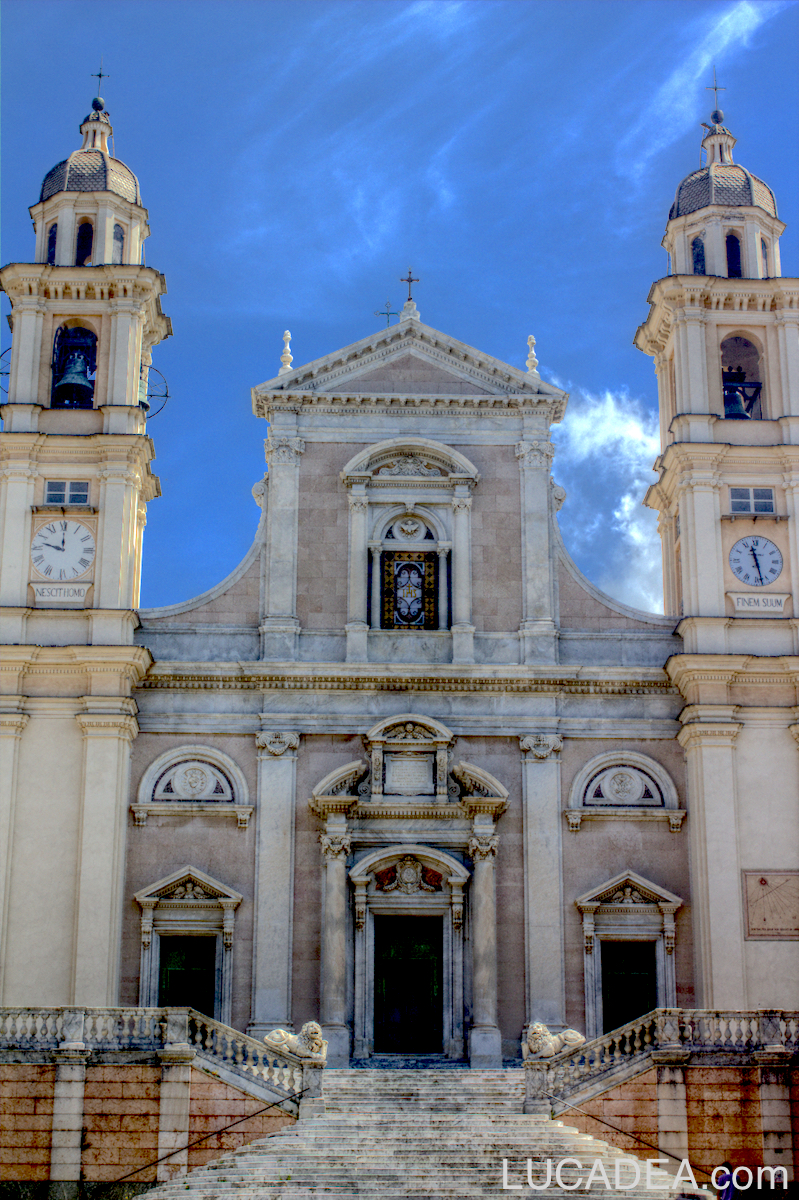
Santo Stefano Basilica in Lavagna

Basilica di Santo Stefano a Lavagna con la grande scalinata e i leoni davanti alla facciata

Santo Stefano Basilica in Lavagna.
Among the most beautiful churches in the Tigullio area, Santo Stefano Basilica is one of the buildings that most often catches my eye when I walk through the historic center of Lavagna. Its façade, broad staircase and central position make it a natural subject for photography, especially when the church can be framed together with the streets and buildings around it.
I am in Lavagna, Liguria, Italy, in the Metropolitan City of Genoa, and this time I stopped in front of the basilica to look more closely at some of its details. The photograph came from one of those walks without a precise plan, when a familiar building suddenly looks slightly different and becomes worth photographing again.
The basilica dominates the main square of the old town and immediately stands out because of the large staircase leading towards the entrance. On either side are the characteristic stone lions, an architectural detail that makes the façade particularly recognizable and one that I always find interesting to include in the frame.
Through the camera, what I like most is the relationship between the size of the church and the much smaller streets surrounding it. The basilica feels imposing, yet it is also a natural part of Lavagna’s urban fabric. Moving only a few steps can completely change the perspective and reveal another view of the same building.
The present church was built in the seventeenth century, between 1650 and 1668, and was consecrated in 1703. A small historical detail I find interesting is that Pope Benedict XV raised it to the status of minor basilica in 1921. These details help explain the importance of the building in Lavagna’s history without taking attention away from the photograph itself.
If you are wondering what to see in Lavagna, Santo Stefano Basilica is naturally one of the places that belongs on a walk through the historic center. But what interests me here is not writing a guide to the church. I prefer to show how the building appears to someone simply walking through these streets. It is almost impossible to cross the center without eventually finding the basilica in front of you.
I have photographed Lavagna several times, and Santo Stefano appears in more than one of my images. I particularly remember another photograph showing the main old-town alley with the basilica visible in the background. It is a very different composition, but it belongs to the same small visual story I have been building around Lavagna. I like it when photographs taken at different moments can complement each other.
Santo Stefano Basilica is also a good example of the way religious architecture and everyday life remain closely connected in Ligurian historic towns. You do not need to search for a special viewpoint. Simply walking through the old streets is often enough for the building to gradually appear between the surrounding houses.
That is what this photograph brings back to me. A familiar place does not have to be seen for the first time to become interesting again. Sometimes all it takes is a different angle, a few extra seconds of observation and a little more attention to details that may have been overlooked many times before.
For me, Santo Stefano remains one of the churches in the Tigullio that I most enjoy photographing. Whenever I return to Lavagna, it is very easy for this building to catch my attention once again.

Is there a church in the Tigullio area that you particularly enjoy photographing? Add a comment or go to the bottom of the site to read what other visitors have written.

Santo Stefano Basilica in Lavagna with its large staircase and stone lions in front of the façade

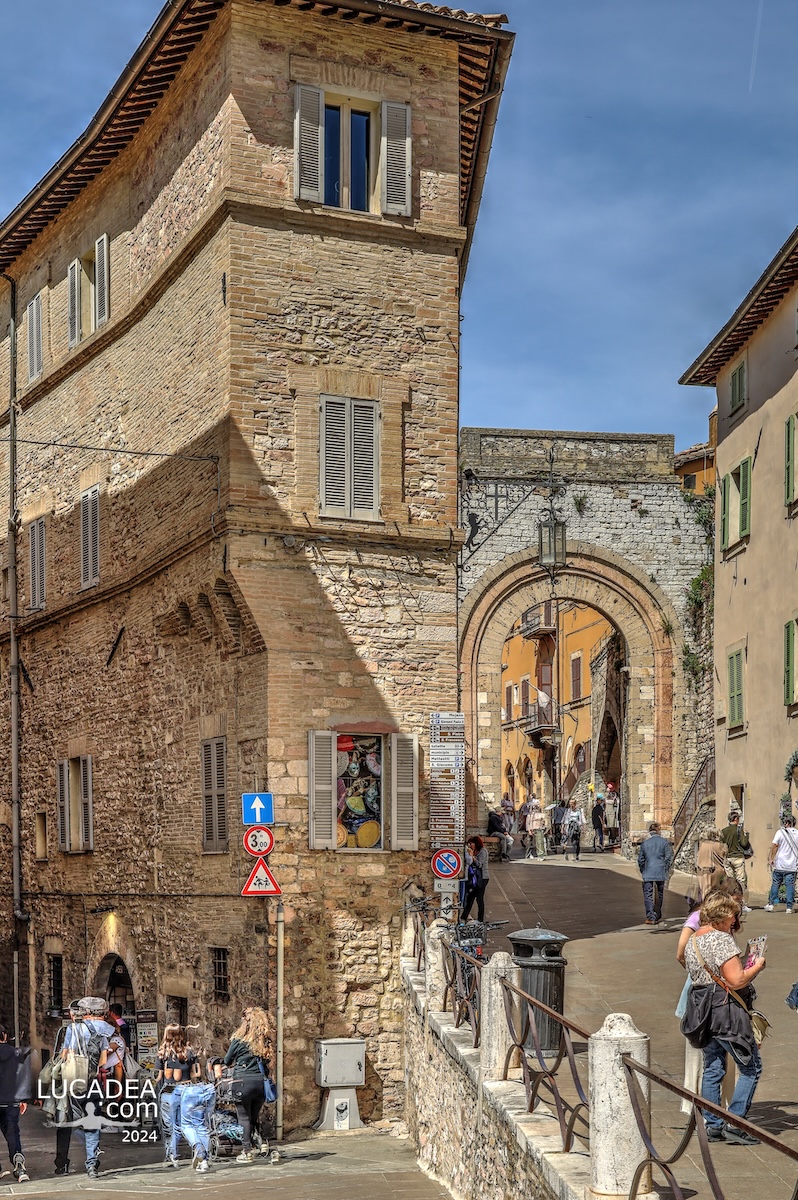
The arch of Portella di San Giorgio in Assisi

Incrocio tra Via di Santa Chiara e Via di Sant’Agnese ad Assisi con la Portella di San Giorgio sullo sfondo in pietra antica

The arch of Portella di San Giorgio in Assisi.
I reach the intersection between Santa Chiara Street and Sant’Agnese Street almost without noticing, guided more by instinct than by any planned route. The arch of Portella di San Giorgio appears in the background with a quiet presence, framing the passage and naturally leading the eye toward a part of the town that seems to move at a slower pace.
At this point in Assisi, everything feels balanced and contained. The streets meet without effort, and there is no need for dramatic elements to capture attention. Instead, the focus settles on this ancient gateway that leads toward the area of Basilica of Santa Chiara. The arch does not dominate the scene; it simply exists within it, blending into the rhythm of the place.
As I move closer, I start noticing the textures. The stone surfaces carry the marks of time, with small imperfections that give depth and authenticity. Nothing feels staged or overly restored. Photographing here becomes less about composition and more about awareness, about recognizing the quiet details that make the scene meaningful.
An interesting detail is that Portella di San Giorgio is often mistaken for Porta Nuova, which lies further east, yet the two are quite different in scale and presence. This one feels more intimate, less imposing, and perhaps more connected to the everyday life of the town.
I pause for a moment, waiting for the space to settle, watching how people move through it or how it briefly empties. In places like this, photography feels like something that happens naturally rather than something to chase.

Have you ever found yourself in a place so quiet it made you slow down without even realizing it? Add a comment or go to the bottom of the site to read what other visitors have written.

Incrocio tra Via di Santa Chiara e Via di Sant’Agnese ad Assisi con la Portella di San Giorgio sullo sfondo in pietra antica

Photo taken with Canon EOS RP and Canon RF 24-50 lens.

To see all the photos of Assisi, click here:

Where is the village located:

The arch of the Portella di San Giorgio in Assisi – L’arc de la Portella di San Giorgio à Assise – El arco de la Portella di San Giorgio en Asís – O arco da Portella di San Giorgio em Assis – Der Bogen der Portella di San Giorgio in Assisi – Vòm Portella di San Giorgio ở Assisi – 阿西西圣乔治小门拱门 – アッシジのサン・ジョルジョ門のアーチ

The text of this post was written with the help of ChatGPT, a language model from OpenAI.

San Frediano bell tower seen from Lucca walls

Campanile della Basilica di San Frediano visto dalle mura di Lucca tra alberi e scorci del centro storico

San Frediano bell tower seen from Lucca walls.
While walking along the city walls of Lucca, Tuscany, Italy, I found this view of San Frediano Basilica, one of the places worth seeing in the historic center, with its bell tower appearing between the leaves of the trees and the rooftops of the old town. This view from Lucca walls shows one of the most interesting ways to discover the city, looking at it from a different perspective than the usual streets below.
During my walk along the ancient fortifications, I photographed the back of the basilica and its bell tower, allowing the trees to naturally frame the scene. I wanted to capture this detail with my camera because sometimes the less obvious viewpoints are the ones that reveal the most authentic images of a place.
The walls of Lucca are one of the features that make the city unique. Unlike many other defensive structures, today they no longer serve a military purpose but have become a panoramic route where people can walk, cycle, or simply enjoy views over the historic center. Along the path, every turn offers a different perspective of towers, churches, gardens, and ancient buildings.
San Frediano Basilica is one of the oldest and most important churches in Lucca. Its most recognizable feature is the large golden mosaic on the facade, but the Romanesque bell tower is also an essential part of the city skyline. The church is dedicated to Saint Frediano, a sixth-century bishop of Lucca, and preserves a long connection with the religious history of the city.
If you are visiting Lucca, walking along the walls is one of the most rewarding experiences to understand the character of the city. It combines history, architecture, and photography without feeling like a simple sightseeing route. Sometimes the most memorable images come from small discoveries, such as a bell tower seen through branches or a hidden view that appears while walking.
This photograph continues my visual story of Lucca, following the images I have shared of its squares and churches, including San Michele in Foro Church, another historic treasure of the city center.
Looking back at this photo, I still think the walls are one of the best places to appreciate the shape and atmosphere of Lucca, finding views that are often impossible to notice from the streets.

Have you ever walked along Lucca walls and discovered a hidden view like this? Add a comment or go to the bottom of the site to read what other visitors have written.

San Frediano Basilica bell tower seen from Lucca walls among trees and historic city center views

Photo taken with a Canon EOS M100 camera and Canon EF-S 10-18 lens.

Click here to see all the photos of Lucca:
foto gallery

The bell tower, located near the apse, was built in several stages: the dark stone base predates the 12th century, while the upper section—made of light-colored stone—was rebuilt in the 13th century and features single-light, two-light, and two tiers each of three-light and four-light windows (the latter doubled on two sides) on every face.
Read more and find out more details on Wikipedia.

The apse mosaic of Sant’Ambrogio

Mosaico absidale dorato della Basilica di Sant’Ambrogio a Milano con Cristo Pantocratore

The apse mosaic of Sant’Ambrogio.
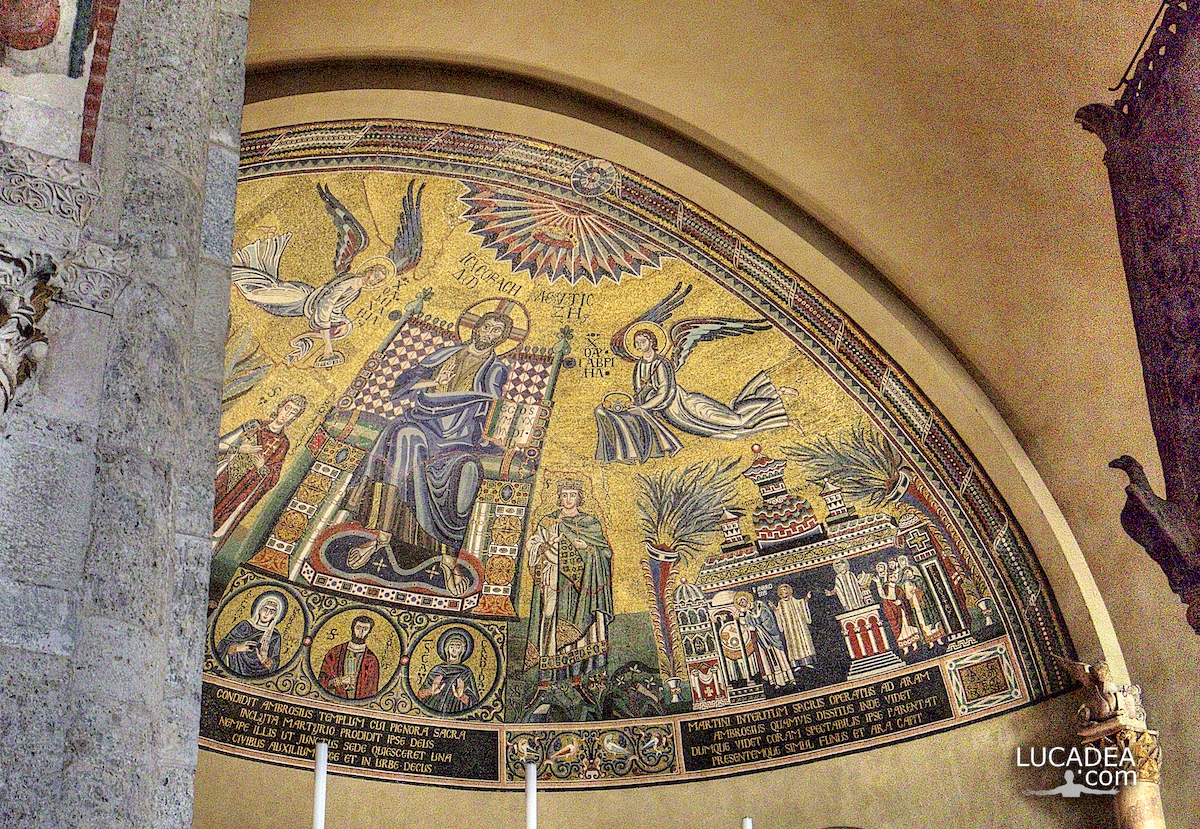
Inside Sant’Ambrogio Basilica in Milan, one of the elements that immediately captures the visitor’s attention is the large mosaic covering the apse, an extraordinary testimony to medieval art and the religious history of the city.
During my visit to the basilica, I wanted to photograph this detail because, besides the famous golden altar and the impressive ciborium, the apse creates one of the most spectacular areas of the entire building. The light reflecting on the golden tiles gives the mosaic a unique atmosphere and highlights the richness of its details.
At the centre of the composition is Christ Pantocrator, seated on a throne with the open book and surrounded by the symbols of the Evangelists. On both sides there are several saints, including Saint Ambrose, the patron saint of Milan to whom the basilica is dedicated.
The mosaic follows the principles of Byzantine medieval iconography, with a solemn and majestic representation of Christ. The vivid colours, the use of gold and the arrangement of the tiles create effects of light and depth that bring the figures to life.
I wanted to capture this detail with my camera because when visiting a church so rich in history, it is easy to focus only on the most famous elements and miss smaller masterpieces that deserve attention.
Sant’Ambrogio Basilica is located in Milan, Lombardy, Italy, and it is one of the most important monuments in the city. Founded in the 4th century by Bishop Ambrose, it preserves many valuable artworks and represents one of the finest examples of Lombard Romanesque architecture.
A small curiosity is that the apse mosaic, despite its ancient origins, has undergone several restorations over the centuries, including work after the damage suffered during the Second World War. Its current beauty is therefore also the result of careful conservation.
After photographing the golden altar of the basilica, I could not miss the opportunity to capture this magnificent golden wall dominating the altar area and welcoming visitors with its impressive presence.
Standing in front of such an artwork, it is natural to think about how many people, throughout the centuries, have looked up at the same mosaic and found in it both an artistic and spiritual reference.

Have you ever visited Sant’Ambrogio Basilica in Milan? Add a comment or go to the bottom of the site to read what other visitors have written.

Golden apse mosaic of Sant’Ambrogio Basilica in Milan featuring Christ Pantocrator

Photo taken with a Canon EOS M100 camera and Canon EF-M 11-22 lens.

This is the church’s official website: basilicasantambrogio.it.

To see all the photos I took at the Basilica, click here:

The mosaic adorning the semi-dome of the apse in the Basilica of Sant’Ambrogio depicts Christ enthroned against a gold background, flanked by Saints Gervasius and Protasius.
Read more and explore further at lombardiabeniculturali.it

The golden altar of Sant’Ambrogio Basilica

Altare maggiore dorato della Basilica di Sant’Ambrogio a Milano con mosaici dell’abside

The golden altar of Sant’Ambrogio Basilica.
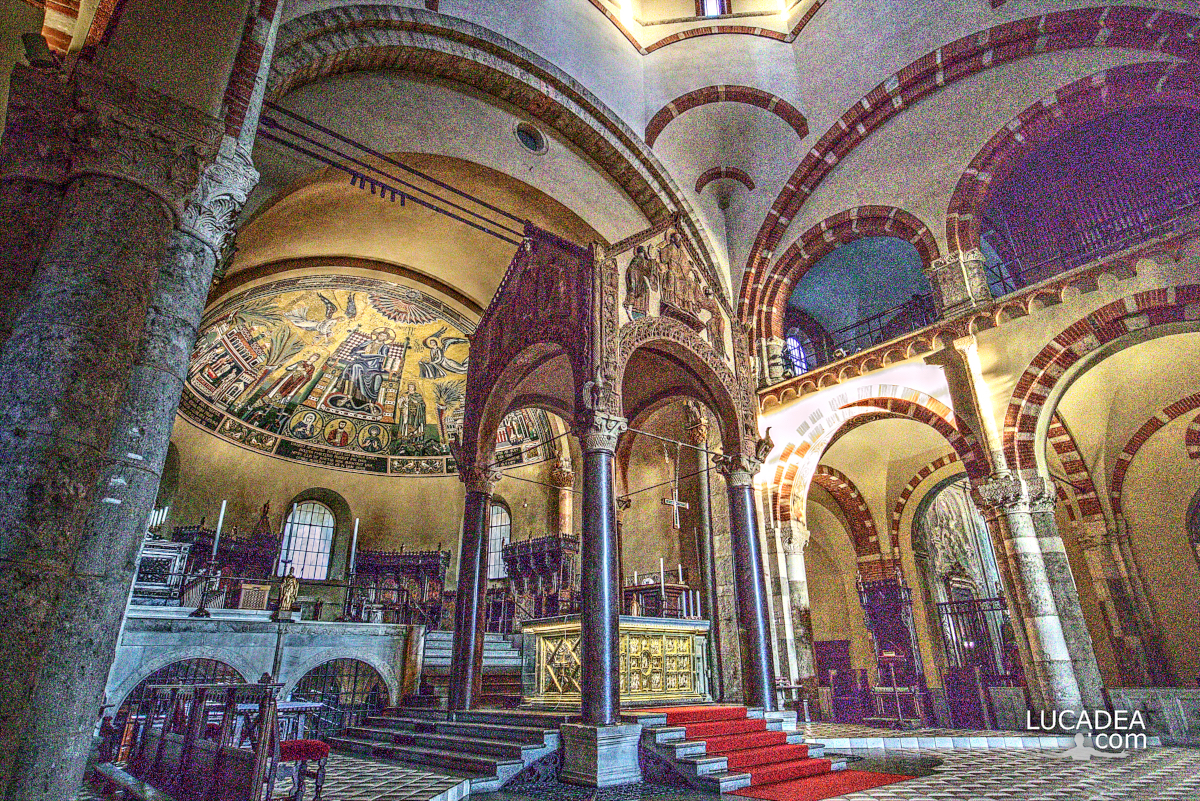
Entering Sant’Ambrogio Basilica in Milan, your eyes are naturally drawn towards the centre of the church, where the magnificent golden altar stands beneath the ciborium, with the colourful mosaics of the apse behind it.
During my visit to the basilica, I wanted to capture this detail with my camera because, beyond its famous brick facade and beautiful cloister, the interior also preserves remarkable artistic and historical elements. Often, these less obvious details are the ones that reveal the true character of a place.
The main altar of Sant’Ambrogio Basilica is one of the most important masterpieces kept inside the church. Its golden and silver surfaces stand out beneath the ciborium, creating a fascinating composition together with the apse mosaic behind it. The richness of the decorations invites visitors to stop and observe carefully.
This photograph comes from my desire to tell the story of this part of the basilica, rather than focusing only on the most famous views. When I visit historic churches, I often try to photograph details that can communicate the feeling of standing in front of something that has survived through many centuries.
Sant’Ambrogio Basilica is located in Milan, Lombardy, Italy, and it is one of the most important religious buildings in the city. For anyone looking for places to see in Milan beyond the Duomo, this church offers a different perspective on the history and origins of the city.
A small curiosity about the altar is that it was created between the 9th and 10th centuries by order of Archbishop Angilberto II. Known as the Altar of Sant’Ambrogio, it is decorated with precious gold and silver panels, enriched with enamel work and gemstones. Beneath it are preserved the relics of Saints Gervasius and Protasius and of Saint Ambrose himself.
On my website I have already shared other views of Milan, from the Navigli area to the Brera district, but this basilica shows a different side of the city: older, quieter and deeply connected to its origins.
Photographing a detail like this means preserving a small fragment of a much larger story, hidden inside the walls of one of Milan’s most important churches.

Have you ever visited Sant’Ambrogio Basilica and looked closely at this remarkable altar? Add a comment or go to the bottom of the site to read what other visitors have written.

Golden main altar of Sant’Ambrogio Basilica in Milan with apse mosaics in the background

Photo taken with a Canon EOS M100 camera and Canon EF-M 11-22 lens.

This is the church’s official website: basilicasantambrogio.it.

To see all the photos I took at the Basilica, click here:

The Altar of Saint Ambrose is the high altar of the Basilica of Saint Ambrose in Milan. The altar is the focal point of the renovation carried out at the basilica by the Frankish bishop Angilbert II. The ancient basilica, with its wealth of relics, serves as the setting for the political and religious agenda guiding the bishop—a representative of Carolingian authority—in his reorganization of the city and its territory.
Read more on Wikipedia

The facade of Sant’Ambrogio Basilica in Milan

Facciata della Basilica di Sant’Ambrogio a Milano con il quadriportico storico davanti alla chiesa

The facade of Sant’Ambrogio Basilica in Milan.
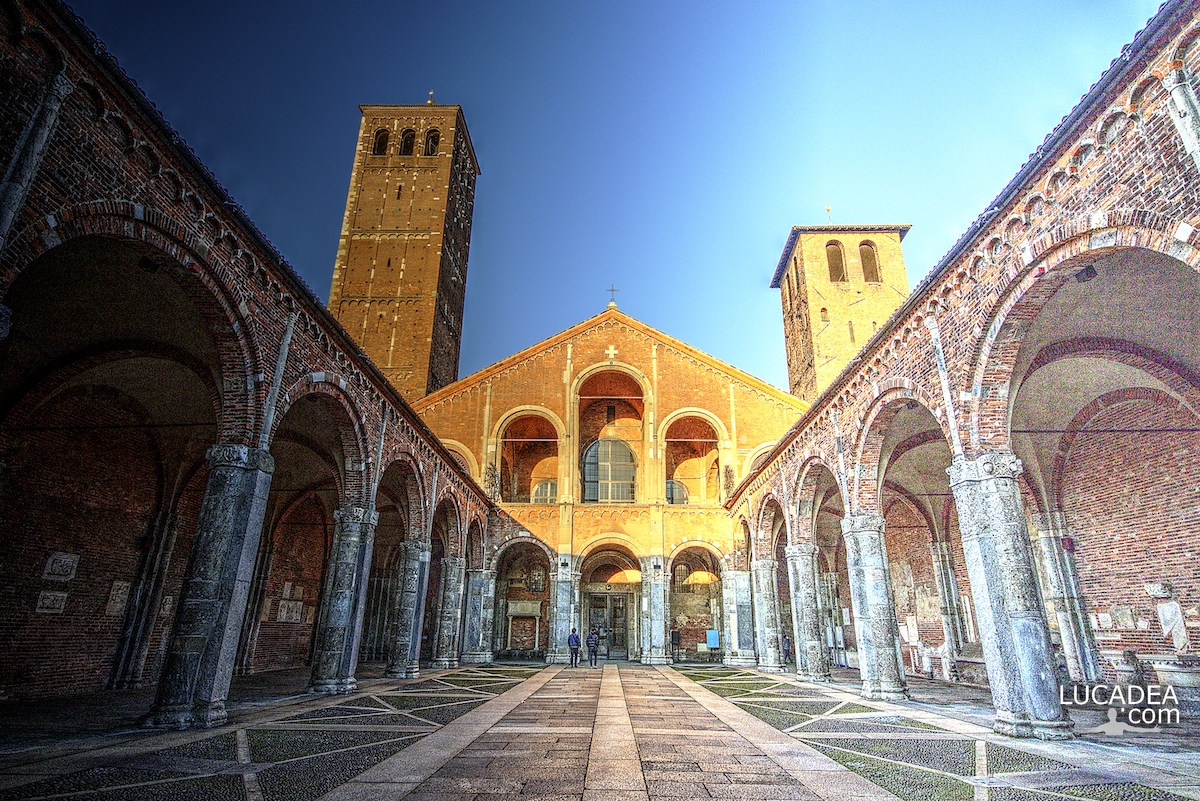
When I visited Sant’Ambrogio Basilica in Milan, one of the most important symbols of the city, I stopped to admire its famous facade with the quadriportico, the architectural element that makes this historic complex instantly recognizable. This photograph is not only about an ancient building, but also about a personal memory connected with a poem I studied many years ago.
While standing in front of the basilica, I remembered “Sant’Ambrogio”, a poem written by Giuseppe Giusti that I learned during middle school. The first verses came back to my mind because the poem begins with the writer describing his arrival at the famous Milanese church:

“Vostra Eccellenza, che mi sta in cagnesco…”

The poem uses the visit to Sant’Ambrogio as a starting point for reflections about history and politics during the period in which it was written. Seeing the place in reality after knowing it from school books gave the visit a special meaning, connecting literature with a real location.
Sant’Ambrogio Basilica is located in the centre of Milan and is dedicated to Saint Ambrose, the patron saint of the city. The current structure mainly dates back to the Romanesque period and is considered one of the most important examples of Romanesque architecture in Lombardy. The large quadriportico in front of the church is one of its most distinctive features and was historically used as a gathering space for visitors and worshippers.
One interesting historical detail is the strong connection between the basilica and Saint Ambrose, the fourth-century bishop who played a fundamental role in the history of Milan and Christianity. Inside the church there are also important artworks, including the famous Carolingian golden altar.
I wanted to capture this facade with my camera because often the exterior of a building is the first element that creates a connection with a place. In this case, it is not just an impressive architectural view, but a meeting point between personal memories, literature and history.
On my blog I often share photographs of Italian places connected with art and culture because I enjoy discovering how a building can preserve stories beyond its appearance.

Have you ever visited Sant’Ambrogio Basilica in Milan, or found yourself in a place you first knew from books? Add a comment or go to the bottom of the site to read what other visitors have written.

Facade of Sant’Ambrogio Basilica in Milan with the historic quadriportico in front of the church

Photo taken with a Canon EOS M100 camera and Canon EF-M 11-22 lens.

This is the church’s official website: basilicasantambrogio.it.

To see all the photos I took at the Basilica, click here:

The basilica features a broad, low-slung gable façade and two superimposed loggias. The sides of the lower loggia—which consists of three equal-sized arches—connect to the portico, which has slightly taller arches.
Read more on Wikipedia

🏠
  • Italiano