
The Clock of Santa Maria di Nazareth Church

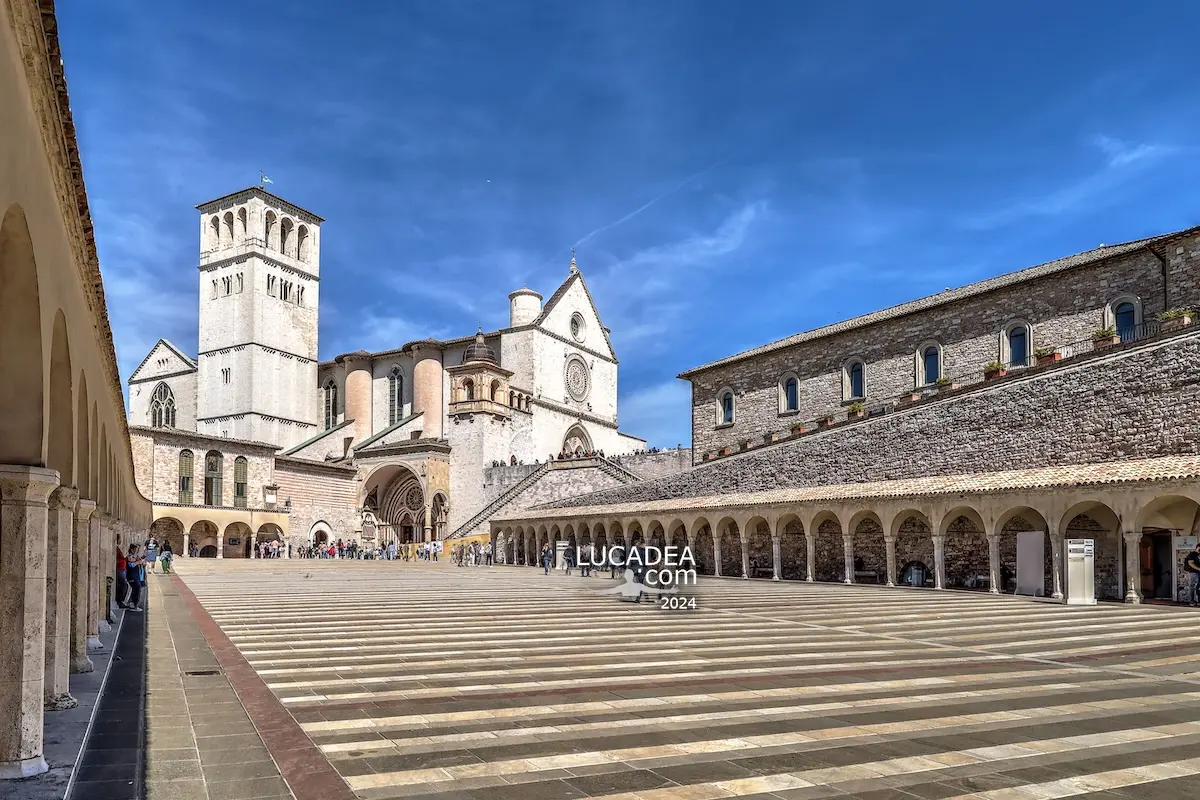
The Sacred Convent of Assisi from the large square.
From the large square that opens in front of the Papal Basilica and the Sacred Convent of Saint Francis, Assisi seems to pause for a moment. The photo was taken under the porticoes, at that precise point where the space widens and the gaze can finally breathe. The basilica presents itself without emphasis, with a solid and silent presence, made of light stone and proportions that invite contemplation rather than wonder.
Walking slowly across the square, one has the feeling that this place does not want to amaze but to welcome. The porticoes accompany the steps, creating a natural threshold between the movement of the city and the quietness that is felt as one approaches. The photograph captures this balance: people passing by, light changing on the arches, and the facade remaining there, motionless, as if it had always been part of the human as well as the architectural landscape.
Observing the basilica from this distance, its dual nature emerges. It is a monumental place, recognized throughout the world, but at the same time it retains something profoundly simple. The stone does not impose, it dialogues. The square does not overwhelm, it accompanies. It is a space designed for pausing, for arriving gradually, perhaps even for preparing oneself inwardly before entering.
Here, in the Sacred Convent, Saint Francis rests. The basilica guards his tomb, becoming the point of reference for Franciscan memory. It is not the place of his earthly passing, which took place at the Porziuncola, in the church of Santa Maria degli Angeli, but it is the place that gathers and preserves his symbolic and spiritual presence. In these days, with the official opening of the commemorative year of the passing of the Poor Man of Assisi, this bond becomes even stronger: the memory of his death is intertwined with the place that preserves his body, creating a silent dialogue between Assisi and the plain below.
The photo tells precisely this: not a specific moment, but a continuity. The large square becomes a space of passage, of encounter, of reflection. A place where history doesn’t weigh you down, but accompanies you, and where simply pausing for a moment is enough to feel part of something that goes beyond a mere snapshot.
Have you ever felt the power of a place not by entering it, but simply by standing in front of it? Add a comment or go to the bottom of the site to read what other visitors have written.
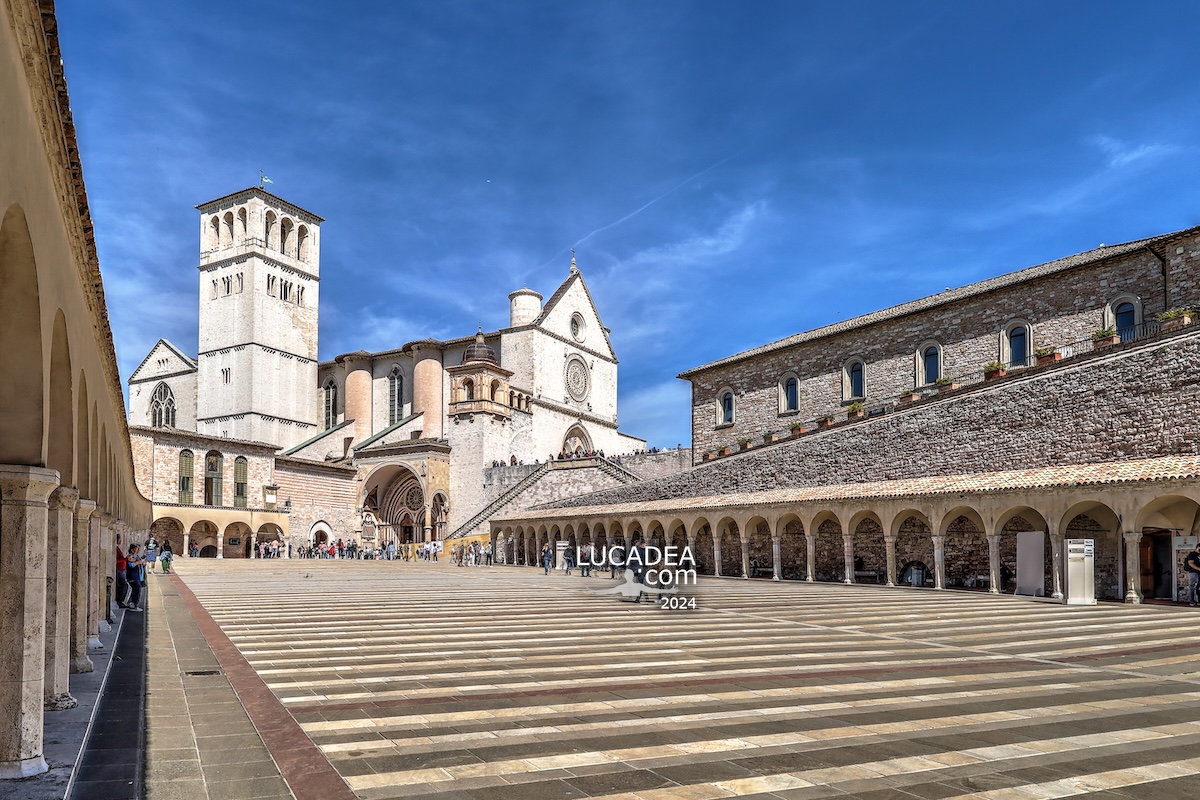
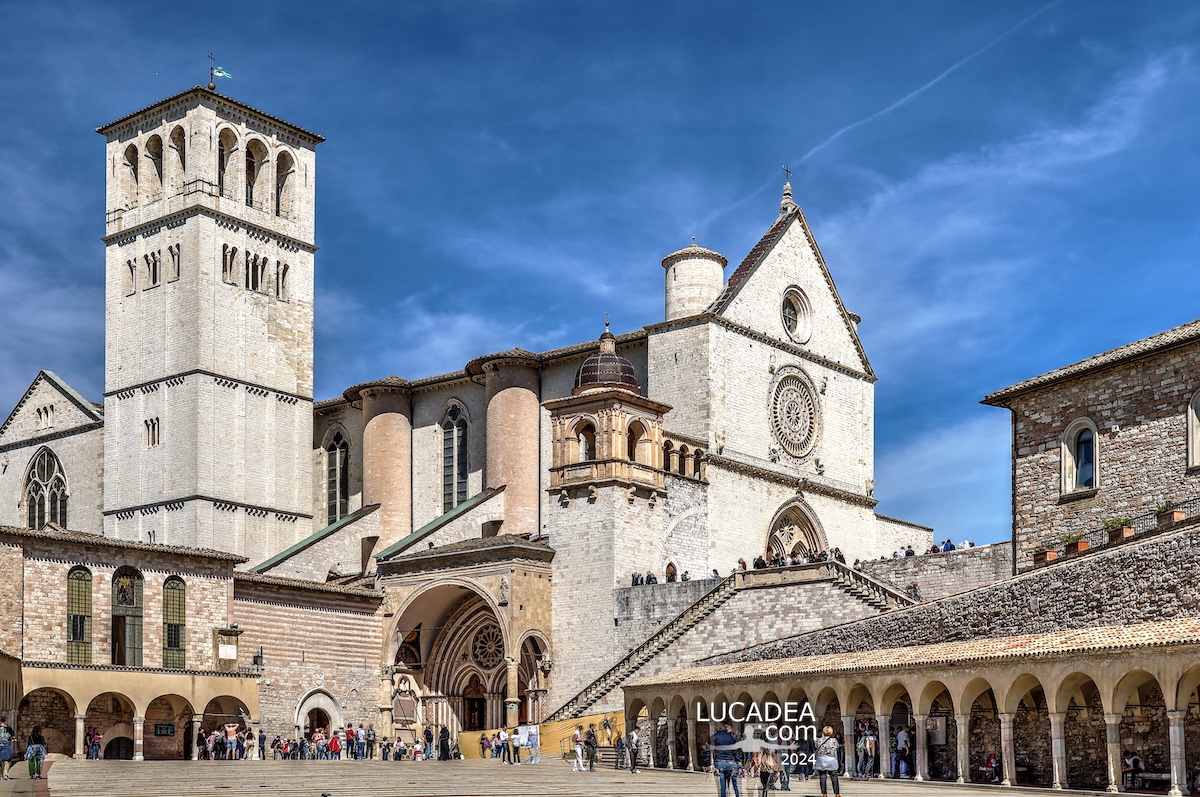
Photos taken with a Canon EOS RP camera and a Canon RF 24-50 lens.
To see all the photos of Assisi click here:

Here’s where the basilica is located:
Commissioned by Pope Gregory IX as a special church, it was granted the title of Head and Mother of the Franciscan Order by the same Pontiff and entrusted in perpetuity to the friars. It is part of the non-extraterritorial properties of the Holy See, and therefore does not enjoy diplomatic immunity. In the complex history that has marked the evolution of the Order, the basilica (and the annexed Sacred Convent) was always guarded by the so-called “friars of the community,” the group that later went on to constitute the Order of Friars Minor Conventual.
Continue and learn more on Wikipedia
The text of this post was written with the help of ChatGPT, a language model from OpenAI.
The rights on images, videos, choruses, text and all other material on the LUCADEA.com website are governed as per Copyright page.

The golden apse of San Babila in Milan.
As soon as I step inside the Basilica of San Babila in Milan, the golden apse immediately draws my attention, radiating a warm glow that contrasts with the subdued atmosphere of the church. The golden apse of San Babila in Milan, located in Milan, Lombardy, Italy, is one of those details that can easily go unnoticed unless you take the time to stop and look upward.
I remain still for a few moments, watching how the golden apse of San Babila in Milan reflects the available light, creating subtle variations across its curved surface. There is a quiet balance here, where architecture and light work together to shape the space in a way that feels both simple and deeply intentional.
If you are visiting Milan and wondering what to see beyond the most famous landmarks, this is a place worth seeing in Milan for those who appreciate hidden details and quieter spaces. The golden apse of San Babila in Milan offers a different perspective on the city, one that is less about movement and more about observation.
This moment reminds me of other interior photographs I’ve shared on lucadea.com, where focusing on architectural details reveals aspects of a place that are often overlooked. Here, the golden apse becomes the focal point of that slower, more attentive way of seeing.
A small historical note: in many churches, the apse is the most symbolically important area, often decorated to highlight its spiritual significance and to draw the viewer’s attention toward the altar.
I linger there just a bit longer, wondering how many people pass through without ever noticing this quiet glow above them. Have you ever looked up and discovered something unexpected? Add a comment or go to the bottom of the site to read what other visitors have written.

Photo taken with Canon EOS R50 V and Canon RF 28 lens.
To see all the photos of the Basilica, click here:

The mosaic in the apse, depicting Saint Babila and the three children martyred with him, was created in 1890 by Luigi Cavenaghi. The lunettes between the side arches and the dome, decorated with the figures of the Redeemer and the Virgin surrounded by various saints, are mosaics superimposed in 1929 over the original frescoes by the same artist.
Continue and learn more at Wikipedia
The text of this post was written with the help of ChatGPT, a language model from OpenAI.
The rights on images, videos, choruses, text and all other material on the LUCADEA.com website are governed as per Copyright page.

The rose window of the Blessed Sacrament Chapel in Brescia.
I look up at the rose window of the Blessed Sacrament Chapel in Brescia and immediately feel drawn into the quiet balance between light and structure, as the filtered glow shapes the space around me. The rose window of the Blessed Sacrament Chapel in Brescia, located in Brescia, Lombardy, Italy, is one of those details that often appear when people search what to see inside the city’s historic cathedral complex.
I stand still for a while, observing how the rose window of the Blessed Sacrament Chapel in Brescia transforms the light into something almost tangible, spreading softly across the interior surfaces. It is not just an architectural element but a focal point that connects space, symbolism, and atmosphere.
If you are visiting Brescia and wondering what to see beyond the main attractions, this chapel and its rose window represent a place worth seeing in Brescia for those who appreciate quieter, more intimate details. The experience feels less like sightseeing and more like a pause within the city.
As I’ve done in other photographic stories shared on lucadea.com, I find myself drawn to these smaller elements, the ones that don’t immediately demand attention but reward those who take the time to look. Here, the rose window of the Blessed Sacrament Chapel in Brescia becomes the center of that slow observation.
A small historical note: chapels dedicated to the Blessed Sacrament in Italian churches are often richly decorated, reflecting their importance in Catholic tradition and the central role of the Eucharist.
Have you ever paused long enough to notice how light alone can define a place? Add a comment or go to the bottom of the site to read what other visitors have written.

Photo taken with Canon EOS RP and Canon RF 50 lens.
To see all the photos I took in the city of Brescia, click here:
The text of this post was written with the help of ChatGPT, a language model from OpenAI.
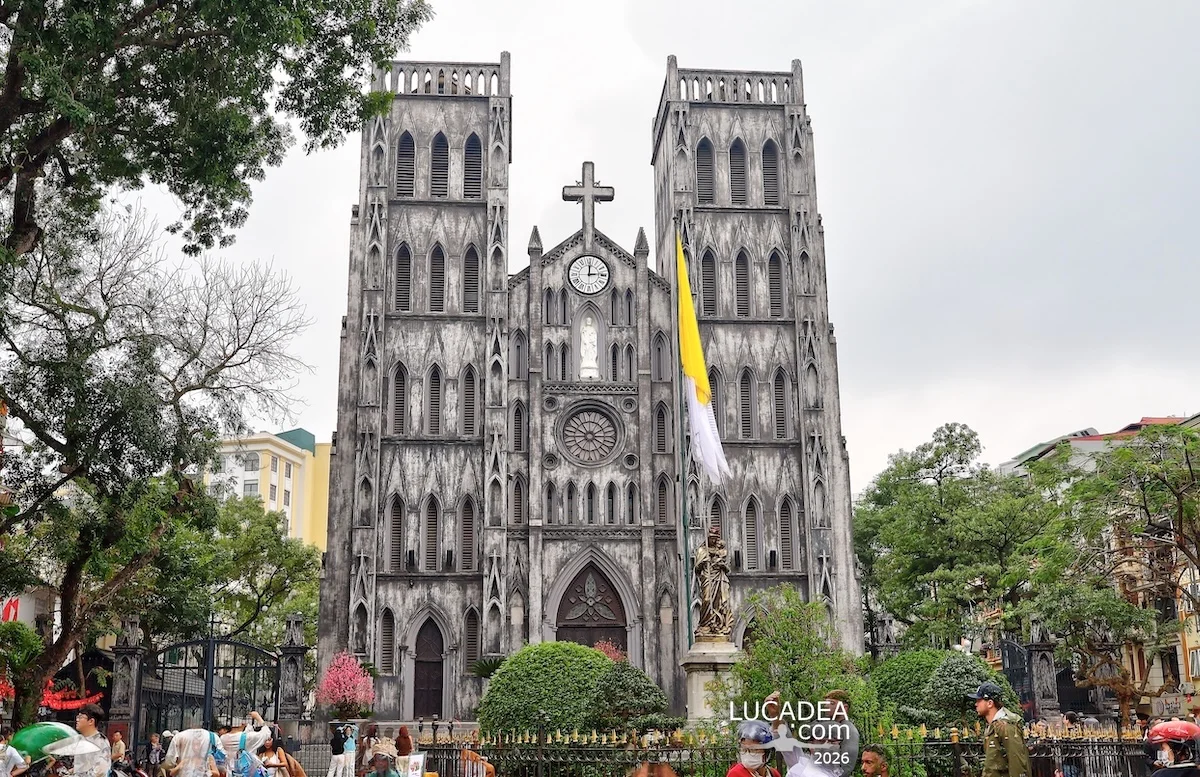
Hanoi cathedral between faith and urban chaos.
Walking through the center of Hanoi, trying to figure out what to see in Hanoi among the constant motion of the streets, I suddenly found myself standing in front of the Catholic cathedral of Hanoi. Among the places to see in Hanoi, this one stands out immediately, almost unexpectedly, as if it belonged somewhere else entirely.
The noise doesn’t stop. Motorbikes flow around you, people talk, sit, move, live their routines. And right in the middle of it all, the cathedral rises with its Gothic lines and weathered facade. When you search for what to see in Hanoi, you might expect temples or lakes, but this building tells a different story, one shaped by history and contrast.
Here we are in Hanoi, in northern Vietnam, where the cathedral becomes part of everyday life rather than something separated from it. I stood there for a while, watching how people interacted with the space. No one seemed particularly impressed, and that made it even more interesting. It felt real, not staged.
If you are visiting Hanoi and wondering what to see, this is definitely a place worth seeing, not just for its architecture but for the atmosphere around it. It shows how different layers of history can coexist naturally, without needing explanations.
It reminded me of another photo I shared on my site from a nearby street, where colonial buildings and modern life blend in a similar way. Hanoi has this ability to surprise you quietly, without trying too hard.
A small interesting fact: St. Joseph’s Cathedral was built in 1886 during the French colonial period and remains one of the oldest churches in the city, inspired by the famous Notre-Dame in Paris.
If you’re exploring what to see in Hanoi, you might realize that some of the most memorable places are the ones that don’t try to stand out, but simply exist within the rhythm of the city.
Have you ever found something unexpected right in the middle of the chaos? Add a comment or go to the bottom of the site to read what other visitors have written.

Photo taken with Canon EOS RP and Canon RF 28 lens.
To see all the photos I took in Hanoi, click here:

The memorial plaque of Saint Julia near Lavagna.
Walking down from the church of Saint Julia towards Lavagna, I came across this small shrine, a discreet detail that could easily be overlooked but preserves a very specific memory connected with the religious history of the area.
I took this photograph because I am always curious about the small signs of local history that appear along roads and paths. This is not a large monument and it does not have the immediate presence of a church or historic building, but the story carved into the plaque made me stop and take a closer look.
The shrine stands along the road leading from the church of Saint Julia down towards Lavagna, in the area of Rigone. Its location is particularly meaningful because the memorial refers to an event that took place in this very area. The plaque commemorates the discovery of a relic of Saint Julia after a sacrilegious theft from the parish church.
The inscription explains that the important relic of Saint Julia was found on the plain below after it had been thrown there by one of the thieves once the stolen goods had been divided. The date recorded on the stone is the night of March 14, 1911. The inhabitants of Rigone placed the memorial here to preserve the memory of what happened.
It is the kind of story that can suddenly make an ordinary road much more interesting. When I think about what to see around Lavagna, I enjoy these unexpected discoveries because they add another layer to a landscape that might otherwise seem familiar and ordinary.
The relic mentioned on the plaque is connected with the devotion to Saint Julia, a saint venerated in several parts of Italy and across the Mediterranean. In Lavagna, the devotion is closely associated with the church of Saint Julia, which stands above the surrounding area and remains an important landmark in the local landscape.
The historical detail behind this photograph is therefore quite simple but significant. The night of March 14, 1911, became more than an isolated episode of religious history: it was preserved through local memory and eventually recorded on this small memorial. More than a century later, the words remain visible along the road.
What attracted me most was precisely the modest appearance of the plaque. If you are simply walking past, you might notice the shrine without realizing why it is there. Once you stop and read the inscription, however, the place takes on a completely different meaning.
I took the photograph myself because I wanted to preserve this small piece of Lavagna’s local memory. There was no need to create a dramatic composition. In photographs like this, the subject already contains the reason for taking the picture: the words, the location and the story connected with them.
I have photographed other places around Lavagna as well, including streets and architectural details in the historic center. In one of my photographs of Dante Alighieri street, for example, I focused on a completely different side of the town. Together, these images show how varied the local landscape can be, from historic streets in the center to small memorials encountered along the roads leading towards the surrounding villages.
For me, this is one of the most rewarding aspects of photographing familiar places. A city or village is not made only of the buildings that appear in guidebooks. Sometimes a small plaque, an old shrine or a few words carved into stone can tell you something that would otherwise remain invisible.
If you are looking for the history of Saint Julia in Lavagna, this little memorial provides a tangible connection between the saint’s devotion, the church and the surrounding territory. It is a modest piece of local heritage, but knowing its story changes the way I look at the road.
That is why I decided to photograph it. The image is simple, but behind those few lines on the stone there is an episode that people in Rigone considered important enough to remember for generations.
The plaque reads:
“Here was found the distinguished relic of St. Julia, which a daring hand had cast onto the plain below after the spoils of the sacrilegious theft—committed in the parish church on the night of March 14, 1911—had been divided up. The residents of Rigone erected this memorial.”
Have you ever discovered an unexpected piece of local history simply by stopping to read a memorial plaque? Add a comment or go to the bottom of the site to read what other visitors have written.
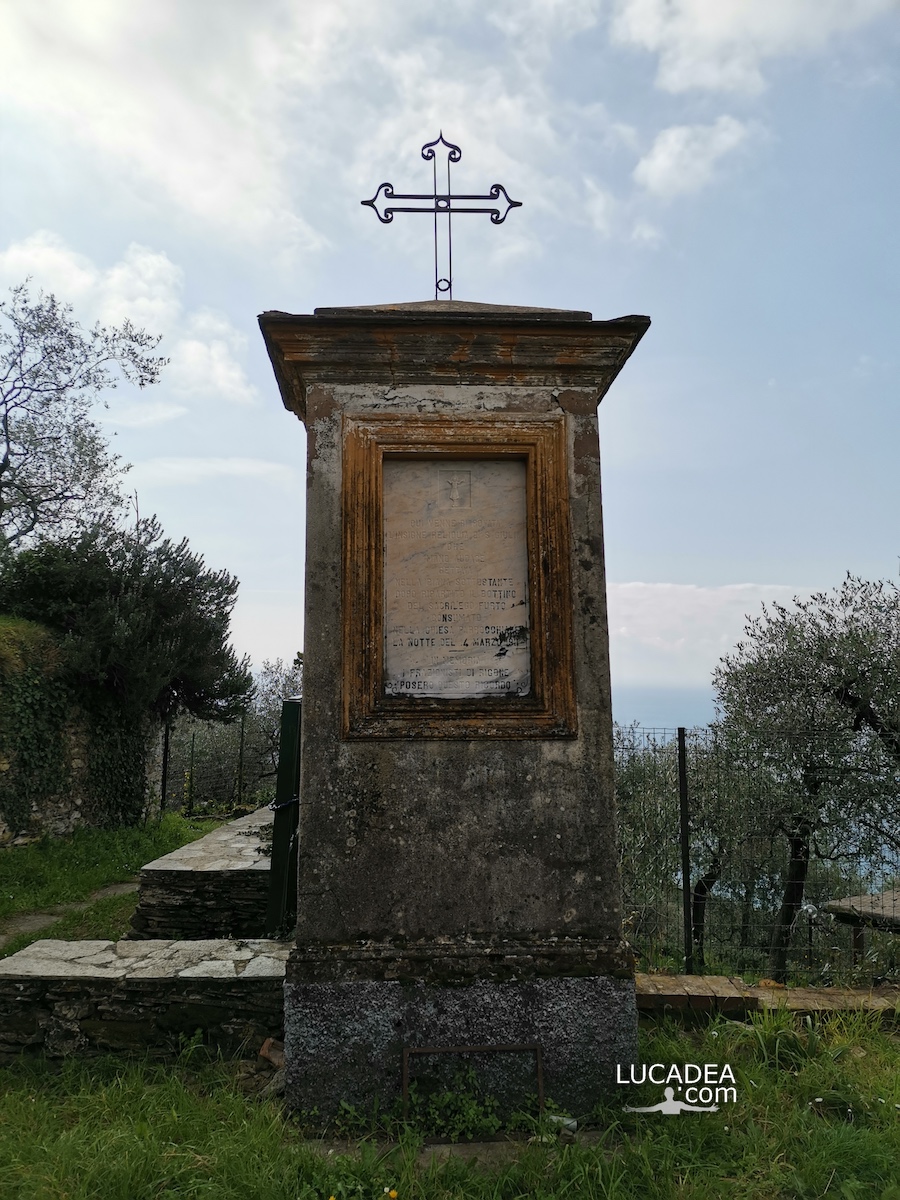

Photo taken with Honor 20.

Santa Luzia and Portas do Sol in Lisbon.
From the ship, looking towards the city, I photographed the Church of Santa Luzia and the Miradouro das Portas do Sol, one of Lisbon’s best-known viewpoints. I have not yet had the chance to properly explore Lisbon, so for now I have to make do with photographing what I can see from the ship.
What I like about this photograph is the unusual point of view. I am not walking through the city streets and I am not standing on the viewpoint itself. I am looking at Lisbon from the water, trying to recognize the buildings and viewpoints rising above the Tagus. It is a different way of getting to know a city, made of glimpses rather than full visits.
The Church of Santa Luzia stands beside the Santa Luzia viewpoint, in the historic Alfama district. A little farther along is the Miradouro das Portas do Sol, opening towards a broad view of Lisbon’s rooftops and the Tagus River. Its elevated position makes the area easy to recognize even when seen from a distance.
If you are wondering what to see in Lisbon, the viewpoints of Alfama are among the places that immediately reveal the city’s unusual shape. In this photograph, however, I was not trying to create a classic panoramic view. I was more interested in the relationship between the city built along the hillside and the wide space of the river in front of it.
The Miradouro das Portas do Sol is one of the most famous viewpoints in Lisbon. Its name refers to the historic Porta do Sol, one of the old gates of the medieval city. Today the viewpoint is a popular place for observing the city, but from the ship it takes on a completely different appearance. The distance removes many small details and leaves the shape of the hillside and the buildings as the main elements.
The photograph comes from this simple opportunity to look at a place before actually reaching it. This happens to me quite often when I am on board. Before I have the chance to explore a city, I start getting to know it through whatever I can see from the deck or the quay. It is obviously not the same as walking through the streets, but these views still become small visual notes of the places I encounter while working.
Lisbon, Portugal, has a very strong relationship with the Tagus and with the hills on which much of the city was built. From the water, that character becomes even clearer. The city appears to rise gradually from the river, while the historic neighborhoods overlap across the hills and create the irregular profile that makes Lisbon so recognizable.
Among the details I wanted to preserve in this photograph are the Church of Santa Luzia and the Portas do Sol area. Seen from a distance, they may seem like only a small part of the larger view, but they help identify the location and reveal something of the character of Alfama.
I would like to have the time one day to leave the ship and properly explore Lisbon, walking through its streets and narrow lanes without having to rush. For now, my connection with the city is still through photography and through the views I can collect during the ship’s stops.
That is also why I find these apparently simple photographs worth keeping. They do not necessarily show everything I would like to see, but they document what was genuinely in front of me at that particular moment. The photograph becomes almost a promise of a future visit, when I can finally explore Lisbon at my own pace.
On the blog I have also shared other places I photographed during my periods working on board, and I like keeping these images connected. A view of a city from a ship can sit alongside photographs of other ports and places encountered along the way, gradually creating a personal map of my travels.
For now, then, I will keep this view of the Church of Santa Luzia and the Miradouro das Portas do Sol, with Lisbon and the Tagus stretching out in front of the ship. Perhaps next time I will finally have the chance to go ashore and photograph these places from much closer.
Have you ever seen Lisbon from the Tagus or from the deck of a ship? Add a comment or go to the bottom of the site to read what other visitors have written.


Photos taken with a Canon EOS RP camera and a Tamron 16-300 lens.
To see all the photos of the ship’s departure from Lisbon, click here:
Here is where the photographed spot is located:

Inside the Basilica of San Domenico Maggiore.
While wandering through the narrow streets of Naples, I came across this important basilica almost by chance and decided to step inside. The central nave of San Domenico Maggiore immediately changed the atmosphere of the walk, replacing the movement of the historic streets with a deep architectural space filled with details that invited me to slow down and look more carefully.
This photograph came from that unexpected stop. I had not planned a visit to the church, but finding it during my walk made me curious enough to enter. Once inside, I took my camera out and chose to photograph the central nave, trying to preserve that first impression rather than simply recording the building as an architectural subject.
When searching for things to see in Naples, it is easy to think first of the streets, squares, historic buildings and views that make the city so recognizable. San Domenico Maggiore offers another way of seeing Naples, through its churches and interiors and through the layers of history that are still present inside them. For me, this is one of the pleasures of photographing a city: sometimes the most interesting frame appears after leaving the obvious route for a few minutes.
The basilica stands in the historic centre of Naples, in Campania, Italy, in the area of Piazza San Domenico Maggiore. Its position is part of what makes the place so interesting. The surrounding streets are among the most characteristic parts of the old city, and the transition from the lively urban setting outside to the interior of the church happens within only a few steps.
Looking at the central nave through the camera, I was interested in the way the architecture guides the eye into the depth of the building. Columns, altars, decorations and architectural lines create a strong perspective, while the many individual details prevent the scene from becoming too simple or purely geometric. I wanted the photograph to retain that sense of looking forward while still allowing the eye to stop on the smaller elements along the way.
San Domenico Maggiore has a long connection with the Dominican Order and has played an important role in the religious and cultural history of Naples. The complex has medieval origins and was modified over the centuries. One of its better-known historical connections is with Thomas Aquinas, who studied and taught within the Dominican tradition and is associated with the complex. The basilica and convent were also connected with intellectual and religious life in Naples over a long period.
That history adds meaning to the photograph, but I did not want the historical background to become more important than the image itself. What interested me was the experience of arriving there after walking through the narrow streets. Naples often creates these sudden changes in perspective: outside there is traffic, conversation and constant movement; inside a historic church, attention naturally shifts toward architecture, artworks and small details.
If you are visiting Naples and looking for places worth seeing in the historic centre, San Domenico Maggiore is the kind of place that can become part of a walk rather than feeling completely separate from it. Its location makes it easy to encounter while exploring the old city, and the surrounding urban fabric helps explain why the basilica feels so closely connected to Naples itself.
I like photographs that begin with an unplanned discovery. There is something different about photographing a place after unexpectedly finding it compared with arriving with a carefully prepared shot in mind. In this case, the photograph records not only the interior of San Domenico Maggiore, but also a small moment in my walk through Naples.
This way of photographing connects with other stories on my blog about churches, historic buildings and details discovered while walking through Italian cities. I often find that one photograph leads naturally to another, especially when the original subject appears unexpectedly along the way.
For me, the central nave remains the most important part of this image because it preserves the feeling of that first look inside. The photograph does not need to explain everything about the basilica. It only needs to remind me why I stopped, looked around, and decided that this particular view deserved a place in my photographic story of Naples.
Have you ever entered a historic church in Naples simply because you happened to pass its entrance? Add a comment or go to the bottom of the site to read what other visitors have written.
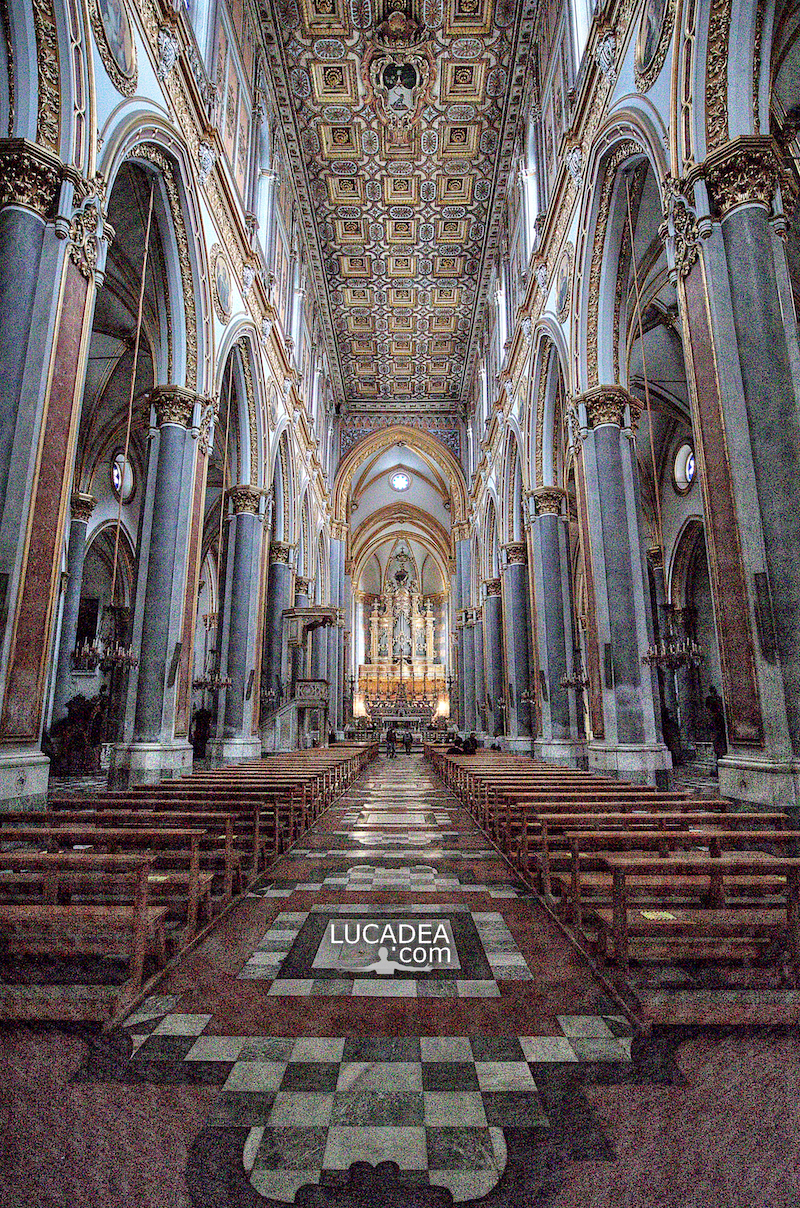
Photo taken with a Canon EOS M100 camera and Canon EF-M 11-22 lens.
To see all the photos I took in Naples—both that weekend and on other trips—click here:

San Bernardo church above Sestri Levante. A little above the town, on the hillside roads leading inland, you reach San Bernardo delle Cascine, a small hamlet where I photographed this modest church, a quiet building with centuries of local history behind it.
It is one of those places that can easily remain familiar only by name. Sestri Levante is naturally associated with the sea, its bays and the peninsula, but moving a little farther from the coast reveals a different side of the town, with hillside communities, quieter roads and old places of worship.
San Bernardo church is the religious landmark of this small community. Its position above Sestri Levante gives it a particular character. It is not a monumental church standing in the historic centre, but a building closely connected with its surroundings, where the hillside landscape becomes part of the photographic subject.
When I took this photograph, what interested me most was simply recording another small part of the town where I live. I enjoy looking for the less obvious corners of Sestri Levante, places that may not appear in the most familiar photographs but that help create a fuller picture of the area.
The history of the church, however, goes back much further than its present appearance might suggest. Before the current building, the local community was associated with a church dedicated to Saint Quiricus, with records of the earlier church dating back to 1151. The present church dedicated to Saint Bernard was built in 1636. That detail changes the way I look at the building: behind this simple church there is a religious history stretching across many centuries.
The full name, San Bernardo delle Cascine, is closely connected with the local hamlet. The church is in Sestri Levante, Liguria, Italy, on the hills rising from the coastal area towards the inland landscape. That transition between town and hills is one of the things I find particularly interesting when photographing this part of Liguria.
If you are wondering what to see in Sestri Levante beyond the best-known coastal sights, the surrounding hamlets can also offer interesting subjects. For me, they are especially rewarding because they show a quieter and more everyday side of the town.
San Bernardo is also a place from which Sestri Levante can be seen from a different perspective. In another photograph I shared on the site, I had already captured the view of Sestri Levante from San Bernardo. I like thinking of these photographs as small chapters of the same landscape: first the view, then the church and the details of the hillside community.
Photography can bring these nearby places together in a way that makes their relationship easier to see. From the coast, we look towards the hills; from the hills, we can turn back towards the town and the sea.
What attracted me to San Bernardo church was also its everyday character. A building does not need to be large or spectacular to deserve a photograph. Sometimes the simplest structures, the ones that belong to the daily life of a small community, carry some of the longest stories.
The earlier church dedicated to Saint Quiricus is a good example. Today we see the seventeenth-century building dedicated to Saint Bernard, but the religious presence here is much older. That detail gives the photograph, at least for me, an additional layer, turning what could simply be a view of the Sestri Levante hills into a small fragment of local history.
I also like the fact that photographs like this do not require a long journey. Sometimes it is enough to know your surroundings a little better, take a different road and stop in front of something you may already have passed many times.
San Bernardo delle Cascine is exactly this kind of discovery. It is a quiet presence on the hills above Sestri Levante, but it also preserves the memory of a community and of a place of worship whose history reaches back to the Middle Ages.
For me, photographing it means preserving more than the image of a church. It means keeping a small fragment of local history. This is one of the reasons I continue photographing Sestri Levante: every time I think I know the area well, another detail appears that I had somehow overlooked.
If you are visiting Sestri Levante and want to see a less familiar side of the town, San Bernardo is one of those places that can add another perspective to the landscape. Not because it is spectacular, but because it shows how closely the town, its hills and its local history are connected.
Have you already seen San Bernardo delle Cascine, or did you discover this small church only after exploring the hills above Sestri Levante? Add a comment or go to the bottom of the site to read what other visitors have written.

Photo taken with Canon EOS M100 and lens Tamron 16-300.

Statues outside Palermo Cathedral.
During my summer visit to Palermo, I also stopped to photograph some of the details surrounding one of the city’s most recognisable monuments. If you are wondering what to see in Palermo, the cathedral is an obvious place to visit, but the area in front of the building also deserves some attention, especially because of the statues and decorative elements that complete the view of its monumental façade.
I took this photograph myself during that visit, as part of a larger series of images I made around the cathedral. I still had many photographs from Palermo waiting to be published and, as I often do with places that give me several photographic ideas, I preferred to spread them out over time rather than publish everything together. Each image can then tell a slightly different part of the same visit.
The photograph focuses on the statues outside Palermo Cathedral in Sicily. They can easily become secondary details when compared with the enormous façade, towers and architectural complexity of the building itself. Yet they contribute considerably to the appearance of the space in front of the cathedral. I often enjoy looking for precisely these details, because it is easy to concentrate on the main monument and overlook everything around it.
Palermo Cathedral stands in the heart of the historic centre of Palermo, Sicily, Italy, occupying a large area that allows the façade to be seen from several viewpoints. The statues and other decorative features create a visual connection between the cathedral and the surrounding urban space, making the transition between architecture and the city feel more natural.
The history of the cathedral is particularly long and reflects the different cultures and periods that shaped Palermo. The present building began to take shape in the twelfth century under Archbishop Walter Ophamil, and numerous changes were made over the centuries. This layered history is one reason why even a simple photograph of the exterior can reveal several different aspects of the monument.
It is therefore not a building that needs to be photographed only from straight in front. As you change position, different details come into view: statues, columns, arches, decorative elements and sections of the façade that look different depending on where you stand. During that visit I allowed myself to follow these changes, looking for photographs that were not simply another full view of the cathedral.
This image came from that kind of observation. I was not necessarily trying to make the classic photograph of Palermo Cathedral. Instead, I wanted to isolate one of the elements around the exterior that had caught my attention. I like working this way because returning to the same monument from different angles can produce photographs that feel completely different.
If you are exploring what to see around Palermo Cathedral, it is worth looking beyond the main façade. The surrounding space contains architectural and decorative details that can become photographic subjects in their own right. For anyone who enjoys noticing small details while walking, this is one of those places where changing your viewpoint slightly can reveal something new.
What I remember most from that visit is the number of photographs I managed to make without moving very far from the cathedral. I started by photographing the monument as a whole and then gradually moved towards smaller details. This happens to me quite often: once I find an interesting area, I prefer to explore it photographically before moving on.
This photograph also connects naturally with the article I published about the Chapel of Santa Rosalia inside Palermo Cathedral. There I turned the camera towards the interior of the monument, while here I stayed outside and focused on the elements surrounding the façade. They are two different ways of telling the story of the same place.
Looking at this image again, I like the fact that you do not need to know the exact history of every statue to appreciate its role in the composition. The photograph is more about observing the relationship between the figures, the building and the surrounding space than about documenting one precise historical detail.
The cathedral remains the dominant visual reference in this part of Palermo. Its size and architecture give even smaller elements greater importance when they are photographed within its surroundings. That relationship between the monumental building and the details around it is what I wanted to preserve in the image.
I still have several photographs from that summer visit and I will continue to publish them gradually, as I usually do. Some will show more of the cathedral itself, while others will focus on details that might initially seem secondary but were enough to make me stop and take out my camera.
For me, that is also part of what a personal photo blog is about. It is not necessary to publish every photograph from the same place at once. Giving each image its own space allows it to bring back a different moment from the visit and a different way of seeing the same location.
And when you visit a large cathedral, do you also stop to look at the statues and smaller details outside? Add a comment or go to the bottom of the site to read what other visitors have written.
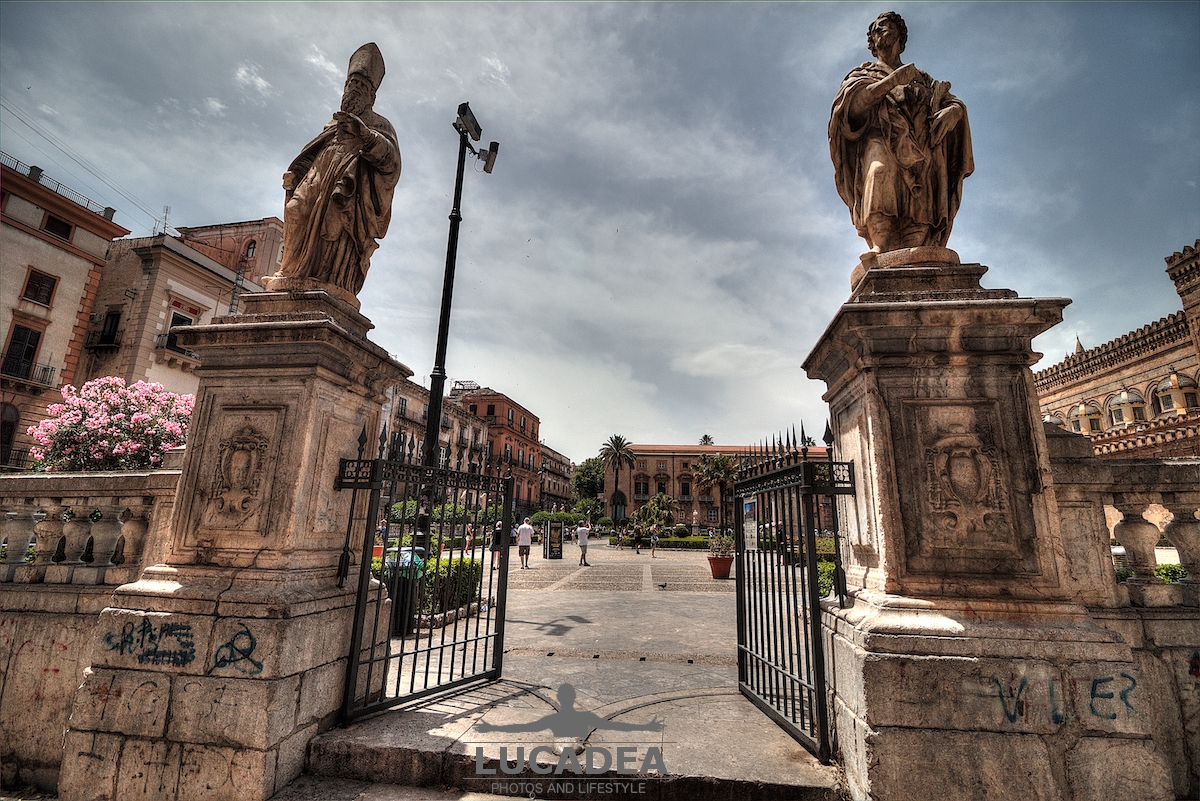
Photo taken with a Canon EOS RP camera and a Canon EF-S 10-18 lens.
Don’t forget the Cathedral’s official website: cattedrale.palermo.it, which offers a complete virtual tour of the monument.
Click here to see more stunning images of the city:
