The facade of Assisi Cathedral in stone and light

Facciata del Duomo di Assisi con rosone centrale e pietra chiara illuminata dalla luce naturale nel centro storico umbro

The facade of Assisi Cathedral in stone and light.
I found myself standing in front of the facade of Assisi Cathedral almost unexpectedly, turning a corner and suddenly facing its wide, pale surface. The stone facade of Assisi Cathedral immediately caught my attention, reflecting the sky in a way that made the whole structure feel alive. Looking at this cathedral in Assisi, there was a quiet balance in its design that didn’t need anything extra to stand out.
I was in Assisi, Umbria, Italy, and everything around me felt consistent with that sense of calm solidity. The facade of Assisi Cathedral is not overwhelming in a dramatic way, but if you are visiting Assisi and wondering what to see, this is definitely a place worth seeing. It draws you in slowly, through its proportions, its symmetry, and the way light interacts with the stone.
I spent time observing the details, especially the large rose window at the center and the smaller circular decorations that echo its shape. The bell tower next to the facade adds a vertical contrast that completes the scene, making it particularly interesting from a photographic point of view. It reminded me of another shot I once shared on the blog, also focused on an Italian church facade, where light played a fundamental role in revealing textures and depth.
There is also an interesting historical note: the cathedral, dedicated to Saint Rufinus, dates back to the 12th century and is one of the most important examples of Umbrian Romanesque architecture. Knowing this adds a different layer to the experience, making every detail feel more meaningful.
I stayed there a little longer before even raising the camera, trying to take in the scene fully. Sometimes the most important part is not the photo, but the moment before it.

Have you ever stood in front of a place and felt its presence without needing to understand it completely? Add a comment or go to the bottom of the site to read what other visitors have written.

Facciata del Duomo di Assisi con rosone centrale e pietra chiara illuminata dalla luce naturale nel centro storico umbro

Photo taken with Canon EOS RP and Canon RF 24-50 lens.

To see all the photos of Assisi, click here:

Here’s where the cathedral is located:

Add one  comment to this article or read  here what other visitors have written.
 
Adv
 
Disclamer

The rights on images, videos, choruses, text and all other material on the LUCADEA.com website are governed as per  Copyright page.


This page has been viewed 1 times today.
This month it has been viewed 1 times.
In total it has been viewed 1 times.
 

Details and columns inside Siena Cathedral

Dettagli delle colonne e capitelli nelle navate laterali del duomo di Siena con decorazioni in marmo bianco e nero

Details and columns inside Siena Cathedral.
There is something quietly captivating about walking inside Siena Cathedral, especially along the side aisles of Siena Cathedral where the columns and architectural details seem to guide your gaze without effort. In these views of Siena Cathedral, I focused on columns, capitals, and metopes, trying to frame fragments rather than the whole. Photographing details inside Siena Cathedral naturally slows you down and makes you notice more.
Siena Cathedral, located in Siena, Tuscany, Italy, is one of those places that reveals itself gradually. If you are visiting Siena and wondering what to see inside Siena Cathedral beyond the famous artworks, these side aisles are a place worth exploring. They feel slightly removed from the main flow, offering a quieter and more reflective atmosphere.
In the two shots I captured, I was drawn to the visual rhythm created by the alternating black and white marble columns. They almost pull your eyes upward, creating a natural sense of movement within the frame. The capitals, finely carved, show an incredible level of craftsmanship that feels both distant and immediate at the same time. Then there are the metopes—small decorative elements that might easily be overlooked, yet they play an essential role in shaping the visual identity of the space.
While taking these photos, I was reminded of another piece I shared on the site about architectural details in a coastal church. There too, I found that the smallest elements often hold the strongest visual impact. In Siena, though, everything feels more pronounced, almost theatrical in its presence.
One interesting detail is that the black and white marble pattern is not purely decorative; it reflects the symbolic colors of Siena, tied to local legends and identity. Knowing this adds another layer to what you see, even if the visual impact is already strong on its own.
For anyone looking for meaningful things to see in Siena Cathedral, these quieter corners offer a different perspective—less obvious, but deeply engaging.

Have you ever found yourself drawn more to the hidden details than to the main attractions? Add a comment or go to the bottom of the site to read what other visitors have written.

Photos taken with Canon EOS R50 V and Tamron 16-300 lens.

To see all the photos of the Duomo, click here:
foto gallery

Add one  comment to this article or read  here what other visitors have written.
 
Adv
 
Disclamer

The rights on images, videos, choruses, text and all other material on the LUCADEA.com website are governed as per  Copyright page.


This page has been viewed 1 times today.
This month it has been viewed 1 times.
In total it has been viewed 1 times.
 

The stylophore lion of Modena Cathedral

Leone stiloforo del Duomo di Modena scolpito in pietra all’ingresso laterale della cattedrale romanica

The stylophore lion of Modena Cathedral.
Approaching the side entrance of Modena Cathedral in Modena, Emilia-Romagna, Italy, the stylophore lion of Modena Cathedral immediately catches my attention with its silent but powerful presence carved in stone. The stylophore lion of Modena Cathedral appears both structural and symbolic, as if it still carries the invisible weight of the column it once supported.
Looking closely, the stylophore lion of Modena Cathedral reveals the depth of Romanesque sculpture, where form and meaning are tightly connected. The surface of the stone is marked by time, weather, and centuries of human passage, giving the sculpture a sense of memory rather than stillness. The stylophore lion of Modena Cathedral becomes a point where architecture and sculpture meet, where function turns into expression.
In Modena, Emilia-Romagna, Italy, the cathedral complex offers multiple layers of vision, and it is often in the side entrances that the most intimate details appear. Away from the main façade, everything feels quieter, allowing the stone to speak more directly to the observer.
If you are visiting Modena and wondering what to see beyond the main square, these sculptural details are among the most rewarding discoveries. The stylophore lion of Modena Cathedral stands as one of those elements that reveal themselves only through slow observation.
A brief historical note: stylophore lions were commonly used in Romanesque architecture as symbolic guardians of sacred entrances, representing strength and protection rather than simple decoration.
Looking back at other images on lucadea.com, I realize how many hidden stories are carved into the cathedral itself, waiting to be noticed only by those who slow down their gaze.

Have you ever looked at a sculpture and felt like it was quietly observing you as well? Add a comment or go to the bottom of the site to read what other visitors have written.

Leone stiloforo del Duomo di Modena scolpito in pietra all’ingresso laterale della cattedrale romanica

Photo taken with Oppo Reno 12.

To see all the photos of the city, click here:

Il leone stiloforo del Duomo di Modena – The stylophore lion of Modena Cathedral – Le lion stylophore de la cathédrale de Modène – El león estilóforo de la Catedral de Módena – Der Stützlöwe des Doms von Modena – Sư tử đỡ cột của Nhà thờ chính tòa Modena – 摩德纳大教堂的柱托石狮 – モデナ大聖堂の柱を支えるライオン像

The text of this post was written with the help of ChatGPT, a language model from OpenAI.

Hanoi cathedral between faith and urban chaos

Cattedrale cattolica di Hanoi con facciata gotica tra traffico e vita urbana, meta tipica per chi cerca cosa vedere a Hanoi

Hanoi cathedral between faith and urban chaos.
Walking through the center of Hanoi, trying to figure out what to see in Hanoi among the constant motion of the streets, I suddenly found myself standing in front of the Catholic cathedral of Hanoi. Among the places to see in Hanoi, this one stands out immediately, almost unexpectedly, as if it belonged somewhere else entirely.
The noise doesn’t stop. Motorbikes flow around you, people talk, sit, move, live their routines. And right in the middle of it all, the cathedral rises with its Gothic lines and weathered facade. When you search for what to see in Hanoi, you might expect temples or lakes, but this building tells a different story, one shaped by history and contrast.
Here we are in Hanoi, in northern Vietnam, where the cathedral becomes part of everyday life rather than something separated from it. I stood there for a while, watching how people interacted with the space. No one seemed particularly impressed, and that made it even more interesting. It felt real, not staged.
If you are visiting Hanoi and wondering what to see, this is definitely a place worth seeing, not just for its architecture but for the atmosphere around it. It shows how different layers of history can coexist naturally, without needing explanations.
It reminded me of another photo I shared on my site from a nearby street, where colonial buildings and modern life blend in a similar way. Hanoi has this ability to surprise you quietly, without trying too hard.
A small interesting fact: St. Joseph’s Cathedral was built in 1886 during the French colonial period and remains one of the oldest churches in the city, inspired by the famous Notre-Dame in Paris.
If you’re exploring what to see in Hanoi, you might realize that some of the most memorable places are the ones that don’t try to stand out, but simply exist within the rhythm of the city.

Have you ever found something unexpected right in the middle of the chaos? Add a comment or go to the bottom of the site to read what other visitors have written.

Cattedrale cattolica di Hanoi con facciata gotica tra traffico e vita urbana, meta tipica per chi cerca cosa vedere a Hanoi

Photo taken with Canon EOS RP and Canon RF 28 lens.

To see all the photos I took in Hanoi, click here:
foto gallery

The Cathedral of Cadiz from the slow sea

La Cattedrale di Cadice dal mare lento vista dalla nave con la città di Cadice sullo sfondo e il profilo urbano costiero

The Cathedral of Cadiz from the slow sea.
The ship moves gently across the water, and the Cathedral of Cadiz from the slow sea slowly emerges along the coastline of Cadice, becoming the first clear shape that defines the arrival. The Cathedral of Cadiz from the slow sea feels distant yet central, as if the entire city is organizing itself around its silhouette.
From the deck, I watch how the harbor gradually opens and how the urban edge becomes more defined with every meter. The Cathedral of Cadiz from the slow sea anchors my attention repeatedly, standing above the pale rooftops like a calm landmark that guides orientation. It is not just architecture; it is a visual signal that the transition from open sea to city has begun.
There is a quiet continuity in this approach that reminds me of other coastal journeys described on this site, where cities are first perceived as outlines and only later become fully readable spaces. Here, the Cathedral of Cadiz from the slow sea plays that exact role, bridging water and land in a single uninterrupted gesture.
If you are traveling through southern Spain and wondering what makes Cádiz unique, this kind of arrival by sea is one of the most memorable experiences you can have. The Cathedral of Cadiz from the slow sea is both a landmark and a reference point, helping the eye settle into the geometry of the city.
Cadice has a strong maritime identity, and its cathedral, built over the 18th and 19th centuries, combines baroque and neoclassical elements. Even from a distance, this mixture can be perceived as subtle shifts in shape and brightness.

As the ship continues forward, I find myself wondering how many cities change completely when seen from the water instead of the land. Have you ever experienced a city arriving like this? Add a comment or go to the bottom of the site to read what other visitors have written.

La Cattedrale di Cadice dal mare lento vista dalla nave con la città di Cadice sullo sfondo e il profilo urbano costiero

Photo taken with Canon EOS RP and Tamron 16-300 lens.

To see all the photos of the Spanish city, click here:
foto gallery

Here’s where the cathedral is located:

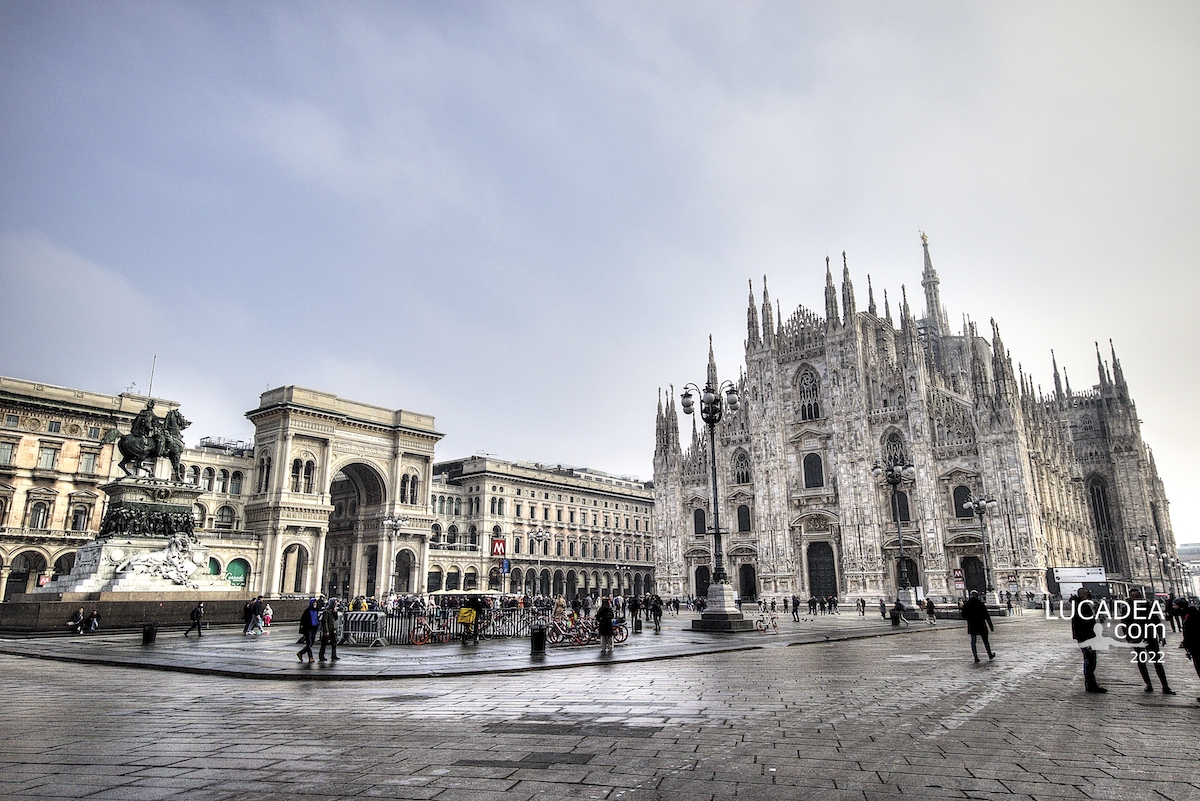
A classic view of Milan’s Duomo Square

Piazza del Duomo a Milano con la cattedrale, la statua di Vittorio Emanuele II e la Galleria Vittorio Emanuele II

A classic view of Milan’s Duomo Square.
In front of me was one of the most recognisable views of Milan, with the Duomo, the statue of Victor Emmanuel II and the monumental entrance to Galleria Vittorio Emanuele II gathered within the same urban space. If you are wondering what to see in Milan, it is difficult to imagine a more familiar starting point, yet I still find something interesting in photographing a place whose details have been seen countless times.
I took this photograph during a visit to Milan and decided to keep the composition deliberately traditional. I was not trying to find an unusual angle or a hidden corner. Instead, I wanted to capture the square as I encountered it, with the cathedral dominating the scene and the Galleria opening on one side.
What makes this view work for me is the relationship between its individual elements. The Duomo naturally attracts most of the attention, but the statue in the centre of the square and the entrance to the Galleria are equally important in creating the overall composition. Together they make the location immediately recognisable, even without any additional explanation.
For anyone visiting Milan, Duomo Square is one of the places worth seeing simply because so much of the city’s identity comes together here. The cathedral, the Galleria and the surrounding buildings belong to different periods and have very different architectural characters, yet they form a remarkably coherent urban setting.
The Duomo itself has a particularly long history. Construction began at the end of the fourteenth century and continued, with changes and additions, for centuries. The result is the extraordinary accumulation of pinnacles, statues and architectural details that makes the cathedral difficult to take in as a whole. Even from a familiar viewpoint, there always seems to be another detail to notice.
For me, however, the photograph remains primarily a memory of being there. When I photograph a famous place, I do not always feel the need to search for something completely different. Sometimes I prefer to record the view that immediately defines the location and then let the surrounding details add their own story.
The Galleria Vittorio Emanuele II is particularly important in this composition. Its monumental entrance creates a strong architectural counterpoint to the cathedral. Beyond it lies the famous covered gallery leading towards Piazza della Scala, making this square part of a natural pedestrian connection between two of Milan’s best-known places.
Milan, Lombardy, Italy, is often associated with fashion, design and modern architecture, but this view shows another side of the city. Standing here, the historical identity of Milan becomes impossible to overlook. The square brings together religious architecture, civic symbolism and nineteenth-century urban design in one place.
The statue in the centre is dedicated to Victor Emmanuel II, the first king of unified Italy, and was unveiled in 1896. It can be easy to overlook when the eye is drawn immediately towards the enormous cathedral, but it plays an important role in the balance of the square and gives the foreground a strong central reference point.
There is also something particularly Milanese about the combination of the cathedral and the Galleria. They are very different architectural experiences. The Duomo rises vertically and is covered with countless decorative details, while the Galleria invites you to look inward through its monumental entrance. From the square, however, the two become part of the same visual story.
The famous Milanese expression came to mind while looking at this scene: “Ma Milan l’è on gran Milan!”, the line from a song by Giovanni D’Anzi. Even without translating it, the phrase captures something of the pride and affection associated with the city.
I like photographs of places like this because they become visual reference points. Later, when looking back at the image, I do not only remember the architecture. I remember being in the middle of the city and seeing all these familiar elements together, from the statue in the square to the entrance of the Galleria and the enormous façade of the cathedral.
This also fits naturally with the way I use Lucadea.com to document places I have actually visited. Some photographs show small details that might otherwise go unnoticed, while others record famous views exactly because they are part of the experience of being there. This one belongs firmly to the second category.
A classic view does not necessarily mean a predictable photograph. The challenge is simply to observe the scene and decide which elements deserve to remain in the frame. Here, I wanted the cathedral, the statue and the Galleria to remain connected, because together they tell much more about this part of Milan than any one of them could do alone.
Looking at the photograph now, I still think that this is one of those views that explains immediately why Duomo Square is such an important part of Milan. It is not only the cathedral that makes the place recognisable, but the entire architectural setting surrounding it.

Have you ever photographed Milan’s Duomo Square from this classic viewpoint? Add a comment or go to the bottom of the site to read what other visitors have written.

Milan’s Duomo Square with the cathedral, Victor Emmanuel II statue and Galleria Vittorio Emanuele II

Photo taken with a Canon EOS M100 camera and Canon EF-M 11-22 lens.

There is also the official website: duomomilano.it

To see all the photos I took on the roof and inside the Duomo, click here:

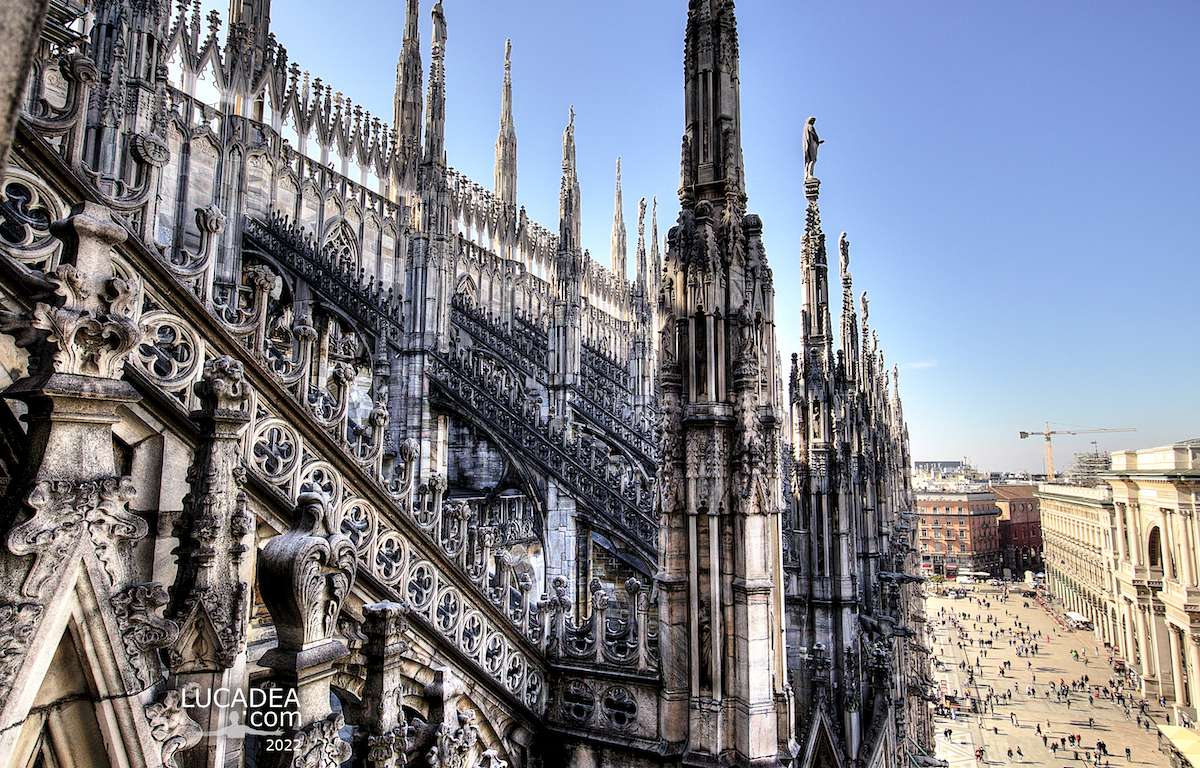
The spires of Milan Cathedral

Guglie e statue del Duomo di Milano viste da vicino, tra pinnacoli e dettagli dell’architettura gotica

The spires of Milan Cathedral.
Whenever I stop to look at Milan Cathedral, I often find my attention moving upward from the huge façade towards the spires, statues and countless details that shape the skyline of the building. In this photograph, I wanted to focus on that upper part of the cathedral, where the architecture seems to turn into an almost endless combination of shapes, points and carved decorations.
Milan Cathedral, in Lombardy, Italy, is one of those monuments that is difficult to take in all at once. Its size and the sheer number of architectural details mean that even after seeing it several times, there always seems to be another element worth noticing. The spires are among the features that define its appearance most strongly, especially when the eye moves away from the main façade and follows the highest parts of the cathedral.
That abundance of detail is what I enjoy photographing. I was not trying to show the cathedral through its most familiar overall view. Instead, I wanted to isolate part of the structure and let the spires and decorations become the main subject of the image. When photographing such a famous monument, I find it interesting to avoid repeating the obvious view and look for a smaller detail within the much larger architectural composition.
The spires are tall, pointed architectural elements that contribute strongly to the silhouette of Milan Cathedral. Together with the statues, pinnacles and ornamental details, they create the distinctive texture that makes the building recognizable even from a distance. Up close, however, the experience is completely different. There are so many sculptures and shapes that it becomes difficult to keep your eyes on just one detail.
The construction of Milan Cathedral began at the end of the fourteenth century and continued for many centuries, involving different phases of work and generations of architects, artists and craftsmen. One detail I find particularly interesting is this extraordinary continuity of construction and restoration. The cathedral we see today is the result of a very long architectural history, in which the original Gothic project was followed by later interventions and restorations that helped shape its present appearance.
The spires should therefore not be considered simply as decoration placed on top of a large church. They are an essential part of the cathedral’s identity and of the way it rises above Milan. Their vertical lines emphasize the upward movement that is so characteristic of Gothic architecture, creating a strong relationship between the stone structure and the sky above it.
If you are visiting Milan and wondering what to see, the cathedral is naturally one of the places that comes first to mind. Yet even people who have already visited it can discover something new by changing the way they look at it. Looking closely at the spires reveals details that can easily disappear when the cathedral is viewed only from the square. Statues, pinnacles, arches and carved decorations form a complex composition that rewards a slower look, especially when photography is involved.
This photograph came from exactly that kind of observation. I wanted to capture a detail of the monument that is often perceived only as part of the cathedral’s enormous silhouette. Once you look closer, however, every element seems to have its own shape and position within the larger structure.
There are already other photographs on the blog exploring Milan Cathedral, including views of its façade and earlier images focusing on its arches and spires. This photograph naturally continues that small visual exploration, with the intention of finding another detail rather than simply repeating the same familiar image.
That is one of the things I enjoy about photographing famous monuments. The more recognizable they are, the more interesting it becomes to look for something that usually escapes attention. With Milan Cathedral, the spires offer almost endless possibilities. A different viewpoint, a closer look at the sculptures or simply raising the camera towards the roof can completely change the way the same monument appears.
For anyone searching for photographs of Milan Cathedral or wondering what makes it so distinctive, the spires are perhaps one of the best places to start looking beyond the familiar postcard view. They are not just part of the skyline: they are a collection of individual details that together create one of Milan’s most recognizable architectural profiles.

Have you ever looked closely at the spires of Milan Cathedral and tried to pick out their individual details? Add a comment or go to the bottom of the site to read what other visitors have written.

Milan Cathedral spires and statues seen up close, with pinnacles and detailed Gothic architectural decorations

Milan Cathedral spires and statues seen up close, with pinnacles and detailed Gothic architectural decorations

Photos taken with a Canon EOS M100 camera and a Canon EF-M 11-22 lens.

This is the official website of the cathedral: duomomilano.it.

Click here if you would like to see all the photos I’ve taken:
foto gallery

Here is where the cathedral is located:

The Main Altar of Fiesole Cathedral

Altare maggiore e abside affrescata del Duomo di Fiesole, sulle colline vicino a Firenze

The Main Altar of Fiesole Cathedral.
Inside the Cathedral of San Romolo, in the hills above Florence, I was immediately struck by the contrast between the rather austere interior and the richer presence of the main altar and the frescoed apse. This is the detail I wanted to capture with my camera.
Fiesole is only a few kilometres from Florence, but climbing into the hills quickly creates a different feeling. In this ancient Tuscan town I found a quieter dimension than the better-known centre of Florence, and the cathedral is one of the most important landmarks of the village.
The photograph shows one of the most visually significant parts of the church: the main altar in front of the apse, with its decorations and frescoes drawing the eye towards the end of the nave. The interior of San Romolo Cathedral is quite restrained, almost austere in places, and this makes the decorative elements around the altar stand out even more.
If you are wondering what to see in Fiesole, the cathedral is certainly one of the places I would include. Not only because of its religious importance, but also because it offers a glimpse into the history of a town that can easily be overshadowed by the much more famous Florence nearby.
Looking at this image, what I like most is the way the architecture guides the eye towards the apse. The altar becomes the visual centre of the composition, while the surrounding structure seems to frame it naturally. When I took the photograph, I wanted to preserve this relationship rather than isolate a single decorative detail.
The Cathedral of San Romolo has very ancient origins and has undergone several alterations and transformations over the centuries. One small curiosity is that its present appearance contains elements from different periods, reflecting the changes the building experienced throughout its long history. Looking carefully at the architecture, it is possible to sense that several generations have contributed to the appearance of the church we see today.
Fiesole, in Tuscany, within the Metropolitan City of Florence, is often considered mainly in relation to the nearby capital of the region. Yet the town has a strong historical identity of its own and preserves evidence of a past that developed alongside, and in some respects before, the better-known history of Florence.
That is one of the things I enjoy when photographing places that are close to famous destinations but have a character of their own. A visit to Fiesole can take you away from the usual Florence itinerary for a while, without actually taking you far from the city. The landscape, architecture and atmosphere change surprisingly quickly as you climb into the hills.
The interior of the cathedral stayed with me precisely because of its simplicity. It is not a church that tries to overwhelm the visitor with decoration at every turn, and perhaps that is why the main altar and the frescoed apse have such a strong visual presence. My attention was drawn to this particular view, and I preferred to preserve that impression in a photograph rather than turn the post into a detailed description of the entire building.
As with other photographs of churches and cathedrals I have shared on the blog, this image comes from the same personal approach: looking for the detail or viewpoint that stays with me after a visit. I have previously written about other religious interiors encountered during my travels, and this photograph from Fiesole naturally continues that thread.
Looking back at the image, I still like the balance between the severe character of the architecture and the richer decoration concentrated around the altar. It is probably something that becomes even clearer when standing inside the cathedral, with the nave leading the eye naturally towards the apse.

If you know Florence already, have you ever climbed up to Fiesole to discover this quieter side of Tuscan history and art? Add a comment or go to the bottom of the site to read what other visitors have written.

Main altar and frescoed apse inside Fiesole Cathedral, in the hills near Florence

Photo taken with a Canon EOS M100 camera and Canon EF-M 11-22 lens.

To see all the photos taken in the Cathedral, click here:

Here is where the cathedral is located:

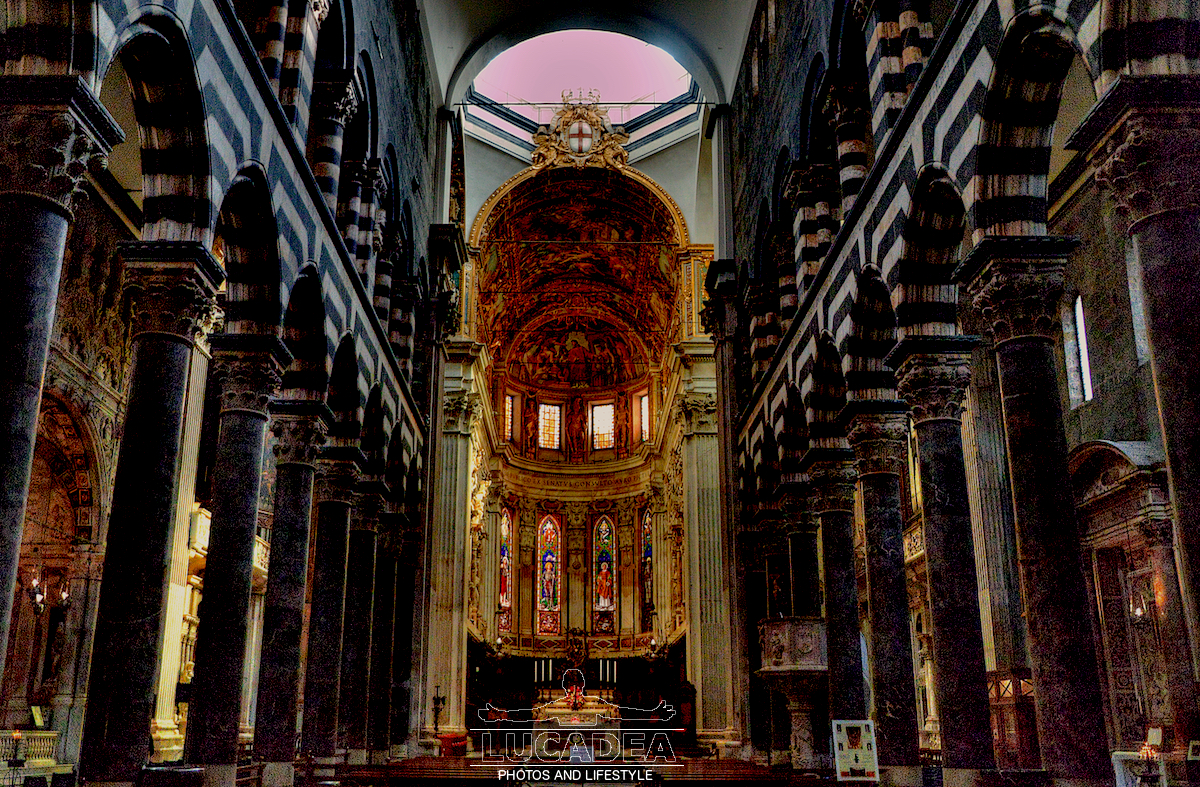
Inside San Lorenzo Cathedral in Genoa

Navata centrale della Cattedrale di San Lorenzo a Genova, con l’altare maggiore e lo scudo di San Giorgio

Inside San Lorenzo Cathedral in Genoa.
From the central nave, my attention was drawn toward the main altar, while the alternating bands of white and green marble gave the interior a character that feels strongly connected with Genoa. This photograph of San Lorenzo Cathedral captures one of the most recognizable spaces in the historic centre, where architecture, history and one of the city’s best-known symbols meet in the same frame.
The photograph shows the central nave of the cathedral, with the main altar at the end of the perspective. I wanted to photograph this particular view because it gives a sense of the scale of the building while also including some details that can easily be missed when walking through the church without stopping to look closely.
San Lorenzo Cathedral stands in the heart of Genoa, Liguria, Italy, surrounded by the dense historic fabric of the old city. It is one of those places where a short walk can take you between very different parts of Genoa’s history, from narrow streets and historic buildings to monumental churches and richly decorated interiors.
The first thing that stands out in the photograph is the use of marble. The contrast between white and green creates a strong visual rhythm along the architecture and gives the central nave much of its distinctive appearance. When I took the photograph, I wanted the perspective itself to do most of the work, allowing the lines of the nave to lead naturally toward the main altar.
High above, the shield bearing the cross of Saint George can also be seen. The red cross on a white background is one of the symbols most closely associated with Genoa and its history. I particularly like this detail because it connects the religious setting of the cathedral with the civic identity of the city and its long maritime past.
The cathedral developed over several centuries, and that history can still be read in its architecture. San Lorenzo combines Romanesque and Gothic elements with later additions and modifications, creating the layered appearance visible today. The alternating marble on the exterior and interior is among the features that make the cathedral immediately recognizable.
One small historical detail I find especially interesting is that San Lorenzo was not created as a single, perfectly unified project. Its appearance is the result of successive phases of construction and changes carried out over time. That helps explain why different architectural languages can be encountered within the same building without making the overall space feel disconnected.
If you are visiting Genoa and looking for what to see in the historic centre, San Lorenzo is naturally one of the places worth entering rather than simply admiring from outside. For me, however, this photograph was not intended as a tourist guide. I was more interested in capturing the experience of standing along the central axis of the nave and seeing the architecture draw the eye toward the altar.
I took this photograph myself, and I tried to keep the composition relatively open so that the proportions of the interior remained visible. A cathedral like this offers countless details that could each become the subject of a separate photograph, but in this case I preferred to step back visually and let the entire nave become the subject.
This image also fits naturally with the other photographs of Genoa and its historic buildings that I have published on the blog. I often find myself photographing churches, palaces and architectural details while walking through the old city, and each image becomes a small part of a larger personal record of Genoa. Rather than trying to document everything, I prefer to stop when a particular view gives me a reason to take out the camera.
Looking at the photograph again, what stays with me is the combination of perspective and colour. The central nave leads toward the altar, the marble creates a clear rhythm on either side, and the cross of Saint George adds a detail that immediately places the scene in Genoa.
It is only one view of the cathedral, but I think it manages to show why the interior deserves the same attention as the famous exterior.

If you have visited San Lorenzo Cathedral, which detail of its interior caught your eye most? Add a comment or go to the bottom of the site to read what other visitors have written.

Central nave inside San Lorenzo Cathedral in Genoa, with the main altar and the shield of Saint George above

Photo taken with Canon EOS RP and lens Tamron 16-300 and polarizing filter.

Here are all the photos I took during my last visit to the Cathedral:
foto gallery

If you are interested, this is the official website for updates on Catholic initiatives and liturgies: chiesadigenova.it.

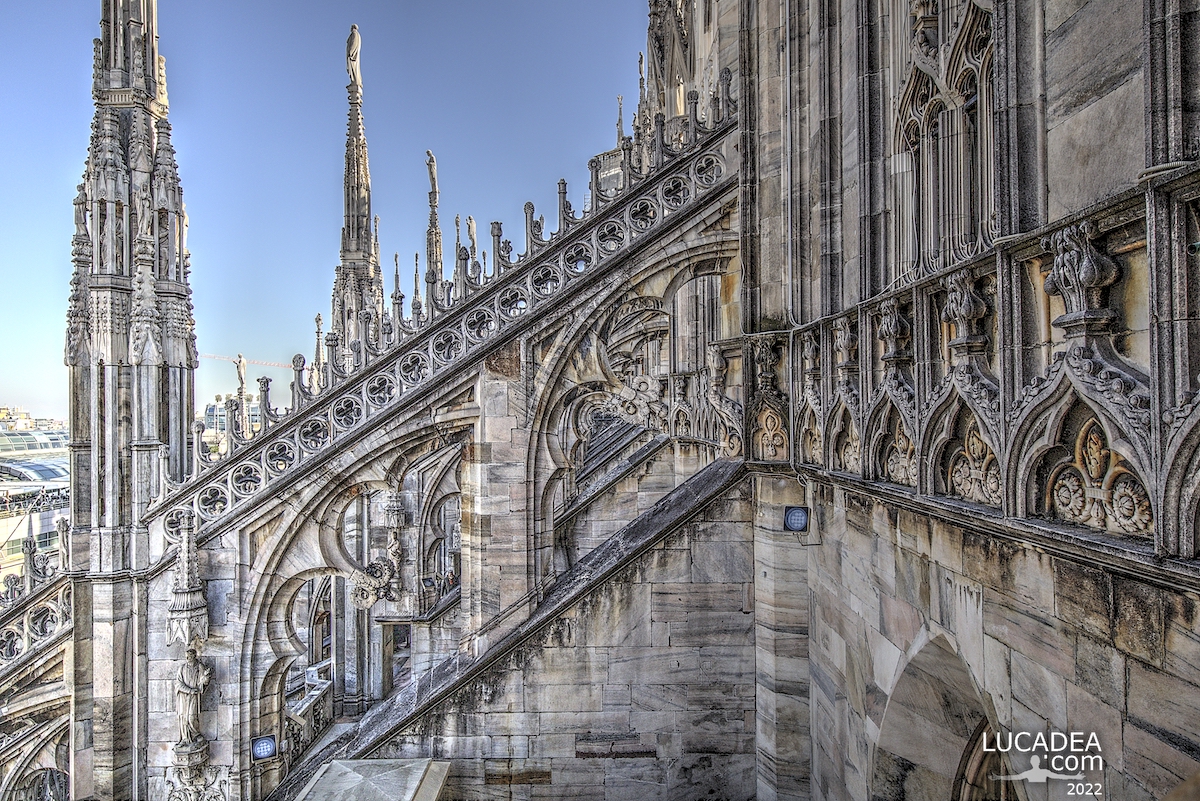
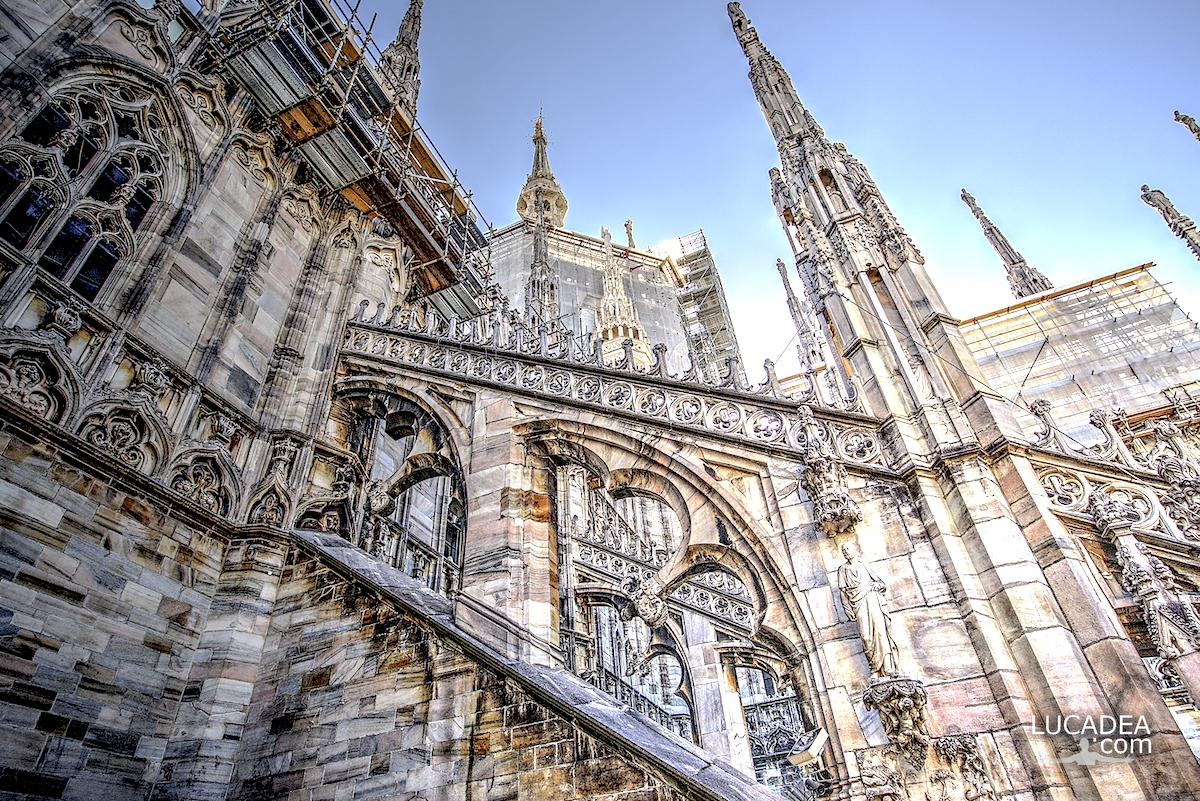
Spikes and arches on Milan Cathedral

Guglie e archi in pietra sulle terrazze del Duomo di Milano, tra le intricate decorazioni della cattedrale

Spikes and arches on Milan Cathedral.
Standing on the rooftop terraces of Milan Cathedral, I found myself surrounded by an extraordinary amount of carved stone, with arches, spires and decorations appearing in almost every direction. It is a completely different perspective from the one you get from the square below, because here you are almost inside the architecture itself.
The main subject of this photograph is the collection of spires and arches on Milan Cathedral, but deciding what to include in the frame was not easy. Every time I moved my eyes, another detail appeared: a statue, a decorative element or a new overlapping arrangement of lines. Photographing such a dense architectural scene without losing the balance of the composition felt like a small challenge.
What struck me most was the feeling of being surrounded by a kind of stone maze. From street level, we are used to seeing the Duomo as one enormous cathedral, while from the rooftops the perception changes completely. The shapes become closer, the proportions are harder to read and the sheer number of architectural elements makes it difficult to understand where one structure ends and another begins.
I took this photograph while visiting the cathedral terraces. I was not trying to make another general picture of Milan Cathedral. Instead, I wanted to preserve the sensation of standing among all those arches and spires, with the carefully worked stone surrounding me.
If you are wondering what to see at Milan Cathedral, the terraces offer a particularly interesting perspective. They are not only a place from which to look across Milan from above, but also an opportunity to get close to architectural details that remain distant and difficult to distinguish from the street.
Milan Cathedral is one of the major examples of Gothic architecture in Italy, and its construction developed over several centuries. One of its most recognisable characteristics is the extraordinary number of spires, pinnacles and decorative elements that shape its silhouette. The famous Madonnina, standing on the highest spire, has also become one of the enduring symbols of Milan.
For this photograph, however, I wanted to stay much closer to the architecture. Rather than looking for the classic image of the cathedral, I chose to concentrate on a small section of the rooftops. Sometimes a detail can tell the story of a building more effectively than a complete view, especially when the architecture is as complex as this.
The biggest difficulty for me was finding a composition that did not become visually confusing. The terraces are filled with architectural elements, and moving only a little can completely change the image. Arches and spires overlap, creating depth while also producing an enormous number of lines that the camera has to organise.
That is one of the things that makes photographing Milan Cathedral so interesting from close range. It is not simply about photographing a famous monument. It is about constantly searching for another point of view. The same building can look completely different depending on the distance, height and portion of the architecture included in the frame.
Standing on the rooftops also makes you realise how much work lies behind the seemingly continuous surface of the cathedral. From a distance, the stone appears almost uniform. Up close, countless details emerge, each with its own shape and position.
I wanted this photograph to retain some of that sensation. I was not simply trying to show that I had visited the terraces. I wanted the image to communicate what it felt like to stand inside that extraordinary collection of forms.
This photograph also connects naturally with other images I have taken over the years of Milan and its landmarks. I enjoy returning to familiar places and looking for a different detail each time, because even a building we know well can reveal an entirely new perspective when we change the way we observe it.
Here, it was the spires and arches that caught my attention. Together they create an almost abstract scene, even though every shape belongs to one of the most recognisable monuments in Italy.
Perhaps that is the real challenge, and also the pleasure, of photographing Milan Cathedral. When there is so much architectural richness in front of the camera, the difficult part is deciding what not to include.

Which detail of Milan Cathedral’s rooftops would have caught your eye first? Add a comment or go to the bottom of the site to read what other visitors have written.

Stone spires and arches on the rooftops of Milan Cathedral, surrounded by intricate Gothic architectural details

Photo taken with a Canon EOS M100 camera and Canon EF-M 11-22 lens.

To see all the photos I took on the roof and inside the Duomo, click here:

This is the official website of the Duomo: duomomilano.it.

Here is where the Duomo is located:

🏠
  • Italiano