Oven-baked sea bream with potatoes and mussels

Orata al forno

Oven-baked sea bream with potatoes and mussels.
When I cook sea bream at home, I like to keep things simple and let the fish remain the main character of the dish. In this photograph, there are a few sea bream fillets served with potatoes and some mussels, a combination I find particularly satisfying.
Oven-baked sea bream is one of those dishes that reminds me how rewarding simple cooking can be. The flesh is delicate but full of flavour, and once cooked it works beautifully with uncomplicated side dishes. The potatoes provide a natural accompaniment, while the mussels bring an extra taste of the sea that fits perfectly with the fish.
I took this photograph at home, capturing what was actually served at the table. There was no intention of turning it into an elaborate restaurant-style presentation. It is simply one of those meals I enjoy preparing, and, at least according to the chef at home, it can easily compete with something served in a restaurant.
Food photography has a different rhythm from photographing streets, landscapes or buildings. With a plate like this, the photograph is tied to a very specific moment: the meal is ready, everything is on the table, and there is usually not much time to think about the composition before somebody starts eating.
I like that spontaneity. A photograph of food can preserve the memory of an ordinary lunch or dinner just as effectively as a photograph from a journey. Sometimes the most familiar moments are precisely the ones that are worth keeping.
Sea bream with potatoes is also a wonderfully flexible preparation. It can remain very simple, allowing the natural flavour of the fish to stand out, or it can be enhanced with a few herbs and seasonings. Baking is particularly convenient because the fish and the side dish can be prepared together without requiring complicated cooking techniques.
There is a small detail behind the name of sea bream itself. The fish is easily recognised by the distinctive golden band between its eyes, which becomes especially noticeable when the fish is whole. It has long been appreciated around the Mediterranean and is commonly prepared baked, grilled or with other straightforward methods that preserve its delicate flavour.
In this image, however, what catches my attention is simply the finished plate: the sea bream fillets, the potatoes beside them and the mussels completing the meal. It is quite different from the photographs of Ligurian villages, streets and seaside views that usually appear on my blog, but food is also part of the places and memories I want to record.
And yes, I have to admit it: at my house we cook like a restaurant. Actually, better!

How do you like to cook sea bream? Add a comment or go to the bottom of the site to read what other visitors have written.

Oven-baked sea bream fillets with potatoes and mussels, a simple homemade seafood dish

Photo taken with Canon 600D and Canon EF 40.

Add one  comment to this article or read  here what other visitors have written.
 
Adv
 
Disclamer

The rights on images, videos, choruses, text and all other material on the LUCADEA.com website are governed as per  Copyright page.


This page has been viewed 0 times today.
This month it has been viewed 0 times.
In total it has been viewed 0 times.
 

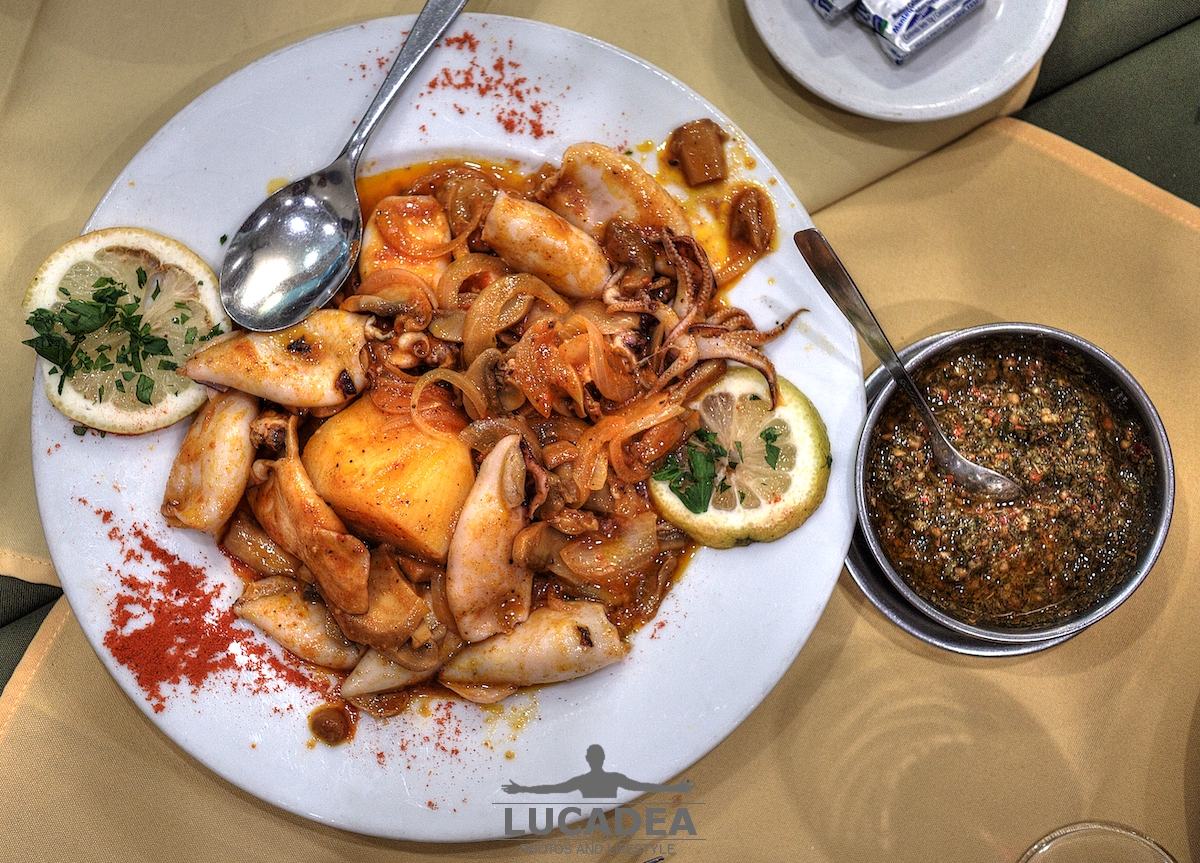
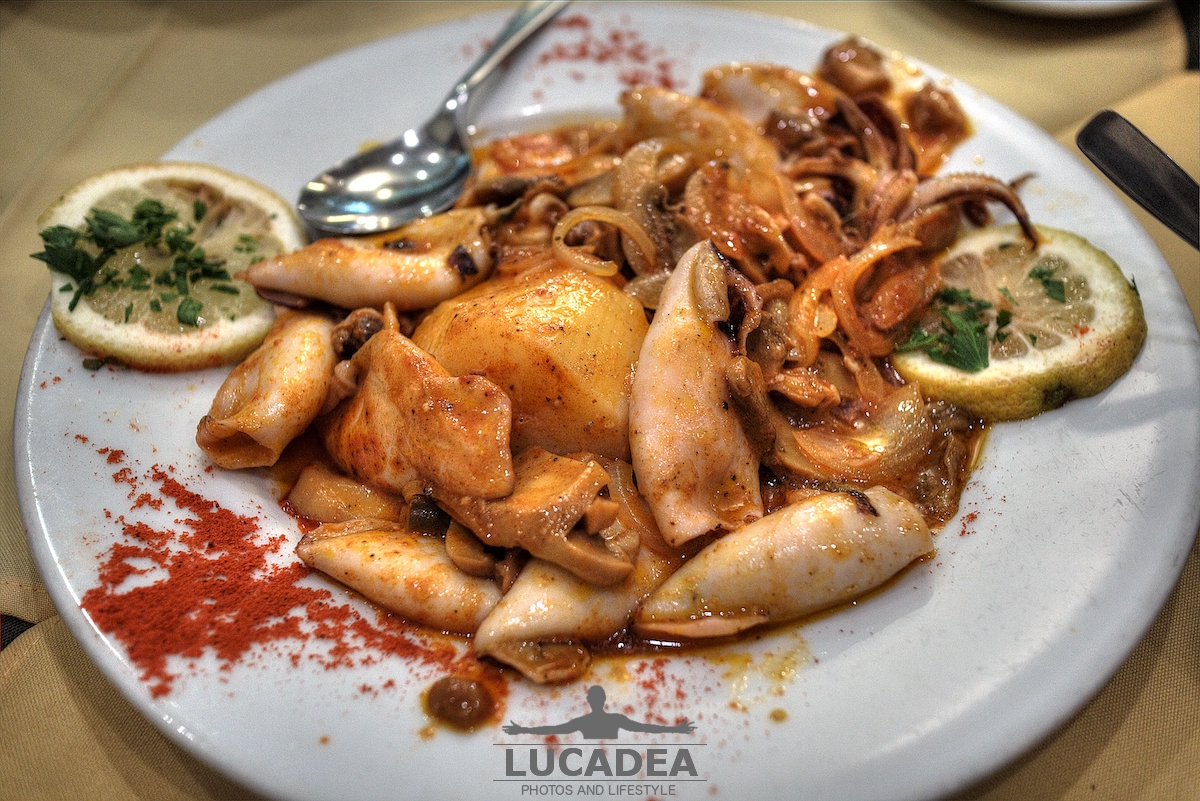
Stewed squid at Montevideo’s Mercado del Puerto

Totanetti in umido a Montevideo

Stewed squid at Montevideo’s Mercado del Puerto.
Among the dishes I photographed during a visit to the Mercado del Puerto in Montevideo, this plate of stewed squid caught my attention with its simple and hearty appearance. Montevideo, Uruguay, is a city where food is closely connected with markets and shared meals, and this dish felt like a small but memorable part of that experience.
The Mercado del Puerto is best known for grilled meat and for the atmosphere surrounding Uruguay’s traditional food culture. Yet seafood also has its place among the many dishes served there. That contrast is exactly what made these stewed squid pieces worth photographing when I came across them.
The dish contains squid cooked slowly with onion, potatoes and mushrooms, with a few spices adding flavour to the preparation. Visually, it is not an elaborate composition, but perhaps that is what makes the photograph work for me. The ingredients are easy to recognise and the whole plate immediately suggests something warm, substantial and comforting.
When I photograph food, I am mostly interested in preserving the impression I had when I saw the dish in front of me. Here I wanted to capture something slightly different from the more predictable images associated with the Mercado del Puerto. Meat is naturally one of the main attractions of the market, but this plate shows that seafood can also find its place in such a strongly meat-oriented setting.
What I like about this photograph is its connection with an actual moment from the trip. I am not trying to present a traditional recipe or explain how to cook stewed squid. It is simply a dish I encountered while travelling and thought was worth remembering through a photograph.
The Mercado del Puerto is located in Montevideo’s Ciudad Vieja and is one of the city’s best-known places for experiencing local food. Its history goes back to the nineteenth century, when the building was inaugurated for market activities. Over time, the space developed into an important gastronomic landmark, while retaining much of the character that makes it so recognisable.
If you are wondering what to eat in Montevideo, the market is interesting precisely because of the variety of dishes available there. For me, though, the strongest memory comes from the individual plates I encountered, because each one is connected with a particular moment of the journey.
This stewed squid with onion, potatoes and mushrooms is the kind of dish that could easily be overlooked beside the market’s more famous grilled meats. Yet these unexpected culinary encounters are often what make a trip feel personal when I look back at the photographs later.
I have also photographed other dishes and markets during my travels, always trying to keep the focus on the food as I actually encountered it rather than turning the photograph into a formal restaurant review. In this case, the memory is especially connected with the surprise of finding a seafood dish in a place so strongly associated with meat.

Have you ever tried stewed squid while travelling in Uruguay? Add a comment or go to the bottom of the site to read what other visitors have written.

Stewed squid with onion, potatoes and mushrooms served at the Mercado del Puerto in Montevideo, Uruguay

Stewed squid with onion, potatoes and mushrooms served at the Mercado del Puerto in Montevideo, Uruguay

Photos taken with Canon EOS M100 and lens Canon EF-M 22.

Add one  comment to this article or read  here what other visitors have written.
 
Adv
 
Disclamer

The rights on images, videos, choruses, text and all other material on the LUCADEA.com website are governed as per  Copyright page.

This page has been viewed 0 times today.
This month it has been viewed 0 times.
In total it has been viewed 0 times.
 

Lobster in Moneglia, lunch at La Ruota

Un ottimo astice gustato nel ristorante La Ruota a Moneglia

Lobster in Moneglia, lunch at La Ruota.
Among the things worth seeing and experiencing in Moneglia, there is also the simple pleasure of sitting down for a good meal, especially when a generous lobster dish arrives at the table. I remember that lunch at La Ruota quite clearly, with the village and the Ligurian coast providing the setting for a relaxed midday meal.
Some time ago I was invited to have lunch at this restaurant in Moneglia, and this was the dish that made me reach for my camera. There was plenty of lobster on the plate, enough to make the meal feel immediately special without needing an elaborate presentation. I like photographs like this because they preserve something very ordinary and very personal at the same time: a meal shared with other people, a place I happened to be visiting, and a dish that deserved to be remembered.
The view from the dining room was almost a second part of the experience. The village and the coastline provided the wider setting, while our attention was naturally drawn back to the food in front of us. I did not take this photograph as a restaurant review or as a promotional image. I simply wanted to keep a visual memory of that invitation and of a particularly generous seafood course enjoyed during lunch.
If you are visiting Moneglia and looking for things to see as well as places connected with local food, this kind of moment can become part of the memory of the town. Moneglia is in Liguria, in the Province of Genoa, Italy, and its position along the Ligurian coast gives the village a particular relationship with the sea. In this case, however, I was not trying to create a classic coastal photograph. I was simply having lunch, enjoying the occasion, and noticed that the meal itself was worth photographing.
One small curiosity about lobster is the dramatic change in appearance that takes place during cooking. Live lobster can have darker bluish or brownish tones, while cooking brings out the familiar red-orange color associated with the finished dish. It is a simple detail, but one that makes seafood interesting to photograph because its visual appearance changes so noticeably between the kitchen and the plate.
What makes this photograph meaningful to me is therefore not only the lobster. It is the combination of food, company and place. La Ruota became part of my memory of Moneglia through this lunch, while the view from the room connected the meal with the coastal landscape outside. A photograph can sometimes work precisely because it does not try to explain everything. It keeps one particular moment and lets the details bring the memory back.
This image also fits naturally with the other stories from Liguria that I have shared on the site. In some of those photographs the landscape or architecture takes center stage; here, the subject is much closer and more immediate. The wider setting is still present, but it remains in the background, leaving the lobster to tell the story of that particular lunch.
There is also something I like about photographing food during a trip or a visit to another place. These images are often less planned than photographs of monuments or landscapes, but years later they can bring back very specific memories. In this case, the lobster immediately reminds me of that lunch at La Ruota and of the view from the dining room.
Looking at the photograph again, I remember more than what was on the plate. I remember being there, sitting down for lunch and discovering that the view from the room made the whole experience feel connected to Moneglia itself. That is why I wanted to keep this image in the blog: it records a real moment rather than simply a dish.

Would you choose a generous lobster dish like this for lunch in Moneglia? Add a comment or go to the bottom of the site to read what other visitors have written.

Photo taken with Honor 20.

This is the restaurant’s website: laruotamoneglia.it.

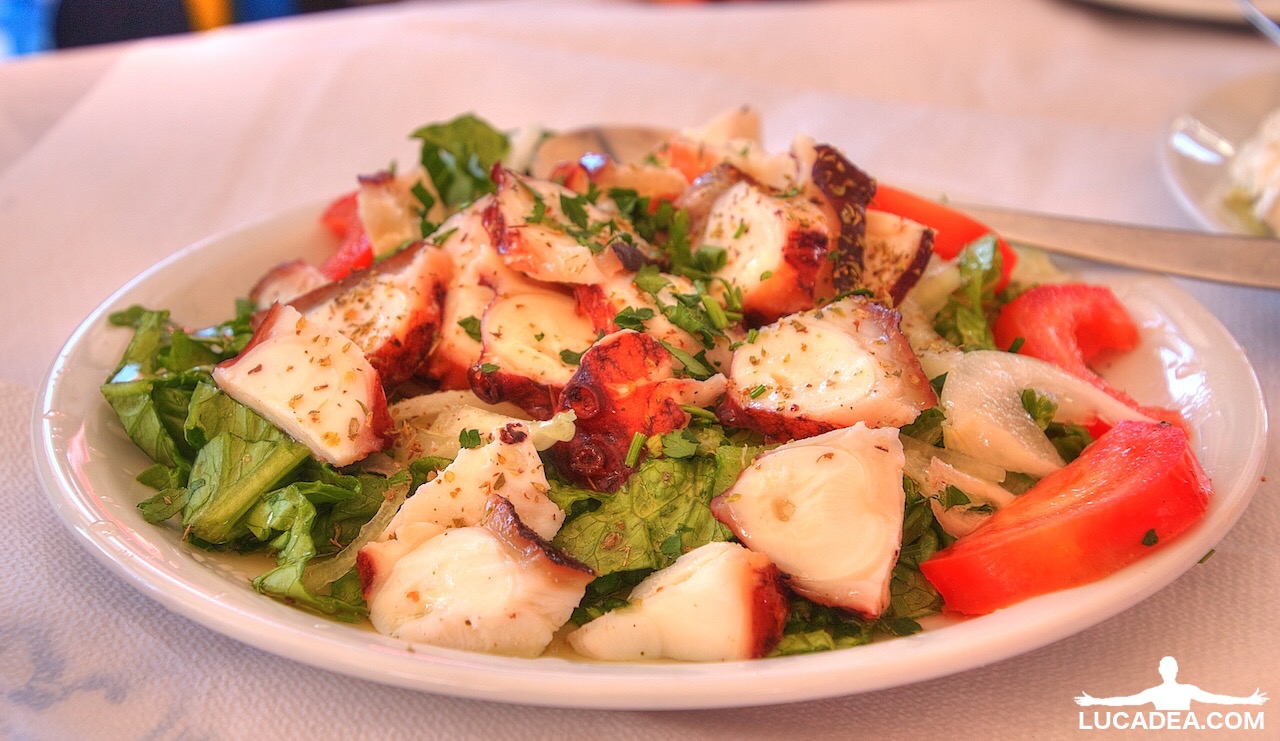
Greek octopus salad from Santorini

Insalata di polpo alla greca fotografata a Santorini, con lattuga, pomodori, cipolla e origano

Greek octopus salad from Santorini.
While I was in Santorini, Greece, I found myself looking at a simple but very appealing dish in which octopus was clearly the main ingredient. This Greek octopus salad, made with fresh vegetables, olive oil, vinegar and oregano, is the kind of food that can say quite a lot about local cooking without needing a long list of ingredients.
Many of my recent food photographs have focused on seafood, and octopus in particular has appeared several times. Whenever I come across a dish that catches my attention, I like to photograph it before eating, trying to preserve something of the moment rather than creating an image that feels too carefully arranged.
Here the ingredients were straightforward: lettuce, onion, tomatoes and stewed octopus, dressed with a little olive oil and a few drops of vinegar. A light sprinkling of oregano finished the dish and immediately gave it a flavour that, at least to me, feels closely connected with Greek cooking.
I took this photograph myself in Santorini during my trip to Greece. I did not want to turn the plate into an overly staged food photograph. I simply wanted to show what was actually in front of me. I enjoy food images more when they retain something of the real situation in which they were taken, because they become part of the memory of the journey rather than looking like catalogue photographs.
If you are wondering what to eat in Santorini, octopus is one of the ingredients you can easily encounter in the island’s local cuisine. Being surrounded by the Aegean Sea, it is natural for seafood to have an important place on local tables, and octopus can be prepared in several different ways, from grilled dishes to slower cooking methods and cold preparations such as the salad I photographed.
What I liked about this particular salad was the balance between the ingredients. The octopus brings its distinctive texture, while lettuce and tomatoes add freshness. Onion, vinegar and oregano give the dish more character, while olive oil brings everything together without making the preparation feel complicated.
It is not the kind of dish that needs a complicated explanation. The photograph immediately reveals most of the main ingredients and gives an idea of what the combination might taste like. This is one of the things I appreciate about Mediterranean cooking: a relatively small number of ingredients can be enough when they work well together.
Octopus has also long been an important ingredient in the cooking of Greek islands and coastal communities. One small culinary curiosity is that Greek tavernas commonly serve octopus grilled or cooked after being allowed to dry, a traditional practice connected with preparing and preserving the catch. It is a simple detail, but it reflects the long relationship between island communities and the sea.
In Santorini, food and landscape often seem to belong to the same Mediterranean setting. Even when sitting at a table with a relatively uncomplicated dish, the ingredients can evoke the island around you. Tomatoes, olive oil, oregano, vegetables and seafood all belong to a very recognisable culinary landscape.
That is why the simplicity of this photograph appealed to me. There was no need to add many elements or create an elaborate composition. The colours of the vegetables, the pieces of octopus and the dressing were enough to tell the story.
After photographing so many places, monuments and city details during my travels, I enjoy occasionally switching to something much more ordinary: a dish that has just been served. Food photographs preserve another part of a journey, the pauses at a table and the meals that can become just as memorable as a beautiful view.
This Greek octopus salad belongs exactly to that kind of memory. It may not be the most elaborate dish I encountered in Santorini, but it caught my attention and, naturally, it also caught the attention of my camera.
I also like the fact that the photograph does not really tell only the story of the food. It brings back the journey in which I discovered it. Santorini remains part of the memory behind the image, while the plate becomes a small reminder of time spent in Greece.
In other food stories on my photo blog, I have also written about dishes I encountered while travelling, always trying to keep the personal experience and the photograph at the centre. Here, I am returning to Greek flavours through a preparation that is simple and immediately recognisable.
Sometimes these uncomplicated dishes are the ones that stay with us. A portion of octopus, a few vegetables, olive oil, vinegar and oregano: ordinary ingredients that together bring back some of the Mediterranean atmosphere I experienced in Santorini.

Have you ever tried octopus salad while travelling in Greece? Add a comment or go to the bottom of the site to read what other visitors have written.

Greek octopus salad photographed in Santorini, with lettuce, tomatoes, onion and oregano on the plate

Photos taken with Canon 600D and Tamron 16-300.

Spaghetti with Octopus Sauce, A Great Result

Spaghetti con il sugo di polpo

Spaghetti with Octopus Sauce, A Great Result.
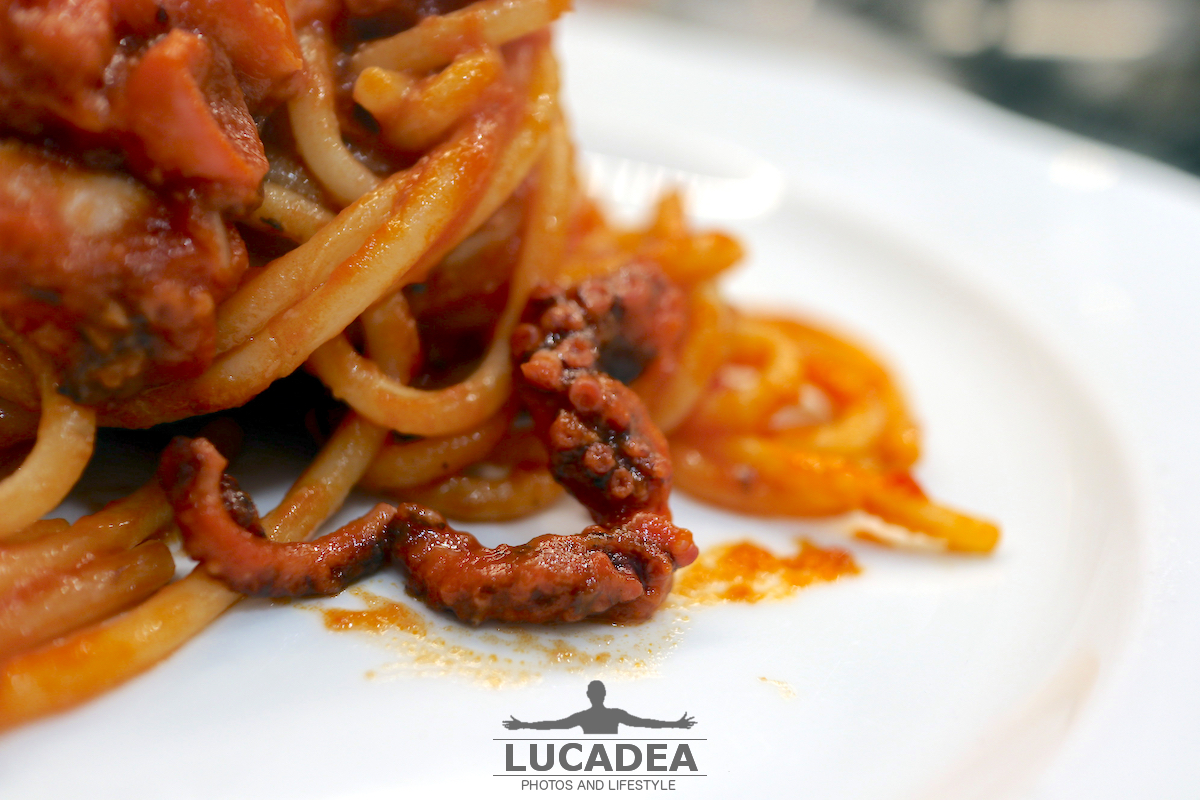
Some time ago I decided to try making this dish myself and, while I was preparing it, I realized that the final result might be worth photographing as well. The octopus sauce had a thick, rich appearance, while the spaghetti seemed perfect for holding onto all that flavour.
I took this photograph to capture the final result of that preparation. The main subject is not simply a plate of pasta, but the combination of spaghetti and a rich octopus sauce with plenty of character. Looking back at the image, what I remember most is the satisfaction of getting something that worked well both on the plate and in the photograph.
Making spaghetti with octopus sauce is not simply a matter of adding a seafood topping to pasta. Octopus has a distinctive flavour and texture, and when it becomes part of a sauce it can give the whole dish a particularly deep taste. On this occasion, I liked the result because the sauce remained thick enough to coat the spaghetti properly.
The pasta itself also played an important part. The spaghetti I used had been given to me by a colleague, and I have to say that they turned out to be excellent. I really liked their texture, and together with the sauce they helped make the dish even more satisfying.
There is also the photographic side of the preparation, which for me often goes hand in hand with cooking. When I make something that turns out particularly well, I like to capture it before sitting down to eat. In this case, the spaghetti covered in sauce already looked convincing enough, so there was no need to build an elaborate setting around the plate.
Perhaps the most interesting thing is precisely that simplicity. A plate of pasta can be very photogenic when the ingredients are easy to recognize and the sauce has enough body to create texture across the pasta. Here, the octopus sauce remains the star without the need for decorative additions.
I do not want to rewrite the actual recipe here, because there is already a related post on the blog. If you would like to try making the dish, you can find the preparation in Loris’s post about octopus sauce, which was the reference I used. It also creates a natural connection between this photograph and another piece of content on the site.
As for the spaghetti, as I mentioned, they were a gift from a colleague. They were made by Regina dei Sibillini, and after tasting them I thought they deserved to be mentioned alongside the photograph.
One thing I enjoy about keeping a photoblog is being able to preserve these small experiments too. Not every photograph needs to be about a journey, a monument or a landscape. Sometimes a homemade dish is enough, especially when the image also records the satisfaction of having prepared it yourself.
Looking at this photograph again now, I would still give the result a positive review: the sauce was thick and full of flavour, the spaghetti were excellent and, at least in my opinion, the photograph turned out rather well too.

Have you ever made spaghetti with octopus sauce? Add a comment or go to the bottom of the site to read what other visitors have written.

Spaghetti with octopus sauce served on a plate, with the thick seafood sauce coating the pasta

Spaghetti with octopus sauce served on a plate, with the thick seafood sauce coating the pasta

Photos taken with Canon EOS M100 and lens Canon EF-M 22.

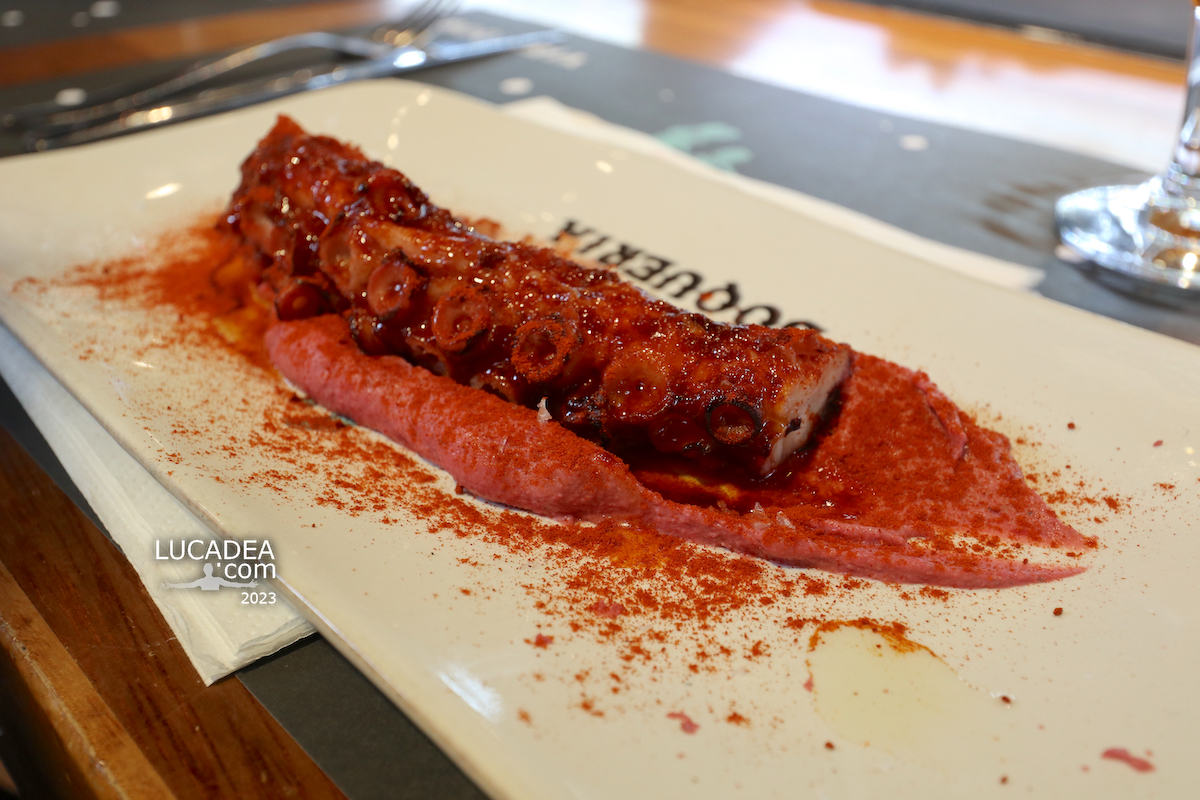
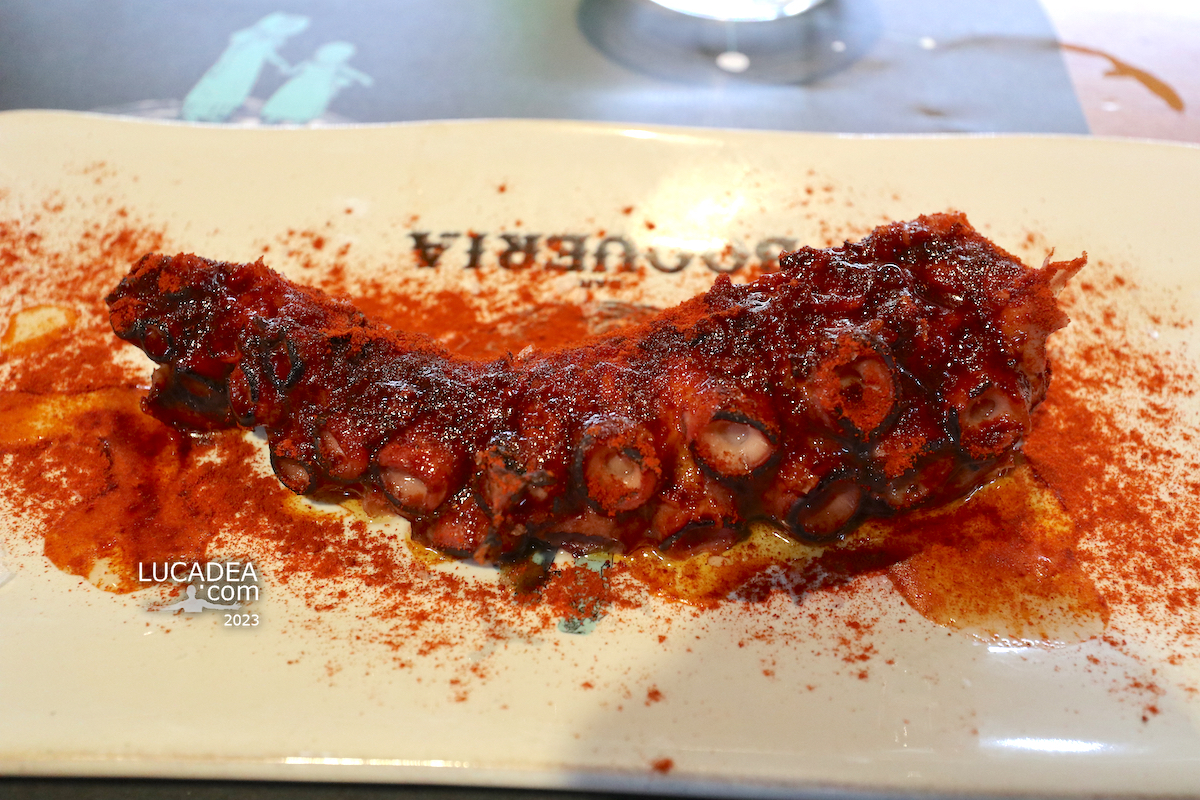
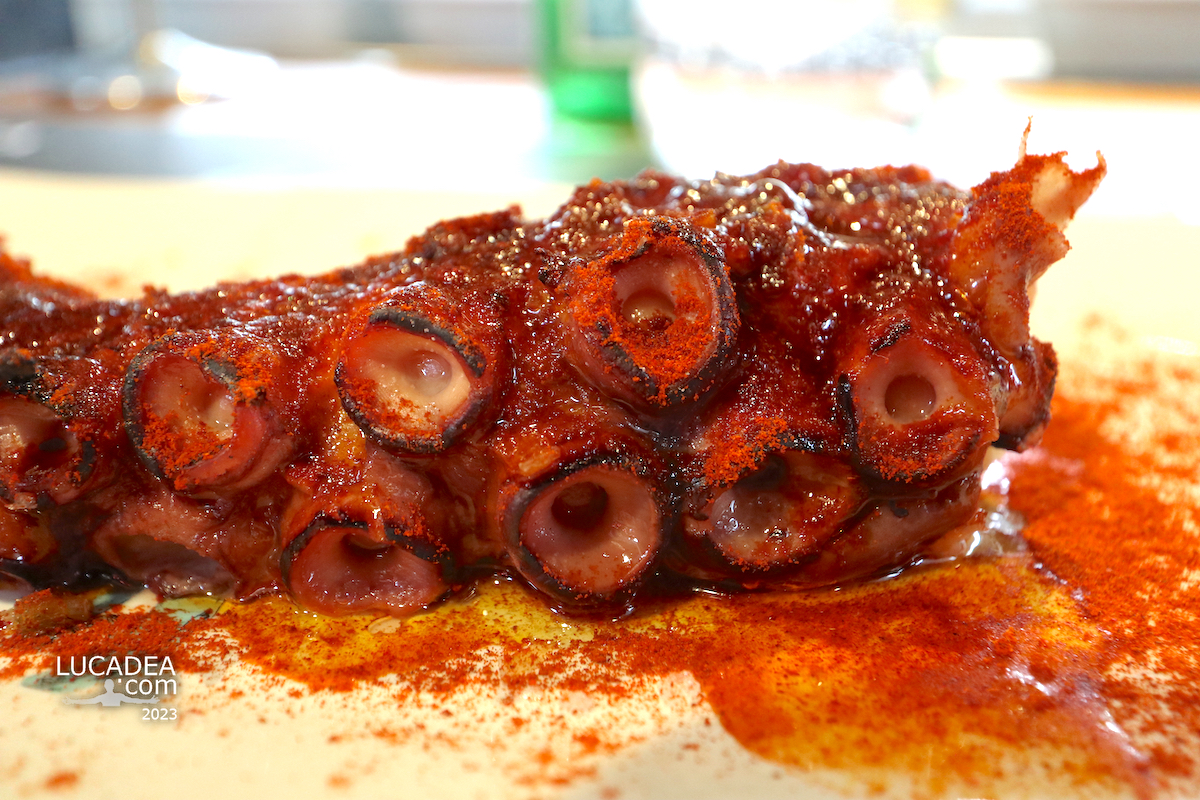
Grilled octopus at La Boqueria in Barcelona

Polpo alla griglia con hummus servito alla Boqueria di Barcellona su banco del mercato con piatto curato e colori vivaci

Grilled octopus at La Boqueria in Barcelona.
Among the busy stalls of La Boqueria market in Barcelona, one of the most popular spots if you are looking for what to eat in Barcelona, I stopped in front of a dish that immediately caught my attention: grilled octopus with hummus. It looked familiar and unfamiliar at the same time, something I knew but presented in a different way.
A few months ago, on my way back from the Caribbean by ship, I decided to take a break here, right in the market that opens onto La Rambla. Barcelona, in Catalonia, Spain, is a place I’ve visited more than once, but food is always what brings a new perspective to the experience.
Octopus has always been one of my favorite dishes, and I usually go for the traditional Galician style, with potatoes, paprika, and olive oil. This time, though, the version was grilled and paired with hummus instead. I still ordered it, and I took this photo because visually it worked really well: the texture of the octopus against the creamy base created a strong contrast that felt worth capturing.
The first bite, however, told a slightly different story. It wasn’t bad at all, but it didn’t give me that familiar feeling I was expecting. Sometimes reinterpretations change the balance more than you think, and I found myself missing the simplicity of the classic version.
A quick note: “pulpo a la gallega” comes from the Galicia region in Spain and was traditionally served during local fairs, cooked in large copper pots and enjoyed as a simple but flavorful dish.
While sitting there, I thought about another seafood dish I had photographed before, completely different in style but equally eye-catching. Food, just like places, can surprise you in unexpected ways depending on how it is presented.
If you are visiting La Boqueria and wondering what to eat, it’s worth trying new things—but maybe don’t skip the classics entirely.

Have you ever ordered something that looked perfect and then realized you preferred the traditional version? Add a comment or go to the bottom of the site to read what other visitors have written.

Grilled octopus with hummus served at La Boqueria market in Barcelona with colorful presentation on a food stall

Grilled octopus with hummus served at La Boqueria market in Barcelona with colorful presentation on a food stall

Grilled octopus with hummus served at La Boqueria market in Barcelona with colorful presentation on a food stall

Photos taken with a Canon EOS M100 camera and Canon EF-M 11-22 lens.

Here is where the famous market on La Rambla is located:

Hummus originates from the Middle East, the region where chickpea cultivation began. Similar variations are documented in Damascus as far back as the 18th century. Today, it is widely popular in Middle Eastern cuisine—particularly Levantine cuisine—where it is considered a staple food and is served alongside pita and falafel.
Read more on Wikipedia

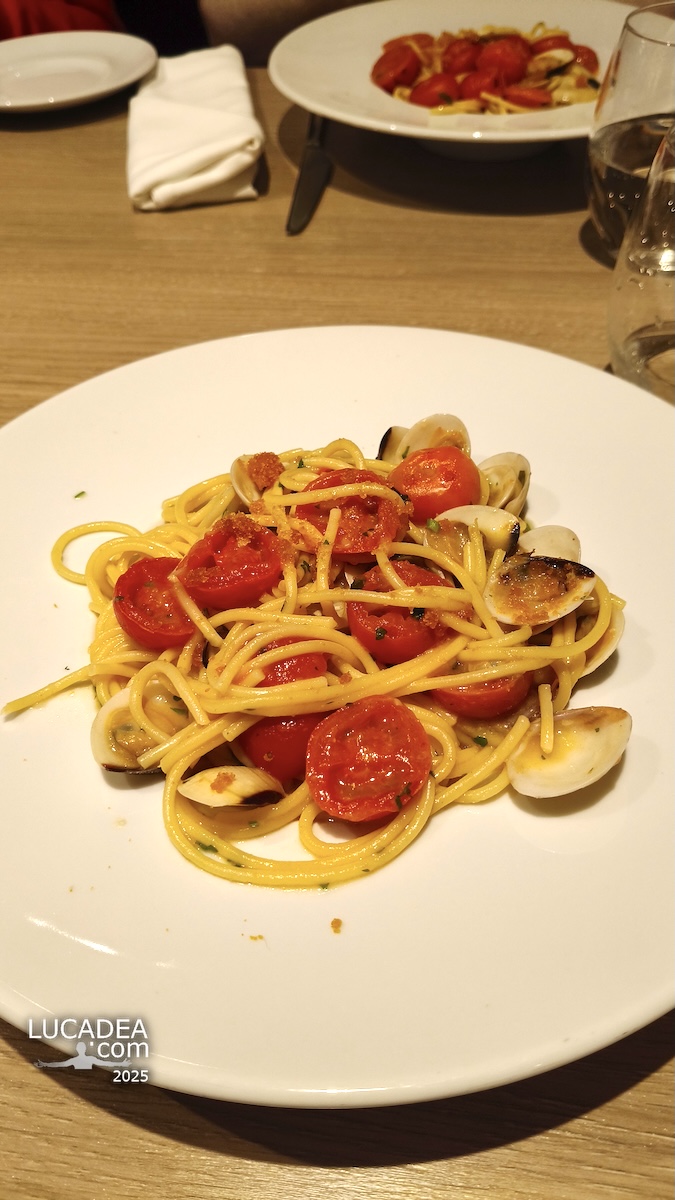
Spaghetti with clams and cherry tomatoes, the recipe

Piatto di spaghetti con vongole e pomodorini servito su tavolo in ristorante, con gusci aperti e pasta lucida ben condita

Spaghetti with clams and cherry tomatoes at the table, the recipe.
The scent of clams reaches me before I even sit down, subtle yet unmistakable, blending with the gentle sweetness of cherry tomatoes. The plate feels unpretentious, almost minimal, yet it immediately draws attention: the spaghetti coils naturally, wrapping around open shells and bright red pieces of tomato.
I find myself watching how the clams are scattered across the dish, some barely open, others fully раскрыted, as if capturing the exact second they met the heat of the pan. The tomatoes have softened just enough, releasing their juices into a light sauce that coats the pasta without overwhelming it.
The clams remain the focus, but never dominate. Each bite feels balanced, carrying that natural briny flavor that doesn’t need to be forced or enhanced. A drizzle of olive oil ties everything together, while a touch of parsley adds freshness without stealing attention.
There’s something deeply familiar about this dish, something that recalls home kitchens and simple seaside restaurants where time seems to slow down. A small curiosity: clams have been part of Mediterranean cuisine since ancient times and were already enjoyed by the Romans, often paired with early forms of pasta.
I pause for a moment, just looking at the plate before truly starting to eat, almost as if I want to preserve the image. Then the first bite confirms everything I expected: balance, simplicity, and a flavor that lingers.

Ingredients

– 200 g spaghetti;
– 500 g clams;
– 10-12 cherry tomatoes;
– 2 garlic cloves;
– Extra virgin olive oil;
– Fresh parsley;
– Salt;
– Pepper.

Preparation

Soak the clams in salted water for at least an hour. Heat the oil and garlic in a pan, then add the clams and cover until they open. Add the halved cherry tomatoes and cook for a few minutes. Meanwhile, cook the spaghetti in salted water. Drain the pasta al dente and toss it in the pan with the sauce. Add fresh parsley and a drizzle of oil before serving.

Do you ever stop to look at a dish before tasting it? Add a comment or go to the bottom of the site to read what other visitors have written.

Photos taken with Oppo Reno 12.

Spaghetti with clams and cherry tomatoes at the table – Spaghetti aux palourdes et tomates cerises à table – Espaguetis con almejas y tomates cherry en la mesa – Espaguete com amêijoas e tomate cereja à mesa – Spaghetti mit Venusmuscheln und Kirschtomaten am Tisch – Mì Ý với nghêu và cà chua bi trên bàn – 蛤蜊樱桃番茄意大利面在餐桌上 – あさりとミニトマトのスパゲッティがテーブルに

The text of this post was written with the help of ChatGPT, a language model from OpenAI.

Grilled baby cuttlefish by the sea in Riva Trigoso

Piatto di seppioline alla griglia servito a Riva Trigoso con cottura dorata e aspetto semplice su tavolo all’aperto

Grilled baby cuttlefish by the sea in Riva Trigoso.
The scent of the sea blends with the unmistakable aroma of grilled baby cuttlefish, creating a memory that feels vivid even before the first bite. Sitting at the table, the dish in front of me seems simple, almost understated, yet it carries a quiet depth that unfolds slowly.
The grilled baby cuttlefish are lightly charred on the outside, with subtle grill marks that hint at careful cooking. Nothing feels overdone or excessive. The presentation is minimal, allowing the natural qualities of the seafood to take center stage. It’s the kind of dish that doesn’t try to impress visually but ends up doing so through its authenticity.
Each bite is clean and balanced. The texture is tender, with just enough firmness to remind you of the sea it comes from. A drizzle of olive oil and perhaps a touch of lemon enhance the flavor without masking it. Eating grilled baby cuttlefish in Riva Trigoso creates a connection between the plate and the surrounding environment that feels almost seamless.
Riva Trigoso, part of Sestri Levante, has long been tied to maritime traditions and shipbuilding, and that relationship with the sea still echoes in its cuisine. Knowing this adds a subtle layer to the experience, making the dish feel rooted in something deeper than just taste.
Time seems to slow slightly as I continue eating. There’s no rush, no need to move on quickly. The experience is not just about the food but about everything around it—the air, the distant sounds, the quiet rhythm of the moment.
Looking back, the memory of those grilled baby cuttlefish is inseparable from the place itself. It’s not just a dish I remember, but a complete scene that stays with me.

Have you ever remembered a meal not only for its flavor but for everything that surrounded it? Add a comment or go to the bottom of the site to read what other visitors have written.

Photos taken with Honor 20.

Meal enjoyed at the pizzeria U Cantu in Riva Trigoso.

Grilled baby cuttlefish in Riva Trigoso – Petites seiches grillées à Riva Trigoso – Sepiolas a la parrilla en Riva Trigoso – Lulinhas grelhadas em Riva Trigoso – Gegrillte kleine Sepien in Riva Trigoso – Mực nang nhỏ nướng tại Riva Trigoso – 里瓦特里戈索的烤小墨鱼 – リーヴァ・トリゴーゾの焼きコウイカ

The text of this post was written with the help of ChatGPT, a language model from OpenAI.

Mussels and clams enjoyed at the market in Tenerife

Muscoli e cozze gustati al mercado a Tenerife

Mussels and clams enjoyed at the market in Tenerife.
Some time ago I visited (and ate at) the Nuestra Señora de África Market in Santa Cruz de Tenerife.
Among the various dishes we tried were these steamed mussels, which only needed a splash of lemon juice and nothing else.
Truly excellent!

Love seafood? Add a comment or scroll down to see what other visitors have written.

Muscoli e cozze gustati al mercado a Tenerife

Photo taken with Honor 20.

To see all the photos I took in Tenerife, click here:
foto gallery

Here’s where the market is located:

Steamed mussels enjoyed at the market in Tenerife – Moules cuites à la vapeur dégustées au marché de Tenerife – Mejillones al vapor disfrutados en el mercado de Tenerife – Mexilhões cozidos a vapor apreciados no mercado de Tenerife – Gedämpfte Muscheln auf dem Markt auf Teneriffa – Vẹm hấp được thưởng thức ở chợ ở Tenerife

Black taglierini with squid, cherry tomatoes and olives

Taglierini neri con calamaretti, pomodorini e olive serviti in un ristorante di Genova dopo una partita allo stadio

Black taglierini with squid, cherry tomatoes and olives.
After a football match in Genoa, my wife, some friends and I stopped in the city to grab something to eat, still carrying the energy of the game with us. While looking for where to eat in Genoa after the stadium, we once again chose Ristorante Pizzeria Piedigrotta, a place we know well and often return to after matches.
The restaurant is simple but reliable, mainly known for its generous pizzas, but it also offers some interesting dishes beyond pizza. That evening I noticed a special dish on the menu: black taglierini pasta with squid, cherry tomatoes and olives.
The visual contrast immediately stood out, with the dark pasta highlighting the bright colors of the ingredients. The taste confirmed the impression: a balanced combination of sea flavors and Mediterranean freshness, with tender squid, sweet tomatoes and the salty touch of olives.
We are in Genoa, Liguria, Italy, a city where the sea is deeply connected to its cuisine, especially in seafood dishes served around the stadium and city center. This plate is a simple but very representative example of that tradition.
In other posts on the blog I often describe Genoa through its architecture and street scenes, but here the memory is tied to a shared moment after a match, where food becomes part of the experience.
An interesting detail is that squid ink pasta is part of traditional Mediterranean cuisine, born from the idea of using every part of the catch and turning it into something refined over time.
In the end, it was not just a meal, but a moment linked to the atmosphere of the evening.

Do you remember a dish that stayed with you more for the moment than for the food itself? Add a comment or go to the bottom of the site to read what other visitors have written.

Taglierini neri con calamaretti, pomodorini e olive serviti in un ristorante di Genova dopo una partita allo stadio

Photo taken with Honor 20.

Dish enjoyed at Piedigrotta pizzeria restaurant (here’s the review on TripAdvisor

Black taglierini with squid, cherry tomatoes and olives – Taglierini noirs aux calamars, tomates et olives – Tagliarines negros con calamares, tomate y aceitunas – Taglierini negros com lulas, tomate e azeitonas – Schwarze Taglierini mit Tintenfisch, Tomaten und Oliven – Mì taglierini đen với mực, cà chua và ô liu – 黑墨鱼面配鱿鱼番茄橄榄 – イカとトマトとオリーブの黒タリオリーニ

The text of this post was written with the help of ChatGPT, a language model from OpenAI.

🏠
  • Italiano