The facade of Assisi Cathedral in stone and light

Facciata del Duomo di Assisi con rosone centrale e pietra chiara illuminata dalla luce naturale nel centro storico umbro

The facade of Assisi Cathedral in stone and light.
I found myself standing in front of the facade of Assisi Cathedral almost unexpectedly, turning a corner and suddenly facing its wide, pale surface. The stone facade of Assisi Cathedral immediately caught my attention, reflecting the sky in a way that made the whole structure feel alive. Looking at this cathedral in Assisi, there was a quiet balance in its design that didn’t need anything extra to stand out.
I was in Assisi, Umbria, Italy, and everything around me felt consistent with that sense of calm solidity. The facade of Assisi Cathedral is not overwhelming in a dramatic way, but if you are visiting Assisi and wondering what to see, this is definitely a place worth seeing. It draws you in slowly, through its proportions, its symmetry, and the way light interacts with the stone.
I spent time observing the details, especially the large rose window at the center and the smaller circular decorations that echo its shape. The bell tower next to the facade adds a vertical contrast that completes the scene, making it particularly interesting from a photographic point of view. It reminded me of another shot I once shared on the blog, also focused on an Italian church facade, where light played a fundamental role in revealing textures and depth.
There is also an interesting historical note: the cathedral, dedicated to Saint Rufinus, dates back to the 12th century and is one of the most important examples of Umbrian Romanesque architecture. Knowing this adds a different layer to the experience, making every detail feel more meaningful.
I stayed there a little longer before even raising the camera, trying to take in the scene fully. Sometimes the most important part is not the photo, but the moment before it.

Have you ever stood in front of a place and felt its presence without needing to understand it completely? Add a comment or go to the bottom of the site to read what other visitors have written.

Facciata del Duomo di Assisi con rosone centrale e pietra chiara illuminata dalla luce naturale nel centro storico umbro

Photo taken with Canon EOS RP and Canon RF 24-50 lens.

To see all the photos of Assisi, click here:

Here’s where the cathedral is located:

Add one  comment to this article or read  here what other visitors have written.
 
Adv
 
Disclamer

The rights on images, videos, choruses, text and all other material on the LUCADEA.com website are governed as per  Copyright page.


This page has been viewed 1 times today.
This month it has been viewed 1 times.
In total it has been viewed 1 times.
 

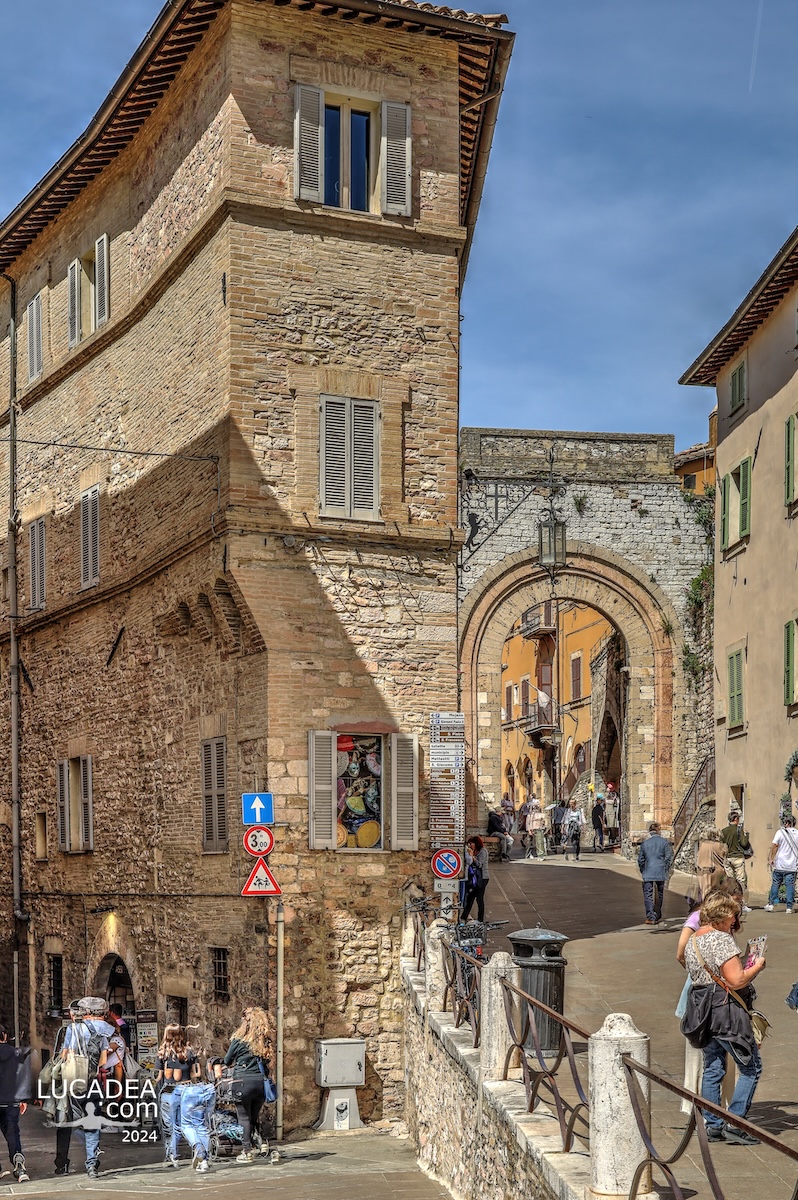
The arch of Portella di San Giorgio in Assisi

Incrocio tra Via di Santa Chiara e Via di Sant’Agnese ad Assisi con la Portella di San Giorgio sullo sfondo in pietra antica

The arch of Portella di San Giorgio in Assisi.
I reach the intersection between Santa Chiara Street and Sant’Agnese Street almost without noticing, guided more by instinct than by any planned route. The arch of Portella di San Giorgio appears in the background with a quiet presence, framing the passage and naturally leading the eye toward a part of the town that seems to move at a slower pace.
At this point in Assisi, everything feels balanced and contained. The streets meet without effort, and there is no need for dramatic elements to capture attention. Instead, the focus settles on this ancient gateway that leads toward the area of Basilica of Santa Chiara. The arch does not dominate the scene; it simply exists within it, blending into the rhythm of the place.
As I move closer, I start noticing the textures. The stone surfaces carry the marks of time, with small imperfections that give depth and authenticity. Nothing feels staged or overly restored. Photographing here becomes less about composition and more about awareness, about recognizing the quiet details that make the scene meaningful.
An interesting detail is that Portella di San Giorgio is often mistaken for Porta Nuova, which lies further east, yet the two are quite different in scale and presence. This one feels more intimate, less imposing, and perhaps more connected to the everyday life of the town.
I pause for a moment, waiting for the space to settle, watching how people move through it or how it briefly empties. In places like this, photography feels like something that happens naturally rather than something to chase.

Have you ever found yourself in a place so quiet it made you slow down without even realizing it? Add a comment or go to the bottom of the site to read what other visitors have written.

Incrocio tra Via di Santa Chiara e Via di Sant’Agnese ad Assisi con la Portella di San Giorgio sullo sfondo in pietra antica

Photo taken with Canon EOS RP and Canon RF 24-50 lens.

To see all the photos of Assisi, click here:

Where is the village located:

The arch of the Portella di San Giorgio in Assisi – L’arc de la Portella di San Giorgio à Assise – El arco de la Portella di San Giorgio en Asís – O arco da Portella di San Giorgio em Assis – Der Bogen der Portella di San Giorgio in Assisi – Vòm Portella di San Giorgio ở Assisi – 阿西西圣乔治小门拱门 – アッシジのサン・ジョルジョ門のアーチ

The text of this post was written with the help of ChatGPT, a language model from OpenAI.

Add one  comment to this article or read  here what other visitors have written.
 
Adv
 
Disclamer

The rights on images, videos, choruses, text and all other material on the LUCADEA.com website are governed as per  Copyright page.


This page has been viewed 1 times today.
This month it has been viewed 1 times.
In total it has been viewed 1 times.
 

A quiet alley in the village of Bevagna

Vicolo in pietra nel borgo di Bevagna con case ocra, insegne storiche e strada lastricata che si perde tra gli edifici

A quiet alley in the village of Bevagna.
Walking along this alley in Bevagna, I immediately feel a subtle shift, as if time has quietly slowed down without making it obvious. The stone pavement beneath my feet carries a soft irregularity, shaped by countless footsteps over the years, giving the entire alley a sense of continuity rather than age.
The buildings on either side rise close and protective, their warm ochre tones reflecting a muted light that doesn’t overpower the scene. Wooden shutters, some closed and some slightly open, create a pattern that feels both random and intentional. Small details begin to emerge the longer I look: an old sign, a lamp hanging above, a doorway that seems to invite curiosity without insisting on it. This alley in Bevagna doesn’t try to impress—it simply exists.
There is a quiet presence here that doesn’t depend on people being visible. Even in the absence of movement, the space feels inhabited. A flag hanging from a wall, a restaurant sign near a doorway, subtle traces of everyday life that suggest routine and familiarity. The alley becomes less of a path and more of a lived-in space.
Bevagna is known for preserving much of its medieval structure, and its layout still reflects its Roman origins. Knowing that this very alley follows ancient routes adds another layer to the experience, turning a simple walk into something that connects different moments in time.
I keep moving slowly, letting the alley guide my pace rather than the other way around. There’s no rush to reach an endpoint. The beauty lies in the continuity, in how every element blends into the next without interruption.

Have you ever found yourself in a place where silence seems to carry more meaning than sound? Add a comment or go to the bottom of the site to read what other visitors have written.

Vicolo in pietra nel borgo di Bevagna con case ocra, insegne storiche e strada lastricata che si perde tra gli edifici

Photo taken with Canon EOS RP and Canon RF 24-50 lens.

To see all the photos I took in the village, click here:

A quiet alley in the village of Bevagna – Une ruelle silencieuse dans le village de Bevagna – Un callejón silencioso en el pueblo de Bevagna – Um beco silencioso na vila de Bevagna – Eine stille Gasse im Dorf Bevagna – Một con hẻm yên tĩnh ở làng Bevagna – 贝瓦尼亚村庄的一条安静小巷 – ベヴァーニャの村の静かな路地

The text of this post was written with the help of ChatGPT, a language model from OpenAI.

Two works by Perugino at the National Gallery of Umbria

Due opere del Perugino alla Galleria Nazionale dell'Umbria a Perugia

Two works by Perugino at the National Gallery of Umbria.
During a holiday in Umbria, in Perugia, I visited the National Gallery of Umbria together with my wife, looking for a deeper sense of what to see in Perugia beyond its historic streets. Inside the quiet museum rooms, we found ourselves standing in front of two works by Perugino that immediately drew our attention.
The paintings were The Adoration of the Magi and the Terzi Altarpiece, two works that clearly show the calm balance and refined composition typical of Renaissance painting. Standing in front of them, you can feel the harmony of forms and the gentle structure that defines Pietro Perugino’s artistic language.
Perugia, Umbria, Italy, felt almost suspended in time within those museum walls. The National Gallery of Umbria is not just a collection of artworks, but a space where paintings seem to speak quietly to each other and to the visitor, without needing explanation. Simply spending a few minutes in front of these works was enough to understand their rhythm.
One interesting detail about Perugino is that he was the teacher of Raphael, and one of the most influential painters of the Italian Renaissance. His style helped shape a visual idea of balance and serenity that can still be seen in many Umbrian artworks from the same period.
I still remember the silence of the room and the way light fell softly across the painted surfaces, revealing details gradually. It wasn’t a rushed visit, but a slow moment of observation that stayed with me long after leaving the museum.
It made me think about how Renaissance art can still communicate so directly today, even without technical knowledge—if you simply take the time to look.

When you visit a museum, do you tend to stay in front of one artwork longer, or move quickly from one to the next? Add a comment or go to the bottom of the site to read what other visitors have written.

Photos taken with Canon EOS RP camera and Canon RF 24-50 lens. Permission was requested from security staff to take and publish the photos on the website.

The Museum’s official website is: gallerianazionaledellumbria.it.

To see all the photos I took in the museum, click here:

Pietro di Cristoforo Vannucci, known as Pietro Perugino, il Perugino, or the Divine Painter (Città della Pieve, c. 1448 – Fontignano, February 1523), was an Italian painter. Simultaneously running two very active workshops, in Florence and Perugia, he was for a couple of decades the most famous and influential Italian painter of his time, so much so that Agostino Chigi called him “the best master in Italy.” He fused the light and monumentality of Piero della Francesca with the naturalism and linear style of Andrea del Verrocchio, filtering them through the gentle manner of Umbrian painting. He was Raphael’s teacher.
Continue and learn more at Wikipedia

Two works by Perugino at the National Gallery of Umbria – Deux œuvres du Pérugin à la Galerie nationale de l’Ombrie – Dos obras de Perugino en la Galería Nacional de Umbría – Duas obras de Perugino na Galeria Nacional da Úmbria – Zwei Werke von Perugino in der Nationalgalerie Umbriens – Hai tác phẩm của Perugino tại Phòng trưng bày Quốc gia Umbria – 乌姆布里亚国家美术馆的佩鲁吉诺作品 – ウンブリア国立美術館のペルジーノ作品

The text of this post was written with the help of ChatGPT, a language model from OpenAI.

The magnificent Basilica of Saint Francis of Assisi

La splendida Basilica di San Francesco d'Assisi

The magnificent Basilica of Saint Francis of Assisi.
The Basilica of Saint Francis of Assisi is one of the most revered places in Christianity and an architectural and artistic masterpiece. Located in the picturesque town of Assisi in Umbria, the basilica is dedicated to Saint Francis, the founder of the Franciscan Order, known for his life of poverty, humility, and love for all creatures. The basilica is made up of two overlapping churches, the Lower Basilica and the Upper Basilica, both rich in priceless artworks and deep spirituality.
Construction of the Basilica of Saint Francis began in 1228, shortly after the canonization of Saint Francis, by order of Pope Gregory IX. It was completed in a relatively short time: the Lower Basilica was consecrated in 1230, while the Upper Basilica was finished and consecrated in 1253.
The entrance to the Lower Basilica is through a portal decorated with intricate Gothic motifs. The interior is marked by a solemn and spiritual atmosphere, with a series of richly frescoed side chapels. The frescoes of the Lower Basilica are attributed to great artists such as Cimabue, Pietro Lorenzetti, and Simone Martini, and depict scenes from the life of Christ, the Virgin Mary, and Saint Francis.
One of the most important points of the Lower Basilica is the crypt, which houses the tomb of Saint Francis. The tomb is a pilgrimage destination for millions of faithful from around the world, who come to pay homage to the saint and pray at his resting place.
The Upper Basilica, built in Gothic style, is known for its brightness and its large stained-glass windows that flood the interior with light. The single nave is decorated with one of the most famous fresco cycles in art history, attributed to Giotto and his workshop. These frescoes narrate the life of Saint Francis in 28 scenes, from his encounter with the leper to the sermon to the birds, up to his death.
Giotto’s frescoes are considered a milestone in Western art, marking the transition from Byzantine mannerism to a more naturalistic and human representation. Each scene is characterized by extraordinary vividness and emotional depth, making the saint’s story accessible and moving for all visitors.
Adjacent to the basilica is the Sacred Convent, a monastic complex that houses a community of Franciscan friars. The convent cloister is a place of great serenity, with its well-kept garden and colonnade offering a space for reflection and prayer. The convent also hosts a library and an archive preserving manuscripts and documents of invaluable historical and spiritual importance.
The Basilica of Saint Francis of Assisi is much more than a simple historical monument; it is a place of profound spirituality and devotion. It was declared a UNESCO World Heritage Site in 2000, recognizing its universal value as a symbol of faith and art.
Every year, the basilica welcomes millions of pilgrims and tourists who come to pay homage to Saint Francis, pray at his tomb, and immerse themselves in the beauty of the artworks that adorn its walls. It is also a place of liturgical celebrations and cultural events that help keep alive the memory and legacy of the saint of Assisi.

Do you know Assisi? Add a comment or go to the bottom of the site to read what other visitors have written.

La splendida Basilica di San Francesco d'Assisi

La splendida Basilica di San Francesco d'Assisi

Photos taken with Canon EOS RP and Canon RF 24-50 lens.

To see all the photos of Assisi, click here:

Here is where the basilica is located:

Commissioned by Pope Gregory IX as a special church, it was awarded the title of Caput et Mater of the Order of Friars Minor by the same Pontiff and simultaneously entrusted in perpetuity to the same friars. It is part of the non-extraterritorial properties of the Holy See and therefore does not enjoy diplomatic immunity. Throughout the complex history that marked the evolution of the Order, the basilica (and the adjoining Sacred Convent) was always cared for by the so-called “community friars,” the group that later formed the Order of Friars Minor Conventual.
Continue and learn more at Wikipedia

The splendid Basilic of St. Francis of Assisi – La splendide basilique de San Francesco d’Assisi – La espléndida basílica de San Francisco de Asís – A esplêndida basílica de San Francesco d’Assisi – Die prächtige Basilika San Francesco d’Assisi – Vương cung thánh đường lộng lẫy San Francesco d’Assisi

The text of this post was written with the help of ChatGPT, a language model from OpenAI.

A red Fiat 500 in Spello’s stone alleys

Fiat 500 rossa parcheggiata in un vicolo di Spello in Umbria tra case in pietra del borgo storico

A red Fiat 500 in Spello’s stone alleys.
Among the things to see in Spello, Umbria, Italy, there are not only historic monuments and famous viewpoints, but also the small everyday details that give a village its unique character. Walking through the stone alleys of Spello, I found this red Fiat 500 parked between old houses, a simple element that transformed an ordinary street scene into a photograph with a strong Italian identity.
During my last holiday in Umbria, I visited several of the most beautiful villages in the region, and Spello was certainly one of the places that impressed me the most. I wanted to capture this moment with my camera because the combination of the car, the narrow street and the ancient stone buildings perfectly represented the atmosphere I was experiencing while walking through the village.
The Fiat 500 is more than just a small car. Over time, it has become one of the most recognizable symbols of Italian culture and everyday life. Seeing one parked in a historic alley of Spello creates an interesting contrast between the old stones of the village and an object that belongs to more recent memories. This meeting between history and daily life is often what makes a photograph more personal and memorable.
Spello, located in the province of Perugia, Umbria, Italy, still preserves the charm of a historic center shaped by narrow streets, arches and stone houses. The ancient Roman town of Hispellum left important traces through its walls and monumental gates, while the medieval village remains a place best explored slowly on foot.
A small historical detail about the Fiat 500 is that the modern version was introduced in 1957 and became one of the vehicles that represented Italy’s economic growth after the Second World War. It quickly became a familiar presence in towns and villages throughout the country.
This photograph connects naturally with my other stories about Spello, from the alleys with support arches to Consolare Gate, Urbica Gate and the Baglioni Chapel. Through these images, I have tried to tell not only the famous attractions of the village but also those small details that reveal its everyday personality.
If you are visiting Spello and wondering what to see, remember to look beyond the main landmarks. An old doorway, an architectural detail or even a colorful car can become the most memorable image of your walk.

Have you ever photographed an everyday object that, placed in a historic setting, became the true subject of your picture? Add a comment or go to the bottom of the site to read what other visitors have written.

Red Fiat 500 parked in a stone alley of Spello, Umbria among historic village houses

Photo taken with Canon EOS RP and Canon RF 24-50 lens.

To see all the photos I took in the village, click here:

Here’s where the village is located:

Spello (Hispellum in Latin) is an Italian municipality in the province of Perugia in Umbria. It is part of the circuit of the most beautiful villages in Italy and boasts the Orange Flag tourism and environmental quality mark, awarded by the Italian Touring Club. Spello was founded by the Umbrians and later named Hispellum in Roman times; it was later registered with the Lemonia tribe. It was later declared a “Colonia Giulia” by Caesar and a “Splendidissima Colonia Julia” by Augustus, because it supported him in the wars of Perugia. After Augustus’ victory, he himself ceded to Hispellum a large part of the territories governed by Perusia, and the dominion of the city of Spello extended to the sources of the Clitunno River, which had previously been under the control of Mevania. It was later called “Flavia Costante” by Constantine. Ancient Spello was considered one of the most important cities in Roman Umbria.
Continue and learn more on Wikipedia

The Monumental Fountain in Bevagna main square

Fontana Monumentale in piazza Filippo Silvestri davanti alla chiesa di San Silvestro a Bevagna

The Monumental Fountain in Bevagna main square.
While walking through the historic centre of Bevagna, in Umbria, Italy, I stopped in the town’s main square to photograph the Monumental Fountain in Piazza Filippo Silvestri, one of the most characteristic corners of the village. Standing in front of the Church of San Silvestro, the fountain completes a space where medieval architecture and everyday life still meet.
This photograph comes from my attention to the small urban details that often make Italian villages so special. I did not want to capture only a famous building, but the relationship between the fountain and the square around it, because it is the combination of these elements that creates the real atmosphere of a place.
The Monumental Fountain of Bevagna is located in the heart of the village, inside Piazza Filippo Silvestri, one of the most beautiful medieval squares in Umbria. Several important buildings overlook this space, including the Church of San Silvestro, creating a harmonious architectural setting that immediately attracts visitors.
I took this photograph during my visit to Bevagna because the square caught my attention with its balance and simplicity. The fountain may appear to be just a small detail, but it helps define the character of the square and becomes a natural meeting point for people walking through the historic centre.
One interesting detail about the square is its connection with Bevagna’s medieval identity. The town is famous for the Mercato delle Gaite, a historical event that recreates medieval life through ancient crafts, workshops and traditions, bringing the atmosphere of the past back into the streets.
Bevagna is located in the province of Perugia, in the Umbria region of Italy, and it is one of those small towns where every walk can reveal a new photographic opportunity. The fountain in Piazza Filippo Silvestri is one of these details: not just a decorative object, but a part of the village’s identity.
On my photo blog I have often shared images of squares, churches and historic Italian towns, trying to focus also on less obvious details that make each place unique. Like other photographs dedicated to Umbrian villages, this image comes from the desire to preserve the memory of a place I personally visited.
If you are looking for places to see in Bevagna, a stop at Piazza Filippo Silvestri and its Monumental Fountain is certainly a good way to discover the atmosphere of this medieval village.

Have you ever walked through Bevagna’s main square and seen this fountain? Add a comment or go to the bottom of the site to read what other visitors have written.

Monumental Fountain in Piazza Filippo Silvestri facing San Silvestro Church in Bevagna

Photo taken with Canon EOS RP and Canon RF 24-50 lens.

To see all the photos I took in the village, click here:

Here’s where the fountain is located:

Filippo Silvestri (Bevagna, June 22, 1873 – Portici, June 10, 1949) was an Italian entomologist. His subsequent career developed within this institution, becoming director of the Higher Agricultural Institute of Portici between 1920 and 1930 and bringing it to worldwide fame. The institute’s insect collection, which includes approximately two thousand species collected by Silvestri in over half a century of activity, is still considered among the most important in the world.
Continue and learn more at Wikipedia

The sculpted sarcophagus of Saint Rufinus in Assisi

Il sarcofago scolpito di San Rufino ad Assisi

The sculpted sarcophagus of Saint Rufino in Assisi.
Inside the Cathedral of Assisi, your gaze moves slowly, almost held back by the weight of the stone and the measured light. The photograph I took was born precisely from this slowing, from the moment your attention falls on the large sculpted sarcophagus that holds the remains of Saint Rufino. It isn’t an element that strikes you with its spectacular grandeur, but rather with a silent, layered strength that can only be perceived by standing still for a moment.
The sarcophagus appears solid, ancient, deeply rooted in its setting. The sculpted surfaces speak to a time when stone was language and testimony, not decoration. Looking at it up close, I had the feeling it wasn’t meant to be “admired,” but recognized. It’s as if it speaks above all to those who are willing to approach slowly, allowing the details to emerge: the worn reliefs, the severe lines, that beauty that doesn’t seek approval but endures.
Photographing it was an exercise in respect. The light from the Duomo is never direct; it glides across surfaces and breaks in the corners. This makes each shot a choice: what to leave in the shadows and what to bring out. The sarcophagus of San Rufino, in this play of light and shade, almost seems to breathe, as if the stone still holds something alive, despite the centuries that have passed.
San Rufino is not just a historical figure, but a founding presence for Assisi. Tradition recognizes him as the city’s first bishop and martyr, and this sarcophagus thus becomes a point of contact between the religious and civic dimensions. It is not a simple container for relics, but a concrete sign of continuity, an object that has survived different eras while maintaining its symbolic role intact.
In the context of the Duomo, the sarcophagus dialogues with the Romanesque architecture that surrounds it, sharing its sobriety and sense of balance. Nothing is excessive, nothing is superfluous. Everything seems to invite a calm, almost intimate contemplation. The photography, in this case, doesn’t seek to explain or document, but rather to convey that feeling of stability and silence I felt standing before this ancient stone.

Have you ever felt the weight of time concentrated in a single object, capable of describing an entire city without words? Add a comment or go to the bottom of the site to read what other visitors have written.

Il sarcofago scolpito di San Rufino ad Assisi

Il sarcofago scolpito di San Rufino ad Assisi

Il sarcofago scolpito di San Rufino ad Assisi

Photos taken with a Canon EOS RP camera and a Canon RF 24-50 lens.

According to a passio dating no earlier than the 9th century, Rufinus was bishop of the city of Amasya in Pontus (present-day Turkey) when a persecution against Christians broke out, during which he was imprisoned along with his son Cesidius. After converting the proconsul of that region to the new faith and being freed by him, he arrived in Italy in the region of the Marsi (in contemporary Marsica), where he founded a church, entrusting it to the leadership of his son Cesidio, venerated as a saint and deacon in Trasacco (AQ). He later moved to Assisi, where he continued to preach the Gospel. But the proconsul Aspasius, after subjecting him to various tortures, condemned him to death (238-239), ordering him to be thrown into the waters of the Chiascio River with a millstone around his neck. An ancient tradition indicates the site of his martyrdom in the village of Costano, now part of the municipality of Bastia Umbra.
Continue and learn more at
Wikipedia

The sculpted sarcophagus of Saint Rufinus in Assisi – Le sarcophage sculpté de Saint Rufin à Assise – El sarcófago esculpido de San Rufino en Asís – O sarcófago esculpido de São Rufino em Assis – Der gemeißelte Sarkophag des heiligen Rufinus in Assisi – Quan tài chạm khắc của Thánh Rufino tại Assisi – 阿西西圣鲁菲诺雕刻石棺 – アッシジ大聖堂の聖ルフィーノの石棺

The text of this post was written with the help of ChatGPT, a language model from OpenAI.

A Narrow Alley in Montefalco, Umbria

Vicolo in pietra nel borgo di Montefalco in Umbria, tra le caratteristiche case del centro storico medievale

A Narrow Alley in Montefalco, Umbria.
Walking through the historic center of Montefalco, among stone streets and houses gathered on the hillside, I stopped in front of this small passage because it seemed to capture something essential about the village. This view of Montefalco is made of only a few elements, yet the street itself says a great deal about the shape and character of the old town.
Montefalco is in the province of Perugia, Umbria, Italy, and its historic center stands on the top of a hill. You notice that position most clearly while walking through the narrow streets. Some roads climb steadily, others follow the shape of the hillside, and many eventually lead towards the central part of the village.
That constant change of perspective is one of the things I enjoy when photographing Montefalco. A few more steps can reveal another facade, a doorway, a short climb or another stretch of stone paving. I do not always look for a particular monument. Quite often, I simply walk and let the streets suggest where I should stop.
I took this photograph myself during my walk through the village. What caught my attention was the simplicity of the scene and the way the surrounding buildings frame the alley. Nothing needs to be added to the image. The road, the houses and the compact structure of the historic center already provide everything needed to describe the place.
If you are wondering what to see in Montefalco, the Town Hall square, churches, historic gates and old buildings naturally come to mind. But I think the smaller alleys deserve attention as well. They connect the better-known places and offer a more direct sense of how the village is actually experienced on foot.
Montefalco’s elevated position also explains its traditional nickname, the “Balcony of Umbria”, referring to the wide views available from the hill across the surrounding countryside. In this photograph, however, I was not looking for the panorama. I turned my camera inward, towards the quieter scale of the historic center.
Montefalco preserves many traces of its medieval past, and the old town still shows a close relationship between streets, houses and historic defensive structures. This makes it particularly rewarding to walk without a strict photographic plan, because small details appear continuously and can become subjects in their own right.
One of the best-known historic places is the former San Francesco complex, now home to the Civic Museum, with important artistic works connected with the history of Montefalco. It provides an interesting glimpse into the cultural importance of the town, but after visiting an important building, I naturally find myself looking again at the surrounding streets.
Those narrow streets often provide the quieter side of the experience. A main square can immediately reveal the history and public importance of a village, while a less prominent alley can show how that historic setting continues to exist as part of everyday life.
Wine is another part of Montefalco’s identity. The surrounding area is particularly associated with Sagrantino, one of Umbria’s best-known local wines. It is a detail that adds another layer to understanding the area, although it was not what I wanted to photograph here. My attention remained on a small fragment of the historic center.
I like to think of this image together with the other photographs of Montefalco that I have shared on the blog. I have already photographed a steep alley and the main square with the Town Hall, and this view can be seen as another part of the same walk. They are not completely separate scenes, but different moments along a route through the village.
What strikes me most when I look at this photograph again is its ordinary quality. It does not necessarily show Montefalco’s most famous landmark. Instead, it shows a street that you might simply encounter while walking around. Those are often the details that make a historic village feel more personal to the photographer.
The alley almost becomes an invitation to continue. The road disappears beyond the frame, leaving the next corner to the imagination. I like that quality in travel photographs: showing enough to establish a place while leaving something outside the frame for the viewer to discover.
For me, Montefalco is largely this combination of slopes, stone, houses and constantly changing perspectives. A photograph of one small alley might seem modest on its own, but within the context of the village it becomes a personal record of a walk through the historic center.
Looking back at this image, I am reminded why I enjoy photographing Italian historic towns. It is not only about preserving memories of monuments. It is also about keeping those unexpected views that appear almost by chance and often become some of the most enjoyable memories after returning home.

Would you stop to photograph a small alley like this while walking through Montefalco? Add a comment or go to the bottom of the site to read what other visitors have written.

Stone alley in Montefalco, Umbria, lined with traditional houses in the medieval historic center

Photo taken with Canon EOS RP and Canon RF 24-50 lens.

To see all the photos I took in the village, click here:

Here’s where Montefalco is located:

Montefalco is an Italian municipality in the province of Perugia in Umbria. It is the hub of the wine region where Sagrantino di Montefalco and Montefalco Rosso are produced. According to tradition, the name Montefalco is attributed to Frederick II of Swabia. The emperor, visiting the area in the 13th century, noted the large number of falcons and decided to change the name of the town from Coccorone (Cors Coronae) to its current name.
Continue and learn more at Wikipedia

The beautiful building in Ruggero Small Square in Assisi

Il bel palazzo in piazzetta Ruggero ad Assisi

The beautiful building in Ruggero Small Square in Assisi.
One of the iconic images of Assisi, apart from the Basilica of Saint Francis, is certainly this building located at the intersection of two streets: Piaggia di Porta San Pietro and Via Fontebella.
It is home to this beautiful votive shrine featuring a Madonna and Child, about which I have not been able to find much information.

Do you know Assisi? Add a comment or go to the bottom of the site to read what other visitors have written.

Il bel palazzo in piazzetta Ruggero ad Assisi

Photo taken with Canon EOS RP and Canon RF 24-50 lens.

To see all the photos of Assisi, click here:

Here’s where this building is located:

The beautiful palace in Piazzetta Ruggero in Assisi – Le magnifique palais de la Piazzetta Ruggero à Assise – El hermoso palacio de la Piazzetta Ruggero en Asís – O belo palácio da Piazzetta Ruggero em Assis – Der wunderschöne Palast auf der Piazzetta Ruggero in Assisi – Cung điện xinh đẹp ở Piazzetta Ruggero ở Assisi
🏠
  • Italiano