Colorful houses in Sestri Levante old town

Case colorate nel centro storico di Sestri Levante in vico dei Macelli con persiane verdi e balconi in ferro

Colorful houses in Sestri Levante old town.
Walking through the historic center of Sestri Levante, these colorful houses immediately catch my eye with their warm tones and green shutters. In this quiet corner of Vico dei Macelli in Sestri Levante, Liguria, Italy, I pause in front of a building that feels both ordinary and deeply characteristic of the town.
There’s something about the balance of colors, balconies, and closed windows that makes the scene feel complete without needing anything else. Colorful houses in Sestri Levante old town are often what people look for when wondering what to see in this Ligurian village, but standing here brings a completely different perception compared to just imagining it.
I take a moment to notice the small imperfections, the worn textures of the walls, and the subtle details that tell a story of everyday life. In streets like Vico dei Macelli, away from the busiest areas, the atmosphere slows down and allows a more attentive way of seeing.
This reminds me of other views I’ve shared on lucadea.com, where small urban details often become more meaningful than the most famous landmarks. Here, the colorful houses in Sestri Levante old town represent exactly that kind of quiet discovery.
An interesting detail is that in many Ligurian historic centers, building colors are not random but follow traditional schemes that helped brighten narrow streets and distinguish homes over time.

I stay there for a few more seconds, wondering how many lives have passed behind those shutters. Would you stop and look at a place like this? Add a comment or go to the bottom of the site to read what other visitors have written.

Case colorate nel centro storico di Sestri Levante in vico dei Macelli con persiane verdi e balconi in ferro

Photo taken with Canon EOS RP and lens Canon RF 24-50.

Add one  comment to this article or read  here what other visitors have written.
 
Adv
 
Disclamer

The rights on images, videos, choruses, text and all other material on the LUCADEA.com website are governed as per  Copyright page.


This page has been viewed 1 times today.
This month it has been viewed 2 times.
In total it has been viewed 2 times.
 

Durian at Con Market in Da Nang

Durian al Con Market di Da Nang esposti su banco di mercato vietnamita tra bancarelle e atmosfera affollata

Durian at Con Market in Da Nang.
The moment I step into Con Market in Da Nang, Vietnam, the presence of durian at Con Market in Da Nang becomes immediately noticeable, filling the space with a strong visual and sensory impact as I move through the crowded aisles. The durian at Con Market in Da Nang stands out among stalls and daily market activity, becoming one of the first elements that captures my attention.
As I continue walking, the durian at Con Market in Da Nang appears repeatedly across different vendors, almost like a visual thread connecting the entire market experience. Con Market in Da Nang is one of the most important local markets in central Vietnam, offering a direct look into everyday urban life far from the more polished tourist areas.
If you are visiting Da Nang in Vietnam and wondering what to see beyond beaches and modern attractions, Con Market is often suggested as one of the most authentic places in the city, and the durian at Con Market in Da Nang becomes part of that raw and genuine experience. It is not just a fruit here, but a cultural presence embedded in daily life.
I also remember other market scenes I’ve photographed and shared on lucadea.com, where different countries reveal their own rhythm through food and street life, yet here in Con Market everything feels especially dense and immediate.
A small detail worth noting is that durian is widely known in Southeast Asia as the “king of fruits,” famous for its powerful and divisive aroma, which makes it one of the most recognizable fruits in any local market.

Would you take a moment to stop in front of durian in a place like this? Add a comment or go to the bottom of the site to read what other visitors have written.

Durian al Con Market di Da Nang esposti su banco di mercato vietnamita tra bancarelle e atmosfera affollata

Photo taken with Canon EOS RP and Canon RF 28 lens.

To see all the photos I took at the market, click here:
foto gallery

Add one  comment to this article or read  here what other visitors have written.
 
Adv
 
Disclamer

The rights on images, videos, choruses, text and all other material on the LUCADEA.com website are governed as per  Copyright page.


This page has been viewed 1 times today.
This month it has been viewed 2 times.
In total it has been viewed 2 times.
 

Atmospheres in Giacomo Matteotti Square in Chiavari

Scorci di Piazza Giacomo Matteotti a Chiavari con prospettive urbane, edifici storici e atmosfera del centro cittadino ligure

Atmospheres in Giacomo Matteotti Square in Chiavari.
The photographs I took in Giacomo Matteotti Square in Chiavari capture a quiet urban balance, where everyday movement and architectural order coexist in a natural rhythm. Known locally by many as Piazza delle Carrozze, this space in Chiavari reveals itself slowly, especially when observed through details rather than a single wide view.
Chiavari, Liguria, Italy, is a coastal town where the relationship between sea and historic center shapes the entire atmosphere of the city, and Giacomo Matteotti Square in Chiavari is one of its most recognizable urban spaces. If you are visiting Liguria and wondering what to see in Chiavari, this square is not about monuments alone, but about how people move through it every day.
In my two images, I focused on the geometry of the square, the rhythm of the facades, and the way light interacts with open urban space. Giacomo Matteotti Square in Chiavari becomes almost a stage where the city quietly performs its daily life.
While working on these photographs, I was reminded of another article I published on the site about Ligurian urban spaces, where I explored how architecture often reveals more through context than through individual landmarks. The same idea applies here, where the square gains meaning through use rather than appearance.
A small historical note about Chiavari is that Giacomo Matteotti Square has long been a central meeting point for the city, shaped by its role as a place of passage and exchange, which explains its popular nickname “Piazza delle Carrozze.”
Looking at these images again, I realize how often a place becomes truly visible only when it is frozen in a photograph.

Have you ever noticed how familiar places can look completely different when seen through a camera lens? Add a comment or go to the bottom of the site to read what other visitors have written.

Photos taken with Honor 20.

Atmospheres in Piazza Giacomo Matteotti in Chiavari – Atmosphères sur la Piazza Giacomo Matteotti à Chiavari – Atmosferas en la Piazza Giacomo Matteotti en Chiavari – Atmosferas na Piazza Giacomo Matteotti em Chiavari – Atmosphären auf der Piazza Giacomo Matteotti in Chiavari – Không khí tại Piazza Giacomo Matteotti ở Chiavari – 基亚瓦里贾科莫马泰奥蒂广场的氛围 – キアヴァリのジャコモ・マッテオッティ広場の雰囲気

The text of this post was written with the help of ChatGPT, a language model from OpenAI.

Details and columns inside Siena Cathedral

Dettagli delle colonne e capitelli nelle navate laterali del duomo di Siena con decorazioni in marmo bianco e nero

Details and columns inside Siena Cathedral.
There is something quietly captivating about walking inside Siena Cathedral, especially along the side aisles of Siena Cathedral where the columns and architectural details seem to guide your gaze without effort. In these views of Siena Cathedral, I focused on columns, capitals, and metopes, trying to frame fragments rather than the whole. Photographing details inside Siena Cathedral naturally slows you down and makes you notice more.
Siena Cathedral, located in Siena, Tuscany, Italy, is one of those places that reveals itself gradually. If you are visiting Siena and wondering what to see inside Siena Cathedral beyond the famous artworks, these side aisles are a place worth exploring. They feel slightly removed from the main flow, offering a quieter and more reflective atmosphere.
In the two shots I captured, I was drawn to the visual rhythm created by the alternating black and white marble columns. They almost pull your eyes upward, creating a natural sense of movement within the frame. The capitals, finely carved, show an incredible level of craftsmanship that feels both distant and immediate at the same time. Then there are the metopes—small decorative elements that might easily be overlooked, yet they play an essential role in shaping the visual identity of the space.
While taking these photos, I was reminded of another piece I shared on the site about architectural details in a coastal church. There too, I found that the smallest elements often hold the strongest visual impact. In Siena, though, everything feels more pronounced, almost theatrical in its presence.
One interesting detail is that the black and white marble pattern is not purely decorative; it reflects the symbolic colors of Siena, tied to local legends and identity. Knowing this adds another layer to what you see, even if the visual impact is already strong on its own.
For anyone looking for meaningful things to see in Siena Cathedral, these quieter corners offer a different perspective—less obvious, but deeply engaging.

Have you ever found yourself drawn more to the hidden details than to the main attractions? Add a comment or go to the bottom of the site to read what other visitors have written.

Photos taken with Canon EOS R50 V and Tamron 16-300 lens.

To see all the photos of the Duomo, click here:
foto gallery

The windmills of Mykonos under the sea wind

Mulini a vento di Mykonos affacciati sul mare delle Cicladi, simbolo dell’isola tra le cose da vedere a Mykonos

The windmills of Mykonos under the sea wind.
Arriving on the island of Mykonos, trying to figure out what to see in Mykonos beyond its beaches and nightlife, I found myself standing in front of the famous windmills overlooking Chora. Among the places to see in Mykonos, these windmills are the most recognizable symbol, the image that defines the island in countless photographs.
The wind is constant here, almost like a language of its own. The windmills of Mykonos were built to work with this force, using it to grind grain and sustain life on the island long before tourism became its main identity. When you search for what to see in Mykonos, you might expect only beaches and sunsets, but this place adds a deeper layer to that expectation.
We are in Mykonos, in the Cyclades, Greece, where whitewashed structures stand against the blue of the Aegean Sea. From this elevated point, the view opens wide, and the horizon feels endless. Historically, there were around sixteen windmills on the island, built between the 16th and 19th centuries, many of which still survive as cultural landmarks.
Standing there, I noticed how the silence of the windmills contrasts with the constant movement of the air. If you are visiting Mykonos and wondering what to see, this is one of those places that naturally becomes part of every journey, because it captures the essence of the island in a simple form.
It reminded me of another photo I shared on my site from a different island landscape, where wind shaped everything around it, but here the atmosphere feels lighter, almost suspended between sky and sea.
A small interesting fact: the windmills were mainly used for milling wheat into flour, forming an essential part of the island’s economy before tourism reshaped its identity.
If you’re exploring what to see in Mykonos, this is one of those views that stays with you long after you leave.

Have you ever stood somewhere where the wind felt like part of the place itself? Add a comment or go to the bottom of the site to read what other visitors have written.

Mulini a vento di Mykonos affacciati sul mare delle Cicladi, simbolo dell’isola tra le cose da vedere a Mykonos

Mulini a vento di Mykonos affacciati sul mare delle Cicladi, simbolo dell’isola tra le cose da vedere a Mykonos

Photos taken with Canon EOS M100 and Canon EF-M 11-22 lens.

To see all the photos of the town, click here:
foto gallery

Mykonos (Greek: Μύκονος) is a Greek island in the Cyclades, located near Tinos, Syros, Greece, and Naxos. It has an area of ​​96 km², and its highest point reaches 341 m above sea level. At the 2001 census, it had 9,320 inhabitants, most of whom live in the town of Mykonos (also known as Chora), which is located on the western coast.
Continue on Wikipedia

Where is Mykonos located:

The windmills of Mykonos under the sea wind – Les moulins à vent de Mykonos face à la mer – Los molinos de viento de Mykonos frente al mar – Os moinhos de vento de Mykonos diante do mar – Die Windmühlen von Mykonos am Meer – Những cối xay gió Mykonos bên biển – 米科诺斯风车在海风中 – ミコノスの風車と海の風

The text of this post was written with the help of ChatGPT, a language model from OpenAI.

The clock of Sestri Levante railway station marking time

Orologio sulla facciata della stazione ferroviaria di Sestri Levante, dettaglio architettonico urbano in Liguria

The clock of Sestri Levante railway station marking time.
Walking through Sestri Levante, trying to understand what to see in Sestri Levante beyond its beaches and famous bays, I stopped in front of the railway station. Among the places to see in Sestri Levante, this building might not be the first that comes to mind, yet a single detail immediately draws attention.
High on the facade stands a large clock, perfectly centered and visible from the square in front. When people search for what to see in Sestri Levante, they usually think of the sea, but this station shows another side of the town, more everyday, more grounded in daily life.
The building has a simple early twentieth-century architectural style, typical of Italian railway stations. The clock becomes the focal point of the facade, a reference not only for travelers but also for locals passing by. It quietly organizes the rhythm of arrivals and departures.
Here we are in Sestri Levante, Liguria, Italy, where time feels slightly slower compared to larger cities. I stood there observing the scene: people arriving, others leaving, a few glances directed upward toward the clock, almost automatically. Even this could be part of what to see in Sestri Levante, if you look beyond the obvious attractions.
It reminded me of another photo I shared on my site, taken in a similar transit space, where time seemed to be measured more by movement than by mechanical precision. Here instead, the clock itself becomes the silent protagonist.
A small interesting fact: many Italian railway stations built between the late 1800s and early 1900s include a central clock on their facade, designed to help travelers orient themselves before the digital age.
If you are exploring what to see in Sestri Levante, you may discover that even a simple station can become a meaningful part of the journey.

Have you ever found yourself noticing the time more in a place than on your own watch? Add a comment or go to the bottom of the site to read what other visitors have written.

Orologio sulla facciata della stazione ferroviaria di Sestri Levante, dettaglio architettonico urbano in Liguria

Orologio sulla facciata della stazione ferroviaria di Sestri Levante, dettaglio architettonico urbano in Liguria

Photos taken with Canon EOS R50 V and lens Tamron 16-300.

Pomodoro’s Large Disk in Milan

Grande Disco di Pomodoro a Milano in bronzo con incisioni complesse, tra le opere da vedere a Milano nel centro città

Pomodoro’s Large Disk in Milan.
Walking through the center of Milan, trying to figure out what to see in Milan beyond the most famous landmarks, I unexpectedly came across the Large Disk by Pomodoro. Among the places to see in Milan, this sculpture stands out immediately, even in a city that is already full of visual contrasts.
It doesn’t blend into the background. The bronze surface, full of intricate carvings and openings, seems to shift as the light changes, creating different impressions depending on where you stand. When you search for what to see in Milan, you might think of cathedrals or historic buildings, but works like this offer a completely different perspective on the city.
Here we are in Milan, Lombardy, Italy, where everything feels fast-paced and dynamic. Yet standing in front of this sculpture, I slowed down without even realizing it. The details suggest hidden mechanisms, almost like the object is alive beneath its surface. It’s not just something to look at, but something to observe carefully.
If you are visiting Milan and wondering what to see, this is a place worth seeing not only for its artistic value but for the way it interacts with the surrounding space. It becomes part of the urban landscape rather than something separate from it.
It reminded me of another photo I shared on my site, also taken in Milan, where contemporary art blended seamlessly with everyday city life. There’s a continuity in these scenes that makes the city feel layered and complex.
A small interesting fact: the sculpture was created by Arnaldo Pomodoro, one of the most important contemporary Italian sculptors, known for his bronze works that reveal complex inner structures beneath smooth outer surfaces.
If you’re exploring what to see in Milan, you might discover that some of the most interesting spots are not the most obvious ones.

Have you ever stopped in front of a piece of art without fully understanding why it caught your attention? Add a comment or go to the bottom of the site to read what other visitors have written.

Grande Disco di Pomodoro a Milano in bronzo con incisioni complesse, tra le opere da vedere a Milano nel centro città

Photo taken with Canon EOS R50 V camera and Canon RF 28 lens.

Click here to see all the photos I took:
foto gallery

Hanoi cathedral between faith and urban chaos

Cattedrale cattolica di Hanoi con facciata gotica tra traffico e vita urbana, meta tipica per chi cerca cosa vedere a Hanoi

Hanoi cathedral between faith and urban chaos.
Walking through the center of Hanoi, trying to figure out what to see in Hanoi among the constant motion of the streets, I suddenly found myself standing in front of the Catholic cathedral of Hanoi. Among the places to see in Hanoi, this one stands out immediately, almost unexpectedly, as if it belonged somewhere else entirely.
The noise doesn’t stop. Motorbikes flow around you, people talk, sit, move, live their routines. And right in the middle of it all, the cathedral rises with its Gothic lines and weathered facade. When you search for what to see in Hanoi, you might expect temples or lakes, but this building tells a different story, one shaped by history and contrast.
Here we are in Hanoi, in northern Vietnam, where the cathedral becomes part of everyday life rather than something separated from it. I stood there for a while, watching how people interacted with the space. No one seemed particularly impressed, and that made it even more interesting. It felt real, not staged.
If you are visiting Hanoi and wondering what to see, this is definitely a place worth seeing, not just for its architecture but for the atmosphere around it. It shows how different layers of history can coexist naturally, without needing explanations.
It reminded me of another photo I shared on my site from a nearby street, where colonial buildings and modern life blend in a similar way. Hanoi has this ability to surprise you quietly, without trying too hard.
A small interesting fact: St. Joseph’s Cathedral was built in 1886 during the French colonial period and remains one of the oldest churches in the city, inspired by the famous Notre-Dame in Paris.
If you’re exploring what to see in Hanoi, you might realize that some of the most memorable places are the ones that don’t try to stand out, but simply exist within the rhythm of the city.

Have you ever found something unexpected right in the middle of the chaos? Add a comment or go to the bottom of the site to read what other visitors have written.

Cattedrale cattolica di Hanoi con facciata gotica tra traffico e vita urbana, meta tipica per chi cerca cosa vedere a Hanoi

Photo taken with Canon EOS RP and Canon RF 28 lens.

To see all the photos I took in Hanoi, click here:
foto gallery

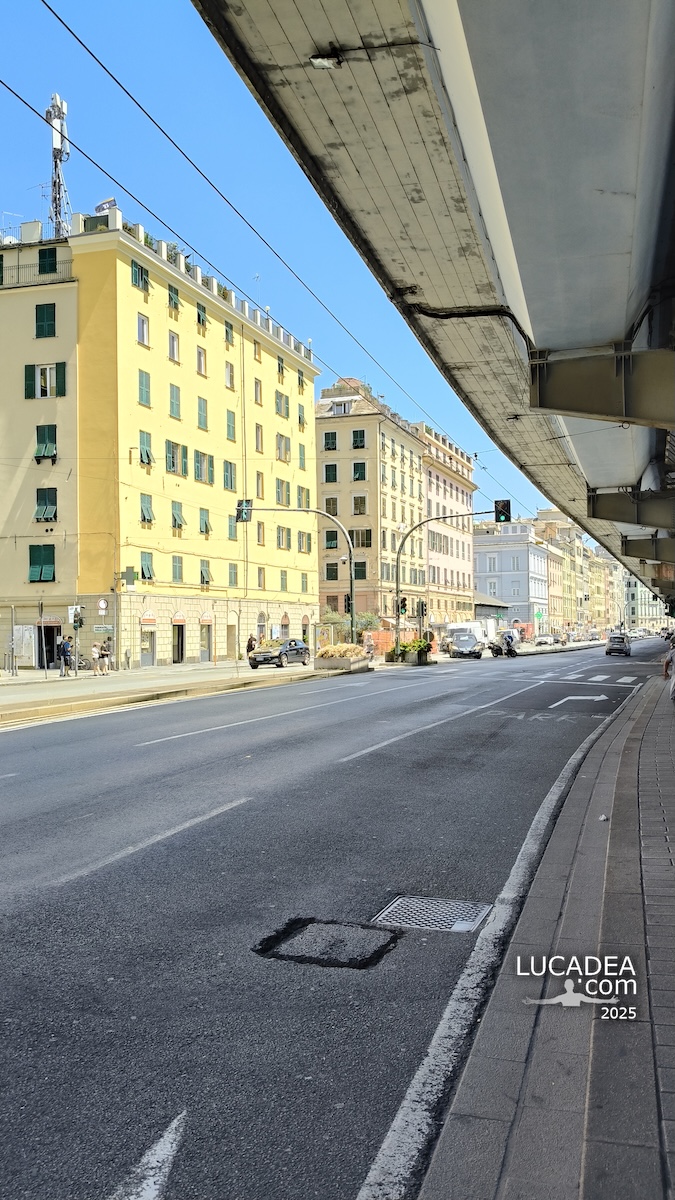
Gramsci street in Genoa between traffic and sea

Via Antonio Gramsci a Genova con sopraelevata e palazzi sul fronte mare, tipica scena urbana per chi cerca cosa vedere a Genova

Gramsci street in Genoa between traffic and sea.
Walking along Via Antonio Gramsci in Genoa, trying to understand what to see in Genoa beyond the usual highlights, I found myself standing beneath the elevated road, surrounded by movement and layers of the city unfolding in front of me. It’s one of those places where the real character of Genoa reveals itself quietly but unmistakably.
Cars were passing above and below, creating a constant flow that felt almost like a rhythm. When people search for what to see in Genoa, they often think of historic alleys or iconic landmarks, but this stretch of road tells another side of the story. It’s a place worth seeing in Genoa if you want to understand how the city lives day by day, balancing its past with the demands of modern life.
Here, in Genoa, Liguria, Italy, the sea is close but not always fully visible. You sense it behind the buildings, beyond the traffic, as if it’s always present but slightly out of reach. The elevated structure above changes the perspective completely, framing the sky and shaping the way light reaches the street.
I paused to take the shot, trying to capture that contrast between the solid concrete and the softer tones of the waterfront buildings. If you are visiting Genoa and wondering what to see, this kind of urban scene might not be the first suggestion you find, but it offers something more subtle and real. It shows how the city adapts and evolves without losing its identity.
It reminded me of another photograph I shared on my site from the Porto Antico area, where the relationship with the sea feels more open. Here, instead, everything is layered, compressed, almost hidden in plain sight.
A small interesting fact: the elevated road known as Sopraelevata Aldo Moro was built in the 1960s to ease traffic across the dense port area, running for several kilometers above the streets below. Today, it remains one of the most recognizable urban elements in Genoa.
If you’re exploring what to see in Genoa, maybe it’s not only about beauty in the traditional sense, but about finding meaning in these everyday views.

Do you ever find yourself drawn to places that others might overlook? Add a comment or go to the bottom of the site to read what other visitors have written.

Via Antonio Gramsci a Genova con sopraelevata e palazzi sul fronte mare, tipica scena urbana per chi cerca cosa vedere a Genova

Photo taken with Oppo Reno 12.

Compass rose on the Bay of Silence

Rosa dei venti sulla Baia del Silenzio a Sestri Levante dipinta su un palazzo sul mare con vista sulla baia ligure tranquilla

The compass rose on the Bay of Silence appears unexpectedly as I walk along the waterfront of Bay of Silence, and this painted detail immediately pulls my attention away from the sea for a moment. It is placed on the side of a building facing the water, and it feels less like decoration and more like a quiet marker embedded in the rhythm of the coastline.
I am in Sestri Levante, Liguria, Italy, where the shoreline curves gently and the town opens directly onto the sea. The atmosphere here is subtle rather than dramatic, shaped by small visual elements that reveal themselves slowly. The compass rose on the Bay of Silence becomes part of this language of details, as if it belongs equally to architecture and to the marine horizon.
If you are searching for what to see in Sestri Levante, this kind of detail often goes unnoticed, yet it changes the way the place is perceived. It is not a monument or a landmark in the traditional sense, but a visual signal that connects navigation, wind, and coastal life. I recall a similar experience from another post on my blog about Ligurian seaside towns, where unexpected elements on facades ended up telling more about the atmosphere than the main attractions.
Standing still, I watch how light moves across the wall, briefly sharpening the lines of the compass rose on the Bay of Silence. The contrast between the stillness of the painted symbol and the constant motion of the water creates a quiet tension that defines the moment.

A thought stays with me: how many people walk past this wall every day without ever noticing what is drawn on it, and how many, like me, stop just long enough to let it become a memory? Add a comment or go to the bottom of the site to read what other visitors have written.

Rosa dei venti sulla Baia del Silenzio a Sestri Levante dipinta su un palazzo sul mare con vista sulla baia ligure tranquilla

Rosa dei venti sulla Baia del Silenzio a Sestri Levante dipinta su un palazzo sul mare con vista sulla baia ligure tranquilla

Photos taken with Canon EOS R50 V and lens Tamron 16-300.

Where is the palace:

Rosa dei venti sulla Baia del Silenzio – Compass rose on Baia del Silenzio – Rose des vents sur la Baia del Silenzio – Rosa de los vientos en Baia del Silenzio – Windrose an der Baia del Silenzio – Hoa gió ở Baia del Silenzio – 巴亚德尔西伦齐奥的风向玫瑰 – バイア・デル・シレンツィオの風配図

The text of this post was written with the help of ChatGPT, a language model from OpenAI.

🏠
  • Italiano