Monleone Fortress Overlooking Moneglia

La torre della Fortezza di Monleone svetta sopra il borgo marinaro di Moneglia, sulla Riviera ligure di Levante

Monleone Fortress Overlooking Moneglia.
In Moneglia, Liguria, Italy, on the Italian Riviera, Monleone Fortress stands above the seaside village, recognisable by its tall tower and commanding position. It is a distinctive feature of the local landscape and a reminder of the long history of this coastal town. Looking up towards the hillside, the fortress naturally draws the eye and becomes one of the most striking elements in the view.
I enjoy photographing historic buildings like this because they are part of the identity of a place. They are not simply structures to admire up close; they are landmarks that shape the appearance of a village and make its skyline recognisable. In Moneglia, the tower of Monleone rises above the houses, recalling a time when defending the settlement and keeping watch over the surrounding territory were essential.
The history of the fortress dates back to the twelfth century. Its construction was commissioned by the Genoese consul Ingone di Flessa and is traditionally dated to 1173, when Moneglia belonged to the territories of the Republic of Genoa. The original stronghold was built for defensive purposes, at a time when controlling settlements and routes along the coast was strategically important.
The site we see today reflects a long and complex history. Alongside the surviving remains of the medieval fortification stands a castle built in the early twentieth century. Despite these changes over the centuries, the place retains a distinctive character, thanks to its elevated position and the way its architecture blends into the Ligurian landscape.
What I find particularly interesting to photograph is the contrast between the seaside village below and the fortress above. The houses cluster along the coast, while the tower seems to keep watch over them from the hillside. Its outline creates a natural focal point and encourages us to look upwards, away from the familiar views of streets and sea.
Photographing historic places also gives me a chance to notice details that might otherwise go unnoticed. An old wall, a tower or a building silhouetted against the sky can tell us something about the character of a town without the need for a long explanation. Monleone Fortress, with its prominent position above Moneglia, is a wonderful example of how architecture and landscape can become inseparable.
For me, photographs like this are a way to preserve the atmosphere of a place as well as its appearance. Even when a building has changed over time, it can still connect the present-day village with the events and people that shaped its past.

Have you ever visited Moneglia and admired the village from the hillside around Monleone Fortress? Add a comment or go to the bottom of the site to read what other visitors have written.

Photos taken with a Canon EOS M100 and a Tamron 16-300 lens.

I took several photos around the village, and if you want to see them all, click here:

Add one  comment to this article or read  here what other visitors have written.
 
Adv
 
Disclamer

The rights on images, videos, choruses, text and all other material on the LUCADEA.com website are governed as per  Copyright page.


This page has been viewed 0 times today.
This month it has been viewed 0 times.
In total it has been viewed 0 times.
 

The round square and houses of Varese Ligure

La piazza e le case di Varese Ligure

The round square and houses of Varese Ligure.
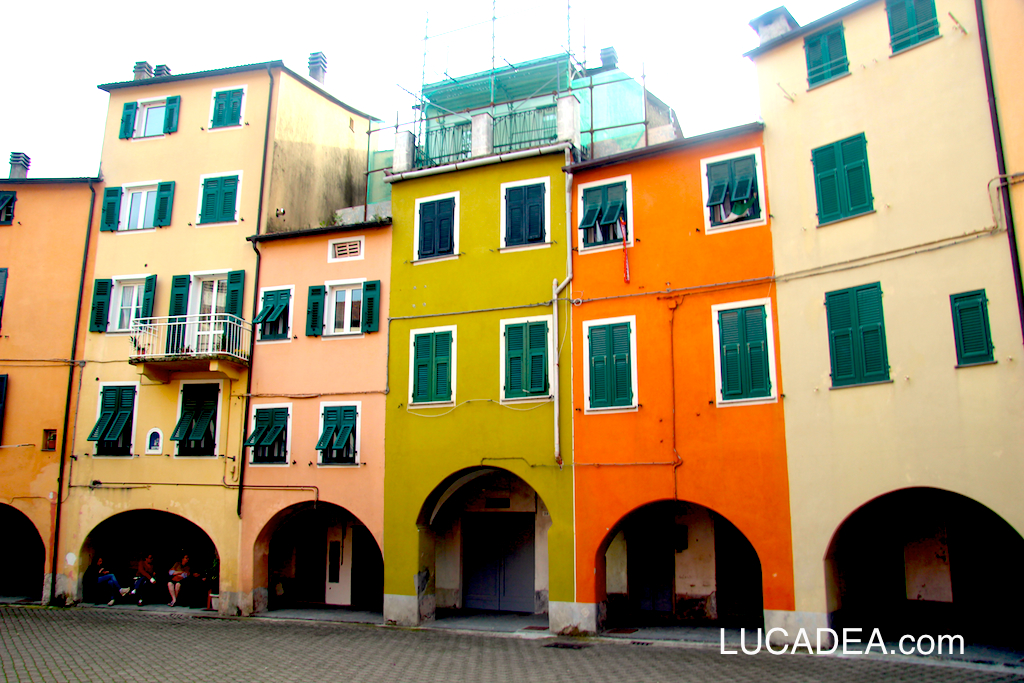
When I arrive in the centre of Varese Ligure, in Liguria, Italy, it is the characteristic arrangement of the houses around the square that immediately catches my attention. The unusual circular layout may not be completely obvious in this photograph, but it is precisely this arrangement that makes the heart of the village so recognisable.
This is one of those images that makes me think about how distinctive the layout of small Ligurian villages can be. The houses do not simply face an open central space. Instead, they follow a particular geometry and guide the eye around the perimeter of the square.
Varese Ligure is one of those inland villages I enjoy photographing precisely because of details like these. Away from the coast and the sea views usually associated with Liguria, the attention here shifts towards the houses, streets and structure of the village. It only takes a moment of looking carefully to realise that even an apparently simple square can reveal something about the place itself.
I took this photograph because of the way these houses are gathered around the centre of the village. I enjoy photographing architecture like this because the buildings work best when seen as a whole. One facade may catch the eye, but it is the sequence of houses that gives the scene its character.
The square is part of the distinctive layout of Varese Ligure’s historic centre and is closely connected with the castle. The circular arrangement of the buildings is one of the features that makes this part of the village so easy to recognise. It is an architectural curiosity that becomes much clearer when viewed from above, while from street level the overall shape can be much harder to perceive, as happens in this photograph.
If you are wondering what to see in Varese Ligure, this is certainly one of the places worth exploring. Not necessarily because there is one particular attraction to look for, but because walking around the square makes it easier to understand the structure of the village and appreciate the details of its buildings.
What I find interesting is the relationship between the houses and the central space. The square does not feel like something simply added to the village. It seems to be an integral part of its structure, with the buildings almost guiding visitors along a circular route and creating different perspectives at every step.
It is also a rewarding place for photography. Moving just a few metres can change the relationship between the houses, the square and the architectural elements around it. One photograph may focus on a particular facade, while another can try to make the circular arrangement more apparent.
I have already photographed Varese Ligure from another viewpoint, from Grecino bridge, showing the houses overlooking the Vara River. That image also presented the village without focusing only on its most famous features. I enjoy returning to places like this because every viewpoint can reveal another side of them.
In this photograph, perhaps, the circular shape of the square is not immediately obvious. But that is also what I like about the image. It can become an invitation to imagine what lies beyond the frame and to look more carefully at the village itself.
Varese Ligure is one of those places where it is worth slowing down, walking without rushing and observing how the houses, streets and public spaces have been arranged over time. Sometimes a simple photograph of a square and its buildings is enough to make me want to return with my camera.

Did you already know about the unusual circular arrangement of the houses in Varese Ligure? Add a comment or go to the bottom of the site to read what other visitors have written.

The round square in Varese Ligure with its characteristic houses arranged around the village centre

Click here to see more photos of the village:
foto gallery

Add one  comment to this article or read  here what other visitors have written.
 
Adv
 
Disclamer

The rights on images, videos, choruses, text and all other material on the LUCADEA.com website are governed as per  Copyright page.

This page has been viewed 0 times today.
This month it has been viewed 0 times.
In total it has been viewed 0 times.
 

The Ducal Court of Milan’s Sforza Castle

Corte Ducale del Castello Sforzesco a Milano con il colonnato del Portico dell'Elefante

The Ducal Court of Milan’s Sforza Castle.
During my last visit to Milan, I finally spent much more time walking around the city with my camera, and the Ducal Court of Sforza Castle was one of the places I wanted to photograph. Milan, Lombardy, Italy, is only a couple of hours away from where I live by train, yet I had not visited the city as a tourist nearly as often as I might have expected.
This time was different. I walked a lot, took plenty of photographs and tried not to concentrate only on the places I already knew from photographs or guidebooks. Sforza Castle was an obvious stop, but once inside I found myself paying more attention to its courtyards and architectural details than to the fortress as a whole.
This photograph shows the Ducal Court and the famous colonnade known as the Elephant Portico. What attracted me was the way the arches create a strong perspective across the open space of the courtyard. The architecture naturally guides the eye through the image, while the surrounding walls give the scene a sense of depth.
I took this photograph because I liked the composition rather than because I was trying to create a conventional picture of the castle. From outside, Sforza Castle is mainly perceived as a massive fortified complex, with its towers, walls and imposing entrances. Once inside, however, the atmosphere changes and the courtyards reveal a much more detailed architectural side.
If you are wondering what to see inside Sforza Castle, the Ducal Court is one of the spaces I would take time to look at rather than simply crossing on the way to another room. For a photographer, there are plenty of perspectives created by the arcades, columns and walls, and the architecture changes considerably depending on where you stand.
One small curiosity about the photograph is the name Elephant Portico. It comes from a fresco depicting an elephant, which gave the portico its traditional name. It is an interesting detail because the first thing most people notice when looking at the structure is its elegant colonnade rather than the decorative element behind the name.
Sforza Castle has undergone many changes throughout its history. It began as a military stronghold and later became associated with the ruling Sforza family and the ducal court. The complex we see today therefore contains different layers of Milan’s history, something that becomes particularly apparent when moving from the massive exterior fortifications into the more refined interior spaces.
For me, the Ducal Court is interesting precisely because it brings these different aspects together. The walls still suggest the original defensive role of the castle, while the arcades and architectural details remind us of its later role as a ducal residence.
I like photographs where the subject is not necessarily one isolated object. Here, the entire court became the subject. The columns, arches, walls and open space all contribute to the composition, and I spent some time looking for a viewpoint that made those elements work together.
That is one of the advantages of visiting a familiar city with more time than usual. During a quick visit, I might have entered the castle, looked around and moved on. On this occasion I had my camera with me and was paying attention to details, so I noticed several views that I would probably otherwise have overlooked.
Milan surprised me in that respect. Although it is relatively close to home, I had never really explored it at this pace. The last visit gave me the chance to walk much more extensively and photograph both the well-known landmarks and the smaller architectural details.
Sforza Castle was particularly rewarding because there are so many different photographic possibilities within the same complex. The exterior, towers, courtyards and arcades all offer completely different subjects, even though they belong to the same historic building.
The Ducal Court was one of the views that stayed with me. I liked the rhythm of the columns and the way the perspective leads through the courtyard. It is a relatively quiet architectural composition compared with the imposing appearance of the castle from outside.
I also like the fact that the photograph records something about my visit rather than simply documenting a famous Milan landmark. I was actually there, walking through the courtyard with my camera, looking for details that interested me. That personal connection is what I want to preserve when I add photographs to Lucadea.
For anyone visiting Milan, Sforza Castle is naturally one of the city’s major historic sights, but I think the experience becomes more interesting when you allow yourself enough time to look beyond the most obvious views. The courtyards are part of that experience, and the Ducal Court offers several perspectives that work particularly well through a camera lens.
This photograph is therefore less about presenting the castle as a tourist attraction and more about remembering a particular moment of my last visit to Milan. I had finally taken the time to explore the city properly, and the camera helped me notice details that might otherwise have passed unnoticed.
Looking back at the image, what I remember most is the perspective created by the Elephant Portico and the feeling of standing inside such a large historic complex after seeing the castle from the outside.

Have you visited Sforza Castle, and which part of the complex did you enjoy photographing the most? Add a comment or go to the bottom of the site to read what other visitors have written.

Ducal Court of Sforza Castle in Milan with the historic Elephant Portico and its columns

Photo taken with a Canon EOS M100 camera and a Canon EF-M 11-22 lens.

To see all the photos I took in Milan, click here:

This is the official website of the Castle: milanocastello.it.

A castle-like villa on Fiume street in Chiavari

Villa dall’aspetto signorile in via Fiume a Chiavari, con elementi architettonici che ricordano un antico castello

A castle-like villa on Fiume street in Chiavari.
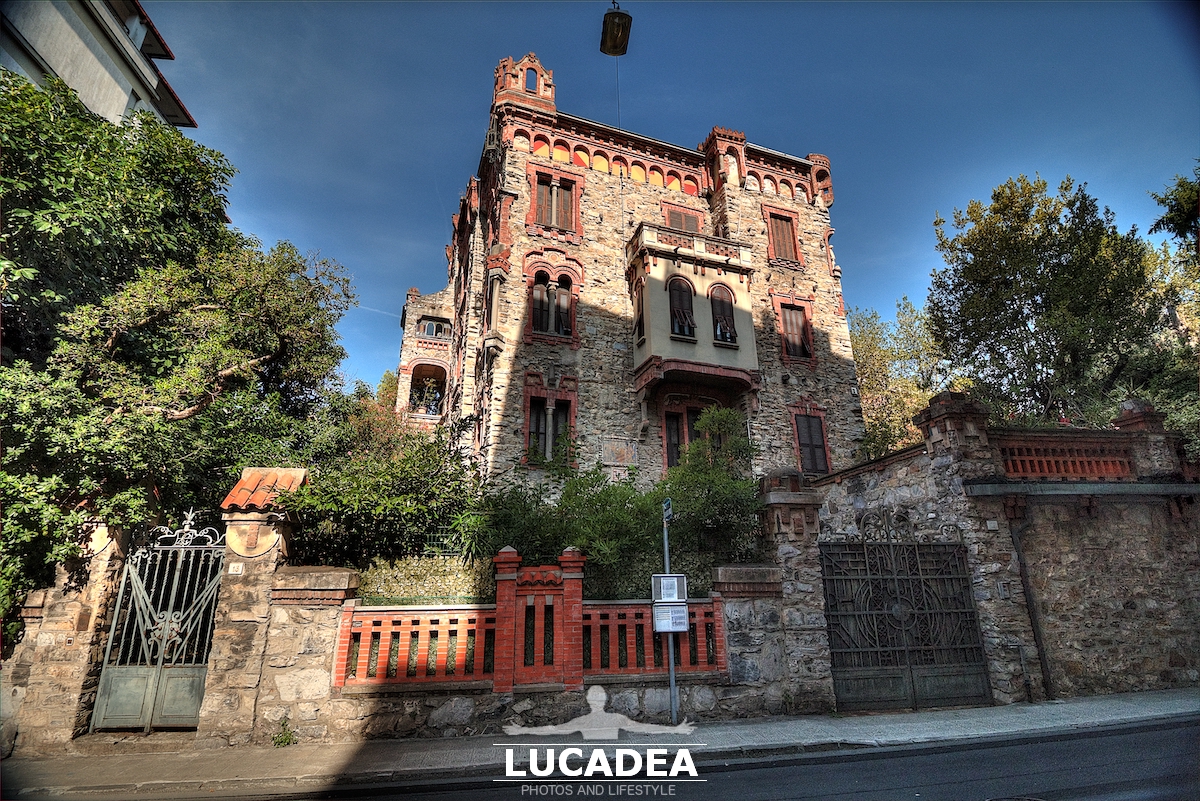
Walking along Fiume street in Chiavari, coming from the roundabout leading towards the motorway entrance, I noticed this large villa with a rather unusual appearance. I could not identify its name with certainty, which is part of what makes the photograph interesting to me: the building looks almost like a small castle, but I do not have enough reliable information to say exactly what it is.
The façade immediately stands out from the more ordinary buildings along this part of the town. It is the kind of place I might easily have walked past without paying much attention, but carrying my camera made me stop and look more carefully at its architecture.
I took this photograph simply because the building caught my eye. I did not have a detailed historical description or a confirmed name to accompany it. I was just walking through Chiavari and came across a villa that seemed unusual enough to deserve a place in my photographic archive.
Chiavari, Liguria, Italy, is a town where more familiar landmarks coexist with many residential buildings that reveal different architectural styles and periods. This is one of the reasons I enjoy walking through its streets rather than concentrating only on the best-known parts of the historic centre.
Fiume street is also an interesting route through the town. Coming from the roundabout towards the motorway entrance, the villa appears along the road and immediately catches the eye because of its rather imposing and elegant character.
At first glance, some of its architectural features can give the impression of a castle. There are elements that suggest a fortified building, at least visually, but I do not want to turn that first impression into a historical claim. I have not found sufficiently reliable information about the building to confirm that it was actually a castle or to identify its original purpose.
That uncertainty is part of the reason I decided to publish the photograph anyway. Urban photography does not always begin with a famous monument or a well-documented building. Sometimes I photograph something simply because it catches my attention while I am walking, and only afterwards do I realise that I know very little about it.
So the question remains open. What is the history of this villa? Was it actually designed with references to medieval architecture, or is its castle-like appearance simply the result of the architectural style chosen for a private residence?
Rather than inventing an answer, I prefer to leave the question open. The photograph is my own record of the building as I encountered it, while anyone familiar with Chiavari may perhaps know more about its history.
This is also one of the reasons I enjoy keeping a photographic blog. Not every image needs to provide a complete historical explanation. Sometimes a photograph can simply document a curiosity and invite further discussion.
I have photographed other villas, palaces and architectural details around Chiavari and the surrounding area, and over time these images have become a small personal collection of the buildings I encounter during my walks. Some are immediately recognisable, while others remain unidentified for a while.
This villa on Fiume street belongs to the second category. What attracted me was not necessarily a single architectural detail, but the overall impression created by the building. It has a presence that makes it different from the surrounding streetscape.
If you are interested in what to see in Chiavari beyond its best-known landmarks, these less obvious buildings can be worth noticing as well. They may not appear in a conventional itinerary, but they can reveal another side of the town, especially when you are simply walking rather than following a fixed route.
For me, the most interesting part is still the unanswered question behind the photograph. Who built the villa? When was it constructed? Was there a particular reason for its unusual appearance? Without reliable information, I would rather not turn guesses into facts.
That is also why I have kept the description deliberately close to what I actually saw. The building is there, on Fiume street in Chiavari, and its architecture certainly resembles that of a small historic castle. Everything beyond that deserves confirmation.
Perhaps someone who lives in the area or knows Chiavari’s architectural history will recognise it immediately. If so, I would be very interested in adding that information to the story of the photograph.
Until then, the image remains a record of one of those unexpected discoveries that make walking with a camera worthwhile. I was simply passing along Fiume street when this villa caught my attention, and now it has become one of those photographs that leaves me with a question rather than an answer.

Do you know the name of this villa or anything about its history? Add a comment or go to the bottom of the site to read what other visitors have written.

Castle-like villa on Fiume street in Chiavari, with elegant architecture resembling an old fortified residence

Photo taken with camera Canon EOS M100 and lens Canon EF-S 10-18.

The Entrance to Brescia Castle, Italy’s Falcon

Ingresso del Castello di Brescia sul colle Cidneo, con il grande portale della fortificazione del Falcone d’Italia

The Entrance to Brescia Castle, Italy’s Falcon.
Walking up towards Brescia Castle on Cidneo Hill, the large gateway is one of the first details that made me feel the scale of the fortress. If you are visiting Brescia and wondering what to see beyond the streets of the city centre, I think a short walk up to the castle is well worth it, even simply for the walls and the changing view over the city.
I took this photograph at the entrance to the first line of walls. Beyond this passage, the fortification continues towards the top of the hill, with further walls, towers, bastions and paths that reveal how complex the defensive system once was. What interested me was precisely this transition: the gateway feels like a threshold between the city below and the world of the fortress.
Brescia Castle occupies Cidneo Hill and remains a constant presence above the city. Its elevated position is also the reason behind the nickname “Falcon of Italy”. Once you reach the castle, it is easy to understand the idea. The hill provides a commanding position over Brescia and helps explain why this site was so important for defence over such a long period.
I was not trying to create a spectacular view when I took this photograph. I was interested in the gateway itself, with its stonework and the heavy walls surrounding it. When I photograph historic places, I often prefer to stop at a particular detail rather than always looking for the most famous viewpoint. Here, the entrance already said a great deal about the character of the castle.
The gateway belongs to the major transformation of the fortress during the sixteenth century. One small detail is particularly interesting: the Lion of Saint Mark, the symbol of the Republic of Venice, appears on the monumental entrance. Brescia remained under Venetian rule for more than four centuries, so the symbol provides a direct visual connection between the architecture and an important period in the city’s history. Municipality of Brescia – Brescia Castle
The rest of the castle is much more complex than this single photograph might suggest. As you climb higher, you encounter structures belonging to different periods, showing how the fortress changed over time. This layering is one of the things I find most interesting about the place: it is not simply one historic building, but a collection of spaces shaped by different military and historical needs.
If you are visiting Brescia, the castle offers more than another historic monument to photograph. The climb itself gradually changes your relationship with the city below. From street level, Cidneo Hill can seem like a natural feature rising above the historic centre. Once inside the walls, it becomes much easier to understand how the position of the hill influenced the development of the fortress.
I like places where a photograph can begin with something very simple. A gateway, a tower or a section of wall may initially seem like just another architectural detail, but when you stand in front of the real structure it becomes part of a much larger experience. This image preserves that beginning for me, before I had continued further into the complex.
Today, the castle is of course much more than a military stronghold. The site is also a place to walk and explore, and it contains museums including the Luigi Marzoli Museum of Arms and the Museum of the Risorgimento. I do not want to turn this post into a visitor’s guide, though. What matters to me here is the reason I stopped at this particular entrance and decided to take the photograph.
The position of the castle is probably its most distinctive feature. Cidneo Hill rises beside the historic part of Brescia, making it easy to understand why this location was used for defensive purposes for so many centuries. The different layers of the fortress also make the history of the site visible without needing to know every detail beforehand.
I also like the fact that the former military site now has a very different relationship with the city. People can walk through the walls and along the paths of the hill without the place feeling closed or inaccessible. The fortress is still imposing, but it has also become part of everyday life in Brescia.
Looking at this photograph, however, I mainly remember that first passage through the entrance. It is the point where the climb into the actual fortified complex begins and, for me, where the visit started to feel different from an ordinary walk through the city.
This is the kind of photograph I enjoy keeping on the blog: not necessarily an image that explains an entire place, but one that brings back a precise moment. In this case, the large gateway is enough to take me back to the walls of the Falcon of Italy and to the beginning of that walk through Brescia Castle.

Have you ever visited Brescia Castle and walked through this entrance? Add a comment or go to the bottom of the site to read what other visitors have written.

Entrance to Brescia Castle on Cidneo Hill, showing the large gateway of the Falcon of Italy

Photo taken with a Canon EOS M100 camera and Canon EF-M 11-22 lens.

To see all the photos I took at Brescia Castle, click here:

Exploring the Sestri Levante Peninsula on foot

Esplorando a piedi la Penisola di Sestri Levante in Liguria

Exploring the Sestri Levante Peninsula on foot.
Some walks become so familiar that I do not really need a specific destination. I can simply start walking and let the road decide where I will stop. The climb up the Sestri Levante Peninsula is one of those walks for me, because within a relatively short distance it takes me away from the center and gradually changes the way I see the town and the sea.
I was in Sestri Levante, Liguria, Italy, and I wanted to photograph this route because of the way its character changes as you climb. The peninsula reaches out into the Ligurian Sea, and the relationship with the town becomes different with every turn. The houses gradually fall behind while new views towards the sea and coastline appear ahead. It is one of the walks I enjoy when I want to see Sestri Levante from somewhere other than its beaches and caruggio.
The climb is not particularly long and does not require special preparation. What interests me, however, is the changing scenery along the way. The point is not simply to reach a viewpoint at the top. The walk itself becomes part of the photographic experience. A bend in the road, a section of vegetation, a wall or a glimpse between buildings can catch my attention before I reach the higher part of the peninsula.
If you are wondering what to see in Sestri Levante, the peninsula is naturally one of the places worth exploring. From different points along the route, it becomes easier to understand the unusual shape of the town and its relationship with the two famous bays. The Bay of Silence and the Bay of Fables appear from changing angles as you move, which is one reason why I never feel that the same walk necessarily produces the same photograph.
That constant change of viewpoint is what interests me most as a photographer. A familiar route can produce completely different images simply because I decide to stop in a different place. For this photograph, I brought my camera with me and tried to preserve some of the views encountered along the climb, without turning the walk into a collection of conventional panoramic shots.
The Sestri Levante Peninsula also has a history connected with its strategic position. At the higher part of the promontory stands the Castle of Sestri Levante, a medieval defensive structure built to protect the settlement and the surrounding territory. It is a reminder that this part of the coast was important not only for its scenery but also for its position overlooking the sea and nearby routes.
As I climb, what continues to interest me is the contrast between the urban side of Sestri and the more natural character of the peninsula. It does not take long to leave the streets of the center behind and find yourself in a setting where the sea becomes the main presence again. The sounds of the town gradually become less dominant, while rocks, vegetation and open views begin to attract more attention.
For anyone who enjoys photography, this walk offers plenty of opportunities without requiring a particular subject. The route creates different perspectives and makes it possible to watch the coastline change according to your position. This is exactly the kind of photography I enjoy: arriving somewhere I already know and allowing the details in front of me to determine what deserves to be photographed.
This image is part of my wider photographic story of Sestri Levante, a town I have photographed many times from different viewpoints. On the blog I have also written about characteristic Penisola Levante street, the houses on the peninsula and other views of this area, including the peninsula seen from Ciappa du Lu. Together, these photographs show how differently the same promontory can appear depending on where you are standing.
That is why I do not think of the climb up the peninsula simply as a route to complete. For me, it is a walk where almost every section can become a reason to stop. The photograph comes from this way of moving through a familiar place: without rushing towards the end and keeping an eye on whatever appears along the road.
If you are visiting Sestri Levante and looking for what to see beyond the famous bays and historic center, walking up the peninsula is a simple way to experience another side of the town. With a camera in hand, it can also become a quiet search for new perspectives in a place that may already seem familiar.

Have you ever walked up the Sestri Levante Peninsula, and which view stayed with you the most? Add a comment or go to the bottom of the site to read what other visitors have written.

Photos taken with Canon EOS RP and Tamron 16-300.

Where is the climb located:

The Octopus Statue by Rapallo Castle

Statua del polpo nella fontana davanti al castello di Rapallo, fotografata di notte durante il palio pirotecnico

The Octopus Statue by Rapallo Castle.
This photograph of the octopus statue in Rapallo was taken several years ago during a July evening, when the waterfront was busy with the town’s fireworks festival. It is one of those small details of Rapallo that can easily go unnoticed during an ordinary walk, yet photographed at the right moment it becomes a memorable part of the town.
The scene shows the fountain in front of the castle, with the octopus statue at its center. What caught my attention that evening was the opportunity to photograph it at night, when the atmosphere was completely different from the one you would experience during the day. Night photography has a way of changing even familiar elements, making them appear less ordinary.
I took this photograph myself several years ago, and today it has acquired an additional value for me. The fountain containing the statue has since been renovated, so the image also preserves the earlier appearance of this part of Rapallo. What was originally just a photograph from an evening walk has therefore become a small visual record of a place that has changed.
The fountain stands directly in front of Rapallo Castle, in Liguria, in the Metropolitan City of Genoa, Italy, in one of the most recognizable areas along the waterfront. The castle has a very strong presence in the town’s landscape, while the small octopus creates an unexpected and more playful element in front of this historic building.
That contrast is what I particularly like about the photograph. On one side there is the castle, with its long history and unmistakable appearance; on the other there is a much smaller subject connected to the everyday character of the town. You do not always need a major landmark to photograph Rapallo. Sometimes a small detail can say just as much.
The octopus also works well as a photographic subject because its shape remains immediately recognizable, even in a nighttime scene. That evening, the atmosphere of the fireworks festival made the waterfront feel different from an ordinary summer night. The photograph does not show everything that was happening around me, but it preserves a small part of the atmosphere I remember.
The fireworks festival is one of the summer events associated with the Tigullio area, particularly because of the displays held over the sea. I do not want to turn this photograph into a story about the event itself, though. For me, the real subject remains the small statue in the fountain.
Looking at the image years later, the renovated fountain adds another layer to the photograph. The place is still recognizable, but the setting is no longer exactly the same. This is one of the things I value most about photography: even an apparently simple image can unexpectedly become a record of how a familiar place looked at a particular moment.
When I look through older photographs of Rapallo, I often recognize corners that have since been restored, modified or simply changed with time. Together, these images form a small personal record of the town, even though I never originally intended them to serve that purpose.
This photograph also fits naturally with the other images of Rapallo I have shared on the blog. I have photographed the Music Pavilion along the seafront, the Delle Saline Gate, the old caruggi and many smaller architectural details discovered during my walks. This time the subject is much smaller, but that is precisely what makes it interesting.
I like the fact that the photograph came from an ordinary evening for the people who were there. At the time, I was simply photographing a statue in the night. Today, I can also look at it as a photograph of an earlier version of this part of Rapallo, before the fountain was renovated.
Not every photograph needs to show something famous or extraordinary to become valuable over time. Sometimes it only needs to preserve a detail that caught our attention at a particular moment.

Do you remember what the fountain in front of Rapallo Castle looked like before it was renovated? Add a comment or go to the bottom of the site to read what other visitors have written.

Octopus statue in the fountain in front of Rapallo Castle, photographed at night during the town's fireworks festival

Sea piers and beaches in Rapallo Liguria

Pontili e stabilimenti balneari a Rapallo in Liguria

Sea piers and beaches in Rapallo Liguria.
Walking along the seafront of Rapallo, I captured this view that tells a very typical story of the Ligurian coast: the close relationship between the sea and the structures created to enjoy it. Among the things to see in Rapallo, there are not only historic buildings and the famous castle by the sea, but also these everyday details that show how coastal towns have adapted to their landscape.
For this photograph, I focused on the sea piers and beach establishments of Rapallo, located a short distance from the castle. The coastline in this area offers limited natural beach space, so over time these structures were created directly over the water to provide more areas for sun loungers and umbrellas.
I was in Rapallo, Liguria, Italy, and this image comes from observing a common summer scene that is often overlooked. The sea piers have become part of the town’s identity and represent a practical solution used by many Riviera destinations to make the most of the available space.
A curious detail is that Rapallo has been an important town in the Gulf of Tigullio for centuries, growing thanks to its connection with the sea and later becoming a popular destination for visitors looking for the atmosphere of the Ligurian coast.
What I like about this photograph is the contrast between the natural landscape and the human elements built around it. The wooden platforms extending over the water, the rows of umbrellas, and the calm seaside atmosphere create a scene that immediately recalls summer days by the Mediterranean.
On the blog I have shared other views of the Tigullio area, including photographs of Sestri Levante and other Ligurian coastal towns, always trying to show not only famous landmarks but also the smaller details that define a place.
If you are visiting Rapallo, looking at the coastline from the promenade is a simple way to understand how the town lives with the sea every day.

Have you ever noticed these sea piers along the coast of Rapallo? Add a comment or go to the bottom of the site to read what other visitors have written.

Photos taken with Canon EOS RP and lens Tamron 16-300.

Where I took the photo:

The piers by the sea in Rapallo Liguria – Les pontons sur la mer à Rapallo en Ligurie – Los embarcaderos junto al mar en Rapallo Liguria – Os pontões junto ao mar em Rapallo Ligúria – Die Stege am Meer in Rapallo Ligurien – Cầu cảng ven biển ở Rapallo Liguria – 利古里亚拉帕洛的海上栈桥 – リグーリア州ラパッロの海辺の桟橋

The text of this post was written with the help of ChatGPT, a language model from OpenAI.

The charm of Rapallo Castle by the sea

Il fascino del massiccio Castello di Rapallo

The charm of Rapallo Castle by the sea.
Every time I visit Rapallo, Rapallo Castle by the sea immediately catches my attention, standing proudly along the waterfront with its unique shape and strong presence. It is one of the landmarks to see in Rapallo and a place that perfectly shows the connection between the town and the gulf surrounding it.
I always find myself taking a few photos of it, trying to capture not only the building itself but also the way it becomes part of the coastal landscape. The castle appears almost suspended between the water and the town, with its stone walls carrying memories of the past while everyday life continues around it.
I was in Rapallo, Liguria, Italy, and once again I stopped along the promenade to look at this familiar view. The combination of the old fortress, the sea, and the colorful buildings creates a scene that never feels exactly the same. It reminds me of other stories I have shared from the Tigullio area, where small details and recognizable places often create the strongest memories.
Rapallo Castle was built in the 16th century as a defensive structure after pirate attacks threatened the coast. Today it is one of the most photographed symbols of the town. An interesting tradition connected to the castle takes place during the summer patron celebrations, when the structure is symbolically “burned” with a spectacular fireworks display that lights up the waterfront.
That summer image may be the most famous one, but I also love seeing the castle in its everyday appearance. Without special effects, it still has a strong character and continues to watch over the promenade, the sea, and the people passing by.
If you are visiting Rapallo, this is one of those places worth seeing not only for its history but also for the atmosphere around it. Sometimes the most meaningful photographs come from places we have already seen many times.

Have you ever photographed the same landmark repeatedly and discovered something new each time? Add a comment or go to the bottom of the site to read what other visitors have written.

Il fascino del massiccio Castello di Rapallo

Photos taken with a Canon EOS RP camera and a Tamron 16-300 lens.

The seaside castle is a defensive structure in Rapallo, in the Metropolitan City of Genoa, built to defend the waters off the Vittorio Veneto seafront. It is also—incorrectly—referred to as a medieval castle, as the structure actually dates back only to the second half of the 16th century.
Read more on Wikipedia

The charm of Rapallo Castle by the sea – Le charme du château de Rapallo au bord de la mer – El encanto del castillo de Rapallo junto al mar – O encanto do castelo de Rapallo junto ao mar – Der Charme der Burg von Rapallo am Meer – Vẻ đẹp của lâu đài Rapallo bên biển – 拉帕洛海边城堡的魅力 – 海辺にあるラパッロ城の魅力

The text of this post was written with the help of ChatGPT, a language model from OpenAI.

The round village of Varese Ligure seen from above

Borgo Rotondo di Varese Ligure visto dal drone con case colorate e Piazza Fieschi nel centro storico

The round village of Varese Ligure seen from above.
This aerial photograph of the round village of Varese Ligure shows one of the most distinctive features of this small Italian town: the circular arrangement of houses surrounding Piazza Fieschi. Seen from above, the village reveals a shape that is difficult to fully appreciate while walking through its streets.
Some time ago I had the chance to take several photographs and videos with my drone during a visit to Varese Ligure, trying to capture the village from a different perspective. The drone regulations at that time did not allow me to fly higher, but even from this position the image clearly shows part of the famous circular layout and the relationship between the buildings and the central square.
What I like most about this photograph is the way the houses seem to follow a precise pattern, creating a balanced composition around the historic center. An aerial view helps reveal details that can remain hidden when exploring only at street level, especially the connection between the buildings, the castle area and the public spaces.
The photograph was taken in Varese Ligure, La Spezia province, Liguria, Italy, showing a section of the historic center with its colorful houses and Piazza Fieschi. If you are looking for places worth seeing in Liguria beyond the famous coastal destinations, this village offers a fascinating combination of history, architecture and a unique urban design.
One curiosity is that the name round village comes from the circular structure developed around the Fieschi Castle, a layout that was also connected to defensive needs in the past.
On my photoblog I have already shared photographs of Piazza Fieschi and other views of Varese Ligure because this village offers many interesting perspectives, both from its narrow streets and from above.
I enjoy using a drone when possible because it reveals shapes and details that are impossible to notice from the ground. It does not replace the traditional way of exploring a place, but it adds another way to tell its story.

Have you ever looked at a familiar place from a completely different point of view? Add a comment or go to the bottom of the site to read what other visitors have written.

Borgo Rotondo di Varese Ligure visto dal drone con case colorate e Piazza Fieschi nel centro storico

Photo taken with a DJI Mavic Mini drone.

And here’s the video of the Ligurian village’s famous circular square, taken with the drone:

Video taken with a DJI Mavic Mini drone.

If you’d like to see all the photos taken in Varese that afternoon and previously, click here:
foto gallery

Built by the Fieschi family to control and defend the Varese area, it consists of identical stone houses arranged along the perimeter. Their elliptical shape encloses the two main squares (Piazza Fieschi and Piazza Castello), where the underlying porticoes housed commercial activities, warehouses, and workshops.
Continue and learn more at Wikipedia

The round village of Varese Ligure seen from a drone – Le village rond de Varese Ligure vu depuis un drone – El pueblo redondo de Varese Ligure visto desde un dron – A vila redonda de Varese Ligure vista por um drone – Das runde Dorf Varese Ligure aus der Drohnenperspektive – Ngôi làng tròn Varese Ligure nhìn từ flycam – 无人机视角下的瓦雷泽利古雷圆形村庄 – ドローンから見たヴァレーゼ・リーグレの円形集落

The text of this post was written with the help of ChatGPT, a language model from OpenAI.

🏠
  • Italiano