Flavoured Salt at Barcelona’s Boqueria Market

Il sale come souvenir al mercato della Boqueria a Barcellona

Flavoured Salt at Barcelona’s Boqueria Market.
Whenever my ship calls at Barcelona, I try to make time to go ashore and visit La Rambla. If the schedule allows, I enjoy stopping at the Boqueria Market for a snack before exploring a little more of the city. Even during a short port visit, this lively market is a place where I can enjoy the atmosphere and discover something unexpected.
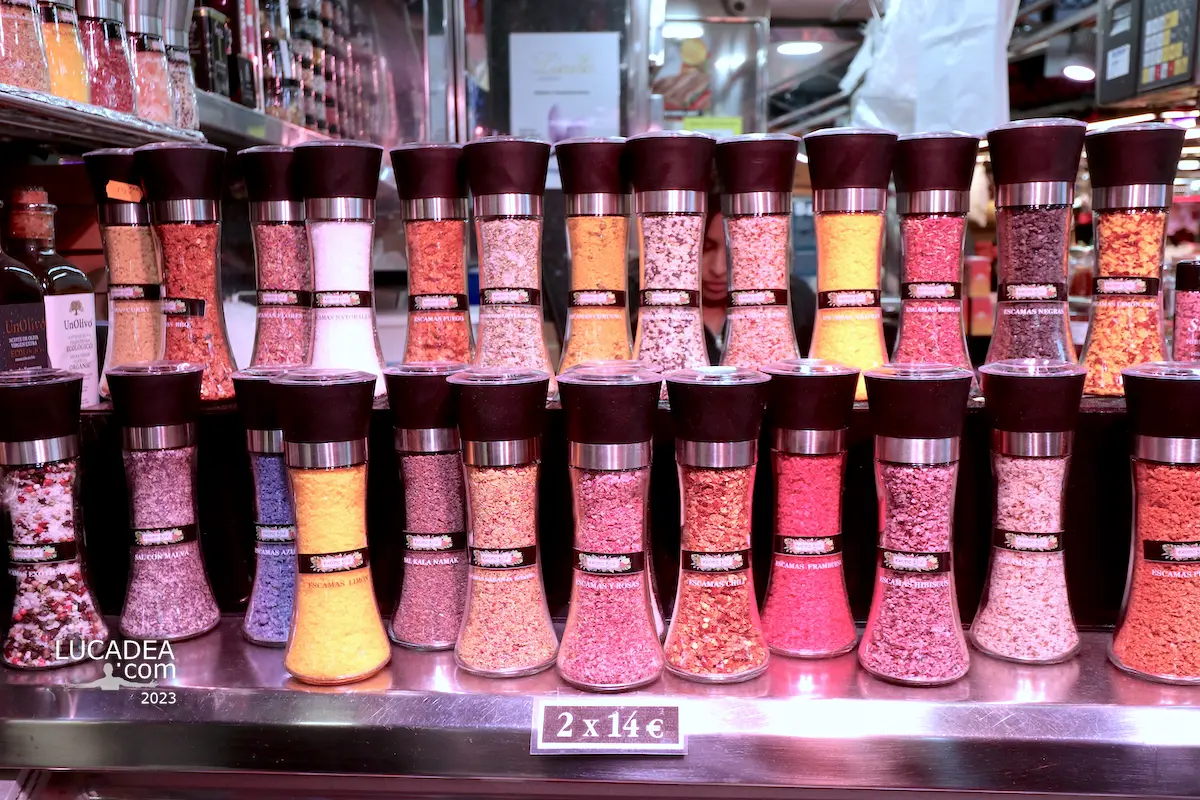
La Boqueria is one of Barcelona’s best-known markets and attracts plenty of visitors. With so many tourists walking through its aisles, the stalls naturally offer products that catch the eye and reflect current trends. During my most recent visit, one particular item stood out: flavoured salt. I noticed it at stall after stall, displayed in an impressive range of colours and varieties. I had never imagined there could be so many different kinds.
There was blue salt, saffron salt and a blend labelled cinco pimientas, made with five types of pepper. Other varieties combined orange with pink peppercorns, tomato, Merlot wine, turmeric or raspberry. I also saw Himalayan pink salt, garlic salt, basil and lemon, wasabi and chilli. The Spanish names on the labels made browsing even more interesting, as each jar seemed to promise a different flavour and a different use in the kitchen. And that was only the selection I happened to notice; there were so many options that I could probably have spent much longer looking through them.
What surprised me most was how an everyday ingredient could be presented as such a colourful and varied product. Salt is something most of us keep in the kitchen without thinking about it very much, yet these blends turn it into an attractive little gift. For someone who enjoys cooking, a small jar of unusual salt could be a practical souvenir from Barcelona, especially compared with the more familiar tourist trinkets.
I found myself wondering how many of these combinations come from established culinary traditions and how many have been developed to appeal to visitors looking for something distinctive to take home. Either way, the display was fun to discover. It was a reminder that markets are not just places to buy food: they also reveal what sellers believe people might enjoy, taste or give as a present.
I always like these little discoveries when travelling. The Boqueria is well known for its fresh produce and snacks, but a walk through the stalls can also turn up something I never expected to see. I took this photograph during one of those visits, drawn to the variety of salts and the unusual idea of turning such a simple kitchen staple into a souvenir.

Barcelona has plenty to offer even when time ashore is limited, and I enjoy finding small details that make each visit memorable. Which of these flavoured salts would you choose to take home? Add an comment or go to the bottom of the site to read what other visitors have written.

Flavoured salts at Barcelona's Boqueria Market, displayed in colourful varieties with spices, fruit and herbs for sale

Flavoured salts at Barcelona's Boqueria Market, displayed in colourful varieties with spices, fruit and herbs for sale

Flavoured salts at Barcelona's Boqueria Market, displayed in colourful varieties with spices, fruit and herbs for sale

Photos taken with a Canon EOS M100 camera and Canon EF-M 11-22 lens.

Here’s where this market is located:

Add one  comment to this article or read  here what other visitors have written.
 
Adv
 
Disclamer

The rights on images, videos, choruses, text and all other material on the LUCADEA.com website are governed as per  Copyright page.


This page has been viewed 0 times today.
This month it has been viewed 0 times.
In total it has been viewed 0 times.
 

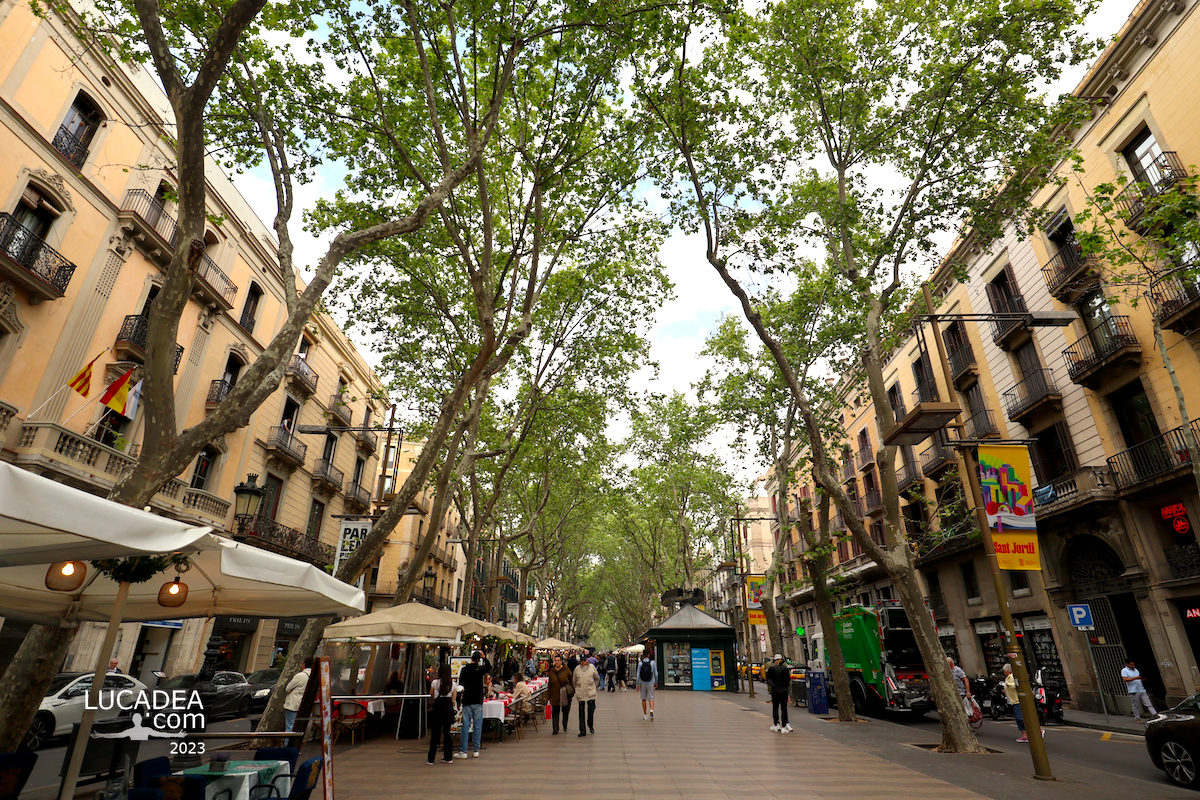
Barcelona’s Rambla, between street and life

La Rambla di Barcellona con il viale alberato, gli edifici e il movimento della strada nel centro della città

Barcelona’s Rambla, between street and life.
Walking along La Rambla, I found myself surrounded by one of those places where the city seems to keep moving in every direction, with people, buildings, trees and changing views appearing from one step to the next. Barcelona’s Rambla is one of the city’s most recognizable streets, but photographing it also means finding a personal viewpoint within a place that is constantly in motion.
Barcelona, in Catalonia, Spain, has La Rambla as one of its most familiar urban landmarks. The street crosses the center of the city, connecting Plaça de Catalunya with the port area, and its atmosphere gradually changes along the way. It is an urban walk where people are an essential part of the scene, together with the buildings, trees and side streets opening along the route.
This photograph came from wanting to preserve one of those passing moments. I wanted to capture the Rambla with my camera without necessarily searching for the most famous landmark or a perfectly arranged composition. I am more interested in photographs that retain something of a street’s everyday character, especially when that street is already known all over the world.
If you are wondering what to see in Barcelona, La Rambla is almost inevitably among the first places mentioned. Its central position also makes it a natural route towards other parts of the city. For me, however, its photographic interest is not only about where the street leads. It is also about how the surroundings change continuously while you walk along it.
Different places appear along the sides of the Rambla. La Boqueria market brings the movement and colors of everyday life, while the Gran Teatre del Liceu gives the street a strong cultural and architectural presence. Then there are street performers, musicians and living statues, all contributing to an urban space that can rarely be photographed in exactly the same way twice.
The word rambla has Arabic origins and comes from ramla, associated with the meaning of sand. The term later became common in several Spanish cities for streets developed along former waterways or areas once crossed by water. I find this a small but interesting detail because behind the name of one of Barcelona’s best-known streets there is still a reference to the landscape from which the name originated.
La Rambla, however, is not only the main pedestrian route seen in the most familiar photographs. One of the interesting parts of walking here is looking at what happens on either side, in the smaller streets and spaces opening between the buildings. The atmosphere can change very quickly, and that is often where I find less predictable photographic subjects.
This image also fits the way I like to document places through personal viewpoints and smaller details. There are already other photographs of Barcelona on the blog, including one dedicated to the Liceu Theatre on the Rambla. Returning to the same place through different images allows a longer visual story to develop naturally, without trying to make every photograph completely different from the previous one.
What interests me most about the Rambla is precisely its ability to change while remaining recognizable. Even when walking along the same stretch, the people, movement, activity and details around the street are never quite identical. A photograph can therefore become a small record of one particular passage rather than simply another representation of a famous place.
For anyone visiting Barcelona, La Rambla is certainly a street worth seeing, but I prefer to think of it as a place to observe rather than simply cross. There is no need to stop at every attraction. Sometimes it is enough to follow the route, look at the façades, watch the people passing by and let a small detail suggest the photograph.
That is where this image comes from. It does not attempt to summarize Barcelona or explain the whole Rambla. It simply keeps one fragment of my own passage through one of the city’s most recognizable streets.

What detail of the Rambla caught your attention most during a walk through Barcelona? Add a comment or go to the bottom of the site to read what other visitors have written.

Barcelona’s Rambla with its tree-lined avenue, historic buildings and everyday movement through the city center

Photo taken with a Canon EOS M100 camera and Canon EF-M 11-22 lens.

To see all the photos I took in Barcelona, ​​click here:
foto gallery

Where the Rambla is located:

Add one  comment to this article or read  here what other visitors have written.
 
Adv
 
Disclamer

The rights on images, videos, choruses, text and all other material on the LUCADEA.com website are governed as per  Copyright page.

This page has been viewed 0 times today.
This month it has been viewed 0 times.
In total it has been viewed 0 times.
 

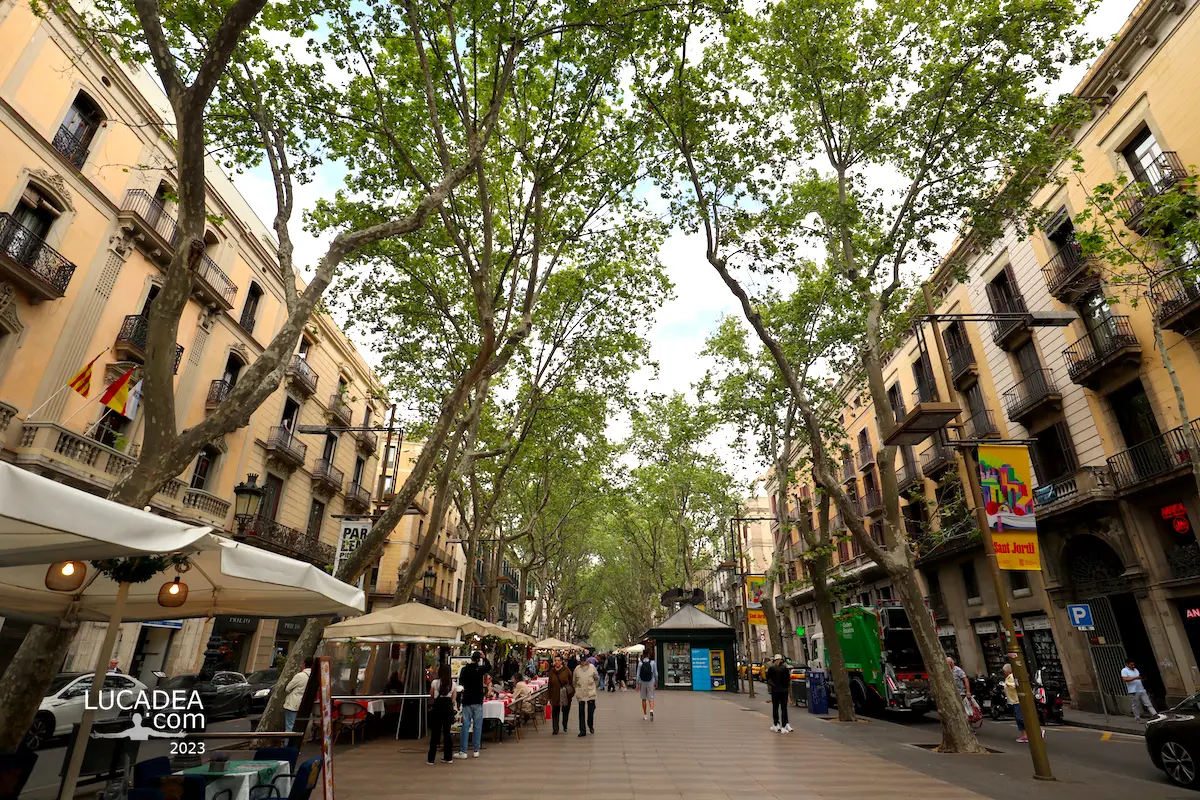
Buildings on La Rambla in Barcelona

Dei bei palazzi sulla Rambla di Barcellona

Buildings on La Rambla in Barcelona.
Walking along La Rambla in Barcelona, I often find myself slowing down without even realizing it, and the buildings on La Rambla in Barcelona become the real focus of my attention. This iconic street is not only movement and people, but also a continuous sequence of façades that each tell a different story, standing side by side in a long urban dialogue.
As I move along La Rambla, my gaze naturally goes upward. The buildings on La Rambla in Barcelona reveal themselves one after another, with decorative details that are never repetitive. Some are elegant, others more elaborate, but all of them have the ability to briefly stop my pace. It’s not just a street to cross, but a place to observe layer upon layer of architecture.
Barcelona, Catalonia, Spain, expresses itself here in one of its most theatrical urban forms. La Rambla is known for its constant flow of life, yet what strikes me most is the contrast between the movement at street level and the stillness of the façades above. If you are visiting Barcelona and wondering what to see beyond the main attractions, this street is a perfect example of how everyday architecture becomes part of the city’s identity.
I like to think that every time I pass here I notice something different. Sometimes I really do, other times I suspect I’ve seen it before but never truly observed it. On another post from my site I described a square in the city where architecture and human movement interacted in a similar way, and here on La Rambla that relationship feels even more intense.
What fascinates me most is the variety of decorative elements: balconies, cornices, carved details that change from one building to the next. There is no monotony, even when the street itself feels familiar.
I keep walking, looking up more than forward, letting details decide what deserves to be photographed.

Have you ever walked down a famous street and realized the real beauty was above your head? Add a comment or go to the bottom of the site to read what other visitors have written.

Dei bei palazzi sulla Rambla di Barcellona

Dei bei palazzi sulla Rambla di Barcellona

Photos taken with Canon EOS M100 and Canon EF-M 11-22 lens.

To see all the photos I took in Barcelona, ​​click here:
foto gallery

Where is La Rambla located:

La Rambla is one of the city’s most iconic landmarks, popular year-round with both tourists and locals. It has different names on its various sections, so it’s sometimes called the plural Les Rambles in Catalan and Las Ramblas in Castilian. The word rambla comes from the Arabic raml (sand) and refers, as in other Spanish cities, to a street created by a dry, buried, or covered watercourse.
Continue and learn more at Wikipedia

I palazzi della Rambla a Barcellona – Buildings on La Rambla in Barcelona – Les bâtiments de La Rambla à Barcelone – Edificios de La Rambla en Barcelona – Edifícios na Rambla de Barcelona – Gebäude an der Rambla in Barcelona – Các tòa nhà trên La Rambla ở Barcelona – 巴塞罗那兰布拉大道的建筑 – バルセロナのランブラス通りの建物

The text of this post was written with the help of ChatGPT, a language model from OpenAI.

Barcelona’s architecture between ancient and modern

L'architettura di Barcellona tra antico e moderno

Barcelona’s architecture between ancient and modern.
Almost every time I walk along La Rambla in Barcelona, I find myself looking at this view, struck by the contrast between the modern lines of this building and the bell tower of the Basilica of Santa María del Pi.
A beautiful contrast, isn’t it?

Do you know Barcelona? Add a comment or go to the bottom of the site to read what other visitors have written.

L'architettura di Barcellona tra antico e moderno

Photo taken with Canon EOS M100 and Canon EF-M 11-22 lens.

To see all the photos I took in Barcelona, ​​click here:
foto gallery

Here’s the exact spot where I took the photo:

La Rambla is one of the city’s most iconic landmarks, popular year-round with both tourists and locals, and has different names along its various sections, so it’s sometimes called the plural Les Rambles in Catalan and Las Ramblas in Castilian. The word rambla comes from the Arabic raml (sand) and refers, as in other Spanish cities, to a street carved out of a dry, buried, or covered watercourse.
Continue and learn more at Wikipedia

The architecture of Barcelona between ancient and modern – L’architecture de Barcelone entre ancien et moderne – La arquitectura de Barcelona entre lo antiguo y lo moderno – A arquitetura de Barcelona entre o antigo e o moderno – Die Architektur Barcelonas zwischen Antike und Moderne – Kiến trúc Barcelona giữa cổ kính và hiện đại – 巴塞罗那古代与现代之间的建筑 – 古代と現代の間のバルセロナの建築

The Liceu Theatre on La Rambla in Barcelona

Il Teatro del Liceu sulla Rambla di Barcellona

The Liceu Theatre on La Rambla in Barcelona.
In the heart of Barcelona, among the lively streets of the Raval district, lies a jewel of culture and art: the Liceu Theatre. Also known as the Gran Teatre del Liceu, this prestigious theatre has been a reference point for opera, ballet, and high-level artistic performances in the Catalan city and beyond for over 170 years.
Inaugurated in 1847, the Liceu Theatre has a long and illustrious history. Its neoclassical façade and sumptuous interior with Belle Époque decorations make it one of the most beautiful and iconic theatres in Europe. Over the years, the Liceu has hosted some of the greatest operas, ballets, and concerts, attracting artists and audiences from all over the world.
The Liceu Theatre has seen some of the greatest names in art and music perform. Opera singers such as Maria Callas and Plácido Domingo have graced its stage, while internationally renowned dancers have brought unforgettable performances to life. Its reputation as a place of artistic excellence has been consistently recognized worldwide.
Beyond traditional productions, the Liceu Theatre is also committed to promoting artistic innovation and discovering new talent. The theatre regularly offers spaces for experimentation, allowing new creators to present their works and explore new forms of expression. This commitment to innovation has kept the Liceu aligned with the times, making it one of Barcelona’s leading cultural institutions.
One of its main goals is to make art and culture accessible to everyone. Through educational programs, guided tours, and community initiatives, the Liceu strives to engage and inspire a diverse audience, offering everyone the opportunity to discover and appreciate the wonders of art.
For anyone visiting Barcelona, an evening at the Liceu Theatre is an unforgettable experience. Whether you are an opera enthusiast, a ballet lover, or simply a curious visitor eager to discover the city’s cultural richness, the Liceu welcomes you with its unique charm and takes you on a journey through centuries of history and artistic beauty.

Do you know Barcelona? Add a comment or go to the bottom of the site to read what other visitors have written.

Il Teatro del Liceu sulla Rambla di Barcellona

Il Teatro del Liceu sulla Rambla di Barcellona

Il Teatro del Liceu sulla Rambla di Barcellona

Photos taken with Canon EOS RP and Canon RF 24-50 lens.

To see all the photos I took in Barcelona, ​​click here:
foto gallery

Where is the theater:

🏠
  • Italiano