
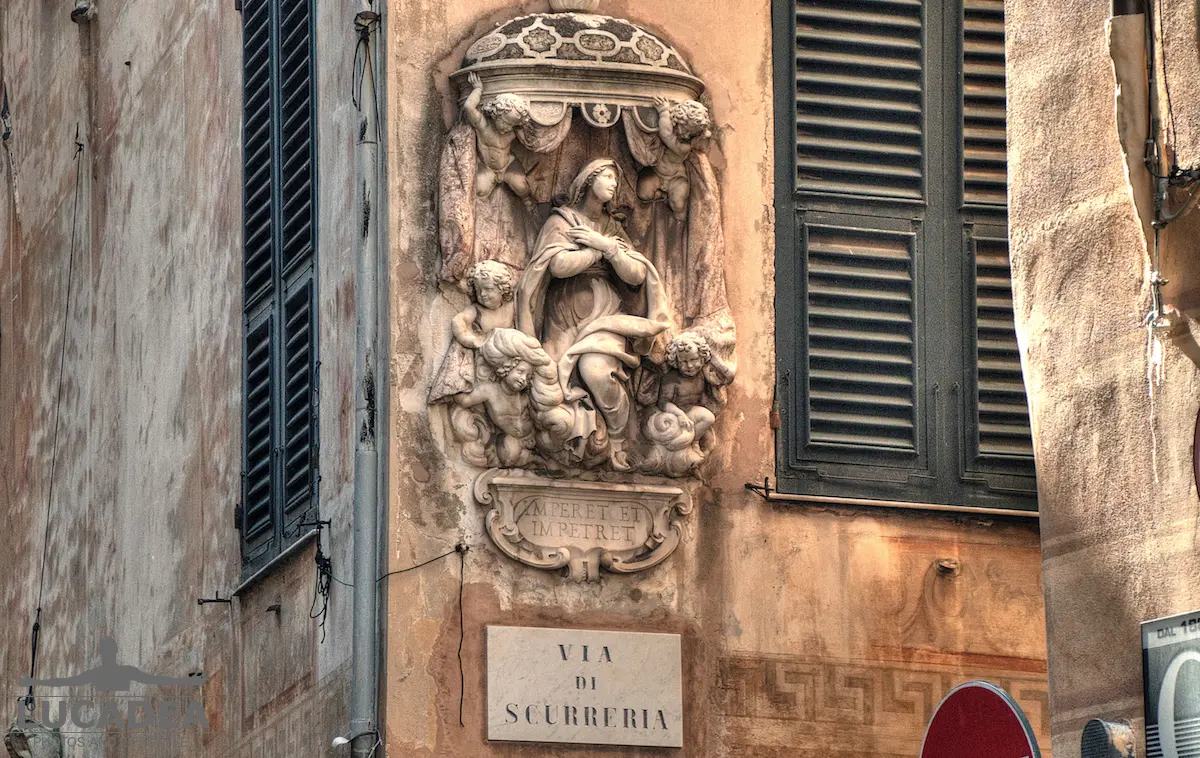
A Votive Shrine in Genoa’s Historic Old Town

Edicola di via di Scurreria a Genova

A Votive Shrine in Genoa’s Historic Old Town.
In the historic centre of Genoa, between Piazza Campetto and Via di Scurreria, this small shrine is a reminder of Liguria’s tradition of popular religious devotion. Votive shrines are a familiar feature of the region’s streets and villages, often found on building façades, at street corners or along the narrow lanes of old neighbourhoods.
These small niches containing sacred images reflect an aspect of everyday history in Ligurian towns and cities. Some are simple and understated, while others have decorated frames and architectural details that make them stand out. They can easily be overlooked by people walking through the old town without stopping, yet a closer look often reveals details that contribute to the character of the surrounding streets.
The shrine on Via di Scurreria is part of a distinctive corner of Genoa, in Liguria, Italy. Narrow streets, closely spaced buildings and passages connecting small squares create a dense urban landscape shaped by different periods of history. Between Piazza Campetto and Via di Scurreria, even a modest religious feature adds another detail to the story of the city and its relationship with the people who live and move through it.
In the past, votive shrines often served as familiar points of reference for local religious life. Sacred images could be cared for by families and neighbourhood residents, particularly during religious celebrations. This tradition has left visible traces throughout Liguria, where many shrines remain part of the region’s historical and cultural heritage.
I took this photograph to focus on one of those small details that help define Genoa’s historic centre. It may not have the imposing presence of a grand palace or church, but it offers a quieter way to appreciate the character of the old town. I enjoy noticing features like this while walking through historic streets, because they encourage me to look beyond the main landmarks and pay attention to places that might otherwise go unnoticed.
The same curiosity can lead to the discovery of other corners of Genoa’s old town, where architecture, tradition and everyday life come together along streets that have connected the city’s neighbourhoods for generations.

Have you ever noticed a votive shrine while walking through Genoa or another town in Liguria? Add a comment or go to the bottom of the site to read what other visitors have written.

Votive shrine on Via di Scurreria, between Piazza Campetto and the narrow streets of Genoa’s historic centre in Liguria, Italy

Photo taken with Canon EOS M100 camera and Tamron 16-300 lens.

Where is it located:

Add one  comment to this article or read  here what other visitors have written.
 
Adv
 
Disclamer

The rights on images, videos, choruses, text and all other material on the LUCADEA.com website are governed as per  Copyright page.


This page has been viewed 0 times today.
This month it has been viewed 0 times.
In total it has been viewed 0 times.
 

The Icon of Montallegro Sanctuary

L’effige originale del Santuario di Montallegro a Rapallo, protetta dagli angeli all’interno del luogo di culto

The Icon of Montallegro Sanctuary.
The image of Our Lady at Montallegro Sanctuary was the detail I chose to photograph inside the sanctuary on the hills above Rapallo, one of the religious places I know best in the Tigullio area. The sacred image, protected and surrounded by angels, immediately conveys the special connection between this sanctuary and the religious history of Rapallo.
The photograph shows the original icon preserved inside the sanctuary. For visitors, it is much more than an artwork to look at: it represents the heart of the tradition connected with the very origins of this place of worship.
Montallegro Sanctuary stands above Rapallo, in Liguria, in the Metropolitan City of Genoa, Italy, overlooking the town and the Gulf of Tigullio from the surrounding hills. Its elevated position is one of the things that makes the sanctuary interesting from a photographic point of view as well. The relationship between the religious site, the mountains and the landscape becomes particularly clear once you reach it.
According to local tradition, the image of the Virgin Mary was found in 1557 by a farmer named Giovanni Chichizola, at the place associated with an apparition of the Virgin. The story says that the image was accompanied by a message indicating the desire for a place of worship to be built there. This tradition became the foundation of the devotion connected with Montallegro and remains an important part of the sanctuary’s identity.
It is difficult to look at the icon without thinking about the generations of people who have climbed these hills to pray, give thanks or simply spend a few quiet moments in front of the image. For me, this photograph came from paying attention to a detail that is not merely decorative, but deeply connected with the history of the sanctuary.
The original icon is still preserved inside Montallegro Sanctuary, and in the photograph it appears protected by angels. I found this detail particularly striking because it creates a very different kind of image from the photographs usually taken outside. There is no wide view of the Tigullio landscape here, only a close and intimate subject connected with faith and memory.
I wanted to capture this detail with my camera because, whenever I enter a religious building, it is often the smaller elements that stay with me the longest. You do not always need to photograph the whole building. A painting, statue or sacred image can sometimes communicate the reason why a place matters much more directly.
Montallegro is also somewhere I have reached several times by walking along the trails above Rapallo. I have already written on the blog about a hike that took me through the Tigullio area to the sanctuary and then down towards Rapallo. Looking at this photograph again brings back those walks and the feeling of finally reaching the sanctuary after the climb.
The story of the icon is one of the details that makes Montallegro particularly recognizable in this part of Liguria. Regardless of personal beliefs, it is interesting to see how a tradition dating back to the sixteenth century has continued to play an important role in the local memory.
The photograph itself, however, remains primarily a personal memory of a visit. I was not trying to create a purely documentary image of the icon. I wanted to preserve the feeling of standing in front of an object that has represented the devotion surrounding this sanctuary for centuries.
That is also why I enjoy photographing places I already know. Every visit can reveal something different, perhaps a detail that I only noticed briefly the previous time. On this occasion, it was the original icon, surrounded and protected by the angels, that caught my attention.
If you are visiting Montallegro Sanctuary, this is certainly one of the details worth taking a moment to look at inside the church. It gives a more personal connection to the story behind the sanctuary than the wider landscape alone can provide.

Have you ever stopped to look closely at the original icon inside Montallegro Sanctuary? Add a comment or go to the bottom of the site to read what other visitors have written.

Original icon inside Montallegro Sanctuary in Rapallo, protected by angels and surrounded by the sacred interior

Foto scattata con macchina Canon EOS M100 e lente Tamron 16-300.

Clicca qui per vedere tutte le foto che ho scattato al Santuario:
foto gallery

Ecco dove si trova il Santuario:

Considerato tra i principali santuari mariani del territorio metropolitano genovese e della Liguria, fu edificato dalla popolazione rapallese tra il 1557 e il 1558, assieme all’annesso ricovero per pellegrini, dopo l’apparizione della Vergine Maria il 2 luglio 1557 al contadino Giovanni Chichizola. L’attuale facciata marmorea è risalente al rifacimento compiuto dall’architetto milanese Luigi Rovelli nel corso del 1896, ed inaugurata con solenne cerimonia il 21 giugno di quell’anno.
Continua e approfondisci su Wikipedia

Add one  comment to this article or read  here what other visitors have written.
 
Adv
 
Disclamer

The rights on images, videos, choruses, text and all other material on the LUCADEA.com website are governed as per  Copyright page.


This page has been viewed 1 times today.
This month it has been viewed 1 times.
In total it has been viewed 1 times.
 

One of the painted doors of Santa Maria Street in Funchal

Uno dei portoni dipinti di via Santa Maria a Funchal in Portogallo

One of the painted doors of Santa Maria Street in Funchal in Portugal.
On one of my recent visits by ship to the town of Funchal on the island of Madeira, I accidentally discovered this street in the old town.
It is a special place where, in addition to many restaurants and bars, you can admire these artistically painted doors (and not only those).
The one in this photo, number 1, represents the street itself.

Do you know Funchal and this little street? Add a comment or go to the bottom of the site to read what other visitors have written.

Uno dei portoni dipinti di via Santa Maria a Funchal in Portogallo

Photo taken with Canon EOS RP and Canon RF 24-50 lens.

To see all the photos of many of the gates, click here:
foto gallery

Where is the street located:

One of the painted doors of Santa Maria street in Funchal, Portugal – Une des portes peintes de la rue Santa Maria à Funchal, Portugal – Una de las puertas pintadas de la calle Santa María en Funchal, Portugal – Uma das portas pintadas da rua de Santa Maria no Funchal, Portugal – Eine der bemalten Türen der Straße Santa Maria in Funchal, Portugal – Một trong những cánh cửa sơn màu trên phố Santa Maria ở Funchal, Bồ Đào Nha – 葡萄牙丰沙尔圣玛丽亚街的彩绘门之一 – ポルトガル、フンシャルのサンタ マリア通りのペイントされたドアの 1 つ

A glimpse of Asilo Maria Teresa Street in Sestri Levante

Via Asilo Maria Teresa a Sestri Levante

A glimpse of Asilo Maria Teresa Street in Sestri Levante.
Asilo Maria Teresa Street is a street located in Sestri Levante, a picturesque town in the Liguria region, Italy. This street hosts several commercial activities and services.
This street is well positioned in the center of Sestri Levante, making it easily accessible and ideal for a walk among shops and restaurants.
Asilo Maria Teresa Street takes its name from the Maria Teresa Asilo, a historic educational institution located along this street. The kindergarten was founded to provide education and care for the children of the local community. The name “Maria Teresa” is likely a tribute to an important figure, possibly a benefactor or someone significant linked to the history of the institution or the town.
Sestri Levante is a picturesque town located on the Riviera di Levante in Liguria, Italy. It is famous for its two bays: the Bay of Silence and the Bay of Fables, the latter named in honor of the writer Hans Christian Andersen who stayed there. The town offers a fascinating mix of natural beauty, with enchanting beaches and a historic center rich in history and culture.
Sestri Levante is also known for its cultural events, such as the Andersen Festival, which celebrates storytelling and street theater. It is an ideal place for those seeking a combination of relaxation, culture, and breathtaking landscapes.

Do you know this street in Sestri Levante? Add a comment or go to the bottom of the site to read what other visitors have written.

Photos taken with Canon EOS RP and lens Canon RF 24-50.

Maria Teresa Nursery School Street in Sestri Levante – La rue appelée Asilo Maria Teresa à Sestri Levante – La calle llamada Asilo Maria Teresa en Sestri Levante – A rua denominada Asilo Maria Teresa em Sestri Levante – Die Straße namens Asilo Maria Teresa in Sestri Levante – Con phố mang tên Asilo Maria Teresa ở Sestri Levante

This post was written with the help of Copilot, an AI-powered virtual assistant.

A glimpse of the historic village of Spello

Uno scorcio del borgo di Spello in Umbria

A glimpse of the historic village of Spello.
Among the things to see in Spello, Umbria, Italy, the small streets and everyday views of the village are some of the best ways to understand its authentic character. This photograph captures one of those quiet moments when walking without a precise destination allows you to discover corners made of stone, narrow passages and old architecture shaped by centuries of history.
When I visited Spello with my wife some time ago, I spent time looking for these less obvious details. I wanted to capture this scene with my camera because it represents the way I experience travel photography: not only through famous monuments, but also through the streets and spaces that reveal the daily life of a place.
Walking through the historic center of Spello means constantly finding new perspectives. Stone houses, streets following the natural shape of the hill and small passages between buildings create different views at every turn. This is what makes photographing a village like Spello so interesting: even a simple street can become a visual story about the connection between people, landscape and architecture.
Spello, located in the province of Perugia, Umbria, Italy, still preserves important traces of its Roman and medieval past. The ancient town of Hispellum was an important Roman settlement, and today the village continues to show this heritage through its walls, monumental gates and historic buildings.
A small historical detail about Spello is its Roman name: Hispellum was known as Splendidissima Colonia Julia, a title that reflected its importance during the imperial period. Today, this ancient history lives together with the medieval appearance of the village, creating a unique combination of different eras.
Besides the quiet views of its streets, Spello offers remarkable places such as Santa Maria Maggiore Church with the Baglioni Chapel decorated by Pinturicchio, Consolare Gate, Venere Gate and the other historic entrances I have photographed in previous stories about the village. Each image adds another piece to the visual journey through this Umbrian town.
One of the most famous events in Spello is the Infiorata festival, when the streets are decorated with flower carpets created for Corpus Christi celebrations. However, this photograph was taken away from that event and shows another side of the village: a quieter atmosphere made of ancient stones, simple streets and everyday beauty.
If you are visiting Spello and wondering what to see, take time to explore the smaller streets as well as the main attractions. Often, the simplest views are the ones that create the strongest memories.

Which Italian village has made you stop most often to photograph small details? Add a comment or go to the bottom of the site to read what other visitors have written.

Historic village view of Spello in Umbria with narrow streets and old stone houses

Photo taken with Canon EOS RP and Canon RF 24-50 lens.

To see all the photos I took in the village, click here:

Here’s where the village is located:

Spello (Hispellum in Latin) is an Italian municipality in the province of Perugia in Umbria. It is part of the circuit of the most beautiful villages in Italy and boasts the Orange Flag tourism and environmental quality mark, awarded by the Italian Touring Club. Spello was founded by the Umbrians and later named Hispellum in Roman times; it was later registered with the Lemonia tribe. It was later declared a “Colonia Giulia” by Caesar and a “Splendidissima Colonia Julia” by Augustus, because it supported him in the wars of Perugia. After Augustus’ victory, he himself ceded to Hispellum a large part of the territories governed by Perusia, and the dominion of the city of Spello extended to the sources of the Clitunno River, which had previously been under the control of Mevania. It was later called “Flavia Costante” by Constantine. Ancient Spello was considered one of the most important cities in Roman Umbria.
Continue and learn more on Wikipedia

🏠
  • Italiano