The San Giacomo archway in Genoa

Archivolto dell’oratorio di San Giacomo in via Santa Croce, tra i vicoli del centro storico di Genova

The San Giacomo archway in Genoa.
While walking through the narrow streets of Genoa’s old town, I came across another one of those small corners that can easily go unnoticed. This one is on Santa Croce street, where a narrow alley passes beneath a tall archway just behind the Walls of the Grazie.
This is exactly the kind of detail I enjoy looking for when I walk through Genoa without a strict destination in mind. The old streets constantly change direction, become narrower, climb and descend, and often hide passages that are almost invisible from the main streets. Here, the archway was enough to make me stop and take out my camera.
The photograph is centered on a simple architectural feature, but its surroundings give it a much deeper context. The archway connects the narrow passage with the historic fabric of the neighborhood, while the nearby Walls of the Grazie are a reminder of the defensive role this part of Genoa once played.
When people search for what to see in Genoa, they will probably think first of the city’s best-known palaces, churches and squares. I often find something different by looking at the smaller details. The narrow passages, stairs and archways are an essential part of the character of Genoa’s historic center, and they give the caruggi an atmosphere that is difficult to reproduce anywhere else.
The location is quite specific: this photograph was taken in Genoa, Liguria, Italy, on Santa Croce street, in an area where different layers of the city’s history can still be seen very close to one another.
The name of the archway refers to the Oratory of San Giacomo, one of the religious places that form part of the dense historic fabric of this area. One small architectural curiosity is the word “archway” itself: in Italian, archivolto refers to an arch following the curve of a vault or opening, and in historic urban areas such structures can also form covered passages between buildings.
Whenever I photograph places like this, I naturally become curious about what came before. I want to understand why a passage was built in a certain way, what it connected and how people used it in the past. I do not always find every answer, but that curiosity is part of what makes photographing old places interesting to me.
It is also one of the reasons I enjoy walking through Genoa’s narrow streets. A route I have already taken can reveal something completely different the next time. Looking up, turning into a side alley or simply choosing another direction can change the whole experience.
This small passage behind the Walls of the Grazie caught my attention precisely because it is not a monumental scene. There is no famous panorama to photograph here. Instead, there are stone walls, the tall arch, the narrow passage and the feeling of being inside a part of the city that has developed over many different periods.
If you are visiting Genoa and want to understand the old town beyond its most famous sights, these smaller architectural details are worth paying attention to. They are not necessarily destinations in themselves, but they help explain why walking through the historic center is such a rewarding photographic experience.
I have written about other narrow streets and small historic corners of Liguria on the blog, and they often remind me of the same thing: the best photograph is not always the one you planned to take. Sometimes it is simply the one you discover while walking.
That is what happened here. I was exploring the narrow streets, came across the archway on Santa Croce street and decided to stop for a photograph before continuing my walk.

What is your favorite corner among the narrow streets of Genoa’s old town? Add a comment or go to the bottom of the site to read what other visitors have written.
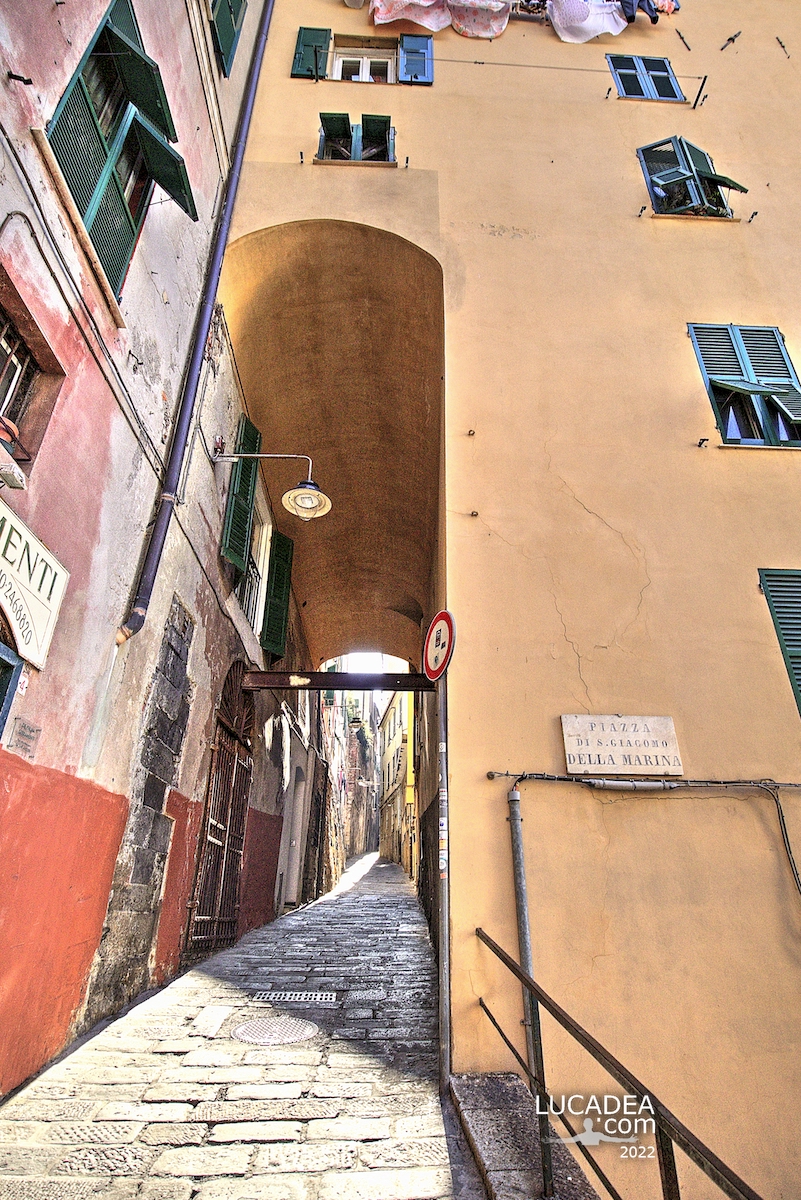
San Giacomo archway on Santa Croce street, among the narrow streets of Genoa's historic city center

Photo taken with a Canon EOS M100 camera and Canon EF-M 11-22 lens.

Here is where I took this photo:

Add one  comment to this article or read  here what other visitors have written.
 
Adv
 
Disclamer

The rights on images, videos, choruses, text and all other material on the LUCADEA.com website are governed as per  Copyright page.


This page has been viewed 1 times today.
This month it has been viewed 2 times.
In total it has been viewed 2 times.
 

The Castellani Chapel in Santa Croce

La Cappella Castellani nella Basilica di Santa Croce a Firenze

The Castellani Chapel in the Basilica of Santa Croce in Florence.
The Basilica of Santa Croce in Florence, famous for being the burial place of illustrious Italian figures, is home to numerous chapels of extraordinary artistic and historical value. Among these, the Castellani Chapel stands out for its rich history and cultural significance.
The Castellani Chapel is named after the Castellani family, one of the oldest and most influential Florentine families. Located along the right side of the basilica’s main nave, the chapel was commissioned by the family during the 14th century, a period of great prosperity for Florence. The Castellani family, known for their devotion and patronage of the arts, wanted to create a sacred space that reflected their faith and social status.
The chapel’s architectural structure follows the typical Florentine Gothic style, characterized by pointed arches and cross vaults. The chapel’s walls are enriched with frescoes and stucco decorations, demonstrating the mastery of the artists of the time.
One of the most notable features of the Castellani Chapel is the fresco cycle created by Agnolo Gaddi, a renowned 14th-century painter. These frescoes, depicting scenes from the life of St. John the Evangelist and the Virgin Mary, are exemplary of Florentine Gothic art due to their vivid colors and delicate figures.
Over the centuries, the chapel has undergone various restorations to preserve its artwork. One of the most significant restorations was carried out in the 19th century, when the chapel underwent a major restoration campaign that restored the original beauty of the frescoes to the public.
The Castellani Chapel is not only a place of worship, but also a symbol of Florence’s rich cultural and historical heritage. It represents a tangible example of the patronage of Florentine families and their contribution to the development of art and architecture in the city.
Every year, thousands of tourists visit the Basilica of Santa Croce to admire its many chapels, including the Castellani Chapel, a testament to a time when Florence was at the center of the Renaissance and European culture.

Do you know or have you visited this beautiful church in Florence?
Add your own comment or go to the bottom of the site to read what other visitors have written.

La Cappella Castellani nella Basilica di Santa Croce a Firenze

Photo taken with Canon EOS M100 and lens Canon EF-M 11-22.

This is the official website: santacroceopera.it.

To see all the photos of the basilica, click here:

The Castellani Chapel, with its double bay, was frescoed by his son Agnolo Gaddi with assistants and features Stories of Saints Anthony Abbot, John the Baptist, John the Evangelist, and Nicholas of Bari. The chapel’s tabernacle is the work of Mino da Fiesole, while the painted cross is by Niccolò Gerini. The statues of the Della Robbia school represent Saints Francis and Dominic, while among the tombstones, the one dedicated to Luisa Stolberg, Countess of Albany, stands out. It is a Neo-Renaissance work by Luigi Giovannozzi and Emilio Santarelli based on a design by Charles Percier.
Continue and learn more at Wikipedia

The Castellani Chapel in the Basilica of Santa Croce in Florence – La chapelle Castellani dans la basilique Santa Croce de Florence – La Capilla Castellani en la Basílica de Santa Croce en Florencia – A Capela Castellani na Basílica de Santa Croce em Florença – Die Castellani-Kapelle in der Basilika Santa Croce in Florenz – Nhà nguyện Castellani trong Vương cung thánh đường Santa Croce ở Florence

The text of this post was written with the help of ChatGPT, a language model from OpenAI.

Add one  comment to this article or read  here what other visitors have written.
 
Adv
 
Disclamer

The rights on images, videos, choruses, text and all other material on the LUCADEA.com website are governed as per  Copyright page.


This page has been viewed 1 times today.
This month it has been viewed 2 times.
In total it has been viewed 83 times.
 

Michelangelo’s tomb in Santa Croce in Florence

La tomba di Michelangelo in Santa Croce a Firenze

Michelangelo’s Tomb in Santa Croce, Florence.
The city of Florence, rich in history and culture, holds within it a treasure trove of art and significance: the tomb of Michelangelo Buonarroti, located in the Basilica of Santa Croce. This sacred place, once the residence of illustrious figures such as Galileo Galilei and Niccolò Machiavelli, welcomes the great master of the Italian Renaissance with a solemnity and respect commensurate with the magnitude of his contribution to art and culture.
Michelangelo, born in 1475 and died in 1564, was one of the greatest artists in history. His influence extended through sculpture, painting, and architecture, creating iconic works such as the statue of David and the Sistine Chapel. After his death, Florence dedicated a final resting place to him in the Basilica of Santa Croce, a place already hallowed for its many tombs of illustrious figures.
Michelangelo’s tomb was designed by Giorgio Vasari, another great artist and architect of the Italian Renaissance. The work, completed in 1578, combines architectural and sculptural elements in a fitting tribute to Michelangelo’s greatness. The monument is located in the Buonarroti family chapel, on the left side of the basilica’s nave.
Michelangelo’s tomb is an eloquent example of Renaissance funerary art. At the center is an allegorical statue of Hope, flanked by statues representing Activity and Philosophy. The figure of Michelangelo, sculpted by Vasari himself, is placed on a sarcophagus surmounted by a portrait of the deceased, executed by Daniele da Volterra. The overall effect is characterized by a sense of balance and harmony, typical of Renaissance style.
Every element of Michelangelo’s tomb is charged with symbolism. Hope, with outstretched wings, suggests the immortality of art and the continuity of its influence over time. The lateral statues symbolize the duality of Michelangelo’s life, between the artist’s creative fervor and the philosophical depth of his thought.
Michelangelo’s tomb in Santa Croce is a masterpiece that unites art and spirituality. Every detail, from the architectural design to the allegorical sculptures, tells the story of a man who shaped the aesthetics of the Renaissance. This sacred site is an essential stop for anyone wishing to immerse themselves in Florence’s artistic and cultural heritage, paying homage to one of the geniuses who made this city eternally legendary.

Do you know or have you visited this beautiful church in Florence? Add your own comment or go to the bottom of the site to read what other visitors have written.

La tomba di Michelangelo in Santa Croce a Firenze

Photo taken with Canon EOS M100 and lens Canon EF-M 11-22.

This is the official website: santacroceopera.it.

To see all the photos of the basilica, click here:

The most famous tomb is perhaps that of Michelangelo Buonarroti, between the first and second altars of the right nave, designed by Vasari after the remains of the great artist arrived in Florence from Rome (1564). Above the tomb, three sculptures represent the personifications of Painting (by Battista Lorenzi, also author of the artist’s bust) (c. 1568), Sculpture (by Valerio Cioli), and Architecture (reattributed to Battista Lorenzi, previously attributed to Giovanni Bandini), saddened by the passing of the great master. However, the entire tomb is a blend of painting, sculpture, and architecture. The frescoes that decorate it are by Giovan Battista Naldini.
Continue and learn more at Wikipedia

Michelangelo’s tomb in the church of Santa Croce in Florence – Le tombeau de Michel-Ange dans l’église de Santa Croce à Florence – La tumba de Miguel Ángel en la iglesia de Santa Croce en Florencia – Túmulo de Michelangelo na igreja de Santa Croce em Florença – Michelangelos Grab in der Kirche Santa Croce in Florenz – Mộ của Michelangelo tại nhà thờ Santa Croce ở Florence – 佛罗伦萨圣十字教堂内的米开朗基罗墓 – フィレンツェのサンタ・クローチェ教会にあるミケランジェロの墓

The text of this post was written with the help of ChatGPT, a language model from OpenAI.

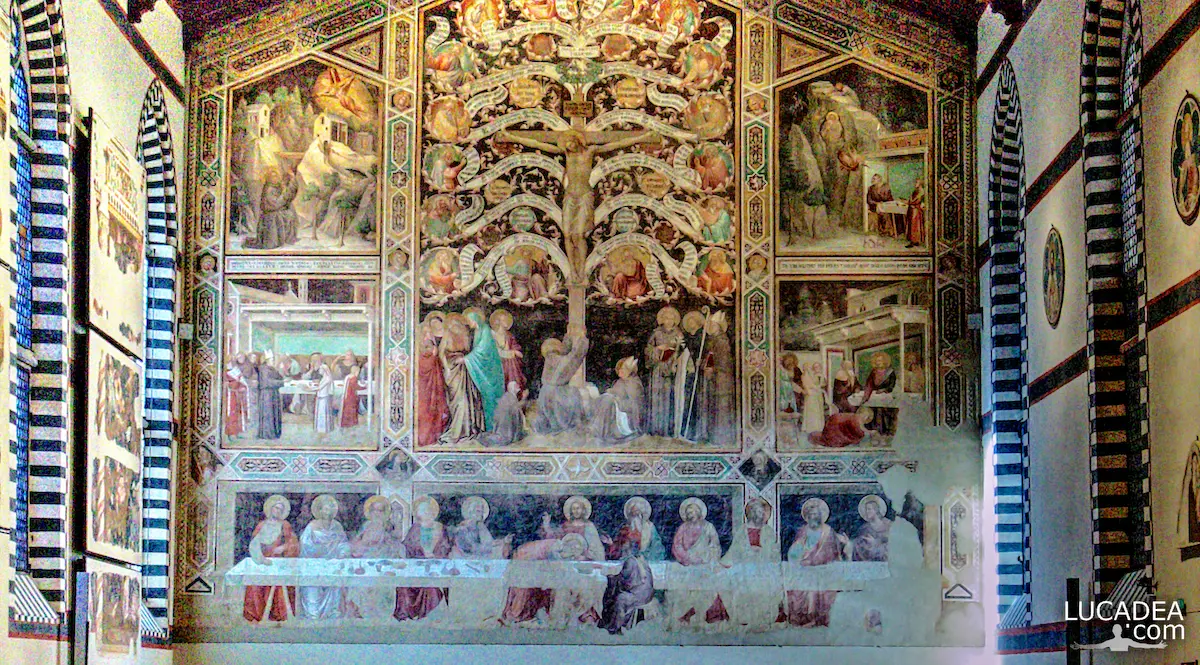
The Tree of Life in Santa Croce, Florence

L'Albero della Vita a Santa Croce: un simbolo di rinascita e speranza

The Tree of Life in Santa Croce.
Inside the Refectory of Santa Croce in Florence, Tuscany, Italy, beyond the famous scene of the Last Supper, there is a detail that often goes unnoticed but truly deserves a closer look: the Tree of Life.
At first glance, visitors are naturally drawn to the main composition, but by observing more carefully, this symbolic element reveals itself, adding a deeper layer of meaning to the entire pictorial cycle.
In Christian art, the Tree of Life is one of the most powerful symbols. It represents spiritual rebirth, salvation, and the promise of eternal life. In this fresco, the tree rises upward with harmony, its roots firmly grounded while its branches extend toward the sky, almost connecting the earthly and divine realms.
A particularly interesting aspect lies in the decorative details: leaves, flowers, and fruits enrich the composition and are far from being mere ornaments. They symbolize fertility, abundance, and new life, all central themes in Christian symbolism.
This element fits perfectly within the context of the Refectory, creating a dialogue with the Last Supper and reinforcing the broader message of the artwork: sacrifice, redemption, and hope.
Interestingly, many visitors, focused on the main scene, tend to overlook these details. Yet, they are exactly what makes the experience richer and more meaningful.
This is one of those situations where slowing down and observing carefully truly makes a difference. Florence is full of masterpieces, but often it is the smallest details that leave the strongest impression.
When you visit Santa Croce, take a moment to look for it—you might see the entire space in a new way.

Had you ever noticed this symbol in the Refectory? Add a comment or scroll down to read what other visitors have written.

Tree of Life fresco in Santa Croce Refectory Florence Christian symbolism

Photo taken with Canon EOS M100 and lens Canon EF-M 11-22.

This is the official website: santacroceopera.it.

To see all the photos of the basilica, click here:

For the Tree of the Cross, Taddeo drew on an iconography best exemplified in the Tree of Pacino di Buonaguida, here however simplified, with the prophets and The evangelists in the roundels replace the episodes from the life of Christ, the prophets, and the evangelists. The characters’ respective writings are linked to the mystery of the Passion as it unfolds.
Continue and learn more at Wikipedia

The Cenotaph of Dante Alighieri in Santa Croce Basilica, Florence

La tomba di Dante Alighieri in Santa Croce a Firenze

The Cenotaph of Dante Alighieri in Santa Croce Basilica, Florence.
Walking inside the beautiful Basilica of Santa Croce in Florence, you can find many monuments dedicated to some of the greatest figures in Italian history. This is why Santa Croce is often called the “Pantheon of Italian glories”, thanks to the many famous personalities remembered and celebrated here.
Among them there is the monumental cenotaph dedicated to Dante Alighieri, one of the greatest poets in world literature and the author of the Divine Comedy. This photograph tells the story of this corner of the basilica, where art, history and memory come together.
I was visiting the Basilica of Santa Croce in Florence, Tuscany, Italy, and I wanted to photograph a monument that is often mistakenly considered Dante’s actual tomb. In reality, this is a cenotaph: a commemorative funerary monument that does not contain the remains of the person it celebrates.
Dante Alighieri’s body is not buried in Florence but is preserved in Ravenna, the city where the poet died in 1321 during his exile. Despite this, Florence wanted to dedicate an important monument to him as a tribute to his fundamental role in Italian culture and literature.

The Cenotaph of Dante Alighieri in Santa Croce Basilica

The cenotaph of Dante, created in 1829 by the sculptor Stefano Ricci, is one of the most famous monuments inside Santa Croce. It represents the strong connection between the poet and his birthplace, even though his life ended far from Florence.
The monument shows Dante seated near a lectern, while the allegorical figures of Italy and Poetry pay tribute to the poet. The artwork reflects the cultural importance that Dante has maintained throughout the centuries.

Dante’s “Tomb” in Florence: a Cenotaph, Not a Burial Place

Although it is often called “Dante’s tomb in Florence”, this monument is not a real tomb because it does not contain his remains. The poet’s actual burial place is located in Ravenna, where Dante spent the last years of his life after being exiled from Florence.
Visiting Santa Croce means taking a journey through Italian art and history. Inside the basilica there are monuments dedicated, among others, to Michelangelo, Galileo Galilei, Niccolò Machiavelli and many other important figures.
What fascinates me about this place is the ability to tell the past through works of art and commemorative monuments. Even a cenotaph, despite not preserving a body, can become a powerful symbol of collective memory.
On my blog I have shared many historical and artistic places visited during my travels, because often it is these small details that make a visit even more fascinating.

Have you ever visited the Basilica of Santa Croce in Florence? Leave a comment or scroll down the page to read what other visitors have written.

Cenotaph of Dante Alighieri in Santa Croce Basilica in Florence

Photo taken with a Canon EOS M100 camera and a Canon EF-M 11-22 lens.

Official website: santacroceopera.it.

To see all the photos of the basilica, click here:

Proseguendo nella navata destra si incontra prima il cenotafio di Dante, smisurato monumento del 1829; piangono il poeta le figure dell’Italia e della Poesia di Stefano Ricci, impostate su uno stile neoclassico alla Canova, ma contaminate dallo spirito neomedievale, romantico e celebrativo del tempo.
Continua e approfondisci su Wikipedia

The Main Altar of Santa Croce in Florence

L'Altare Maggiore della Basilica di Santa Croce a Firenze

The Main Altar of Santa Croce in Florence.
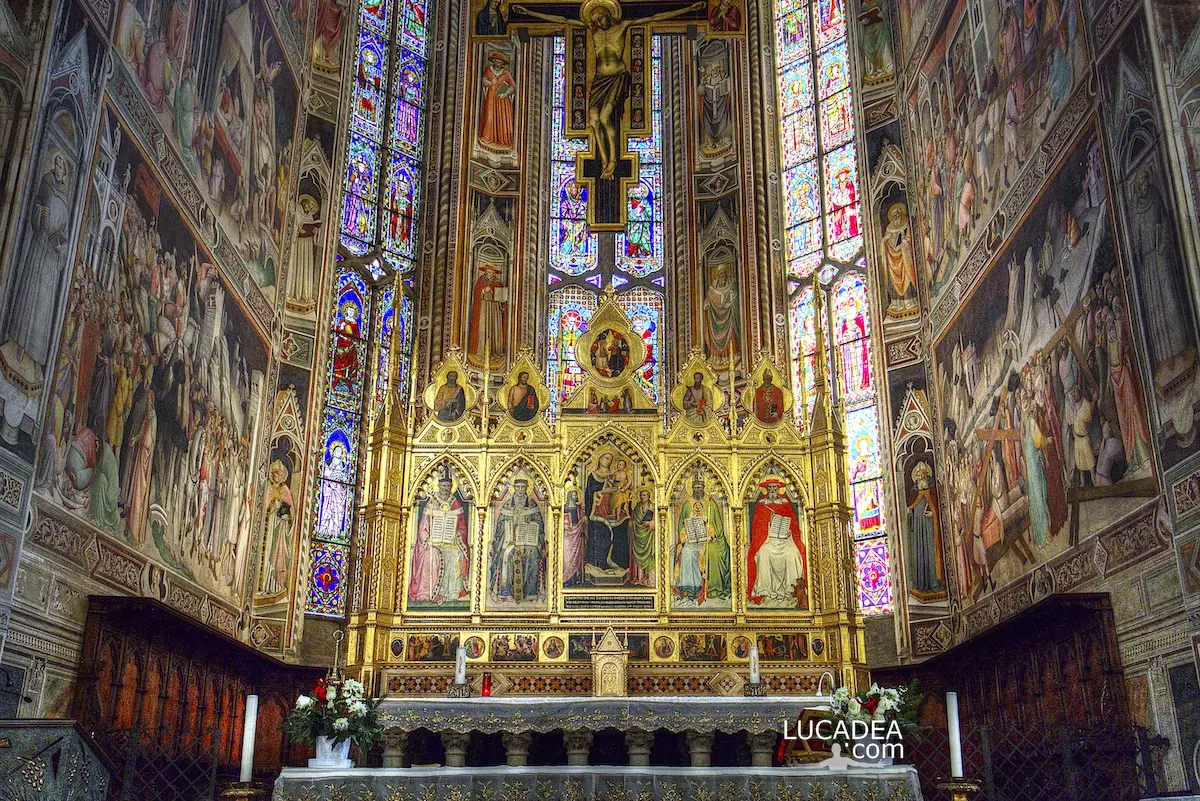
Entering the Basilica of Santa Croce in Florence, Tuscany, Italy, I found myself looking at one of the details that best represents the artistic richness of the city: the Main Altar of the Cappella Maggiore. This photograph of Santa Croce’s altar shows a quieter subject compared with the most famous artworks inside the church, but it captures an important part of what to see in Florence when exploring its artistic heritage.
During my visit, I wanted to spend some time observing this area of the basilica, looking at the structure of the altar, the decorations, and the way every element contributes to the atmosphere of the space. I took this photograph with my camera because I was fascinated by how many details could be contained in a single view. In places like Santa Croce, visitors are often focused on the famous people connected to the church, but the architectural and artistic details deserve the same attention.
The Cappella Maggiore is one of the central areas of the Basilica of Santa Croce and represents one of the most important parts of the building. Looking at the altar, it is possible to feel the connection between art and spirituality that can be found in many Italian churches, where painting, sculpture, and architecture come together in the same space.
Santa Croce is also known as the “Temple of the Italian Glories” because it contains the tombs and monuments of many important figures, including Michelangelo, Galileo Galilei, and Niccolò Machiavelli. This historical aspect gives the basilica an additional importance, as every corner is connected to centuries of culture and history.
Among my photographs of Florence, I have also shared other views of the city’s landmarks, such as the Cathedral and Piazza della Signoria. Here too, my goal was to capture a detail that might be overlooked among the many famous artworks surrounding it.
The Main Altar of Santa Croce represents an invitation to slow down and observe carefully. Photography cannot replace the experience of being inside the basilica, but it can preserve a small fragment of that moment and the feeling of standing in front of a place shaped by centuries of artistic work.

When visiting a church full of artworks, do you prefer focusing on the famous masterpieces or discovering the smaller details that reveal themselves slowly? Add a comment or go to the bottom of the site to read what other visitors have written.

Main Altar of the Basilica of Santa Croce in Florence with artistic decorations inside the Cappella Maggiore

Photo taken with Canon EOS M100 and Canon EF-M 11-22 lens.

To see all the photos of the basilica, click here:

This is the official website: santacroceopera.it.

The designs for the stained glass windows are also by Agnolo Gaddi, except for the uppermost oculi, which are older. The painted cross is by the Master of Figline, while the polyptych of the high altar is the result of a recomposition: the Madonna in the center is by Niccolò Gerini, while the Doctors of the Church are by Giovanni del Biondo and another unknown painter.
Continue and learn more at Wikipedia

Galileo Galilei’s tomb in Santa Croce Florence

La tomba di Galileo Galilei in Santa Croce a Firenze

Galileo Galilei’s tomb in Santa Croce Florence.
Walking inside the Basilica of Santa Croce in Florence, I photographed one of the most meaningful monuments preserved in the church: the tomb of Galileo Galilei, located along the left nave among the many memorials dedicated to important figures of Italian history.
Galileo Galilei’s tomb in Florence is one of the things worth seeing inside Santa Croce, a basilica often considered a pantheon of Italian personalities because of the number of artists, writers and thinkers buried there. Moving through the interior of the church, every monument tells a different story and reveals the importance of the people remembered in this place.
I took this photograph because I was fascinated by the connection between the monument and the person it represents. Galileo’s tomb is not simply a burial place, but a symbol of scientific curiosity and the desire to understand the world through observation and research.
This photograph was taken in Florence, in the Tuscany region of Italy, while focusing on one of the many details that make Santa Croce such a fascinating place to explore. If you are visiting Florence and looking for places worth seeing beyond the most famous landmarks, the basilica offers an extraordinary collection of artistic and historical memories.
The tomb of Galileo is located in the left nave of the church and is one of the most recognizable monuments inside Santa Croce. A historical curiosity is that after Galileo’s death in 1642, his burial and public commemoration were initially complicated because of the conflict between his scientific ideas and the Church. Only later was the impressive monument we see today created in his honour.
I enjoy photographing places like Santa Croce because they allow me to connect architecture, history and small visual details. Like the other photographs I have shared from this basilica, this image comes from the desire to capture not only a beautiful object but also the story behind it.
Galileo’s name is still associated with observation and discovery, and those ideas have a special connection with photography as well. Looking carefully, finding details and trying to understand what is in front of us are essential parts of both scientific research and photographic work.
A visit to Santa Croce is therefore not only about admiring a historic church, but also about meeting the memories of people who shaped Italian culture. Galileo’s tomb is one of those places where it is worth stopping for a moment and looking closely.

Have you ever visited Santa Croce and taken time to admire Galileo Galilei’s tomb? Add a comment or go to the bottom of the site to read what other visitors have written.

Galileo Galilei’s tomb inside Santa Croce Basilica in Florence with the monument in the left nave

Photo taken with Canon EOS M100 and lens Canon EF-M 11-22.

This is the official website: santacroceopera.it.

To see all the photos of the basilica, click here:

Galileo’s tomb is decorated with a bust by Giovan Battista Foggini and the personifications of Astronomy (by Vincenzo Foggini) and Geometry by Girolamo Ticciati. The surrounding frescoes are remnants of the 14th-century decoration of the nave, attributed to Mariotto di Nardo.
Continue and learn more at Wikipedia

The Lunette of Santa Croce in Florence

La lunetta del portale centrale di Santa Croce a Firenze

The Lunette of Santa Croce in Florence.
Among the many details to be found on the façade of the Basilica of Santa Croce in Florence, I wanted to focus on the one above the central portal. It is the kind of detail that can easily disappear when looking at the façade as a whole, but moving closer reveals a remarkable amount of sculptural detail.
The photograph shows the lunette above the central portal, with the sculptural group known as The Triumph of the Cross, created by Giovanni Duprè. This is the kind of detail I enjoy photographing when visiting an historic city: not only the monument as a whole, but also the smaller sections of a façade that tell a story through sculpture and architecture.
When thinking about what to see in Florence, the Basilica of Santa Croce is naturally one of the places worth paying attention to. Its large marble façade immediately catches the eye, but standing in front of the central portal for a few minutes reveals how much there is to discover in the smaller details. In this photograph I wanted the lunette to become the main subject rather than simply part of a wider view.
The subject represented is the Cross, the central symbol of the basilica and of Christian tradition. The sculptural group is known as The Triumph of the Cross and was created by Giovanni Duprè, a nineteenth-century Italian sculptor. The scene belongs to the nineteenth-century decorative programme of the façade and contributes to the monumental appearance that still makes Santa Croce one of the most recognisable landmarks in Florence.
There is a small historical detail that makes the façade particularly interesting. Although the basilica itself has medieval origins, the façade we see today dates from the nineteenth century and was created as part of the completion of the church’s exterior. Looking at Santa Croce therefore means looking at different historical periods layered together: the much older history of the basilica and the considerably later decorative intervention visible on its façade.
That contrast is part of what interests me in this photograph. The lunette is not simply an isolated decoration. It belongs to a much more elaborate façade where marble, arches, columns and sculptures form a complex composition. By moving closer with my camera, however, I chose to leave most of the building outside the frame and concentrate on the sculpted scene.
I wanted to capture this detail because small elements like this are often the things that remain in my memory after visiting a place. The façade of Santa Croce is one of those views that can be recognised immediately, but looking at it carefully reveals countless different photographic subjects.
The basilica stands in the historic centre of Florence, Tuscany, Italy, in an area that has an extraordinary concentration of artistic and historical landmarks. Santa Croce is closely associated with many important figures of Italian culture, but in this post I prefer to leave that larger story aside and focus on the particular detail that caught my attention.
It also continues a thread running through other articles I have published about churches and architectural details photographed during my travels. As with my photograph of the portico beneath the Vasari Corridor, I was not interested in simply reproducing another classic view of Florence. I wanted to isolate a detail that takes on its own character when seen from closer up.
Looking through the camera, what caught my attention most was the relationship between the sculpted figures and the architectural frame around them. Because the lunette sits directly above the central entrance, it becomes a visual point of transition: anyone entering the basilica passes beneath this representation of the Cross.
The photograph therefore does not attempt to tell the entire story of Santa Croce. It focuses on a small fragment of its façade. Yet that is enough to show how a single lunette can become a subject capable of bringing together art, history and architecture.

If you are visiting Florence, have you ever stopped to look closely at the lunette above Santa Croce’s central portal? Add a comment or go to the bottom of the site to read what other visitors have written.

Lunette above the central portal of Santa Croce Basilica in Florence with The Triumph of the Cross

Photo taken with Canon EOS M100 and Canon EF-M 11-22 lens.

To see all the photos of the basilica, click here:

This is the official website: santacroceopera.it.

The facade of the Basilica of Santa Croce in Florence

La facciata della Basilica di Santa Croce a Firenze

The façade of the Basilica of Santa Croce in Florence.
I’ve been to the Tuscan city of Florence several times, but despite having long been meaning to, I only recently managed to visit the Basilica of Santa Croce.
And it was truly a wonderful visit, given the many beauties and pages of history this monument holds within.

Do you know or have you visited this beautiful church in Florence? Add a comment or go to the bottom of the site to read what other visitors have written.

La facciata della Basilica di Santa Croce a Firenze

Photo taken with Canon EOS M100 and Canon EF-M 11-22 lens.

To see all the photos of the basilica, click here:

This is the official website: santacroceopera.it.

The Basilica of Santa Croce in the square of the same name in Florence is one of the largest Franciscan churches and one of the greatest examples of Gothic architecture in Italy, and holds the rank of minor basilica. Santa Croce is a prestigious symbol of Florence, the meeting place of the greatest artists, theologians, religious figures, writers, humanists, and politicians, who, for better or worse, shaped the identity of the late medieval and Renaissance city.
Continue and learn more at Wikipedia

The facade of the Basilica of Santa Croce in Florence – La façade de la Basilique de Santa Croce à Florence – La fachada de la Basílica de Santa Croce en Florencia – A fachada da Basílica de Santa Croce em Florença – Die Fassade der Basilika Santa Croce in Florenz – Mặt tiền của Vương cung thánh đường Santa Croce ở Florence – 佛罗伦萨圣十字大教堂的正面 – フィレンツェのサンタクローチェ大聖堂のファサード

The view of all of Florence from Piazzale Michelangelo

La vista su tutta Firenze da piazzale Michelangelo

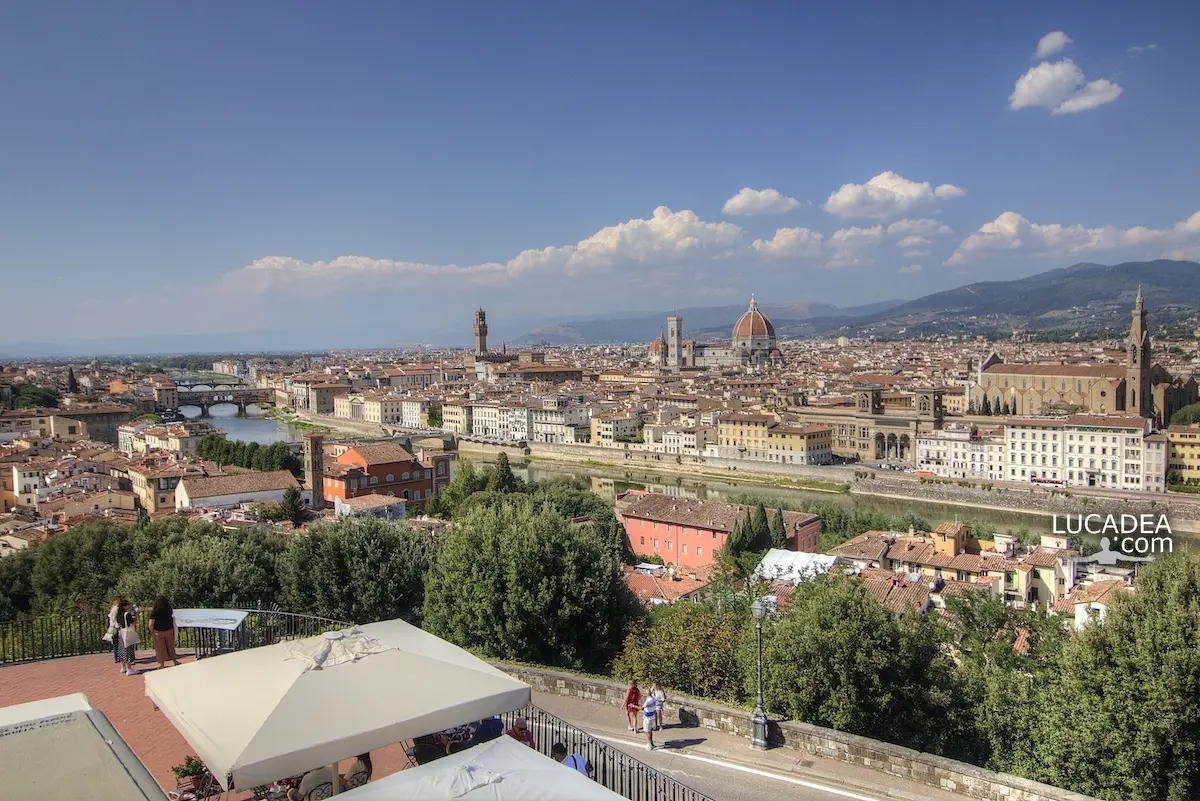
The view of all of Florence from Piazzale Michelangelo.
There’s no better place to see (and photograph) the splendid city of Florence than Piazzale Michelangelo.
From here you can see almost everything: the Duomo di Santa Maria del Fiore, Palazzo Vecchio, the Basilica of Santa Croce, and the Ponte Vecchio.

Have you been to Florence and Piazzale Michelangelo? Add a comment or go to the bottom of the site to read what other visitors have written.

La vista su tutta Firenze da piazzale Michelangelo

La vista su tutta Firenze da piazzale Michelangelo

Photos taken with Canon EOS M100 and Canon EF-S 10-18 lens.

To see all the photos I took in the beautiful Tuscan town, click here:

Piazzale Michelangelo in Florence is the most famous observation point of the city skyline, depicted on countless postcards and a must-see for tourists visiting the city.
It was built in 1869 based on a design by architect Giuseppe Poggi on a hill just south of the historic center, completing the redevelopment of the left bank of the Arno.
Continue and learn more at Wikipedia

The view across Florence from Piazzale Michelangelo – La vue sur Florence depuis la Piazzale Michelangelo – Der Blick über Florenz vom Piazzale Michelangelo – Khung cảnh khắp Florence từ Piazzale Michelangelo
🏠
  • Italiano