The Saint Ambrose Bronze Door of Milan Cathedral

Un particole di uno dei portali del Duomo di Milano

The Saint Ambrose Bronze Door of Milan Cathedral.
During my visit to Milan Cathedral, one of the details that caught my attention most was one of its five monumental bronze doors. As I was leaving the Cathedral after the visit, I stopped to admire this particular entrance, dedicated to Saint Ambrose, the patron saint of Milan. Its sculpted panels depict episodes connected with the life and works of this important religious figure.
The door was created by Giannino Castiglioni, a Milanese sculptor who made a significant contribution to Italian sculpture in the twentieth century. The bronze panels form a visual narrative, with figures and scenes arranged across the surface. What might otherwise be simply an entrance becomes a work of art in its own right, telling a story through sculpted images.
Saint Ambrose occupies a special place in Milan’s history. He was bishop of the city in the fourth century and became one of the most influential figures in its religious and civic life. His legacy has remained closely connected with Milan’s identity, and he is still celebrated as the city’s patron saint. His feast day, on December 7, is an important date in the local calendar and remains a much-loved Milanese tradition.
Looking closely at the bronze door, it is easy to appreciate how an architectural element designed for everyday use can also become a remarkable artistic surface. Bronze allows the sculptor to create raised figures and intricate details, while the changing light produces contrasts between highlights and shadows. The reliefs seem to emerge from the metal, encouraging visitors to pause and follow the scenes one by one.
Milan Cathedral is best known for its imposing Gothic architecture, its countless statues, its spires and its extraordinary scale. Yet a visit to such an important monument is also an opportunity to discover details that can be just as fascinating as the overall structure. The monumental doors are part of this artistic heritage, and each one deserves attention for its decoration and subject.
What particularly impressed me was the meeting of history and sculpture. The story of Saint Ambrose, a figure so deeply associated with Milan, is presented through the artistic work of Giannino Castiglioni. The result belongs naturally to the setting of the Cathedral while offering visitors another way to appreciate its cultural and artistic richness.
The photograph I took preserves the memory of this detail, which I noticed towards the end of my visit. It is easy to focus on the immense scale of the building and overlook its individual elements, but taking a closer look reveals stories that are an essential part of the monument. This bronze door is a fine example of how art, faith and the history of a city can come together in a single architectural feature.

And what about you? When visiting a great cathedral, do you also take time to admire its doors and smaller artistic details? Add a comment or go to the bottom of the site to read what other visitors have written.

Detail of the bronze door dedicated to Saint Ambrose, created by Giannino Castiglioni for Milan Cathedral

Photo taken with a Canon EOS M100 camera and Canon EF-M 11-22 lens.

To see all the photos I took on the roof and inside the Duomo click here:

Add one  comment to this article or read  here what other visitors have written.
 
Adv
 
Disclamer

The rights on images, videos, choruses, text and all other material on the LUCADEA.com website are governed as per  Copyright page.


This page has been viewed 1 times today.
This month it has been viewed 2 times.
In total it has been viewed 2 times.
 

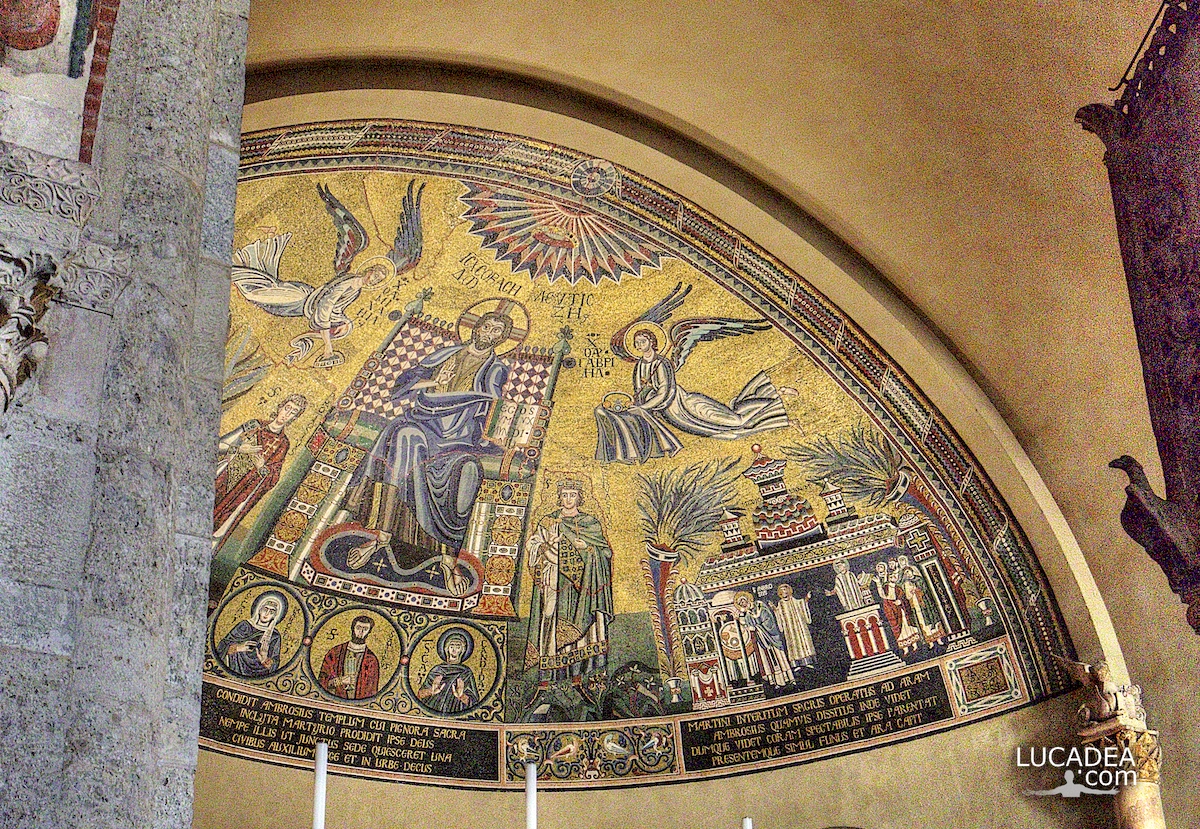
The apse mosaic of Sant’Ambrogio

Mosaico absidale dorato della Basilica di Sant’Ambrogio a Milano con Cristo Pantocratore

The apse mosaic of Sant’Ambrogio.
Inside Sant’Ambrogio Basilica in Milan, one of the elements that immediately captures the visitor’s attention is the large mosaic covering the apse, an extraordinary testimony to medieval art and the religious history of the city.
During my visit to the basilica, I wanted to photograph this detail because, besides the famous golden altar and the impressive ciborium, the apse creates one of the most spectacular areas of the entire building. The light reflecting on the golden tiles gives the mosaic a unique atmosphere and highlights the richness of its details.
At the centre of the composition is Christ Pantocrator, seated on a throne with the open book and surrounded by the symbols of the Evangelists. On both sides there are several saints, including Saint Ambrose, the patron saint of Milan to whom the basilica is dedicated.
The mosaic follows the principles of Byzantine medieval iconography, with a solemn and majestic representation of Christ. The vivid colours, the use of gold and the arrangement of the tiles create effects of light and depth that bring the figures to life.
I wanted to capture this detail with my camera because when visiting a church so rich in history, it is easy to focus only on the most famous elements and miss smaller masterpieces that deserve attention.
Sant’Ambrogio Basilica is located in Milan, Lombardy, Italy, and it is one of the most important monuments in the city. Founded in the 4th century by Bishop Ambrose, it preserves many valuable artworks and represents one of the finest examples of Lombard Romanesque architecture.
A small curiosity is that the apse mosaic, despite its ancient origins, has undergone several restorations over the centuries, including work after the damage suffered during the Second World War. Its current beauty is therefore also the result of careful conservation.
After photographing the golden altar of the basilica, I could not miss the opportunity to capture this magnificent golden wall dominating the altar area and welcoming visitors with its impressive presence.
Standing in front of such an artwork, it is natural to think about how many people, throughout the centuries, have looked up at the same mosaic and found in it both an artistic and spiritual reference.

Have you ever visited Sant’Ambrogio Basilica in Milan? Add a comment or go to the bottom of the site to read what other visitors have written.

Golden apse mosaic of Sant’Ambrogio Basilica in Milan featuring Christ Pantocrator

Photo taken with a Canon EOS M100 camera and Canon EF-M 11-22 lens.

This is the church’s official website: basilicasantambrogio.it.

To see all the photos I took at the Basilica, click here:

The mosaic adorning the semi-dome of the apse in the Basilica of Sant’Ambrogio depicts Christ enthroned against a gold background, flanked by Saints Gervasius and Protasius.
Read more and explore further at lombardiabeniculturali.it

Add one  comment to this article or read  here what other visitors have written.
 
Adv
 
Disclamer

The rights on images, videos, choruses, text and all other material on the LUCADEA.com website are governed as per  Copyright page.

This page has been viewed 1 times today.
This month it has been viewed 1 times.
In total it has been viewed 2 times.
 

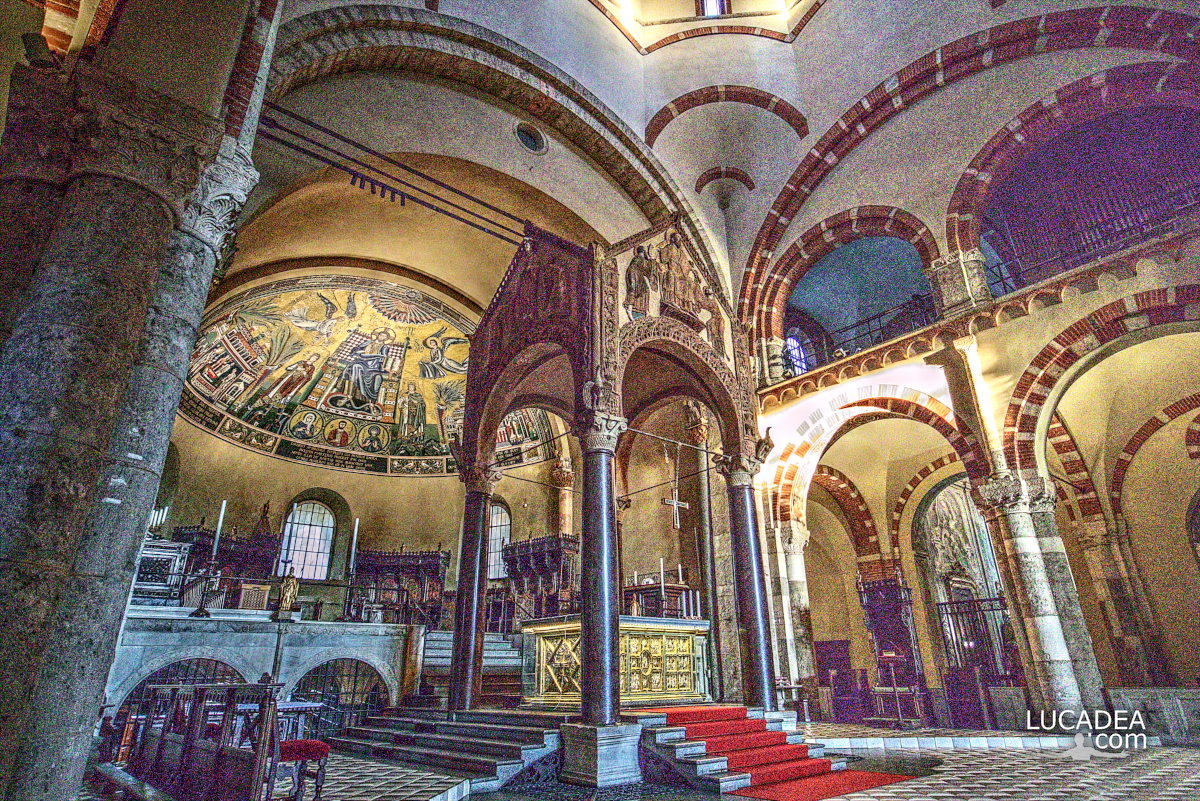
The golden altar of Sant’Ambrogio Basilica

Altare maggiore dorato della Basilica di Sant’Ambrogio a Milano con mosaici dell’abside

The golden altar of Sant’Ambrogio Basilica.
Entering Sant’Ambrogio Basilica in Milan, your eyes are naturally drawn towards the centre of the church, where the magnificent golden altar stands beneath the ciborium, with the colourful mosaics of the apse behind it.
During my visit to the basilica, I wanted to capture this detail with my camera because, beyond its famous brick facade and beautiful cloister, the interior also preserves remarkable artistic and historical elements. Often, these less obvious details are the ones that reveal the true character of a place.
The main altar of Sant’Ambrogio Basilica is one of the most important masterpieces kept inside the church. Its golden and silver surfaces stand out beneath the ciborium, creating a fascinating composition together with the apse mosaic behind it. The richness of the decorations invites visitors to stop and observe carefully.
This photograph comes from my desire to tell the story of this part of the basilica, rather than focusing only on the most famous views. When I visit historic churches, I often try to photograph details that can communicate the feeling of standing in front of something that has survived through many centuries.
Sant’Ambrogio Basilica is located in Milan, Lombardy, Italy, and it is one of the most important religious buildings in the city. For anyone looking for places to see in Milan beyond the Duomo, this church offers a different perspective on the history and origins of the city.
A small curiosity about the altar is that it was created between the 9th and 10th centuries by order of Archbishop Angilberto II. Known as the Altar of Sant’Ambrogio, it is decorated with precious gold and silver panels, enriched with enamel work and gemstones. Beneath it are preserved the relics of Saints Gervasius and Protasius and of Saint Ambrose himself.
On my website I have already shared other views of Milan, from the Navigli area to the Brera district, but this basilica shows a different side of the city: older, quieter and deeply connected to its origins.
Photographing a detail like this means preserving a small fragment of a much larger story, hidden inside the walls of one of Milan’s most important churches.

Have you ever visited Sant’Ambrogio Basilica and looked closely at this remarkable altar? Add a comment or go to the bottom of the site to read what other visitors have written.

Golden main altar of Sant’Ambrogio Basilica in Milan with apse mosaics in the background

Photo taken with a Canon EOS M100 camera and Canon EF-M 11-22 lens.

This is the church’s official website: basilicasantambrogio.it.

To see all the photos I took at the Basilica, click here:

The Altar of Saint Ambrose is the high altar of the Basilica of Saint Ambrose in Milan. The altar is the focal point of the renovation carried out at the basilica by the Frankish bishop Angilbert II. The ancient basilica, with its wealth of relics, serves as the setting for the political and religious agenda guiding the bishop—a representative of Carolingian authority—in his reorganization of the city and its territory.
Read more on Wikipedia

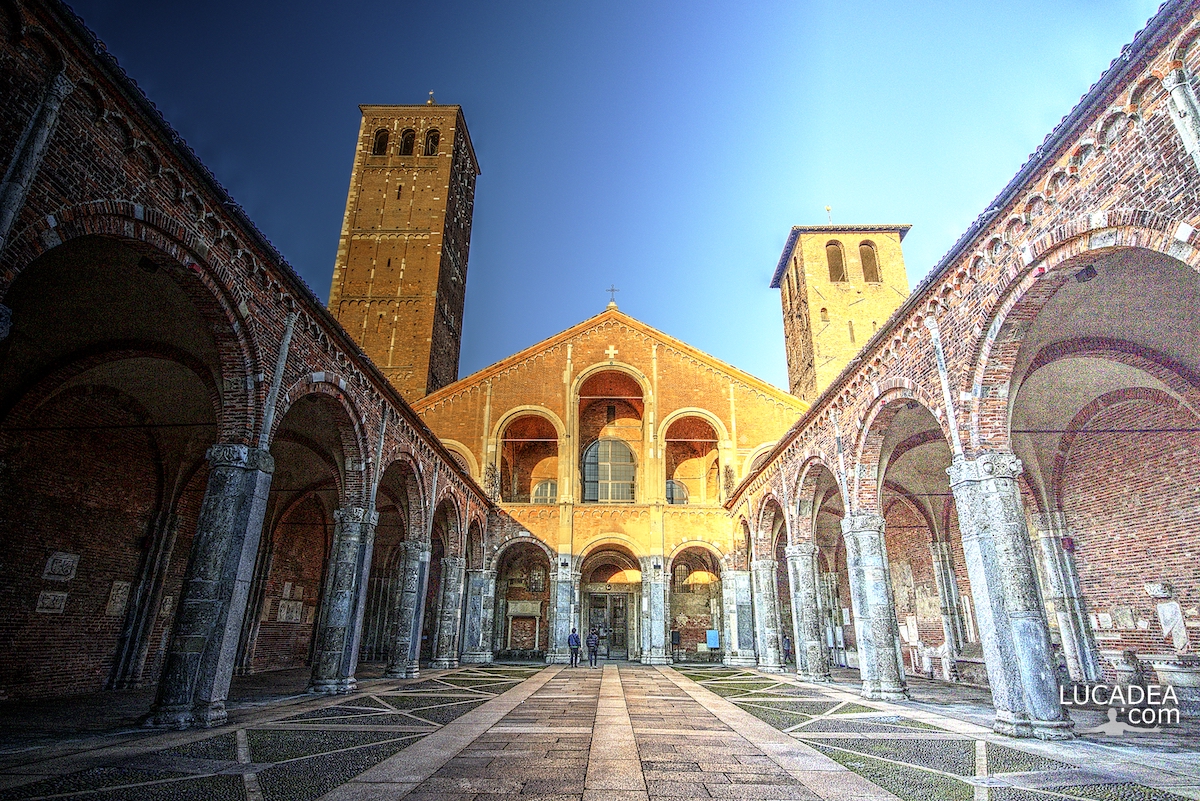
The facade of Sant’Ambrogio Basilica in Milan

Facciata della Basilica di Sant’Ambrogio a Milano con il quadriportico storico davanti alla chiesa

The facade of Sant’Ambrogio Basilica in Milan.
When I visited Sant’Ambrogio Basilica in Milan, one of the most important symbols of the city, I stopped to admire its famous facade with the quadriportico, the architectural element that makes this historic complex instantly recognizable. This photograph is not only about an ancient building, but also about a personal memory connected with a poem I studied many years ago.
While standing in front of the basilica, I remembered “Sant’Ambrogio”, a poem written by Giuseppe Giusti that I learned during middle school. The first verses came back to my mind because the poem begins with the writer describing his arrival at the famous Milanese church:

“Vostra Eccellenza, che mi sta in cagnesco…”

The poem uses the visit to Sant’Ambrogio as a starting point for reflections about history and politics during the period in which it was written. Seeing the place in reality after knowing it from school books gave the visit a special meaning, connecting literature with a real location.
Sant’Ambrogio Basilica is located in the centre of Milan and is dedicated to Saint Ambrose, the patron saint of the city. The current structure mainly dates back to the Romanesque period and is considered one of the most important examples of Romanesque architecture in Lombardy. The large quadriportico in front of the church is one of its most distinctive features and was historically used as a gathering space for visitors and worshippers.
One interesting historical detail is the strong connection between the basilica and Saint Ambrose, the fourth-century bishop who played a fundamental role in the history of Milan and Christianity. Inside the church there are also important artworks, including the famous Carolingian golden altar.
I wanted to capture this facade with my camera because often the exterior of a building is the first element that creates a connection with a place. In this case, it is not just an impressive architectural view, but a meeting point between personal memories, literature and history.
On my blog I often share photographs of Italian places connected with art and culture because I enjoy discovering how a building can preserve stories beyond its appearance.

Have you ever visited Sant’Ambrogio Basilica in Milan, or found yourself in a place you first knew from books? Add a comment or go to the bottom of the site to read what other visitors have written.

Facade of Sant’Ambrogio Basilica in Milan with the historic quadriportico in front of the church

Photo taken with a Canon EOS M100 camera and Canon EF-M 11-22 lens.

This is the church’s official website: basilicasantambrogio.it.

To see all the photos I took at the Basilica, click here:

The basilica features a broad, low-slung gable façade and two superimposed loggias. The sides of the lower loggia—which consists of three equal-sized arches—connect to the portico, which has slightly taller arches.
Read more on Wikipedia

🏠
  • Italiano