
Swiss Gipfel, the buttery traditional pastry

Swiss Gipfel, the buttery traditional pastry.
During one of my trips to Switzerland, I stopped to enjoy one of those simple local specialties that often tell more about a country than famous dishes: the Gipfel, the typical Swiss butter croissant enjoyed for breakfast or during a quiet break.
This photograph comes from my curiosity about Swiss food and about those everyday products that may look familiar but still have their own identity. When thinking about what to eat in Switzerland, many people immediately mention cheese or chocolate, but small bakery products like the Swiss Gipfel are also an important part of local habits.
The Swiss Gipfel is very similar in appearance to a classic croissant, but it is usually made with a buttery dough and is not necessarily sweet like the Italian cornetto. Its delicate flavour and rich buttery taste make it perfect even without fillings, simply enjoyed with a coffee or another warm drink.
I decided to photograph this specialty because food is also part of the story of a place. A country is not only made of landscapes, architecture and famous attractions, but also of small daily moments: entering a bakery, choosing a freshly prepared pastry and tasting something that local people have known for generations.
The Gipfel, also called Buttergipfel or Swiss croissant, is one of the most common pastries found in Swiss bakeries. The name comes from Swiss German and means “summit” or “peak”, probably referring to its curved shape that recalls the mountains surrounding many Swiss regions.
While looking for information about this pastry, I found many recipes for butter croissants but much less information about its exact origins. It is still fascinating to see how a preparation related to the French croissant developed its own Swiss character and became part of everyday life.
If you are visiting Switzerland, trying a Gipfel in a local bakery is one of those small experiences worth having because it gives a taste of the country beyond the most famous attractions.
On my blog I have often shared other small discoveries from my travels, because sometimes a simple taste, a local product or an unexpected detail can become one of the strongest memories of a journey.

Have you ever tasted a Swiss Gipfel during a trip, or is there another Swiss specialty you would recommend trying? Add a comment or go to the bottom of the site to read what other visitors have written.

Swiss Gipfel butter pastry, a traditional Swiss croissant photographed during a travel experience

Persistent popular stories circulate that mistakenly attribute the origin and shape of the croissant to the celebration of the defeat of the Ottoman Empire in the siege of Vienna in 1683 or the siege of Budapest in 1686. According to these stories, a baker working at night heard the noise of the Turks digging an underground tunnel. As a reward for saving the city, the baker received the exclusive right to produce crescent-shaped pastries to commemorate the event. However, there are no original sources from the period to confirm any of these stories.
Continue on Wikipedia

Add one  comment to this article or read  here what other visitors have written.
 
Adv
 
Disclamer

The rights on images, videos, choruses, text and all other material on the LUCADEA.com website are governed as per  Copyright page.

This page has been viewed 0 times today.
This month it has been viewed 0 times.
In total it has been viewed 22 times.
 

Pilgrim souvenirs in Santiago

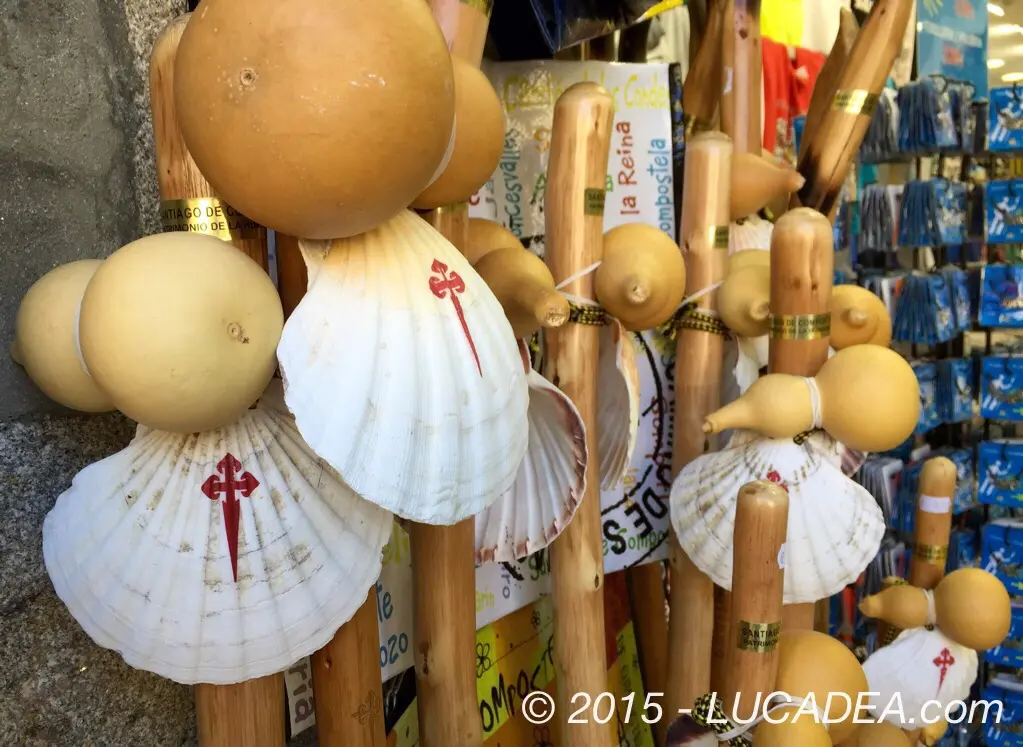
Souvenir dei pellegrini del Cammino di Santiago con bastoni conchiglie e borracce

Pilgrim souvenirs in Santiago de Compostela.
Walking through the historic center of Santiago de Compostela, in Galicia, Spain, one of the most important pilgrimage destinations in the world, it is almost impossible not to notice the many symbols connected with the famous Camino.
Among them, the pilgrim’s staff, the shell, and the traditional gourd used as a water bottle certainly stand out. Simple objects that, over the centuries, have taken on a deep meaning for all those who undertake the long journey to the cathedral that houses the remains of the Apostle Saint James.
The staff is probably one of the oldest elements associated with pilgrims. Besides being a practical help during the walk, it also represents the support needed to face a journey made of effort, sacrifice, and personal growth.
The shell is instead the most recognizable symbol of the Camino de Santiago. In the past, it was collected on the Galician coast by pilgrims who reached their destination and, over time, became the distinctive sign of those who complete this extraordinary spiritual and cultural experience.
The gourd, used as a water container, also recalls the image of the medieval pilgrim. Today these objects have lost their original practical purpose, but they continue to be purchased as souvenirs or as symbols of an experience that often changes those who live it.
Of course, these symbols cannot be missing from the many souvenir shops in the city. Among magnets, statues, crosses, and other memories, visitors can find staffs, shells, and small gourds that tell a story going back many centuries.
Even a simple souvenir can therefore hide a special meaning: it is not just an object bought during a holiday, but the memory of a journey, an encounter, or perhaps a dream that has come true.

Have you ever walked the Camino de Santiago or would you like to do it someday? Add a comment or go to the bottom of the site to read what other visitors have written.

Camino de Santiago pilgrim souvenirs with staffs shells and gourds

It is renowned because, according to Christian tradition, it has been the resting place of the mortal remains of James the Great—an apostle of Jesus—for over a millennium. Santiago de Compostela and the famous pilgrimage route of the same name were declared a UNESCO World Heritage Site in 1985. The city is the seat of the Galician autonomous government (Xunta de Galicia), a destination for religious pilgrims from around the world, and home to a university with a history spanning more than 500 years.
Read more on Wikipedia

Add one  comment to this article or read  here what other visitors have written.
 
Adv
 
Disclamer

The rights on images, videos, choruses, text and all other material on the LUCADEA.com website are governed as per  Copyright page.


This page has been viewed 1 times today.
This month it has been viewed 2 times.
In total it has been viewed 2 times.
 
🏠
  • Italiano