
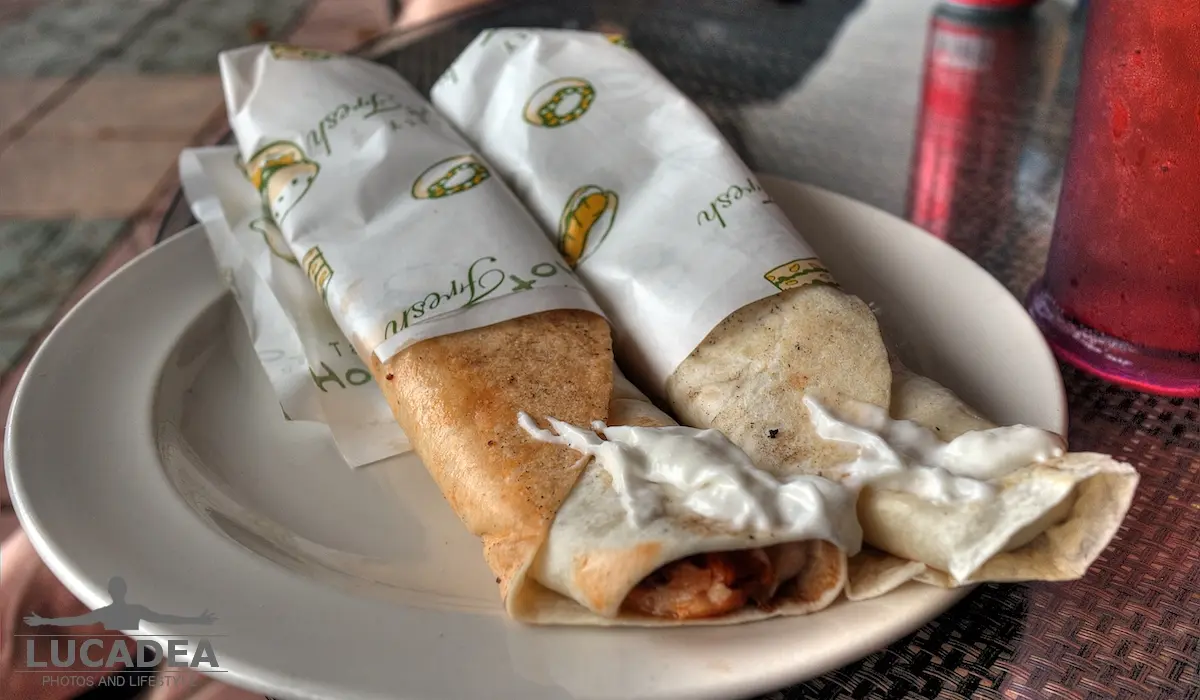
Kebab, a dish far from my favourite tastes

Kebab servito in un piatto con carne, pane e ingredienti tipici della cucina mediorientale

Kebab, a dish far from my favourite tastes.
Among all the different foods that can be discovered around the world, kebab is one of those dishes my son wanted me to write about after trying it during a recent trip to Malaysia.
It is not the kind of food I would usually choose, but this is exactly why I found it interesting to tell its story. Even a dish that is not among my personal favourites can become a reason to remember a journey, discover a different culture and look at how food habits change from one country to another.
Kebab is now one of the most widespread street foods in the world, but its origins are connected to the Middle Eastern area, especially Turkey. The word refers to a way of cooking meat on a spit, and the traditional preparation involves layers of meat slowly cooked on a vertical rotating skewer. The outer part is cut away as it becomes ready, creating the typical thin slices associated with this dish.
The kebab that many people know today is often different from the original version. Like many popular foods, it has adapted to local tastes, available ingredients and economic conditions. In Greece, for example, a similar dish is known as gyros and is often prepared with pork or chicken, served with vegetables, fries and sauces inside a type of flatbread.
This evolution is what makes me a little uncertain about the dish. The quality of a kebab can depend greatly on where it is prepared and on the attention given to the ingredients. The name alone does not guarantee a good experience; as with many foods, preparation and quality make the real difference.
This photograph comes from my son’s experience and from my curiosity about a food that can now be found almost everywhere. Even if kebab is not my ideal meal, I still find fascinating the way a dish can travel across countries, change its appearance and become part of everyday life in completely different cultures.
A small curiosity is that traditional kebab was not originally created as a quick sandwich, but as a method of cooking meat connected to the culinary traditions of Turkey and surrounding regions.
On my blog I have already shared other stories about particular foods and products discovered during travels or brought home, because food, just like the places I photograph, always carries a story.

Have you ever tried kebab and enjoyed it, or do you also consider it a food that is not really for you? Add a comment or go to the bottom of the site to read what other visitors have written.

Kebab served with meat, bread and typical ingredients from Middle Eastern street food tradition

Photo taken with Canon EOS M100 and lens Canon EF-M 22.

Shawerma, (Arabic: شاورما‎, in turn from the Turkish çevirme), is a Middle Eastern meat dish. Although the word derives from the Turkish çevirme, meaning “which turns”, in Türkiye this preparation is called döner kebabı; in Greece it is called γύρος gyros, and in the latter case it is mainly made from pork, an animal excluded from food consumption for Islamic populations.
Continue and learn more on Wikipedia

Add one  comment to this article or read  here what other visitors have written.
 
Adv
 
Disclamer

The rights on images, videos, choruses, text and all other material on the LUCADEA.com website are governed as per  Copyright page.


This page has been viewed 0 times today.
This month it has been viewed 0 times.
In total it has been viewed 0 times.
 

A Turkish dish in Barcelona: Kofte Kebab

Un piatto turco a Barcellona: Kofte Kebab

A Turkish dish in Barcelona: Kofte Kebab.
When I’m in Barcelona, ​​I like to try some Turkish food for a change. I normally opt for the classic kebab, but last time I tried this dish.
In the vast universe of Middle Eastern cuisine, few dishes can match the unmistakable taste and enveloping aroma of Kofte Kebab. Originally from Turkey, this dish has spread throughout the world thanks to its simplicity, versatility, and, above all, its incredible flavor.
Kofte Kebab is a classic of Turkish cuisine, with roots dating back centuries. “Kofte” comes from the Persian word “kufta,” meaning “minced” or “chopped,” while “kebab” is a Turkish word that refers to a dish cooked on a grill or skewer. This combination of minced ingredients and grilling makes Kofte Kebab a dish as delicious as it is rich in history.
The basic recipe for Kofte Kebab calls for minced meat, traditionally lamb or beef, although chicken or turkey variations are also common. Key ingredients include onion, garlic, parsley, and a combination of spices that can vary depending on personal taste and region. Common spices include cumin, black pepper, chili powder, and sweet or smoked paprika.
Once the ingredients are mixed, the meat is shaped into small patties or elongated shapes, skewered, and then grilled until evenly browned and juicy. This open-fire cooking process gives Kofte Kebab its distinctive smoky, aromatic flavor that makes it so irresistible.
Like many traditional dishes, Kofte Kebab has numerous regional variations that reflect different culinary influences and local preferences. For example, in the Black Sea region of Turkey, it’s common to add soaked and mashed stale bread to the meat mixture to impart a softer texture and a slightly different flavor. In contrast, in southeastern Turkey, kofte are often served with spicy tomato sauce or yogurt.
Kofte Kebab is often served with fresh and colorful side dishes, such as tomato and cucumber salad, thinly sliced ​​red onions, fresh parsley leaves, and squeezed lemon. These accompaniments not only add a refreshing note to the meal, but also perfectly balance the rich, intense flavors of the kebab.
The dish can be served on a bed of pilaf rice or accompanied by freshly baked flatbread, such as traditional “pide,” or Turkish bread. Some kofte kebab lovers also prefer to add a generous helping of yogurt sauce, enriched with garlic and mint, for an extra touch of freshness and creaminess.

In conclusion, kofte kebab is much more than just a plate of grilled meat; it is a symbol of conviviality, tradition, and culinary passion. Its simple yet delicious recipe and endless possibilities for customization make it a cornerstone of Middle Eastern cuisine beloved around the world. Whether you enjoy it in an authentic Turkish restaurant or prepare it yourself in the kitchen, Kofte Kebab is definitely a culinary treasure to be appreciated and enjoyed.

Add a comment or scroll down to read what other visitors have written.

Un piatto turco a Barcellona: Kofte Kebab

Photo taken with Honor 20.

Here’s where the restaurant is located:

A Turkish dish enjoyed in Barcelona: Kofte Kebab – Un plat turc apprécié à Barcelone : le Kofte Kebab – Un plato turco que se disfruta en Barcelona: Kofte Kebab – Um prato turco apreciado em Barcelona: Kofte Kebab – Ein türkisches Gericht, das man in Barcelona genießt: Kofte Kebab – Một món ăn Thổ Nhĩ Kỳ được thưởng thức ở Barcelona: Kofte Kebab

The text of this post was written with the help of ChatGPT, a language model from OpenAI.

Add one  comment to this article or read  here what other visitors have written.
 
Adv
 
Disclamer

The rights on images, videos, choruses, text and all other material on the LUCADEA.com website are governed as per  Copyright page.


This page has been viewed 0 times today.
This month it has been viewed 0 times.
In total it has been viewed 0 times.
 

Crossing the Bosphorus Strait

Stretto del Bosforo

Crossing the Bosphorus Strait.
Add some photos of the Bosphorus Strait, a picturesque stretch of water connecting the Mediterranean Sea to the Black Sea, of the bridges connecting the two shores of Turkey, and of the splendid buildings overlooking the sea.

Have you ever passed through here by boat?
Add a comment or go to the bottom of the site to read what other visitors have written.

Stretto del Bosforo

The photos are here:
foto gallery

Where is the strait located?

The Bosphorus is the strait that connects the Black Sea to the Sea of ​​Marmara and, together with the Dardanelles, marks the southern border between the European and Asian continents. It is 31.7 km long and 550 to 3,000 meters wide. On the European shore, around the Golden Horn, the city of Istanbul, the ancient Constantinople, developed; its current urban area also extends to the Asian shore for about 18 kilometers.
Continue and learn more at Wikipedia

Crossing the Bosphorus Strait – Traversée du détroit du Bosphore – Cruzando el estrecho del Bósforo – Atravessando o Estreito de Bósforo – Überquerung des Bosporus – Vượt qua eo biển Bosphorus
🏠
  • Italiano