A Votive Shrine in Genoa’s Historic Old Town

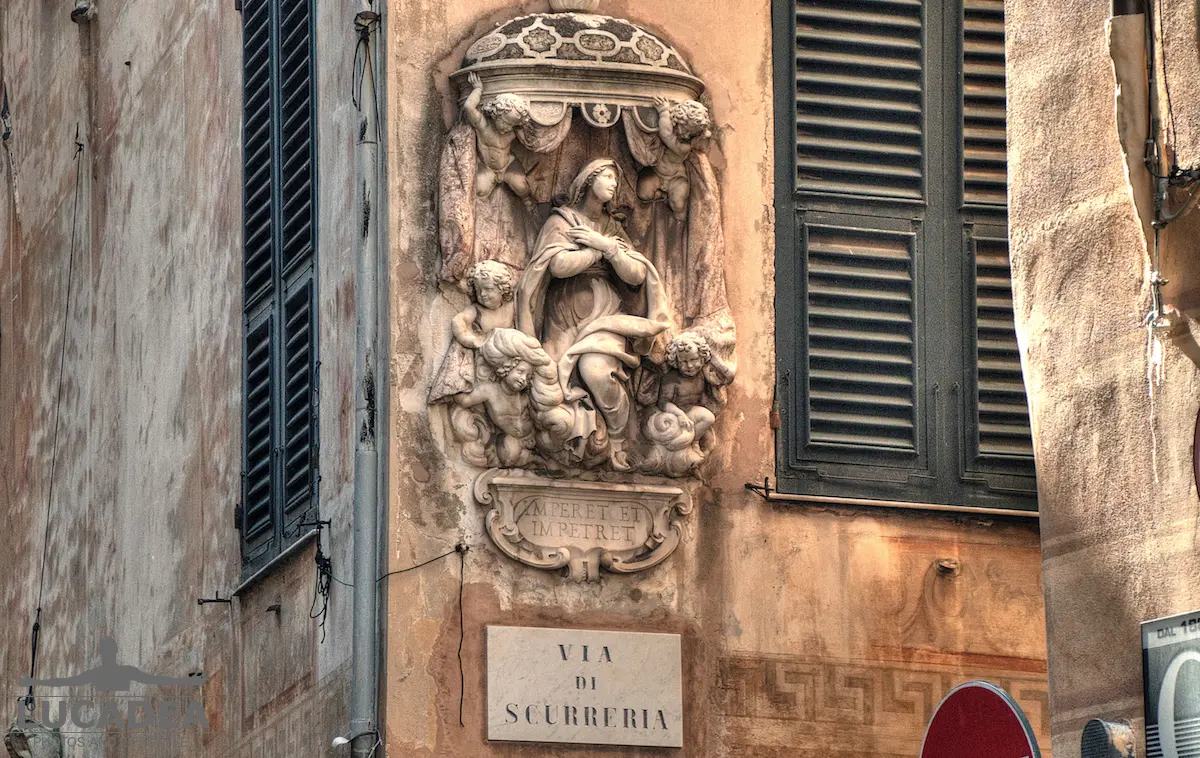
Edicola di via di Scurreria a Genova

A Votive Shrine in Genoa’s Historic Old Town.
In the historic centre of Genoa, between Piazza Campetto and Via di Scurreria, this small shrine is a reminder of Liguria’s tradition of popular religious devotion. Votive shrines are a familiar feature of the region’s streets and villages, often found on building façades, at street corners or along the narrow lanes of old neighbourhoods.
These small niches containing sacred images reflect an aspect of everyday history in Ligurian towns and cities. Some are simple and understated, while others have decorated frames and architectural details that make them stand out. They can easily be overlooked by people walking through the old town without stopping, yet a closer look often reveals details that contribute to the character of the surrounding streets.
The shrine on Via di Scurreria is part of a distinctive corner of Genoa, in Liguria, Italy. Narrow streets, closely spaced buildings and passages connecting small squares create a dense urban landscape shaped by different periods of history. Between Piazza Campetto and Via di Scurreria, even a modest religious feature adds another detail to the story of the city and its relationship with the people who live and move through it.
In the past, votive shrines often served as familiar points of reference for local religious life. Sacred images could be cared for by families and neighbourhood residents, particularly during religious celebrations. This tradition has left visible traces throughout Liguria, where many shrines remain part of the region’s historical and cultural heritage.
I took this photograph to focus on one of those small details that help define Genoa’s historic centre. It may not have the imposing presence of a grand palace or church, but it offers a quieter way to appreciate the character of the old town. I enjoy noticing features like this while walking through historic streets, because they encourage me to look beyond the main landmarks and pay attention to places that might otherwise go unnoticed.
The same curiosity can lead to the discovery of other corners of Genoa’s old town, where architecture, tradition and everyday life come together along streets that have connected the city’s neighbourhoods for generations.

Have you ever noticed a votive shrine while walking through Genoa or another town in Liguria? Add a comment or go to the bottom of the site to read what other visitors have written.

Votive shrine on Via di Scurreria, between Piazza Campetto and the narrow streets of Genoa’s historic centre in Liguria, Italy

Photo taken with Canon EOS M100 camera and Tamron 16-300 lens.

Where is it located:

Add one  comment to this article or read  here what other visitors have written.
 
Adv
 
Disclamer

The rights on images, videos, choruses, text and all other material on the LUCADEA.com website are governed as per  Copyright page.


This page has been viewed 0 times today.
This month it has been viewed 0 times.
In total it has been viewed 0 times.
 

Palace of Saint George in Genoa

Palazzo San Giorgio

Palace of Saint George in Genoa.
Whenever I walk around the Old Port, I find it difficult to pass this historic building without stopping to admire its elegant façade. The Palace of Saint George is one of the landmarks that best expresses Genoa’s long relationship with the sea, maritime trade and civic history. Standing close to the waterfront in Genoa, Liguria, Italy, the palace immediately catches the eye with its architectural details and colourful painted decorations.
The sea-facing façade is especially striking. Among its painted figures, one of the most recognisable is Saint George defeating the dragon. This image is much more than a decorative feature: Saint George was the patron saint of the Republic of Genoa, and the red cross on a white background associated with him remains an important symbol of the city’s historical identity. It is a detail that connects the building to the proud maritime republic that once played a major role in Mediterranean commerce.
The palace itself has a long and fascinating past. Construction began in the second half of the thirteenth century, when Guglielmo Boccanegra commissioned a public building near the harbour, close to the centre of Genoa’s commercial activity. Over the centuries, the building changed its purpose and appearance. It later became the headquarters of the Bank of Saint George, a powerful financial institution involved in managing public finances and revenues connected with the Republic. Its Renaissance appearance developed through later extensions and decorative work, including the celebrated frescoes painted by Lazzaro Tavarone between 1606 and 1608.
When I photograph historic places, I enjoy looking beyond the overall view and paying attention to the details that give each building its own character. Here, the painted façade offers plenty to discover, from the central scene of Saint George and the dragon to the surrounding figures and architectural decorations. I took this photograph to capture the charm of a building that continues to stand out, even in an area visited by so many people.
The Palace of Saint George is an excellent stop for anyone exploring Genoa’s Old Port. From here, it is easy to continue towards the historic lanes, the arcades of Sottoripa and other landmarks in the old city. If you are searching for historic buildings to see in Genoa, this palace deserves a place on your itinerary, even if you only have a few minutes to spare.
I also enjoy photographing the city’s less obvious details, from old façades and narrow streets to the squares that reveal different layers of Genoese history. Each image becomes a way to remember a place and share a little of its atmosphere.

When you visit Genoa’s Old Port, do you stop to admire the painted façade of the Palace of Saint George? Add an comment or go to the bottom of the site to read what other visitors have written.

The Palace of Saint George in Genoa, a historic building overlooking the Old Port with a painted façade depicting Saint George and the dragon

The Palace of Saint George in Genoa, a historic building overlooking the Old Port with a painted façade depicting Saint George and the dragon

Photos taken with a Canon EOS M100 camera and Tamron 16-300 lens.

Where is the building located:

Add one  comment to this article or read  here what other visitors have written.
 
Adv
 
Disclamer

The rights on images, videos, choruses, text and all other material on the LUCADEA.com website are governed as per  Copyright page.


This page has been viewed 0 times today.
This month it has been viewed 0 times.
In total it has been viewed 0 times.
 

Sunset from Montaldo Viewpoint in Genoa

La vista dal belvedere Montaldo a Genova

Sunset from Montaldo Viewpoint in Genoa.
Some places offer a completely different way of seeing a city, and Montaldo Viewpoint in Genoa’s Castelletto district is certainly one of them. It was quite some time ago that I first visited this part of the city. I had wanted to explore the area for a while, having heard about the beautiful panorama from this elevated spot overlooking Genoa.
Castelletto lies on the hills above the historic centre of Genoa, in Liguria, northwestern Italy. From here, the view opens across the city’s rooftops, tightly packed buildings and the urban landscape stretching towards the sea. It is a very different perspective from the narrow streets and alleyways below. Looking out from above makes it easier to appreciate the way Genoa has developed between the hills and the harbour, with buildings following the slopes of a landscape that is far from flat.
Montaldo Viewpoint is one of the district’s best-known panoramic spots, and it is easy to understand why. The view brings together layers of rooftops, streets and distant hills, offering a broad impression of the city. Depending on the weather and the time of day, the same scene can look remarkably different. Light, haze and cloud cover all influence the colours and the visibility of the landscape.
On the day I visited, there was quite a lot of haze. The distant buildings were not as sharply defined as they might have been on a clear day, and the horizon appeared softened by the atmospheric conditions. At first, this might seem like a disadvantage for landscape photography, but the sunset made the scene especially attractive. The warm light brought out beautiful colours, giving the photographs a mood that I still remember.
One of the things I enjoy about photography is discovering that imperfect conditions can sometimes produce the most interesting results. A clear sky reveals every detail, while haze creates depth and softens the outlines of buildings in the distance. As the sun gets lower, warm tones spread across rooftops and façades, contrasting with cooler shades in the shadowed parts of the city. This combination can give an urban panorama a distinctive and almost painterly quality.
That visit helped me appreciate another side of Genoa. The city is often associated with its harbour, historic alleyways, grand palaces and famous waterfront attractions, but the views from Castelletto reveal how closely the urban landscape is connected to the surrounding hills. From an elevated viewpoint, the relationship between the old city, its buildings and the sea becomes easier to understand.
Montaldo Viewpoint is worth visiting whether you are discovering Genoa for the first time or simply looking for a fresh perspective on a familiar place. It is a good spot to pause, take in the scenery and watch the changing light. If you enjoy photography, it is worth allowing enough time to see how the panorama transforms as the sun approaches the horizon. Even when haze reduces visibility, the colours and atmosphere can make the experience worthwhile.
Although my visit took place some time ago, the photographs bring back the memory of that evening and the beautiful shades that appeared across the city. I enjoy sharing images like these because they show that a familiar urban landscape can offer something new every time we look at it under different conditions.

Have you ever watched the sunset over Genoa from Montaldo Viewpoint? Do you prefer crisp, clear panoramas or the softer colours and atmospheric mood created by a hazy evening? Add an comment or go to the bottom of the site to read what other visitors have written.

View of Genoa from Montaldo Viewpoint in the Castelletto district, with the city's rooftops softened by haze in the evening light

View of Genoa from Montaldo Viewpoint in the Castelletto district, with the city's rooftops softened by haze in the evening light

Photos taken with a Canon EOS M100 camera and Canon EF-S 10-18 lens.

Here’s where the viewpoint is located:

Vacca Gate at the start of Genoa’s alleys

Porta dei Vacca a Genova all’inizio di via del Campo, storico accesso ai caruggi del centro antico

Vacca Gate at the start of Genoa’s alleys.
When I reached Genoa’s historic centre, I found myself once again in front of one of the city’s most recognisable gateways to the narrow old-town streets, right where Campo street begins. If you are looking for what to see in Genoa’s old town, Vacca Gate is one of those places that immediately brings you into the atmosphere of the caruggi, where the wider streets give way to the dense network of historic alleys.
I was in Genoa that day with my camera and had taken many photographs that I planned to publish gradually on the blog and in my section dedicated to Zena. This was one of the images I decided to keep because it captures a simple but very characteristic moment: the entrance into the older part of the city.
Vacca Gate is more than an old gateway in the medieval walls. Its position is what makes it particularly interesting to me. Immediately beyond the arch begins Campo street, one of the best-known streets in Genoa’s historic centre. The gate therefore works almost like a threshold, marking the moment when the character of the surrounding city begins to change.
The structure belongs to Genoa’s medieval fortifications and dates back to the twelfth century. It was originally known as the Gate of Santa Fede, after the nearby church, while its current name is connected with the Vacca family. I find this kind of small historical detail useful because it gives a little more depth to something that might otherwise look simply like an old stone gateway.
Genoa, Liguria, Italy, still preserves a remarkably dense network of narrow streets in its historic centre, and it is very easy to lose your sense of direction while walking through them. That is one of the things I enjoy photographing. I am not always looking for the most famous monument; sometimes I am more interested in the point where a street narrows, changes direction or, as here, passes through an old gateway.
Vacca Gate has survived centuries of change and is now completely integrated into everyday city life. People pass through the area, traffic moves along the surrounding streets and businesses continue to operate nearby, while the medieval arch remains as a reminder of the defensive system that once surrounded Genoa.
I took this photograph because I liked that contrast. I was not trying to create an isolated architectural portrait of the gate. I wanted to show an old element of Genoa still surrounded by the life of the modern city, precisely at the point where one of its most characteristic historic streets begins.
Then there is Campo street itself. The street became famous far beyond Genoa through Fabrizio De André, who dedicated one of his best-known songs to it. That connection with music has given the street another layer of cultural memory, alongside its history and architecture.
I have already written on Lucadea.com about walking from Campo street to Fossatello square. It is a natural continuation of this photograph, because here the journey begins at the gateway and then continues deeper into the old-town streets. I like these connections between photographs because they allow individual images to become part of a larger record of walking through Genoa.
Another photograph I published in English shows the same Vacca Gate from Antonio Gramsci street. That different viewpoint makes the gate look quite different, and it is a good reminder that familiar places can change considerably depending on where the camera is standing.
This is one of the reasons I keep photographing Genoa even when I already know the area. I do not necessarily need a completely new subject. A different viewpoint, a different walk or simply a little more attention can be enough to produce another photograph.
For anyone visiting Genoa, this is also a useful point from which to understand the geography of the historic centre. From Vacca Gate, Campo street leads directly into the network of narrow streets that makes this part of the city so distinctive. You can continue walking without following a strict itinerary and simply let the streets guide you.
That freedom is part of what I like about the caruggi. The city reveals itself gradually. A doorway, an old façade, a small square or a passage beneath a building can become the subject of a photograph simply because I happened to notice it while walking.
That day I had planned to take many pictures around Genoa, but I did not know which ones would eventually become articles. Some photographs stay in my archive, while others immediately feel connected to a particular memory. This one belongs to the second group because Vacca Gate is such a clear marker of the transition into the old town.
Looking at the image again, I still like its simplicity. I was not trying to create a dramatic composition. I simply wanted to preserve a place I had encountered during my walk, at the exact point where the wider urban environment gives way to Campo street and the narrow streets beyond it.
For me, this is an important part of keeping a photographic blog. The photographs are not only about famous landmarks. They also record the places I actually walked through, the details that caught my attention and the small discoveries that gradually build my personal memory of a city.
Vacca Gate works particularly well in that sense. It is a historic monument, but it is also an entrance, a meeting point and part of an ordinary Genoese street scene. Its meaning comes from both its history and the way it continues to be used today.

Have you ever walked through Vacca Gate on your way into the caruggi of Genoa? Add a comment or go to the bottom of the site to read what other visitors have written.

Vacca Gate in Genoa at the beginning of Campo street, leading into the historic centre and its narrow alleys

Photo taken with Canon EOS M100 and lens Tamron 16-300.

Where is the Gate:

The San Giacomo archway in Genoa

Archivolto dell’oratorio di San Giacomo in via Santa Croce, tra i vicoli del centro storico di Genova

The San Giacomo archway in Genoa.
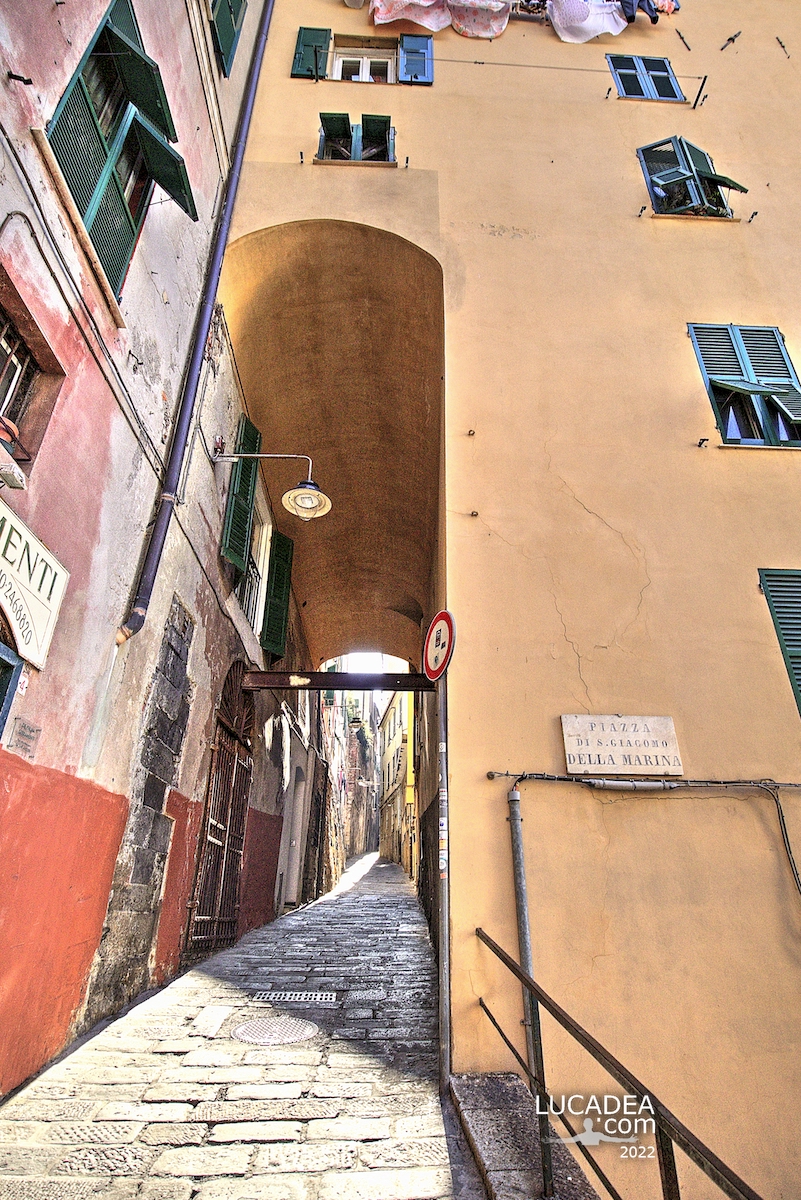
While walking through the narrow streets of Genoa’s old town, I came across another one of those small corners that can easily go unnoticed. This one is on Santa Croce street, where a narrow alley passes beneath a tall archway just behind the Walls of the Grazie.
This is exactly the kind of detail I enjoy looking for when I walk through Genoa without a strict destination in mind. The old streets constantly change direction, become narrower, climb and descend, and often hide passages that are almost invisible from the main streets. Here, the archway was enough to make me stop and take out my camera.
The photograph is centered on a simple architectural feature, but its surroundings give it a much deeper context. The archway connects the narrow passage with the historic fabric of the neighborhood, while the nearby Walls of the Grazie are a reminder of the defensive role this part of Genoa once played.
When people search for what to see in Genoa, they will probably think first of the city’s best-known palaces, churches and squares. I often find something different by looking at the smaller details. The narrow passages, stairs and archways are an essential part of the character of Genoa’s historic center, and they give the caruggi an atmosphere that is difficult to reproduce anywhere else.
The location is quite specific: this photograph was taken in Genoa, Liguria, Italy, on Santa Croce street, in an area where different layers of the city’s history can still be seen very close to one another.
The name of the archway refers to the Oratory of San Giacomo, one of the religious places that form part of the dense historic fabric of this area. One small architectural curiosity is the word “archway” itself: in Italian, archivolto refers to an arch following the curve of a vault or opening, and in historic urban areas such structures can also form covered passages between buildings.
Whenever I photograph places like this, I naturally become curious about what came before. I want to understand why a passage was built in a certain way, what it connected and how people used it in the past. I do not always find every answer, but that curiosity is part of what makes photographing old places interesting to me.
It is also one of the reasons I enjoy walking through Genoa’s narrow streets. A route I have already taken can reveal something completely different the next time. Looking up, turning into a side alley or simply choosing another direction can change the whole experience.
This small passage behind the Walls of the Grazie caught my attention precisely because it is not a monumental scene. There is no famous panorama to photograph here. Instead, there are stone walls, the tall arch, the narrow passage and the feeling of being inside a part of the city that has developed over many different periods.
If you are visiting Genoa and want to understand the old town beyond its most famous sights, these smaller architectural details are worth paying attention to. They are not necessarily destinations in themselves, but they help explain why walking through the historic center is such a rewarding photographic experience.
I have written about other narrow streets and small historic corners of Liguria on the blog, and they often remind me of the same thing: the best photograph is not always the one you planned to take. Sometimes it is simply the one you discover while walking.
That is what happened here. I was exploring the narrow streets, came across the archway on Santa Croce street and decided to stop for a photograph before continuing my walk.

What is your favorite corner among the narrow streets of Genoa’s old town? Add a comment or go to the bottom of the site to read what other visitors have written.

San Giacomo archway on Santa Croce street, among the narrow streets of Genoa's historic city center

Photo taken with a Canon EOS M100 camera and Canon EF-M 11-22 lens.

Here is where I took this photo:

Santo Stefano Abbey above XX Settembre Street

Abbazia di Santo Stefano a Genova sopra via XX Settembre, vista dalla terrazza vicino al Ponte Monumentale

Santo Stefano Abbey above XX Settembre Street.
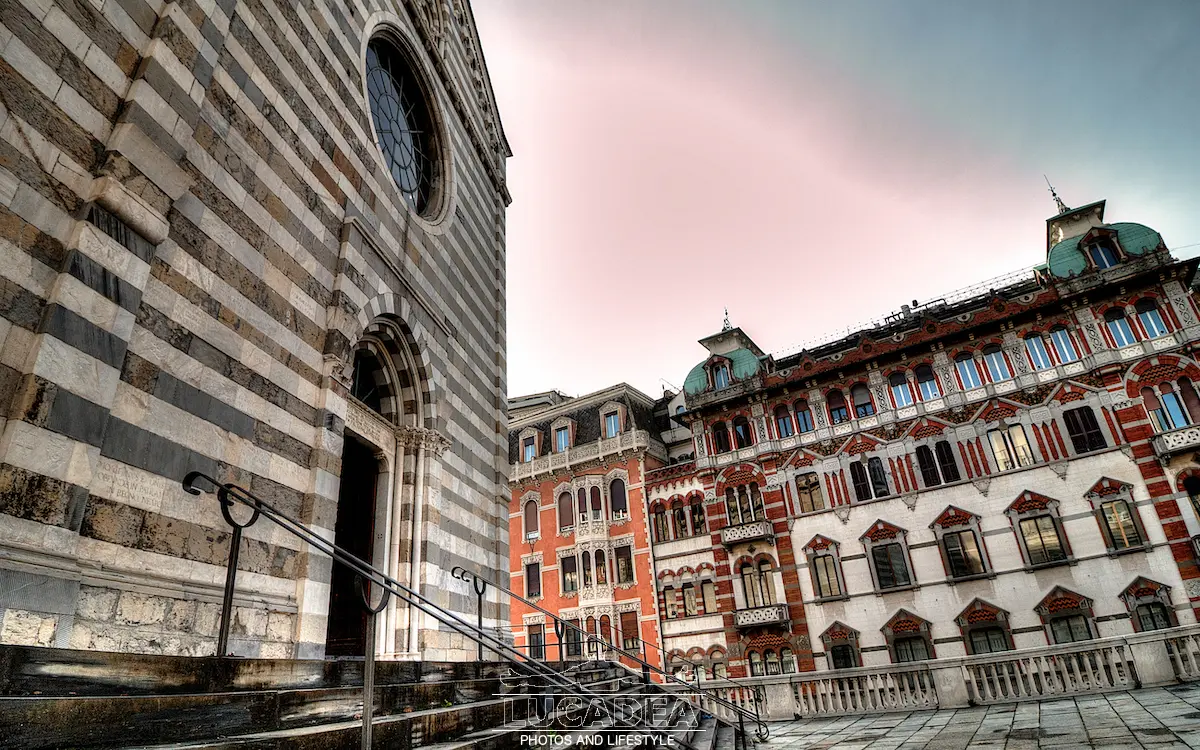
In the heart of busy Genoa, just above XX Settembre Street, I found a church that seems to carve out a quiet space above one of the city’s busiest streets. If you are looking for things to see in central Genoa, this is one of those places that can appear almost unexpectedly after climbing just a few steps near the Monumental Bridge.
The change happens very quickly. A moment earlier I was surrounded by the movement of the street, shops, traffic and the imposing buildings of this part of the city. Then, after a short flight of steps, I reached the terrace where Santo Stefano Abbey stands, and the atmosphere felt completely different.
That contrast was what made me want to take this photograph. On one side there is the historic abbey, while on the other are the elegant buildings along XX Settembre Street. It is not one of Genoa’s huge monumental squares, nor is it necessarily the first place that comes to mind when thinking about the city. For me, that is precisely what makes the view worth noticing.
The photograph was taken in Genoa, Liguria, Italy, right in the center of the city, from a point where the historic church can be seen together with the architecture of the surrounding urban landscape. If you are wondering where Santo Stefano Abbey is, one useful reference is XX Settembre Street near the Monumental Bridge. From street level, the small staircase leading to the terrace is easy to miss.
This location says something I particularly like about Genoa. Historic buildings are not always presented through large, carefully arranged spaces. Sometimes you have to walk into an alley, cross a street, climb a staircase or simply look above street level before discovering something worth photographing.
Santo Stefano Abbey has very ancient origins and is one of Genoa’s historic churches. Its history is also connected with the Doria family, and according to tradition Christopher Columbus was baptized here. It is a small historical detail, but one that gives the building another layer of meaning without taking the photograph away from the place itself.
What interests me most, however, is the way the abbey exists alongside the city that developed around it. XX Settembre Street is one of the major streets in central Genoa, and its buildings belong to a very different period from that of the abbey. In the photograph, these different moments of the city seem to meet within a very small area.
This is one of the reasons I enjoy photographing Genoa. I do not always look for the most famous monument or the view that everyone immediately recognizes. Sometimes a less obvious perspective is much more interesting, especially when it reveals something about how the city is actually experienced by the people who live there.
From this terrace, the church almost becomes a small balcony overlooking the surrounding city. The abbey is on one side, the elegant buildings of XX Settembre Street on the other, while everyday Genoa continues moving below.
I have found the same kind of character in other photographs I have published from Genoa, especially those showing its alleys and less obvious corners. In those images, as in this one, I like the idea of showing a city that does not need to be staged. It only needs someone to stop for a moment and notice what is already there.
One of the things I like most about this particular spot is how easy it is to reach. There is no long walk or complicated detour. Near the Monumental Bridge, a few steps are enough to leave the level of the street and arrive at a completely different viewpoint.
That small change in elevation makes the area feel surprisingly layered. An old church, a major urban street, elegant historic buildings and a quiet terrace all coexist within a very short distance.

Have you ever noticed this terrace above XX Settembre Street, or have you also walked past Santo Stefano Abbey without realizing that this viewpoint was just a few steps away? Add a comment or go to the bottom of the site to read what other visitors have written.

Santo Stefano Abbey in Genoa above XX Settembre Street, seen from the terrace near the Monumental Bridge

Photo taken with camera Canon EOS M100 and lens Canon EF-S 10-18.

Here is where the church is located:

Where Genoa’s narrow streets meet

Incrocio tra via San Luca, via San Siro e via di Fossatello nei vicoli del centro storico di Genova

Where Genoa’s narrow streets meet.
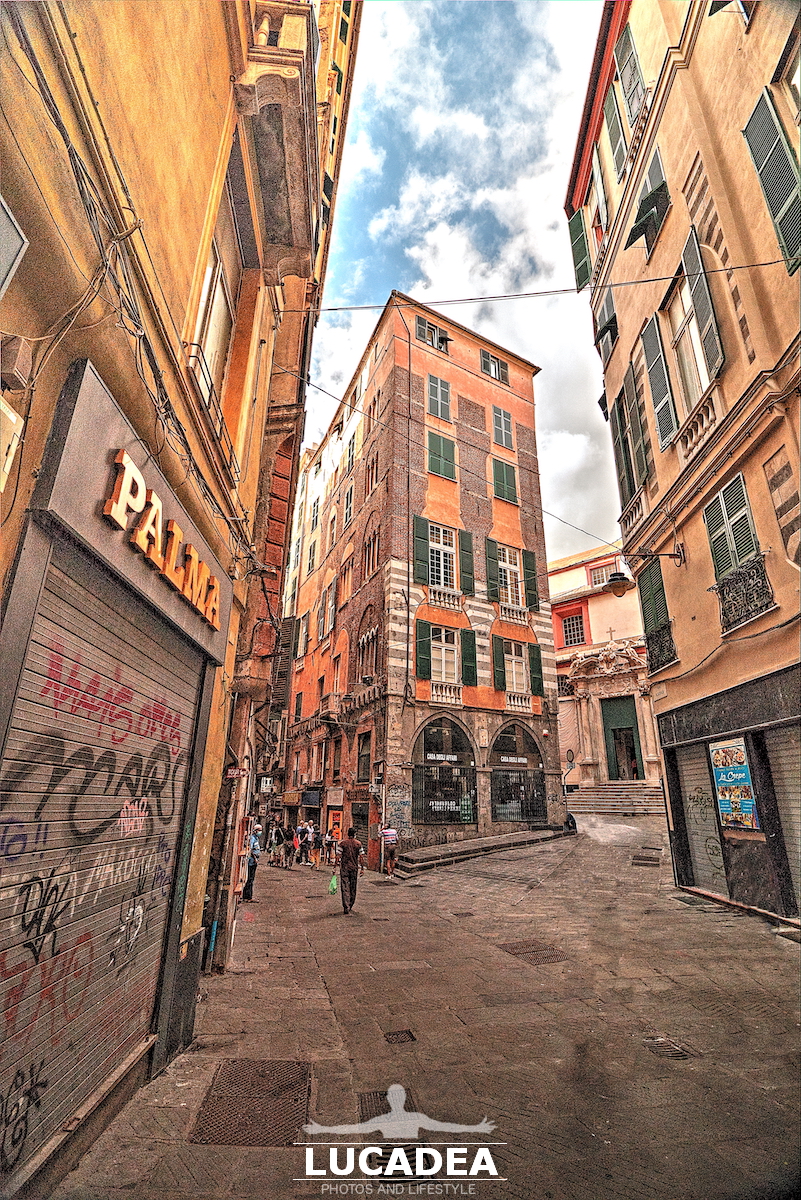
Between Via San Luca, Via San Siro and Via di Fossatello, I stopped at an intersection in the historic centre that feels less like a proper square and more like a small open space created naturally by three streets coming together. It is the kind of view of Genoa I enjoy photographing because it does not need a famous monument to make the city recognizable.
I had arrived from Via San Luca, which is behind me in the photograph, while Via San Siro opens to the right and Via di Fossatello continues ahead. In the middle of this meeting point stands an attractive historic building that almost becomes the visual anchor of the entire scene. I tried to find out whether this particular space had a specific name, but I could not find one that actually identified it as a square.
Perhaps that uncertainty is part of what makes the image interesting to me. Walking through the historic centre of Genoa, not every corner has an obvious name or an entry in a guidebook. Some places simply belong to the structure of the city itself, shaped by streets, buildings and centuries of urban development rather than by the fame of a particular monument.
I took this photograph myself while walking through the narrow streets of Genoa, and it came from observation rather than from a planned search for a specific subject. There was no famous building I had set out to photograph. Instead, the spontaneous geometry of the three streets caught my attention, together with the building standing at their centre. Sometimes an ordinary intersection creates a better photographic composition than a carefully chosen landmark.
The scene is in the historic centre of Genoa, Liguria, Italy, in the part of the city where narrow streets constantly change direction and a short turn can completely alter the atmosphere around you. If you are wondering what to see in Genoa’s old town, I think these small encounters between streets are worth noticing because they show a side of the city that is easy to miss when concentrating only on its best-known attractions.
The historic centre grew over many centuries within a dense urban space, and its famous narrow streets are closely connected with that development. The network of caruggi, with buildings often standing very close to one another, creates an environment where streets, passages and small openings continually produce new perspectives. That is one reason why walking through this part of Genoa can feel so different from following a conventional city plan.
In this photograph, I particularly like the fact that no single element completely dominates the scene. Via San Luca leads away behind me, Via San Siro opens on the right, and Via di Fossatello continues forward, while the building in the middle seems to hold the whole composition together. It is a simple arrangement, but it felt worth stopping for.
The name Zena, the Genoese name for Genoa, also seems fitting to me here. I am not using it as a decorative reference to local culture, but because it reminds me of the identity that becomes more visible when you move away from the city’s most photographed views and simply walk through the caruggi.
That is why I described this as perhaps the most authentic Genoa. The city’s cathedrals, historic palaces and famous viewpoints are certainly important parts of its identity. But there is another Genoa that appears in everyday corners like this one, in narrow streets, entrances, façades and intersections that may not have a famous name but still form the character of the old city.
This photograph also connects naturally with the other images of Genoa that I have published on the blog. Even when I photograph an important church, a historic building or an architectural detail, the route often takes me through these narrow streets first. Sometimes the streets themselves become the subject, as they did here.
Looking at the photograph now, I like the idea that it captures a small fragment of Genoa that might be difficult to identify for someone who does not know the area, but immediately familiar to people who regularly walk through the historic centre. A place does not need a famous name to be memorable. Sometimes three streets meeting around an old building are enough.
This is exactly the kind of corner that makes me take out my camera even when I had not planned to photograph anything.

Which narrow street or intersection in Genoa has stayed in your memory? Add a comment or go to the bottom of the site to read what other visitors have written.

Intersection of Via San Luca, Via San Siro and Via di Fossatello in Genoa’s historic narrow streets

Photo taken with a Canon EOS M100 camera and a Canon EF-S 10-18 lens.

Here is the location where I took the shot:

Fossatello street among Genoa’s old alleys

Via Fossatello nei vicoli del centro storico di Genova, tra palazzi ravvicinati e scorci tipici dei caruggi

Fossatello street among Genoa’s old alleys.
Walking along Fossatello street in Genoa’s old town, I find myself in one of those places where slowing down for a moment is enough to discover something worth photographing. Genoa’s narrow alleys are an endless source of views, details and unexpected perspectives, and this street, just a short distance from the port, shows many of the characteristics that make the historic centre so distinctive.
I took this photograph during one of my walks through the old town. I was not looking for a famous monument or a particular landmark. I simply wanted to capture a small scene that caught my attention along the way. This is one of the things I enjoy most about photographing Genoa: interesting images often appear when I am simply walking, without having planned a specific subject beforehand.
Fossatello street is in the historic centre of Genoa, Liguria, Italy, very close to the old port area. The dense arrangement of the buildings and the narrow streets constantly change the way you see the surroundings. Looking upwards can reveal façades, windows and architectural details that are easy to miss when you are simply trying to get somewhere.
That is why I like keeping my camera ready in the Genoese alleys. There is no need to search for something spectacular. An ordinary façade, a shop sign, a narrow passage or the way several buildings meet above the street can become an interesting photographic subject when seen from the right position.
This part of Genoa also feels very different from the city’s more open spaces. Buildings stand close together and many streets are remarkably narrow, creating a strong relationship between the architecture and the small amount of public space available. The result is a constantly changing series of perspectives as you walk.
The word “caruggi” is one of the terms most closely associated with Genoa’s historic centre. It comes from the Ligurian dialect and refers to the narrow streets characteristic of the old town. Their compact form developed over centuries in a dense urban environment where available space was limited, creating the intricate network of passages that can still be experienced today.
What I like about Fossatello street is its everyday character. You do not need to stand in front of a major monument to feel that you are somewhere historically important. People moving through the street, shops opening onto the alleys, tall buildings and small architectural details are enough to create a strong sense of place.
The proximity of the port adds another interesting contrast. A short walk can take you from the enclosed atmosphere of the old alleys to the much more open spaces around the waterfront. This is one of the things I enjoy about Genoa: distances can be very short, yet the character of the surroundings can change almost immediately.
When I photograph streets like this, I try not to make the composition unnecessarily complicated. There are already plenty of elements competing for attention, and adding too much can take away from the everyday quality that attracted me in the first place. I prefer to observe, wait and let the street itself suggest the photograph.
This image is also part of the collection of photographs I have taken while walking through Genoa over the years. As with other posts about the old alleys on Lucadea.com, I am not trying to describe the entire city. I am simply keeping a personal record of small fragments that I have actually encountered.
That personal aspect is important to me. A photograph of a familiar street does not have to show something new to everyone else. Sometimes it is enough that I noticed something differently on that particular day.
This is especially true in Genoa’s historic centre. Even when I return to streets I already know, I often notice a detail I had overlooked before. A window, part of a façade, a sign or simply a different perspective can make a familiar place feel slightly different.
If you are visiting Genoa and wondering what to see beyond the major landmarks, walking through the old alleys is one of the simplest ways to experience another side of the city. I would not describe it as a checklist of attractions. For me, the interest is in walking slowly enough to notice the details between the better-known places.
Fossatello street is a good example of that kind of experience. It is a place where the ordinary surroundings become the subject itself. The architecture, the narrow passage and the movement of everyday life are enough to make me stop with my camera.
Perhaps that is why I continue photographing Genoa’s old town. The city does not always need a grand viewpoint or a famous building to be interesting. Sometimes a narrow street is enough.
This is the Genoa I like to photograph: not only the monuments and panoramic views, but also the everyday city of old buildings, narrow alleys and unexpected details that appear while walking.

Which corner of Genoa’s old town would you most like to photograph? Add a comment or go to the bottom of the site to read what other visitors have written.

Fossatello street in Genoa's old town, with tall buildings and a typical view of the city's narrow caruggi

Photo taken with Canon EOS M100 and lens Canon EF-S 10-18.

Here’s where exactly the street is:

🏠
  • Italiano