The Apse of San Giovanni e Reparata in Lucca

L'abside della chiesa dei Santi Giovanni e Reparata a Lucca

The Apse of San Giovanni e Reparata in Lucca.
I have visited the beautiful Tuscan city of Lucca only a few times, but my first visit was enough to convince me that it was worth coming back. It is a lovely town to explore on foot, with a historic centre full of picturesque views, squares, churches and palaces that tell a long and fascinating story. When I had another opportunity to visit, I decided to spend a weekend there and enjoy the city at a more relaxed pace.
The photograph shows the apse of the Church of Saints John and Reparata, located in Saint John Square, just a short walk from Lucca Cathedral. It is a church I would certainly recommend visiting, not least because its history goes back much further than its present appearance might suggest.
The Romanesque building we see today dates mainly from the second half of the twelfth century, but the origins of the religious complex are much older. An early Christian basilica already stood on this site between the fourth and fifth centuries, playing a fundamental role in the religious life of the city. In fact, this church was Lucca’s first cathedral, before that title and function passed to the nearby Church of Saint Martin in the early medieval period.
The complex is also particularly interesting from an archaeological point of view. Excavations carried out during the twentieth century revealed several layers of the city’s history. Beneath the church and in the surrounding areas, archaeologists discovered remains of Roman buildings, ancient baths, mosaic floors, the early Christian basilica and its baptistery. Visiting the archaeological area is therefore like travelling through different periods of Lucca’s past, from Roman times to the Middle Ages.
The structure visible today also preserves traces of the many changes made over the centuries. The church underwent significant alterations during the sixteenth century, when some architectural features were renewed and a coffered ceiling was added. The baptistery, with its distinctive pointed dome, had already been built towards the end of the fourteenth century. The result is a building in which medieval elements coexist with additions from later periods.
I particularly enjoy visiting places like this, where you are not simply looking at a religious building but discovering the different chapters of a city’s history. Lucca is especially rewarding in this respect: you only need to walk a short distance to come across another monument, a beautiful square or a little corner that deserves to be photographed.
If you visit Lucca, I would recommend not limiting your visit to the Cathedral of Saint Martin. Make some time for the Church of Saints John and Reparata and its archaeological area as well. It is an experience that adds another dimension to discovering this wonderful Tuscan town.

Did you know that this church was once Lucca’s first cathedral? Have you had the chance to visit it and explore its archaeological remains? Add a comment or go to the bottom of the site to read what other visitors have written.

The apse of the Church of Saints John and Reparata, a historic religious building in the centre of Lucca, Tuscany

Photo taken with a Canon EOS M100 camera and Canon EF-M 11-22 lens.

Click here to see all the photos of Lucca:

This is the official website of the museum complex: museocattedralelucca.it.

Add one  comment to this article or read  here what other visitors have written.
 
Adv
 
Disclamer

The rights on images, videos, choruses, text and all other material on the LUCADEA.com website are governed as per  Copyright page.


This page has been viewed 0 times today.
This month it has been viewed 0 times.
In total it has been viewed 0 times.
 

The Main Altar of Fiesole Cathedral

Altare maggiore e abside affrescata del Duomo di Fiesole, sulle colline vicino a Firenze

The Main Altar of Fiesole Cathedral.
Inside the Cathedral of San Romolo, in the hills above Florence, I was immediately struck by the contrast between the rather austere interior and the richer presence of the main altar and the frescoed apse. This is the detail I wanted to capture with my camera.
Fiesole is only a few kilometres from Florence, but climbing into the hills quickly creates a different feeling. In this ancient Tuscan town I found a quieter dimension than the better-known centre of Florence, and the cathedral is one of the most important landmarks of the village.
The photograph shows one of the most visually significant parts of the church: the main altar in front of the apse, with its decorations and frescoes drawing the eye towards the end of the nave. The interior of San Romolo Cathedral is quite restrained, almost austere in places, and this makes the decorative elements around the altar stand out even more.
If you are wondering what to see in Fiesole, the cathedral is certainly one of the places I would include. Not only because of its religious importance, but also because it offers a glimpse into the history of a town that can easily be overshadowed by the much more famous Florence nearby.
Looking at this image, what I like most is the way the architecture guides the eye towards the apse. The altar becomes the visual centre of the composition, while the surrounding structure seems to frame it naturally. When I took the photograph, I wanted to preserve this relationship rather than isolate a single decorative detail.
The Cathedral of San Romolo has very ancient origins and has undergone several alterations and transformations over the centuries. One small curiosity is that its present appearance contains elements from different periods, reflecting the changes the building experienced throughout its long history. Looking carefully at the architecture, it is possible to sense that several generations have contributed to the appearance of the church we see today.
Fiesole, in Tuscany, within the Metropolitan City of Florence, is often considered mainly in relation to the nearby capital of the region. Yet the town has a strong historical identity of its own and preserves evidence of a past that developed alongside, and in some respects before, the better-known history of Florence.
That is one of the things I enjoy when photographing places that are close to famous destinations but have a character of their own. A visit to Fiesole can take you away from the usual Florence itinerary for a while, without actually taking you far from the city. The landscape, architecture and atmosphere change surprisingly quickly as you climb into the hills.
The interior of the cathedral stayed with me precisely because of its simplicity. It is not a church that tries to overwhelm the visitor with decoration at every turn, and perhaps that is why the main altar and the frescoed apse have such a strong visual presence. My attention was drawn to this particular view, and I preferred to preserve that impression in a photograph rather than turn the post into a detailed description of the entire building.
As with other photographs of churches and cathedrals I have shared on the blog, this image comes from the same personal approach: looking for the detail or viewpoint that stays with me after a visit. I have previously written about other religious interiors encountered during my travels, and this photograph from Fiesole naturally continues that thread.
Looking back at the image, I still like the balance between the severe character of the architecture and the richer decoration concentrated around the altar. It is probably something that becomes even clearer when standing inside the cathedral, with the nave leading the eye naturally towards the apse.

If you know Florence already, have you ever climbed up to Fiesole to discover this quieter side of Tuscan history and art? Add a comment or go to the bottom of the site to read what other visitors have written.

Main altar and frescoed apse inside Fiesole Cathedral, in the hills near Florence

Photo taken with a Canon EOS M100 camera and Canon EF-M 11-22 lens.

To see all the photos taken in the Cathedral, click here:

Here is where the cathedral is located:

Add one  comment to this article or read  here what other visitors have written.
 
Adv
 
Disclamer

The rights on images, videos, choruses, text and all other material on the LUCADEA.com website are governed as per  Copyright page.


This page has been viewed 1 times today.
This month it has been viewed 1 times.
In total it has been viewed 3 times.
 

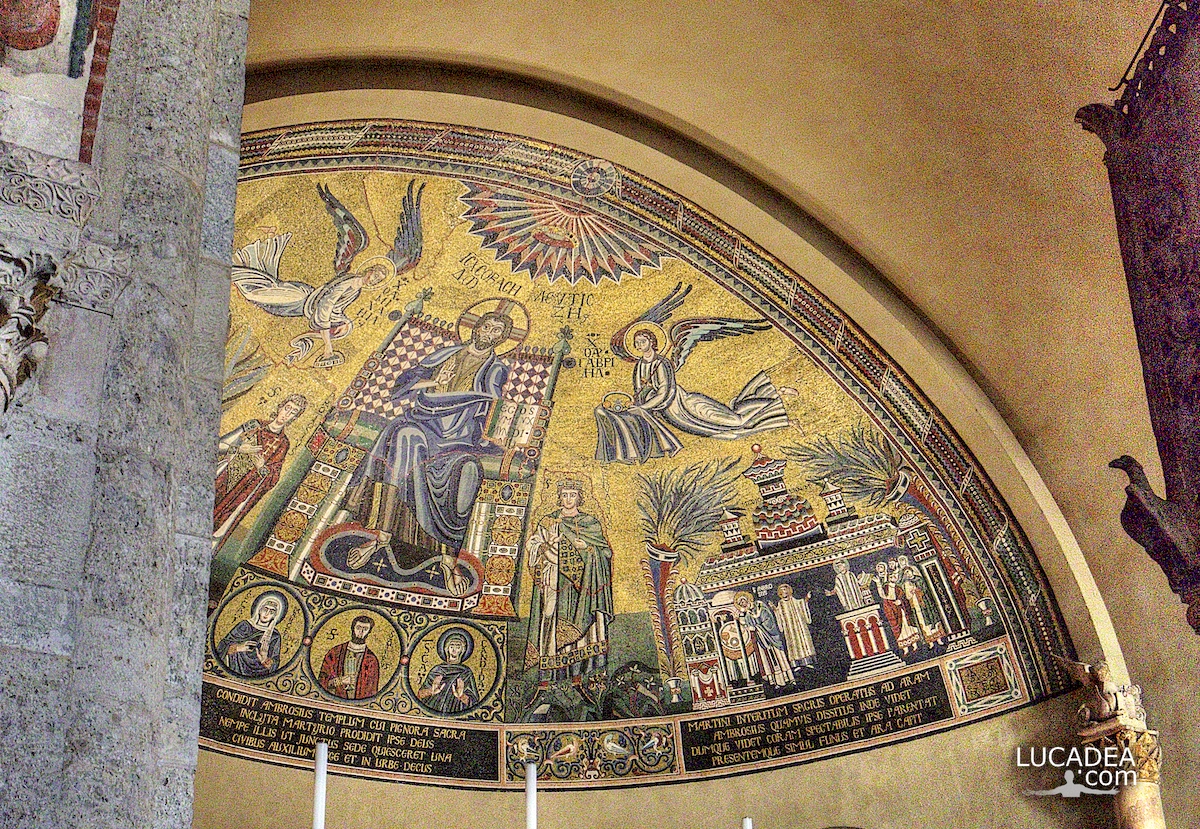
The apse mosaic of Sant’Ambrogio

Mosaico absidale dorato della Basilica di Sant’Ambrogio a Milano con Cristo Pantocratore

The apse mosaic of Sant’Ambrogio.
Inside Sant’Ambrogio Basilica in Milan, one of the elements that immediately captures the visitor’s attention is the large mosaic covering the apse, an extraordinary testimony to medieval art and the religious history of the city.
During my visit to the basilica, I wanted to photograph this detail because, besides the famous golden altar and the impressive ciborium, the apse creates one of the most spectacular areas of the entire building. The light reflecting on the golden tiles gives the mosaic a unique atmosphere and highlights the richness of its details.
At the centre of the composition is Christ Pantocrator, seated on a throne with the open book and surrounded by the symbols of the Evangelists. On both sides there are several saints, including Saint Ambrose, the patron saint of Milan to whom the basilica is dedicated.
The mosaic follows the principles of Byzantine medieval iconography, with a solemn and majestic representation of Christ. The vivid colours, the use of gold and the arrangement of the tiles create effects of light and depth that bring the figures to life.
I wanted to capture this detail with my camera because when visiting a church so rich in history, it is easy to focus only on the most famous elements and miss smaller masterpieces that deserve attention.
Sant’Ambrogio Basilica is located in Milan, Lombardy, Italy, and it is one of the most important monuments in the city. Founded in the 4th century by Bishop Ambrose, it preserves many valuable artworks and represents one of the finest examples of Lombard Romanesque architecture.
A small curiosity is that the apse mosaic, despite its ancient origins, has undergone several restorations over the centuries, including work after the damage suffered during the Second World War. Its current beauty is therefore also the result of careful conservation.
After photographing the golden altar of the basilica, I could not miss the opportunity to capture this magnificent golden wall dominating the altar area and welcoming visitors with its impressive presence.
Standing in front of such an artwork, it is natural to think about how many people, throughout the centuries, have looked up at the same mosaic and found in it both an artistic and spiritual reference.

Have you ever visited Sant’Ambrogio Basilica in Milan? Add a comment or go to the bottom of the site to read what other visitors have written.

Golden apse mosaic of Sant’Ambrogio Basilica in Milan featuring Christ Pantocrator

Photo taken with a Canon EOS M100 camera and Canon EF-M 11-22 lens.

This is the church’s official website: basilicasantambrogio.it.

To see all the photos I took at the Basilica, click here:

The mosaic adorning the semi-dome of the apse in the Basilica of Sant’Ambrogio depicts Christ enthroned against a gold background, flanked by Saints Gervasius and Protasius.
Read more and explore further at lombardiabeniculturali.it

The Modena Cathedral seen from the rear

Vista del Duomo di Modena dal lato posteriore con abside romanica e torre Ghirlandina, cielo chiaro e piazza in primo piano.

The Modena Cathedral seen from the rear.
The Modena Cathedral from the rear reveals itself in a quieter, more intimate way than the grand façade most people recognize. The Modena Cathedral from the rear doesn’t try to impress with symmetry or dramatic perspectives, but instead tells its story through curved lines, layered arches, and stones shaped by time.
I find myself drawn to the Romanesque apse, where repeating arches create a visual rhythm that feels almost like a pattern you can follow with your eyes. The warm tones of the stone, shifting between beige and soft pink, stand out even under a pale sky, giving the entire structure a gentle, almost glowing presence. Beside it, the Ghirlandina tower rises with elegance, both strong and refined, naturally pulling the gaze upward.
There is something deeply authentic about this angle. The Modena Cathedral from the rear feels less monumental and more connected to everyday life, as if this side belongs more to the people who pass by without ceremony. A few figures move slowly across the open space, their presence adding scale without breaking the calm.
Details begin to emerge the longer I look. Small windows set deep into the walls, subtle decorative elements, and the way light softly wraps around the curves of the apse. This is where Romanesque architecture shows its essence—balance, proportion, and a quiet sense of harmony rather than excess.
Taking a photograph here feels different. I hesitate, adjusting my frame, realizing that no single shot can fully capture the depth of what I’m seeing. The slight imperfections in the structure make it feel alive, as if every stone has absorbed centuries of history.
I stay a little longer, letting this less obvious view settle into memory, appreciating how sometimes the most meaningful perspectives are the ones we don’t expect.

Have you ever looked at a famous place from a completely different angle and discovered something new? Add a comment or go to the bottom of the site to read what other visitors have written.

Vista del Duomo di Modena dal lato posteriore con abside romanica e torre Ghirlandina, cielo chiaro e piazza in primo piano.

Photo taken with Canon EOS RP and Canon RF 24-50 lens.

To see all the photos of the city, click here:

The Modena Cathedral seen from the rear – Une vue arrière de la cathédrale de Modène – Vista trasera de la catedral de Módena – Vista traseira da catedral de Modena – Rückansicht des Doms von Modena – Góc nhìn phía sau nhà thờ Modena – 从后方看到的摩德纳大教堂 – モデナ大聖堂の裏側の眺め

The text of this post was written with the help of ChatGPT, a language model from OpenAI.

The apse ceiling of Santa Maria sopra Minerva in Rome

Il soffitto absidale di Santa Maria sopra Minerva a Roma

The apse ceiling of Santa Maria sopra Minerva in Rome.
Santa Maria sopra Minerva is one of the most important churches in Rome and is located near the Pantheon, in the Pigna district. Built in the 13th century by the Dominican Friars, it is one of the rare examples of Gothic architecture in Rome, renowned for its history, art, and architecture.
The basilica stands on a site that was previously occupied by a pagan temple, originally believed to be dedicated to the goddess Minerva, but actually devoted to Isis. The name “sopra Minerva” derives from this ancient belief. Construction of the Gothic church began in 1280 and was completed in the early 14th century. Over the centuries, the church has undergone numerous modifications and restorations, while preserving its Gothic character.
The interior of Santa Maria sopra Minerva is richly decorated and retains its original Gothic structure. It features a three-aisled plan with pointed arches and vaulted ceilings. The side aisles host several richly decorated chapels with important works of art.
The apse ceiling is particularly impressive, with a ribbed vault richly adorned with vivid colors and intricate patterns. At the center of the apse there is a large painting depicting religious scenes, contributing to a solemn and evocative atmosphere.
Other notable elements include the funerary monument of Saint Catherine of Siena (she is buried in the basilica, and her tomb is a place of great devotion) and Bernini’s Elephant (in the square in front of the church stands an Egyptian obelisk supported by a statue of an elephant designed by Gian Lorenzo Bernini; this monument is commonly known as the “Minerva Chick”).
Santa Maria sopra Minerva is a place of great historical, artistic, and religious significance, representing a unique example in Rome’s architectural landscape for its Gothic style and the numerous artworks it houses.

Do you know Rome’s monuments? Add a comment or go to the bottom of the site to read what other visitors have written.

Photos taken with Canon EOS RP and lens Canon RF 24-50.

Here I leave you the official website of the basilica: santamariasopraminerva.it.

To see all the photos I took in Rome, click here:
foto gallery

Here is where the basilica is located:

The Basilica of Santa Maria sopra Minerva (Latin: basilica Sanctæ Mariæ supra Minervam) is a minor basilica in Rome located in the Pigna district, in Piazza della Minerva, near the Pantheon. It is one of the very few examples of Gothic architecture in Rome. The basilica houses the remains of several important figures, including Catherine of Siena, proclaimed a Doctor of the Church in 1970, the mystical painter Beato Angelico, proclaimed “Universal Patron of Artists” in 1984, and Pope Benedict XIII. Inside, it preserves valuable works of art, including frescoes by Melozzo da Forlì and Filippino Lippi.
Continue and learn more at Wikipedia

The apse ceiling of Santa Maria sopra Minerva in Rome – Le plafond de l’abside de Santa Maria sopra Minerva à Rome – El techo del ábside de Santa María sopra Minerva en Roma – O teto da abside de Santa Maria sopra Minerva em Roma – Die Apsisdecke von Santa Maria sopra Minerva in Rom – Trần nhà của Santa Maria sopra Minerva ở Rome

The text of this post was written with the help of ChatGPT, a language model from OpenAI.

The Madonna Enthroned mosaic in Naples

Il mosaico della Madonna in trono col Bambino fra i santi Gennaro e Restituta a Napoli

The Madonna Enthroned mosaic in Naples.
Among the things worth seeing inside Naples Cathedral, this mosaic caught my attention because it seems to belong to a quieter corner of a building already filled with remarkable works and layers of history. Inside the Basilica of Santa Restituta, I stopped in front of the apse and found myself looking at the Madonna with Child between Saint Januarius and Saint Restituta, an artwork that I personally find remarkably beautiful.
I had entered the cathedral with the simple curiosity of looking around, but the visit became more interesting when I began paying attention to the parts of the complex that are less immediately visible. Naples Cathedral is not only the imposing cathedral most visitors recognize from the street. Within the cathedral complex there is also the Basilica of Santa Restituta, an older church whose presence adds another historical layer to the building.
That is where I photographed this mosaic by Lello da Orvieto. What first caught my eye was the clarity of the composition. The Madonna sits at the centre with the Child, while Saint Januarius and Saint Restituta stand on either side. Behind them, the golden background gives the scene a distinctive visual presence, while the architectural throne creates a strong structure around the central figure.
I took this photograph myself because I wanted to keep the memory of standing in front of the apse and taking time to look at the details. I was not trying to create a formal record of the artwork. Instead, I wanted the photograph to preserve something of the experience of discovering it during my visit to Naples.
The Basilica of Santa Restituta is in the historic centre of Naples, Campania, Italy, incorporated into the larger cathedral complex. This location is part of what makes the visit particularly interesting. Within a relatively compact space, different periods of the city’s religious and artistic history appear alongside one another. If you are visiting Naples and looking for things to see inside the cathedral, Santa Restituta is a part of the complex that deserves more than a passing glance.
The Madonna Enthroned with Child between Saint Januarius and Saint Restituta is attributed to Lello da Orvieto and is dated to 1322. It is preserved in the Chapel of Santa Maria del Principio inside Santa Restituta. One fascinating detail is that the mosaic’s inscription is an important piece of evidence for identifying Lello and reconstructing what little is known about an artist whose biography remains relatively uncertain.
For me, however, the historical information comes after the visual experience. The gold tesserae, the figures, the throne and the balanced arrangement of the composition are enough to hold the attention before knowing anything about its date or authorship. Learning that the work belongs to the early fourteenth century simply adds another layer to the photograph.
I also like the way this mosaic changes the experience of Naples Cathedral. The cathedral is one of the city’s best-known landmarks, but the complex contains many details that can easily be missed if you move through it too quickly. Santa Restituta encourages a different pace. It rewards looking closely rather than simply passing through.
This photograph also connects naturally with another story on my blog about Naples, the interior of the Basilica of San Domenico Maggiore. In both cases, I found myself photographing a church interior after allowing curiosity to guide the visit. These are not photographs I planned long in advance; they are the result of noticing something while I was already there.
That is one of the reasons I enjoy photographing historic places. A building can be famous, but there is always the possibility of discovering one detail that makes the visit personal. For me, this mosaic was that detail. The Madonna at the centre, the two saints beside her and the golden background create an image that still holds my attention when I look back at the photograph.
If you are interested in art and history in Naples, this is one of those details worth seeing inside the cathedral, especially because it offers a glimpse of a much older layer of the city than the surrounding streets might suggest.

I called it a masterpiece when I first wrote about it. Looking at it again, I still think the word fits. Would you call it a masterpiece too? Add a comment or go to the bottom of the site to read what other visitors have written.

Madonna Enthroned with Child mosaic in the Basilica of Santa Restituta inside Naples Cathedral

Photo taken with Canon EOS M100 and Canon EF-M 11-22 lens.

Click here to see many more photos of Naples:
foto gallery

The Coronation of the Virgin in Spoleto Cathedral

L'Incoronazione della Vergine nel Duomo di Spoleto

The Coronation of the Virgin in Spoleto Cathedral.
Spoleto Cathedral, also known as the Cathedral of Santa Maria Assunta, is one of Umbria’s architectural jewels. Among its many works of art, “The Coronation of the Virgin” stands out, a fresco of extraordinary beauty and historical importance.
The fresco of the Coronation of the Virgin was created by the renowned Renaissance painter Filippo Lippi between 1467 and 1469. Lippi, known for his refined style and his ability to infuse life and spirituality into his works, created this masterpiece (at the commission of the Bishop of Spoleto, Bartolomeo della Rovere wrong infrmation).
The fresco is located in the apse of the Cathedral and depicts the Virgin Mary being crowned Queen of Heaven by Jesus Christ. The scene is surrounded by a multitude of angels and saints, who witness the event with expressions of joy and devotion. The composition is characterized by a skillful use of perspective and a rich color palette, which lend depth and vibrancy to the work.
“The Coronation of the Virgin” is a work full of religious symbolism. The crown placed on Mary’s head symbolizes her role as Queen of Heaven and Mother of the Church. The angels and saints surrounding her represent the communion of saints and heavenly glory. The work also reflects the Marian devotion of the Renaissance period and the importance of the Virgin Mary in Christian spirituality.
Over the centuries, the fresco has undergone various restorations to preserve its beauty and integrity. The last significant restoration was carried out in the 20th century, when modern techniques were used to stabilize the colors and repair damage caused by time and humidity.
The Spoleto Cathedral is open to visitors year-round and offers the opportunity to admire this masterpiece of the Italian Renaissance up close. In addition to the Coronation of the Virgin, the cathedral houses other valuable works of art, including frescoes, sculptures, and stained-glass windows.

Do you know the city of Spoleto? Add a comment or go to the bottom of the site to read what other visitors have written.

L'Incoronazione della Vergine nel Duomo di Spoleto

L'Incoronazione della Vergine nel Duomo di Spoleto

Photos taken with Canon EOS RP and lens Canon RF 24-50.

Here is the official website: duomospoleto.it.

To see all the photos I took of the city, click here:

Where is the Duomo?

The Stories of the Virgin are a cycle of frescoes by Filippo Lippi, dated from 1466 to 1469 and housed in the tribune of the Cathedral of Santa Maria Assunta in Spoleto. The frescoes were commissioned in 1466, when Lippi had just finished the Stories of Saint Stephen and Saint John the Baptist in the Cathedral of Prato. Work was abruptly interrupted by the artist’s death in 1469, and was then completed, in about three months, by the master’s workshop. According to Vasari, the artist’s death, at the age of 63, was caused by poison due to his habit of harassing young girls, which had already caused great scandal in Prato.
Continue and learn more on Wikipedia

The Coronation of the Virgin in Spoleto Cathedral – Le couronnement de la Vierge dans la cathédrale de Spolète – La Coronación de la Virgen en la Catedral de Spoleto – A Coroação da Virgem na Catedral de Spoleto – Die Krönung der Jungfrau in der Kathedrale von Spoleto – Lễ đăng quang của Đức Trinh Nữ tại Nhà thờ Spoleto

This post was written with the help of Copilot, an AI-powered virtual assistant.

🏠
  • Italiano