Under the Stone of Genoa Latin Inscription

Dettaglio dell’arco marmoreo a Genova con iscrizione latina di Genova e stemma del grifone scolpito nella pietra storica

Under the Stone of Genoa Latin Inscription.
The marble arch stands quietly in front of me, carrying a sense of time that feels almost suspended, and the Latin inscription of Genoa immediately becomes the visual and emotional focus of the scene. The Latin inscription of Genoa is carved into the stone like a message that refuses to fade, guiding my attention through every groove and shadow.
I am in Genoa, Liguria, Italy, walking through a city where stone is never just architecture but a layered memory of centuries. The Latin inscription of Genoa appears here as a fragment of civic identity, something that still connects the present streets with a medieval past. The geometry of the arch, with its alternating marble tones, frames the inscription as if it were part of a larger dialogue between structure and meaning.
The griffin emblem carved nearby adds another level to the composition, suggesting protection and strength. A historical curiosity explains this symbol: the motto associated with Genoa refers to the griffin holding its power over enemies, a medieval representation of the city’s resilience and identity. This detail transforms the stone into something more than decoration, turning it into a statement of belonging and defense.
As I look closer, I think about how many times I might have passed similar details without noticing them. The Latin inscription of Genoa feels like a quiet reminder that cities speak through their surfaces, even when we are not paying attention. I remember a similar atmosphere in another post from my blog, where Genoa revealed itself through equally hidden architectural traces, almost like a visual conversation across time.
If you are visiting Genoa, Liguria, Italy, this is one of those small but meaningful details worth seeing, not because it is grand, but because it carries the weight of centuries in a few carved letters. It makes me wonder how many stories are still written into stone around us, waiting to be read.

What would you notice if you slowed down in front of an old city wall like this? Add a comment or go to the bottom of the site to read what other visitors have written.
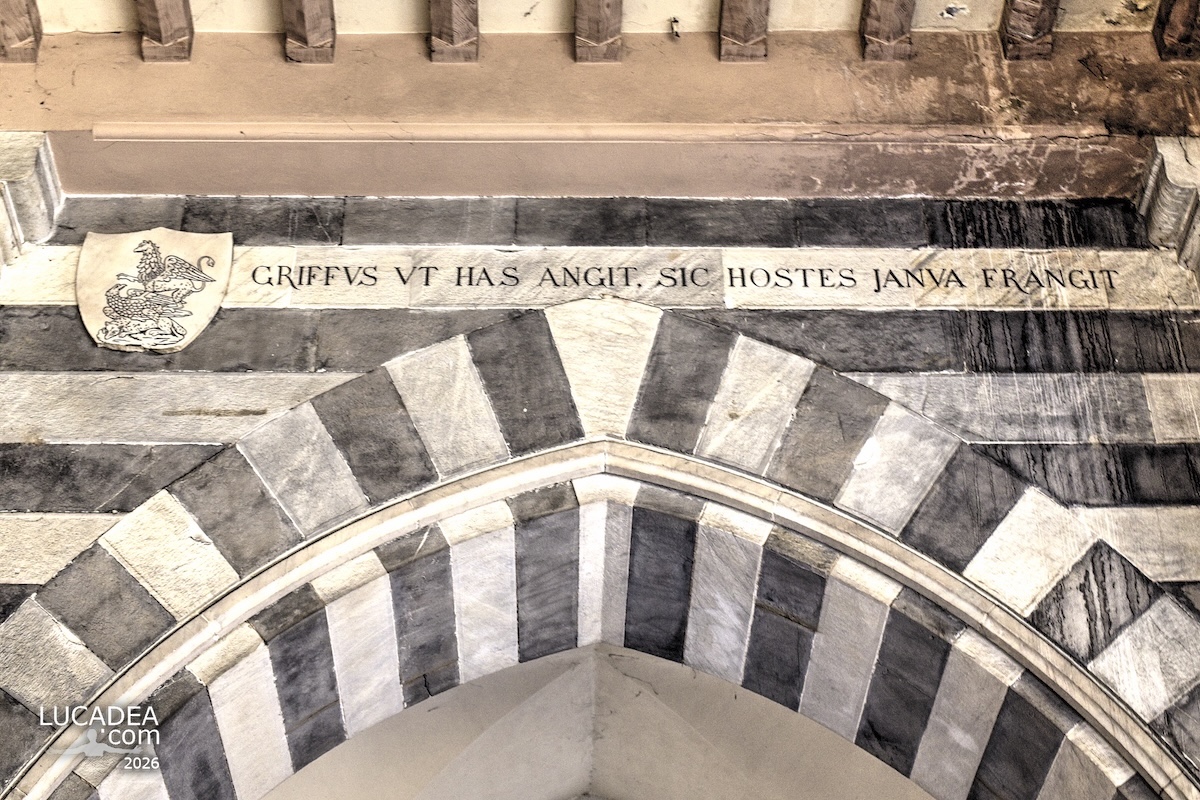
Dettaglio dell’arco marmoreo a Genova con iscrizione latina di Genova e stemma del grifone scolpito nella pietra storica

Photo taken with Canon EOS R50 V and lens Canon RF 28.

Under the Stone of Genoa Latin Inscription – Sous la pierre de Gênes inscription latine – Bajo la piedra de Génova inscripción latina – Sob a pedra de Génova inscrição latina – Unter dem Stein von Genua lateinische Inschrift – Dưới đá Genoa bia khắc Latin – 热那亚石下的拉丁铭文 – ジェノヴァの石の下のラテン碑文

The text of this post was written with the help of ChatGPT, a language model from OpenAI.

Add one  comment to this article or read  here what other visitors have written.
 
Adv
 
Disclamer

The rights on images, videos, choruses, text and all other material on the LUCADEA.com website are governed as per  Copyright page.


This page has been viewed 1 times today.
This month it has been viewed 1 times.
In total it has been viewed 1 times.
 

The Arch of Constantine near the Colosseum

L'Arco di Costantino: uno dei monumenti più famosi di Roma

The Arch of Constantine near the Colosseum.
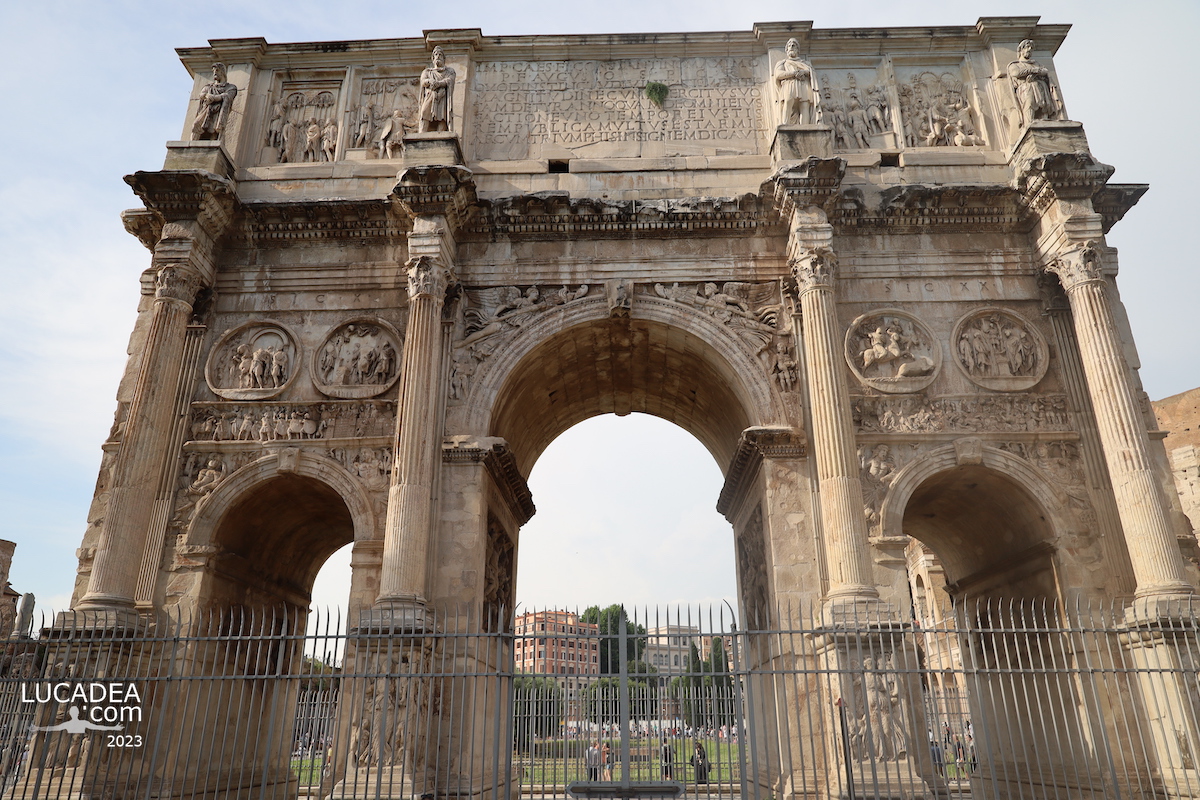
Standing in front of its three arches, surrounded by the remains of ancient Rome and the nearby silhouette of the Colosseum, I wanted to capture with my camera one of the most recognizable monuments in the city and one of the most searched things to see in Rome. This photograph of the Arch of Constantine tells a story of architecture, history and carved details that still preserve the memory of a changing empire.
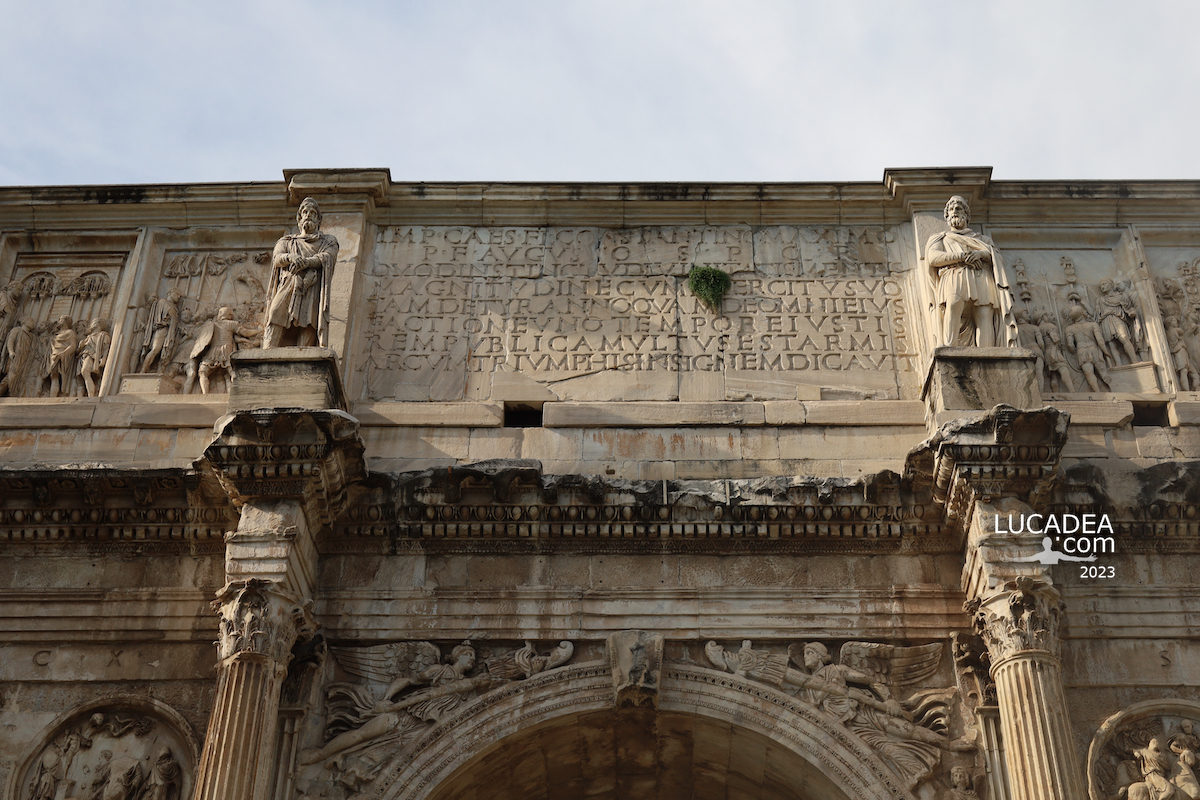
While walking through the archaeological area of Rome, Lazio, Italy, the arch appears as a connection between different historical periods. Its location next to the Colosseum makes it immediately recognizable, but looking closer reveals details that can easily be missed when seeing it only from a distance. The inscriptions, sculptures and reliefs describe an important moment in Roman history and show how this monument combines art, politics and memory.
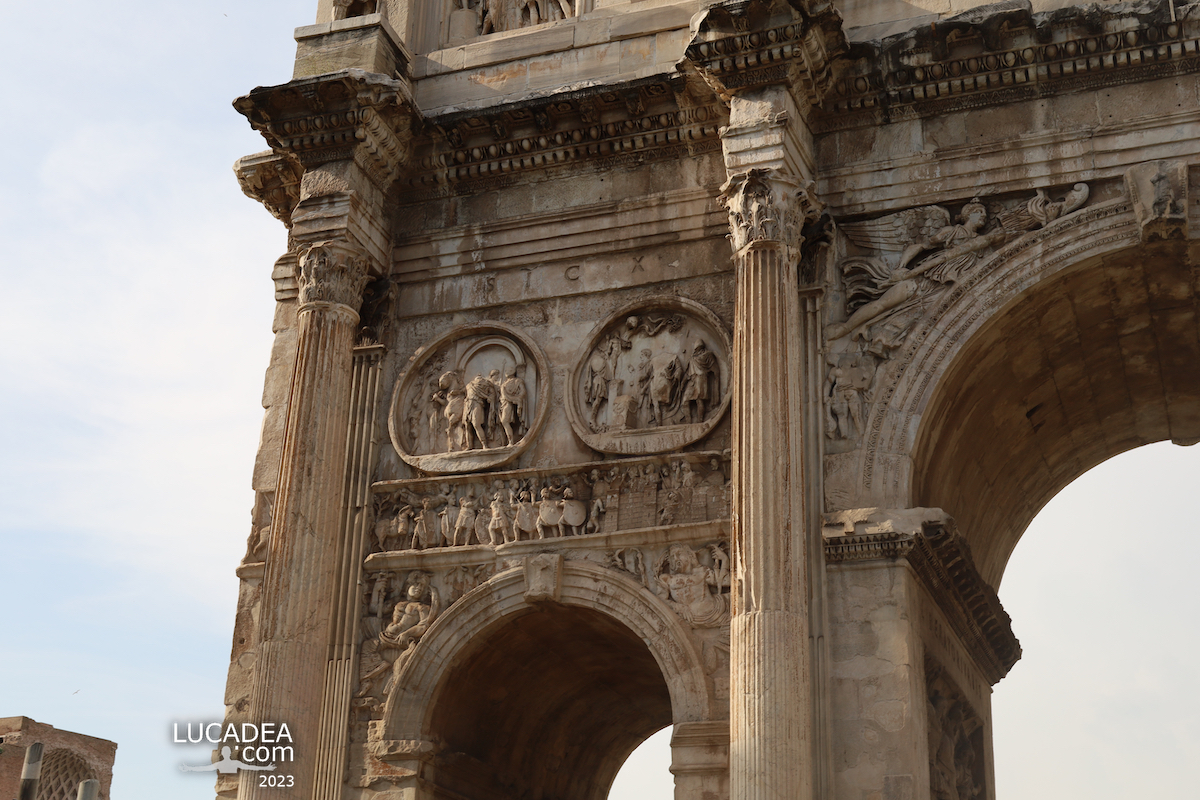
I chose to photograph the Arch of Constantine because it is one of those places where every detail can reveal another story. It is not only a triumphal arch to admire for its size, but also a monument that preserves elements from earlier periods of the Roman Empire. Looking at its surface, it is possible to notice decorations created in different centuries and brought together to celebrate Emperor Constantine’s victory after the Battle of the Milvian Bridge in 312 AD.
The Arch of Constantine was completed in 315 AD and has three openings, with a larger central arch and two smaller side arches. One interesting detail concerns its decoration: several sculptures were reused from monuments dedicated to emperors such as Trajan, Hadrian and Marcus Aurelius, adapting them to the new message of imperial celebration. This reuse of older artworks connected Constantine’s authority with the long tradition of Roman rulers.
This photograph comes from my attention to a monument that can tell much more than the simple image of an ancient ruin. The Arch of Constantine represents a period of transformation for Rome, when the empire was changing politically and religiously. Its presence near the Colosseum makes it one of the most interesting places worth seeing in Rome for anyone who wants to understand the relationship between the city and its past.
In my photographic journey through Rome, I have also explored other ancient landmarks, and this image naturally continues that search for places where stones, sculptures and architecture can still communicate stories after centuries.

When facing a monument with so many layers of history, which detail would you photograph first? Add a comment or go to the bottom of the site to read what other visitors have written.

Arch of Constantine in Rome near the Colosseum with three arches and ancient Roman decorations

Arch of Constantine in Rome near the Colosseum with three arches and ancient Roman decorations

Arch of Constantine in Rome near the Colosseum with three arches and ancient Roman decorations

Arch of Constantine in Rome near the Colosseum with three arches and ancient Roman decorations

Arch of Constantine in Rome near the Colosseum with three arches and ancient Roman decorations

Arch of Constantine in Rome near the Colosseum with three arches and ancient Roman decorations

Photos taken with a Canon EOS RP camera and Canon RF 24-50 lens.

Click here to see all the other photos I took in Rome:
foto gallery

The Arch of Constantine is a triple-arched triumphal arch (featuring a central passageway flanked by two smaller side passages) located in Rome, a short distance from the Colosseum. Beyond its significant historical importance as a monument, the Arch can be considered a veritable museum of official Roman sculpture, extraordinary in its richness and significance.
Read more on Wikipedia

Add one  comment to this article or read  here what other visitors have written.
 
Adv
 
Disclamer

The rights on images, videos, choruses, text and all other material on the LUCADEA.com website are governed as per  Copyright page.

This page has been viewed 0 times today.
This month it has been viewed 0 times.
In total it has been viewed 0 times.
 

The Victory Arch and Piazza della Vittoria in Genoa

Arco della Vittoria a Genova al centro di piazza della Vittoria, con colonne monumentali e spazio urbano aperto attorno.

The Victory Arch and Piazza della Vittoria in Genoa.
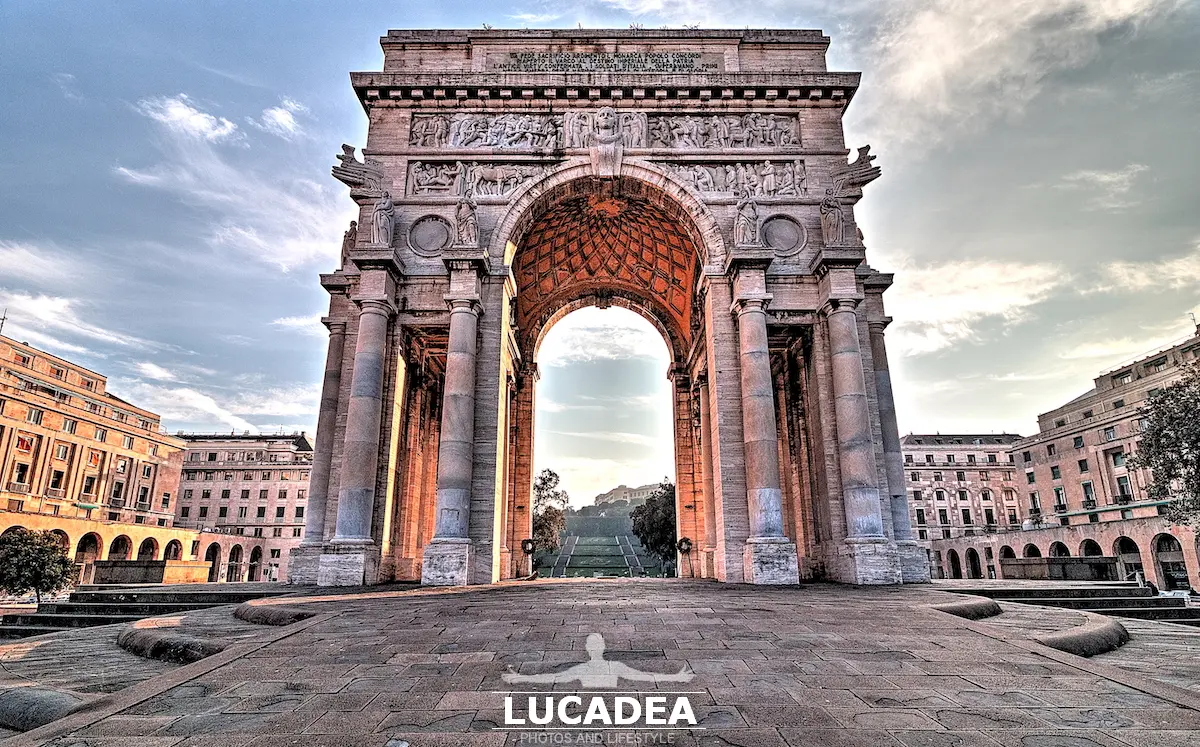
I stop right in the middle of the square, letting the Victory Arch slowly fill my frame as I look for the right composition. Piazza della Vittoria opens around me with a sense of order and space, and the arch seems to gather everything into a single focal point, a quiet anchor holding the entire scene together.
I walk slowly, shifting my perspective step by step. The proportions of the Victory Arch change slightly, but its presence remains steady, almost unmoved compared to the constant motion of the square. People cross without really stopping, while I stay there, watching details emerge gradually: the carvings, the surfaces, the rhythm of the columns.
Photographing Piazza della Vittoria means accepting this balance between emptiness and movement. There are moments when the space feels wide and open, leaving the arch standing alone, and others when cars and pedestrians fill every corner. I wait for that subtle balance, when the scene arranges itself without force.
I focus on details, but never lose sight of the whole. The Victory Arch is not just a subject—it defines the square, giving it structure and rhythm. Every shot becomes an attempt to capture that relationship rather than just the object. Even the smallest shift in position changes everything: a line aligns, a perspective opens.
There’s one detail I often think about: the arch was built to commemorate those who died in World War I, and perhaps that’s why it carries a certain gravity, a quiet presence that you can feel even without knowing its history. It’s not something that demands attention, but something that reveals itself slowly.

When I lower my camera, I remain there for a moment longer, taking in Piazza della Vittoria as a whole. There isn’t a perfect moment, just many small ones blending together. Have you ever stood in the center of a square like this, without feeling the need to rush away? Add a comment or go to the bottom of the site to read what other visitors have written.

Arco della Vittoria a Genova al centro di piazza della Vittoria, con colonne monumentali e spazio urbano aperto attorno.

Photo taken with Oppo Reno 12.

L’arco della vittoria e piazza della Vittoria a Genova – The Victory Arch and Piazza della Vittoria in Genoa – L’arc de la victoire et la place de la Victoire à Gênes – El arco de la victoria y la plaza de la Victoria en Génova – Der Siegesbogen und die Piazza della Vittoria in Genua – O arco da vitória e a Piazza della Vittoria em Gênova – ジェノヴァの勝利のアーチとヴィットリア広場 – Арка Победы и площадь Победы в Генуе

The text of this post was written with the help of ChatGPT, a language model from OpenAI.

The Victory Arch in Genoa through lines and views

L'arco in Piazza della Vittoria a Genova

The arch in Piazza della Vittoria in Genoa.
A few months ago, I took some photos of the Arch of Victory in the square of the same name in Genoa.
One of the most famous monuments of the Superba, undoubtedly in the city’s largest square.
If you look carefully, between the columns of the arch, you can see in the distance the three caravels drawn on the terraces at the end of the square.

Do you know and love Genoa? Add a comment or go to the bottom of the site to read what other visitors have written.

L'arco in Piazza della Vittoria a Genova

Photo taken with Canon EOS M100 and lens Canon EF-S 10-18.

Where the monument is located:

The Victory Arch, also known as the Monument to the Fallen or the Arch of the Fallen, is an imposing triumphal arch built during the Fascist regime, located in Piazza della Vittoria in Genoa. It is dedicated to the Genoese who fell during the First World War and was inaugurated on May 31, 1931.
Continue and learn more at Wikipedia

The Arch of Victory in Genoa – L’Arc de la Victoire à Gênes – El Arco de la Victoria en Génova – O Arco da Vitória em Génova – Der Siegesbogen in Genua – Khải hoàn môn ở Genoa – 热那亚的胜利拱门 – ジェノヴァの勝利の凱旋門

A small alley in the village of Bevagna

Un piccolo vicolo nel borgo di Bevagna in Umbria

A small alley in the village of Bevagna in Umbria.
The photo was taken while walking without a specific direction, as often happens in villages that manage to captivate you more than expected. I came across this small alley in Bevagna almost by chance, during a visit almost two years ago, and I clearly remember the feeling of tranquility that accompanied me as I slowly walked through it. There was no one around, only the sound of my footsteps on the cobblestones and the fresh air flowing between the ancient walls.
The alley is narrow, intimate, with stone walls that seem to get closer as you move forward. There is an arch above, simple but striking, that connects the two facades and creates a kind of natural frame. Looking at it today in the photograph, I am struck by how essential everything appears: no bright colors, no superfluous elements, only matter, time, and silence. It is one of those places that need no explanation, because they speak for themselves.
I remember stopping halfway, almost instinctively. Not to immediately take the photo, but to observe. The worn stones, the signs of dampness, a few wires running along the walls, a hanging lantern that seems to belong to another era. Everything contributed to creating an intimate atmosphere, as if that alley was designed more for those who live in the village than for those who visit it. And perhaps this is its greatest charm.
Bevagna is a place that still preserves a very legible medieval structure, made up of narrow streets, covered passages, and connections between the houses. Alleys like this were not only suggestive glimpses, but functional spaces, designed to protect from the heat, the wind, and to make the village more defensible. Walking through them today means crossing an ancient daily life that has remained partly intact.
Looking at this image again, I recall that feeling of suspended time, of a slowed pace without a specific reason. It’s a photograph that doesn’t depict an event, but a moment, one of those that remain etched in memory precisely because of its simplicity. An ordinary alley, perhaps, but one that manages to capture the discreet soul of Bevagna.

Do you ever stop in alleys without really knowing why? Add a comment or go to the bottom of the page to read what other visitors have written.

Un piccolo vicolo nel borgo di Bevagna in Umbria

Photo taken with a Canon EOS RP camera and a Canon RF 24-50 lens.

To see all the photos I took in the village, click here:

A small alley in the village of Bevagna – Une petite ruelle dans le village de Bevagna – Un pequeño callejón en el pueblo de Bevagna – Um pequeno beco na vila de Bevagna – Eine kleine Gasse im Dorf Bevagna – Một con hẻm nhỏ trong làng Bevagna – 贝瓦尼亚村的一条小巷 – ベヴァーニャの村にある小さな路地

The text of this post was written with the help of ChatGPT, a language model from OpenAI.

The medieval Ticinese Gate in Milan

Porta Ticinese medievale lungo Corso di Porta Ticinese, vicino alle Colonne di San Lorenzo a Milano

The medieval Ticinese Gate in Milan.
During a visit to Milan, I found myself in the area around the Columns of San Lorenzo, where the route naturally continues along Ticinese Gate Avenue towards the city centre. Walking along the avenue, I came across this large medieval gate and decided to stop for a photograph.
I took this picture myself because I liked the way such an old structure remains part of the modern city. The Ticinese Gate does not feel like an isolated monument set apart from everyday life. It stands directly along the route, connecting the historic surroundings with the streets that people still walk through today.
The photograph shows the medieval Ticinese Gate in Milan, Lombardy, Italy, near the Columns of San Lorenzo. This is an interesting part of the city for photography because several different periods of Milan’s history can be encountered within a relatively short walk. Ancient remains, historic buildings and today’s urban life all occupy the same space.
If you are wondering what to see in Milan beyond the best-known landmarks, this area is particularly interesting for the contrasts it offers. The Columns of San Lorenzo and the basilica are nearby, while Ticinese Gate Avenue continues towards the centre, passing through a neighbourhood where traces of the old city remain visible alongside contemporary Milan.
What caught my attention most was the role of the gate as an actual passage. It is not simply an architectural object to admire from a distance. Its position along the avenue makes it part of the urban landscape, and that relationship with the surrounding streets is what I wanted to preserve in the photograph.
The name Ticinese Gate is connected with the route leading towards the area of the Ticino River. It belongs to the medieval history of Milan and represents one of the old access points through which people entered and left the city. As Milan expanded over the centuries, the urban landscape grew far beyond these earlier boundaries, leaving structures such as this one as reminders of the city’s previous scale.
One small historical detail I find interesting is the original practical purpose of medieval city gates. They were not built simply to make an entrance look impressive. They were part of the city’s defensive and administrative system, controlling movement through important routes. Today, that function has completely changed, but the gate still marks a point of transition between different parts of Milan.
During my visit, I was not looking for a historical reconstruction of the city. I was simply walking through the area around the Columns of San Lorenzo and observing what appeared along the way. The gate caught my attention because of its size and because Ticinese Gate Avenue passes directly through this historic structure.
That is one of the things I enjoy about taking photographs while walking. I do not always need to plan every subject beforehand. A church, a building or even a street corner can lead naturally to the next photograph. In this case, the Ticinese Gate became the subject simply because it appeared in front of me during the walk.
The image also connects naturally with the other photographs of Italian cities and architectural details that I have published on the blog. I often prefer this kind of encounter to a carefully planned photographic stop because the resulting image preserves something about the way I actually experienced the place.
Looking at the photograph again, what I like is the meeting between the old and the current city. The medieval gate belongs to another period of Milan’s history, but it is still surrounded by the movement of the modern city. Walking along Ticinese Gate Avenue, that contrast becomes particularly easy to notice.
For me, this is what makes the photograph more interesting than a simple picture of an old gate. It records a moment during a walk through Milan when the city’s past suddenly became part of the route I was following.

Have you ever walked through the Ticinese Gate during a visit to Milan? Add a comment or go to the bottom of the site to read what other visitors have written.

Medieval Ticinese Gate on Ticinese Gate Avenue near the Columns of San Lorenzo in Milan

Photo taken with Canon EOS M100 and Canon EF-M 11-22 lens.

To see all the photos I took on the roof and inside the Duomo, click here:

And here’s where the door is:

Arches in the historic alleys of Spello

Gli archi nei vicoli del borgo di Spello in Umbria

Arches in the historic alleys of Spello.
Among the things to see in Spello, Umbria, Italy, there are not only famous landmarks and artistic treasures, but also small architectural details hidden along the village streets. Walking through the alleys of Spello, you can often find stone arches connecting old buildings, quiet elements that reveal how historic villages have developed and adapted through the centuries.
This photograph comes from my fascination with these particular structures. I have always been attracted by arches that cross narrow streets in old towns because they combine a practical purpose with a strong visual character. In architecture, these structures are known as flying buttress arches or support arches, created to reinforce the connection between buildings. For me, however, they are much more than a technical solution: they are signs of time, details that give personality to a simple street.
This was a small alley in the village of Spello, and I wanted to capture with my camera one of those details that can easily be missed when walking too quickly. The shape of the arch, the relationship between the stone walls and the narrow perspective of the street create a simple but meaningful composition. It is not a major monument marked on every map, but a discovery made by slowing down and observing.
Spello, located in the heart of Umbria, Italy, still preserves the atmosphere of a village shaped by centuries of history. Its streets reflect Roman origins, medieval transformations and Renaissance influences, with buildings that often reveal how architecture adapted to limited urban spaces.
A small historical detail about these arches is that they were often built when houses expanded closer together and needed additional structural support. Today, they have become one of the most recognizable features of many Italian historic villages because they add depth, character and a unique rhythm to the streets.
After sharing photographs of other details of Spello, such as the Baglioni Chapel, Venere Gate and the village alleys, this image represents another part of the same photographic journey: not the most famous symbol of the town, but a small element that helps define its identity.
If you are visiting Spello and wondering what to see, remember to look above eye level as well. Sometimes the most interesting discoveries are not the largest ones, but the small architectural details that quietly tell the story of a place.

Which architectural detail from a journey has ever made you stop and take a photograph? Add a comment or go to the bottom of the site to read what other visitors have written.

Support arch in an alley of Spello, Umbria between old stone houses in the historic village center

Photo taken with Canon EOS RP and Canon RF 24-50 lens.

To see all the photos I took in the village, click here:

Here’s where the village is located:

Spello (Hispellum in Latin) is an Italian municipality in the province of Perugia in Umbria. It is part of the circuit of the most beautiful villages in Italy and boasts the Orange Flag tourism and environmental quality mark, awarded by the Italian Touring Club. Spello was founded by the Umbrians and later named Hispellum in Roman times; it was later registered with the Lemonia tribe. It was later declared a “Colonia Giulia” by Caesar and a “Splendidissima Colonia Julia” by Augustus, because it supported him in the wars of Perugia. After Augustus’ victory, he himself ceded to Hispellum a large part of the territories governed by Perusia, and the dominion of the city of Spello extended to the sources of the Clitunno River, which had previously been under the control of Mevania. It was later called “Flavia Costante” by Constantine. Ancient Spello was considered one of the most important cities in Roman Umbria.
Continue and learn more on Wikipedia

A Glimpse of Varese Ligure

Uno scorcio di Varese Ligure

A Glimpse of Varese Ligure.
Walking through the narrow lanes of the Borgo Rotondo in Varese Ligure, I often find myself slowing down when a small architectural detail suddenly gives the street its character. This is one of those views: a stone stairway, old plastered walls, green shutters, potted plants and a broad supporting arch come together in a compact corner of the historic centre. It is also a good example of what to see in Varese Ligure when the quieter details are more interesting than a single famous landmark.
Every time I return to the Borgo Rotondo, I end up taking several photographs around the historic centre and Piazza Fieschi. I like looking at the connections between the houses, especially where stairs, passages and arches create different levels within a very small space. This particular scene caught my attention because the stairway does not simply lead somewhere; it also frames the lane behind it. The arch above becomes almost a second doorway, while the green shutters and plants give the old stone and plaster a distinctly lived-in feeling.
I took this photograph myself, focusing on the whole arrangement rather than on one isolated architectural feature. The composition is vertical, which allows the eye to move naturally from the paving in the foreground up the steps, under the arch and toward the buildings beyond. The green railings repeat the colour of the shutters, while the terracotta pots add another small layer of everyday detail. The wall surfaces are not perfectly uniform, and that is precisely what makes the scene work for me: the marks, repairs and changes in texture show that these buildings have been used and maintained over time.
Varese Ligure is in Liguria, in the province of La Spezia, Italy, and the Borgo Rotondo is especially recognizable for the way its historic houses developed around Piazza Fieschi. The circular arrangement is a small architectural curiosity that becomes easier to understand once you walk through the surrounding lanes. From inside the streets, the overall shape is less obvious, but the sequence of arches, passages and stairways gives the settlement a distinctive sense of continuity.
If you are visiting Varese Ligure, this is the kind of corner worth seeing without rushing from one attraction to another. The photograph suggests a simple way of exploring the village: look at the transitions between buildings, notice the stairs and follow the smaller passages. For me, these details often say more about a place than a broad view ever could. They also explain why I keep returning to the same historic centres with my camera: familiar streets can still reveal a different composition each time.
The arch of the photograph is particularly important to the way I see the scene. Structurally, an arch of this kind can help connect and support neighbouring masonry walls, but visually it does something else as well. It creates a strong horizontal line above the stairway and separates the closer part of the lane from the buildings farther inside. The effect is almost like finding a frame already built into the street.
The watermark in the photograph carries the year 2024. I do not have EXIF information from the image file that would allow me to establish a precise shooting date or time, so I prefer to leave those details open rather than attach an unsupported date to the photograph.
This image also connects naturally with the other photographs I have published on Lucadea.com about Ligurian villages and historic centres. I enjoy returning to that same photographic thread, because every small street seems to offer another combination of stone, colour, plants and old architecture. Here, the relationship between the stairway and the arch is what made me stop, but the green shutters and terracotta pots are what keep the image visually alive.

Which detail would catch your eye first here: the arch, the green shutters or the line of terracotta pots? Add a comment or go to the bottom of the site to read what other visitors have written.

Stone stairway in Varese Ligure’s Borgo Rotondo, framed by an old arch, green shutters and terracotta pots

Photo taken with Canon EOS RP and Canon RF 28 lens.

If you want to see all the photos taken in Varese Ligure, click here:
foto gallery

Here’s where the town is located:

The Arco di Sbataccio in the Heart of the Alley

Un arco di sbataccio nel cuore del caruggio di Chiavari

A sbataccio arch in the heart of Chiavari’s alleyways.
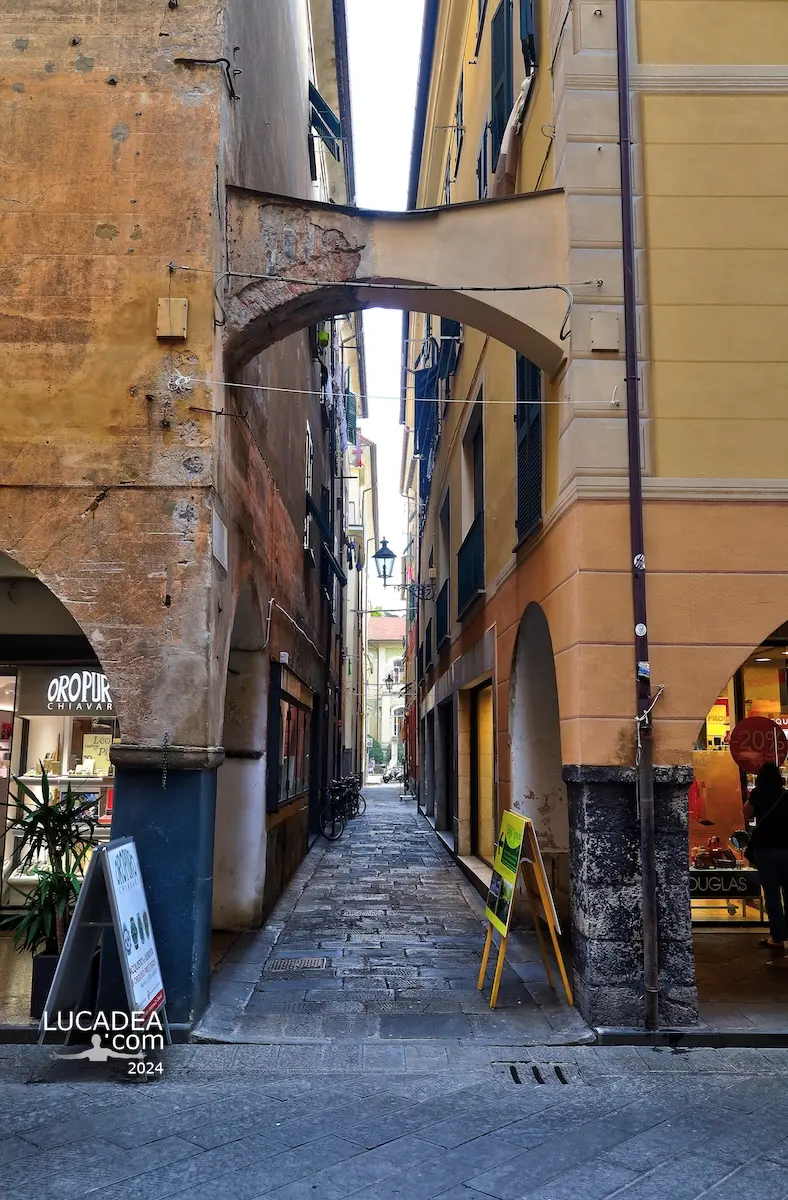
I often walk through Chiavari’s alleys, those narrow streets reminiscent of history, salt, and distant voices, and that time I stopped at this sbataccio arch. It’s a tiny passageway, barely an opening between two ancient stone walls, yet when you walk through it, it feels like crossing a threshold between past and present. The light changes, warmer, more golden—as if time were pausing to whisper something worth listening to. I stopped, leaning against the cold stone, and felt a sense of belonging flow through me that I didn’t know I was looking for.
The sbataccio arch has never been featured in postcards or travel guides; it’s one of those tiny details that captures the heart.
That time, while I was taking photos, trying to capture the special light that enveloped the arch in the late afternoon, an elderly resident of the alleyway approached. “You know,” he said with a smile, “this arch has seen generations pass by. It’s our little Gate of Time.” Those words struck me. Because it’s true: passing under the arch doesn’t just enter another stretch of alley, it enters another era, made of daily gestures that seem suspended between yesterday and today.
And so every time I think of Chiavari, one of the first images that comes to mind is that narrow passageway, with its bricks worn by wind and salt, with that ever-unique light that seems to want to embrace anyone who dares to stop for a moment to look beyond mere glance.

Have you ever found yourself in a small place that told you a story bigger than itself?
Add a comment or go to the bottom of the site to read what other visitors have written.

Un arco di sbataccio nel cuore del caruggio di Chiavari

Foto scattata con macchina Canon EOS RP e lente Canon RF 28.

L’Arco di Sbataccio nel cuore del caruggio – The Arco di Sbataccio in the Heart of the Alley – L’Arche de Sbataccio au cœur du caruggio – El Arco de Sbataccio en el corazón del caruggio – O Arco di Sbataccio no coração do caruggio – Der Arco di Sbataccio im Herzen der Gasse – Cổng Sbataccio trong trái tim con hẻm – 阿尔科·迪·斯巴塔乔在巷子中心 – カルッジョの中心にあるスバタッチョのアーチ

Il testo del post è stato scritto con l’aiuto di ChatGPT, un modello di lingua di OpenAI.

The arch and stairs of St. Ercolano in Perugia

L'Arco e le Scalette di S. Ercolano a Perugia

The Arch and Stairs of Sant’Ercolano in Perugia.
Perugia, with its rich history and medieval charm, offers numerous picturesque corners to explore. Among these, the Arch and Stairs of Sant’Ercolano are a must-see for those wishing to immerse themselves in the city’s history.
The Arch of Sant’Ercolano, known in ancient times as Porta Cornea, is one of the most fascinating remains of the Etruscan city walls. Built in the second half of the 3rd century BC, this arch was one of the seven gates to the Etruscan city. During the Middle Ages, the original round arch was replaced with a pointed arch, giving it its current appearance.
The Stairs of Sant’Ercolano are a picturesque route that connects the lower part of the city with the Church of Sant’Ercolano. Climbing these steps is like stepping back in time, passing through the ancient Porta Cornea and immersing yourself in Perugia’s medieval atmosphere. The church, dedicated to Sant’Ercolano, is another architectural gem worth a visit.
Via Sant’Ercolano, with its steps, church, and Etruscan arch, is one of Perugia’s most characteristic spots. However, it is important that these historical treasures be preserved and maintained in good condition. The beauty and historical value of these places require attention and care, both from local authorities and private citizens.

Do you know the beautiful city of Perugia?
Add a comment or go to the bottom of the site to read what other visitors have written.

L'Arco e le Scalette di S. Ercolano a Perugia

Photo taken with Canon EOS RP and Canon RF 24-50 lens.

To see all the photos of Perugia, click here:

Where is the arch located:

The Arch of Sant’Ercolano (formerly Porta Cornea) is located in Perugia on the homonymous steps of Sant’Ercolano. It was part of the Etruscan city walls, built in the second half of the 3rd century BC. It was one of the seven access gates to the Etruscan city. It was remodeled in the Middle Ages, and the original round arch was replaced with a pointed arch.
Continue and learn more at Wikipedia

The Arch and the Stairs of S. Ercolano in Perugia – L’Arc et l’Escalier de S. Ercolano à Pérouse – El Arco y las Escaleras de San Herculano en Perugia – O Arco e a Escadaria de S. Ercolano em Perugia – Der Bogen und die Treppe von S. Ercolano in Perugia – Cổng vòm và cầu thang của S. Ercolano ở Perugia

The text of this post was written with the help of Copilot, an artificial intelligence-based virtual assistant.
References:
– http://www.latramontanaperugia.it/articolo.asp?id=5820

🏠
  • Italiano