
Chocolate bears for Valentine’s Day in Barcelona

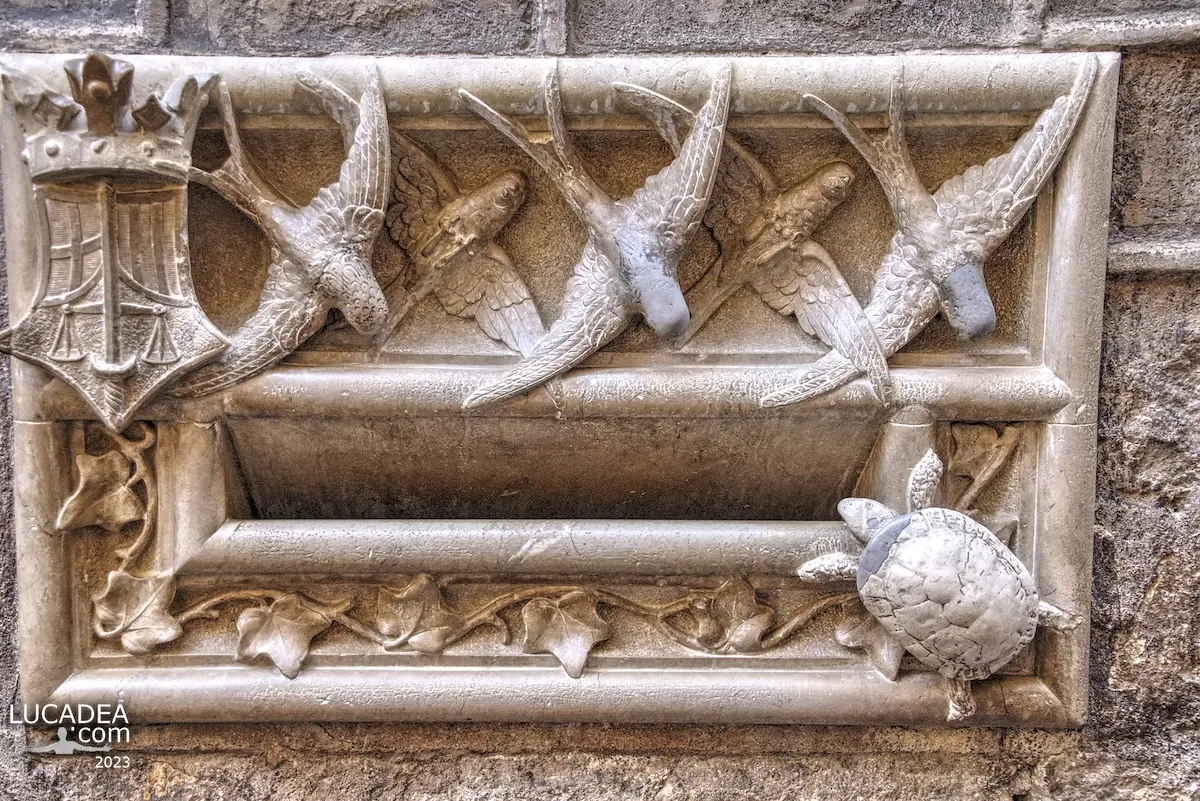
The letter box of the Archdeacon’s House in Barcelona.
Walking through the center of Barcelona, away from the most crowded paths of La Rambla, I discovered a small work of art hidden in the details of a historic building. This decorated letter box of the Archdeacon’s House in Barcelona caught my attention because of its refined shapes and the small symbols that tell a story.
I was heading toward Barcelona Cathedral when I noticed this unusual element on the facade of the Archdeacon’s House, something very different from ordinary letter boxes. The five swallows and the turtle carved into the decoration immediately attracted my attention, creating a small composition full of meaning. The coat of arms visible on the piece is still a mystery to me, and I could not identify with certainty which family it belonged to.
The photograph was taken in Barcelona, Catalonia, Spain, during a walk through the historic center. If you are visiting Barcelona and wondering what to see beyond the famous attractions, these small architectural details are often what make a walk truly memorable. A simple letter box can reveal something about the history of a building and the neighborhood around it.
The Archdeacon’s House, known in Catalan as Casa de l’Ardiaca, is a historic building located near Barcelona Cathedral and is one of the most interesting examples of the Gothic Quarter’s architecture. One curious detail is that the letter box was created at the end of the 19th century by modernist architect Lluis Domènech i Montaner and is considered a small decorative masterpiece.
What I enjoy about urban photography is the possibility of finding unexpected details while walking. There is not always a need to search for famous monuments or spectacular views; sometimes a door, a window or a small object on a wall can become the most interesting subject.
On my photoblog, I often share these kinds of accidental discoveries, where hidden elements of a city become the main focus of an image. This photograph was created in exactly that way: by leaving the usual route and following curiosity.
I stopped in front of this letter box because it seemed to preserve a story of its own, even though it is only a small part of a much larger building.
Have you ever discovered a surprising detail in a city just because you decided to take a different street? Add a comment or go to the bottom of the site to read what other visitors have written.

Photo taken with Canon EOS RP and Tamron 16-300 lens.
To see all the photos I took in Barcelona, click here:

Here is where this monument is located:
The Casa de l’Ardiaca (in English, the Archdeacon’s House) is a building located in the Gothic Quarter of Barcelona. The building was constructed in the 12th century over the ancient Roman wall and was one of the residences of the canons of Barcelona. At the end of the 15th century, the building became the residence of Archdeacon Lluís Desplà, who transformed the house into a Gothic palace.
Continue and learn more at Wikipedia
The text of this post was written with the help of ChatGPT, a language model from OpenAI.
The rights on images, videos, choruses, text and all other material on the LUCADEA.com website are governed as per Copyright page.

A Turkish dish in Barcelona: Kofte Kebab.
When I’m in Barcelona, I like to try some Turkish food for a change. I normally opt for the classic kebab, but last time I tried this dish.
In the vast universe of Middle Eastern cuisine, few dishes can match the unmistakable taste and enveloping aroma of Kofte Kebab. Originally from Turkey, this dish has spread throughout the world thanks to its simplicity, versatility, and, above all, its incredible flavor.
Kofte Kebab is a classic of Turkish cuisine, with roots dating back centuries. “Kofte” comes from the Persian word “kufta,” meaning “minced” or “chopped,” while “kebab” is a Turkish word that refers to a dish cooked on a grill or skewer. This combination of minced ingredients and grilling makes Kofte Kebab a dish as delicious as it is rich in history.
The basic recipe for Kofte Kebab calls for minced meat, traditionally lamb or beef, although chicken or turkey variations are also common. Key ingredients include onion, garlic, parsley, and a combination of spices that can vary depending on personal taste and region. Common spices include cumin, black pepper, chili powder, and sweet or smoked paprika.
Once the ingredients are mixed, the meat is shaped into small patties or elongated shapes, skewered, and then grilled until evenly browned and juicy. This open-fire cooking process gives Kofte Kebab its distinctive smoky, aromatic flavor that makes it so irresistible.
Like many traditional dishes, Kofte Kebab has numerous regional variations that reflect different culinary influences and local preferences. For example, in the Black Sea region of Turkey, it’s common to add soaked and mashed stale bread to the meat mixture to impart a softer texture and a slightly different flavor. In contrast, in southeastern Turkey, kofte are often served with spicy tomato sauce or yogurt.
Kofte Kebab is often served with fresh and colorful side dishes, such as tomato and cucumber salad, thinly sliced red onions, fresh parsley leaves, and squeezed lemon. These accompaniments not only add a refreshing note to the meal, but also perfectly balance the rich, intense flavors of the kebab.
The dish can be served on a bed of pilaf rice or accompanied by freshly baked flatbread, such as traditional “pide,” or Turkish bread. Some kofte kebab lovers also prefer to add a generous helping of yogurt sauce, enriched with garlic and mint, for an extra touch of freshness and creaminess.
In conclusion, kofte kebab is much more than just a plate of grilled meat; it is a symbol of conviviality, tradition, and culinary passion. Its simple yet delicious recipe and endless possibilities for customization make it a cornerstone of Middle Eastern cuisine beloved around the world. Whether you enjoy it in an authentic Turkish restaurant or prepare it yourself in the kitchen, Kofte Kebab is definitely a culinary treasure to be appreciated and enjoyed.
Add a comment or scroll down to read what other visitors have written.

Photo taken with Honor 20.
Here’s where the restaurant is located:
The text of this post was written with the help of ChatGPT, a language model from OpenAI.
The rights on images, videos, choruses, text and all other material on the LUCADEA.com website are governed as per Copyright page.

The Bishop’s Bridge in Barcelona Gothic Quarter.
The Bishop’s Bridge in Barcelona appears suddenly while walking through the narrow streets of the Gothic Quarter, one of those details you often encounter when searching what to see in Barcelona or exploring architectural highlights in the old city. The Bishop’s Bridge in Barcelona immediately stands out, suspended between two buildings like a small piece of stone theatre.
Walking through the Barcelona, especially inside the Gothic Quarter, you are constantly surrounded by layers of history, and this structure, known locally as Pont del Bisbe, fits naturally into that dense urban rhythm. It connects two buildings in a way that feels almost symbolic, as if the street itself had folded upward.
I came across the Bishop’s Bridge in Barcelona while wandering without a fixed direction, simply looking up at the surrounding architecture. It is one of those places that rewards curiosity more than planning. The Gothic Quarter is full of similar surprises, but this one feels especially theatrical, framed perfectly within the narrow streets below.
As I raised my camera, I noticed the contrast between the medieval atmosphere of the surroundings and the relatively recent construction of the bridge itself. Yet visually, it blends in so well that it feels older than it actually is. That kind of architectural illusion is part of what makes Barcelona so interesting to photograph.
I often think about how small details like this can define a walk through a city. It’s not always the major landmarks that stay in memory, but these suspended connections between buildings, shadows, and space. I have shared other architectural details from different cities on this site, but this one has a particularly strong presence because of how enclosed and intimate the space feels.
A small historical note: the Pont del Bisbe was built in the 20th century in a neo-Gothic style, designed to match the medieval character of the neighborhood while subtly adding a modern interpretation of it.
Walking away, I kept looking back, as if the bridge would change depending on the angle.
Have you ever found a detail in a city that felt more memorable than the main landmarks? Add a comment or go to the bottom of the site to read what other visitors have written.


Photos taken with Canon EOS RP and lens Tamron 16-300.
To see all the photos I took in Barcelona click here:
Here’s where the bridge is located:

A plate of kebab in Barcelona during a stop by ship.
Whenever I stop in Barcellona while traveling by ship, I often don’t follow the expected path of trying local Spanish food, even though the city offers plenty of choices. Instead, I usually end up going to a small Turkish restaurant and ordering a plate of kebab in Barcelona during a stop by ship.
It is a recurring choice, almost automatic over time. Barcelona has so many culinary possibilities, yet I keep returning to this simple dish instead of exploring more traditional local options. It becomes a personal habit within the context of travel.
The plate of kebab in Barcelona during a stop by ship is straightforward: no complexity, no interpretation needed. That simplicity fits the mindset of movement, where everything is temporary and constantly shifting.
The kebab is direct and familiar: seasoned meat, simple sides, and a clear identity. In a city like Barcelona, full of culinary variety, this simplicity stands out even more as a personal constant.
Some people might find this choice unusual, especially in a place known for its rich gastronomy, but travel often creates its own routines, and this dish has become one of mine.
A small fact about kebab is that it was originally designed as a practical, fast food for people on the move, which explains why it fits so naturally into travel situations.
When I finish eating, I’m left with the feeling of having repeated a familiar pattern once again.
Have you ever found yourself always choosing the same dish even when traveling somewhere new? Add a comment or go to the bottom of the site to read what other visitors have written.


Photos taken with Honor 20.
Here’s where I’m going, on a side street off La Rambla:
The term kebab is essentially of Persian origin: Arab tradition holds that the dish was invented in the Middle Ages by Persian soldiers who used their swords to grill meat over an open fire. According to Ibn Battuta, a Moroccan traveler, in India kebab was not only served in royal palaces during the Delhi Sultanate (1206–1526 AD), but common people also ate it for breakfast with naan, a leavened, baked bread. An older variant of kebab (Greek: obeliskos) is attested in Greece from the 8th century BC in the writings of Homer and the classical works of Aristophanes, Xenophon, and Aristotle.
Continue on Wikipedia
The text of this post was written with the help of ChatGPT, a language model from OpenAI.

Buildings on La Rambla in Barcelona.
Walking along La Rambla in Barcelona, I often find myself slowing down without even realizing it, and the buildings on La Rambla in Barcelona become the real focus of my attention. This iconic street is not only movement and people, but also a continuous sequence of façades that each tell a different story, standing side by side in a long urban dialogue.
As I move along La Rambla, my gaze naturally goes upward. The buildings on La Rambla in Barcelona reveal themselves one after another, with decorative details that are never repetitive. Some are elegant, others more elaborate, but all of them have the ability to briefly stop my pace. It’s not just a street to cross, but a place to observe layer upon layer of architecture.
Barcelona, Catalonia, Spain, expresses itself here in one of its most theatrical urban forms. La Rambla is known for its constant flow of life, yet what strikes me most is the contrast between the movement at street level and the stillness of the façades above. If you are visiting Barcelona and wondering what to see beyond the main attractions, this street is a perfect example of how everyday architecture becomes part of the city’s identity.
I like to think that every time I pass here I notice something different. Sometimes I really do, other times I suspect I’ve seen it before but never truly observed it. On another post from my site I described a square in the city where architecture and human movement interacted in a similar way, and here on La Rambla that relationship feels even more intense.
What fascinates me most is the variety of decorative elements: balconies, cornices, carved details that change from one building to the next. There is no monotony, even when the street itself feels familiar.
I keep walking, looking up more than forward, letting details decide what deserves to be photographed.
Have you ever walked down a famous street and realized the real beauty was above your head? Add a comment or go to the bottom of the site to read what other visitors have written.


Photos taken with Canon EOS M100 and Canon EF-M 11-22 lens.
To see all the photos I took in Barcelona, click here:
Where is La Rambla located:
La Rambla is one of the city’s most iconic landmarks, popular year-round with both tourists and locals. It has different names on its various sections, so it’s sometimes called the plural Les Rambles in Catalan and Las Ramblas in Castilian. The word rambla comes from the Arabic raml (sand) and refers, as in other Spanish cities, to a street created by a dry, buried, or covered watercourse.
Continue and learn more at Wikipedia
The text of this post was written with the help of ChatGPT, a language model from OpenAI.

Saint James on horseback in Barcelona square.
I find myself standing in Plaça Sant Jaume as the constant movement of people flows around me, while the equestrian statue of Saint James quietly emerges between the institutional buildings. The Saint James on horseback statue in Barcelona does not try to dominate the space; instead, it naturally becomes part of the rhythm of the square, almost like a silent anchor in the middle of urban motion.
Walking through this central area of Barcelona, Catalonia, Spain, I feel how the square balances administrative function and historical presence. The Saint James statue, known locally as Sant Jaume, fits into this environment with a kind of calm continuity, as if it has always belonged exactly there.
The equestrian statue of Saint James becomes a way to read the square itself. It is not just an object to photograph, but a visual pause between the surrounding architecture and the constant flow of pedestrians. The longer I observe it, the more it feels like a threshold between institutional space and everyday life.
I remember another photograph from my site where a sculpture appeared in a completely different urban context, yet created the same effect: a moment of stillness inside movement. Here in Barcelona that sensation is even stronger, because everything is structured yet constantly alive.
A small historical detail adds depth: the sculpture was created in 1902 by the sculptor Manuel Fuxà and was originally intended for a charitable institution building before being relocated to this public square. This shift transformed its meaning, turning it into a civic landmark rather than a private decorative piece.
I stay a little longer, watching people pass without noticing it. And I wonder how many of these silent details exist in cities we think we already know.
Have you ever noticed something so subtle in a place you’ve walked through many times? Add a comment or go to the bottom of the site to read what other visitors have written.


Photos taken with Canon EOS RP and Tamron 16-300 lens.
To see all the photos I took in Barcelona, click here:
Where is the statue located:
James the Greater, also known as James of Zebedee (Bethsaida, … – Jerusalem, 44), is one of the twelve apostles of Jesus, as reported in the Gospels and the Acts of the Apostles. He is called “Greater” to distinguish him from the apostle of the same name, James of Alphaeus, known as “Minor” or “the brother of the Lord.”
Continue and learn more at Wikipedia
The text of this post was written with the help of ChatGPT, a language model from OpenAI.

Turkish patlican kebab in Barcelona.
Patlican kebab is a traditional Turkish dish combining eggplant (patlican in Turkish) and meat, usually lamb or beef. This kebab is especially appreciated for its rich flavor and preparation that highlights fresh, flavorful ingredients typical of Turkish cuisine.
There are several variations depending on the region and personal preferences. Some recipes use different spices or add other vegetables such as zucchini or onions. In some versions, eggplants and meat can be cooked together in an oven tray instead of skewers.
Patlican kebab represents a perfect combination of flavors and techniques of Turkish cuisine, offering a rich and aromatic dish that celebrates fresh ingredients and the culinary tradition of the country.
Do you like Middle Eastern cuisine? Add a comment or scroll down to see what other visitors have written.


Photos taken with Honor 20.
Here’s where the restaurant is located:
The text of this post was written with the help of ChatGPT, a language model from OpenAI.

Barcelona’s architecture between ancient and modern.
Almost every time I walk along La Rambla in Barcelona, I find myself looking at this view, struck by the contrast between the modern lines of this building and the bell tower of the Basilica of Santa María del Pi.
A beautiful contrast, isn’t it?
Do you know Barcelona? Add a comment or go to the bottom of the site to read what other visitors have written.

Photo taken with Canon EOS M100 and Canon EF-M 11-22 lens.
To see all the photos I took in Barcelona, click here:
Here’s the exact spot where I took the photo:
La Rambla is one of the city’s most iconic landmarks, popular year-round with both tourists and locals, and has different names along its various sections, so it’s sometimes called the plural Les Rambles in Catalan and Las Ramblas in Castilian. The word rambla comes from the Arabic raml (sand) and refers, as in other Spanish cities, to a street carved out of a dry, buried, or covered watercourse.
Continue and learn more at Wikipedia

A kebab in Barcelona, far from La Rambla.
The photograph of this kebab dish takes me back to a lunch break unlike any other, in the middle of a workday in Barcelona. It was midday, the sun was already high, and the city outside was bustling, with the constant sound of footsteps and voices wafting up La Rambla. I, however, had decided to walk a few meters away, slipping into a quieter side street, the kind that changes atmosphere in the space of a few steps. It was there that I noticed that small Turkish restaurant, simple, straightforward, and unpretentious.
The dish arrived shortly thereafter, just as it should be: thinly sliced kebab, still-warm fries, onion, a few fresh vegetables, and a yogurt sauce that perfectly complemented everything. I photographed it before starting because it had that sincere look that always strikes me. It wasn’t a dish designed to impress, but to nourish, to accompany a brief, necessary break in a busy day.
Eating kebab in Barcelona, I know, isn’t an orthodox choice. But at that moment, I wasn’t looking for gastronomic coherence. I needed something I truly enjoyed, a familiar flavor that required no explanation. The kebab was flavorful, the fries added texture, the onions added character, and the yogurt sauce held everything together without covering anything up. A practical, straightforward dish, perfect for a quick but satisfying lunch.
That Turkish restaurant seemed frequented more by local workers than tourists. Tables occupied briefly, dishes arrived quickly, people eating slowly but without getting lost. A real, concrete pause. Photographing that kebab was a way to capture an ordinary yet meaningful moment: a simple interlude in a working day away from home.
Looking back at the photo, I rediscover that precise feeling of everyday freedom. Eating what I want, even if it’s not “right” for where I am. That kebab, enjoyed at midday on a side street off La Rambla, has become a small, personal memory, more authentic than many forced choices.
Have you ever followed the taste of the moment, even when it wasn’t the most predictable choice? Add a comment or go to the bottom of the site to read what other visitors have written.


Photos taken with Oppo Reno 12.
Here’s where I’m going, on a side street off La Rambla:
The term kebab is essentially of Persian origin: Arab tradition holds that the dish was invented in the Middle Ages by Persian soldiers who used their swords to grill meat over an open fire. According to Ibn Battuta, a Moroccan traveler, in India kebab was not only served in royal palaces during the Delhi Sultanate (1206–1526 AD), but common people also ate it for breakfast with naan, a leavened, baked bread. An older variant of kebab (Greek: obeliskos) is attested in Greece from the 8th century BC in the writings of Homer and the classical works of Aristophanes, Xenophon, and Aristotle.
Continue on Wikipedia
The text of this post was written with the help of ChatGPT, a language model from OpenAI.
