The long stairway to Ong Nui Buddha

Ripida scalinata di Ong Nui Pagoda in Vietnam con grande statua del Buddha bianco in cima e simbolo dorato all’ingresso

The long stairway to Ong Nui Buddha.
In this image taken during my trip to Vietnam in Binh Dinh, the complex of Ong Nui Pagoda reveals itself through an extremely long and steep staircase leading directly toward a massive white Buddha statue at the top of the hill. The The long stairway to Ong Nui Buddha immediately becomes the dominant visual and symbolic element of the scene, turning the ascent into something far more meaningful than a simple climb.
At the base of the staircase there is a golden symbol shaped like a wheel. This is most likely the Dharma Wheel, one of the most important symbols in Buddhism, representing the teachings of the Buddha and the cycle of spiritual law. It marks the beginning of a journey that is both physical and symbolic.
The staircase rises sharply and disappears into perspective, drawing the eye all the way up to the white Buddha statue that overlooks the entire landscape. Ong Nui Pagoda is known for this sense of gradual ascent, where each step creates a stronger feeling of separation from the everyday world and a closer connection to silence and reflection.
Looking at this scene, I naturally start wondering what to see in Vietnam beyond its cities and coastal areas. Places like this reveal another dimension of the country, where spirituality is deeply embedded in the landscape itself.
I have seen similar hilltop temples in other parts of Southeast Asia, but the scale and intensity here feel particularly striking. The climb becomes an experience of rhythm and focus, where movement itself becomes part of the meaning.

And as I imagine walking those steps, I wonder how different the experience must feel when lived slowly, one step at a time. Add a comment or go to the bottom of the site to read what other visitors have written.

Ripida scalinata di Ong Nui Pagoda in Vietnam con grande statua del Buddha bianco in cima e simbolo dorato all’ingresso

Photo taken with Canon EOS R50 V and Tamron 16-300 lens.

To see all the photos of the temple, click here:
foto gallery

Stairway to Ong Nui Pagoda Buddha – Escalier vers le Bouddha de la pagode Ong Nui – Escalinata hacia el Buda de Ong Nui – Escadaria para o Buda da Pagode Ong Nui – Treppe zum Buddha der Ong Nui Pagode – Cầu thang lên tượng Phật chùa Ông Núi – 通往翁努寺佛像的阶梯 – オンヌイ寺の仏陀へ続く階段

The text of this post was written with the help of ChatGPT, a language model from OpenAI.

Add one  comment to this article or read  here what other visitors have written.
 
Adv
 
Disclamer

The rights on images, videos, choruses, text and all other material on the LUCADEA.com website are governed as per  Copyright page.


This page has been viewed 1 times today.
This month it has been viewed 1 times.
In total it has been viewed 1 times.
 

Ky Co beach in Quy Nhon, Vietnam

Mare da sogno: la spiaggia di Ky Co in Quy Nhon in Vietnam

Ky Co beach in Quy Nhon, Vietnam.
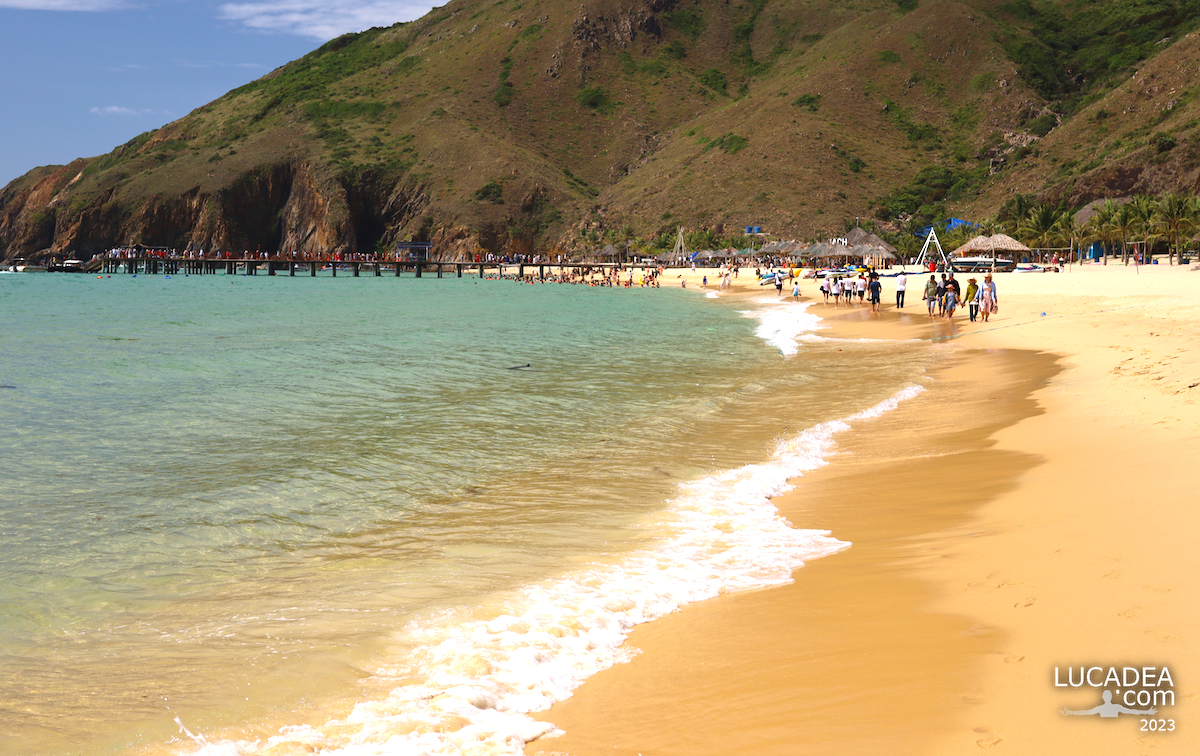
During my latest holiday in Vietnam, I had another opportunity to stop and photograph this beautiful stretch of coastline, and this is one of the images I chose to keep. Ky Co stayed in my memory because of the direct relationship between the beach, the sea and the landscape around it.
If you are wondering what to see in Quy Nhon, Ky Co beach is certainly one of the coastal places worth seeing. I experienced it mainly through photography, trying to collect a few views that could preserve at least part of what it felt like to stand in front of this landscape.
This photograph comes from a moment during my latest trip to Vietnam. There is no complicated story behind the image. I simply like having a visual record of the places I have actually visited, and when I travel I usually keep my camera ready for the views that catch my attention along the way.
Ky Co is located near Quy Nhon, in Binh Dinh province on the central coast of Vietnam. It offers a coastal setting quite different from the better-known images of Vietnam’s large cities. Here, the sea, beach and surrounding rocky landscape become the main subjects, and for me that simplicity is part of what makes the location interesting.
Looking at this photograph brings back one of the things I enjoy most about travelling. Arriving somewhere unfamiliar means that, for a few moments, I do not yet know exactly where the best viewpoint will be. Sometimes I take the camera out immediately. Other times I stop, look around and try to understand what has actually caught my eye.
With Ky Co, it was the character of the beach and the surrounding coastline that made me want to photograph it. A travel photograph does not always have to document a major experience or an entire itinerary. Sometimes it can simply preserve the memory of a short stop, a particular stretch of coast and the impression it left behind.
There is also a small geographical detail that I find interesting. Quy Nhon is the coastal capital of Binh Dinh province, while Ky Co is one of the beach destinations in the surrounding area. This makes the relationship between the city and the nearby coastline particularly interesting: a relatively short journey can take you from an urban setting to a much more open coastal landscape.
If you are looking for a beach in Vietnam with strong photographic appeal, Ky Co offers a very different subject from the country’s busy streets and historic cities. Here, the story is told by the coastline itself, by the sea and by the relationship between the water and the land.
This is also why I enjoy publishing several photographs from the same trip. One image can rarely tell the whole story of a place. Each photograph captures a different fragment, and together those fragments often recreate the memory of a holiday much better than a general description could.
On my photo blog I have already shared other moments and places from my travels, and I like keeping those images connected. Sometimes looking at a new photograph brings back the memory of an older one, creating a kind of visual diary that grows naturally over time.
This photograph of Ky Co is therefore simply another small piece of my latest trip to Vietnam. A beach, a stretch of coastline and a moment when I stopped to look through my camera and keep what I saw.

Have you ever been to a beach in Vietnam? Add a comment or go to the bottom of the site to read what other visitors have written.

Ky Co beach in Quy Nhon, Vietnam, showing the coastline and sea in a quiet travel photograph

Ky Co beach in Quy Nhon, Vietnam, showing the coastline and sea in a quiet travel photograph

Ky Co beach in Quy Nhon, Vietnam, showing the coastline and sea in a quiet travel photograph

Photos taken with Canon EOS RP and lens Canon RF 24-50.

Here is where the beach is located:

Add one  comment to this article or read  here what other visitors have written.
 
Adv
 
Disclamer

The rights on images, videos, choruses, text and all other material on the LUCADEA.com website are governed as per  Copyright page.

This page has been viewed 1 times today.
This month it has been viewed 1 times.
In total it has been viewed 1 times.
 

The great white Buddha at Ong Nui temple

Grande statua bianca del Buddha al tempio Ong Nui in Vietnam, con lunga scalinata centrale e vegetazione ai lati

The great white Buddha at Ong Nui temple.
The staircase stretches upward in a straight, almost hypnotic line, pulling my eyes toward the massive Buddha sitting quietly above everything else. The Buddha seems to merge with the pale sky, its white surface dissolving into the soft light, creating a calm yet striking presence that immediately anchors the scene.
As I follow the steps visually, I begin to notice the human scale hidden within the composition. Tiny figures move along the stairs, emphasizing just how immense the Buddha truly is. The structure feels deliberate, designed to slow down both the body and the gaze. The Buddha sits in a meditative pose, its robe carved with flowing lines that appear soft despite the solid material. There is no motion, yet it feels deeply alive.
Ong Nui temple, also known as Linh Phong Pagoda, is home to one of the largest seated Buddha statues in Vietnam, and that fact becomes almost obvious just by looking at it. The size is not overwhelming in a chaotic way, but rather grounding, as if everything here is meant to guide visitors toward stillness and reflection.
The rocky slopes on both sides frame the staircase naturally, while the green vegetation breaks the dominance of white and adds texture to the scene. This balance between nature and structure gives the image a sense of harmony. And above it all, the Buddha remains unchanged, a fixed point that contrasts with the subtle movement of people below.
There is an implied silence in this place. Even without hearing anything, I can almost feel the quiet atmosphere surrounding the temple. The Buddha does not demand attention; it simply exists, and that is enough to shift the way you perceive the space around you.
Looking back at this moment, I wonder if the real experience was the physical climb or that instant when I lifted my eyes and truly understood the scale of the Buddha.

Have you ever stood in front of something so vast that it made you feel small in a comforting way? Add a comment or go to the bottom of the site to read what other visitors have written.

Photos taken with Canon EOS R50 V and Tamron 16-300 lens.

To see all the photos of the complex, click here:
foto gallery

The great white Buddha of Ong Nui temple – Le grand Bouddha blanc du temple Ong Nui – El gran Buda blanco del templo Ong Nui – O grande Buda branco do templo Ong Nui – Der große weiße Buddha des Ong Nui Tempels – Tượng Phật trắng lớn tại chùa Ong Nui – 翁努寺的巨大白色佛像 – オングヌイ寺の大きな白い仏像

The text of this post was written with the help of ChatGPT, a language model from OpenAI.

Quy Nhơn beach on Vietnam’s central coast

Spiaggia di Bãi Biển in Quy Nhơn

Quy Nhơn beach on Vietnam’s central coast.
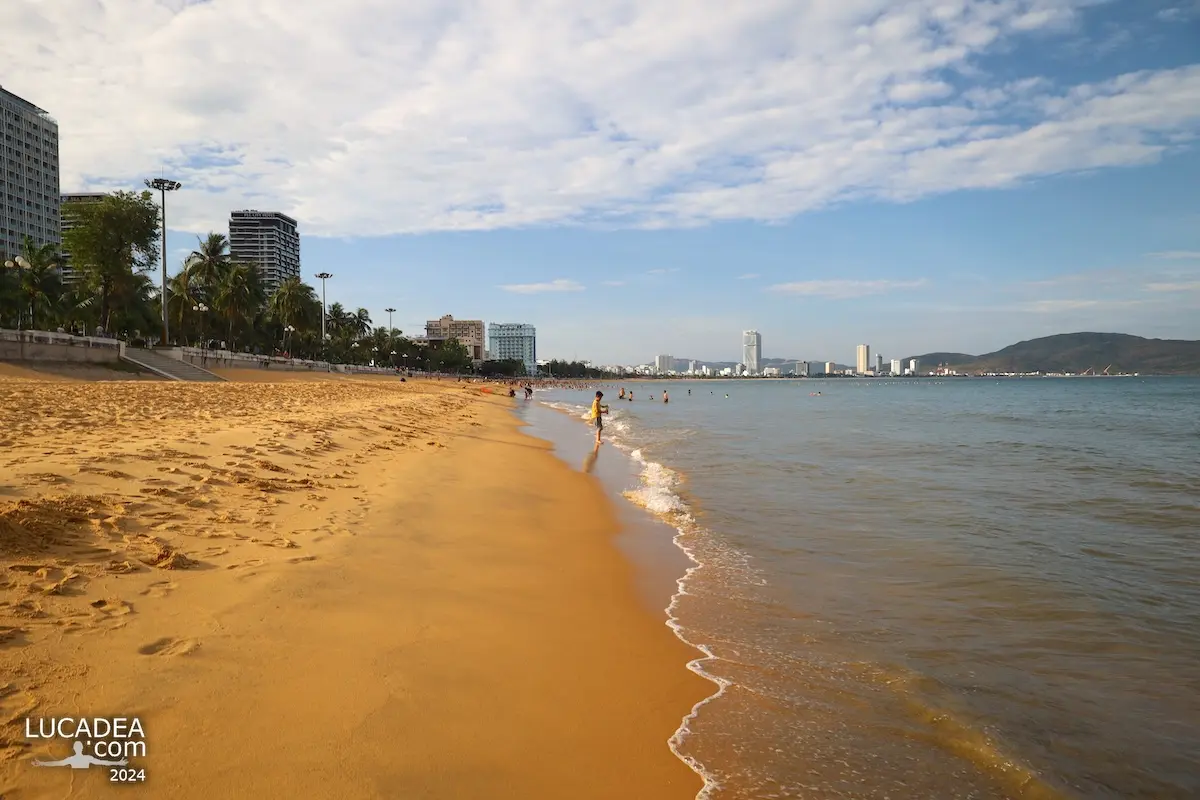
Standing in front of this long stretch of golden sand, I found myself looking at one of the quieter faces of Vietnam’s coastline. Bãi Biển in Quy Nhơn runs along the sea, with hotels and restaurants following the coast and becoming part of the cityscape.
I took this photograph last year while travelling through Vietnam with my wife. What I remember most is the sheer length of the beach and the way the city seemed to unfold behind it. It was not one of those perfectly sunny days that photographers always hope for, but the softer conditions were enough to make me stop and capture the scene.
If you are wondering what to see in Quy Nhơn, the beach is naturally one of the places worth seeing. Not necessarily because it offers the typical tropical postcard view, but because it gives a good sense of the relationship between the city and the sea. Here, the coastline is not separated from everyday urban life: hotels, restaurants and buildings facing the water are all part of the landscape.
Quy Nhơn is in Bình Định province in central Vietnam, and its position on the coast has played an important role in the city’s development. During my visit, however, I was mostly interested in experiencing the place at a slower pace, looking along the beach and finding small details that could become photographs.
The golden sand takes up much of the scene and creates a wide open foreground in front of the buildings. Even without strong sunlight, its colour remains visible and provides a natural contrast with the sea. This balance between the natural coastline and the built-up city is one of the things I enjoy photographing in seaside towns.
There is also a small detail about the name. Quy Nhơn is commonly written as Quy Nhon when Vietnamese diacritics are omitted in international contexts. The city is now one of the main urban centres of Bình Định province and has strong connections with the culture and history of central Vietnam.
I did not try to hide the lack of sunshine in this photograph. It is part of the memory of that particular day. When travelling, we naturally hope for perfect conditions, especially when carrying a camera, but photographs made under less-than-perfect skies can sometimes feel more honest because they preserve the journey as it actually happened.
This photograph also has a personal meaning because I was not travelling alone. My wife was with me, and that makes the image part of a shared memory rather than simply a picture of a beach in Vietnam. When I look back at photographs taken far from home, I often remember not only the place itself but also the circumstances in which I first saw it.
After photographing other coastal towns and beaches during my travels, Quy Nhơn has become another small part of my personal collection of places encountered along the way. Not every photograph needs perfect light or dramatic scenery to be worth keeping. Sometimes an image is valuable simply because it brings back a place, a journey and a particular moment.
For anyone interested in a less immediately familiar side of Vietnam, Quy Nhơn offers an interesting combination of a long coastal beach and a growing seaside city. That mixture is what caught my attention more than any single landmark.

Would you rather see Quy Nhơn under a bright blue sky, or do you like the softer atmosphere in this photograph? Add a comment or go to the bottom of the site to read what other visitors have written.

Photos taken with Canon EOS RP camera and Canon RF 24-50 lens.

Here’s where this beach is located:

The direction sign on Nhon Hai beach

Il cartello con le direzioni nella spiaggia di Nhon Hai

The direction sign on Nhon Hai beach.
When I was in Vietnam last year, I visited the Binh Dinh region and, during an excursion, we went to the beautiful Nhon Hai beach where there was this classic sign with many other locations and their directions.

Do you know Vietnam? Add a comment or go to the bottom of the site to read what other visitors have written.

Il cartello con le direzioni nella spiaggia di Nhon Hai

Photo taken with Canon EOS RP and lens Canon RF 24-50.

Here is where the beach is located:

The direction sign at Nhon Hai Beach – Le panneau de direction à la plage de Nhon Hai – La señal de dirección en la playa de Nhon Hai – A placa de direção na praia de Nhon Hai – Das Wegweiserschild am Nhon Hai Beach – Biển chỉ đường tại bãi biển Nhon Hải – 仁海海滩的方向标志 – ニョハイビーチの方向標識

The Great Buddha at Ngoc Hoa Monastery

Grande statua dorata del Buddha nel monastero Ngoc Hoa nella zona di Qui Nhon, Vietnam

The Great Buddha at Ngoc Hoa Monastery.
During a trip to Vietnam last year, my wife and I travelled around the Qui Nhon area and, during one of our excursions, visited Ngoc Hoa Monastery. Among the things that immediately caught my attention was the huge golden Buddha statue standing within this small spiritual centre.
This photograph comes directly from that visit. I wanted to capture the Buddha with my camera because its size made it dominate the surrounding scene. The golden surface also made the statue particularly noticeable, creating a very clear focal point even when viewed from some distance.
When I think about what to see around Qui Nhon, this is one of the visits I remember with particular curiosity. The area is not only about beaches and the sea. There are also religious and cultural places that offer a completely different perspective on the region and on everyday spiritual life in Vietnam.
Ngoc Hoa Monastery is in the Qui Nhon area, in Binh Dinh Province, Vietnam. Visiting a place like this means stepping away for a while from the more urban side of the destination and entering an environment where the religious character of the site becomes immediately apparent.
The Buddha statue was clearly the main subject I wanted to photograph. Its scale naturally draws the eye upwards and gives the image a very precise focal point. I enjoy this kind of photography because the composition does not always need to be complicated. Sometimes the proportions of the subject itself are enough to create the structure of the photograph.
There is also an interesting detail behind Buddhist representations: Buddha statues can look very different depending on the artistic tradition and cultural setting in which they are created. Body position, hand gestures and facial expression can carry symbolic meanings, so even a seemingly simple statue can offer many details to observe.
During the visit I looked at more than just the statue, of course, but it was definitely the element that stayed with me most strongly. Its scale, colour and position within the monastery made it the dominant feature of the whole setting.
That is one of the things I enjoy about travel photography. You do not always have to search for the most famous monument or the most recognisable viewpoint. Sometimes you simply encounter a subject whose proportions, position or relationship with the surrounding space immediately catches your eye.
My camera allowed me to preserve that particular impression. Looking at the image again today brings back the excursion I made with my wife and, above all, the surprise of finding such an imposing statue in a place that was completely new to me.
If you are wondering what to see around Qui Nhon, places like this can add another dimension to a visit. It is not simply about photographing a large Buddha statue, but about experiencing a setting where architecture, spirituality and the surrounding landscape come together.
The golden Buddha remains the strongest visual memory I have of Ngoc Hoa Monastery. This photograph belongs to that journey through Vietnam and, rather than trying to explain the entire place, it allows me to remember one specific moment from our excursion.
As with other travel photographs I have shared, I like this image because there is a real experience behind it. I was there, I saw the statue with my own eyes and I chose to photograph it because something about its presence immediately caught my attention.
This is one of the reasons I continue to keep and publish photographs that might seem simple at first glance. Years later, a single image can bring back not just the subject itself, but an entire journey, a particular day and the feeling of discovering somewhere completely new.

Have you ever come across such an imposing Buddha statue while travelling through Vietnam? Add a comment or go to the bottom of the site to read what other visitors have written.

Large golden Buddha statue at Ngoc Hoa Monastery near Qui Nhon, Vietnam

Photo taken with Canon EOS RP and lens Canon RF 24-50.

Here’s where the statue is located:

According to Buddhism, a Buddha, also known as budda in Italian, is a being who has reached the highest level of enlightenment (bodhi). Buddha is the past participle of the Sanskrit budh, meaning to become aware, to awaken. Buddha therefore means “awakened,” referring to the passage of consciousness from the state of sleep (ὕπνος, hypnos) to the state of full realization.
Continue and learn more at Wikipedia

The famous stony beach of Eo Gió in Vietnam

La famosa spiaggia pietrosa di Eo Gió in Vietnam

The famous rocky beach of Eo Gió in Vietnam.
This small bay, famous in Vietnam, is located in the town of Quang Trung (Thành phố Qui Nhơn, Bình Dinh Province).
I was there last year when my wife and I visited a friend of hers who lives in the area.
We took a trip to the beach and then took a bus to visit this small bay (which is very crowded with tourists).
The peculiarity is that the coast is very rocky and the stones are all very square-shaped.

Do you know Vietnam? Add a comment or go to the bottom of the site to read what other visitors have written.

La famosa spiaggia pietrosa di Eo Gió in Vietnam

La famosa spiaggia pietrosa di Eo Gió in Vietnam

La famosa spiaggia pietrosa di Eo Gió in Vietnam

Photo taken with Canon EOS RP and lens Canon RF 24-50.

Here is where the beach is located:

The famous stony beach of Eo Gió in Vietnam – La célèbre plage de galets d’Eo Gió au Vietnam – La famosa playa pedregosa de Eo Gió en Vietnam – A famosa praia rochosa de Eo Gió no Vietnã – Der berühmte Steinstrand von Eo Gió in Vietnam – Bãi đá Eo Gió nổi tiếng ở Việt Nam – 越南著名的 Eo Gió 石滩 – ベトナムのエオジオの有名な石のビーチ

Bãi Biển Beach along Vietnam’s peaceful coast

La spiaggia di Bãi Biển in Vietnam

Bãi Biển Beach along Vietnam’s peaceful coast.
On the coast near Quy Nhơn, in Binh Dinh, Vietnam, I found a view that represents the quiet beauty of lesser-known Vietnam beaches. Bãi Biển Beach, with its long stretch of sand and natural surroundings, became a perfect subject for a photograph focused on space, simplicity, and the connection between land and sea.
I wanted to capture this scene with my camera because I was attracted by the balance between the open coastline and the peaceful atmosphere. Some places do not need famous landmarks or dramatic elements to be memorable. A quiet beach, away from the busiest routes, can often reveal more about the character of a region.
Bãi Biển Beach is located near Quy Nhơn, a coastal city in central Vietnam known for its beaches, seafood culture, and a more relaxed atmosphere compared with some of the country’s better-known seaside destinations. The golden sand, calm waters, and surrounding greenery make this area an interesting place to see in Quy Nhơn for travelers looking to experience a different side of Vietnam.
Looking at this photograph, what stands out to me is the sense of calm. The beach is not only a place to spend a few hours, but a landscape where you can slow down, observe the coastline, and appreciate the small details created by nature. This is often what I try to preserve in my travel photographs: not only the appearance of a place, but the feeling connected to that moment.
A small historical curiosity about Quy Nhơn is its connection with the ancient Cham culture, which left important architectural traces throughout the region. This cultural heritage adds another layer of interest to an area already known for its natural landscapes.
During my travels, I discovered that Vietnam offers incredibly different experiences, from crowded cities to quiet coastal corners. This beach reminds me of other seaside views I have shared on the blog, where the strength of an image comes from the meeting point between nature and local life.
If you are visiting Vietnam and looking for places to see away from the most popular beaches, Bãi Biển Beach near Quy Nhơn offers a chance to experience a quieter and more authentic coastline.

What is the most unexpected beach you have discovered during your travels? Add a comment or go to the bottom of the site to read what other visitors have written.

Bãi Biển Beach near Quy Nhơn Vietnam with golden sand, calm sea and green vegetation along the coastline

Bãi Biển Beach near Quy Nhơn Vietnam with golden sand, calm sea and green vegetation along the coastline

Photos taken with Canon EOS RP camera and Canon RF 24-50 lens.

Here’s where this beach is located:

🏠
  • Italiano