The interior of the great Basilica of San Petronio in Bologna

L'interno della grande Basilica di San Petronio a Bologna

The interior of the great Basilica of San Petronio in Bologna.
One of the largest churches in Italy captivates with its grandeur and austerity.
The red bricks dominate.
You can’t visit Bologna without visiting this church.

Have you ever seen this Cathedral?
Add your own comment or go to the bottom of the site to read what other visitors have written.

L'interno della grande Basilica di San Petronio a Bologna

Photo taken with Canon EOS M100 and Tamron 16-300 lens.

Click here to see all the photos I took in San Petronio:

The basilica dedicated to San Petronio, patron saint of Bologna, of which he was bishop in the first half of the 5th century, rises above Piazza Maggiore, the political and historical center of the city. Construction of this basilica began in 1390 based on a design by Antonio di Vincenzo, who died shortly before the work had begun. In the early 16th century, Arduino Arriguzzi conceived a completion of colossal proportions, unparalleled anywhere in the world.
Continue and learn more at Basilicadisanpetronio.org

The interior of the great Basilica of San Petronio in Bologna – L’intérieur de la grande basilique San Petronio de Bologne – El interior de la gran Basílica de San Petronio en Bolonia – O interior da grande Basílica de San Petronio em Bolonha – Das Innere der großen Basilika San Petronio in Bologna – Nội thất của Vương cung thánh đường lớn San Petronio ở Bologna – 博洛尼亚圣彼得罗尼奥大教堂的内部 – ボローニャのサン ペトロニオ大聖堂の内部
Add one  comment to this article or read  here what other visitors have written.
 
Adv
 
Disclamer

The rights on images, videos, choruses, text and all other material on the LUCADEA.com website are governed as per  Copyright page.


This page has been viewed 1 times today.
This month it has been viewed 3 times.
In total it has been viewed 53 times.
 

The Medieval Cloister of Bologna’s Seven Churches

Il chiostro delle Sette Chiese a Bologna

The Medieval Cloister of Bologna’s Seven Churches.
In the heart of Bologna, in the Emilia-Romagna region of Italy, the Santo Stefano complex contains one of the city’s most atmospheric architectural spaces: the medieval cloister of the Benedictine monastery. Its arcades, columns and two levels of galleries create a beautiful setting where centuries of religious and architectural history can still be appreciated.
This photograph focuses on the upper gallery, with its graceful sequence of columns and arches. I was drawn to the rhythm of the architecture and the way the individual elements come together to form a harmonious whole. The repeated shapes create a sense of balance, while the details of the stonework give the gallery its distinctive medieval character. It is the kind of place where taking a little time to look around makes all the difference.
The cloister belonged to the Benedictine monastery that developed alongside the churches of Santo Stefano. Its two levels were built in different periods: the lower section probably dates back to the eleventh century, while the upper gallery was added during the second half of the twelfth century. The result is an architectural space that brings together different stages of medieval construction.
The Santo Stefano complex is commonly known as the Seven Churches because it brings together several religious buildings and spaces that were constructed and modified over many centuries. The visitor’s route includes the Church of the Crucifix, the Basilica of the Holy Sepulchre, the Church of Saints Vitale and Agricola, Pilate’s Courtyard and the medieval cloister. According to tradition, the complex was conceived as a symbolic representation of important places associated with Christian Jerusalem.
One of the most fascinating details can be found in the capitals decorating the columns. Some feature unusual human and animal figures, particularly along the western side of the cloister. Local tradition connects these sculptures with Dante Alighieri, suggesting that they may have inspired some of the punishments described in the Divine Comedy. It is an intriguing story rather than a proven historical fact, but it certainly encourages visitors to examine the carvings more closely.
What I particularly enjoy about Santo Stefano is that it is not simply a monumental church to admire from the outside. It is a sequence of interconnected spaces, each with its own atmosphere and historical character. Moving from one area to another offers a different perspective on Bologna’s religious and architectural heritage. In my other photographs of the city, I also enjoy focusing on these smaller details that are easy to overlook during a first visit.

I took this photograph to capture the beauty of the upper gallery and the elegant lines of its columns. If you are visiting Bologna and wondering what to see beyond the city’s famous towers and porticoes, the Santo Stefano complex is well worth including in your itinerary. Have you ever explored this remarkable medieval cloister? Add a comment or go to the bottom of the site to read what other visitors have written.

Upper gallery with medieval columns in the Benedictine cloister of the Seven Churches complex in Bologna, Italy

Photo taken with Canon EOS M100 and Tamron 16-300 lens.

If you want to see all the photos I took in the city, click here:

This is the official website: santostefanobologna.it.

Add one  comment to this article or read  here what other visitors have written.
 
Adv
 
Disclamer

The rights on images, videos, choruses, text and all other material on the LUCADEA.com website are governed as per  Copyright page.


This page has been viewed 0 times today.
This month it has been viewed 0 times.
In total it has been viewed 36 times.
 

A detail of the Re Enzo Palace in Bologna

Un particolare del Palazzo Re Enzo a Bologna

A detail of the Re Enzo Palace in Bologna.
One of the most beautiful palaces dominating the center of Bologna is Palazzo Re Enzo.
The beauty of the brickwork finds one of its finest examples in this building.

Do you know or have you ever been to Bologna?
Add a comment or go to the bottom of the site to read what other visitors have written.

Un particolare del Palazzo Re Enzo a Bologna

Photo taken with a Canon EOS M100 camera and a Tamron 16-300 lens.

If you want to see all the photos I took in the city, click here:

Here’s where the palace is located:

It was built between 1244 and 1246 at the behest of the podestà Filippo Ugoni as an extension of the municipal buildings of the Palazzo del Podestà (together with the Palazzo del Capitano del Popolo) and for this reason called Palatium Novum, but its historical events have always linked it to the figure of King Enzo of Sardinia.
Continue and learn more on Wikipedia

The beautiful palace of King Enzo in Bologna – Le magnifique palais du roi Enzo à Bologne – El hermoso palacio del rey Enzo en Bolonia – O belo Palazzo Re Enzo em Bolonha – Der schöne Palast von König Enzo in Bologna – Cung điện tuyệt đẹp của Vua Enzo ở Bologna – 博洛尼亚美丽的雷恩佐宫 – ボローニャの美しいパラッツォレエンツォ

The view of Bologna from the portico of San Luca

La vista sulla città di Bologna dal portico di San Luca

The view of the city of Bologna from the portico of San Luca.
Bologna, “the Learned, the Red, and the Fat,” its rooftops and towers photographed while descending from the Sanctuary of San Luca along the very long devotional portico.

Do you know Bologna, the learned city? Add a comment or scroll to the bottom of the page to read what other visitors have written.

La vista sulla città di Bologna dal portico di San Luca

Photo taken with a Canon EOS M100 camera and a Tamron 16-300 lens.

There is also the official website: santuariodisanluca.it.

If you want to see all the photos I took in the city, click here:

The road that winds up the Colle della Guardia to the sanctuary was initially paved with cobblestones in 1589 by the city government. The custom of pilgrims hanging images of the Mysteries of the Rosary on the trees along the path led in 1640 to the vicar Olimpia Boccaferri beginning the construction of 15 chapels.
Continue and learn more on Wikipedia

The view over the city of Bologna from the portico of San Luca – La vue sur la ville de Bologne depuis le portique de San Luca – La vista sobre la ciudad de Bolonia desde el pórtico de San Luca – Der Blick über die Stadt Bologna vom Portikus von San Luca – Quang cảnh thành phố Bologna từ cổng San Luca – 从圣卢卡门廊俯瞰博洛尼亚市 – サン・ルカのポルティコから見たボローニャの街並み

Tortellini with Parmesan Cream in Bologna

Tortellini alla crema di parmigiano da 051 Osteria Quadrilatero a Bologna

Tortellini with Parmesan Cream in Bologna.
A few weeks ago, I shared a photograph of some delicious tortellini served in broth during a visit to Bologna. It was a meal I remembered fondly, even though quite some time had passed since I enjoyed it. This time, I want to show you another version of the same classic pasta: tortellini covered in a lovely Parmesan cheese cream at 051 Osteria Quadrilatero.
Bologna, in Emilia-Romagna, is famous for its food traditions, and tortellini are among the best-known specialities of the city. They are small parcels of fresh pasta filled with a savoury mixture, traditionally served in a rich broth. That version is a wonderful example of how a few carefully prepared ingredients can create a comforting and memorable dish.
The plate in this photograph offers a different experience. Instead of broth, the tortellini are coated in a smooth, creamy Parmesan sauce. Its rich flavour complements the filled pasta beautifully, giving the dish a velvety texture and a satisfying taste. It looks inviting even before the first bite, and the combination of fresh pasta and cheese makes it difficult to resist.
I really enjoyed this dish. I appreciate traditional recipes, but I also like discovering alternative ways to serve familiar favourites. The broth version has its own warmth and simplicity, while the Parmesan cream brings a more indulgent character to the table. Both have their appeal, and tasting them on separate occasions is a good reminder of how versatile Italian cuisine can be.
I had these tortellini at 051 Osteria Quadrilatero, in the historic centre of Bologna. The 051 group highlights fresh pasta and traditional Bolognese cooking, making it a fitting place to enjoy a dish so closely connected with the local food culture.
Food photographs are a lovely way to preserve memories of a trip. Looking at this plate brings back the pleasure of discovering a delicious meal in Bologna, a city where it is easy to find reasons to sit down and enjoy another local speciality. And of course, after trying these tortellini with Parmesan cream, I can say that they were truly delicious.

How do you prefer your tortellini: the traditional way in broth, or served with a rich and creamy Parmesan sauce? Add an comment or go to the bottom of the site to read what other visitors have written.

Bolognese tortellini coated in creamy Parmesan cheese sauce, enjoyed at 051 Osteria Quadrilatero in Bologna, Italy

Bolognese tortellini coated in creamy Parmesan cheese sauce, enjoyed at 051 Osteria Quadrilatero in Bologna, Italy

Photos taken with Canon EOS M100 and lens Canon EF-M 22.

I tortellini in brodo gustati a Bologna

I tortellini in brodo della 051 Osteria Quadrilatero a Bologna

Tortellini in broth from 051 Osteria Quadrilatero in Bologna.
A beautiful, and delicious, dish of Bolognese (and Modenese) cuisine that I enjoyed some time ago when I spent a weekend in the Emilian city.

I tasted them at 051 Osteria Quadrilatero in the center of Bologna.

Have you ever tasted this dish?
Add a comment or go to the bottom of the site to read what other visitors have written.

I tortellini in brodo della 051 Osteria Quadrilatero a Bologna

I tortellini in brodo della 051 Osteria Quadrilatero a Bologna

Photos taken with a Canon EOS M100 camera and a Canon EF-M 22 lens.

The first traces of tortellini date back to a parchment from 1112, as well as a bull from Pope Alexander III in 1169. Tortellini in broth are often served on Christmas menus. The Bolognese historian Alessandro Cervellati reports that this tradition in Bologna dates back to the 12th century.
Continue and learn more on Wikipedia

Tortellini in broth from 051 Osteria Quadrilatero in Bologna – Tortellini au bouillon de 051 Osteria Quadrilatero à Bologne – Tortellini en caldo de 051 Osteria Quadrilatero en Bolonia – Tortellini em caldo de 051 Osteria Quadrilatero em Bolonha – Tortellini in Brühe von 051 Osteria Quadrilatero in Bologna – Tortellini trong nước dùng từ 051 Osteria Quadrilatero ở Bologna – 来自博洛尼亚 051 Osteria Quadrilatero 肉汤中的意大利饺子 – ボローニャの051オステリアクアドリラテロからのブロスのトルテリーニ

The Crucifix in the Basilica of San Petronio in Bologna

Il crocifisso della Basilica di San Petronio a Bologna

The Crucifix in the Basilica of San Petronio in Bologna.
One of the details that caught my attention inside the Basilica of San Petronio is this monumental wooden crucifix, decorated with gold and positioned above the main altar. Set high in the centre of the church, it stands out against the surrounding architecture and draws the eye towards the heart of this impressive place of worship.
The Basilica of San Petronio is one of the best-known landmarks in Bologna, in the Emilia-Romagna region of Italy. Its imposing interior offers plenty to admire, from the scale of the building to the many artistic details found throughout the church. When visiting a place like this, I enjoy looking beyond the overall impression and noticing individual works that might otherwise be overlooked.
The crucifix combines the natural appearance of wood with the brightness of its gilded decoration. This contrast gives the work a solemn presence, while its central position above the main altar makes it an important visual feature of the interior. In a large church filled with architectural details, paintings and other works of art, the crucifix provides a natural focal point.
I find that looking upwards is often part of the experience when visiting historic churches. Some of the most interesting details are not at eye level, but high above the congregation, where they can be difficult to examine closely. Even from a distance, however, it is possible to appreciate how an artwork relates to the surrounding space and how its placement contributes to the atmosphere of the building.
San Petronio is well worth exploring beyond the main altar. A visit offers the opportunity to discover other artistic features and architectural details, while the surrounding Piazza Maggiore provides a wonderful starting point for exploring Bologna’s historic centre. The city has many places where art, history and everyday life come together, and its churches are an important part of that experience.

This photograph records one particular detail that stayed with me after visiting the basilica: a large wooden crucifix with golden decoration, placed prominently above the main altar. It is a reminder that a visit to a famous monument can be just as rewarding when we pause to look carefully at one individual object rather than trying to take everything in at once. When you visit a church, do you tend to notice works positioned high above the altar, or are you more drawn to paintings, chapels and architectural details at ground level? Add an comment or go to the bottom of the site to read what other visitors have written.

Monumental wooden crucifix with gold decoration above the main altar in the Basilica of San Petronio in Bologna

Photo taken with Canon EOS M100 and lens Tamron 16-300.

Click here to see all the photos I took in San Petronio:

Caplett pasta with butter and Parmesan cheese in Bologna

The caplet with butter and Parmesan cheese from Locanda Ca’ Pelletti in Bologna.
The cappelletti, which are usually enjoyed in broth, were truly excellent even when seasoned with butter and Parmesan cheese.
When the ingredients used are of excellent quality and locally sourced, the result can only be amazing, even in simple dishes.

This dish was enjoyed at the Ca’ Pelletti inn in the center of Bologna and they were truly delicious.

My dad wrote you the lasagna recipe a while ago. Add a comment or go to the bottom of the site to read what other visitors have written.

I caplett burro e parmigiano della Locanda Ca' Pelletti a Bologna

Photos taken with Canon EOS M100 camera and Canon EF-M 22 lens.

Cappelletti are a traditional stuffed egg pasta shape, so called because of their characteristic shape that resembles a hat. They are made by cutting the pasta sheet into squares, with the filling placed in the center. The pasta is then folded in half into a triangle, and the two ends are joined together by overlapping them.
Continue and learn more on Wikipedia

The caplett butter and parmesan of Locanda Ca ‘Pelletti in Bologna – Le beurre caplett et le parmesan de Locanda Ca ‘Pelletti à Bologne – El caplett de mantequilla y parmesano de Locanda Ca ‘Pelletti en Bolonia – A manteiga caplett e parmesão da Locanda Ca ‘Pelletti em Bolonha – Die Caplettbutter und der Parmesan von Locanda Ca ‘Pelletti in Bologna – Bơ caplett và parmesan của Locanda Ca ‘Pelletti ở Bologna – 博洛尼亚 Locanda Ca ‘Pelletti 的 caplett 黄油和帕尔马干酪 – ボローニャのロカンダカペレッティのカプレットバターとパルメザン

The Bolognese cutlet from Osteria 051 Quadrilatero

La cotoletta alla bolognese dell'Osteria 051 Quadrilatero a Bologna

The cotoletta alla bolognese from Osteria 051 Quadrilatero in Bologna.
One of Bologna’s signature dishes is its cotoletta.
Famous for its slice of prosciutto and generous amounts of melted Parmigiano Reggiano.

I enjoyed it at 051 Osteria Quadrilatero in downtown Bologna.

Have you ever tried this dish? Add a comment or go to the bottom of the site to read what other visitors have written.

La cotoletta alla bolognese dell'Osteria 051 Quadrilatero a Bologna

Photo taken with Canon EOS M100 and lens Canon EF-M 22.

It consists of a veal cutlet (scannello or sottonoce) breaded with eggs, flour, and breadcrumbs. It is first fried in lard or butter, then covered with a generous slice of prosciutto and a generous handful of Parmigiano-Reggiano cheese, then briefly basted with beef broth to flavor and moisten it. Finally, it is baked until the cheese has melted.
Continue and learn more at Wikipedia

The Bolognese cutlet of Osteria 051 Quadrilatero in Bologna – L’escalope bolognaise de l’Osteria 051 Quadrilatero à Bologne – La chuleta boloñesa de Osteria 051 Quadrilatero en Bolonia – A costeleta à bolonhesa de Osteria 051 Quadrilatero em Bolonha – Das Bolognese-Schnitzel der Osteria 051 Quadrilatero in Bologna – Bolognese cốt lết của Osteria 051 Quadrilatero ở Bologna – 博洛尼亚 Osteria 051 Quadrilatero 的博洛尼亚肉排 – ボローニャのオステリア051Quadrilateroのボロネーゼカトレット

D’Accursio Palace and Neptune Fountain in Bologna

Il palazzo D'Accursio e la fontana di Nettuno a Bologna

D’Accursio Palace and Neptune Fountain in Bologna.
Walking through the historic centre of Bologna, in Emilia-Romagna, Italy, sooner or later brings you to Maggiore Square. It is one of those places where you can immediately appreciate the character of the city. Two impressive landmarks catch your eye: the magnificent Neptune Fountain, with its monumental statue, and D’Accursio Palace, the historic building also known as the Town Hall. Together, they create one of the most recognisable views in Bologna.
In this photograph, I wanted to capture these two important features of the square in the same composition. On one side there is the fountain, with the imposing figure of Neptune rising above it. On the other stands the large D’Accursio Palace, whose historic façade gives the scene a strong architectural presence. They are very different subjects, but they complement each other beautifully and help define the appearance of this part of Bologna.
The Neptune Fountain is certainly difficult to overlook. The statue of the Roman god of the sea immediately draws attention and gives the square a distinctive character. Its monumental presence makes it one of the city’s best-known landmarks. Even when viewed from a little distance, the sculpture stands out and becomes a natural focal point for anyone exploring this area.
D’Accursio Palace is just as impressive in its own way. Also known as the Town Hall, it is closely connected with the civic life of Bologna. Its façade, the tower and the different architectural elements that make up the building provide plenty of details to look at. It is a subject that deserves attention, especially when seen together with the fountain and the surrounding square.
I enjoy photographing places like this because even the most famous landmarks can offer interesting views and compositions. A small change in position can alter the relationship between the buildings and the monuments, while a different framing can bring out details that might otherwise go unnoticed. Here, I was particularly interested in bringing the fountain and the palace together, showing two important parts of the same urban setting.
Maggiore Square is certainly one of the places worth visiting when exploring Bologna. It is a good spot to take your time, walk around and look at the surrounding buildings from different angles. There is always something to notice, whether it is a monumental façade, a sculptural detail or the overall appearance of the square.
For anyone wondering what to see in Bologna’s historic centre, this is an excellent place to start. The Neptune Fountain and D’Accursio Palace are both here, forming a setting that brings together the city’s architecture, history and everyday life.

Which of these two landmarks would you choose to photograph: the impressive Neptune Fountain or D’Accursio Palace? Add a comment or go to the bottom of the site to read what other visitors have written.
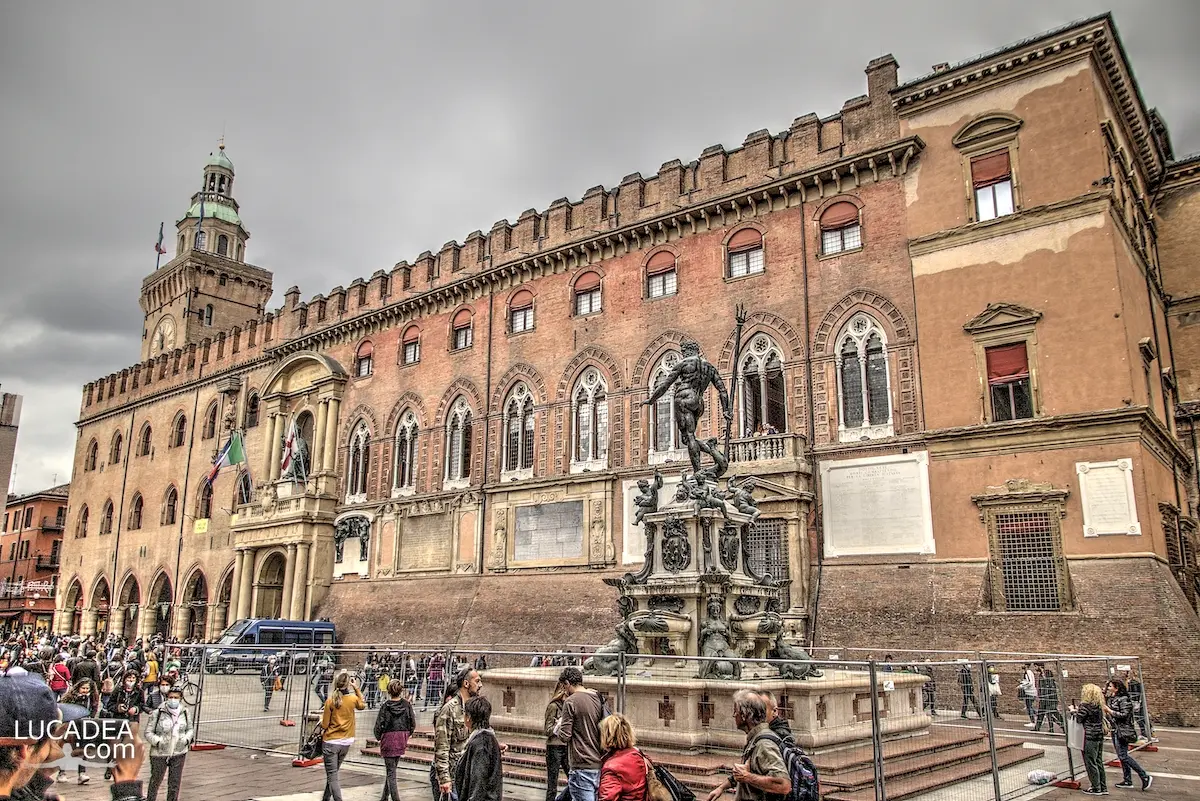
D’Accursio Palace and Neptune Fountain in Maggiore Square, two of the most recognisable landmarks in Bologna

Photo taken with Canon EOS M100 and Tamron 16-300 lens.

If you want to see all the photos I took in the city, click here:

🏠
  • Italiano
