Christmas Lights over the Centre of Chiavari

Luci di Natale

Christmas Lights over the Centre of Chiavari.
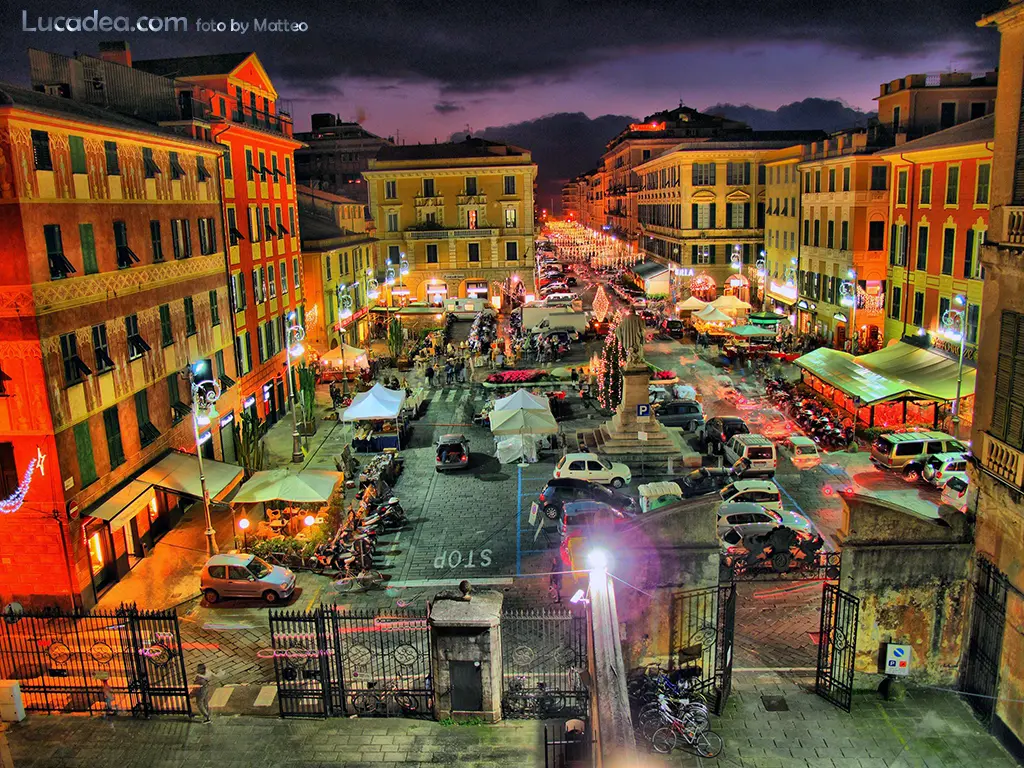
Christmas is getting closer, and the festive atmosphere is already beginning to appear in Chiavari. The town’s Christmas lights have been switched on, adding a seasonal touch to its streets and squares. From the terrace of Villa Rocca, I took this panoramic photograph showing Garibaldi Avenue and Carriages Square, two familiar parts of the town centre now framed by the decorations for the coming celebrations.
I particularly like this viewpoint because it offers a different way to look at Chiavari. Rather than seeing the town from street level, among the arcades and shopfronts, the terrace provides a wider perspective over the urban landscape. From here, the streets and buildings can be seen together, and the Christmas lights become part of a larger view of the town. It is a pleasant way to appreciate how familiar places change when the festive season begins.
Garibaldi Avenue is one of the central streets of Chiavari, closely connected with the everyday life of the town. Throughout the year, it is a place for shopping, walking and meeting people. With Christmas approaching, the illuminated decorations add a different character to this familiar setting. Carriages Square also appears in the panorama, helping to create a view that brings together some of the central areas of Chiavari.
Christmas lights have a special role in Italian towns and cities. They are more than simple decorations: their arrival is one of the first signs that the festive season is approaching. Streets that we walk through every day suddenly look different, and evening walks become more atmospheric. Even a familiar square can feel a little more special when the lights are switched on and the town begins to prepare for Christmas.
Chiavari is particularly enjoyable to explore on foot, with its historic centre, arcades, shops and small squares. During the weeks before Christmas, the decorations add another reason to spend some time in the town centre. The lights provide a seasonal backdrop to everyday life, while the streets remain places where residents and visitors meet, shop and enjoy a walk.
I wanted to capture this view from Villa Rocca because it represents that moment of anticipation before Christmas actually arrives. The celebrations are still ahead, but the town has already begun to dress up for the occasion. The photograph brings together the lights, the familiar streets and the atmosphere of a place getting ready for the holidays. It is a small seasonal detail, but one that I enjoy preserving alongside the other views and everyday discoveries I share on lucadea.com.

Have the Christmas lights already been switched on in your town? Which street or square do you most enjoy seeing illuminated during the festive season? Add an comment or go to the bottom of the site to read what other visitors have written.

Christmas lights over Garibaldi Avenue and Carriages Square in Chiavari, photographed from the terrace of Villa Rocca

Add one  comment to this article or read  here what other visitors have written.
 
Adv
 
Disclamer

The rights on images, videos, choruses, text and all other material on the LUCADEA.com website are governed as per  Copyright page.


This page has been viewed 2 times today.
This month it has been viewed 4 times.
In total it has been viewed 4 times.
 

Homemade ravioli for Easter with family

Ravioli fatti in casa per Pasqua disposti sul tavolo pronti per la cottura nella tradizione ligure.

Homemade ravioli for Easter with family.
The table slowly fills up as rows of fresh pasta appear, and homemade ravioli for Easter become the center of attention long before they are even cooked. Ravioli with ragù are one of the most traditional foods to eat in Liguria during holidays, and just looking at them brings back a familiar sense of time and routine.
There is something deeply personal in this process. Watching the dough being rolled, the filling carefully placed, and each ravioli sealed by hand creates a rhythm that feels almost meditative. Homemade ravioli for Easter are not just about food, they are about sharing a moment that belongs to the family.
The kitchen feels warm and calm. The smell of ragù slowly builds in the background while the fresh pasta rests on the table. Ravioli with ragù are waiting for their moment, but even before cooking, they already tell a story made of gestures repeated over the years.
This scene takes place in Liguria, Italy, where homemade ravioli are still a key part of celebrations like Easter and Christmas. In many households, making ravioli together remains an important tradition passed down through generations.
A small curiosity: Ligurian ravioli often include a rich filling made with meat and vegetables, and they are traditionally served with a slow-cooked ragù, making them a complete and satisfying dish.
If you are visiting Italy and want to experience something truly authentic, food traditions like this reveal more about the culture than any landmark. It is not just about what you eat, but how it is prepared and shared.
On my photo blog, I have often shared images of simple everyday moments, from local breakfasts to small details of daily life. This photograph continues that story, focusing on a moment inside the home rather than outside.
Photographing homemade ravioli for Easter is a way to preserve a memory that goes beyond the image. It captures a moment of connection, where time slows down and everything revolves around a shared activity.

Do you have a traditional dish that your family always prepares for Easter? Add a comment or go to the bottom of the site to read what other visitors have written.

Ravioli fatti in casa per Pasqua disposti sul tavolo pronti per la cottura nella tradizione ligure.

Homemade ravioli for Easter with family – Raviolis faits maison pour Pâques en famille – Ravioles caseras para Pascua en familia – Ravioli caseiro para a Páscoa em família – Hausgemachte Ravioli zu Ostern mit der Familie – Ravioli tự làm cho lễ Phục Sinh cùng gia đình – 复活节家庭自制意大利饺子 – 家族で過ごす復活祭の手作りラビオリ

The text of this post was written with the help of ChatGPT, a language model from OpenAI.

Add one  comment to this article or read  here what other visitors have written.
 
Adv
 
Disclamer

The rights on images, videos, choruses, text and all other material on the LUCADEA.com website are governed as per  Copyright page.


This page has been viewed 0 times today.
This month it has been viewed 0 times.
In total it has been viewed 0 times.
 

Homemade ravioli for Christmas lunch

Piatto di ravioli fatti in casa preparati per Natale, fotografati in dettaglio durante un momento familiare

Homemade ravioli for Christmas lunch.
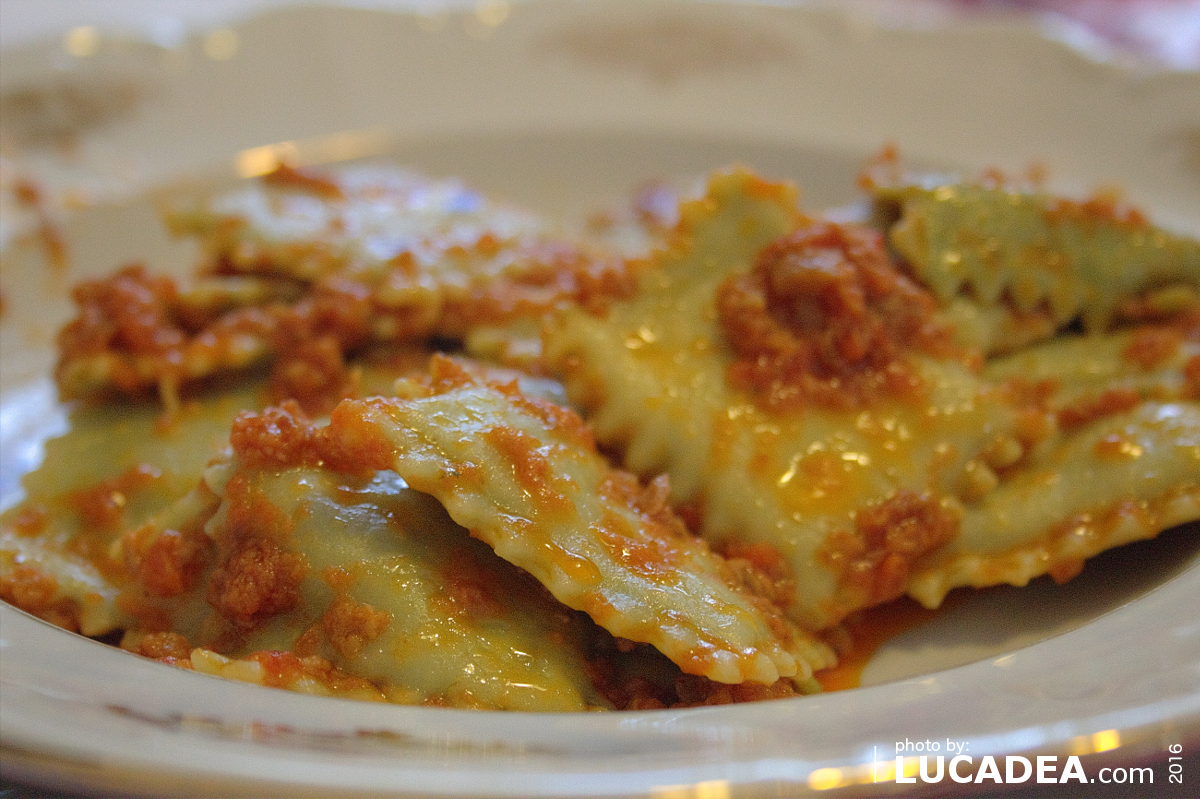
Even though several days have already passed, I had kept this macro photograph aside: a beautiful plate of homemade ravioli prepared by my mom for last Christmas lunch. Fresh filled pasta and Italian home cooking are subjects that, even when photographed many times, always have something personal to tell.
This image comes from a very simple moment: a family meal and the desire to preserve its memory through photography. Homemade ravioli are not just a traditional dish, but often represent a connection between generations, made of familiar gestures, carefully chosen ingredients and time spent preparing something special.
I know that I have already shared other food-related images on my photoblog, but every time I find a reason to add another photograph. Like the fresh tagliatelle with meat sauce I wrote about in another article, this image is not only about the food itself, but also about everything behind a homemade dish.
The photograph focuses on the details of the ravioli, trying to capture the shape of the pasta and the inviting appearance of the plate. There is no distant destination or famous place behind this picture, but one of those everyday moments that are part of my life and that sometimes deserve a place on the blog.
Italian cuisine includes countless regional traditions, and ravioli are one of the best-known examples of filled pasta. Every area has its own versions, with different fillings and sauces depending on local habits and family recipes.
For me, photographing homemade ravioli also means telling a family memory. It is about sharing something simple, without always needing to search for unusual locations or extraordinary subjects. Sometimes a dish prepared at home can create an image capable of transmitting a feeling.
This photograph may not be something completely new for those who have followed my website for a long time, but I believe some images deserve to be published because they represent authentic moments.
If you are looking for the charm of Italian home cooking, sometimes the most interesting stories can be found around a family table rather than in a distant place.

What homemade dish reminds you most of your family moments? Add a comment or go to the bottom of the site to read what other visitors have written.

Piatto di ravioli fatti in casa preparati per Natale, fotografati in dettaglio durante un momento familiare

Photo taken with Canon 600D and Canon 18-55 EFS.

Homemade ravioli for Christmas lunch – Raviolis faits maison pour le déjeuner de Noël – Ravioles caseros para el almuerzo de Navidad – Ravioli caseiros para o almoço de Natal – Hausgemachte Ravioli zum Weihnachtsessen – Bánh ravioli tự làm cho bữa trưa Giáng sinh – 圣诞午餐的自制意大利饺子 – クリスマスランチの自家製ラビオリ

The text of this post was written with the help of ChatGPT, a language model from OpenAI.

Marinated Salmon on Board the Ship

Salmone marinato a bordo della nave

Marinated salmon on board the ship.
Food on cruise ships has always been abundant, but in recent years the way it is presented has changed significantly. It’s no longer just about quantity, but also about quality, presentation, and the overall dining experience. And this shift is especially noticeable in the onboard restaurants.
During last year’s Christmas and New Year cruise, my wife was with me on the former Costa Firenze, and we often chose to dine in the restaurant instead of sticking to the buffets. It turned out to be a great decision, allowing us to enjoy dishes that were clearly more refined, both visually and in terms of taste.
This dish, if I remember correctly, was part of the Christmas menu: salmon marinated in beetroot with vodka and lime. At first glance, it immediately stood out thanks to its deep, almost purplish color from the beetroot, giving it an elegant and distinctive look. The plating was simple yet refined, with the salmon as the clear centerpiece.
The taste was even better. The marinade was well balanced: the sweetness of the beetroot blended perfectly with the freshness of the lime, while the vodka added a subtle note that enhanced the overall flavor without overpowering the fish. The salmon itself was tender, soft, and practically melted in your mouth.
Dishes like this really change your perception of cruise dining. It’s not just about endless buffets and standard meals anymore, but also about more creative proposals, thoughtful pairings, and attention to detail.
Of course, not every dish reaches this level, but when it happens, it turns a simple dinner into a memorable experience—especially in a unique setting like a ship during the holiday season.
And I have to say, this salmon is one of those dishes I still remember clearly today.

Have you ever had something like this on a cruise? Add a comment or go to the bottom of the site to read what other visitors have written.

Photos taken with Honor 20.

Marinating is a traditional cooking technique for preparing meat, fish, and vegetables for cooking, or even as an alternative to cooking. It involves immersing cooked or raw food (in the latter case, thinly sliced) for a variable amount of time in a liquid typically composed of three types of ingredients: acids, such as vinegar, lemon juice, wine, or beer; oils; and flavorings (spices and herbs). Marinating was created with the aim of extending the shelf life of foods, even before adding flavor.
Continue and learn more on Wikipedia

The statue of John Paul II in Chiavari Cathedral

La statua dedicata a Giovanni Paolo II nella Cattedrale di Chiavari

The statue of John Paul II in Chiavari Cathedral.
During a visit to Chiavari Cathedral, I captured with my camera a detail of the pronaos, the entrance portico of the church, where the statue dedicated to Pope John Paul II stands. Created by the sculptor Gaspare Da Brescia, this artwork represents a meeting point between contemporary sculpture, religious memory and one of the most important places in the historic centre of Chiavari.
The statue of John Paul II in Chiavari is located in front of the Cathedral of Our Lady of the Garden, in Chiavari, Liguria, Italy, and welcomes visitors and worshippers entering this important religious building. I wanted to photograph this detail because, beyond its spiritual meaning, it shows how a modern artwork can become part of a historic setting while maintaining harmony with the surrounding architecture.
The pronaos of the cathedral creates a particular frame for the sculpture. The covered entrance, the columns and the position of the statue allow it to be viewed together with the structure of the church. It is not only a monument dedicated to an important figure of recent history, but also an element of the city landscape that accompanies the daily life of Chiavari.
John Paul II, born Karol Wojtyła in Poland, was one of the most recognised religious figures of the twentieth century. His long papacy began in 1978 and was marked by numerous international journeys and a strong connection with people around the world.
A historical curiosity about the cathedral is that the Cathedral of Our Lady of the Garden was built starting in the seventeenth century and became the main religious building of Chiavari. Over time, different artistic elements were added, creating a space where works from different periods coexist.
This photograph comes from my attention to details that can easily be missed while walking through a town. As I have already shared in other photographs dedicated to Chiavari and its historic corners, I enjoy capturing places where architecture, art and everyday life meet.
The statue dedicated to John Paul II is therefore not only a decorative element, but also a sign of recent memory placed in a location that preserves centuries of history. During the holiday season, I chose to share this image as a simple greeting connected with a place of tradition and reflection.

Have you ever photographed a contemporary artwork placed inside a historic building? Add a comment or go to the bottom of the site to read what other visitors have written.

Statue of John Paul II in the pronaos of Chiavari Cathedral with religious architecture in the background

Photo taken with Canon EOS RP camera and Canon RF 24-50 lens.

He was elected Pope on October 16, 1978. Following the cause for beatification, he was beatified on May 1, 2011, by his successor, Pope Benedict XVI; he is celebrated on the day of his inauguration, October 22. In the history of the Church, it had not happened for about a millennium that a pope beatified his immediate predecessor. On April 27, 2014, together with Pope John XXIII, he was proclaimed a saint by Pope Francis.
Continue and learn more at Wikipedia

The Nativity Figures of San Gregorio Armeno

Alcune statuette dei famosi negozi di presepi a Napoli

The Nativity Figures of San Gregorio Armeno.
Walking along San Gregorio Armeno in the heart of Naples, it is easy to stop in front of a shop window and discover an astonishing variety of small handmade figures. I took this photograph of modern nativity figures in Naples some time ago and kept it aside, thinking that the Christmas season would eventually be the right moment to publish it.
The famous nativity street is one of those places where tradition and contemporary life constantly meet. Alongside the familiar figures of the traditional nativity scene, new characters appear all the time, inspired by people who are currently well known or often in the news. Politicians, football players, singers, actors and television personalities can all become small handmade figures, ready to take their place among the more traditional characters.
That was exactly what caught my attention when I took this photograph. I was not simply looking at handmade objects, but at a tradition capable of constantly adapting to the present. The Neapolitan nativity scene keeps its traditional characters while also leaving plenty of room for humour and imagination, allowing craftsmen to represent contemporary society in their own distinctive way.
If you are visiting Naples around Christmas and wondering what to see, San Gregorio Armeno is one of the places that naturally comes to mind. The street is narrow and lined with workshops and small shops where figures are displayed almost everywhere. Even without entering a shop, there are countless small details to notice and photograph as you walk through the street.
What I enjoy most is the variety. You do not necessarily need to be passionate about nativity scenes to appreciate these figures: some belong to the religious tradition, others represent occupations and everyday life, while many others are inspired by current events. It is an unusual way of seeing Naples through its craftsmanship.
There is also a small historical curiosity behind this tradition. Neapolitan nativity making has very old roots and gradually developed far beyond a simple representation of the Nativity. Over the centuries, the nativity scene became an important form of popular art, bringing together sacred figures and a large cast of characters inspired by everyday life.
I wanted to photograph these modern figures because they show particularly well how the old and the contemporary can coexist. The photograph does not attempt to show an entire nativity scene or document San Gregorio Armeno as a whole. Instead, I wanted to isolate a small group of characters and let them suggest the atmosphere of this famous Neapolitan street.
There is also something amusing about the temporary nature of some of these characters. Someone who is instantly recognisable today can become one of the most photographed figures in the street, while a few years later that same person may have almost disappeared from public attention. In a way, these little sculptures become a record of the present, created not with a camera but with clay, paint and remarkable craftsmanship.
The photograph also connects naturally with other posts I have published about Naples, where I have often tried to capture not only the city’s famous monuments but also the smaller details encountered while walking through its streets. After churches, squares and historic corners, these little figures offer another glimpse of the Naples I experienced during my walks.
With Christmas approaching, it finally seemed like the right time to bring this photograph out of my archive. I can only wonder which new characters may have appeared in the workshops of San Gregorio Armeno since I took it.

Which contemporary character would you like to find among the Neapolitan nativity figures? Add a comment or go to the bottom of the site to read what other visitors have written.

Modern nativity figures in Naples displayed outside a workshop along San Gregorio Armeno, the famous Christmas street

Photo taken with Canon EOS M100 and lens Canon EF-M 11-22.

To see all the photos I took in Naples, both that weekend and on other trips, click here:

The dome of Galeries Lafayette in Paris

Cupola Galeries Lafayette Parigi con albero di Natale centrale e struttura in vetro Art Nouveau nel grande magazzino di Parigi

The dome Galeries Lafayette Paris.
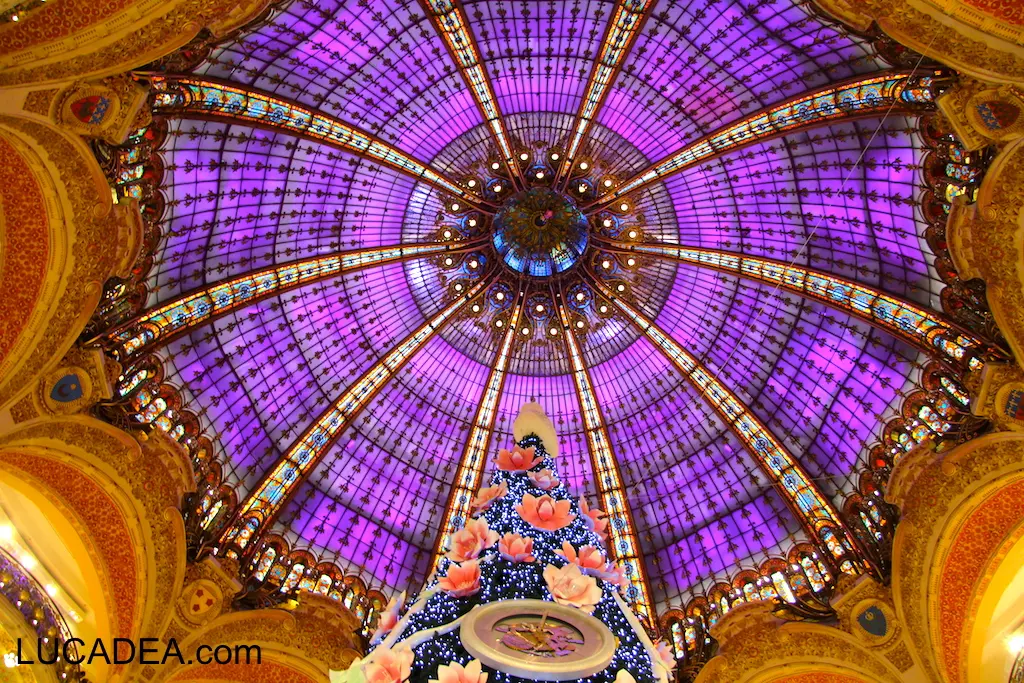
The dome Galeries Lafayette Paris rises above me like a vast structure of glass and light, immediately becoming the visual center of everything happening below. The dome Galeries Lafayette Paris draws the eye upward, especially with the tip of the Christmas tree reaching through its center like a vertical axis connecting all floors.
I am inside Paris, Île-de-France, France, within the Galeries Lafayette, one of the most famous department stores in the world. The feeling is not that of a typical shopping mall, but of an architectural monument where commerce, design, and spectacle coexist under a single monumental roof.
I walk slowly along the upper balconies, constantly returning to the dome Galeries Lafayette Paris from different perspectives. Each step slightly changes the geometry, each reflection in the glass shifts the perception of space. The dome Galeries Lafayette Paris feels less like a ceiling and more like a living structure that transforms with movement and light.
The atmosphere inside is vibrant but controlled, typical of Parisian luxury retail spaces where global brands are displayed almost like museum pieces. Even without focusing on shopping itself, the place becomes an experience of architecture and visual rhythm.
On other posts from my site about Paris, I have often described how interiors can completely change perception when dominated by a single architectural element, and this dome is one of the strongest examples of that idea.
A small but important historical note: the dome, originally completed in 1912, is one of the finest surviving examples of Art Nouveau commercial architecture in Europe, restored several times while preserving its original decorative spirit.
Standing there, I realize the dome Galeries Lafayette Paris is never static; it changes continuously with light, reflections, and the flow of people beneath it.

Have you ever felt inside a building that looked more like an artwork than a store? Add a comment or go to the bottom of the site to read what other visitors have written.

Cupola Galeries Lafayette Parigi con albero di Natale centrale e struttura in vetro Art Nouveau nel grande magazzino di Parigi

h6>The dome of Galeries Lafayette in Paris – La coupole des Galeries Lafayette à Paris – La cúpula de Galeries Lafayette en París – A cúpula das Galeries Lafayette em Paris – Die Kuppel der Galeries Lafayette in Paris – Vòm mái Galeries Lafayette ở Paris – 巴黎老佛爷百货穹顶 – パリ・ギャラリー・ラファイエットのドーム

The text of this post was written with the help of ChatGPT, a language model from OpenAI.

🏠
  • Italiano