
Campopisano Lane in Genoa

Il bel Vico Superiore di Campopisano nel centro storico di Genova

Campopisano Lane in Genoa.
Wandering through the narrow lanes of Genoa’s historic centre is one of my favourite ways to discover the city. Even after many walks through the old town, I still come across places I have never properly explored. That was the case when I finally made my way to Campopisano Square, a charming little space tucked away among the medieval streets.
This photograph was taken in the main lane leading to the square, which is behind me in the picture. The street is called Campopisano Lane, and what immediately caught my attention was the beautiful stone archway ahead. It creates a natural frame and gives the narrow passage a sense of depth, making this a particularly appealing scene to photograph.
Genoa’s historic centre is full of these unexpected views. The streets are often narrow, buildings stand close together, and arches or covered passages appear between the façades. Walking here is different from following a conventional sightseeing route: instead of moving from one famous landmark to another, you can simply turn into a small lane and discover an architectural detail that makes you stop. I enjoy this slower way of exploring the city because it reveals the character of everyday Genoese streets.
Campopisano also has an intriguing connection with Genoa’s medieval history. Its name is traditionally associated with Pisan prisoners captured by the Genoese after the Battle of Meloria in 1284. According to local tradition, some of these prisoners were held in this area. The story reflects the long rivalry between Genoa and Pisa, two powerful maritime republics that competed for influence across the Mediterranean. As with many historic place names, the tradition adds another layer of meaning to a place that might otherwise seem like just another quiet corner of the old town.
What I like most about this view is its simplicity. There is no grand monument in the foreground, just a narrow lane, old buildings and an archway that invites you to keep walking. Yet these details are part of what makes Genoa so fascinating to photograph. They preserve the atmosphere of a historic city shaped over centuries, where every turn can reveal a new perspective.
If you are exploring Genoa’s old town, it is worth seeking out Campopisano Square and taking a moment to look at the lane that leads to it. Sometimes the approach to a place is just as memorable as the destination itself.

Have you discovered Campopisano and its surrounding lanes, or is this a part of Genoa you would like to explore one day? Add an comment or go to the bottom of the site to read what other visitors have written.

Campopisano Lane in Genoa's historic centre, featuring a traditional stone archway along the narrow passage leading to the square

Photo taken with a Canon EOS M100 camera and Canon EF-M 11-22 lens.

And here’s where the alley is:

Add one  comment to this article or read  here what other visitors have written.
 
Adv
 
Disclamer

The rights on images, videos, choruses, text and all other material on the LUCADEA.com website are governed as per  Copyright page.


This page has been viewed 0 times today.
This month it has been viewed 0 times.
In total it has been viewed 0 times.
 

Palace of Saint George in Genoa

Palazzo San Giorgio

Palace of Saint George in Genoa.
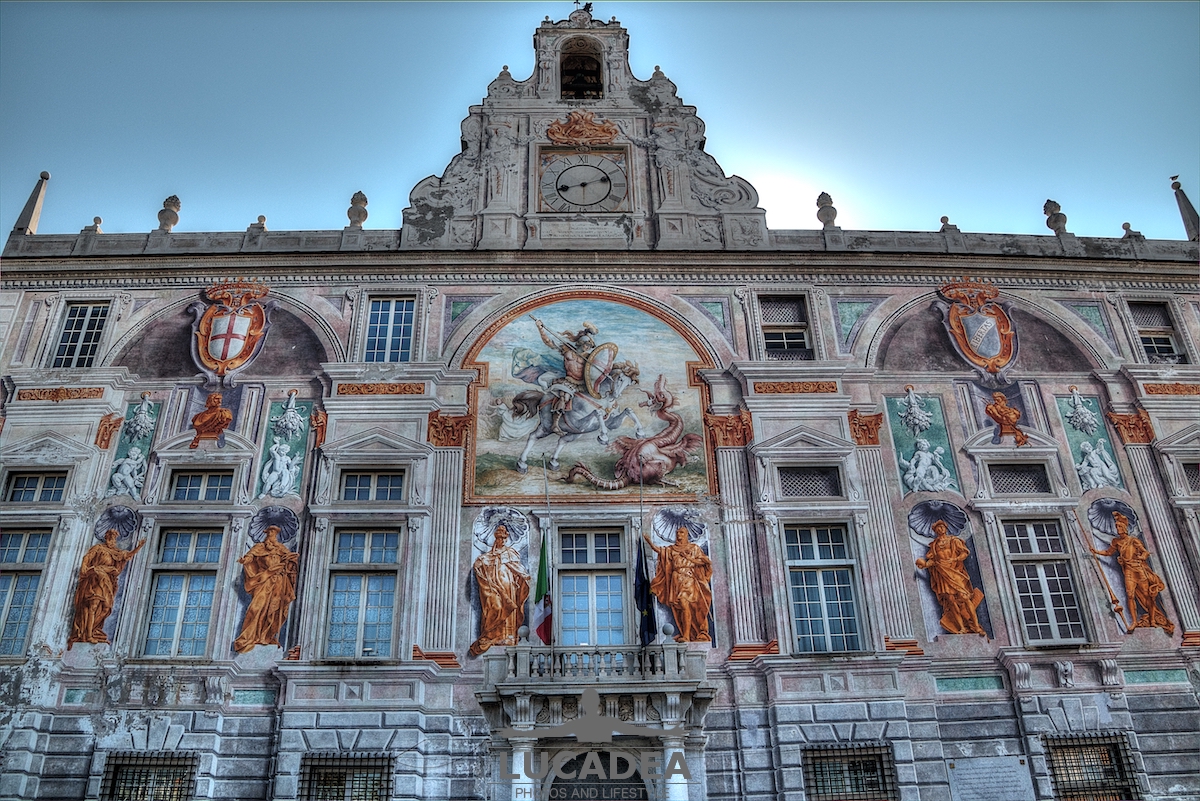
Whenever I walk around the Old Port, I find it difficult to pass this historic building without stopping to admire its elegant façade. The Palace of Saint George is one of the landmarks that best expresses Genoa’s long relationship with the sea, maritime trade and civic history. Standing close to the waterfront in Genoa, Liguria, Italy, the palace immediately catches the eye with its architectural details and colourful painted decorations.
The sea-facing façade is especially striking. Among its painted figures, one of the most recognisable is Saint George defeating the dragon. This image is much more than a decorative feature: Saint George was the patron saint of the Republic of Genoa, and the red cross on a white background associated with him remains an important symbol of the city’s historical identity. It is a detail that connects the building to the proud maritime republic that once played a major role in Mediterranean commerce.
The palace itself has a long and fascinating past. Construction began in the second half of the thirteenth century, when Guglielmo Boccanegra commissioned a public building near the harbour, close to the centre of Genoa’s commercial activity. Over the centuries, the building changed its purpose and appearance. It later became the headquarters of the Bank of Saint George, a powerful financial institution involved in managing public finances and revenues connected with the Republic. Its Renaissance appearance developed through later extensions and decorative work, including the celebrated frescoes painted by Lazzaro Tavarone between 1606 and 1608.
When I photograph historic places, I enjoy looking beyond the overall view and paying attention to the details that give each building its own character. Here, the painted façade offers plenty to discover, from the central scene of Saint George and the dragon to the surrounding figures and architectural decorations. I took this photograph to capture the charm of a building that continues to stand out, even in an area visited by so many people.
The Palace of Saint George is an excellent stop for anyone exploring Genoa’s Old Port. From here, it is easy to continue towards the historic lanes, the arcades of Sottoripa and other landmarks in the old city. If you are searching for historic buildings to see in Genoa, this palace deserves a place on your itinerary, even if you only have a few minutes to spare.
I also enjoy photographing the city’s less obvious details, from old façades and narrow streets to the squares that reveal different layers of Genoese history. Each image becomes a way to remember a place and share a little of its atmosphere.

When you visit Genoa’s Old Port, do you stop to admire the painted façade of the Palace of Saint George? Add an comment or go to the bottom of the site to read what other visitors have written.

The Palace of Saint George in Genoa, a historic building overlooking the Old Port with a painted façade depicting Saint George and the dragon

The Palace of Saint George in Genoa, a historic building overlooking the Old Port with a painted façade depicting Saint George and the dragon

Photos taken with a Canon EOS M100 camera and Tamron 16-300 lens.

Where is the building located:

Add one  comment to this article or read  here what other visitors have written.
 
Adv
 
Disclamer

The rights on images, videos, choruses, text and all other material on the LUCADEA.com website are governed as per  Copyright page.

This page has been viewed 0 times today.
This month it has been viewed 0 times.
In total it has been viewed 0 times.
 

The Straight Caffaro Street in the Castelletto Neighborhood

La dritta via Caffaro nel quartiere di Castelletto a Genova

The Straight Caffaro Street in the Castelletto Neighborhood.
Some streets reveal a city’s history through their architecture and layout, and Caffaro Street is a good example. Located in the Castelletto neighborhood of Genoa, Liguria, Italy, this long, remarkably straight road offers a distinctive urban perspective, framed by elegant residential buildings and historic façades.
Walking along Caffaro Street, I notice how different it feels from the narrow lanes of Genoa’s medieval old town. Here, the street follows a more regular route, reflecting a period when the city began to expand uphill and create more direct connections between the historic center and the surrounding neighborhoods. Caffaro Street belongs to Genoa’s nineteenth-century urban development, when new roads helped reshape the area around Castelletto.
The buildings lining Caffaro Street give it much of its character. Grand entrance doors, balconies, decorative details and carefully designed façades reveal the tastes of different periods. Many of the residential buildings in this part of Genoa date from the nineteenth and early twentieth centuries, when the neighborhood was taking on a more defined urban identity. Looking closely, it is possible to appreciate details that might otherwise go unnoticed while passing through on the way somewhere else.
What attracts me most is the perspective. The straight alignment of Caffaro Street creates a strong visual line, while the buildings on either side guide the eye toward the distance. Genoa is famous for its steep streets, winding paths and dramatic changes in elevation, so a road with such a clear, direct layout feels particularly distinctive. Depending on the light, the façades take on different tones, and architectural features stand out in ways that make the street rewarding to photograph.
The photograph accompanying this article captures one of those everyday urban scenes that I enjoy discovering in my own city. Genoa is often associated with its harbor, narrow medieval lanes and grand historic palaces, but Castelletto offers another side of local life. Caffaro Street and the surrounding residential roads tell a story of urban growth and changing architectural tastes, while remaining closely connected to the city center below.
Caffaro Street is also a useful starting point for exploring the surrounding area. From the Portello, visitors can continue toward nearby streets and discover more of Castelletto, including routes leading to panoramic viewpoints over Genoa’s rooftops and harbor. If you enjoy urban photography and historic architecture, comparing Caffaro Street with other places featured in my articles about Genoa can reveal how varied the city’s streetscapes really are.
For me, Caffaro Street is more than a practical route through the neighborhood. Its straight perspective and historic character preserve a visible trace of Genoa’s transformation as the city grew beyond its older boundaries. It is a reminder that even a familiar street can tell an interesting story when we take the time to look.

Have you ever walked along Caffaro Street and noticed the striking perspective created by its straight alignment and historic buildings? Add an comment or go to the bottom of the site to read what other visitors have written.

Caffaro street in Genoa's Castelletto neighborhood, showing the straight street perspective and elegant historic residential buildings

Photo taken with Canon EOS RP and Tamron 16-300.

Where is the street:

🏠
  • Italiano