The character of Giuseppe Garibaldi street

Via Giuseppe Garibaldi nel centro storico di Sestri Levante con archivolto e vicoli caratteristici

The character of Giuseppe Garibaldi street.
Among the narrow lanes of the historic centre of Sestri Levante, Liguria, Italy, this small street preserves one of the views that most reminds me of the older side of my hometown. Giuseppe Garibaldi street is easy to walk through without paying much attention, but stopping for a moment reveals the archway, the old façades and the way the lane continues towards Marina di Ponente alley.
This is exactly the kind of detail I enjoy photographing when I walk around Sestri Levante. I am not always looking for the most famous panorama or another view of the Bay of Silence. Sometimes I simply enter the narrow streets and slow down enough to notice what is around me.
I took this photograph during one of those moments. I wanted to capture a section of Giuseppe Garibaldi street that represents the atmosphere of Sestri Levante’s historic centre. The lane is narrow and enclosed, with buildings that seem to almost meet above your head, creating the familiar character of many old Ligurian streets.
The element that first caught my attention was the archway. Structures like these are common in historic Ligurian centres and help create a sense of continuity between one street and another. For photography, they can also provide naturally framed views without needing anything elaborate.
Giuseppe Garibaldi street continues towards Marina di Ponente alley and belongs to the part of the historic centre that sits very close to the waterfront promenade. This location reveals another interesting detail about the street: the back rooms of several restaurants and pizzerias open onto it, while their main entrances face the seafront.
Over the years, some of these secondary spaces have become places where restaurants can add tables and welcome customers. The atmosphere is quite different from sitting along the busier waterfront. There is something more private and almost home-like about eating in a small historic lane surrounded by old façades.
If you are wondering what to see in Sestri Levante beyond its famous bays, these narrow streets are worth noticing as well. The historic centre is not only about sea views. It is also made of archways, doorways, small passages and businesses that continue to give everyday life to the older part of town.
What I find interesting is how easily these details can be overlooked. When walking through Sestri Levante, it is natural to think about where you are going next, especially when the sea is only a short distance away. I often find myself doing the opposite: slowing down when a perspective looks interesting through the camera.
The connection with the sea is still present here even when the water cannot be seen in the photograph. Knowing that the waterfront is just beyond these lanes helps explain the way the historic centre and the more active seafront area fit together.
One small architectural curiosity is the widespread presence of archways and covered passages in old Ligurian settlements. They helped make efficient use of limited urban space and became part of the everyday structure of historic neighbourhoods. In Sestri Levante, they remain a natural part of the streetscape and often create some of the most interesting photographic perspectives.
What I particularly like about Giuseppe Garibaldi street is its ordinary character. There is no need for every photograph to celebrate a famous monument. An everyday street can tell us just as much about a place when we take the time to look at it carefully.
Here, the restaurants also show that the lane is not simply a preserved fragment of the past. It remains a working part of the town, with businesses and people using the old spaces in contemporary ways.
That combination is what makes the photograph interesting to me. The façades and archway provide the historic character, while the restaurants and tables reveal that the street is still part of everyday life in Sestri Levante.
I have already photographed and written about several corners of Sestri Levante, and like those other views of the historic centre, this image adds another small piece to the collection. It is quite different from photographs of the bays, but it belongs to the same town and to the same personal experience of photographing it.
There is also something rewarding about photographing a place I know well. After returning to the same streets many times, I still find details that make me stop and take out the camera. Sometimes a familiar street only needs a different point of view to become interesting again.

When walking through the historic centre of Sestri Levante, do you tend to notice the narrow streets and archways, or are you usually drawn straight towards the sea? Add a comment or go to the bottom of the site to read what other visitors have written.
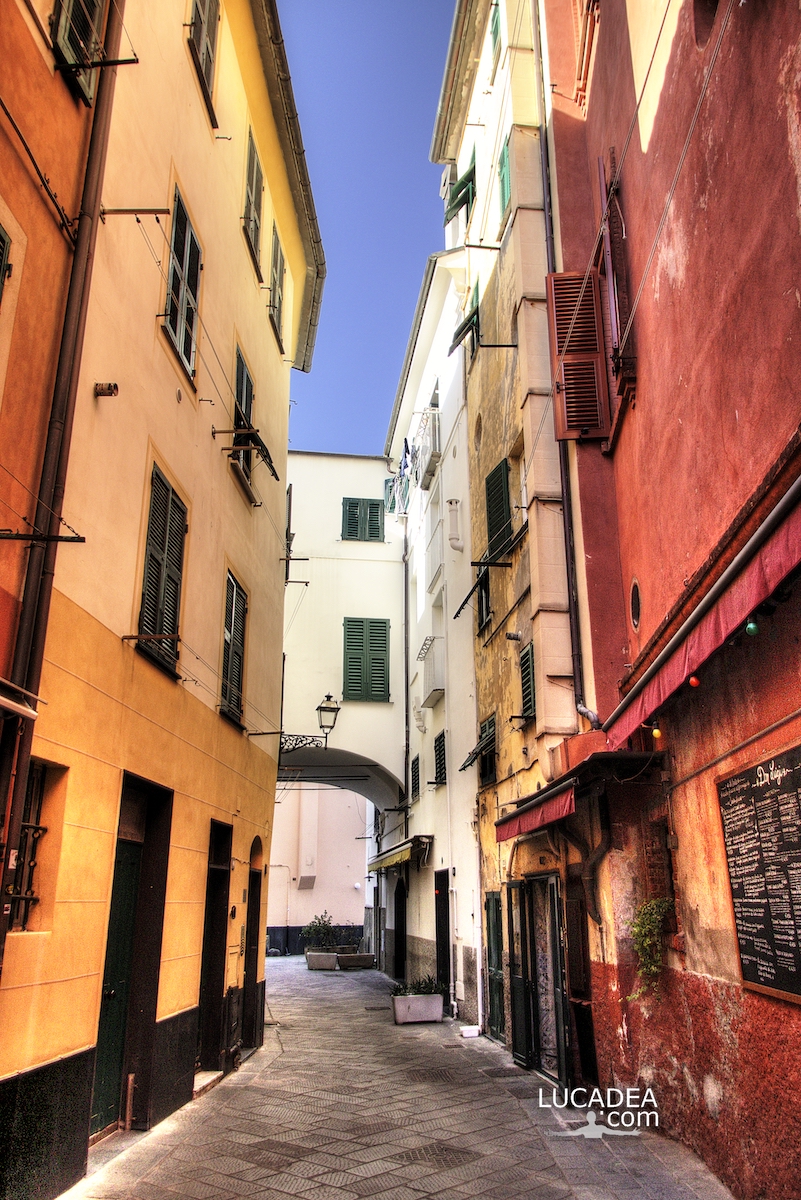
Giuseppe Garibaldi street in historic Sestri Levante with a traditional archway and narrow old-town lanes

Photo taken with Canon EOS M100 and lens Tamron 16-300.

Here’s where the street is:

Add one  comment to this article or read  here what other visitors have written.
 
Adv
 
Disclamer

The rights on images, videos, choruses, text and all other material on the LUCADEA.com website are governed as per  Copyright page.


This page has been viewed 0 times today.
This month it has been viewed 0 times.
In total it has been viewed 0 times.
 

The view along Garibaldi Boulevard in Chiavari

Vista prospettica di Corso Garibaldi a Chiavari con fontana Elena Bono e statua di Colombo sullo sfondo

The view along Garibaldi Boulevard in Chiavari.
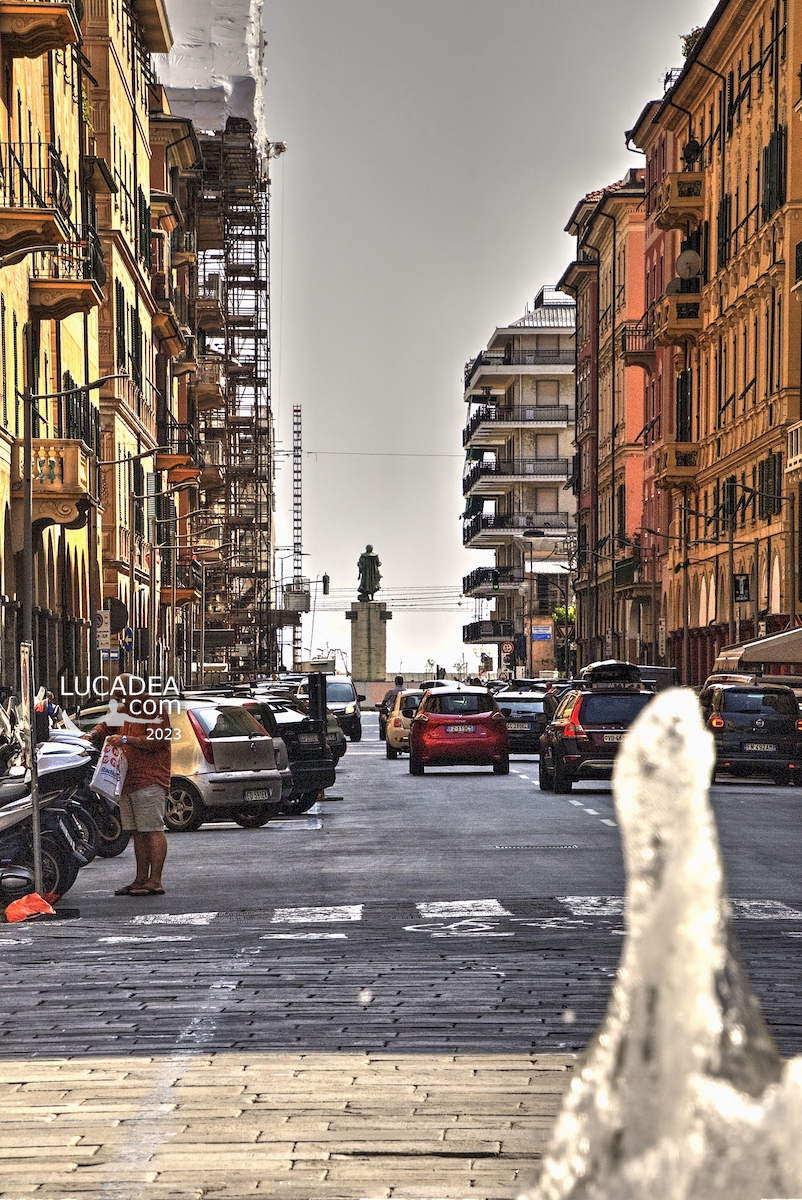
Looking at this photograph of Garibaldi Boulevard in Chiavari, you can appreciate a unique perspective of the town, created thanks to the use of a telephoto lens. Among the things to see in Chiavari, Garibaldi Boulevard is one of the main roads that connects the town center with the seaside promenade.
In this image, the entire street seems to be compressed into a single visual line: in the foreground, you can see the water spray from the fountain dedicated to Elena Bono, while in the distance the statue of Christopher Columbus marks the end of the view near the seafront. The telephoto lens creates a particular effect, bringing distant elements closer together and making the urban landscape appear almost suspended.
I was in Chiavari, Liguria, Italy, and I wanted to capture this unusual perspective of one of the town’s most important streets. Garibaldi Boulevard is a busy road used every day by residents and visitors, but seen from this point of view it becomes a photographic composition made of lines, depth, and details.
What I like about this photograph is the way the city unfolds toward the sea. The fountain in the foreground, the buildings along the boulevard, and the statue in the distance create a visual path that guides the eye through the entire scene.
An interesting detail is that the fountain is dedicated to Elena Bono, a writer and poet connected to Chiavari, adding a cultural element to an otherwise everyday urban view.
On the blog I have shared other photographs of Chiavari and the Ligurian Riviera, because I enjoy showing places from perspectives that are not always the most obvious ones. Sometimes a familiar street can become a completely different subject when photographed from a new angle.
If you are visiting Chiavari, Garibaldi Boulevard is one of the places worth seeing to understand the rhythm of the town, between everyday life, historic buildings, and the nearby sea.

Have you ever noticed this long perspective of Garibaldi Boulevard in Chiavari? Add a comment or go to the bottom of the site to read what other visitors have written.

Vista prospettica di Corso Garibaldi a Chiavari con fontana Elena Bono e statua di Colombo sullo sfondo

Photo taken with a Canon EOS RP camera and a Tamron 16-300 lens.

Here is the spot where I took the photo:

The view along Corso Garibaldi in Chiavari – La vue sur le Corso Garibaldi à Chiavari – La vista del Corso Garibaldi en Chiavari – A vista do Corso Garibaldi em Chiavari – Der Blick auf den Corso Garibaldi in Chiavari – Quang cảnh Corso Garibaldi ở Chiavari – 基亚瓦里加里波第大街的景色 – キアーヴァリのガリバルディ通りの眺め

The text of this post was written with the help of ChatGPT, a language model from OpenAI.

Add one  comment to this article or read  here what other visitors have written.
 
Adv
 
Disclamer

The rights on images, videos, choruses, text and all other material on the LUCADEA.com website are governed as per  Copyright page.

This page has been viewed 1 times today.
This month it has been viewed 1 times.
In total it has been viewed 1 times.
 

The Garibaldi statue in Chiavari’s heart

Statua di Giuseppe Garibaldi nel centro di Chiavari tra il caruggio dritto e corso Garibaldi in Liguria

The Garibaldi statue in Chiavari’s heart.
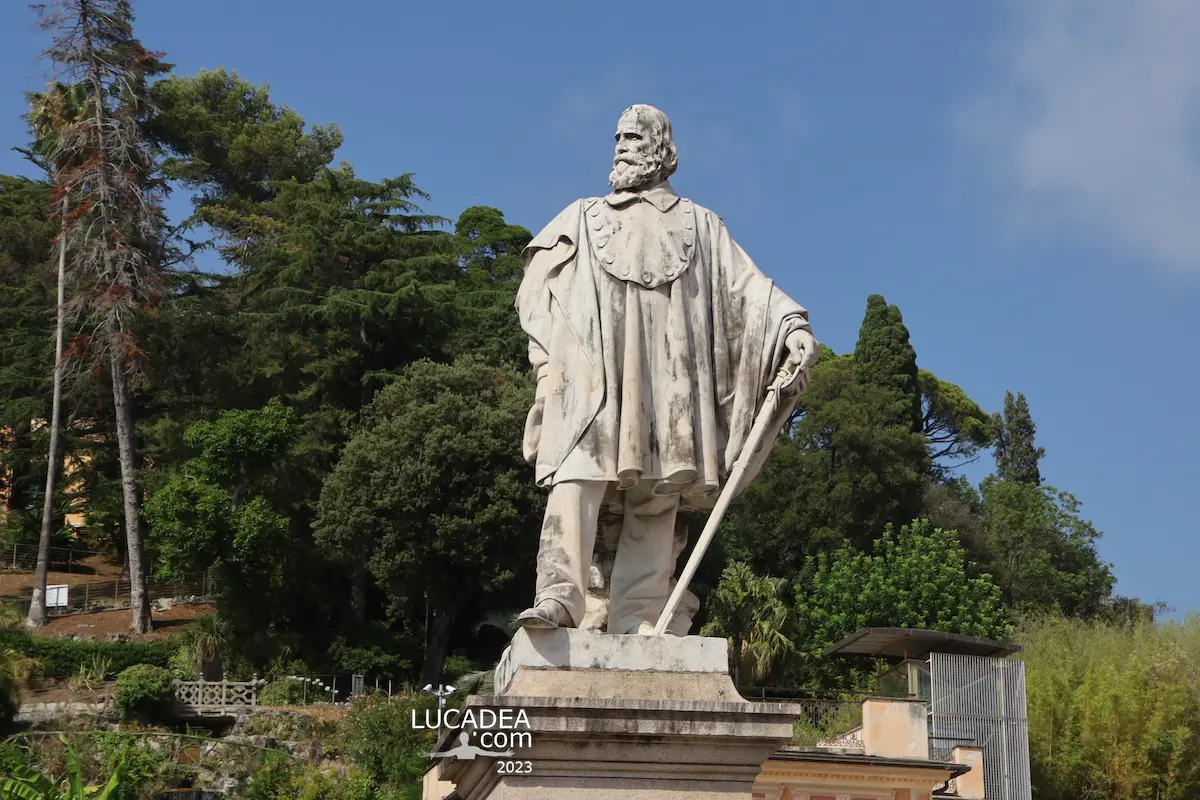
While walking through the historic center of Chiavari, I stopped in front of this monument dedicated to Giuseppe Garibaldi, a detail of the city that quietly connects everyday life with an important part of Italian history. The Garibaldi statue in Chiavari is one of the interesting places to see in the town center, especially for those who enjoy discovering historical references hidden among ordinary streets.
The monument stands where the main caruggio crosses Corso Garibaldi, one of the most recognizable areas of the old town. Here, the statue is not separated from its surroundings but becomes part of the daily rhythm of the city. People walking by, historic buildings, and small urban details create a setting where the past and present naturally meet.
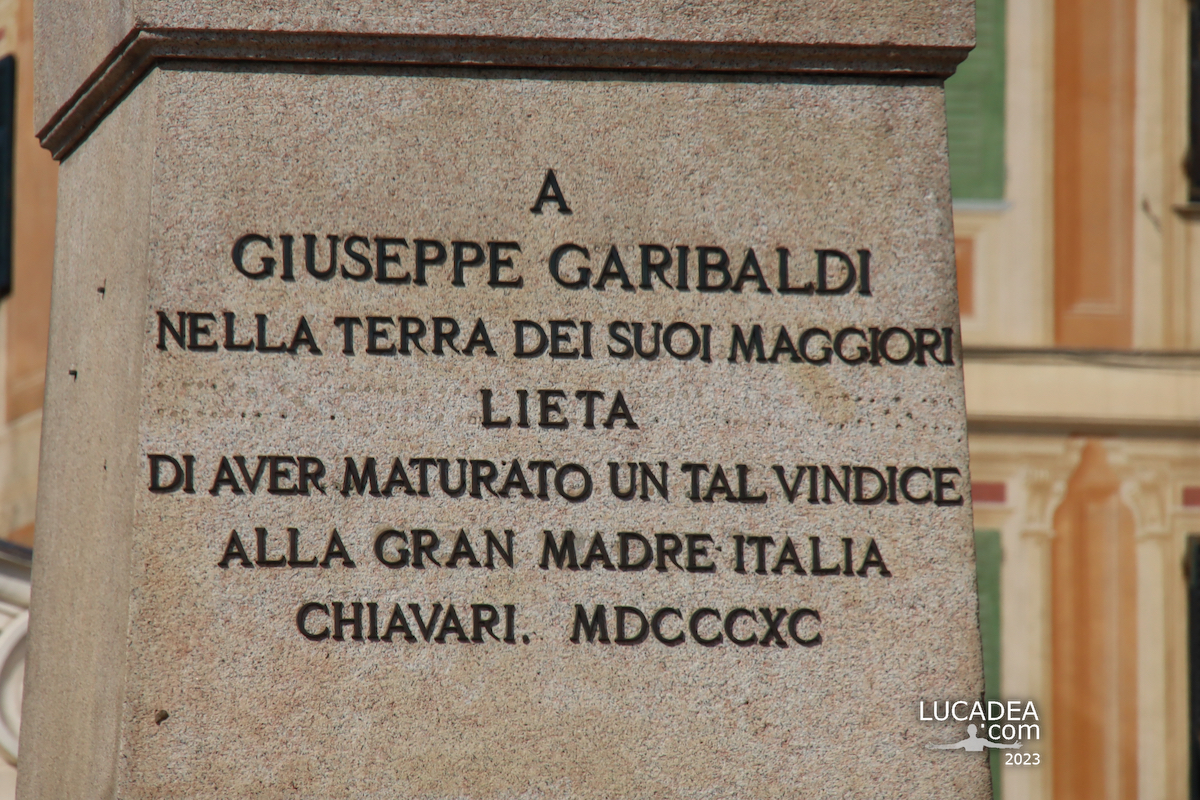
The Garibaldi statue is located in Chiavari, Liguria, Italy, and recalls the connection between the city and the family of the famous Italian figure. The inscription on the monument remembers that Garibaldi’s father, Domenico, was born in Chiavari. This local connection gives the statue a more personal meaning, making it more than just a tribute to a historical character.
When I photograph monuments, I like to look beyond the subject itself. The real story often comes from the relationship between the object and the place around it. In this image, the statue becomes part of the street scene, surrounded by the architecture and atmosphere of the Ligurian town.
One interesting detail is that Giuseppe Garibaldi received the nickname “Hero of the Two Worlds” because of his military activities in both South America and Europe, becoming one of the key figures of the Italian unification movement.
On the blog, I have also shared other views of Chiavari and eastern Ligurian towns, because small details found during a walk often reveal the strongest identity of a place. A monument, a street corner, or an old building can tell a story without needing a large explanation.

This photograph reminds me that history is often closer than we think, waiting in the places we cross every day. Have you ever discovered an unexpected historical connection while exploring a town? Add a comment or go to the bottom of the site to read what other visitors have written.

A
GIUSEPPE GARIBALDI
NELLA TERRA DEI SUOI MAGGIORI
LIETA
DI AVER MATURATO UN TAL VINDICE
ALLA GRAN MADRE ITALIA
CHIAVARI. MDCCCXC

Statua di Giuseppe Garibaldi nel centro di Chiavari tra il caruggio dritto e corso Garibaldi in Liguria

Foto scattata con macchina Canon EOS RP e lente Tamron 16-300.

Here’s where the monument is located:

Giuseppe Maria Garibaldi (Nice, July 4, 1807 – Caprera, June 2, 1882) was an Italian general, patriot, military leader, writer, sailor, and politician. A key figure of the Risorgimento, he was one of the most celebrated historical figures of his era. He is also known as the “hero of two worlds” for his military exploits in both Europe and South America.
Continue and learn more at Wikipedia

La statua di Garibaldi nel cuore di Chiavari – The Garibaldi statue in the heart of Chiavari – La statue de Garibaldi au cœur de Chiavari – La estatua de Garibaldi en el corazón de Chiavari – A estátua de Garibaldi no coração de Chiavari – Die Garibaldi-Statue im Herzen von Chiavari – Tượng Garibaldi giữa trung tâm Chiavari – 基安瓦里的加里波第雕像 – キアーヴァリ中心部のガリバルディ像

The text of this post was written with the help of ChatGPT, a language model from OpenAI.

The statue of Garibaldi in Cairoli Square in Milan

La statua di Garibaldi in largo Cairoli a Milano

The statue of Garibaldi in Cairoli Square in Milan.
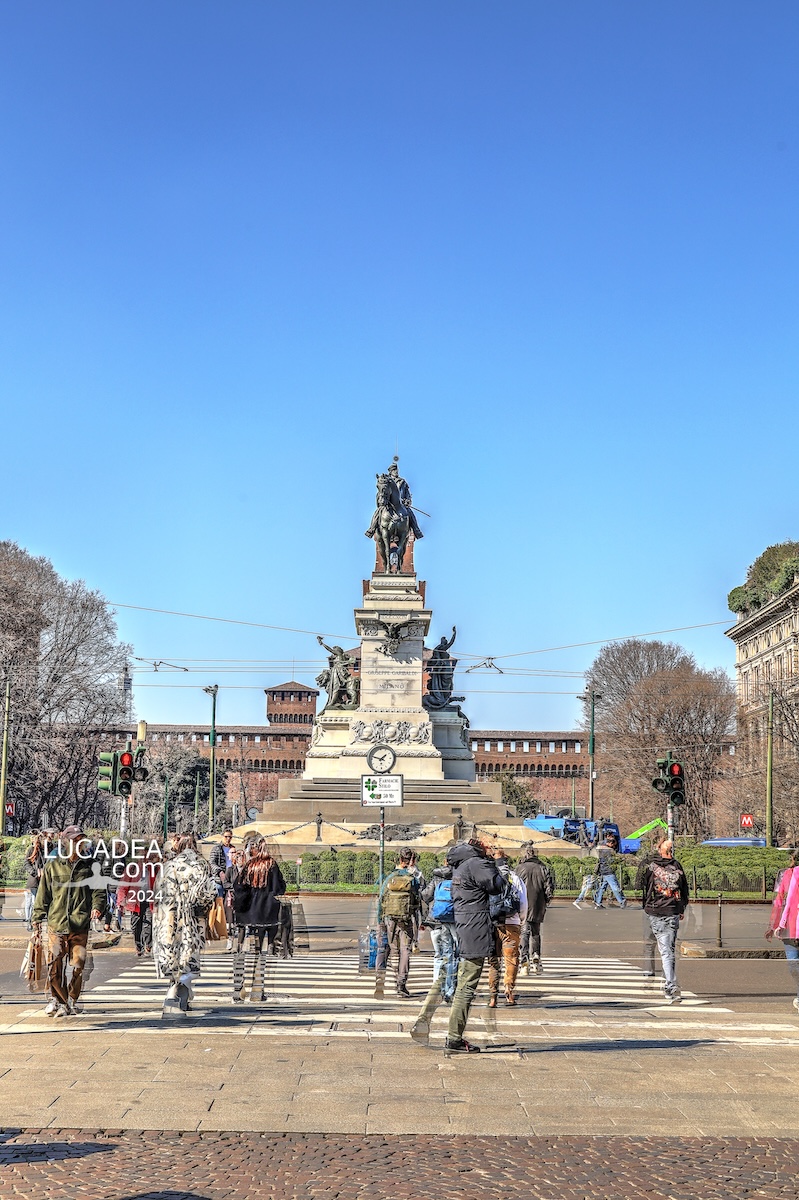
Walking along Dante Street, the road that connects Milan Cathedral to Sforza Castle, you reach a wide open space known as Cairoli Square. It is one of those places where the constant flow of people meets history, creating a lively atmosphere that still preserves a strong connection with the past.
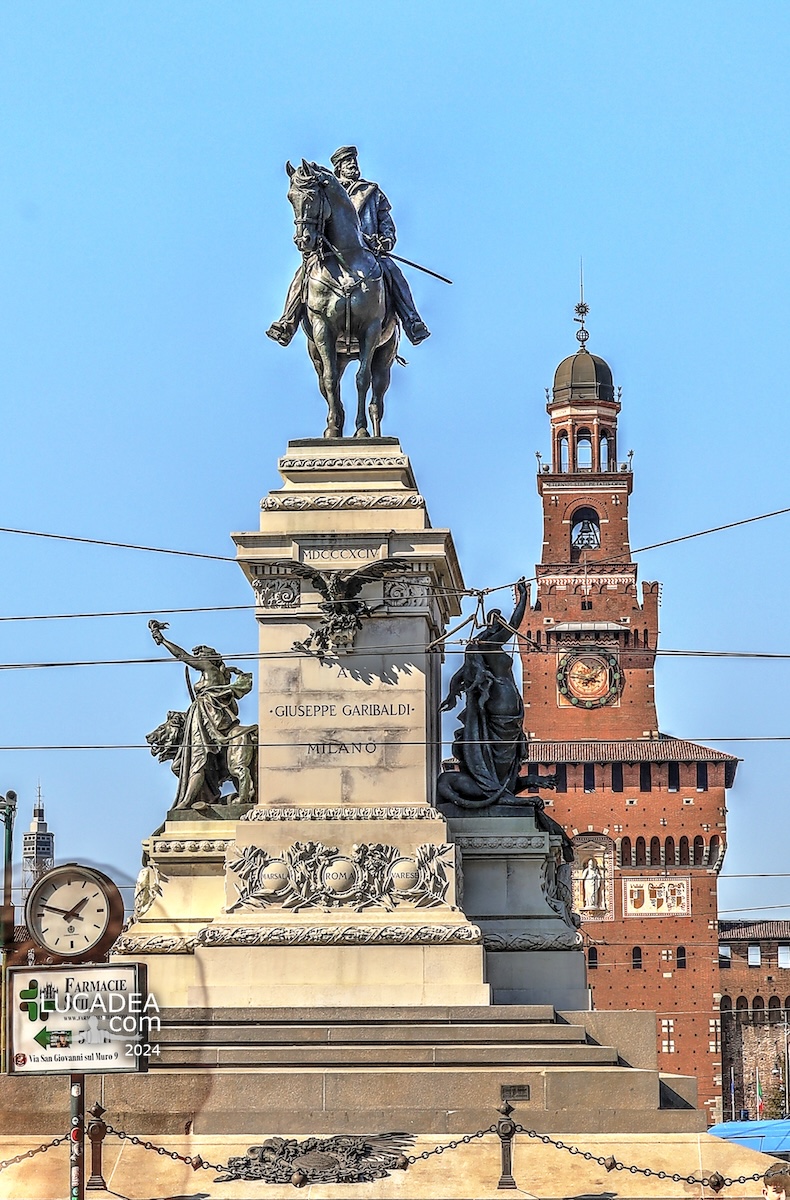
At the center of the square stands the equestrian statue dedicated to Giuseppe Garibaldi, one of the most important figures in Italian history. The monument shows him on horseback in a strong and dynamic pose, overlooking the surrounding space. It is a landmark that many people pass by every day, often without realizing its historical significance.
Milan, in Lombardy, Italy, is a city where modern life blends with historical heritage, and routes like the one between the Cathedral and Sforza Castle offer many interesting details to discover. Cairoli Square is both a crossing point and a place where visitors can stop and observe the city.
The statue was created by the sculptor Ettore Ximenes and inaugurated at the end of the nineteenth century. It celebrates Garibaldi’s role in the unification of Italy, especially his leadership during the Expedition of the Thousand and other military campaigns that contributed to the creation of the Italian state.
Photographing this monument means capturing not only the sculpture itself but also the urban environment around it. What struck me most was the contrast between the historical figure represented and the everyday movement of people in the square.
On lucadea.com I have often shared photos of monuments and historical places, because I believe that even a simple image can preserve the memory of a place and tell part of its story.
Milan is full of interesting views, and sometimes it is enough to stop for a moment along a busy street to notice a detail that deserves attention.

Have you ever noticed this statue while walking between the Cathedral and Sforza Castle? Add a comment or go to the bottom of the site to read what other visitors have written.

Photos taken with Canon EOS RP and Canon RF 24-50 lens.

Click here if you want to see all the photos I took:
foto gallery

Here’s where the statue is located:

Considered by 20th-century historiography and popular culture as Italy’s foremost national hero, he began his travels around the world as a merchant ship’s officer, later becoming a sea captain. His most famous exploit was the victorious Expedition of the Thousand, which led to the annexation of the Kingdom of the Two Sicilies to the nascent Kingdom of Italy, a pivotal episode in the unification process of the new nation.
Continue and learn more at Wikipedia

The statue of Garibaldi in Cairoli Square in Milan – La statue de Garibaldi sur la place Cairoli à Milan – La estatua de Garibaldi en la plaza Cairoli de Milán – A estátua de Garibaldi na praça Cairoli em Milão – Die Garibaldi-Statue auf dem Cairoli Platz in Mailand – Tượng Garibaldi tại quảng trường Cairoli ở Milan – 米兰开罗利广场的加里波第雕像 – ミラノのカイローリ広場にあるガリバルディ像

The text of this post was written with the help of ChatGPT, a language model from OpenAI.

The alleyway of Chiavari and the plaque for Garibaldi

Il caruggio di Chiavari e la targa per Garibaldi

The alleyway of Chiavari and the plaque for Garibaldi.
One of the many snapshots I enjoy taking when strolling through the alleyways of Chiavari.
In this case, from the portico, you can see this plaque (perhaps a gravestone) in memory of Giuseppe Garibaldi.
Since it’s impossible to read the text in this photo, I’ll transcribe it below:

Here on September 5 and 6, 1849,
Giuseppe Garibaldi,
a citizen of Chiavari,
hero of Two Worlds,
was hosted by his cousin
and beloved brother,
Alberto Puccio Di Antonio.

The Economic Society,
owner of the house that once belonged
to Emanuele Gonzalez,
a great benefactor of the people,
placed it on October 29, 1882.

Have you ever seen this plaque? Add a comment or go to the bottom of the site to read what other visitors have written.

Il caruggio di Chiavari e la targa per Garibaldi

Photo taken with Honor 20.

Considered by historiography and in the mass culture of the 20th century as the main Italian national hero, he began his travels around the world as an officer of merchant ships, and then became a long-serving captain. His best-known undertaking was the victorious expedition of the Thousand which led to the annexation of the Kingdom of the Two Sicilies to the nascent Kingdom of Italy, a central episode in the process of unification of the new nation.
Continue and learn more on Wikipedia

The alleyway of Chiavari and the plaque for Garibaldi – La ruelle de Chiavari et la plaque pour Garibaldi – El callejón de Chiavari y la placa de Garibaldi – O beco de Chiavari e a placa de Garibaldi – Die Gasse von Chiavari und die Gedenktafel für Garibaldi – Con hẻm Chiavari và tấm biển dành cho Garibaldi – 基亚瓦里的小巷和加里波第的牌匾 – キアーヴァリの路地とガリバルディの銘板

The Cannara Gate of the village of Bevagna in Umbria

La porta Cannara del borgo di Bevagna in Umbria

The Cannara Gate of the village of Bevagna in Umbria.
Cannara Gate is one of the historical gems of Bevagna, a charming town in Umbria. Dating back to the medieval period, this gate is one of the best-preserved testimonies of the town’s past. The structure, with its imposing tower, arrow slits, and coats of arms, evokes images of a distant yet timeless era.
An interesting detail is the central niche, once decorated with a fresco, which adds an artistic touch to the fortified architecture. Inside the gate, a sundial painted in the 18th century can be admired, a testament to the skill and attention to detail of the craftsmen of the time.
Visiting Cannara Gate means immersing yourself in the history of Bevagna and appreciating the timeless beauty of an urban work of art. A symbol of identity and tradition that continues to enchant visitors.
On the gate there are a sundial, although it is now very faded, and a plaque in memory of Giuseppe Garibaldi.

Do you know the beautiful Umbrian village of Bevagna? Add a comment or go to the bottom of the site to read what other visitors have written.

Photos taken with Canon EOS RP camera and Canon RF 24-50 lens.

To see all the photos I took in the village, click here:

Where is the door located:

The Cannara gate of the village of Bevagna in Umbria – La porte Cannara du village de Bevagna en Ombrie – La puerta de Cannara del pueblo de Bevagna en Umbría – O portão de Cannara da aldeia de Bevagna, na Úmbria – Das Cannara-Tor des Dorfes Bevagna in Umbrien – Cổng Cannara của làng Bevagna ở Umbria

This post was written with the help of Copilot, an AI-powered virtual assistant.

The street called Giuseppe Garibaldi in Varese

La via chiamata Giuseppe Garibaldi a Varese Ligure

Giuseppe Garibaldi Street in Varese Ligure.
Walking through the streets of Varese Ligure on a rather gloomy Sunday, trying to take some photos that offer a different perspective from Piazza Fieschi with its houses and porticoes.

Have you ever visited Varese Ligure? What struck you most about this enchanting village? Add a comment or go to the bottom of the site to read what other visitors have written.

La via chiamata Giuseppe Garibaldi a Varese Ligure

Photo taken with Canon EOS RP and Canon RF 28 lens.

If you’d like to see all the photos taken in Varese that afternoon and previously, click here:
foto gallery

Here’s where the street is:

Giuseppe Maria Garibaldi (Nice, July 4, 1807 – Caprera, June 2, 1882) was an Italian general, politician, patriot, sailor, and writer. A leading figure of the Risorgimento, he was one of the most celebrated historical figures of his era. He is also known as the “Hero of Two Worlds” for his military exploits in both Europe and South America. Considered Italy’s foremost national hero by 20th-century historiography and popular culture, he began his travels around the world as a merchant ship’s officer, later becoming a sea captain. His most famous feat was the victorious Expedition of the Thousand, which led to the annexation of the Kingdom of the Two Sicilies to the nascent Kingdom of Italy, a pivotal episode in the unification of the new nation.
Continue and learn more on Wikipedia

The street called Giuseppe Garibaldi in Varese Ligure – La rue Giuseppe Garibaldi à Varese Ligure – La calle llamada Giuseppe Garibaldi en Varese Ligure – A rua chamada Giuseppe Garibaldi em Varese Ligure – Die Straße namens Giuseppe Garibaldi in Varese Ligure – Con phố có tên Giuseppe Garibaldi ở Varese Ligure

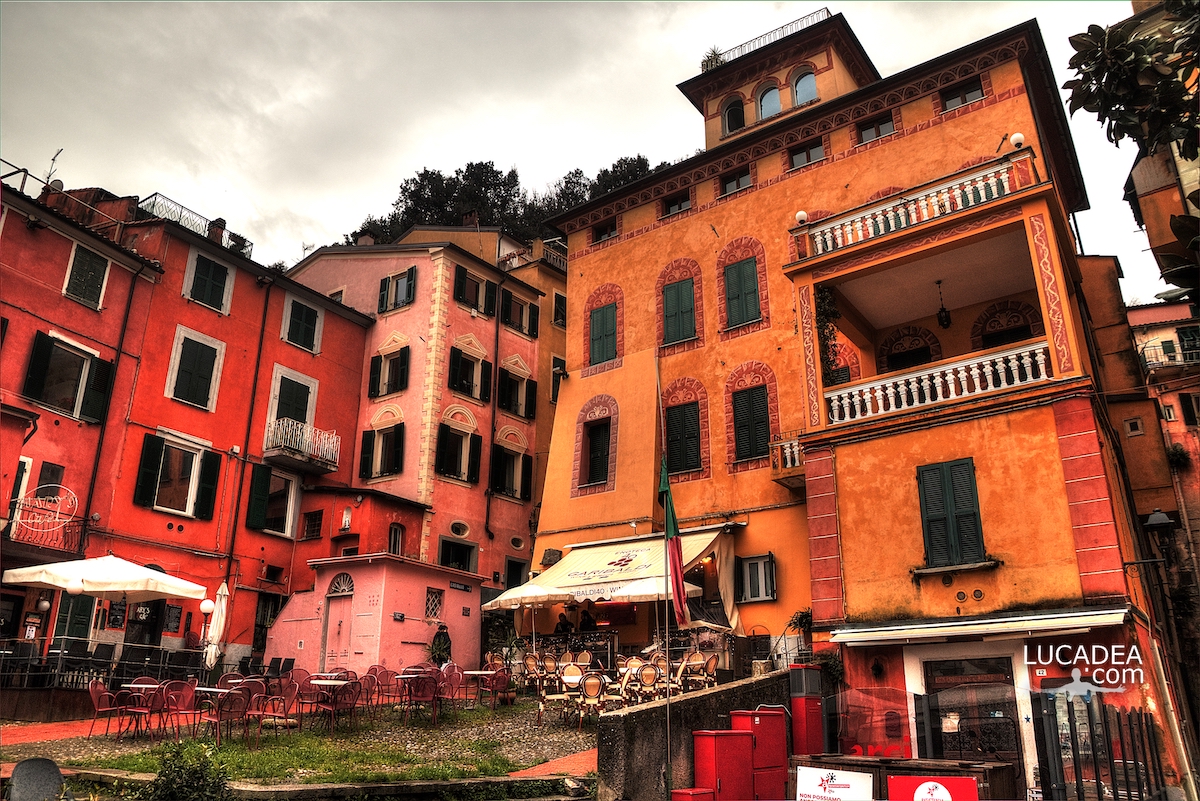
Garibaldi Square in Lerici and its colorful houses

Piazza Giuseppe Garibaldi a Lerici

Garibaldi Square in Lerici and its colorful houses.
Walking through the center of Lerici in Liguria, Italy, I suddenly found myself in one of the most recognizable spots in town, Garibaldi Square Lerici, often mentioned among the places to see in Lerici. The colorful houses immediately draw your attention, with their warm tones and slightly worn facades telling stories of everyday life by the sea.
The square opens naturally between narrow streets, almost like a pause in the rhythm of the village. It’s not just a place you pass through, but somewhere you instinctively slow down. I took this photograph because of that balance: no dramatic scene, just the quiet harmony of architecture and lived-in space that feels real and unfiltered.
Lerici, in the province of La Spezia, Liguria, Italy, has managed to keep its character even as it attracts visitors. In Garibaldi Square, that authenticity is still visible in small details: shutters left half open, subtle imperfections on the walls, traces of daily routines. These are the elements that make photographing the colorful houses in Lerici so interesting without needing to search for hidden corners.
There’s also a simple historical detail behind these colors: fishermen used to recognize their homes from the sea thanks to the distinct painted facades, giving each building a unique identity. What started as a practical solution became one of the most iconic visual features of Ligurian villages.
While taking this shot, I was reminded of another part of Lerici I photographed on a different day, where narrow alleys and colors played a similar role but created a completely different feeling. That’s what keeps me coming back to places like this.
If you are visiting Lerici, this square is definitely one of the most interesting places to pause, even without a specific reason, just to watch the surroundings and absorb the atmosphere.

Have you ever stopped in a place like this and realized that simply being there was enough? Add a comment or go to the bottom of the site to read what other visitors have written.

Colorful houses in Garibaldi Square Lerici, view of the Ligurian village center with traditional buildings and everyday atmosphere

Photo taken with Canon EOS M100 and Tamron 16-300 lens.

Click here to see all the photos I took in beautiful Lerici:
foto gallery

It was under the Republic of Genoa that Lerici began to assume a more important role.
After acquiring Porto Venere and making it a strategic base for controlling the Gulf of La Spezia, Genoa also acquired Lerici, negotiating with the Lords of Vezzano and Arcola, who were the feudal lords of the town.
Continue and learn more on Wikipedia

🏠
  • Italiano