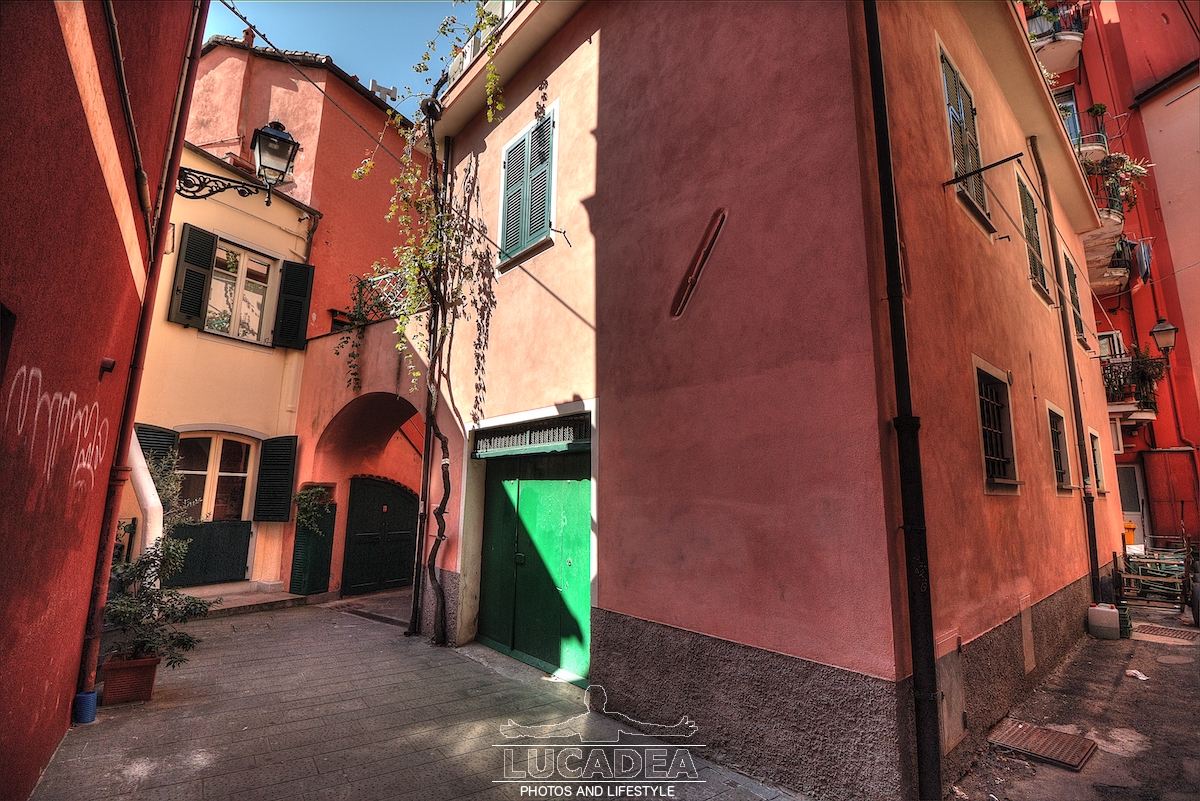
The Vine House on Chiusa Street.
Walking through the historic centre of Sestri Levante, it is difficult not to notice this distinctive house, which also appears frequently in photographs taken by tourists visiting my town.
It is located on Chiusa Street, one of the small side streets leading off the historic carruggio of Sestri Levante, and immediately stands out because of its vivid colours. But the feature that makes it truly unusual is the large grapevine climbing along the façade, starting at ground level and reaching all the way towards the upper part of the building.
It is precisely this vine that gave the house its name. The plant covers almost the entire façade and creates a particularly characteristic view, especially when seen from the narrow lane.
At the top there is a roofed structure and, judging from the appearance of the house, I imagine there may be a terrace with a beautiful pergola. These are exactly the kinds of details that attract me when I photograph buildings in historic centres. They are not necessarily monuments, but lived-in houses that have developed their own identity over time.
This Vine House is probably one of the best known and most photographed in Sestri Levante. You only have to walk through the carruggio to come across it and immediately understand why it attracts so much attention.
But it is not the only one.
I have photographed three Vine Houses in Sestri Levante. The second is in Bottone Lane, while the third is in Marina di Ponente Lane.
I like the idea that three buildings in the historic centre share such an unusual characteristic. They are different houses, but the vines growing across their façades make them immediately recognisable and create almost a small photographic trail through the lanes of Sestri Levante.
The grapevine is also an element deeply connected with the landscape and traditions of Liguria. Here, instead of seeing it only in vineyards and on the hillsides, we find it directly on the façade of a house in the historic centre, turning it into a kind of natural decoration.
This is exactly the sort of detail I enjoy looking for when I walk around Sestri Levante. My town is best known for its bays, sea and scenery, but you only have to turn into one of the smaller lanes to discover completely different and equally interesting details.
And I am convinced that these three are not necessarily the only Vine Houses in town. There may be others, perhaps less well known or hidden in a corner that I have not photographed yet.
If you know of another one, let me know. I would be very curious to discover it and add it to my small photographic collection.
This one, however, remains one of my favourites. Every time I walk along Chiusa Street I find myself looking at it and, whenever I have my camera with me, I almost always feel like taking another photograph.
These are precisely the small details that make a walk through a historic centre interesting. You do not always need to look for a famous monument. Sometimes a colourful façade, a vine growing across it and a characteristic little street are enough to tell us something about a place.
Have you ever seen this Vine House while walking through the carruggio of Sestri Levante? Add your comment or go to the bottom of the site to read what other visitors have written.


Photos taken with a Canon EOS M100 camera and a Canon EF-S 10-18 lens.
I also made a great video that I then uploaded to my YouTube channel:
Video recorded with GoPro Hero5.
Where this house is located:
The rights on images, videos, choruses, text and all other material on the LUCADEA.com website are governed as per Copyright page.