The Modern Cathedral of Christ the King in La Spezia

Esterno e interno della moderna Cattedrale di Cristo Re alla Spezia, con struttura circolare, pilastri e cupola luminosa

The Modern Cathedral of Christ the King in La Spezia.
In La Spezia, Liguria, Italy, the Cathedral of Christ the King is one of the most distinctive buildings in the city. Its modern architecture, with its circular shape and clean lines, looks very different from that of traditional European cathedrals. In this series of photographs, I wanted to show both the exterior and the interior, two perspectives that reveal different aspects of the same building.
From the outside, the cathedral stands out for its imposing, pale structure overlooking Piazza Europa. Its shape is geometric and almost sculptural. Rather than the elaborate façades and decorative details found on many historic churches, the design focuses on form, proportions and simple surfaces. This architectural approach gives the building its unmistakable character and makes it an interesting subject to photograph.
The interior deserves just as much attention. Once inside, visitors find themselves in a large circular space, with the layout drawing the eye towards the centre and the altar. The roof is supported by twelve pillars arranged radially, symbolically representing the twelve Apostles. Natural light enters through the central opening in the dome and through a continuous glazed band around the perimeter, creating a bright atmosphere that differs considerably from that of older churches.
The cathedral was designed by architect Adalberto Libera in 1956. Following his death, the project was continued by Cesare Galeazzi, and the building was completed and consecrated in 1975. It is an important example of twentieth-century religious architecture, combining modern materials and forms with a space intended for worship and community life.
Photographing both the exterior and interior makes it easier to appreciate the design as a whole. From outside, the compact shape and its relationship with the surrounding square are the main features. Inside, the roof structure, the pillars and the movement of natural light become the main points of interest. The two views complement each other: what appears simple and almost closed from the outside becomes a spacious, light-filled environment within.
I enjoy discovering this kind of architecture during my photographic walks. Religious buildings do not necessarily need centuries of history or lavish decoration to capture my attention. Sometimes, their simple shapes and innovative design solutions are just as fascinating. The Cathedral of Christ the King is an unmistakable landmark in La Spezia and offers an opportunity to explore how modern architecture can shape a sacred space.
For me, photographing a building from different angles is also a way to understand it better. The exterior shows its relationship with the city, while the interior reveals how its structure works and how light changes the atmosphere. Together, these photographs offer a more complete impression of this distinctive cathedral.

Do you prefer historic cathedrals filled with elaborate decorations, or do you also appreciate the clean lines of a modern building like this one? Add a comment or go to the bottom of the site to read what other visitors have written.

Exterior and interior of the modern Cathedral of Christ the King in La Spezia, showing its circular design, pillars and light-filled dome

Exterior and interior of the modern Cathedral of Christ the King in La Spezia, showing its circular design, pillars and light-filled dome

Exterior and interior of the modern Cathedral of Christ the King in La Spezia, showing its circular design, pillars and light-filled dome

Photo taken with a Canon EOS M100 camera and Canon EF-M 11-22 lens.

If you want to see all the photos I took in the city, click here:

Add one  comment to this article or read  here what other visitors have written.
 
Adv
 
Disclamer

The rights on images, videos, choruses, text and all other material on the LUCADEA.com website are governed as per  Copyright page.


This page has been viewed 0 times today.
This month it has been viewed 0 times.
In total it has been viewed 0 times.
 

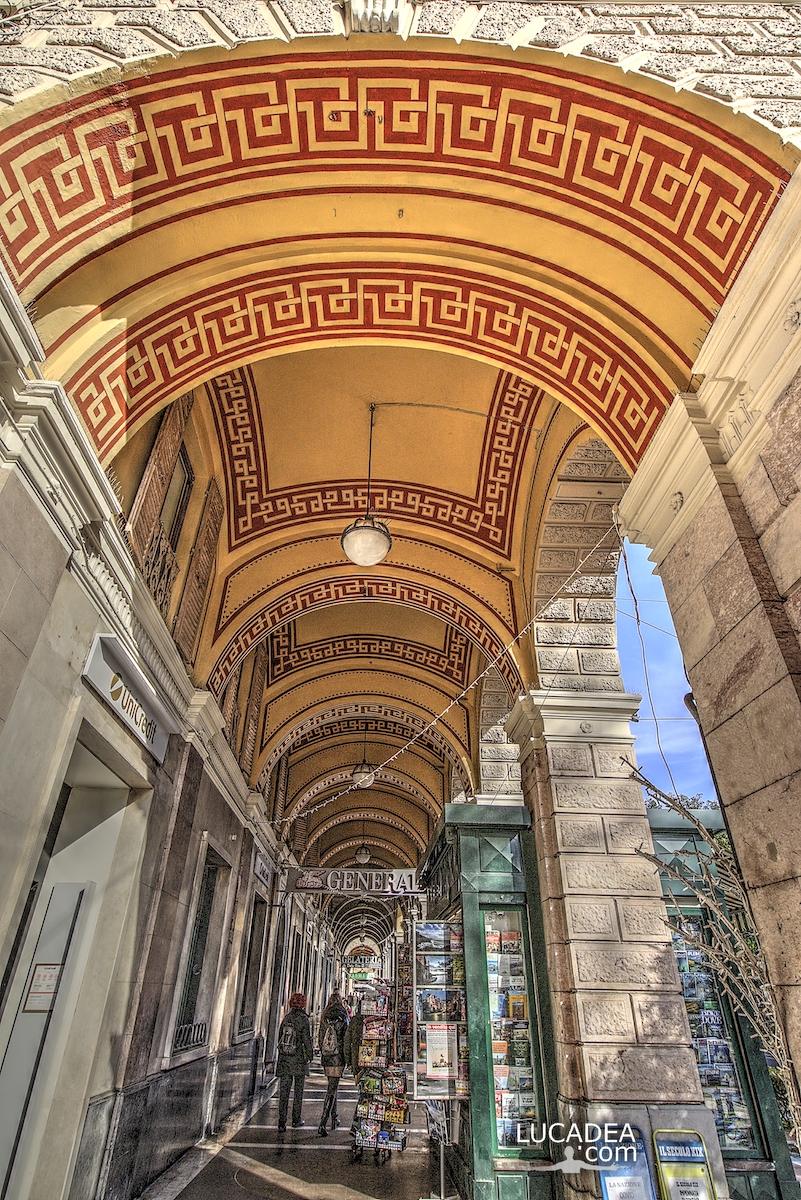
The arcades of Chiodo Street in La Spezia

Portici decorati di via Domenico Chiodo alla Spezia vicino ai giardini pubblici del centro storico

The arcades of Chiodo Street in La Spezia.
Walking through the city centre of La Spezia, I stopped to photograph this elegant sequence of arches, decorations and architectural details that gives a different character to the urban landscape. The arcades of Chiodo Street are one of the interesting places to see in La Spezia if, like me, you enjoy discovering cities through their less obvious corners.
I took this photograph during one of my walks through the town, carrying my camera and looking for details that could tell something about the place. Often, the images I like the most are not necessarily the ones showing the most famous landmarks, but those small everyday views that reveal the atmosphere of a city.
These arcades run along Chiodo Street, next to the Public Gardens of La Spezia, one of the historic green areas in the centre of the city. The covered walkways create a pleasant perspective, with the repeated rhythm of the columns and arches leading the eye along the street. The decorations on the buildings add an elegant touch and make this part of La Spezia particularly interesting to photograph.
Compared with the traditional arcades that can be found in some Ligurian seaside villages, these have a more urban and nineteenth-century appearance. La Spezia changed considerably during that period, especially after the construction of the Naval Arsenal, which transformed the city from a small coastal town into an important military and industrial centre.
A small historical curiosity is connected with the name of the street. Domenico Chiodo was an Italian military engineer and general who played a key role in the design and construction of the Naval Arsenal of La Spezia. The city dedicated this street to him in recognition of his contribution to the development of the area.
What attracted me to this scene was the balance between architecture and everyday life. The arches create a strong geometric pattern, but the street remains a normal place where people walk, meet and continue their daily activities. This contrast is what makes the photograph interesting to me.
As I have already shown in other photographs from Eastern Liguria, from villages in the countryside to historic streets, I often find the identity of a place in these simple details. They are not always the first things visitors notice, but they are often the ones that remain in memory.
If you are visiting La Spezia, this is one of those corners worth seeing while walking through the city centre, especially if you like historic architecture and urban details.

Have you ever walked along Chiodo Street in La Spezia and noticed these decorated arcades? Add a comment or go to the bottom of the site to read what other visitors have written.

Decorated arcades of Chiodo Street in La Spezia beside the Public Gardens in the city centre

Photo taken with a Canon EOS M100 camera and Canon EF-M 11-22 lens.

If you want to see all the photos I took in the city, click here:

Domenico Chiodo (Genoa, October 30, 1823 – La Spezia, March 19, 1870) was an Italian general and architect—an officer in the Military Engineers—who designed the naval arsenals at La Spezia and Taranto and oversaw the expansion of the one in Venice.
Read more and find out more on Wikipedia

Add one  comment to this article or read  here what other visitors have written.
 
Adv
 
Disclamer

The rights on images, videos, choruses, text and all other material on the LUCADEA.com website are governed as per  Copyright page.


This page has been viewed 0 times today.
This month it has been viewed 0 times.
In total it has been viewed 0 times.
 

The small harbor of Tellaro between houses and sea

Porticciolo di Tellaro in Liguria con barche, case colorate e mare davanti al borgo marinaro

The small harbor of Tellaro between houses and sea.
The small harbor of Tellaro is one of those corners of Liguria where the connection between the village and the water still feels natural and unchanged. Between colorful houses facing the sea and small boats resting near the shore, this little landing place tells a story of everyday life deeply connected to the coast.
While walking through the village with my camera, I stopped to capture a scene made of simple details but full of character: fishing boats pulled onto the shore, pastel-colored walls and the typical Ligurian way of building houses almost directly above the sea. The harbor of Tellaro is not a large marina, but its small scale is exactly what makes it fascinating for anyone who enjoys photographing authentic places.
Tellaro, near La Spezia, is one of the most famous seaside villages in Liguria, known for its position on the rocky coastline and its views over the Gulf of Poets. This photograph was taken in Tellaro, Liguria, Italy, trying to capture the atmosphere of a small village where the sea is not just a background, but an essential part of daily life.
When I think about places worth seeing in Liguria, I often remember that the most interesting locations are not always the biggest or most famous ones. Small villages like this reveal a more intimate side of the region, where boats, houses and the coastline are still connected in a very direct way.
One curiosity about Tellaro is that the village has been included among the “Most Beautiful Villages in Italy”, a recognition dedicated to small Italian towns with particular historical and landscape value.
On my photoblog I have shared other views of the Ligurian coast, including photographs from Sestri Levante and other seaside locations, because I often find that the smallest details create the strongest memories.
I like photographing places like Tellaro because they do not need impressive monuments to attract attention. Their beauty comes from the atmosphere, the colors and the relationship between people, buildings and the sea.

Have you ever visited a small seaside village where you felt that time had slowed down? Add a comment or go to the bottom of the site to read what other visitors have written.

Porticciolo di Tellaro in Liguria con barche, case colorate e mare davanti al borgo marinaro

Photo taken with Canon EOS M100 and Tamron 16-300 lens.

To see the many photos I took in the seaside village of Tellaro, click here:
foto gallery

Tellaro is the easternmost hamlet of the municipality of Lerici, in the province of La Spezia. It has been listed as one of the most beautiful villages in Italy. The town is a small seaside village, perched on a cliff overlooking the Gulf of La Spezia. A destination for many Italian and foreign artists, Mario Soldati found a home here during his long years of retirement.
Continue and learn more at Wikipedia

The small harbor of Tellaro between houses and sea – Le petit port de Tellaro entre maisons et mer – El pequeño puerto de Tellaro entre casas y mar – O pequeno porto de Tellaro entre casas e mar – Der kleine Hafen von Tellaro zwischen Häusern und Meer – Cảng nhỏ Tellaro giữa những ngôi nhà và biển – 泰拉罗小港,房屋与大海之间 – テッラーロの小さな港、家々と海の間

The text of this post was written with the help of ChatGPT, a language model from OpenAI.

The Stone Staircase of San Pietro

La scalinata in pietra della chiesa di San Pietro a Portovenere

The Stone Staircase of San Pietro.
The stone staircase of the Church of San Pietro in Portovenere, Liguria, in the province of La Spezia, Italy, is one of those architectural details that help make this beautiful seaside village so distinctive. The church stands on a rocky promontory extending into the Gulf of Poets, directly opposite Palmaria Island, and is one of the most recognisable landmarks along the Ligurian coast. In this particular view, the focus is on the steps leading to the terrace beside the bell tower.
I enjoy looking at details like these because they tell the story of a place in a different way from the familiar views of its main monuments. A stone staircase might seem like a simple, almost secondary feature, but in a setting like Portovenere it becomes an essential part of the landscape. The worn surfaces, irregular shapes and relationship with the surrounding structures create an atmosphere that immediately evokes the village’s long history.
The Church of San Pietro has very ancient origins. The present complex brings together an older section associated with early Christian and Romanesque architecture and a Gothic structure built by the Genoese during the thirteenth century. The distinctive alternating bands of light and dark stone have become one of Portovenere’s most recognisable architectural features. Its dramatic position between the rocky headland and the open sea makes the entire complex even more remarkable.
The staircase leads visitors towards the terrace beside the bell tower, where beautiful views open across the coastline and the waters surrounding the promontory. It is a place worth exploring slowly, noticing how the stonework blends with the natural rock and how the architecture seems to follow the shape of the ground. Here, the landscape is not simply a backdrop; it is an essential part of the experience.
When exploring places like this, I often try to pay attention to less obvious features that might go unnoticed while everyone searches for the most famous photograph. A staircase, an old wall or a corner beside a bell tower can reveal a great deal about a place’s character and offer interesting photographic perspectives.
On Lucadea.com, I share photographs of landscapes, villages and architectural details discovered during my travels. This staircase is another small fragment of Portovenere, a place where history and natural beauty come together in a remarkable way.

Have you visited the Church of San Pietro in Portovenere? Do you also stop to admire architectural details, or are you more drawn to the views across the sea? Add a comment or go to the bottom of the site to read what other visitors have written.

Stone staircase at the Church of San Pietro in Portovenere, with steps leading to the terrace beside the historic bell tower

Photo taken with Canon EOS RP and Canon RF 24-50 lens.

I also recorded a short video of me walking around the village:

Video recorded with Gopro Hero5.

Click here to see all the photos of the village:
foto gallery

Where is the church:

The Terrace of San Pietro in Portovenere

La spianata della chiesa di San Pietro a Portovenere

The Terrace of San Pietro in Portovenere.
The terrace of the Church of San Pietro in Portovenere, in Liguria, in the province of La Spezia, Italy, is one of the most beautiful places along the eastern Ligurian coast. Set on the rocky tip of the headland, where the village seems to end above the open sea, this stone-paved area offers remarkable views of the cliffs, the sky and the waters of the Gulf of Poets.
When I visit a place like this, what strikes me most is the relationship between architecture and nature. The stone paving and the old walls seem to belong naturally to this stretch of coastline. On one side stands the famous Church of San Pietro, with its distinctive black-and-white stripes; on the other, the sea opens towards the horizon and Palmaria Island. Together, they create a landscape that is both dramatic and peaceful.
It is difficult to imagine a more striking location for a church. The building stands on the rocky promontory overlooking the sea, and its distinctive appearance has become one of the symbols of Portovenere. The present church brings together structures from different periods. The oldest section is associated with the early Christian origins of the site, while the Gothic church commissioned by the Genoese was built during the thirteenth century. This combination of historical layers makes the entire complex even more fascinating.
However, it is the open space outside the church that particularly captures my attention. Here, visitors can walk at a leisurely pace, stop to admire the rocks descending towards the water and watch the light change throughout the day. The wind, the sound of the waves and the vastness of the view create an atmosphere quite different from the narrow, lively streets of the village. On the terrace, everything seems to open out towards the sea.
From this vantage point, it is also possible to appreciate the rugged character of the coastline, with its weathered cliffs and the water breaking against the rocks below. Not far away lies the famous Byron’s Grotto, associated with the English poet who was drawn to this landscape and the Ligurian sea. It is easy to understand why places like this have inspired artists and writers: natural beauty and historic architecture come together here without needing any elaborate explanation.
On Lucadea.com, I enjoy sharing photographs of places that catch my attention because of their atmosphere and their relationship with the surrounding landscape. The terrace of San Pietro is one of those places where it is worth slowing down, looking around and appreciating the details.

Have you visited the Church of San Pietro in Portovenere? What impressed you most: its architecture, the terrace or the spectacular sea views? Add a comment or go to the bottom of the site to read what other visitors have written.

The stone terrace of the Church of San Pietro in Portovenere, overlooking the sea and rugged cliffs along the Gulf of Poets in Liguria

Photo taken with Canon EOS RP camera and Canon RF 24-50 lens.

Click here to see all the photos of the village:
foto gallery

Here’s the spot where I took the shot:

A historic jewelry shop in La Spezia

Vetrina in legno dell'oreficeria Caracciolo nel centro storico della Spezia, una gioielleria storica della città

A historic jewelry shop in La Spezia.
While walking through the city center, I stopped in front of the Caracciolo jewelry shop, a long-established presence whose own signage dates its activity back to 1880. What caught my attention, however, was not simply the jewelry displayed inside, but the wooden shop window itself, which has retained an unmistakably old-fashioned character.
When I photograph a city, I do not always look for monuments or famous viewpoints. Sometimes an ordinary business encountered during a walk can reveal something much more personal about a place. This historic jewelry shop in La Spezia became interesting to me because its storefront seemed to preserve a small piece of the city’s commercial past right in the middle of everyday urban life.
The wooden display window is the detail that makes the photograph for me. Its proportions, materials and overall appearance feel very different from the bright, highly polished storefronts commonly found in modern jewelry stores. Here, the display itself has a presence. It does not simply provide a setting for the objects inside; it becomes part of the story.
That is exactly the kind of detail I enjoy finding while walking with my camera. A shop window may seem purely functional, designed to attract customers and display products, but when an old structure has survived for generations, it can become an informal record of how a street and its businesses have changed. The photograph therefore says something about the shop, but also about the continuity of the surrounding city.
La Spezia is in Liguria, Italy, on the Gulf of Poets in the eastern part of the region. Its city center offers a mixture of urban architecture, commercial streets and everyday details that can be particularly rewarding to photograph. If you are visiting La Spezia and wondering what to see beyond the most familiar sights, walking through the central streets can reveal small details that are easy to miss when moving too quickly.
I took this photograph myself because I wanted to preserve that particular storefront as I found it during my walk. There was no elaborate photographic setup behind the image. I simply noticed the old wooden display and thought it deserved to be recorded. For me, that spontaneous reaction is an important part of photographing cities.
The Caracciolo jewelry shop identifies its history as beginning in 1880. That date gives the business a remarkably long connection with the city, but from a photographic point of view, the wooden storefront is what makes the history visible. Rather than needing a long historical explanation, the surviving details of the shop allow the passage of time to be felt directly through the image.
There is a small curiosity here about historic shopfronts. They are often overlooked when people think about architectural heritage, yet old display windows can preserve materials, proportions and decorative choices that tell us how businesses presented themselves in earlier periods. In this photograph, the wood is therefore much more than a background: it is the element that first made me stop.
I also like the contrast between the jewelry and its surroundings. Jewelry is associated with precision, elegance and carefully selected details, while the wooden display creates a warmer and more traditional visual setting. The two elements belong to different aesthetic periods, yet they work naturally together.
This photograph also connects with other images I have shared from Ligurian towns, where I have often focused on streets, storefronts and smaller urban details rather than only on the most recognizable landmarks. These photographs become a kind of visual thread through the places I have visited, linking one walk to another.
One of the pleasures of urban photography is precisely this lack of certainty about what will become the subject. I can start a walk without having a particular photograph in mind and end up stopping because of an old sign, a doorway or a shop window. In this case, the history associated with the jewelry shop made the encounter even more interesting, but it was the wooden storefront that ultimately convinced me to take the picture.
La Spezia naturally offers many more obvious subjects, yet I think these smaller encounters deserve space in a photographic blog as well. A long-established shop can become part of the visual identity of a street simply by continuing to be there, year after year.

Have you ever stopped to photograph an old shop window because it seemed to preserve a piece of a city’s history? Add a comment or go to the bottom of the site to read what other visitors have written.

Wooden display window of Caracciolo jewelry shop in central La Spezia, a historic storefront in the Ligurian city

Photo taken with Canon EOS RP camera and Canon RF 24-50 lens.

If you want to see all the photos I took in the city, click here:

This is the jewelry store’s website: spezia.caracciolononsologioielli.it.
Here’s where it is located:

The Old Town Gate of Portovenere

La Porta del Borgo di Portovenere

The Old Town Gate of Portovenere.
The Old Town Gate of Portovenere, in Liguria, in the province of La Spezia, Italy, is one of the most charming entrances to the historic centre of this beautiful village overlooking the Gulf of Poets. I find it fascinating to imagine how many people have passed beneath its arch over the centuries and how many stories these ancient stones could tell. It is a place where medieval architecture remains part of everyday life in the village.
The gate stands within the old defensive walls and opens onto Giovanni Capellini Street, the characteristic narrow lane that runs through the heart of the historic centre. Beyond the entrance, a maze of narrow alleys, stairways, arches and tall, colourful houses invites visitors to explore. Every turn seems to reveal another interesting view. This is more than a simple passage into the village: walking through it feels like stepping into another period of history.
The Old Town Gate is closely connected to Portovenere’s medieval past and its relationship with the Republic of Genoa. During the twelfth century, Genoa developed the village into an important fortified settlement on the eastern Ligurian coast. Above the entrance, the historic inscription “Colonia Ianuensis 1113” recalls the village’s connection with Genoa. The gate and the surrounding walls formed part of a defensive system designed to protect a strategically important settlement for trade and coastal control.
What catches my attention most is the imposing simplicity of the stone structure. Elaborate decoration is not necessary to make this entrance impressive. The strength of the arch, the uneven surfaces of the stone blocks and the contrast with the buildings around it give the gate its distinctive character. Imagining Portovenere as it might have appeared centuries ago makes it easier to appreciate how important this entrance must have been for both residents and visitors arriving at the village.
Once through the gate, I can follow the narrow main lane and explore at my own pace, passing shops, small restaurants and picturesque corners along the way. The streets also lead towards some of Portovenere’s best-known landmarks, including the Church of San Pietro and Doria Castle, both important features of the village’s historic landscape.
On Lucadea.com, I enjoy sharing architectural details like this because small features often reveal something special about a place. The Old Town Gate is more than an ancient entrance: it is a tangible reminder of Portovenere’s past and an invitation to discover its historic streets.

When you visit a historic village, do you stop to admire its old gates and defensive walls, or do you prefer to wander straight into the narrow streets? Add a comment or go to the bottom of the site to read what other visitors have written.

The Old Town Gate of Portovenere, a medieval stone archway set within the historic defensive walls of this Ligurian village in Italy

Photo taken with Canon EOS RP camera and Canon RF 24-50 lens.

At another time, I also recorded a short video of me walking around the village:

Video recorded with GoPro Hero5.

Click here to see all the photos of the village:
foto gallery

Where is Portovenere?

A view of Corso Cavour in La Spezia city centre

La vista del centrale Corso Cavour alla Spezia

A view of Corso Cavour in La Spezia city centre.
While walking through the streets of La Spezia, I stopped to capture this view of Corso Cavour, one of the main roads crossing the heart of the city and a place where everyday urban life meets the architecture of Liguria.
This photograph was taken during a simple walk through the centre, when I discovered a perspective that had not previously caught my attention. The long line of the street, the buildings along the road and the rhythm of the urban landscape created a composition that I wanted to preserve with my camera.
If you are visiting La Spezia, Corso Cavour is one of the streets worth seeing to understand the character of the city beyond the most famous attractions. It is not a single landmark, but a living part of the urban fabric, where shops, historic buildings and local life come together along one of the central routes of the city.
I took this image in La Spezia, Liguria, Italy, during my visit to the city centre. What interested me was the possibility of finding a photographic subject in an ordinary street scene. Sometimes a familiar road can reveal its personality through a different viewpoint, and this is exactly what happened with this shot.
The street is named after Camillo Benso, Count of Cavour, an important figure of Italian history and the first Prime Minister of the Kingdom of Italy. Corso Cavour has long been one of the main urban axes of La Spezia, connecting different areas of the city and following its transformation over time.
Looking at this photograph, I like the balance between the historical character of the buildings and the contemporary life that continues around them. For me, these details are often what make a city interesting to photograph: not only its famous monuments, but also the streets where people walk every day.
I have photographed other corners of La Spezia as well, collected in the city gallery on my site, where different streets and views show another side of this Ligurian town. Each photograph becomes a small memory of a place discovered step by step.
This image remains a personal record of that walk through Corso Cavour, a simple street view that represents the atmosphere of La Spezia and its everyday identity.

Have you ever walked along Corso Cavour while exploring the centre of La Spezia? Add a comment or go to the bottom of the site to read what other visitors have written.

View of Corso Cavour in La Spezia with historic buildings and the main street of the Ligurian city centre

Photo taken with Canon EOS RP and Canon RF 24-50 lens.

If you want to see all the photos I took in the city, click here:

Where is the street located:

Portovenere’s colorful houses by the sea

Le case colorate sul mare a Portovenere

Portovenere’s colorful houses by the sea.
Standing by the harbor, the first thing that catches my attention is the row of colorful houses in Portovenere, packed closely together and facing directly onto the water. It is one of those places worth seeing in Liguria where the relationship between the village and the sea is impossible to miss, and the view stays in your mind long after you have left.
In this photograph, I wanted to capture precisely that relationship: the houses following the edge of the harbor and forming an almost continuous wall of color along the waterfront. They are noticeably taller than many of the houses found in other Ligurian villages, and that vertical character gives Portovenere a distinctive appearance.
Portovenere is in Liguria, in the province of La Spezia, overlooking the Gulf of Poets. It is one of the most interesting places to see in this part of the Italian Riviera and is sometimes described informally as a kind of “sixth Cinque Terre.” It is not actually part of the Cinque Terre, but the comparison is easy to understand. Both areas share colorful buildings, steep coastal landscapes and a strong connection between everyday life and the sea.
From the harbor, the structure of the village becomes particularly clear. Very little separates the houses from the water, and the colorful façades create a continuous urban front facing the port. Windows, shutters and balconies add small variations to the composition, while the different shades of the buildings keep the scene from becoming visually uniform.
That is what attracted me to photograph this view. I was not necessarily looking for the most famous monument in Portovenere. Instead, I wanted to stop and record an ordinary part of the village that says a great deal about its character. The houses themselves become the subject, and the sea provides the space that makes their colors stand out.
There is also a historical reason why Portovenere has such a strong and compact appearance. The village was fortified by the Republic of Genoa and developed as an important strategic and maritime settlement. Its architecture still reflects that history, with defensive structures and buildings shaped by the need to make the most of a narrow coastal position.
The comparison with the Cinque Terre becomes especially interesting when you look closely at the architecture. In places such as Vernazza or Manarola, buildings often seem to climb the hillsides. In Portovenere, the houses along the harbor create a more compact façade facing the sea. The difference is subtle, but from a photographic point of view it changes the whole composition.
This photograph also connects naturally with other images I have taken in Liguria, where I often find myself focusing on colorful façades, narrow streets and small views toward the water. Each village has its own character, but there is always that same close relationship between architecture and landscape.
If you are visiting Portovenere and wondering what to see, I would not limit yourself to the best-known landmarks. Take some time to look back toward the waterfront and observe the houses from the harbor. Their colors, height and position tell a quieter story about the village.

Have you ever seen Portovenere from the harbor and noticed how closely its colorful houses meet the sea? Add a comment or go to the bottom of the site to read what other visitors have written.

Colorful houses facing the sea in Portovenere, with the tall waterfront buildings lining the village harbor in Liguria

Photo taken with Canon EOS RP camera and Canon RF 24-50 lens.

Click here to see all the photos of the village:
foto gallery

Where is Portovenere located:

In 1997, Porto Venere, along with the islands of Palmaria, Tino, Tinetto, and the Cinque Terre, was listed as a UNESCO World Heritage Site. The municipality of Porto Venere lies at the southern end of a peninsula, which, branching off from the rugged coastline of the eastern Ligurian Riviera, forms the western shore of the Gulf of La Spezia, also known as the “Gulf of Poets.”
Continue and learn more at Wikipedia

🏠
  • Italiano