Funchal from Above with Costa Deliziosa in Port

Funchal dall'alto

Funchal from Above with Costa Deliziosa in Port.
The view over Funchal from the church of Nossa Senhora do Monte, on the Portuguese island of Madeira, is truly spectacular. From this elevated position, the city stretches towards the ocean, with rooftops, green hillsides and the harbour in the distance. My cruise ship, Costa Deliziosa, can also be seen down below, adding a personal touch to this impressive panorama.
Reaching this viewpoint offers a very different perspective from walking through the streets of the city centre. Funchal seems to spread across the hillside, following the natural shape of the land all the way down to the coast. The contrast between the buildings, the vegetation and the blue waters of the Atlantic creates a rich landscape full of details worth taking time to appreciate.
The Church of Nossa Senhora do Monte stands above Funchal and is one of the best-known religious landmarks on Madeira. The sanctuary is dedicated to Our Lady of the Mount and has a special place in local religious tradition. Its elevated location makes it an appealing destination not only for its historical and spiritual significance but also for the broad views it offers over the island’s capital.
From up here, the harbour is clearly visible, and the presence of Costa Deliziosa makes the scene particularly meaningful to me. It is not simply another ship in the port: it is the cruise ship I travelled on. Seeing it from above, framed by the city and the coastline, brings together the place I am visiting and the journey that brought me here.
Madeira is an autonomous region of Portugal in the Atlantic Ocean, known for its mountainous scenery, lush vegetation and viewpoints that change character with the light and weather. Funchal brings many of these features together. Houses climb the slopes, while the ocean draws the eye towards the horizon. It is the kind of place where it is worth pausing for a little longer, simply to take in the relationship between the city, the harbour and the surrounding landscape.
I took this photograph to preserve the memory of this wonderful view, with Funchal spread out below the hillside and Costa Deliziosa visible in the port. I enjoy viewpoints like this because they reveal the shape of a city while allowing me to include a detail connected with my own experience of travelling. The result is both a landscape photograph and a personal memory of my time on Madeira.

Would you like to admire Funchal from this panoramic viewpoint, or would you rather explore the city by walking through its streets? Add a comment or go to the bottom of the site to read what other visitors have written.

Panoramic view of Funchal from Nossa Senhora do Monte Church, with Costa Deliziosa docked in the harbour beside the Atlantic Ocean

Click here to see all the photos of Funchal:
foto gallery

Add one  comment to this article or read  here what other visitors have written.
 
Adv
 
Disclamer

The rights on images, videos, choruses, text and all other material on the LUCADEA.com website are governed as per  Copyright page.


This page has been viewed 0 times today.
This month it has been viewed 0 times.
In total it has been viewed 0 times.
 

The Houses of Sestri Levante’s “Island”

Le case dell’“Isola” di Sestri Levante viste dalla passeggiata di Sant’Anna, lungo il tratto di costa che guarda la Baia delle Favole

The Houses of Sestri Levante’s “Island”.
From the final stretch of the Sant’Anna seafront promenade, the view follows a line of houses towards the part of Sestri Levante traditionally known as the “Island”. In this photograph, the buildings trace the coastline between the Bay of Fables and the first streets of the historic centre, offering a glimpse of how the town meets the sea.
I took this picture from the waterfront at Sant’Anna, looking towards a familiar part of the Ligurian coast. The houses in the foreground catch the eye first, but the view becomes more interesting when you follow the buildings along the shoreline. Their position helps reveal the shape of the land and the way the town has developed around its two bays.
The name “Island” may seem puzzling to visitors seeing Sestri Levante for the first time. Today, this area is a peninsula connected to the mainland, rather than an island separated by water. The traditional name reflects the area’s earlier geographical configuration, when a stretch of water separated it from the rest of the land. Although the landscape has changed, the old name has remained part of local identity and everyday speech.
I find this kind of detail particularly interesting because it adds another layer to an otherwise ordinary view. A row of houses beside the sea might seem like a straightforward photographic subject, yet the name of the place reveals something about its past. The landscape is not just a backdrop for the town; it also reflects the changes that have shaped the coastline over time.
Sestri Levante lies in the Metropolitan City of Genoa, in Liguria, northwestern Italy. Its historic centre occupies the peninsula between the Bay of Fables and the better-known Bay of Silence. Each bay offers a different perspective on the town, and the stretch of promenade at Sant’Anna provides a useful vantage point for looking towards the houses facing the Bay of Fables and the area locally called the “Island”.
There is another small piece of local history connected with this view. In front of the house in the foreground of the photograph, a circular building once stood as the headquarters of the Port Authority of Sestri Levante. The authority is now based in the port area, but the former building remains part of the story of a waterfront that has changed over the years. Details like this can be easy to overlook when walking along the seafront, yet they help us imagine how the town once looked and functioned.
For me, photographing places like this is about finding a balance between the image itself and the story that can be discovered within it. Not every photograph needs a famous monument or a dramatic panorama. Sometimes the character of a place emerges through its houses, the line of the coast and a name that has survived long after the landscape changed.
This is also what makes returning to familiar places worthwhile. A different viewpoint can reveal relationships between buildings, streets and the shoreline that might otherwise go unnoticed. The photograph keeps my attention on a small section of Sestri Levante, while the details behind it offer a reason to look a little more closely.
On Lucadea.com, I have shared other views of Sestri Levante and its bays, including photographs of the Bay of Silence. Looking at these locations from different angles helps build a more complete picture of the town and its relationship with the Ligurian Sea.

Have you ever wondered why this part of Sestri Levante is still called the “Island” even though it is now a peninsula? And did you know about the former circular Port Authority building? Add a comment or go to the bottom of the site to read what other visitors have written.

Houses on Sestri Levante’s “Island” peninsula, photographed from the Sant’Anna seafront promenade overlooking the Bay of Fables

Photo taken with a Canon EOS M100 camera and a Tamron 16-300 lens.

Add one  comment to this article or read  here what other visitors have written.
 
Adv
 
Disclamer

The rights on images, videos, choruses, text and all other material on the LUCADEA.com website are governed as per  Copyright page.


This page has been viewed 1 times today.
This month it has been viewed 1 times.
In total it has been viewed 1 times.
 

Piscina dei Castelli in Sestri Levante

Piscina dei Castelli a Sestri Levante vista dal porto, con la struttura sul mare e la scogliera della Liguria

Piscina dei Castelli in Sestri Levante.
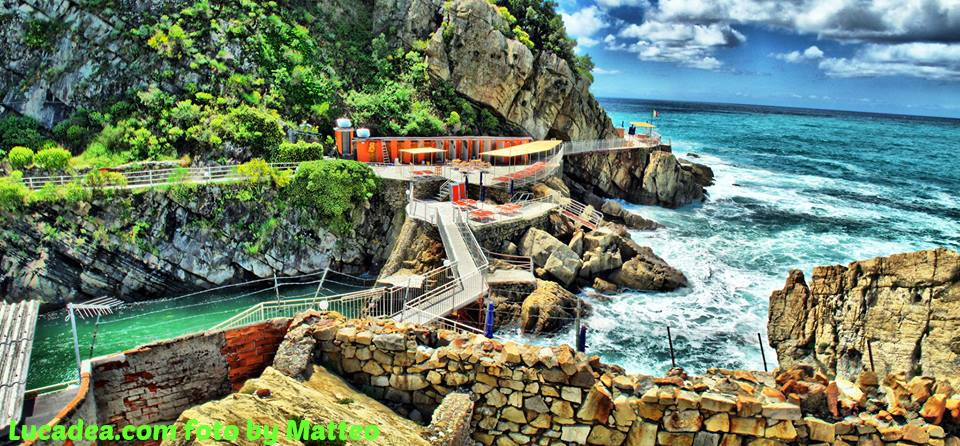
I took this photograph in 2013 from the harbour of Sestri Levante, stopping to look toward the coastline and the unusual seaside structure that had long been part of the town’s summer life. When I think about photos of Sestri Levante and what to see along this part of Liguria, Piscina dei Castelli is one of those places that immediately brings me back to a particular period in the town’s history.
At the time, the nightclub was closed. In my original article, I mentioned that closure almost as a hope for the future. Looking at the photograph now, that detail makes the image even more interesting because we know that the story of Piscina dei Castelli did not end there.
The photograph came from simply observing the landscape. From the harbour I had a wide enough viewpoint to avoid photographing the structure in isolation and instead include it within its natural setting, together with the sea and the coastline. That is why I preferred a slightly distant composition: I wanted to preserve not only Piscina dei Castelli itself, but also the surroundings that make this location so distinctive.
The setting is one of the most unusual features of the place. Piscina dei Castelli is located in the tourist harbour of Sestri Levante, Liguria, Italy, and the venue follows the edges of a natural seawater pool carved into the rocky coastline. Rock, water and architecture are therefore closely connected, and that relationship can already be appreciated from the harbour.
In my original article, I focused mainly on the seaside establishment and its connection with the historic nightclub of the same name. During its active years, the beach in front of the pool and the concrete platforms became part of the spaces used during summer nights. It was an unusual way of experiencing a nightclub, with music and the sea occupying almost the same space.
The history of Piscina dei Castelli, however, began long before I took this photograph. According to the official Piscina dei Castelli website, its story dates back to 1968, when Tino Barbera and Rudy Ciuffardi created a venue combining music and live concerts with a seaside setting. Over the following years, many well-known Italian and international performers appeared there, helping the venue become part of the cultural and nightlife history of Sestri Levante.
One detail I found particularly interesting is connected with 1987, when several themed parties were introduced and later became strongly associated with the name Piscina dei Castelli. They included the Festa in Bianco, the Full Moon Party and the Hawaiian-themed Hanoa Hanoa. The venue also recalls its Halloween Party as one of the earliest events of its kind in Italy.
In 1985, the owners had decided to focus more strongly on the nightclub side of the business after a long period characterised by live performances. This transition helps explain how Piscina dei Castelli evolved over the decades while maintaining its identity around music and its unusual position beside the sea.
When I took the photograph in 2013, however, all of that belonged to the history of the venue. Piscina dei Castelli was going through a period of closure, yet its distinctive structure was still clearly visible from the harbour. That contrast is what strikes me most today: a place created for music, dancing and crowds, photographed during a quiet chapter of its story.
The story would eventually continue. After eight years of closure, Piscina dei Castelli reopened in 2015 and returned to activity as a club and event venue. The official location page still describes the venue through its relationship with the natural seawater pool, the rocky shore and the spaces overlooking the water.
Knowing this now inevitably changes the way I look at the photograph. In 2013 I had no way of knowing that the venue would reopen only two years later. To me, it was simply a familiar place that deserved another photograph from the harbour.
This image also connects with another photograph I had published a few years earlier, showing Piscina dei Castelli as it looked in 2009. That photograph also came from a period when the nightclub was closed. Looking at the two images today, I almost feel as though I unintentionally followed a small part of the venue’s history through my camera.
There are other photographs of Sestri Levante on the site as well, including the Bay of Silence at night. They are very different images, but they belong to the same idea of documenting the town through personal viewpoints and different moments. I am more interested in preserving what I actually saw than in turning the photograph into a conventional travel guide.
If you are wondering where Piscina dei Castelli is in Sestri Levante, the reference point is the tourist harbour. The official contact page gives the address as Piazzale Mariani d’Italia 3, Sestri Levante. For current events, opening times and activities, the official website is naturally the best place to check because those details can change over time.
What remains constant, however, is the relationship with the sea. That is the detail that first caught my attention when I took the photograph and that I still consider the real subject of the image. The structure does not simply stand beside the coastline: it follows the shape of the rock and the natural seawater pool, becoming almost part of the landscape.
Looking at this photograph many years later, I realise that its value is not only in showing Piscina dei Castelli. It shows Sestri Levante at a particular moment, when the venue was closed and its future was uncertain. What was once simply a personal memory has become a way of comparing two different chapters in the history of this place.
That is also why I think it is worth photographing the things we encounter during an ordinary walk, even when they do not seem especially important at the time. Buildings change, venues close or reopen, people’s habits evolve and, years later, a simple photograph can become a way of remembering how a familiar place once looked.
Piscina dei Castelli is now once again part of Sestri Levante’s life, while this photograph remains connected with 2013 and that period of waiting. For me, that is precisely why I wanted to update this old article without losing its connection with the original photograph.

Do you also have an old photograph that, years later, made you realise how much the place in front of your camera had changed? Add a comment or go to the bottom of the site to read what other visitors have written.


Piscina dei Castelli in Sestri Levante seen from the harbour, with the seaside structure and rocky Ligurian coastline

The colorful houses overlooking Portofino square

Case colorate affacciate sulla piazzetta di Portofino con piccolo porticciolo e mare calmo, atmosfera tipica della Riviera ligure

The colorful houses overlooking Portofino square.
The square opens in front of me like a compact theatre set, framed by pastel façades that follow the natural curve of the hillside. The Portofino square appears immediately as the visual and emotional centre of the village, and the Portofino square in Liguria, Italy becomes the reference point that structures my entire observation.
I am in Portofino, Liguria, Italy, standing right by the small harbour where the colourful houses form a continuous backdrop to the waterfront. Here the Portofino square is not just an open space but a condensed landscape where sea, architecture, and daily life merge into a single composition. The Portofino square in Liguria, Italy feels like a place designed to be looked at slowly, where every façade contributes to a larger visual rhythm.
As I take in the scene, I realize how carefully everything seems to fit together: the harbour curves naturally into the square, while the buildings seem to embrace the water rather than resist it. I have seen similar reflections in other posts on this site about the Ligurian Riviera, but here the effect feels more iconic, almost universally recognised.
For centuries, this waterfront area was primarily a working space for fishermen and small-scale trade, long before becoming one of the most photographed symbols of Italian coastal life. That transformation is still visible in the compact layout and layered architecture surrounding the Portofino square.
Standing still, I let the composition settle in front of me, noticing how the colours of the houses seem to intensify when reflected by the sea light.

Have you ever visited a place so famous that it feels familiar even before you actually experience it? Add a comment or go to the bottom of the site to read what other visitors have written.

Case colorate affacciate sulla piazzetta di Portofino con piccolo porticciolo e mare calmo, atmosfera tipica della Riviera ligure

Case colorate affacciate sulla piazzetta di Portofino con piccolo porticciolo e mare calmo, atmosfera tipica della Riviera ligure

Photo taken with Canon EOS M100 and Canon EF-M 11-22 lens.

To see all (or many) of the photos I took in Portofino, click here:
foto gallery

Since the great influx of foreign guests—first British and then German—in the early 1900s, Portofino’s economy has been closely tied to tourism. The local “Piazzetta,” lined with restaurants, shops, boutiques, and other businesses, was recognized in July 2012 as a Historic Place of Italy, the first and only certification issued by the association of the same name, for its historical and cultural value.
Continue and learn more at Wikipedia

The colorful houses overlooking the Portofino square – Les maisons colorées sur la piazzetta de Portofino – Las casas coloridas con vista a la plaza de Portofino – As casas coloridas na piazzetta de Portofino – Die bunten Häuser an der Piazzetta von Portofino – Những ngôi nhà đầy màu sắc nhìn ra quảng trường Portofino – 波托菲诺广场上的彩色房屋 – ポルトフィーノの広場を望む色とりどりの家々

The text of this post was written with the help of ChatGPT, a language model from OpenAI.

View of Portofino from the castle path

Vista di Portofino dal sentiero per il Castello Brown con porticciolo, case colorate e mare in luce HDR.

View of Portofino from the castle path.
The first impression is how the small harbour opens between the tightly packed colourful houses, forming a natural amphitheatre that feels almost unchanged over time. This view of Portofino comes after several days spent along the Ligurian coast, and the Portofino view from the castle path becomes the exact moment where everything aligns into a single frame.
I am in Portofino, Liguria, Italy, walking along the trail that leads up toward Castello Brown, one of the most iconic viewpoints over the village. From here, the photography of Portofino view from the castle path takes on a layered structure, especially when captured in HDR, balancing deep shadows with bright reflections on the sea. The harbour sits quietly below, like a miniature stage facing the water.
As I continue to look, I realize that this view of Portofino from the castle path is not just about composition, but about understanding how the village is built into the landscape itself. Boats, façades, vegetation, and sea all coexist without competing, each finding its own visual rhythm. I remember other posts on this site about the Ligurian Riviera, where similar coastal towns were explored, yet Portofino always feels like the most condensed version of that relationship between land and sea.
A historical detail that adds depth here is that the path to Castello Brown follows ancient defensive routes used to monitor maritime traffic in the Gulf of Tigullio during medieval times. This makes the photography of Portofino view from the castle path not only scenic but also historically layered.
Standing still, the view of Portofino becomes quieter, almost suspended, as if the village itself is holding its breath for the photograph.

Have you ever looked at a place and felt it was already perfectly composed before you even raised the camera? Add a comment or go to the bottom of the site to read what other visitors have written.

Vista di Portofino dal sentiero per il Castello Brown con porticciolo, case colorate e mare in luce HDR.

To see all (or many) of the photos I took of Portofino, click here:
foto gallery

The best way to appreciate the wonders of the park is to safely explore its most characteristic and fascinating trails, all of which are adequately marked. By traversing the dense network of over 60 km, you can discover the richness and variety of the natural environments, panoramas, and complex monuments of the promontory.
Continue and learn more on Wikipedia

View of Portofino from the castle path – Vue de Portofino depuis le sentier du château – Vista de Portofino desde el sendero del castillo – Vista de Portofino a partir do caminho do castelo – Blick auf Portofino vom Burgweg – Cảnh Portofino từ đường lên lâu đài – 从城堡小路看到的波托菲诺景色 – 城への道から見たポルトフィーノの眺め

The text of this post was written with the help of ChatGPT, a language model from OpenAI.

The Yellow Seaside Villa in Bogliasco, Liguria

Le belle ville sul mare a Bogliasco in Liguria

The Yellow Seaside Villa in Bogliasco, Liguria
The charming seaside village of Bogliasco, in Liguria, offers beautiful views for anyone who enjoys photographing the Italian coast. Along the waterfront, colourful buildings, small boats and distinctive architecture come together to create the atmosphere that makes this part of the Italian Riviera so appealing.
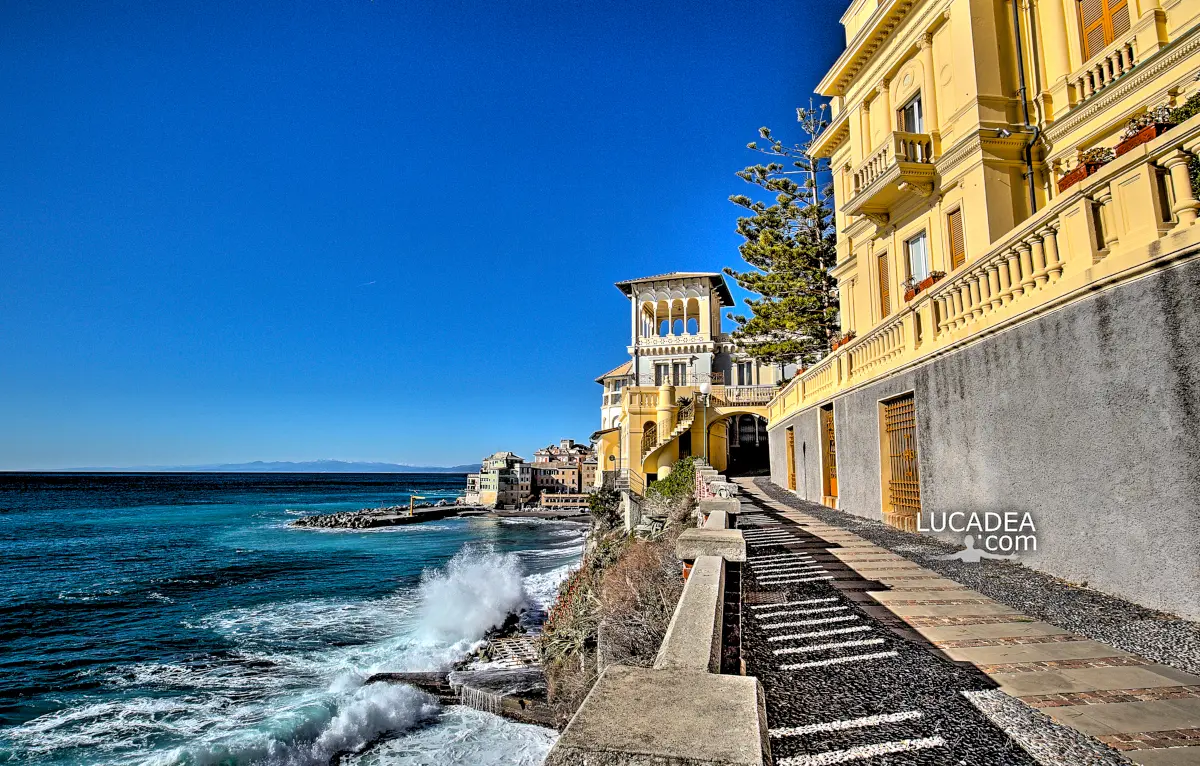
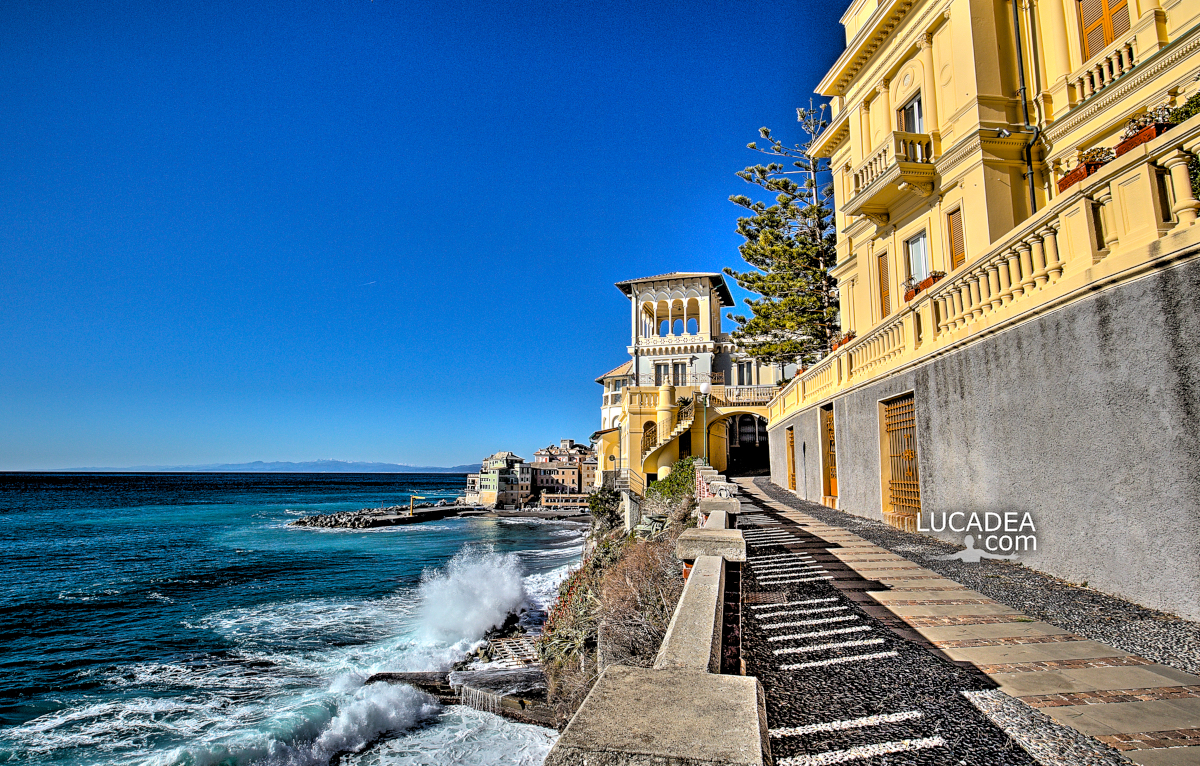
In this photograph, I captured a lovely yellow villa overlooking the sea. Its distinctive shape gives it an almost castle-like appearance, making it stand out against the surrounding landscape. The warm colour of the facade contrasts beautifully with the blue water, while the small harbour in the background completes the composition and adds to the charm of the scene.
I enjoy photographing places like this because even a simple view can tell a story about a location. The villa immediately attracts attention, but the sea and harbour are just as important in creating a sense of depth. The architecture and the coastal scenery complement each other naturally, without the need for elaborate effects or an artificial composition.
Bogliasco is located in the Metropolitan City of Genoa, in Liguria, north-western Italy. It is a small coastal village with the distinctive character of the seaside communities found along the Italian Riviera. The sea has played an important role in local life for generations, particularly through fishing and other maritime activities. The harbour remains an important feature of the village landscape and reflects its long-standing connection with the sea.
One interesting feature of Ligurian seaside villages is the way their buildings often follow the natural shape of the coastline. With limited space between the hills and the water, houses and narrow streets fit closely into the landscape. This creates distinctive viewpoints and photographic opportunities that change with the light and the weather.
I took this photograph because I was drawn to the contrast between the yellow villa, which almost resembles a small castle, and the blue sea. The harbour in the background adds context and completes the view, capturing a characteristic corner of Bogliasco.
For me, this is part of the appeal of exploring the Ligurian coast with a camera: discovering buildings, colours and views that might otherwise be overlooked. Even a brief stop can reveal an interesting detail that makes a photograph memorable.

What do you think of this yellow villa overlooking the sea in Bogliasco? Would you like to visit this charming Ligurian village and take photographs of its beautiful coastal scenery? Add a comment or go to the bottom of the site to read what other visitors have written.

Yellow castle-like villa overlooking the sea in Bogliasco, Liguria, with the village's small harbour visible in the background

Photo taken with Canon EOS M100 and Canon EF-M 11-22 lens.

To see all the photos I took in the village, click here:
foto gallery

And here are some videos I made:


Videos recorded with Gopro Hero 10 Black.

Here’s where I took the shot:

Camogli: A Distant View of the Ligurian Village

Il bel borgo di Camogli visto da lontano

Camogli: A Distant View of the Ligurian Village.
Some places are beautiful even before you get close enough to explore their streets, and Camogli is a wonderful example. Seen from a distance, this colourful fishing village on the Italian Riviera stands out along the coastline, with its closely packed buildings, blue sea and green hills creating a distinctive view.
The pastel façades are one of the first things that catch the eye. The houses seem to follow the shape of the shore, forming a colourful strip between the water and the hillside. From far away, it is easier to appreciate the whole composition rather than individual architectural details. The colours of the buildings contrast with the sea, while the vegetation behind the village adds another layer to the landscape.
Camogli lies in Liguria, in the Metropolitan City of Genoa, overlooking the Golfo Paradiso on Italy’s north-western coast. It is well known for its maritime character and traditional connection with the sea. Even from a distant viewpoint, the village has a strong identity: its buildings appear tightly gathered along the waterfront, giving the coastline a shape that is easy to recognise.
The Basilica of Santa Maria Assunta is another distinctive feature of the village. Located close to the harbour, the church forms part of the familiar Camogli skyline and adds a historic element to the seaside panorama. From a distance, it becomes part of the overall scene, blending with the surrounding buildings and the natural landscape.
The small harbour contributes to the charm as well. Boats, waterfront houses and the curve of the coast suggest the long relationship between the local community and the sea. When the light is good, the colours become especially vivid, and the entire village seems to stand out against the water. The view can change throughout the day, as shifting light gives the buildings and hills a different appearance.
I enjoy photographing places like Camogli from a distance because a wider view can reveal something that is harder to notice while walking through the streets. Instead of focusing on one doorway or one building, the photograph brings together the colours, the coastline and the character of the village in a single frame. It is a reminder that sometimes the best way to appreciate a place is to step back and take in the whole picture.

Camogli has plenty to discover up close, from its harbour to its narrow streets, but the distant view is memorable in its own right. Would you rather admire Camogli from a viewpoint across the coast, or explore it on foot among the colourful houses and boats by the harbour? Add an comment or go to the bottom of the site to read what other visitors have written.

Distant view of Camogli with colourful waterfront houses, the small harbour and the Basilica of Santa Maria Assunta on the Ligurian coast

Distant view of Camogli with colourful waterfront houses, the small harbour and the Basilica of Santa Maria Assunta on the Ligurian coast

Photos taken with Canon EOS RP and Tamron 16-300 lens.

To see all the photos I took of the village, click here:

Here’s where I took the photo from:

Gold Street Steps in Genoa among old alleys

La bella Salita dell'Oro nel cuore di Genova

Gold Street Steps in Genoa among old alleys.
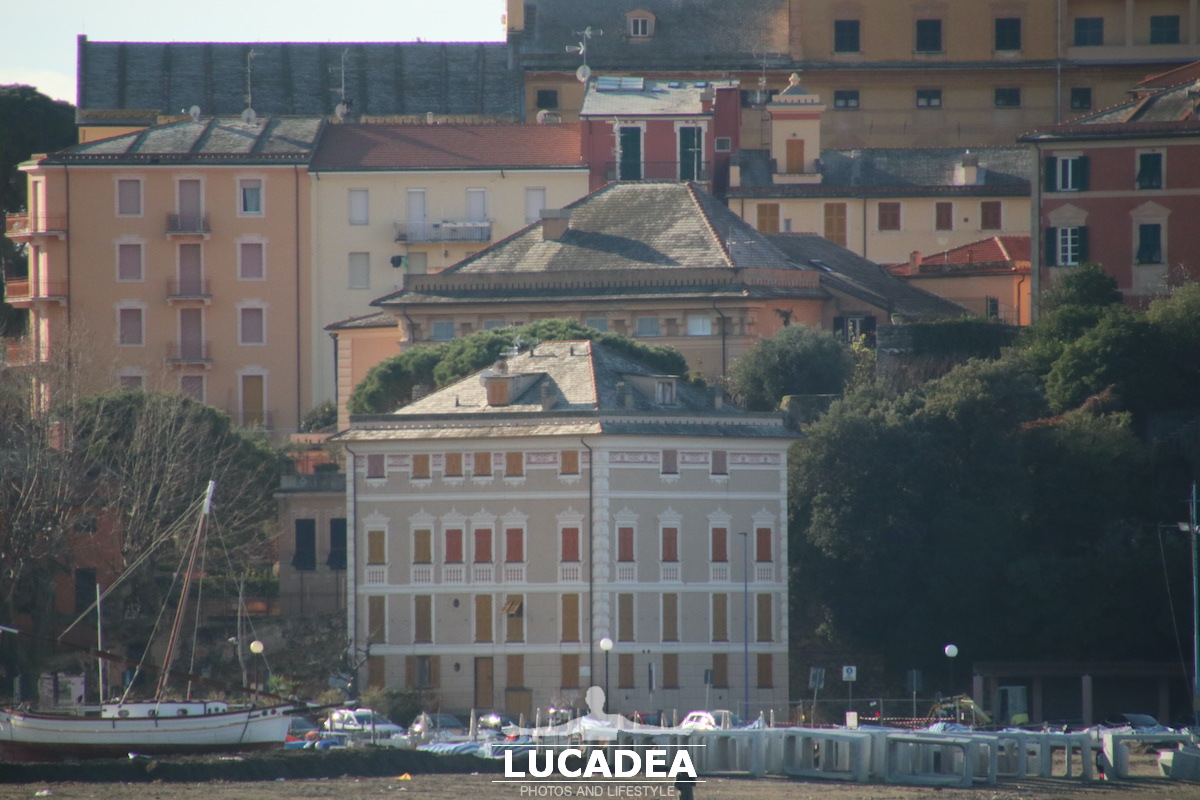
While walking through the historic centre of Genoa, I captured with my camera a view of Salita dell’Oro, one of those small uphill and downhill paths that reveal the true character of the city. This photograph of Gold Street Steps in Genoa comes from my habit of getting lost among the old alleys, observing details and only later, once back home, researching the names and stories of the places that caught my attention.
The historic alleys of Genoa, Liguria, Italy, form a complex network of narrow streets, steps and passages connecting different areas of the city. Salita dell’Oro is one of these routes, descending from the area of Cairoli Street towards del Campo Street and the harbour, creating a link between the more elegant part of the city and the older popular neighbourhoods.
I wanted to photograph this corner because of its everyday character. There is no famous monument in the centre of the image, but a lived-in street with stone surfaces, old façades and the particular atmosphere that can only be discovered by walking without a fixed destination. Often, the most interesting photographic subjects are found in places that appear ordinary at first glance.
If you are visiting Genoa, the historic centre is a place worth seeing not only for its famous buildings but also for its hidden alleys and unexpected views. Walking through these streets allows you to understand how the city developed vertically between the hills and the sea.
A curious detail about Genoa’s many salita streets is that their names often come from old families, historical references, professions or characteristics of the area. Even when the original meaning is no longer immediately clear, these names continue to preserve a small piece of the city’s memory.
This photograph connects with other stories on my blog dedicated to Genoa’s caruggi and historic streets. As I have already shown in photographs of places such as del Campo Street, I enjoy discovering those paths where the identity of the city is still visible in everyday life.
For me, Salita dell’Oro represents exactly this kind of discovery: a place found almost by chance, photographed because it attracted my attention and later explored through curiosity. It is the pleasure of walking, looking around and allowing the city itself to suggest the next photograph.

Have you ever entered an unknown street and discovered a part of a city you did not expect? Add a comment or go to the bottom of the site to read what other visitors have written.
Photos taken with Canon EOS RP and lens Canon RF 24-50.

Here’s where the street is:

In Genoa, near Via Cairoli, there are streets dedicated to precious metals; the evocative toponymy of the Superba has given us Vico del Piombo, Vico dell’Argento, and Salita dell’Oro.
Continue and learn more at dearmissfletcher.com

Some excellent fish ravioli tasted in Lavagna

Degli ottimi ravioli di pesce gustati a Lavagna

Some excellent fish ravioli enjoyed in Lavagna.
Some time ago, while in Lavagna for lunch with my wife, we decided to stop for lunch at one of the many trattorias and osterias in the center of the Tigullian town.
We chose Trattoria U Pescou, where I ordered this plate of excellent fish ravioli with fish sauce.

Do you like fish ravioli? Add a comment or go to the bottom of the site to read what other visitors have written.
If you prefer ravioli with ragù, I invite you to visit my page dedicated to the ranking of the best ones in Eastern Liguria.

Photos taken with Oppo Reno 12.

This is the trattoria’s official website: upescou.it, but perhaps the review on TripAdvisor is better.

Some excellent fish ravioli tasted in Lavagna – Excellents raviolis de poisson dégustés à Lavagna – Excelentes raviolis de pescado que se disfrutan en Lavagna – Excelente ravioli de peixe apreciado em Lavagna – Ausgezeichnete Fischravioli im Lavagna – Ravioli cá tuyệt vời được thưởng thức tại Lavagna

Martiri della Libertà Square in Santa Margherita Ligure

Piazza Martiri della Libertà a Santa Margherita Ligure

Martiri della Libertà Square in Santa Margherita Ligure.
Walking through the center of Santa Margherita Ligure, Liguria, Italy, I stopped to photograph one of the most recognizable corners of the town: Martiri della Libertà Square. Among the things worth seeing in Santa Margherita Ligure there are not only the seafront, the harbor, and the elegant historic buildings, but also these lively urban spaces where the atmosphere of the town can be felt throughout the day.
This photograph shows a different side of this Ligurian coastal town, less connected to the classic seaside postcard and more related to the everyday life that develops around its streets. Martiri della Libertà Square is particularly known for the many restaurants and lounge bars that surround it, making it one of the most popular meeting places during the evening.
I wanted to capture this corner because it represents an important part of Santa Margherita Ligure’s character. It is not simply a place to walk through while exploring the town, but a square where people stop, meet friends, enjoy dinner, and spend time outdoors. This social aspect is one of the elements that makes the town feel alive beyond its famous views and coastal landscapes.
When I photograph places like this, I always try to look for something beyond the classic images that everyone knows. A square can tell a story through its buildings, its businesses, the people who visit it, and the way its atmosphere changes during the day. With my camera, I wanted to preserve this mix of elegance and everyday life.
Martiri della Libertà Square takes its name from the memory of those who fought for freedom and is part of the historical identity of Santa Margherita Ligure. Today it is mainly appreciated as a meeting point, where the traditional charm of the Ligurian Riviera meets a more modern evening atmosphere.
I enjoy photographing these less famous details of the places I visit, just as I have done with other corners of the Tigullio area shared on the site. Small urban spaces often reveal a more authentic side of a destination than the most famous landmarks.
If you are visiting Santa Margherita Ligure, this square is one of the places where you can experience the local atmosphere and see how the town changes after sunset.

Have you ever spent an evening in Martiri della Libertà Square? Add a comment or go to the bottom of the site to read what other visitors have written.

Martiri della Libertà Square in Santa Margherita Ligure with restaurants and evening venues

Photo taken with Canon EOS RP camera and Canon EF-S 10-18 lens.

Here’s exactly where the square is located:

🏠
  • Italiano