
Monleone Fortress Overlooking Moneglia

La torre della Fortezza di Monleone svetta sopra il borgo marinaro di Moneglia, sulla Riviera ligure di Levante

Monleone Fortress Overlooking Moneglia.
In Moneglia, Liguria, Italy, on the Italian Riviera, Monleone Fortress stands above the seaside village, recognisable by its tall tower and commanding position. It is a distinctive feature of the local landscape and a reminder of the long history of this coastal town. Looking up towards the hillside, the fortress naturally draws the eye and becomes one of the most striking elements in the view.
I enjoy photographing historic buildings like this because they are part of the identity of a place. They are not simply structures to admire up close; they are landmarks that shape the appearance of a village and make its skyline recognisable. In Moneglia, the tower of Monleone rises above the houses, recalling a time when defending the settlement and keeping watch over the surrounding territory were essential.
The history of the fortress dates back to the twelfth century. Its construction was commissioned by the Genoese consul Ingone di Flessa and is traditionally dated to 1173, when Moneglia belonged to the territories of the Republic of Genoa. The original stronghold was built for defensive purposes, at a time when controlling settlements and routes along the coast was strategically important.
The site we see today reflects a long and complex history. Alongside the surviving remains of the medieval fortification stands a castle built in the early twentieth century. Despite these changes over the centuries, the place retains a distinctive character, thanks to its elevated position and the way its architecture blends into the Ligurian landscape.
What I find particularly interesting to photograph is the contrast between the seaside village below and the fortress above. The houses cluster along the coast, while the tower seems to keep watch over them from the hillside. Its outline creates a natural focal point and encourages us to look upwards, away from the familiar views of streets and sea.
Photographing historic places also gives me a chance to notice details that might otherwise go unnoticed. An old wall, a tower or a building silhouetted against the sky can tell us something about the character of a town without the need for a long explanation. Monleone Fortress, with its prominent position above Moneglia, is a wonderful example of how architecture and landscape can become inseparable.
For me, photographs like this are a way to preserve the atmosphere of a place as well as its appearance. Even when a building has changed over time, it can still connect the present-day village with the events and people that shaped its past.

Have you ever visited Moneglia and admired the village from the hillside around Monleone Fortress? Add a comment or go to the bottom of the site to read what other visitors have written.

Photos taken with a Canon EOS M100 and a Tamron 16-300 lens.

I took several photos around the village, and if you want to see them all, click here:

Add one  comment to this article or read  here what other visitors have written.
 
Adv
 
Disclamer

The rights on images, videos, choruses, text and all other material on the LUCADEA.com website are governed as per  Copyright page.

This page has been viewed 0 times today.
This month it has been viewed 0 times.
In total it has been viewed 0 times.
 

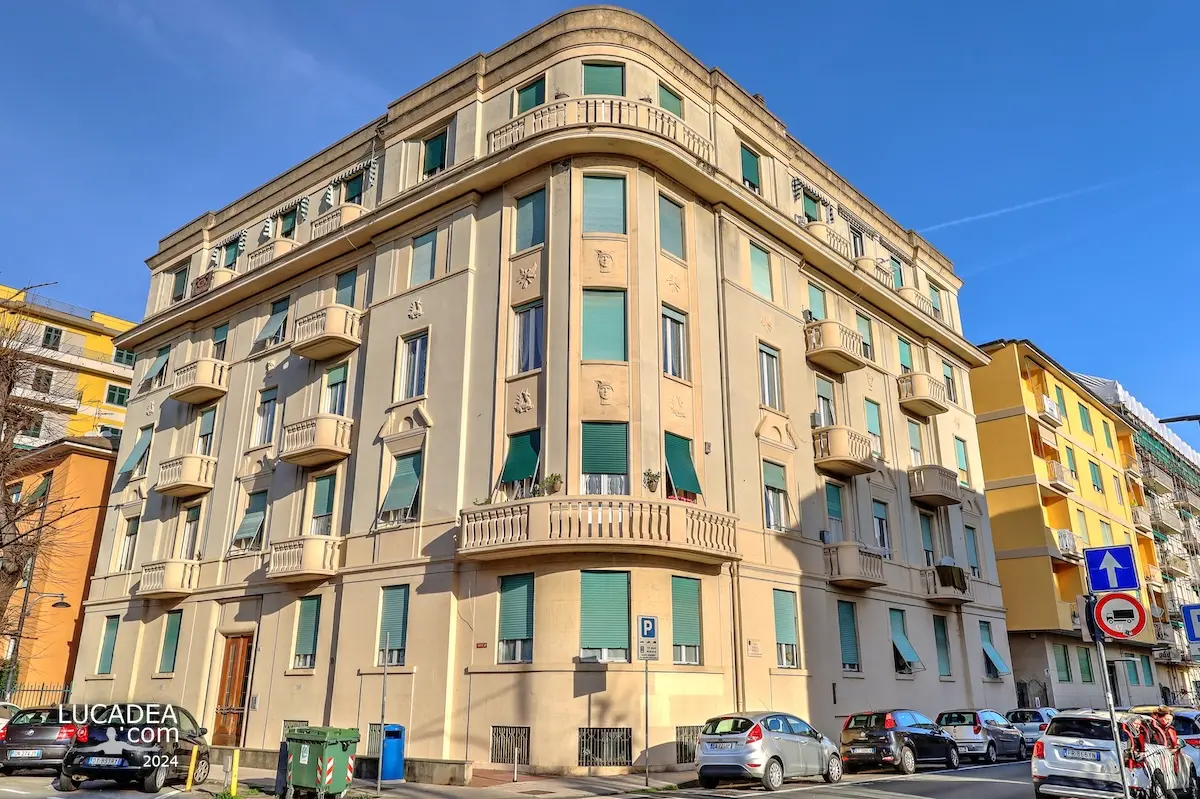
A beautiful building on Buenos Aires Avenue in Lavagna

Un bel palazzo in corso Buenos Aires a Lavagna

A beautiful building on Buenos Aires Avenue in Lavagna.
While walking along the lovely tree-lined avenue in Lavagna, I photographed several buildings and villas.
Like this one, which I especially liked for the decorative details on its façade.

Do you know this building in Lavagna? Add a comment or go to the bottom of the site to read what other visitors have written.

Un bel palazzo in corso Buenos Aires a Lavagna

Un bel palazzo in corso Buenos Aires a Lavagna

Photos taken with Canon EOS RP camera and Canon RF 24-50 lens.

Here’s where this beautiful building is located:

A beautiful building in Corso Buenos Aires in Lavagna – Un bel immeuble à Corso Buenos Aires à Lavagna – Un hermoso edificio en Corso Buenos Aires en Lavagna – Um belo edifício no Corso Buenos Aires em Lavagna – Ein wunderschönes Gebäude im Corso Buenos Aires in Lavagna – Một tòa nhà đẹp ở Corso Buenos Aires ở Lavagna
Add one  comment to this article or read  here what other visitors have written.
 
Adv
 
Disclamer

The rights on images, videos, choruses, text and all other material on the LUCADEA.com website are governed as per  Copyright page.


This page has been viewed 1 times today.
This month it has been viewed 3 times.
In total it has been viewed 3 times.
 

The Ducal Palace of Modena and time

Il Palazzo Ducale di Modena e il tempo

The Ducal Palace of Modena and time.
I’ve been there only once, over a year ago, yet the Ducal Palace of Modena remains there, firmly planted in my memory, as certain places do that don’t need to be visited often to leave their mark. I remember stopping before its façade with an almost involuntary sense of respect, as if the palace commanded a pause, a natural slowing of pace and thoughts. I wasn’t there for a special occasion, nor for a planned visit: it was one of those chance encounters that end up being the most enduring.
The Ducal Palace presents itself with a solidity that is never cold. The proportions are large, studied, but not ostentatious. The pale stone changes tone with the light, going from an almost austere severity in the morning to an unexpected softness in the late afternoon. Knowing that it was the residence of the Este family and that it now houses the Military Academy gives the sense of a rare continuity, of a building that has never truly ceased to play a central role.
That time, I didn’t go in. I stayed outside, watching, and perhaps that was precisely what made the experience more intense. Standing before the monumental portal, with the city still moving around me, I clearly perceived the distance between everyday time and historical time. Modena flowed quickly, amidst bicycles and voices, while the palace remained still, like a silent landmark, indifferent to the rush.
More than a year later, what comes to mind isn’t a specific detail, but a feeling: that of a place that observes, that protects, that doesn’t need to explain itself. The Ducal Palace doesn’t demand attention, it doesn’t invite. It just stands. And that, sometimes, is more than enough to make you stay.

Have you ever visited a place only once and still felt close to it even after a long time?
comment or go to the bottom of the site to read what other visitors have written.

Photos taken with Canon EOS RP and lens Canon RF 24-50.

To see all the photos of the city, click here:

Where is the palace located?

The Ducal Palace of Modena and time – Le Palais Ducal de Modène et le temps – El Palacio Ducal de Módena y el tiempo – O Palácio Ducal de Modena e o tempo – Der Herzogspalast von Modena und die Zeit – Cung điện Công tước Modena và thời gian – 摩德纳公爵宫与时间 – モデナ公爵宮と時間

The text of this post was written with the help of ChatGPT, a language model from OpenAI.

TVittorio Emanuele II Gallery, Milan’s Elegant Salon

La Galleria Vittorio Emanuele II: il salotto elegante di Milano

Vittorio Emanuele II Gallery, Milan’s Elegant Salon.
In the heart of Milan, Italy, between Cathedral Square and La Scala, stands one of the city’s most impressive architectural landmarks. The Vittorio Emanuele II Gallery is much more than a covered shopping arcade. It is a meeting place, a symbol of Milanese elegance and a wonderful example of how historic architecture can remain part of everyday urban life.
As soon as I enter the gallery, the magnificent glass roof and iron framework draw my eyes upwards. Natural light filters through the glazed ceiling, illuminating the decorative details and the colourful mosaics beneath my feet. At the centre, an imposing octagonal dome creates a spectacular focal point, while the long covered passages lead towards the surrounding streets and squares. The combination of light, height and symmetry makes this place particularly attractive for architectural photography.
Designed by architect Giuseppe Mengoni, the gallery was built between 1865 and 1877. Its architecture reflects the ambitions of nineteenth-century Milan, a city increasingly associated with commerce, culture and modern urban life. The use of iron and glass created a spacious covered environment that was both practical and visually striking for its time.
The gallery was conceived as a grand public meeting place, often described as Milan’s elegant drawing room. That role continues today. Fashion boutiques, restaurants, cafés and historic businesses line its passages, while visitors and local residents move between the city’s major landmarks. Some people come to shop or enjoy a meal; others simply walk through the arcade, admire its decorations and take photographs.
One of its best-known details is the mosaic of a bull on the floor near the central dome. According to a popular local tradition, spinning on one’s heel over the bull is supposed to bring good luck. Visitors regularly repeat the gesture, and the spot has become noticeably worn over time. It is a small curiosity that adds a playful element to the gallery’s grand surroundings.
For me, places like this are especially rewarding to explore with a camera. Looking upwards reveals patterns and perspectives that might otherwise be missed, while changes in daylight give the architecture a different appearance throughout the day. Even a familiar landmark can offer something new when viewed from another angle.
The Vittorio Emanuele II Gallery is also an ideal stop for anyone exploring central Milan on foot. Its location makes it easy to combine a visit with the cathedral, Cathedral Square and the famous La Scala opera house. Whether you are interested in architecture, shopping or simply enjoying the atmosphere, there is always something to catch your attention.
If you enjoy historic buildings and beautiful urban spaces, you may also appreciate my photographs of Italian squares, palaces and picturesque city streets.

Would you enjoy spending time in the Vittorio Emanuele II Gallery, admiring its architecture and discovering its little details? Add an comment or go to the bottom of the site to read what other visitors have written.

The Vittorio Emanuele II Gallery in Milan, featuring its elegant nineteenth-century architecture, glass dome and decorative interior

The Vittorio Emanuele II Gallery in Milan, featuring its elegant nineteenth-century architecture, glass dome and decorative interior

Foto scattate con macchina Canon EOS RP e lente Canon RF 24-50.

Click here to see all the photos I took:
foto gallery

Where to find the gallery:

The Straight Caffaro Street in the Castelletto Neighborhood

La dritta via Caffaro nel quartiere di Castelletto a Genova

The Straight Caffaro Street in the Castelletto Neighborhood.
Some streets reveal a city’s history through their architecture and layout, and Caffaro Street is a good example. Located in the Castelletto neighborhood of Genoa, Liguria, Italy, this long, remarkably straight road offers a distinctive urban perspective, framed by elegant residential buildings and historic façades.
Walking along Caffaro Street, I notice how different it feels from the narrow lanes of Genoa’s medieval old town. Here, the street follows a more regular route, reflecting a period when the city began to expand uphill and create more direct connections between the historic center and the surrounding neighborhoods. Caffaro Street belongs to Genoa’s nineteenth-century urban development, when new roads helped reshape the area around Castelletto.
The buildings lining Caffaro Street give it much of its character. Grand entrance doors, balconies, decorative details and carefully designed façades reveal the tastes of different periods. Many of the residential buildings in this part of Genoa date from the nineteenth and early twentieth centuries, when the neighborhood was taking on a more defined urban identity. Looking closely, it is possible to appreciate details that might otherwise go unnoticed while passing through on the way somewhere else.
What attracts me most is the perspective. The straight alignment of Caffaro Street creates a strong visual line, while the buildings on either side guide the eye toward the distance. Genoa is famous for its steep streets, winding paths and dramatic changes in elevation, so a road with such a clear, direct layout feels particularly distinctive. Depending on the light, the façades take on different tones, and architectural features stand out in ways that make the street rewarding to photograph.
The photograph accompanying this article captures one of those everyday urban scenes that I enjoy discovering in my own city. Genoa is often associated with its harbor, narrow medieval lanes and grand historic palaces, but Castelletto offers another side of local life. Caffaro Street and the surrounding residential roads tell a story of urban growth and changing architectural tastes, while remaining closely connected to the city center below.
Caffaro Street is also a useful starting point for exploring the surrounding area. From the Portello, visitors can continue toward nearby streets and discover more of Castelletto, including routes leading to panoramic viewpoints over Genoa’s rooftops and harbor. If you enjoy urban photography and historic architecture, comparing Caffaro Street with other places featured in my articles about Genoa can reveal how varied the city’s streetscapes really are.
For me, Caffaro Street is more than a practical route through the neighborhood. Its straight perspective and historic character preserve a visible trace of Genoa’s transformation as the city grew beyond its older boundaries. It is a reminder that even a familiar street can tell an interesting story when we take the time to look.

Have you ever walked along Caffaro Street and noticed the striking perspective created by its straight alignment and historic buildings? Add an comment or go to the bottom of the site to read what other visitors have written.

Caffaro street in Genoa's Castelletto neighborhood, showing the straight street perspective and elegant historic residential buildings

Photo taken with Canon EOS RP and Tamron 16-300.

Where is the street:

Genoa’s Albergo dei Poveri

L'albergo dei Poveri di Genova

Genoa’s Albergo dei Poveri.
Some buildings are memorable not only for their architecture or history, but also for the personal experiences connected to them. The Albergo dei Poveri in Genoa is one of those places for me. When I was studying law at university, some of my classes occasionally took place inside this enormous complex, located behind the university buildings. At the time, the site seemed to be in several different stages of restoration, with some areas still neglected, others under renovation and parts already refurbished.
Returning to the area with my camera brought back memories of those university days, although this time I was exploring the surroundings rather than going to a lecture. The building’s sheer size makes it difficult to overlook. Its imposing architecture reflects the ambition behind the original project, while the different conditions of its sections have long given it the appearance of a place moving gradually between past and present.
The Albergo dei Poveri is one of Genoa’s most significant historic complexes. Its origins date back to the seventeenth century, when it was conceived as a major charitable institution intended to provide assistance and accommodation for people experiencing poverty and hardship. It was much more than an ordinary residential building: its scale reflected the intention to address social needs through a large, organised institution. Over the centuries, the complex has experienced changes in use and periods of transformation, remaining an important part of Genoa’s architectural and social heritage.
When I took these photographs, I was walking behind the complex. From this side, the open, level areas below Corso Firenze are clearly visible. There are several cultivated plots that look like small vegetable gardens or perhaps nurseries, although I cannot say exactly what they are. I found the contrast interesting: the monumental building rises above a landscape of smaller plots and everyday activities, creating a view that feels quite different from the familiar streets of central Genoa.
This part of the city reveals another side of Genoa, a place shaped by steep slopes, terraces, green spaces and buildings arranged at different levels. I enjoy photographing these less familiar perspectives because they show how varied the urban landscape can be. Away from the busy historic centre and the waterfront, there are many quieter corners where the city’s architecture and daily life come together.

For me, the Albergo dei Poveri also carries a personal connection with my years as a law student. Seeing it again through the camera lens allowed me to combine those memories with a fresh appreciation of its scale and setting. Do you have a building that brings back memories of your school or university years whenever you see it again? Add an comment or go to the bottom of the site to read what other visitors have written.

Genoa's Albergo dei Poveri viewed from behind, with open ground and cultivated plots below Corso Firenze in the city

Genoa's Albergo dei Poveri viewed from behind, with open ground and cultivated plots below Corso Firenze in the city

Photos taken with Canon EOS M100 camera and Tamron 16-300 lens.

🏠
  • Italiano