The Clock Tower in Piazza dei Signori, Padua

La Torre dell'Orologio del Palazzo del Capitanio a Padova

The Clock Tower of the Palazzo del Capitanio in Padua.
While walking through the historic centre of Padua, it is hard not to stop and admire the Clock Tower overlooking one side of Piazza dei Signori. Together with the palace beneath it, the tower is one of the most distinctive features of this elegant square, a place that has witnessed centuries of civic life, public gatherings and everyday encounters.
It is the kind of monument that catches your eye even when you are simply crossing the square on your way somewhere else. The palace façade, the tower rising above the surrounding buildings and the large clock face create an architectural ensemble that tells part of the story of the city. This is much more than a device for telling the time: it is a landmark that connects modern Padua with its historical identity.
The tower is part of the Palazzo del Capitanio complex, associated with the city’s political and administrative life during the period of Venetian rule. Padua became part of the territories of the Republic of Venice in 1405, and Venetian influence left a lasting mark on the city’s institutions, public spaces and architecture. Piazza dei Signori became one of the important settings for civic life and the display of political authority.
The most fascinating feature is, of course, the astronomical clock. Its purpose goes beyond simply showing the hours. Monumental clocks of the medieval and Renaissance periods reflected the close relationship between timekeeping, astronomical knowledge, craftsmanship and civic prestige. They were practical instruments, but also impressive public works that demonstrated the skills and ambitions of the communities that built them.
The clock face is also associated with a curious local legend: the zodiac sign of Libra is missing. According to a popular story, which is generally treated as legend rather than established historical fact, the clockmaker deliberately left out Libra because he had been paid less than the amount originally agreed upon. Since Libra is traditionally associated with balance and justice, its absence supposedly became a symbolic protest against the unfair treatment he had received. It is an intriguing tale that gives the clock an extra layer of mystery, even if there is no firm reason to regard it as a proven explanation.
I enjoy photographing monuments like this because their appeal lies not only in their appearance, but also in the stories and small details that can be overlooked during a hurried visit. I took the photograph accompanying this article to capture the tower and its relationship with the square, where Padua’s past continues to meet the rhythm of everyday life.

If you visit Piazza dei Signori, take a moment to look closely at the clock face and see if you can spot the missing zodiac sign. Had you heard the legend of Libra before, or is this the first time you have come across it? Add a comment or go to the bottom of the site to read what other visitors have written.

The Clock Tower of the Palazzo del Capitanio overlooking Piazza dei Signori in the historic centre of Padua, Italy

Photo taken with a Canon EOS M100 camera and Canon EF-M 11-22 lens.

To see all the photos I took in the city of the Saint, click here:

Add one  comment to this article or read  here what other visitors have written.
 
Adv
 
Disclamer

The rights on images, videos, choruses, text and all other material on the LUCADEA.com website are governed as per  Copyright page.


This page has been viewed 0 times today.
This month it has been viewed 0 times.
In total it has been viewed 0 times.
 

The vaulted entrance of Padua’s Bo Palace

Volta dell’ingresso di Palazzo Bo a Padova, decorata con numerosi stemmi legati alla storia dell’Università

The vaulted entrance of Padua’s Bo Palace.
As soon as I entered this historic building in Padua, I found myself looking upward at the ceiling covered with a remarkable number of coats of arms. It is the kind of detail that can easily be missed when walking through an entrance, yet it deserves a moment of attention.
During my visit to Padua, I could not miss the opportunity to photograph Bo Palace, the historic home of the University of Padua. I chose to focus on the entrance vault rather than the entire building because the collection of coats of arms creates a particularly interesting subject and gives a very different impression of the university’s long history.
If you are wondering what to see in Padua, Bo Palace is certainly worth including when you are interested in the city’s academic and cultural heritage. It is not simply an old university building. Its rooms and decorations are closely connected with centuries of students, professors and scientific research.
What caught my attention here was the ceiling itself. The coats of arms are spread across the vault in such numbers that the decoration almost becomes an architectural surface of its own. Looking more carefully, however, they stop being just decorative details and begin to suggest the many people who passed through this institution over the centuries.
The tradition was connected with students of noble origins, who could leave their family coat of arms as a sign of distinction. Over time, these emblems became part of the visual character of Bo Palace. It is a small historical detail, but it changes the way I look at this photograph: the vault is not simply decorated with symbols, but preserves traces of the people who once studied here.
Bo Palace is also famous for its connection with the history of medicine. The building contains the Anatomical Theatre, created in the late sixteenth century and generally regarded as the oldest permanent anatomical theatre still in existence. This gives the university complex an importance that extends well beyond its architectural appearance.
The University of Padua was founded in 1222 and remains one of the oldest universities in the world still in operation. Standing inside Bo Palace, details such as these coats of arms make that history feel much more tangible. Instead of simply reading about centuries of academic tradition, you can see some of its traces directly above your head.
I wanted this photograph to concentrate on that particular feeling. A famous building does not always need to be photographed from the outside to be recognizable. Sometimes a ceiling, a doorway or a small architectural detail can say more about a place than a conventional view of its facade.
Padua is in the Veneto region of Italy, and its historic center is deeply connected with university life. Bo Palace remains one of the clearest expressions of that connection, with its historic rooms and architectural details forming part of the identity of the city.
This is also one of the things I enjoy when photographing historic places. I try not to stop at the most obvious view. Once I am inside, I start looking at the details around me: what is above a doorway, what is carved into a wall, or what might otherwise disappear into the background.
The entrance vault at Bo Palace is a perfect example. From a distance it could simply appear to be a richly decorated ceiling, but knowing why so many coats of arms are there gives the photograph another layer.
For me, that is what makes these small architectural details worth photographing. They connect the image with the people and stories that came before us, while still remaining part of the building visitors can see today.

Have you ever visited Bo Palace and taken the time to look closely at all the coats of arms on its entrance vault? Add a comment or go to the bottom of the site to read what other visitors have written.

Vaulted entrance of Bo Palace in Padua, covered with numerous coats of arms linked to the university’s history

Photo taken with a Canon EOS M100 camera and Canon EF-M 11-22 lens.

To see all the photos I took in the “City of the Saint,” click here:

Add one  comment to this article or read  here what other visitors have written.
 
Adv
 
Disclamer

The rights on images, videos, choruses, text and all other material on the LUCADEA.com website are governed as per  Copyright page.


This page has been viewed 0 times today.
This month it has been viewed 0 times.
In total it has been viewed 0 times.
 

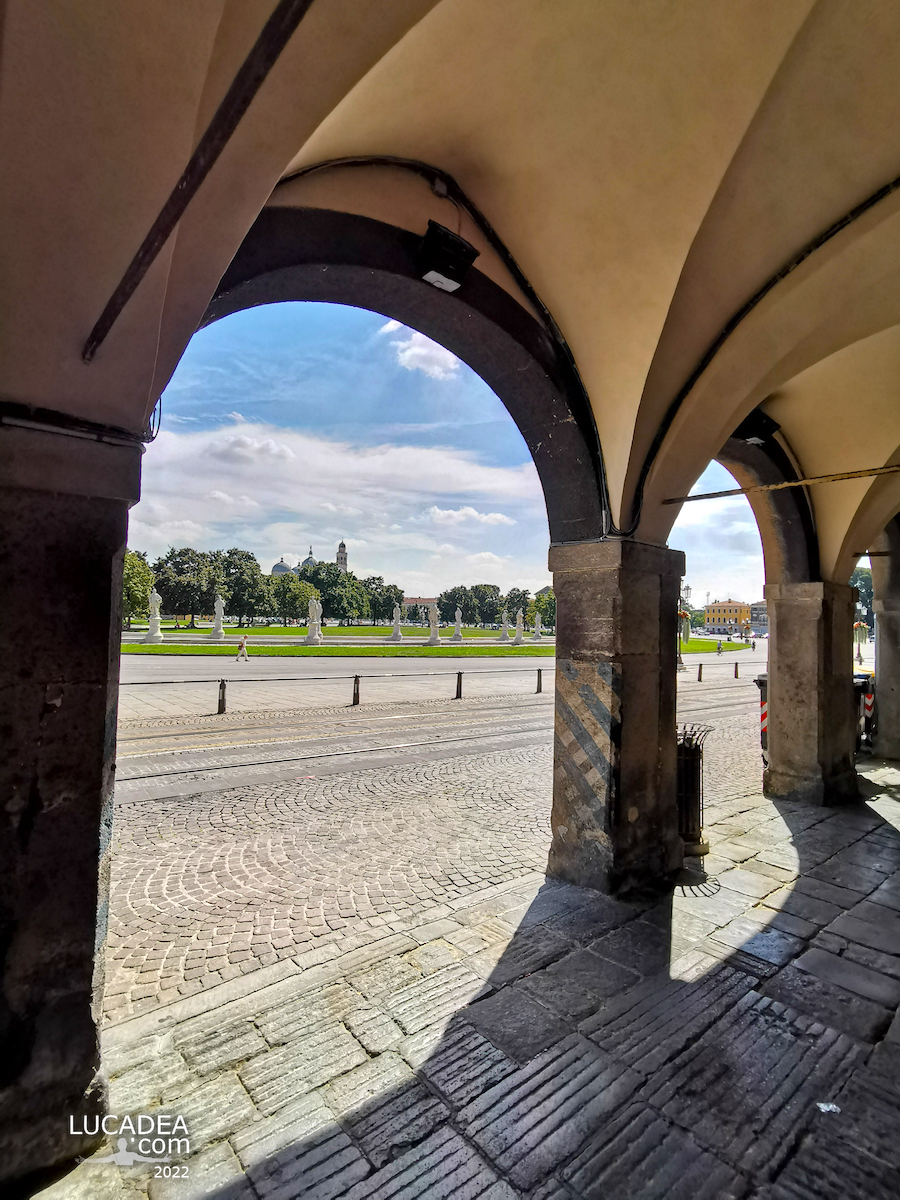
Prato della Valle from under the arcades

Scorcio di Prato della Valle a Padova visto dai portici della Loggia Amulea tra colonne e architettura storica

Prato della Valle from under the arcades.
Walking beneath the arcades around Loggia Amulea, I stopped to capture a different view of one of the most famous places in Padua. Among the things to see in Padua, Prato della Valle is certainly one of the landmarks that immediately represents the city, but this photograph tells it from a quieter and more intimate perspective.
Instead of focusing on the entire square from the usual viewpoints, I chose to photograph the details that surround it: the columns, the arches, and the way the architecture frames the open space beyond. The arcades create a natural border around the image, leading the eye toward the centre of the square and giving a different feeling compared to the classic panoramic views.
I was in Padua, Veneto, Italy, during a walk through the historic centre, and I wanted to capture this particular atmosphere. Prato della Valle is not only a large urban space but also a place where people meet, walk, relax, and experience the city at a slower pace.
The square is one of the largest in Europe and its current appearance dates back to the eighteenth-century renovation designed by Andrea Memmo. A curious detail is that the central area, known as Isola Memmia, is surrounded by a canal decorated with numerous statues representing important figures connected with Padua and Italian history.
What I like about this photograph is the contrast between the protected space under the arcades and the openness of the square outside. The darker lines of the architecture create depth, while the perspective invites the viewer to continue looking beyond the first elements of the image.
On the blog I have shared other photographs from Italian cities, often searching for unusual viewpoints rather than only the most famous attractions. As happened in other stories dedicated to historic places, this image comes from the simple pleasure of walking without a precise destination and discovering small details that reveal the character of a city.
If you are visiting Padua, Prato della Valle is a place worth seeing not only from the centre of the square but also from its surrounding arcades, where architecture and perspective create a completely different experience.

Have you ever looked at Prato della Valle from under the arcades? Add a comment or go to the bottom of the site to read what other visitors have written.

Scorcio di Prato della Valle a Padova visto dai portici della Loggia Amulea tra colonne e architettura storica

Photo taken with Honor 20.

To see all the photos I took in the city of Milan, click here:

Prato della Valle is the largest square in the city of Padua, covering an area of ​​88,620 m². Its current layout dates back to the late 18th century and features a central elliptical island known as Isola Memmia (approximately 20,000 m²). This island is encircled by a small canal—fed by the Alicorno Canal—whose banks are lined with a double ring of statues, forming an outer circumference of 1,450 meters.
Read more and find out more at milanofree

A glimpse of Prato della Valle from under the arcades in Padua – Un aperçu du Prato della Valle depuis les arcades à Padoue – Una vista del Prato de la Valle desde los soportales en Padua – Uma vista do Prato della Valle sob os pórticos em Pádua – Ein Blick auf den Prato della Valle unter den Arkaden in Padua – Góc nhìn Prato della Valle từ dưới các mái vòm ở Padua – 从帕多瓦拱廊下看到的普拉托德拉瓦莱 – パドヴァの回廊の下から見たプラート・デッラ・ヴァッレ

The text of this post was written with the help of ChatGPT, a language model from OpenAI.

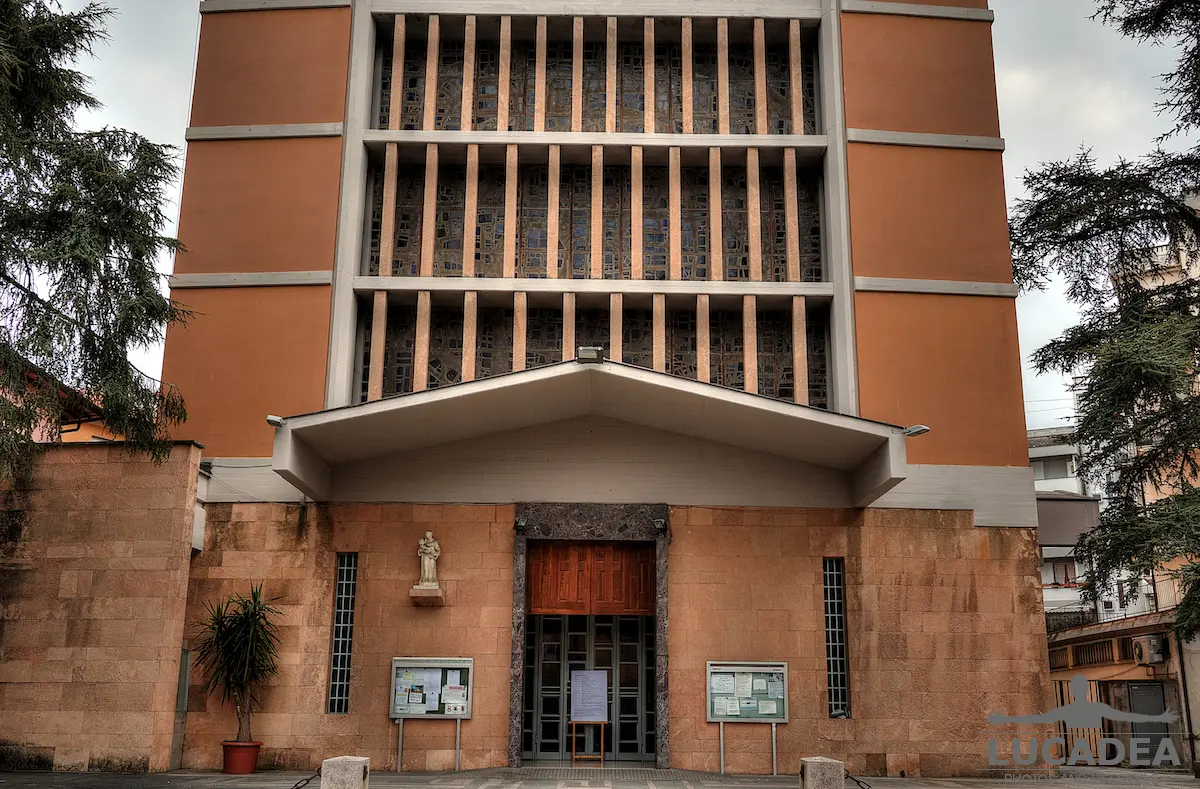
Saint Anthony Church in Sestri Levante

Chiesa di Sant’Antonio a Sestri Levante in Liguria, edificio moderno nel centro della cittadina rivierasca

Saint Anthony Church in Sestri Levante.
In the center of Sestri Levante, among the streets of the town and the everyday rhythm of local life, stands the church dedicated to Saint Anthony of Padua. The Saint Anthony Church in Sestri Levante is a modern building, different from the historic architecture usually associated with the town, but this is exactly what makes it an interesting subject to observe.
I stopped to photograph it while trying to capture the relationship between the building and the surrounding urban space. A place does not always need centuries of history to tell a story; sometimes more recent buildings reveal how a community grows and how a town changes over time.
The Saint Anthony Church is located in Sestri Levante, Liguria, Italy, and it is connected to one of the most important parish communities in the town. Its role is mainly related to everyday life rather than tourism, and this ordinary connection with local people is what made me curious from a photographic point of view.
Looking at the structure, I noticed the contrast with the most famous image of Sestri Levante, usually associated with colorful houses, bays, and historic buildings overlooking the sea. This is another side of the town, the one experienced daily by residents, where meeting places and shared spaces become part of normal life.
It reminded me of another photograph I shared on the site about less obvious corners of Sestri Levante, because here too the story comes from a different perspective. Sometimes the most interesting images are not found in the most famous views, but in places that are simply part of everyday surroundings.
A small curiosity is that Saint Anthony of Padua is one of the most widely venerated saints in the Catholic tradition, known especially as a protector of the poor and for the worldwide spread of his devotion.
Photographing this church allowed me to tell a quieter story about Sestri Levante, away from the classic images but still deeply connected to the identity of the town.

Have you ever photographed an ordinary place in your town and discovered that it had a story worth telling? Add a comment or go to the bottom of the site to read what other visitors have written.

Chiesa di Sant’Antonio a Sestri Levante in Liguria, edificio moderno nel centro della cittadina rivierasca

Photo taken with Canon EOS M100 camera and Canon EF-M 22 lens.

Anthony of Padua, known in Portugal as Anthony of Lisbon (in Portuguese António de Lisboa), born Fernando Martins de Bulhões (Lisbon, August 15, 1195 – Padua, June 13, 1231), was a Portuguese priest and member of the Franciscan Order, proclaimed a saint by Pope Gregory IX in 1232 and declared a Doctor of the Church in 1946.
Continue and learn more at Wikipedia

Saint Anthony Church in Sestri Levante – Église Saint-Antoine à Sestri Levante – Iglesia de San Antonio en Sestri Levante – Igreja de Santo António em Sestri Levante – Antonius-Kirche in Sestri Levante – Nhà thờ Sant’Antonio ở Sestri Levante – 塞斯特里莱万特的圣安东尼教堂 – セストリ・レヴァンテの聖アントニオ教会

The text of this post was written with the help of ChatGPT, a language model from OpenAI.

The Chapel of Saint Anthony inside the basilica in Padua

La cappella di Sant'Antonio nella basilica a Padova

The Chapel of Saint Anthony inside the basilica in Padua.
Stepping inside, you quickly understand what to see in Padua Basilica of Saint Anthony when your attention is drawn to a more intimate space, slightly apart from the rest, where the chapel dedicated to the saint feels quietly significant. Among the places to see in Padua, this part of the basilica offers something beyond architecture, something more personal and reflective.
I pause for a moment before moving closer, letting the details reveal themselves gradually. The decorations, the soft light, and the slow movements of visitors create a different rhythm compared to the rest of the church. If you are visiting and wondering what to see in Padua Basilica of Saint Anthony, you might first think about the scale of the building, but this chapel tells a quieter story.
Padua, Veneto, Italy becomes tangible as I look around. The chapel houses the relics of Saint Anthony and is one of the most visited areas inside the basilica. It reminds me of another photo I shared on my site, taken outside among the domes and architectural lines; here, instead, everything is focused into a smaller, more concentrated space.
An interesting detail is that the chapel has been enriched over centuries with artworks and decorations, making it both a place of devotion and an example of sacred art. Knowing this adds depth to what you see, making every detail feel more meaningful.
I stay there a little longer, observing how people approach quietly, each in their own way. There is no rush, no noise, just a sequence of small, repeated gestures. It’s one of those places that is not just photographed, but experienced.
If you are thinking about what to see in Padua Basilica of Saint Anthony, this is one of the most interesting places in Padua to truly pause and take in the atmosphere.

Have you ever found a place that completely changed the pace of your visit? Add a comment or go to the bottom of the site to read what other visitors have written.

Photos taken with Honor 20.

This is the basilica’s official website: santantonio.org.

To see all the photos I took in the city of the Saint, click here:

The magnificent Palazzo della Ragione in Padua

Il meraviglioso Palazzo della Ragione a Padova

The magnificent Palazzo della Ragione in Padua.
One of the symbols of the city of Padua is the magnificent Palazzo della Ragione.
Once the ancient seat of the city’s court, it now hosts a covered market and a museum.

Have you ever visited beautiful Padua? Add a comment or go to the bottom of the site to read what other visitors have written.

Il meraviglioso Palazzo della Ragione a Padova

Photo taken with Honor 20.

To see all the photos I took in the city of the Saint, click here:

The Palazzo della Ragione (also known as the Salone, by synecdoche) was the ancient seat of the city courts and the covered market of Padua. The lower part already existed in 1166, but it is estimated that it was erected between 1218 and 1219, and between 1306 and 1309, Giovanni degli Eremitani added the portico and loggias and raised the roof, which he gave the characteristic shape of an upturned ship’s hull.
Continue and learn more at Wikipedia

The famous palace called della Ragione in Padua – Le célèbre Palazzo della Ragione à Padoue – El famoso Palacio della Ragione en Padua – O famoso Palazzo della Ragione em Pádua – Der berühmte Palazzo della Ragione in Padua – Palazzo della Ragione nổi tiếng ở Padua – 帕多瓦著名的 Palazzo della Ragione – パドヴァの有名なパラッツォ デッラ ラジョーネ

A beautiful terrace among the alleys of Padua

Un bel terrazzo tra i vicoli di Padova

A beautiful terrace among the alleys of Padua.
Padua is a charming city located in the Veneto region of northern Italy. Wandering through the alleys of its large historic center, you can stumble upon beautiful buildings like the one photographed and featured in this article.
Padua is one of the oldest cities in Italy, with a history dating back to the 13th century BC. Founded, according to legend, by the Trojan prince Antenor, the city played an important role during the Roman and medieval eras. In the 14th century, under the rule of the Carraresi family, Padua became a major cultural center, contributing to the Italian Renaissance.
Founded in 1222, the University of Padua is one of the oldest and most prestigious in the world. Its illustrious professors and students include Galileo Galilei and Nicolaus Copernicus. The university remains a center of academic and research excellence today.
Monuments and Attractions:
– The Scrovegni Chapel: famous for its frescoes by Giotto, it is a masterpiece of medieval art.
– Prato della Valle: one of the largest squares in Europe, surrounded by statues and canals.
– The Basilica of Saint Anthony: known simply as “The Saint,” it is an important place of pilgrimage.
– The Botanical Garden: the oldest university botanical garden in the world, founded in 1545 and declared a UNESCO World Heritage Site.
Padua is known as “the city of the three withouts”:
– The Café without Doors: Caffè Pedrocchi, once open 24 hours a day.
– The Meadow without Grass: Prato della Valle, which was once a marshy area.
– The Saint without a Name: the Basilica of Saint Anthony, simply called “The Saint” by the Paduans.
Today, Padua is a vibrant and dynamic city, with a population of over 200,000. It is an important economic and cultural center, with numerous events, festivals, and a rich culinary scene.

Have you ever visited beautiful Padua? Add a comment or go to the bottom of the site to read what other visitors have written.

Un bel terrazzo tra i vicoli di Padova

Photo taken with Honor 20.

To see all the photos I took in the city of the Saint, click here:
immagine generica per link alla pagina con foto

The city was one of the cultural capitals of the fourteenth century, thanks to the presence of the Carraresi or Da Carrara family, who made Padua one of the main centers of pre-humanism. Between the fourteenth and fifteenth centuries, a powerful cultural movement devoted to antiquity developed in conjunction with Florence, which would later become the Paduan Renaissance and influence the artistic landscape of all of northern Italy in the fifteenth century. Padua is home to two UNESCO World Heritage Sites: the botanical garden, the oldest in the world, and the fourteenth-century fresco cycles preserved in eight building complexes, including the Scrovegni Chapel.
Continue and learn more at Wikipedia

A beautiful terrace among the alleys of Padua – Une belle terrasse dans les ruelles de Padoue – Una hermosa terraza en las callejuelas de Padua. – Um belo terraço nas ruelas de Pádua – Eine wunderschöne Terrasse in den Gassen von Padua – Một sân thượng tuyệt đẹp trong các con hẻm ở Padua

This post was written with the help of Copilot, an AI-powered virtual assistant.

A view of a canal in Padua

Lo sguardo su un canale di Padova

A view of a canal in Padua.
Padua, a city rich in history and culture, is crisscrossed by a network of canals that add a unique charm to its urban landscape. These waterways not only represent an essential part of the city’s history and development, but also offer evocative views that enchant residents and visitors.
Padua’s canals have ancient origins and have been used for various purposes over the centuries. In Roman times, the canals were primarily used for irrigation and the transportation of goods. During the Middle Ages and the Renaissance, the canal network was expanded and improved to support the city’s growing trade. The canals became essential transport routes for goods such as grain, timber, and salt.
One of Padua’s most important canals is the Piovego, which connects the city to the Brenta River, facilitating river transport to the Venetian Lagoon. This connection was crucial to the city’s trade and economic development.
Walking along Padua’s canals is a unique experience that offers the opportunity to discover hidden corners and picturesque views. The canals are lined with historic buildings, ancient bridges, and lush vegetation, creating a romantic and relaxing atmosphere. The calm waters reflect the colors and shapes of the surrounding buildings, adding another layer of beauty to the urban landscape.
One of the most evocative spots is the Canale delle Navi, which runs through the historic center of the city. This canal, with its calm waters and stone bridges, offers a fascinating glimpse of medieval Padua. Along the canal, you can admire historic buildings, churches, and other buildings of great artistic and architectural value.
Padua’s canals are not only landscape elements; they are also an integral part of the city’s daily life. Their banks are home to commercial activities, cultural events, and leisure activities. Open-air markets, fairs, and events are frequently held along the canals, offering visitors the opportunity to discover local products and artisanal crafts.
Numerous cafés and restaurants with terraces overlooking the canals invite you to relax and enjoy the view. Sipping a coffee or enjoying a traditional meal while watching the boats pass by is an unforgettable experience. During summer evenings, the canals come alive with lights and music, creating a festive and lively atmosphere.
The preservation of Padua’s canals is essential to preserving the city’s history and heritage. In recent years, numerous restoration and enhancement projects have been undertaken to keep the canals clean and in good condition. These efforts not only help protect the environment, but also promote tourism and improve the quality of life for residents.
The city administration, in collaboration with local associations and citizens, works constantly to ensure that Padua’s canals remain a living and breathing element of the city. Bank redevelopment projects, infrastructure improvements, and the promotion of cultural activities along the canals are just some of the initiatives implemented to enhance this precious heritage.

Have you ever visited beautiful Padua?
Add a comment or go to the bottom of the site to read what other visitors have written.

Lo sguardo su un canale di Padova

Photo taken with Honor 20.

To see all the photos I took in the city of the Saint, click here:

The city was one of the cultural capitals of the fourteenth century, thanks to the presence of the Carraresi or Da Carrara family, who made Padua one of the main centers of pre-humanism. Between the fourteenth and fifteenth centuries, a powerful cultural movement devoted to antiquity developed in conjunction with Florence, which would later become the Paduan Renaissance and influence the artistic landscape of all of northern Italy in the fifteenth century. Padua has two UNESCO World Heritage Sites: the botanical garden, the oldest in the world, and the fourteenth-century fresco cycles, preserved in eight building complexes, including the Scrovegni Chapel.
Continue and learn more at Wikipedia

The view on a canal in Padua – Le regard sur un canal à Padoue – La mirada sobre un canal en Padua – O olhar sobre um canal em Pádua – Der Blick auf einen Kanal in Padua – Quang cảnh một con kênh ở Padua

The text of this post was written with the help of ChatGPT, a language model from OpenAI.

The Chapel of Blessed Luca Belludi in Padua

La Cappella del beato Luca Belludi a Padova

The Chapel of Blessed Luca Belludi in Padua.
The Chapel of Blessed Luca Belludi, located in the Basilica of Saint Anthony in Padua, is an artistic and spiritual gem of great importance. This sacred place, dedicated to one of Saint Anthony’s closest collaborators, is not only a point of reference for devotees but also an extraordinary example of medieval art and architecture.
Luca Belludi was born in Padua in 1200 and became a Franciscan friar, known for his life of humility and devotion. A disciple and friend of Saint Anthony, Luca continued his evangelizing and charitable work after the saint’s death. His life was characterized by a profound spirituality and a constant commitment to serving the poor and needy. His beatification took place in 1927, officially recognizing his sanctity and his contribution to the Church.
The Chapel of Blessed Luca Belludi is a refined example of medieval art, with frescoes dating back to the 14th century, attributed to the school of Giotto. Located in the Basilica of Saint Anthony, one of the most venerated sites in Padua, the chapel is a place of pilgrimage for the faithful seeking the intercession of Blessed Luca.
The chapel’s frescoes recount the life and miracles of Blessed Luca Belludi and Saint Anthony. The scenes are rich in vivid detail and brilliant colors, conveying a sense of profound spirituality and religious devotion. Among the most famous scenes are those depicting Blessed Luca in prayer and his numerous acts of charity.
The chapel’s architecture reflects the Gothic style, with elegant pointed arches and a structure that invites contemplation. The slender lines and stained-glass windows contribute to creating an atmosphere of recollection and peace, ideal for prayer and meditation.
The Chapel of Blessed Luca Belludi is a place of profound spiritual importance for the faithful. Devotion to Blessed Luca is particularly heartfelt in Padua, where many pilgrims come to pray for graces and favors. The chapel is also a place where Masses and other religious ceremonies are celebrated, keeping alive the memory and cult of Blessed Luca.
Over the centuries, the Chapel of Blessed Luca Belludi has undergone various restorations to preserve its beauty and integrity. These works have preserved the frescoes and architectural structure in good condition, ensuring that this artistic and spiritual treasure can be admired and venerated by future generations.

The Chapel of Blessed Luca Belludi is a place of extraordinary beauty and spirituality, perfectly combining art and faith. This jewel of the Basilica of Saint Anthony in Padua continues to attract devotees and art lovers from around the world, offering a unique opportunity to immerse yourself in the history and spirituality of one of the most fascinating periods of the Italian Middle Ages. Its preservation and veneration testify to the enduring importance of Blessed Luca Belludi in Padua’s religious and cultural tradition.

Have you ever visited beautiful Padua?
Add a comment or go to the bottom of the site to read what other visitors have written.

Photos taken with Honor 20.

This is the official website of the basilica: santantonio.org.

To see all the photos I took in the city of the Saint, click here:

The interior of the Scrovegni Chapel in Padua

L'interno della Cappella degli Scrovegni a Padova

The interior of the Scrovegni Chapel in Padua.
The interior of the Scrovegni Chapel in Padua is one of the masterpieces of Western art, thanks to Giotto’s frescoes created between 1303 and 1305.
The chapel is decorated with a fresco cycle covering approximately 700 square meters, narrating the life of the Virgin Mary and Christ in 39 episodes. These frescoes are arranged in three overlapping registers along the walls of the nave.
The vault is painted a deep blue, symbolizing heaven, and decorated with golden stars.
On the counterfaçade is the majestic fresco of the Last Judgement, with Christ the Judge at the center, surrounded by angels, saints, and the damned.
The lower sections of the main walls depict monochrome allegories of the Vices and Virtues, guiding the viewer toward the Last Judgement.
The upper register narrates the stories of Mary’s parents, Joachim and Anne.
The two middle registers recount the life and miracles of Christ, from the Nativity to the Resurrection.
The Scrovegni Chapel is an extraordinary example of how art can tell sacred stories through powerful and compelling images, profoundly influencing 14th-century European painting.

Have you ever visited beautiful Padua?
Add a comment or go to the bottom of the site to read what other visitors have written.

Photos taken with Honor 20.

This is the chapel’s official website: cappelladegliscrovegni.it.

To see all the photos I took in the city of the Saint, click here:

The Scrovegni Chapel is a church in Padua, formerly a private chapel, now part of the Civic Museums of Padua. It houses a famous fresco cycle by Giotto from the early 14th century, considered one of the masterpieces of Western art. The paintings inside the Scrovegni Chapel sparked a pictorial revolution that continued throughout the fourteenth century and influenced the history of painting.
Continue and learn more at Wikipedia

The interior of the Scrovegni Chapel in Padua – L’intérieur de la chapelle des Scrovegni à Padoue – El interior de la Capilla de los Scrovegni en Padua – O interior da Capela Scrovegni em Pádua – Das Innere der Scrovegni-Kapelle in Padua – Nội thất của Nhà nguyện Scrovegni ở Padua

The text of this post was written with the help of Copilot, a virtual assistant based on artificial intelligence.
References:
– https://it.wikipedia.org/wiki/Cappella_degli_Scrovegni
– https://www.cappelladegliscrovegni.it/index.php/it/
– https://www.artesvelata.it/cappella-scrovegni-giotto/
– https://cappellascrovegni.padovamusei.it/it/lettura-affreschi-cappella-scrovegni

🏠
  • Italiano