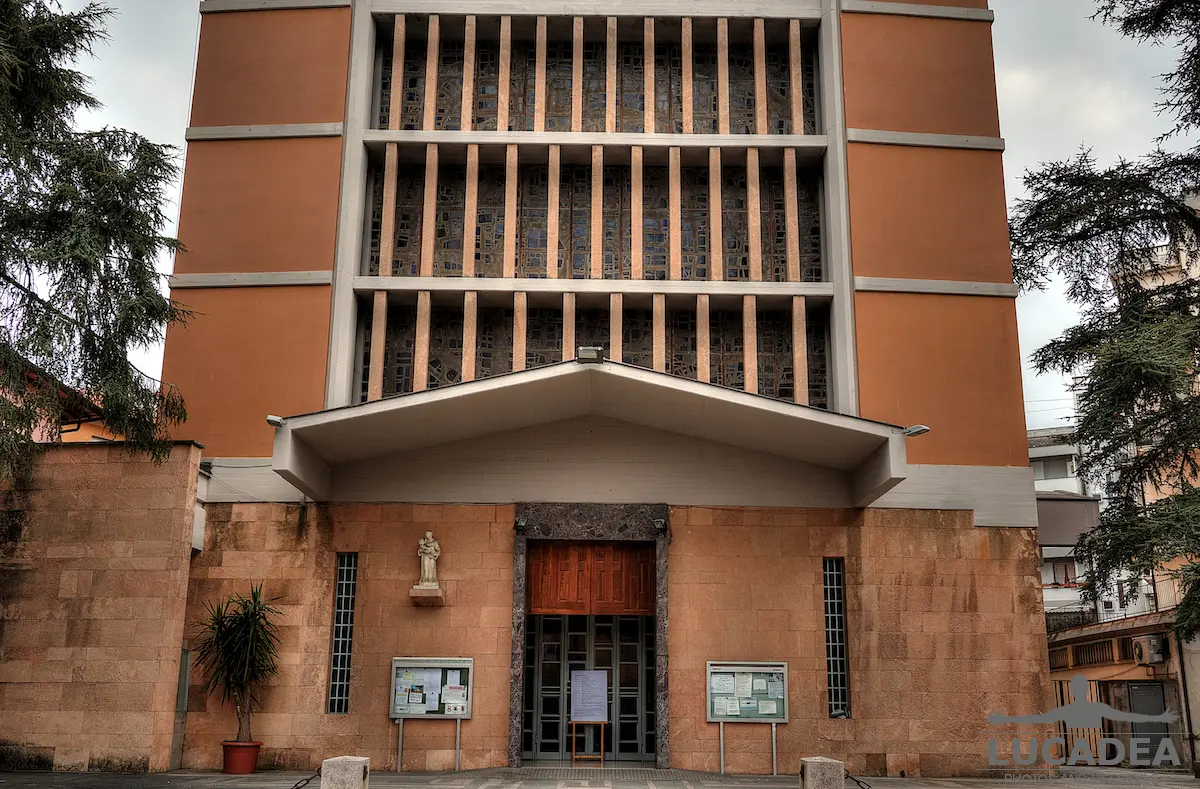
San Bernardo church above Sestri Levante. A little above the town, on the hillside roads leading inland, you reach San Bernardo delle Cascine, a small hamlet where I photographed this modest church, a quiet building with centuries of local history behind it.
It is one of those places that can easily remain familiar only by name. Sestri Levante is naturally associated with the sea, its bays and the peninsula, but moving a little farther from the coast reveals a different side of the town, with hillside communities, quieter roads and old places of worship.
San Bernardo church is the religious landmark of this small community. Its position above Sestri Levante gives it a particular character. It is not a monumental church standing in the historic centre, but a building closely connected with its surroundings, where the hillside landscape becomes part of the photographic subject.
When I took this photograph, what interested me most was simply recording another small part of the town where I live. I enjoy looking for the less obvious corners of Sestri Levante, places that may not appear in the most familiar photographs but that help create a fuller picture of the area.
The history of the church, however, goes back much further than its present appearance might suggest. Before the current building, the local community was associated with a church dedicated to Saint Quiricus, with records of the earlier church dating back to 1151. The present church dedicated to Saint Bernard was built in 1636. That detail changes the way I look at the building: behind this simple church there is a religious history stretching across many centuries.
The full name, San Bernardo delle Cascine, is closely connected with the local hamlet. The church is in Sestri Levante, Liguria, Italy, on the hills rising from the coastal area towards the inland landscape. That transition between town and hills is one of the things I find particularly interesting when photographing this part of Liguria.
If you are wondering what to see in Sestri Levante beyond the best-known coastal sights, the surrounding hamlets can also offer interesting subjects. For me, they are especially rewarding because they show a quieter and more everyday side of the town.
San Bernardo is also a place from which Sestri Levante can be seen from a different perspective. In another photograph I shared on the site, I had already captured the view of Sestri Levante from San Bernardo. I like thinking of these photographs as small chapters of the same landscape: first the view, then the church and the details of the hillside community.
Photography can bring these nearby places together in a way that makes their relationship easier to see. From the coast, we look towards the hills; from the hills, we can turn back towards the town and the sea.
What attracted me to San Bernardo church was also its everyday character. A building does not need to be large or spectacular to deserve a photograph. Sometimes the simplest structures, the ones that belong to the daily life of a small community, carry some of the longest stories.
The earlier church dedicated to Saint Quiricus is a good example. Today we see the seventeenth-century building dedicated to Saint Bernard, but the religious presence here is much older. That detail gives the photograph, at least for me, an additional layer, turning what could simply be a view of the Sestri Levante hills into a small fragment of local history.
I also like the fact that photographs like this do not require a long journey. Sometimes it is enough to know your surroundings a little better, take a different road and stop in front of something you may already have passed many times.
San Bernardo delle Cascine is exactly this kind of discovery. It is a quiet presence on the hills above Sestri Levante, but it also preserves the memory of a community and of a place of worship whose history reaches back to the Middle Ages.
For me, photographing it means preserving more than the image of a church. It means keeping a small fragment of local history. This is one of the reasons I continue photographing Sestri Levante: every time I think I know the area well, another detail appears that I had somehow overlooked.
If you are visiting Sestri Levante and want to see a less familiar side of the town, San Bernardo is one of those places that can add another perspective to the landscape. Not because it is spectacular, but because it shows how closely the town, its hills and its local history are connected.
Have you already seen San Bernardo delle Cascine, or did you discover this small church only after exploring the hills above Sestri Levante? Add a comment or go to the bottom of the site to read what other visitors have written.

Photo taken with Canon EOS M100 and lens Tamron 16-300.
The rights on images, videos, choruses, text and all other material on the LUCADEA.com website are governed as per Copyright page.