
San Domenico Square and the Immaculate Conception Column in Palermo

Piazza San Domenico a Palermo

San Domenico Square and the Immaculate Conception Column in Palermo.
In the historic centre of Palermo, Sicily, San Domenico Square is one of those places that invites visitors to stop and appreciate the beauty of the city. The square is known for the imposing façade of the Church of San Domenico and the Immaculate Conception Column, two landmarks that give this part of Palermo its distinctive character. From here, it is also easy to reach the Vucciria, one of the city’s best-known historic market districts.
As I look across the square, my attention is naturally drawn to the monumental church façade. The Church of San Domenico is one of Palermo’s most important religious buildings and has a long history connected with the Dominican order. Its impressive architecture gives the square a sense of grandeur, while the surrounding streets preserve the lively atmosphere of the old town.
The Immaculate Conception Column stands in front of the church, adding another striking feature to the scene. This Baroque monument is dedicated to the Virgin Mary and dates back to the eighteenth century. Its position in the square creates a visual connection with the church façade and reflects the important place that religious traditions have held in Palermo’s history and cultural life.
The location also makes San Domenico Square a wonderful starting point for exploring the city on foot. From here, visitors can continue towards the Vucciria, a historic market area known for its narrow lanes, lively atmosphere and traditional character. The contrast between the monumental architecture of the square and the smaller streets nearby is part of what makes Palermo so fascinating to discover at a leisurely pace.
I took this photograph to capture a corner of Palermo where architecture, history and everyday city life come together. The church, the column and the surrounding buildings create a scene that rewards a closer look, especially for anyone who enjoys discovering places beyond the most famous landmarks. Palermo, in Sicily, offers countless unexpected views, and a walk through its historic centre often reveals something worth stopping for around the next corner.
I find that some of the most memorable impressions of a city come from these open spaces and architectural details rather than from a single famous attraction. San Domenico Square is a good example: a place where a monumental church, a religious column and the nearby historic streets form part of the same urban landscape. It is also a reminder of how much there is to discover by simply walking through Palermo and taking the time to look around.

Have you visited San Domenico Square and the nearby Vucciria during a walk through Palermo? Add a comment or go to the bottom of the site to read what other visitors have written.

San Domenico Square in Palermo, with the Church of San Domenico façade and the Immaculate Conception Column in Sicily, Italy

Photo taken with a Canon EOS M100 camera and a Canon EF-S 10-18 lens.

Click here to see more stunning images of the city:
foto gallery

Where is the square:

Add one  comment to this article or read  here what other visitors have written.
 
Adv
 
Disclamer

The rights on images, videos, choruses, text and all other material on the LUCADEA.com website are governed as per  Copyright page.

This page has been viewed 0 times today.
This month it has been viewed 0 times.
In total it has been viewed 0 times.
 

A Votive Shrine in Genoa’s Historic Old Town

Edicola di via di Scurreria a Genova

A Votive Shrine in Genoa’s Historic Old Town.
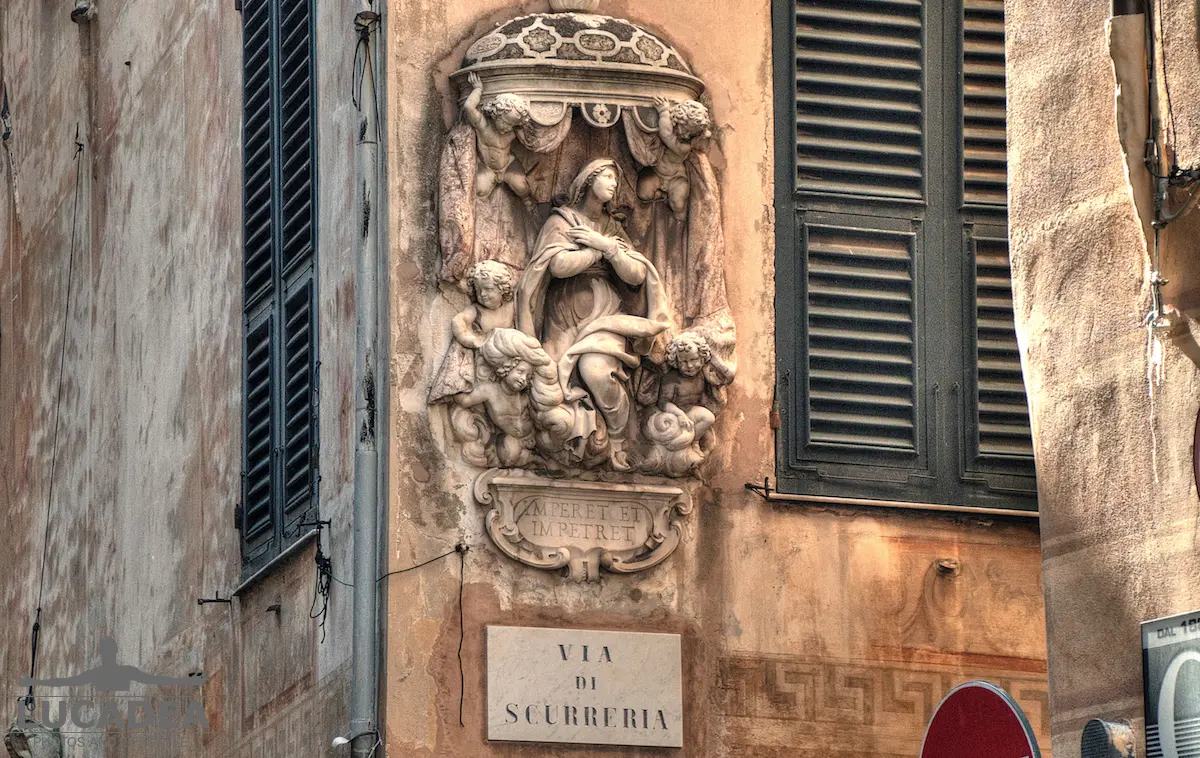
In the historic centre of Genoa, between Piazza Campetto and Via di Scurreria, this small shrine is a reminder of Liguria’s tradition of popular religious devotion. Votive shrines are a familiar feature of the region’s streets and villages, often found on building façades, at street corners or along the narrow lanes of old neighbourhoods.
These small niches containing sacred images reflect an aspect of everyday history in Ligurian towns and cities. Some are simple and understated, while others have decorated frames and architectural details that make them stand out. They can easily be overlooked by people walking through the old town without stopping, yet a closer look often reveals details that contribute to the character of the surrounding streets.
The shrine on Via di Scurreria is part of a distinctive corner of Genoa, in Liguria, Italy. Narrow streets, closely spaced buildings and passages connecting small squares create a dense urban landscape shaped by different periods of history. Between Piazza Campetto and Via di Scurreria, even a modest religious feature adds another detail to the story of the city and its relationship with the people who live and move through it.
In the past, votive shrines often served as familiar points of reference for local religious life. Sacred images could be cared for by families and neighbourhood residents, particularly during religious celebrations. This tradition has left visible traces throughout Liguria, where many shrines remain part of the region’s historical and cultural heritage.
I took this photograph to focus on one of those small details that help define Genoa’s historic centre. It may not have the imposing presence of a grand palace or church, but it offers a quieter way to appreciate the character of the old town. I enjoy noticing features like this while walking through historic streets, because they encourage me to look beyond the main landmarks and pay attention to places that might otherwise go unnoticed.
The same curiosity can lead to the discovery of other corners of Genoa’s old town, where architecture, tradition and everyday life come together along streets that have connected the city’s neighbourhoods for generations.

Have you ever noticed a votive shrine while walking through Genoa or another town in Liguria? Add a comment or go to the bottom of the site to read what other visitors have written.

Votive shrine on Via di Scurreria, between Piazza Campetto and the narrow streets of Genoa’s historic centre in Liguria, Italy

Photo taken with Canon EOS M100 camera and Tamron 16-300 lens.

Where is it located:

Add one  comment to this article or read  here what other visitors have written.
 
Adv
 
Disclamer

The rights on images, videos, choruses, text and all other material on the LUCADEA.com website are governed as per  Copyright page.


This page has been viewed 0 times today.
This month it has been viewed 0 times.
In total it has been viewed 0 times.
 

The Coronation of the Virgin in Spoleto Cathedral

L'Incoronazione della Vergine nel Duomo di Spoleto

The Coronation of the Virgin in Spoleto Cathedral.
Spoleto Cathedral, also known as the Cathedral of Santa Maria Assunta, is one of Umbria’s architectural jewels. Among its many works of art, “The Coronation of the Virgin” stands out, a fresco of extraordinary beauty and historical importance.
The fresco of the Coronation of the Virgin was created by the renowned Renaissance painter Filippo Lippi between 1467 and 1469. Lippi, known for his refined style and his ability to infuse life and spirituality into his works, created this masterpiece (at the commission of the Bishop of Spoleto, Bartolomeo della Rovere wrong infrmation).
The fresco is located in the apse of the Cathedral and depicts the Virgin Mary being crowned Queen of Heaven by Jesus Christ. The scene is surrounded by a multitude of angels and saints, who witness the event with expressions of joy and devotion. The composition is characterized by a skillful use of perspective and a rich color palette, which lend depth and vibrancy to the work.
“The Coronation of the Virgin” is a work full of religious symbolism. The crown placed on Mary’s head symbolizes her role as Queen of Heaven and Mother of the Church. The angels and saints surrounding her represent the communion of saints and heavenly glory. The work also reflects the Marian devotion of the Renaissance period and the importance of the Virgin Mary in Christian spirituality.
Over the centuries, the fresco has undergone various restorations to preserve its beauty and integrity. The last significant restoration was carried out in the 20th century, when modern techniques were used to stabilize the colors and repair damage caused by time and humidity.
The Spoleto Cathedral is open to visitors year-round and offers the opportunity to admire this masterpiece of the Italian Renaissance up close. In addition to the Coronation of the Virgin, the cathedral houses other valuable works of art, including frescoes, sculptures, and stained-glass windows.

Do you know the city of Spoleto? Add a comment or go to the bottom of the site to read what other visitors have written.

L'Incoronazione della Vergine nel Duomo di Spoleto

L'Incoronazione della Vergine nel Duomo di Spoleto

Photos taken with Canon EOS RP and lens Canon RF 24-50.

Here is the official website: duomospoleto.it.

To see all the photos I took of the city, click here:

Where is the Duomo?

The Stories of the Virgin are a cycle of frescoes by Filippo Lippi, dated from 1466 to 1469 and housed in the tribune of the Cathedral of Santa Maria Assunta in Spoleto. The frescoes were commissioned in 1466, when Lippi had just finished the Stories of Saint Stephen and Saint John the Baptist in the Cathedral of Prato. Work was abruptly interrupted by the artist’s death in 1469, and was then completed, in about three months, by the master’s workshop. According to Vasari, the artist’s death, at the age of 63, was caused by poison due to his habit of harassing young girls, which had already caused great scandal in Prato.
Continue and learn more on Wikipedia

The Coronation of the Virgin in Spoleto Cathedral – Le couronnement de la Vierge dans la cathédrale de Spolète – La Coronación de la Virgen en la Catedral de Spoleto – A Coroação da Virgem na Catedral de Spoleto – Die Krönung der Jungfrau in der Kathedrale von Spoleto – Lễ đăng quang của Đức Trinh Nữ tại Nhà thờ Spoleto

This post was written with the help of Copilot, an AI-powered virtual assistant.

The Crucifix in the Basilica of San Petronio in Bologna

Il crocifisso della Basilica di San Petronio a Bologna

The Crucifix in the Basilica of San Petronio in Bologna.
One of the details that caught my attention inside the Basilica of San Petronio is this monumental wooden crucifix, decorated with gold and positioned above the main altar. Set high in the centre of the church, it stands out against the surrounding architecture and draws the eye towards the heart of this impressive place of worship.
The Basilica of San Petronio is one of the best-known landmarks in Bologna, in the Emilia-Romagna region of Italy. Its imposing interior offers plenty to admire, from the scale of the building to the many artistic details found throughout the church. When visiting a place like this, I enjoy looking beyond the overall impression and noticing individual works that might otherwise be overlooked.
The crucifix combines the natural appearance of wood with the brightness of its gilded decoration. This contrast gives the work a solemn presence, while its central position above the main altar makes it an important visual feature of the interior. In a large church filled with architectural details, paintings and other works of art, the crucifix provides a natural focal point.
I find that looking upwards is often part of the experience when visiting historic churches. Some of the most interesting details are not at eye level, but high above the congregation, where they can be difficult to examine closely. Even from a distance, however, it is possible to appreciate how an artwork relates to the surrounding space and how its placement contributes to the atmosphere of the building.
San Petronio is well worth exploring beyond the main altar. A visit offers the opportunity to discover other artistic features and architectural details, while the surrounding Piazza Maggiore provides a wonderful starting point for exploring Bologna’s historic centre. The city has many places where art, history and everyday life come together, and its churches are an important part of that experience.

This photograph records one particular detail that stayed with me after visiting the basilica: a large wooden crucifix with golden decoration, placed prominently above the main altar. It is a reminder that a visit to a famous monument can be just as rewarding when we pause to look carefully at one individual object rather than trying to take everything in at once. When you visit a church, do you tend to notice works positioned high above the altar, or are you more drawn to paintings, chapels and architectural details at ground level? Add an comment or go to the bottom of the site to read what other visitors have written.

Monumental wooden crucifix with gold decoration above the main altar in the Basilica of San Petronio in Bologna

Photo taken with Canon EOS M100 and lens Tamron 16-300.

Click here to see all the photos I took in San Petronio:

🏠
  • Italiano