San Bernardo church above Sestri Levante

Chiesa di San Bernardo delle Cascine sulle alture di Sestri Levante, antico luogo di culto della frazione

San Bernardo church above Sestri Levante. A little above the town, on the hillside roads leading inland, you reach San Bernardo delle Cascine, a small hamlet where I photographed this modest church, a quiet building with centuries of local history behind it.
It is one of those places that can easily remain familiar only by name. Sestri Levante is naturally associated with the sea, its bays and the peninsula, but moving a little farther from the coast reveals a different side of the town, with hillside communities, quieter roads and old places of worship.
San Bernardo church is the religious landmark of this small community. Its position above Sestri Levante gives it a particular character. It is not a monumental church standing in the historic centre, but a building closely connected with its surroundings, where the hillside landscape becomes part of the photographic subject.
When I took this photograph, what interested me most was simply recording another small part of the town where I live. I enjoy looking for the less obvious corners of Sestri Levante, places that may not appear in the most familiar photographs but that help create a fuller picture of the area.
The history of the church, however, goes back much further than its present appearance might suggest. Before the current building, the local community was associated with a church dedicated to Saint Quiricus, with records of the earlier church dating back to 1151. The present church dedicated to Saint Bernard was built in 1636. That detail changes the way I look at the building: behind this simple church there is a religious history stretching across many centuries.
The full name, San Bernardo delle Cascine, is closely connected with the local hamlet. The church is in Sestri Levante, Liguria, Italy, on the hills rising from the coastal area towards the inland landscape. That transition between town and hills is one of the things I find particularly interesting when photographing this part of Liguria.
If you are wondering what to see in Sestri Levante beyond the best-known coastal sights, the surrounding hamlets can also offer interesting subjects. For me, they are especially rewarding because they show a quieter and more everyday side of the town.
San Bernardo is also a place from which Sestri Levante can be seen from a different perspective. In another photograph I shared on the site, I had already captured the view of Sestri Levante from San Bernardo. I like thinking of these photographs as small chapters of the same landscape: first the view, then the church and the details of the hillside community.
Photography can bring these nearby places together in a way that makes their relationship easier to see. From the coast, we look towards the hills; from the hills, we can turn back towards the town and the sea.
What attracted me to San Bernardo church was also its everyday character. A building does not need to be large or spectacular to deserve a photograph. Sometimes the simplest structures, the ones that belong to the daily life of a small community, carry some of the longest stories.
The earlier church dedicated to Saint Quiricus is a good example. Today we see the seventeenth-century building dedicated to Saint Bernard, but the religious presence here is much older. That detail gives the photograph, at least for me, an additional layer, turning what could simply be a view of the Sestri Levante hills into a small fragment of local history.
I also like the fact that photographs like this do not require a long journey. Sometimes it is enough to know your surroundings a little better, take a different road and stop in front of something you may already have passed many times.
San Bernardo delle Cascine is exactly this kind of discovery. It is a quiet presence on the hills above Sestri Levante, but it also preserves the memory of a community and of a place of worship whose history reaches back to the Middle Ages.
For me, photographing it means preserving more than the image of a church. It means keeping a small fragment of local history. This is one of the reasons I continue photographing Sestri Levante: every time I think I know the area well, another detail appears that I had somehow overlooked.
If you are visiting Sestri Levante and want to see a less familiar side of the town, San Bernardo is one of those places that can add another perspective to the landscape. Not because it is spectacular, but because it shows how closely the town, its hills and its local history are connected.

Have you already seen San Bernardo delle Cascine, or did you discover this small church only after exploring the hills above Sestri Levante? Add a comment or go to the bottom of the site to read what other visitors have written.

San Bernardo church in San Bernardo delle Cascine above Sestri Levante, a historic hillside place of worship

Photo taken with Canon EOS M100 and lens Tamron 16-300.

Add one  comment to this article or read  here what other visitors have written.
 
Adv
 
Disclamer

The rights on images, videos, choruses, text and all other material on the LUCADEA.com website are governed as per  Copyright page.


This page has been viewed 1 times today.
This month it has been viewed 1 times.
In total it has been viewed 1 times.
 

The plaque of San Bernardo in Sestri Levante

Lapide sulla chiesa di San Bernardo a Sestri Levante con iscrizione religiosa del 1891 incisa sulla facciata

The plaque of San Bernardo in Sestri Levante.
Walking up the hills above Sestri Levante, I found myself in front of a small church, quiet and almost hidden, where a simple plaque on the facade immediately caught my eye. The plaque of San Bernardo in Sestri Levante is one of those details that quietly tells a story, reflecting local faith and traditions that have lasted for generations.
I moved closer to read the inscription, trying to understand each line as if it were a message carried through time. The plaque on the church of San Bernardo feels like a collective prayer, written by the local community and addressed to their patron saint. The words, dated 1891, have a poetic rhythm, expressing devotion and a request for protection.
This place is located in the San Bernardo area, on the hills of Sestri Levante, Liguria, Italy, where the atmosphere still feels intimate and genuine. Here, the plaque is more than decoration; it represents a tangible connection to the people who once gathered here. I found myself wondering how many others had stood in the same spot, reading those same lines before entering the church.
A curious detail is the reference to San Bernardo, likely Bernard of Clairvaux, a major figure in medieval theology and a Doctor of the Church, widely respected across Europe. This aligns with the phrase “great doctor of our Holy Church” carved into the stone.
One small detail remains unclear: the word “SII” after the name, which is difficult to read in the photo. It might be an old form of the verb “to be,” used as an imperative, meaning something like “be our defense.” That uncertainty adds a layer of mystery, making the plaque feel even more alive.
If you are visiting Sestri Levante and want to explore beyond the coastline, places like this reveal a deeper side of the area. I have shared other similar details from this region on my blog, connecting small discoveries like this to a broader sense of place.

I like how photography can turn simple observations into questions waiting for answers. What do you think that inscription really means? Add a comment or go to the bottom of the site to read what other visitors have written.

D.O.M
IL POPOLO CHE PREGA
IL PATRONO
DELLA SUA CHIESA
MIO PADRE E GRAN DOTTORE
DI NOSTRA SANTA CHIESA
BERNARDO SII DIFESA
—
PRESENTA AL MIO SIGNORE
QUESTA NOSTRA PREGHIERA
DOVUTA TUTTA INTERA
IN NOME DEL PASTORE
1891

Lapide sulla chiesa di San Bernardo a Sestri Levante con iscrizione religiosa del 1891 incisa sulla facciata

Photo taken with Canon EOS M100 and lens Tamron 16-300.

Where the church (and the tombstone) is located:

Plaque of San Bernardo in Sestri Levante – Plaque de San Bernardo à Sestri Levante – Lápida de San Bernardo en Sestri Levante – Placa de San Bernardo em Sestri Levante – Tafel von San Bernardo in Sestri Levante – Bia tưởng niệm San Bernardo ở Sestri Levante – 塞斯特里莱万特圣贝尔纳多教堂石碑 – セストリ・レヴァンテのサンベルナルドの碑文

The text of this post was written with the help of ChatGPT, a language model from OpenAI.

Add one  comment to this article or read  here what other visitors have written.
 
Adv
 
Disclamer

The rights on images, videos, choruses, text and all other material on the LUCADEA.com website are governed as per  Copyright page.


This page has been viewed 0 times today.
This month it has been viewed 0 times.
In total it has been viewed 0 times.
 

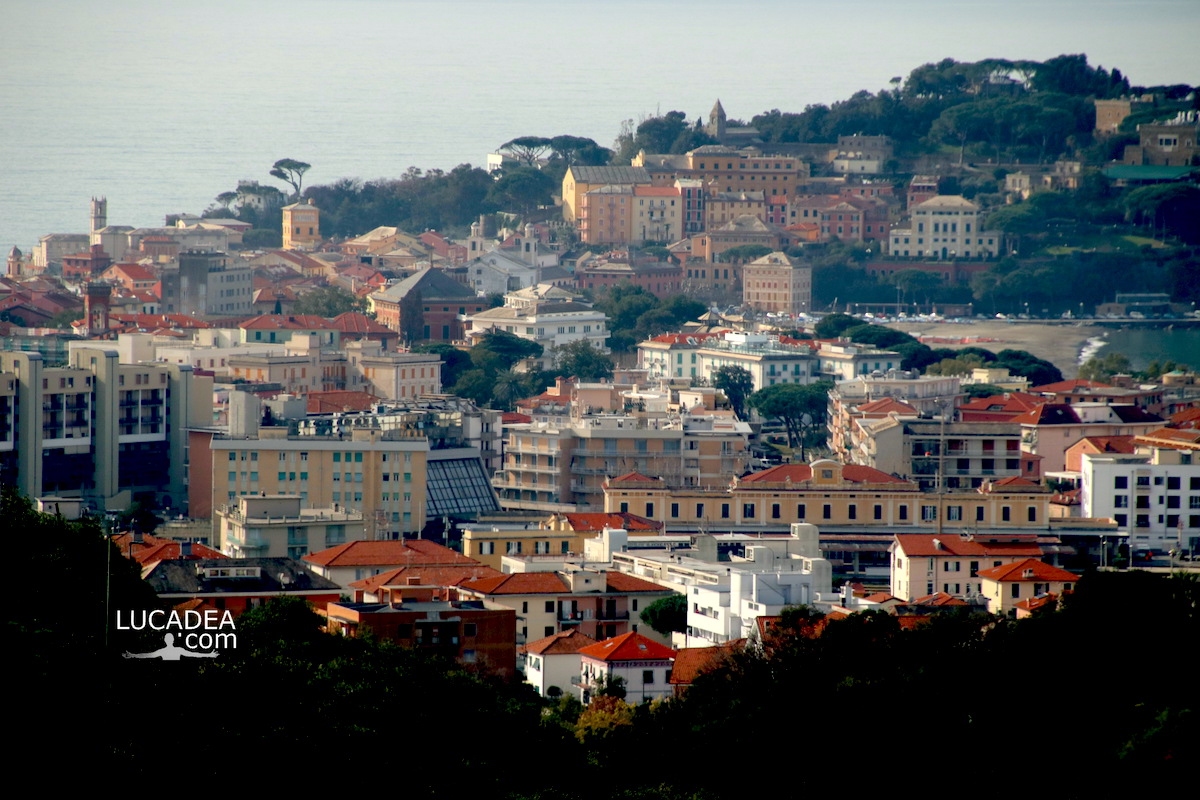
Sestri Levante from the hills of San Bernardo

Particolari di Sestri Levante vista da San Bernardo

Sestri Levante from the hills of San Bernardo.
To photograph Sestri Levante from a different perspective, I have to leave the centre for a while and climb into the hills. From San Bernardo, a small hillside area above my hometown, the view changes completely and offers a chance to look down towards Sestri Levante and notice details that are easily missed from sea level.
There is something particularly appealing to me about these walks because they do not require travelling far. A little climbing is enough, and gradually the landscape begins to open up. This is one of my favourite ways of photographing places I already know well: changing the viewpoint and trying to see my own town almost as if I were discovering it for the first time.
I took this photograph in San Bernardo, along one of the paths running through the hills surrounding Sestri Levante. The image is not necessarily about creating a huge postcard panorama. Instead, I wanted to capture some details of the town that look different when seen from higher ground.
From above, it becomes easier to understand the shape of the landscape. Sestri Levante lies between the sea and the hills, and climbing upwards makes that relationship much more apparent. Houses, roads and patches of vegetation begin to form a broader picture, while the town itself seems to gather beneath the viewpoint.
This is exactly the kind of perspective I enjoy looking for when I have my camera with me. A photograph does not always need a remarkable subject. Sometimes all it takes is finding a position from which something familiar can be seen in an unfamiliar way. San Bernardo offers several opportunities like this, with different views appearing as the paths climb higher.
If you are wondering where to see Sestri Levante from above, the hills behind the town are certainly worth considering. There is no need to remain only in the best-known parts of the centre. Walking towards the hillside areas can reveal quieter viewpoints and a different relationship between the town and its surroundings.
There is a small geographical detail that becomes particularly clear from this perspective. Sestri Levante is shaped by its position between two bays and the promontory of Punta Manara, making the proximity of hills and sea an important part of its character. From San Bernardo, that landscape is easier to read as a whole.
I wanted to capture one of these views because San Bernardo belongs to a side of Sestri Levante that is often less visible in the most familiar photographs. Images of the Bay of Silence or the caruggio are certainly more immediate, but these views from above also tell the story of my town and the landscape around it.
I have previously photographed Sestri Levante from the centre, walking through the almost empty caruggio on winter mornings, and from the Bay of Silence, one of my favourite subjects. Seeing the town from San Bernardo is a completely different experience. The viewpoint changes, and naturally the way I photograph it changes as well.
That is one of the things I continue to appreciate about photography: even a place I know extremely well can reveal something new simply by moving a few hundred metres and climbing a little higher.

Do you prefer seeing Sestri Levante from the sea or from viewpoints like this in the hills? Add a comment or go to the bottom of the site to read what other visitors have written.

Sestri Levante seen from above in San Bernardo, with the Ligurian hills surrounding the coastal town

Photo taken with Canon EOS M100 and lens Tamron 16-300.

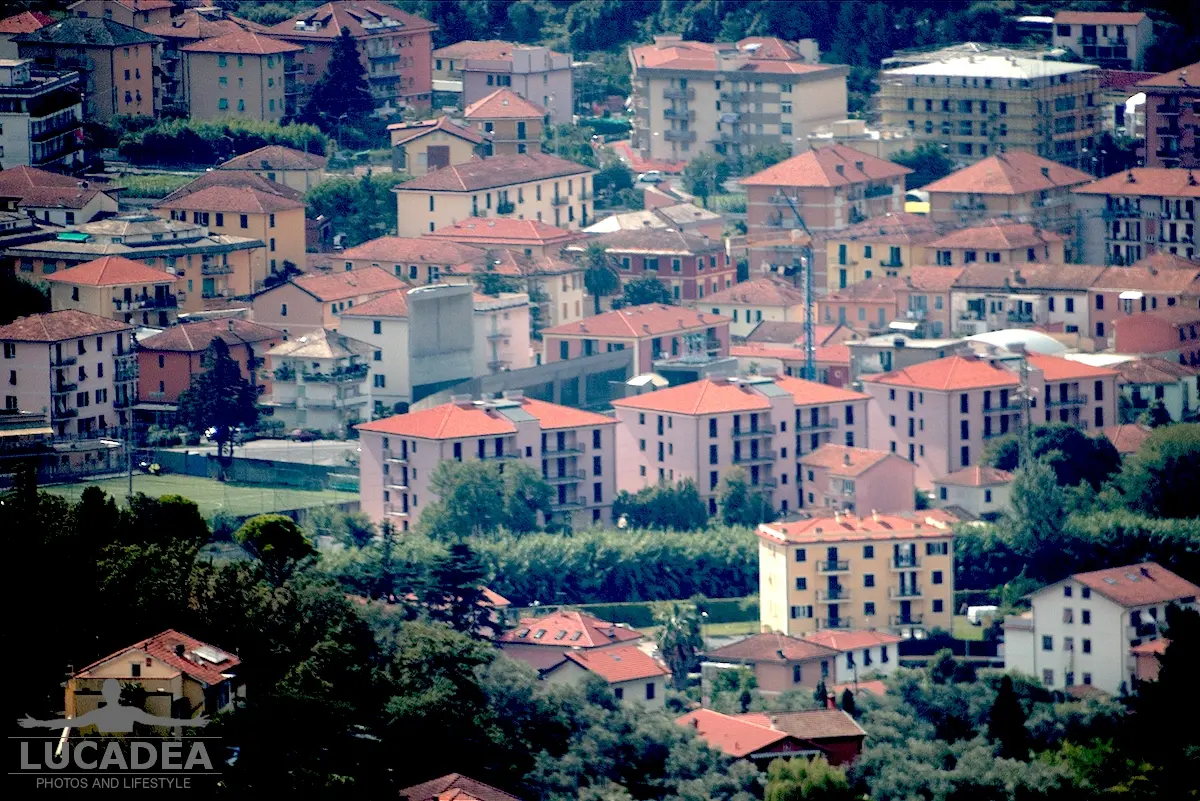
Pila sul Gromolo from Sestri Levante hills

Vista di Pila sul Gromolo a Sestri Levante con il campo Sivori A e la chiesa di San Paolo

Pila sul Gromolo from Sestri Levante hills.
From the hills of San Bernardo, I wanted to capture with my camera a different view of Pila sul Gromolo, a neighborhood of Sestri Levante that tells a lesser-known part of the town, away from the most famous images of the sea and the coastline. This photograph of Pila in Sestri Levante shows an everyday landscape made of homes, sports facilities and community spaces that represent ordinary local life.
Looking down from San Bernardo towards the valley of Sestri Levante, Liguria, Italy, I could see the Sivori A football field, where the local Corsari team plays, and beside it the modern San Paolo Church in Pila. The distance and the strong humidity made the photograph technically challenging, but this wider perspective gives a chance to understand the neighborhood as a whole, connected with the surrounding landscape.
I chose to photograph this view because I often find that less famous neighborhoods can reveal an important part of a place’s identity. Pila sul Gromolo is not an ancient village or a traditional tourist attraction, but a residential area that grew together with the industrial development of Sestri Levante. Its apartment buildings are linked to the history of the former FIT factory and the Shipyard, which provided work for many local residents and contributed to the growth of the community.
Today Pila is a fully established residential neighborhood. The football field and San Paolo Church represent two important elements of local life: one connected with sport and the other with the social and spiritual community of the area.
A small curiosity concerns San Paolo Church in Pila, an example of modern religious architecture that differs from the older churches commonly found in Liguria. Its presence among residential buildings reflects the changes that took place during the twentieth century, when expanding neighborhoods needed new places for community life.
This photograph comes from my desire to tell Sestri Levante also through places that are not always highlighted. After photographing the historic center, streets and seaside views, I enjoy discovering the parts of the town where the story is made not only by monuments, but also by people, work and everyday experiences.
If you are visiting Sestri Levante and looking for places worth seeing beyond the beaches and the most famous viewpoints, looking at the town from the surrounding hills offers a different perspective and shows how the urban landscape extends inland.

Have you ever looked at Sestri Levante from a viewpoint different from the sea? Add a comment or go to the bottom of the site to read what other visitors have written.

View of Pila sul Gromolo in Sestri Levante with Sivori A football field and San Paolo Church

Photo taken with Canon EOS M100 and lens Tamron 16-300.

Where is this neighborhood located:

San Bernardo church tower above Sestri Levante

frazione san bernardo

San Bernardo church tower above Sestri Levante.
My camera turns once again towards the hills above my hometown, where the tiny hamlet of San Bernardo offers a different perspective on Sestri Levante. This time I focused on the church tower, a simple but recognisable feature of this small hillside settlement.
San Bernardo is one of those places I know especially well through photography. I have taken several photographs from this tiny hamlet above Sestri Levante, and some of them have already found their way onto this blog. The position makes it possible to look at the town from a different angle, away from the immediate views of the centre and the coastline.
For this photograph, however, I was not necessarily looking for a wide panorama. I pointed the camera towards the church tower and allowed this small architectural detail to become the main subject. I enjoy photographing familiar places in this way: returning to the same location and finding a different detail or a new way of framing something I have already seen many times.
When thinking about what to see in Sestri Levante, most people will naturally think of the Bay of Silence, the caruggio, the peninsula and the sea. The hills are less obvious, but they are part of the same landscape and offer another side of the town. San Bernardo is a good example of this quieter, more rural dimension.
The position of the hamlet also makes the relationship between the small settlement and the surrounding hills particularly noticeable. As you move away from the areas closer to the sea, the landscape gradually changes and the hills become more present. This transition is one of the things I enjoy observing whenever I bring my camera up here.
The church tower in this photograph therefore works as more than just an architectural detail. It is also a visual reference for San Bernardo itself. In a settlement this small, the church and its tower naturally become part of the identity of the place and help define its appearance.
I took the photograph because that particular detail caught my attention. I do not always need to find a completely new subject when I am photographing Sestri Levante. Sometimes changing the viewpoint or simply narrowing the frame is enough. That is one of the reasons I can keep photographing my hometown even after having already covered so many of its corners.
This image also connects naturally with other photographs I have shared from the hills around Sestri Levante, including another photograph taken in San Bernardo that looks back towards the town from above. They are small pieces of the same landscape, each recorded from a slightly different point of view.
If you are looking for where to see Sestri Levante from a less familiar perspective, the hillside hamlets offer exactly that opportunity. They take you away from the centre while keeping you closely connected to the town below. For me, there is an added pleasure in photographing these places because I know the area well and can keep discovering small details.
The church tower may not be one of the landmarks normally mentioned when people talk about Sestri Levante, but that is precisely what makes it interesting to me. A personal photo blog is also about preserving these quieter corners and giving them a little space alongside the more famous views.

Have you ever made your way up to San Bernardo to see Sestri Levante from this side of the hills? Add a comment or go to the bottom of the site to read what other visitors have written.

The church tower in San Bernardo above Sestri Levante, photographed from the surrounding Ligurian hills

🏠
  • Italiano