San Giorgio Palace Overlooking Genoa’s Old Port

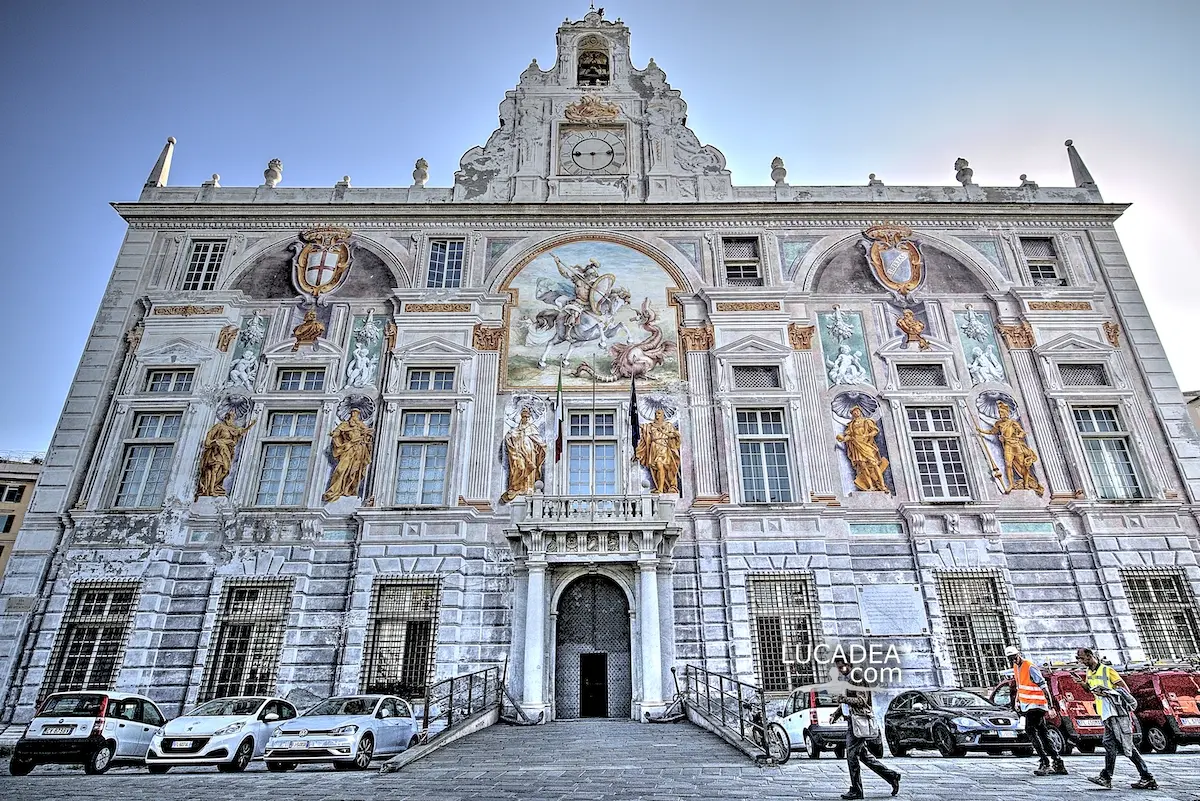
Il maestoso Palazzo San Giorgio di fronte al Porto Antico di Genova

San Giorgio Palace Overlooking Genoa’s Old Port.
San Giorgio Palace is one of the most recognisable and frequently photographed buildings in Genoa, Italy. Located right beside the Old Port, it immediately catches the attention of visitors, especially because of the large painting on its façade depicting Saint George slaying the dragon. It is one of those familiar views that help define this part of the city and make it such a popular place to stop and take photographs.
The palace occupies a particularly interesting position, directly in front of the Old Port and close to the entrance to Genoa’s historic centre. Here, two different sides of the city meet. On one side are the open spaces of the harbour, with its quays and waterfront; on the other are the narrow streets and alleyways of the old town, where historic buildings stand close together. It is a place where a short walk can take you from the atmosphere of the port straight into the heart of historic Genoa.
Whenever I visit this area, San Giorgio Palace is one of the buildings that naturally draws my attention. Its façade is full of decorative details, but the large image of Saint George is undoubtedly the main attraction. The saint is shown on horseback, armed and facing the dragon. The scene is dramatic and immediately recognisable, giving the building a distinctive appearance that makes it stand out from its surroundings.
Saint George has a special place in Genoa’s identity. The image of the saint fighting the dragon is one of the city’s best-known symbols and also appears in its coat of arms. Seeing such a prominent representation on the façade of this historic building feels particularly appropriate. San Giorgio Palace is not simply an attractive landmark: it is also closely connected with the history of Genoa and its maritime and commercial importance.
The palace itself has a long and fascinating past. Built in the Middle Ages, it became closely associated with the financial and commercial activities of the Republic of Genoa. Its name is linked to the House of Saint George, an institution that played an important role in the city’s economic history. Today, many visitors know the building primarily as one of the most photographed sights around the Old Port, but its historical importance goes far beyond its attractive exterior.
From a photographic point of view, its location offers plenty of interesting possibilities. I particularly like the contrast between the richly decorated façade and the more open surroundings of the harbour. People are constantly walking past, stopping to admire the building or continuing towards the old town. This combination of architecture, movement and maritime atmosphere makes the area especially appealing to photograph.
For anyone visiting Genoa, stopping in front of San Giorgio Palace is almost unavoidable. The building stands in a natural position along the route between the Old Port and the historic centre, inviting visitors to pause and admire its details. The painting of Saint George and the dragon is certainly one of the features that makes it memorable.

Have you ever photographed San Giorgio Palace while walking around Genoa’s Old Port? Add a comment or go to the bottom of the site to read what other visitors have written.

San Giorgio Palace in Genoa, featuring the large façade painting of Saint George slaying the dragon beside the Old Port

Photo taken with a Canon EOS M100 camera and Canon EF-M 11-22 lens.

Where is the building located:

Add one  comment to this article or read  here what other visitors have written.
 
Adv
 
Disclamer

The rights on images, videos, choruses, text and all other material on the LUCADEA.com website are governed as per  Copyright page.


This page has been viewed 1 times today.
This month it has been viewed 2 times.
In total it has been viewed 2 times.
 

San Giorgio Castle, Overlooking La Spezia

Castello San Giorgio a La Spezia

San Giorgio Castle, Overlooking La Spezia.
Rising above the historic centre of La Spezia, in Liguria, Italy, San Giorgio Castle is one of the city’s most recognisable landmarks. Its impressive stone walls stand on a hill overlooking the urban area, giving the fortress a commanding position above the surrounding streets and buildings. Even from different parts of the city, the castle remains a distinctive feature of the skyline and an important reminder of La Spezia’s past.
I took this photograph to capture the imposing appearance of the fortress and its relationship with the city below. San Giorgio Castle stands on Poggio Hill, a strategic location that would have been particularly important when defending the settlement. Before the city expanded into the modern urban centre we see today, a fortified position overlooking the surrounding area offered a significant advantage.
The structure has a strong, defensive appearance. Its stone walls, towers and fortified sections give it the character of a medieval stronghold. Looking at the building, it is easy to understand why this elevated position was chosen. The castle was designed to protect an important settlement and to help control the surrounding territory. Its presence on the hill still gives it a sense of authority, even though the city around it has changed considerably over the centuries.
The origins of San Giorgio Castle date back to the Middle Ages. Like many historic fortifications, it underwent several alterations and expansions over time, adapting to changing military needs and political circumstances. La Spezia occupied an important position along the Ligurian coast, and the castle formed part of the defensive system protecting the settlement. Its present appearance reflects different periods of construction rather than a single building project completed at one particular moment.
One of the most interesting aspects of the castle is how closely it is connected to the modern city. It is not an isolated fortress standing in the countryside, but a historic building surrounded by the urban landscape. From below, its walls can be seen rising above the rooftops. Walking up towards the castle offers a different perspective, with views across the streets and buildings of La Spezia.
Today, San Giorgio Castle houses the Ubaldo Formentini Civic Archaeological Museum. Its collections preserve archaeological finds and historical evidence connected with the local area. This gives the fortress an additional role beyond its architectural and historical importance. Visitors can explore the building while also discovering objects that help explain the ancient history of La Spezia and its surroundings.
I enjoy photographing places like this because they give a city a recognisable identity. San Giorgio Castle is not simply an old building on a hill: it is a landmark that has watched over La Spezia through centuries of change. Its walls tell a story of defence and transformation, while its elevated position continues to make it one of the most striking features of the city.
La Spezia is often associated with its harbour and its position as a gateway to the Gulf of Poets and the Cinque Terre. However, the castle offers another way to understand the city, through its medieval history and its older urban landscape. It is well worth looking beyond the waterfront to discover places like this, which reveal a different side of the town.

Have you visited San Giorgio Castle in La Spezia, or would you like to explore its historic rooms and enjoy the views from the hill? Add a comment or go to the bottom of the site to read what other visitors have written.

San Giorgio Castle standing on Poggio Hill above the historic centre of La Spezia, with its imposing medieval stone walls

San Giorgio Castle standing on Poggio Hill above the historic centre of La Spezia, with its imposing medieval stone walls

Photo taken with a Canon EOS M100 camera and Canon EF-M 11-22 lens.

If you want to see all the photos I took in the city, click here:

Add one  comment to this article or read  here what other visitors have written.
 
Adv
 
Disclamer

The rights on images, videos, choruses, text and all other material on the LUCADEA.com website are governed as per  Copyright page.


This page has been viewed 2 times today.
This month it has been viewed 2 times.
In total it has been viewed 2 times.
 

Palace of Saint George in Genoa

Palazzo San Giorgio

Palace of Saint George in Genoa.
Whenever I walk around the Old Port, I find it difficult to pass this historic building without stopping to admire its elegant façade. The Palace of Saint George is one of the landmarks that best expresses Genoa’s long relationship with the sea, maritime trade and civic history. Standing close to the waterfront in Genoa, Liguria, Italy, the palace immediately catches the eye with its architectural details and colourful painted decorations.
The sea-facing façade is especially striking. Among its painted figures, one of the most recognisable is Saint George defeating the dragon. This image is much more than a decorative feature: Saint George was the patron saint of the Republic of Genoa, and the red cross on a white background associated with him remains an important symbol of the city’s historical identity. It is a detail that connects the building to the proud maritime republic that once played a major role in Mediterranean commerce.
The palace itself has a long and fascinating past. Construction began in the second half of the thirteenth century, when Guglielmo Boccanegra commissioned a public building near the harbour, close to the centre of Genoa’s commercial activity. Over the centuries, the building changed its purpose and appearance. It later became the headquarters of the Bank of Saint George, a powerful financial institution involved in managing public finances and revenues connected with the Republic. Its Renaissance appearance developed through later extensions and decorative work, including the celebrated frescoes painted by Lazzaro Tavarone between 1606 and 1608.
When I photograph historic places, I enjoy looking beyond the overall view and paying attention to the details that give each building its own character. Here, the painted façade offers plenty to discover, from the central scene of Saint George and the dragon to the surrounding figures and architectural decorations. I took this photograph to capture the charm of a building that continues to stand out, even in an area visited by so many people.
The Palace of Saint George is an excellent stop for anyone exploring Genoa’s Old Port. From here, it is easy to continue towards the historic lanes, the arcades of Sottoripa and other landmarks in the old city. If you are searching for historic buildings to see in Genoa, this palace deserves a place on your itinerary, even if you only have a few minutes to spare.
I also enjoy photographing the city’s less obvious details, from old façades and narrow streets to the squares that reveal different layers of Genoese history. Each image becomes a way to remember a place and share a little of its atmosphere.

When you visit Genoa’s Old Port, do you stop to admire the painted façade of the Palace of Saint George? Add an comment or go to the bottom of the site to read what other visitors have written.

The Palace of Saint George in Genoa, a historic building overlooking the Old Port with a painted façade depicting Saint George and the dragon

The Palace of Saint George in Genoa, a historic building overlooking the Old Port with a painted façade depicting Saint George and the dragon

Photos taken with a Canon EOS M100 camera and Tamron 16-300 lens.

Where is the building located:

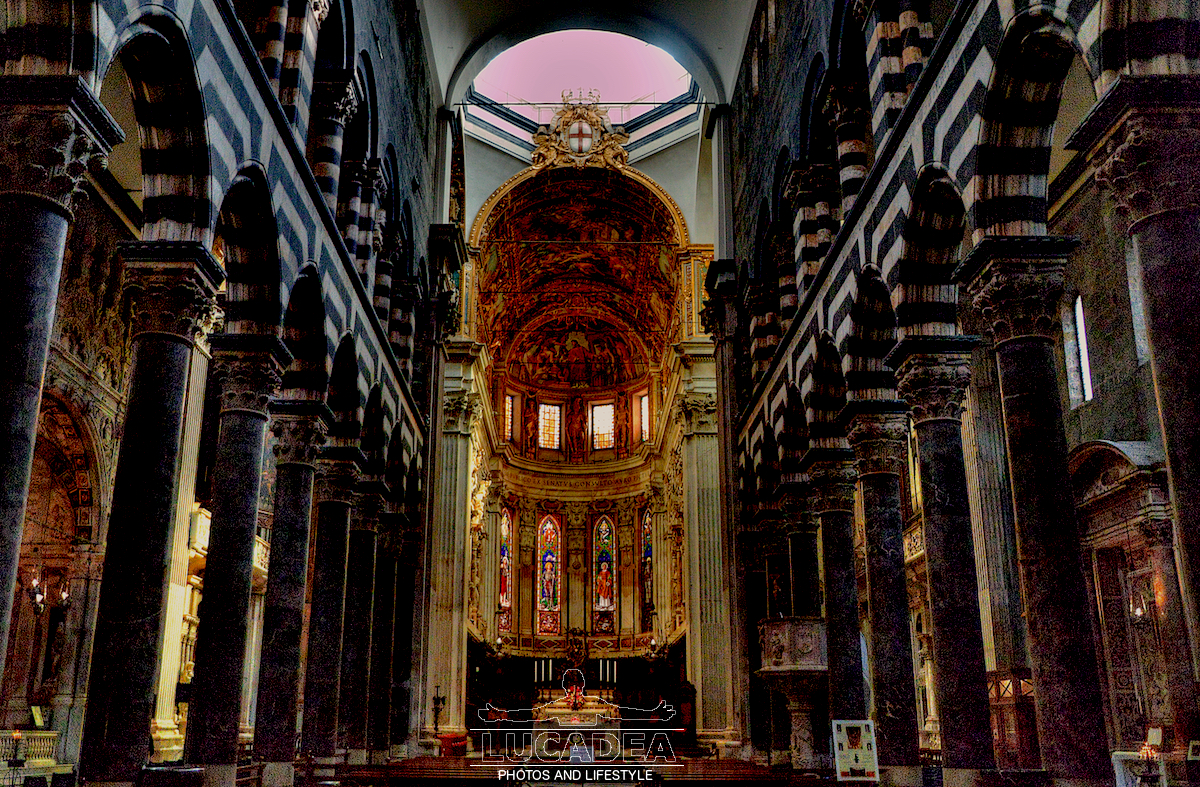
Inside San Lorenzo Cathedral in Genoa

Navata centrale della Cattedrale di San Lorenzo a Genova, con l’altare maggiore e lo scudo di San Giorgio

Inside San Lorenzo Cathedral in Genoa.
From the central nave, my attention was drawn toward the main altar, while the alternating bands of white and green marble gave the interior a character that feels strongly connected with Genoa. This photograph of San Lorenzo Cathedral captures one of the most recognizable spaces in the historic centre, where architecture, history and one of the city’s best-known symbols meet in the same frame.
The photograph shows the central nave of the cathedral, with the main altar at the end of the perspective. I wanted to photograph this particular view because it gives a sense of the scale of the building while also including some details that can easily be missed when walking through the church without stopping to look closely.
San Lorenzo Cathedral stands in the heart of Genoa, Liguria, Italy, surrounded by the dense historic fabric of the old city. It is one of those places where a short walk can take you between very different parts of Genoa’s history, from narrow streets and historic buildings to monumental churches and richly decorated interiors.
The first thing that stands out in the photograph is the use of marble. The contrast between white and green creates a strong visual rhythm along the architecture and gives the central nave much of its distinctive appearance. When I took the photograph, I wanted the perspective itself to do most of the work, allowing the lines of the nave to lead naturally toward the main altar.
High above, the shield bearing the cross of Saint George can also be seen. The red cross on a white background is one of the symbols most closely associated with Genoa and its history. I particularly like this detail because it connects the religious setting of the cathedral with the civic identity of the city and its long maritime past.
The cathedral developed over several centuries, and that history can still be read in its architecture. San Lorenzo combines Romanesque and Gothic elements with later additions and modifications, creating the layered appearance visible today. The alternating marble on the exterior and interior is among the features that make the cathedral immediately recognizable.
One small historical detail I find especially interesting is that San Lorenzo was not created as a single, perfectly unified project. Its appearance is the result of successive phases of construction and changes carried out over time. That helps explain why different architectural languages can be encountered within the same building without making the overall space feel disconnected.
If you are visiting Genoa and looking for what to see in the historic centre, San Lorenzo is naturally one of the places worth entering rather than simply admiring from outside. For me, however, this photograph was not intended as a tourist guide. I was more interested in capturing the experience of standing along the central axis of the nave and seeing the architecture draw the eye toward the altar.
I took this photograph myself, and I tried to keep the composition relatively open so that the proportions of the interior remained visible. A cathedral like this offers countless details that could each become the subject of a separate photograph, but in this case I preferred to step back visually and let the entire nave become the subject.
This image also fits naturally with the other photographs of Genoa and its historic buildings that I have published on the blog. I often find myself photographing churches, palaces and architectural details while walking through the old city, and each image becomes a small part of a larger personal record of Genoa. Rather than trying to document everything, I prefer to stop when a particular view gives me a reason to take out the camera.
Looking at the photograph again, what stays with me is the combination of perspective and colour. The central nave leads toward the altar, the marble creates a clear rhythm on either side, and the cross of Saint George adds a detail that immediately places the scene in Genoa.
It is only one view of the cathedral, but I think it manages to show why the interior deserves the same attention as the famous exterior.

If you have visited San Lorenzo Cathedral, which detail of its interior caught your eye most? Add a comment or go to the bottom of the site to read what other visitors have written.

Central nave inside San Lorenzo Cathedral in Genoa, with the main altar and the shield of Saint George above

Photo taken with Canon EOS RP and lens Tamron 16-300 and polarizing filter.

Here are all the photos I took during my last visit to the Cathedral:
foto gallery

If you are interested, this is the official website for updates on Catholic initiatives and liturgies: chiesadigenova.it.

Saint George Church overlooking Portofino

Chiesa di San Giorgio a Portofino con sagrato in ciottoli bianchi e neri sopra il borgo ligure

Saint George Church overlooking Portofino.
While climbing above the village of Portofino, Liguria, Italy, I photographed one of the most characteristic views of this famous coastal town: Saint George Church with its small churchyard decorated with traditional black and white stones. Among the things to see in Portofino, this place is certainly one of the most rewarding viewpoints because it offers a different perspective over the famous square and the small harbor that made this village known around the world.
This photograph was born from my desire to capture not only the beauty of the church itself, but also the special relationship between the building and the landscape around it. The elevated position of Saint George Church creates a unique view of Portofino, with its colorful houses facing the sea and the boats gathered in the small bay below.
The current church preserves features of Ligurian Romanesque architecture and was rebuilt after suffering damage during the Second World War. Inside, it also houses relics traditionally associated with Saint George, the patron saint to whom the church is dedicated. The black and white stone pattern of the churchyard is one of those typical details found in Ligurian churches that immediately catches the attention of photographers.
I wanted to take this picture because Portofino is often associated only with its famous waterfront square, but just walking a little higher reveals quieter corners that are equally interesting. The path leading to Saint George Church offers one of these special viewpoints, where architecture and scenery become part of the same image.
This photograph continues my personal collection dedicated to Liguria and its coastal villages, where I often try to show not only the most famous places but also the smaller details that give each location its own identity.
Saint George Church is therefore a place that allows visitors to discover another side of Portofino, more peaceful and connected to the history of the village.

Have you ever reached Saint George Church in Portofino to enjoy the view over the famous square and harbor? Add a comment or go to the bottom of the site to read what other visitors have written.

Saint George Church in Portofino with black and white stone churchyard above the Ligurian village

Photo taken with a Canon EOS M100 camera and Canon EF-S 10-18 lens.

To see all (or many of) the photos I took in Portofino, click here:
foto gallery

According to a plaque inside the church, the building was erected in the Romanesque style in 1154, although further excavations have revealed an ancient square-plan chapel dating back perhaps to the Lombard era in Liguria, when the monks of Saint Columbanus were active in the region.
Read more on Wikipedia

The San Giorgio church above Portofino

Chiesa di San Giorgio a Portofino vista dall’alto con il borgo e il porticciolo sul mare ligure

The San Giorgio church above Portofino.
Walking down the trail from San Fruttuoso di Camogli towards Portofino, I found several viewpoints where the village reveals itself from above. This view of Portofino is one of the most interesting places to see in Liguria because it combines the small harbour, the colourful houses and the San Giorgio church standing above the coastline.
During that walk, I stopped in one of these panoramic spots and took this photograph of the small church overlooking the port. I always enjoy photographing well-known places from less common perspectives, because a different viewpoint can completely change the way a familiar landscape feels.
The San Giorgio church is one of the most recognizable elements of Portofino. Its position on the hillside makes it visible from many areas of the village and from the sea, creating a strong connection between the historic buildings and the natural landscape around them.
I wanted to capture this particular moment with my camera because the path towards Portofino offers many changing views. Every turn of the trail creates a different composition, with the sea, the vegetation and the buildings becoming part of the same scene. This photograph comes from my desire to collect these small visual memories while exploring the Ligurian coast.
Portofino is located in Liguria, in the Metropolitan City of Genoa, Italy, inside the protected natural area of the Portofino Park. The unique position between the hills and the sea is one of the reasons why the village has become one of the most famous coastal locations in the region.
A small historical curiosity about the church is that San Giorgio has been connected to the village for many centuries. The building has changed over time due to restorations and reconstructions, but it has always remained an important landmark for both residents and visitors.
If you are visiting Portofino, the harbour and the famous square are not the only places worth seeing. The walking paths around the village offer some of the best views because they show the relationship between the architecture and the natural surroundings.
I have shared other photographs of the Ligurian coast and its walking routes in previous posts, including views around the Gulf of Tigullio. These paths continue to be some of my favourite places to photograph because every visit can reveal a new perspective.

Have you ever walked the trail towards Portofino and stopped to admire the village from above? Add a comment or go to the bottom of the site to read what other visitors have written.

San Giorgio church in Portofino seen from above with the village and harbour along the Ligurian coast

Photo taken with a Canon EOS M100 camera and Tamron 16-300 lens.

According to a plaque inside the church, the building was erected in the Romanesque style in 1154, although further excavations have uncovered an ancient square-plan chapel—possibly dating back to the era of the Lombards in Liguria, when the monks of Saint Columbanus were active in the region.
Read more on Wikipedia

🏠
  • Italiano