The interior of the great Basilica of San Petronio in Bologna

L'interno della grande Basilica di San Petronio a Bologna

The interior of the great Basilica of San Petronio in Bologna.
One of the largest churches in Italy captivates with its grandeur and austerity.
The red bricks dominate.
You can’t visit Bologna without visiting this church.

Have you ever seen this Cathedral?
Add your own comment or go to the bottom of the site to read what other visitors have written.

L'interno della grande Basilica di San Petronio a Bologna

Photo taken with Canon EOS M100 and Tamron 16-300 lens.

Click here to see all the photos I took in San Petronio:

The basilica dedicated to San Petronio, patron saint of Bologna, of which he was bishop in the first half of the 5th century, rises above Piazza Maggiore, the political and historical center of the city. Construction of this basilica began in 1390 based on a design by Antonio di Vincenzo, who died shortly before the work had begun. In the early 16th century, Arduino Arriguzzi conceived a completion of colossal proportions, unparalleled anywhere in the world.
Continue and learn more at Basilicadisanpetronio.org

The interior of the great Basilica of San Petronio in Bologna – L’intérieur de la grande basilique San Petronio de Bologne – El interior de la gran Basílica de San Petronio en Bolonia – O interior da grande Basílica de San Petronio em Bolonha – Das Innere der großen Basilika San Petronio in Bologna – Nội thất của Vương cung thánh đường lớn San Petronio ở Bologna – 博洛尼亚圣彼得罗尼奥大教堂的内部 – ボローニャのサン ペトロニオ大聖堂の内部
Add one  comment to this article or read  here what other visitors have written.
 
Adv
 
Disclamer

The rights on images, videos, choruses, text and all other material on the LUCADEA.com website are governed as per  Copyright page.


This page has been viewed 1 times today.
This month it has been viewed 3 times.
In total it has been viewed 53 times.
 

The Crucifix in the Basilica of San Petronio in Bologna

Il crocifisso della Basilica di San Petronio a Bologna

The Crucifix in the Basilica of San Petronio in Bologna.
One of the details that caught my attention inside the Basilica of San Petronio is this monumental wooden crucifix, decorated with gold and positioned above the main altar. Set high in the centre of the church, it stands out against the surrounding architecture and draws the eye towards the heart of this impressive place of worship.
The Basilica of San Petronio is one of the best-known landmarks in Bologna, in the Emilia-Romagna region of Italy. Its imposing interior offers plenty to admire, from the scale of the building to the many artistic details found throughout the church. When visiting a place like this, I enjoy looking beyond the overall impression and noticing individual works that might otherwise be overlooked.
The crucifix combines the natural appearance of wood with the brightness of its gilded decoration. This contrast gives the work a solemn presence, while its central position above the main altar makes it an important visual feature of the interior. In a large church filled with architectural details, paintings and other works of art, the crucifix provides a natural focal point.
I find that looking upwards is often part of the experience when visiting historic churches. Some of the most interesting details are not at eye level, but high above the congregation, where they can be difficult to examine closely. Even from a distance, however, it is possible to appreciate how an artwork relates to the surrounding space and how its placement contributes to the atmosphere of the building.
San Petronio is well worth exploring beyond the main altar. A visit offers the opportunity to discover other artistic features and architectural details, while the surrounding Piazza Maggiore provides a wonderful starting point for exploring Bologna’s historic centre. The city has many places where art, history and everyday life come together, and its churches are an important part of that experience.

This photograph records one particular detail that stayed with me after visiting the basilica: a large wooden crucifix with golden decoration, placed prominently above the main altar. It is a reminder that a visit to a famous monument can be just as rewarding when we pause to look carefully at one individual object rather than trying to take everything in at once. When you visit a church, do you tend to notice works positioned high above the altar, or are you more drawn to paintings, chapels and architectural details at ground level? Add an comment or go to the bottom of the site to read what other visitors have written.

Monumental wooden crucifix with gold decoration above the main altar in the Basilica of San Petronio in Bologna

Photo taken with Canon EOS M100 and lens Tamron 16-300.

Click here to see all the photos I took in San Petronio:

Add one  comment to this article or read  here what other visitors have written.
 
Adv
 
Disclamer

The rights on images, videos, choruses, text and all other material on the LUCADEA.com website are governed as per  Copyright page.


This page has been viewed 1 times today.
This month it has been viewed 1 times.
In total it has been viewed 24 times.
 

The Last Judgment in the Bolognini Chapel

Il Giudizio Universale nella Cappella Bolognini del Duomo di Bologna

The Last Judgment in the Bolognini Chapel.
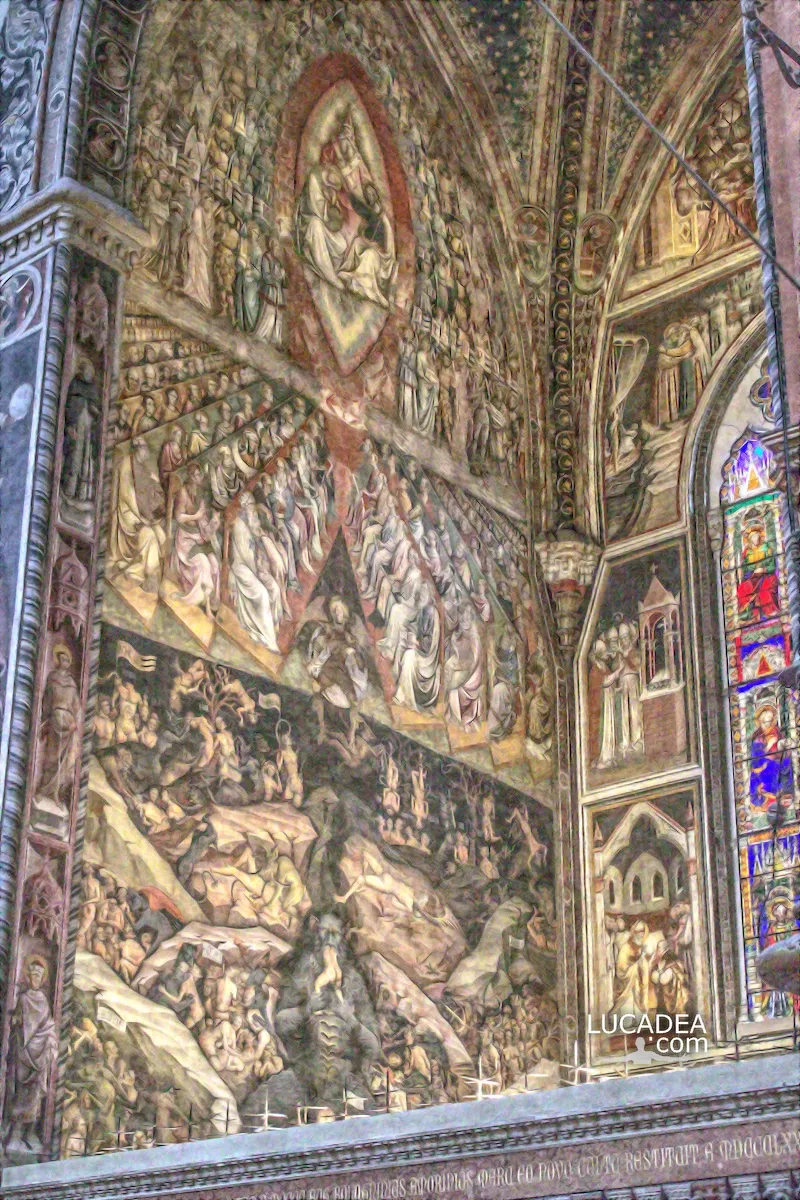
In Bologna, Emilia-Romagna, Italy, the Bolognini Chapel inside the Basilica of San Petronio houses one of the most striking fresco cycles of Italian medieval art: the Last Judgment by Giovanni da Modena. Photographing this monumental composition is a fascinating experience, as the eye keeps discovering new details in both the depiction of Paradise and the dramatic scenes of Hell.
When I stood in front of this wall, I tried to capture as much of the composition as possible in a single photograph. Unfortunately, I had to take the picture from an angle, so the perspective is not ideal. Nevertheless, I think the image still conveys something of the richness and complexity of the artwork. With a scene this crowded with figures and details, even a photograph taken from an oblique position can offer plenty to explore.
What strikes me most is the contrast between the two worlds depicted. On one side is Paradise, with its sacred figures and the solemnity of the heavenly scene. Below, Hell is filled with the damned and terrifying creatures, portrayed in a dramatic and remarkably detailed way. Giovanni da Modena created a visual world in which every section seems to tell its own story, inviting visitors to stop, look closely and gradually discover the many elements within the fresco.
The painting dates to the fifteenth century and occupies the left wall of the Bolognini Chapel, also known as the Chapel of the Magi. The chapel contains other important scenes, but the depictions of Paradise and Hell are among the most memorable parts of the cycle. The images have considerable narrative power: they do more than decorate the walls, conveying ideas, fears and beliefs through expressive gestures, faces and a wide variety of situations.
Photographing a work of art like this also means accepting certain limitations. The position from which you take the picture, the perspective and the conditions inside a church may prevent you from achieving the composition you had hoped for. In this case, however, I preferred to take the photograph rather than miss the opportunity altogether. Looking at the image afterwards, I can still examine its many details and remember the impression made by standing in front of such an extraordinary wall.
This is what I enjoy most about photographing art: it is not simply about documenting what I see, but also about preserving an image that allows me to return to the experience later. A photograph can never replace seeing a masterpiece in person, but it can keep the memory alive and encourage us to look again.

Have you ever seen Giovanni da Modena’s Last Judgment? Which detail of this remarkable fresco would catch your attention first? Add a comment or go to the bottom of the site to read what other visitors have written.

Angled photograph of Giovanni da Modena's Last Judgment fresco in the Bolognini Chapel of San Petronio Basilica in Bologna, Italy

Photo taken with Canon EOS M100 and Tamron 16-300 lens.

Click here to see all the photos I took in San Petronio:

The Main Altar of the Basilica of San Petronio in Bologna

L'altare maggiore della Basilica di San Petronio a Bologna

The Main Altar of the Basilica of San Petronio in Bologna.
In the heart of the city, overlooking Maggiore Square, stands one of the most important and impressive churches in the Emilia-Romagna region. Inside the basilica, towards the apse, the eye is immediately drawn to the main altar and the magnificent architectural structure rising above it. This monumental ensemble deserves to be admired at leisure, especially when you consider the long and complicated history of the church’s construction.
The Basilica of San Petronio is dedicated to Bologna’s patron saint, a bishop who lived in the fifth century and played an important role in the city’s religious and civic history. The foundation stone was laid on 7 June 1390, following a design by the architect Antonio di Vincenzo. The construction was commissioned by the Municipality of Bologna, which wanted a religious building capable of expressing the city’s importance and identity.
The original project was extraordinarily ambitious. The plan was to create a basilica even larger than the one we see today, with a Latin cross layout and an enormous transept. Over the centuries, however, financial difficulties, political changes and practical problems on the building site led to the original design being scaled down. The basilica therefore remained unfinished in comparison with the initial plans. This is particularly evident on the façade, whose lower section is covered in marble while the upper part remains exposed brick.
The area around the main altar also has a distinctive architectural history. After several projects and changes, the present arrangement of the apse took shape during the seventeenth century. The monumental structure above the altar, known as the ciborium, was designed by Gian Giacomo Monti and built between 1662 and 1663. The sculptures of the tribune were created by Giovan Battista Barberini. It is fascinating to think that such an important part of the basilica was completed several centuries after construction of the church had begun.
The photograph gives a good impression of the scale of the main altar and its position within the apse. The rich decoration, columns and elaborate upper structure create a striking focal point, naturally drawing the visitor’s gaze towards the sanctuary. It is a solemn space and a fine example of how different artistic styles and tastes came together during the basilica’s long history.
San Petronio also contains numerous works of art, richly decorated side chapels and a famous meridian line. It was first created by Egnazio Danti in 1576 and later modified by Gian Domenico Cassini. There is therefore plenty to discover inside the church, even beyond its best-known features.

I enjoy stopping to admire architectural details like these because they tell us so much about a building’s history, often more than a general view can reveal. Have you ever visited San Petronio and taken a closer look at its magnificent main altar? Add a comment or go to the bottom of the site to read what other visitors have written.

The main altar of the Basilica of San Petronio in Bologna, featuring the monumental ciborium inside the apse

Photo taken with Canon EOS M100 and Tamron 16-300 lens.

Click here to see all the photos I took in San Petronio:

🏠
  • Italiano