
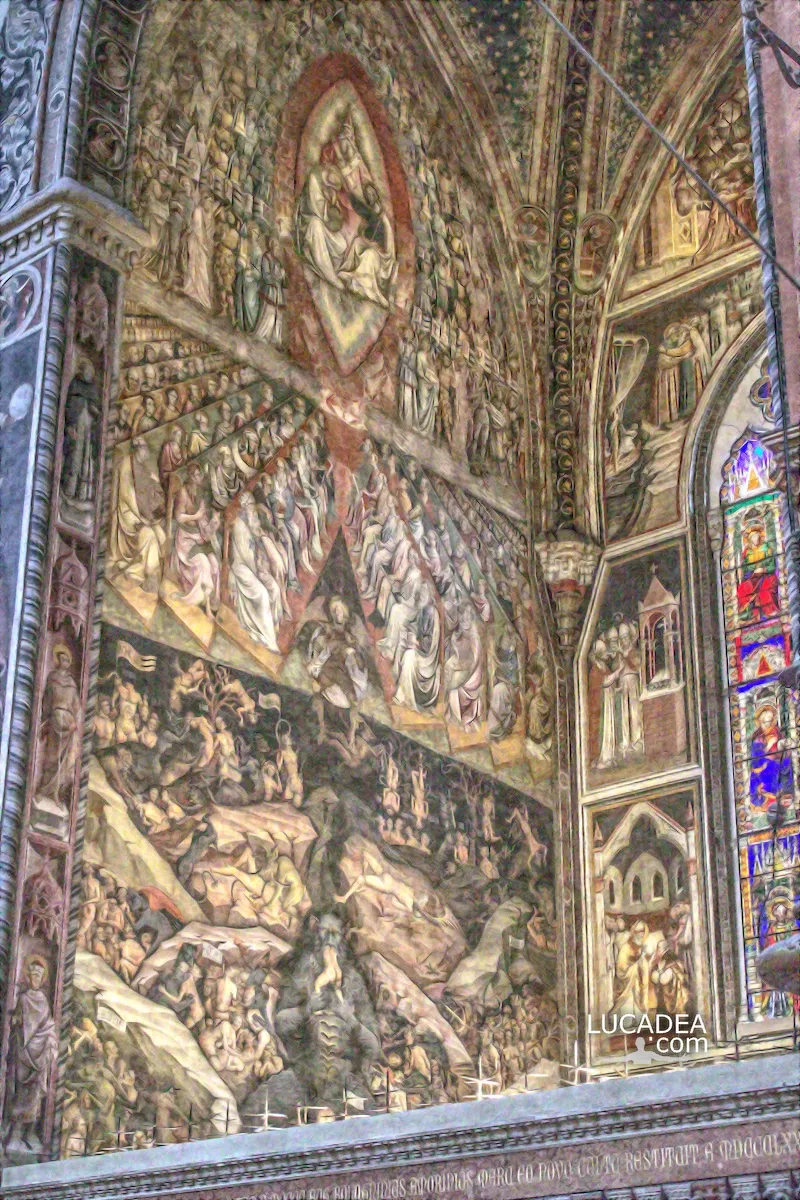

The Last Judgment in the Bolognini Chapel
The Last Judgment in the Bolognini Chapel.
In Bologna, Emilia-Romagna, Italy, the Bolognini Chapel inside the Basilica of San Petronio houses one of the most striking fresco cycles of Italian medieval art: the Last Judgment by Giovanni da Modena. Photographing this monumental composition is a fascinating experience, as the eye keeps discovering new details in both the depiction of Paradise and the dramatic scenes of Hell.
When I stood in front of this wall, I tried to capture as much of the composition as possible in a single photograph. Unfortunately, I had to take the picture from an angle, so the perspective is not ideal. Nevertheless, I think the image still conveys something of the richness and complexity of the artwork. With a scene this crowded with figures and details, even a photograph taken from an oblique position can offer plenty to explore.
What strikes me most is the contrast between the two worlds depicted. On one side is Paradise, with its sacred figures and the solemnity of the heavenly scene. Below, Hell is filled with the damned and terrifying creatures, portrayed in a dramatic and remarkably detailed way. Giovanni da Modena created a visual world in which every section seems to tell its own story, inviting visitors to stop, look closely and gradually discover the many elements within the fresco.
The painting dates to the fifteenth century and occupies the left wall of the Bolognini Chapel, also known as the Chapel of the Magi. The chapel contains other important scenes, but the depictions of Paradise and Hell are among the most memorable parts of the cycle. The images have considerable narrative power: they do more than decorate the walls, conveying ideas, fears and beliefs through expressive gestures, faces and a wide variety of situations.
Photographing a work of art like this also means accepting certain limitations. The position from which you take the picture, the perspective and the conditions inside a church may prevent you from achieving the composition you had hoped for. In this case, however, I preferred to take the photograph rather than miss the opportunity altogether. Looking at the image afterwards, I can still examine its many details and remember the impression made by standing in front of such an extraordinary wall.
This is what I enjoy most about photographing art: it is not simply about documenting what I see, but also about preserving an image that allows me to return to the experience later. A photograph can never replace seeing a masterpiece in person, but it can keep the memory alive and encourage us to look again.
Have you ever seen Giovanni da Modena’s Last Judgment? Which detail of this remarkable fresco would catch your attention first? Add a comment or go to the bottom of the site to read what other visitors have written.

Photo taken with Canon EOS M100 and Tamron 16-300 lens.
Click here to see all the photos I took in San Petronio:

More articles on this topic:
The rights on images, videos, choruses, text and all other material on the LUCADEA.com website are governed as per Copyright page.
