Modena Cathedral and the Ghirlandina Tower

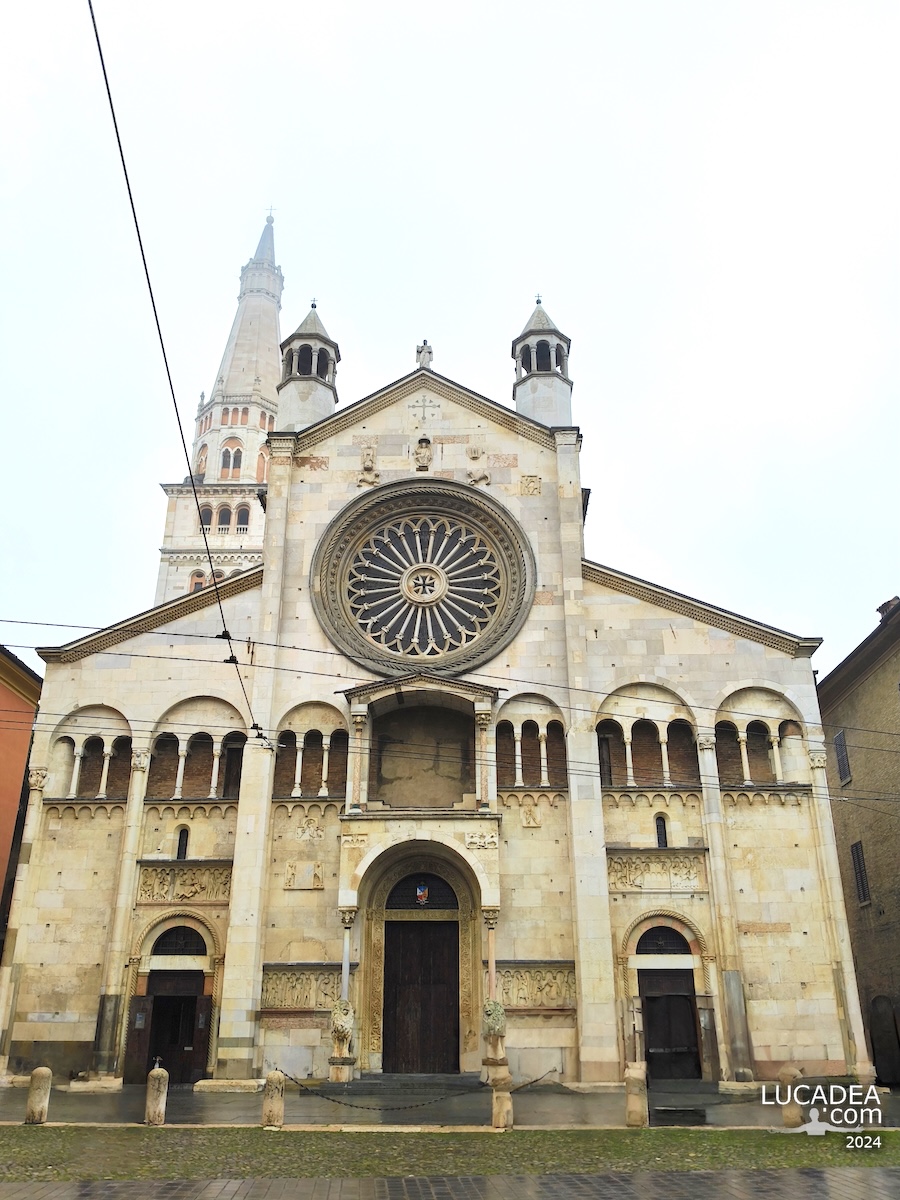
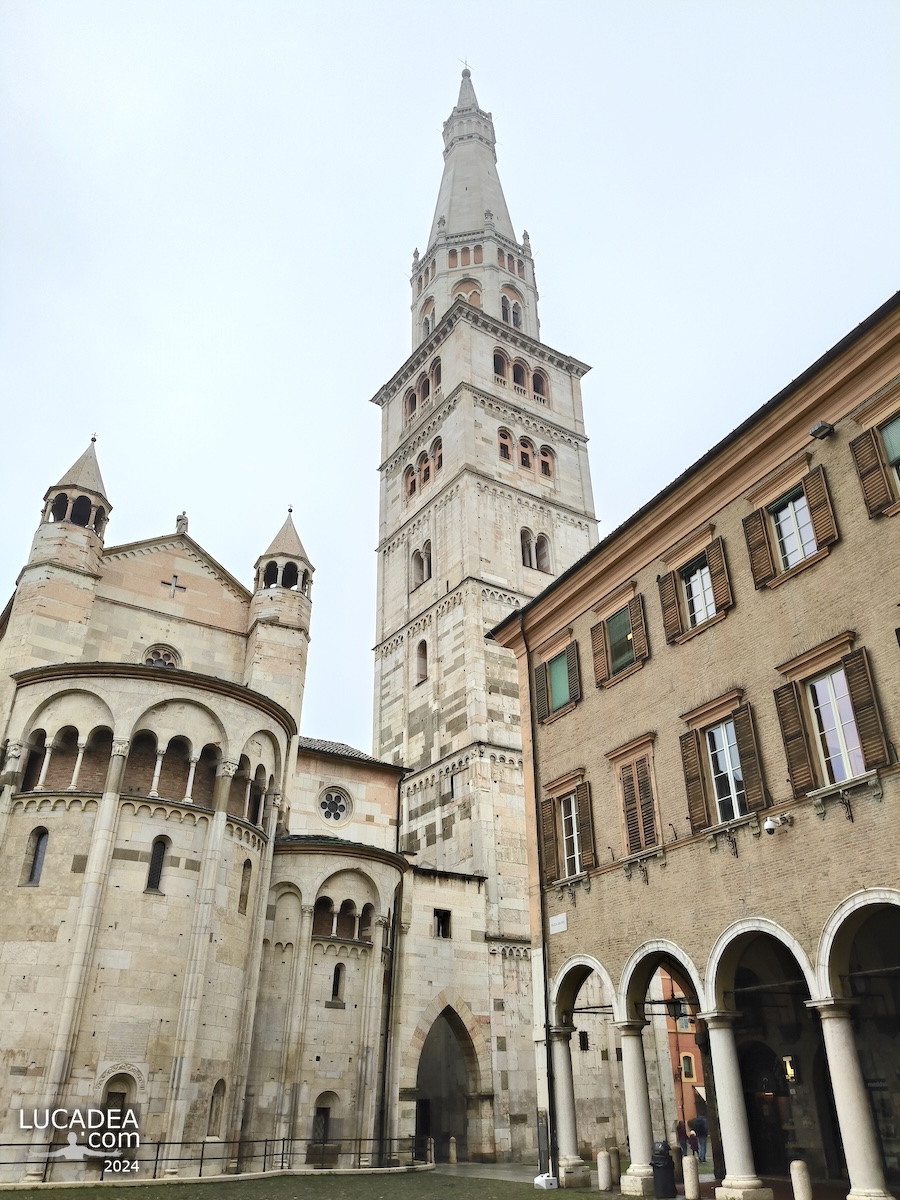
Duomo di Modena in due vedute: la facciata romanica della cattedrale e il lato con la torre Ghirlandina

Modena Cathedral and the Ghirlandina Tower.
In Modena, Emilia-Romagna, Italy, the Cathedral of the Assumption of the Virgin Mary and Saint Geminianus is one of the most remarkable monuments to discover while exploring the historic centre. In these two photographs, I wanted to capture two different views of the same monumental complex: the first shows the magnificent main façade, while the second offers a side view with the imposing Ghirlandina Tower rising beside the cathedral.
The cathedral’s façade immediately stands out for the richness of its Romanesque architecture. The light-coloured stone, sculpted decorations, entrance portal and large rose window come together in a remarkably balanced composition. Looking more closely reveals countless details worth appreciating: figures, reliefs and decorative elements that tell religious and symbolic stories. This is not a façade to admire only from a distance. Every time you focus on a particular section, another interesting detail seems to emerge.
Construction of the cathedral began in 1099, following the design of the architect Lanfranco. The celebrated sculptures were largely created by Wiligelmo and his workshop. The building is regarded as one of the greatest masterpieces of European Romanesque architecture. Together with Piazza Grande and the Civic Tower, it was included on the UNESCO World Heritage List in 1997.
The second photograph shows the complex from another angle. Here, the Ghirlandina Tower also takes centre stage. This impressive bell tower rises above the historic centre and has become one of Modena’s most recognisable landmarks. It stands approximately 89 metres tall and is closely connected to the identity of the cathedral and the city itself. According to tradition, its name refers to the marble balustrades decorating its upper sections, which resemble delicate garlands. Seen beside the cathedral, the tower creates a striking architectural composition.
I enjoy photographing monuments like this from different viewpoints because a single image cannot always convey the full character of a place. The front view highlights the richness of the decorations and the grandeur of the cathedral, while the side view reveals the relationship between the building and its famous tower. Together, the two photographs offer a more complete impression of this remarkable historic landmark.
These are two views of one of the most beautiful places in Modena, where art, history and architecture come together in a truly memorable setting.

Have you ever visited Modena Cathedral? Which view do you find more impressive: the richly decorated façade or the elegant Ghirlandina Tower? Add a comment or go to the bottom of the site to read what other visitors have written.
Photos taken with Oppo Reno 12.

To see all the photos of the city, click here:

Add one  comment to this article or read  here what other visitors have written.
 
Adv
 
Disclamer

The rights on images, videos, choruses, text and all other material on the LUCADEA.com website are governed as per  Copyright page.


This page has been viewed 0 times today.
This month it has been viewed 0 times.
In total it has been viewed 0 times.
 

Biduino’s Medieval Carving at San Salvatore in Lucca

L'architrave scolpita da Biduino della chiesa di San Salvatore a Lucca

Biduino’s Medieval Carving at San Salvatore in Lucca.
Walking through the historic streets of Lucca, in Tuscany, it is almost impossible not to come across something beautiful or interesting at every turn. Sometimes it is a famous monument, while on other occasions it is a small architectural detail that could easily go unnoticed unless you stop and take a closer look. This carved stone lintel, set into the façade of the ancient church of San Salvatore, is one of those details. It is a reminder of the remarkable artistic heritage preserved throughout this historic city.
The church, also known as San Salvatore in Mustolio, is documented as early as 1009 and was rebuilt during the 12th century. It stands in Piazza San Salvatore, in an area of the old town where Lucca’s history can be discovered in its churches, palaces and medieval buildings. Compared with some of the city’s more elaborate religious façades, the exterior of San Salvatore may seem rather modest. However, a closer look at its doorways reveals some fascinating works of medieval sculpture.
The carved lintel in this photograph is one of them. Its surface is filled with figures and architectural details that illustrate a religious story. In medieval times, sculptures placed above church entrances were not simply decorative elements. They often had a narrative and symbolic purpose, presenting episodes from religious tradition to the people who visited or passed by the church. In a way, the façade became a page carved in stone, telling stories that could be understood even by those who could not read written texts.
These works are associated with the artistic circle of Biduino, a sculptor active during the second half of the 12th century in the areas of Lucca and Pisa. He is an important figure in the development of Romanesque sculpture in Tuscany. His name is particularly valuable to art historians because some of his works carry his signature, offering direct evidence of an individual artist at a time when many sculptural projects were produced by workshops and groups of craftsmen.
There is an interesting distinction between the two carved lintels at San Salvatore. The relief on the façade is generally associated with Biduino’s workshop or artistic circle, while the lintel on the side doorway is the one that bears his signature. Both works are connected with stories from the life of Saint Nicholas. The façade relief illustrates the legend of the golden bowl, involving a banquet held by a Saracen ruler and a young man named Adeodatus, who is eventually returned to his family through the saint’s intervention. The signed side lintel depicts the first washing of the newborn Saint Nicholas, who, according to tradition, stood upright in the bathing basin while being washed.
I find it fascinating to think about how many generations have passed in front of these sculptures. They have witnessed changes to the city, its streets and the everyday lives of its residents, yet they still attract the attention of visitors today. The stone has naturally been marked by the passage of time, but these signs of age also give the carvings a special character. Looking closely, it is possible to appreciate the figures and the craftsmanship that went into creating them.
Lucca is a city that rewards anyone who enjoys exploring on foot without necessarily following a strict itinerary. Beyond its famous walls, squares and major churches, it preserves countless smaller details waiting to be discovered: a medieval doorway, a carved capital, a relief or an ornament set into an old façade. San Salvatore is one of those places where it is worth stopping for a moment. Something that might initially seem like a minor architectural feature can reveal a story stretching back almost a thousand years.
With this photograph, I wanted to draw attention to one of these remarkable examples of medieval sculpture. It is a small piece of history carved in stone, right in the heart of a city that continues to surprise anyone willing to look beyond its most famous landmarks.

And what about you? When visiting Lucca, do you take time to look for details like these on the façades of its churches, or do you tend to focus on the city’s best-known monuments? Add a comment or go to the bottom of the site to read what other visitors have written.

Medieval Romanesque carved stone lintel on the façade of San Salvatore church in the historic centre of Lucca, Tuscany

Photo taken with a Canon EOS M100 camera and Canon EF-S 10-18 lens.

To see all the photos I took, over a couple of visits, to Lucca click here:
foto gallery

Add one  comment to this article or read  here what other visitors have written.
 
Adv
 
Disclamer

The rights on images, videos, choruses, text and all other material on the LUCADEA.com website are governed as per  Copyright page.


This page has been viewed 1 times today.
This month it has been viewed 2 times.
In total it has been viewed 2 times.
 

The Medieval Cloister of Bologna’s Seven Churches

Il chiostro delle Sette Chiese a Bologna

The Medieval Cloister of Bologna’s Seven Churches.
In the heart of Bologna, in the Emilia-Romagna region of Italy, the Santo Stefano complex contains one of the city’s most atmospheric architectural spaces: the medieval cloister of the Benedictine monastery. Its arcades, columns and two levels of galleries create a beautiful setting where centuries of religious and architectural history can still be appreciated.
This photograph focuses on the upper gallery, with its graceful sequence of columns and arches. I was drawn to the rhythm of the architecture and the way the individual elements come together to form a harmonious whole. The repeated shapes create a sense of balance, while the details of the stonework give the gallery its distinctive medieval character. It is the kind of place where taking a little time to look around makes all the difference.
The cloister belonged to the Benedictine monastery that developed alongside the churches of Santo Stefano. Its two levels were built in different periods: the lower section probably dates back to the eleventh century, while the upper gallery was added during the second half of the twelfth century. The result is an architectural space that brings together different stages of medieval construction.
The Santo Stefano complex is commonly known as the Seven Churches because it brings together several religious buildings and spaces that were constructed and modified over many centuries. The visitor’s route includes the Church of the Crucifix, the Basilica of the Holy Sepulchre, the Church of Saints Vitale and Agricola, Pilate’s Courtyard and the medieval cloister. According to tradition, the complex was conceived as a symbolic representation of important places associated with Christian Jerusalem.
One of the most fascinating details can be found in the capitals decorating the columns. Some feature unusual human and animal figures, particularly along the western side of the cloister. Local tradition connects these sculptures with Dante Alighieri, suggesting that they may have inspired some of the punishments described in the Divine Comedy. It is an intriguing story rather than a proven historical fact, but it certainly encourages visitors to examine the carvings more closely.
What I particularly enjoy about Santo Stefano is that it is not simply a monumental church to admire from the outside. It is a sequence of interconnected spaces, each with its own atmosphere and historical character. Moving from one area to another offers a different perspective on Bologna’s religious and architectural heritage. In my other photographs of the city, I also enjoy focusing on these smaller details that are easy to overlook during a first visit.

I took this photograph to capture the beauty of the upper gallery and the elegant lines of its columns. If you are visiting Bologna and wondering what to see beyond the city’s famous towers and porticoes, the Santo Stefano complex is well worth including in your itinerary. Have you ever explored this remarkable medieval cloister? Add a comment or go to the bottom of the site to read what other visitors have written.

Upper gallery with medieval columns in the Benedictine cloister of the Seven Churches complex in Bologna, Italy

Photo taken with Canon EOS M100 and Tamron 16-300 lens.

If you want to see all the photos I took in the city, click here:

This is the official website: santostefanobologna.it.

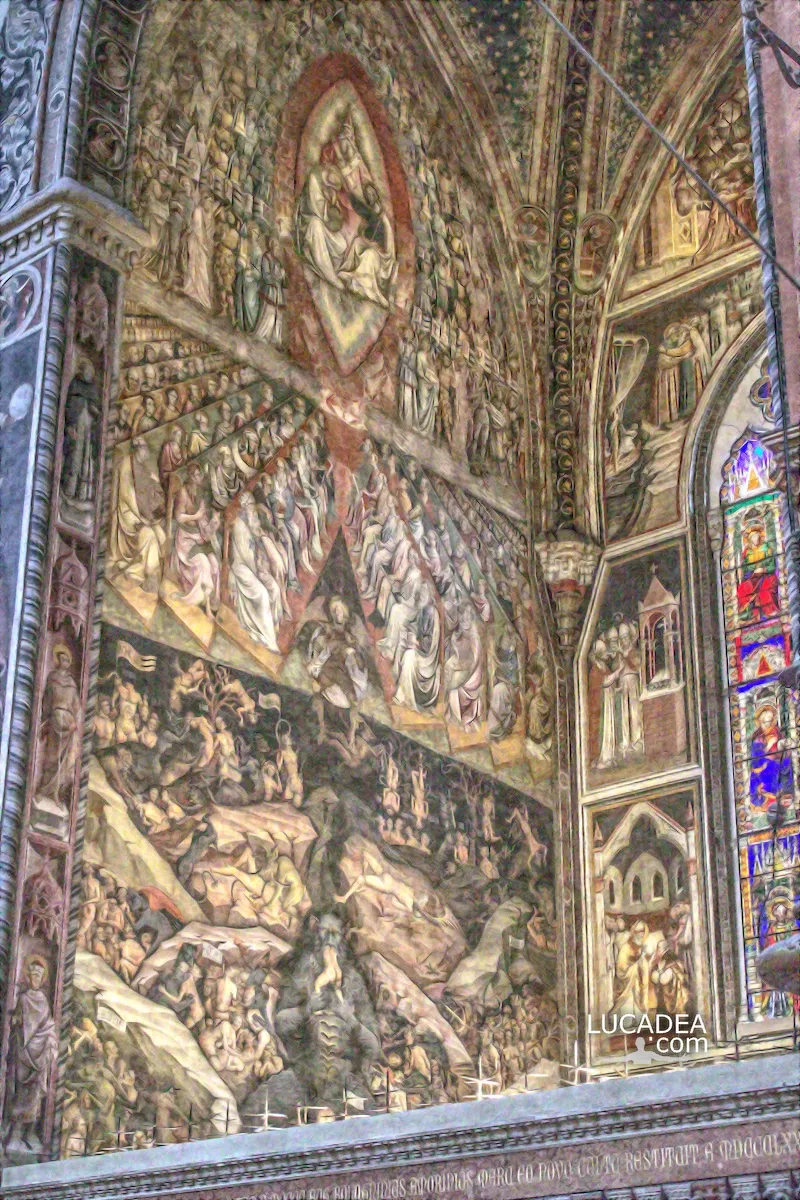
The Last Judgment in the Bolognini Chapel

Il Giudizio Universale nella Cappella Bolognini del Duomo di Bologna

The Last Judgment in the Bolognini Chapel.
In Bologna, Emilia-Romagna, Italy, the Bolognini Chapel inside the Basilica of San Petronio houses one of the most striking fresco cycles of Italian medieval art: the Last Judgment by Giovanni da Modena. Photographing this monumental composition is a fascinating experience, as the eye keeps discovering new details in both the depiction of Paradise and the dramatic scenes of Hell.
When I stood in front of this wall, I tried to capture as much of the composition as possible in a single photograph. Unfortunately, I had to take the picture from an angle, so the perspective is not ideal. Nevertheless, I think the image still conveys something of the richness and complexity of the artwork. With a scene this crowded with figures and details, even a photograph taken from an oblique position can offer plenty to explore.
What strikes me most is the contrast between the two worlds depicted. On one side is Paradise, with its sacred figures and the solemnity of the heavenly scene. Below, Hell is filled with the damned and terrifying creatures, portrayed in a dramatic and remarkably detailed way. Giovanni da Modena created a visual world in which every section seems to tell its own story, inviting visitors to stop, look closely and gradually discover the many elements within the fresco.
The painting dates to the fifteenth century and occupies the left wall of the Bolognini Chapel, also known as the Chapel of the Magi. The chapel contains other important scenes, but the depictions of Paradise and Hell are among the most memorable parts of the cycle. The images have considerable narrative power: they do more than decorate the walls, conveying ideas, fears and beliefs through expressive gestures, faces and a wide variety of situations.
Photographing a work of art like this also means accepting certain limitations. The position from which you take the picture, the perspective and the conditions inside a church may prevent you from achieving the composition you had hoped for. In this case, however, I preferred to take the photograph rather than miss the opportunity altogether. Looking at the image afterwards, I can still examine its many details and remember the impression made by standing in front of such an extraordinary wall.
This is what I enjoy most about photographing art: it is not simply about documenting what I see, but also about preserving an image that allows me to return to the experience later. A photograph can never replace seeing a masterpiece in person, but it can keep the memory alive and encourage us to look again.

Have you ever seen Giovanni da Modena’s Last Judgment? Which detail of this remarkable fresco would catch your attention first? Add a comment or go to the bottom of the site to read what other visitors have written.

Angled photograph of Giovanni da Modena's Last Judgment fresco in the Bolognini Chapel of San Petronio Basilica in Bologna, Italy

Photo taken with Canon EOS M100 and Tamron 16-300 lens.

Click here to see all the photos I took in San Petronio:

🏠
  • Italiano