Jolly Beach, a Dream Beach in Antigua

Spiagge da sogno: la bellissima Jolly Beach ad Antigua

Jolly Beach, a Dream Beach in Antigua.
Among the beaches in Antigua that I have had the chance to visit, Jolly Beach is one of the ones I remember most clearly: a long stretch of white sand along Lignum Vitae Bay, with the sea in front and several resorts behind the beach. When I think about what to see in Antigua, this is one of the places that comes back to me almost immediately.
Someone once told me that Antigua is also known as “the island of 365 beaches”, supposedly one for every day of the year. I could not tell you whether that number is exact, but I can say that I personally visited at least ten of them and, up to that point, I had not found a single one that I would call disappointing.
Jolly Beach was one of those beaches that seemed to keep going. The pale sand stretched along the bay, creating a strong sense of space, while the coastline seemed to open out in front of me. I took this photograph myself because I wanted to preserve that first impression: not just the appearance of the beach, but the feeling of seeing such a long Caribbean shoreline in front of me.
Jolly Beach is on Antigua, in Antigua and Barbuda in the Caribbean, along the island’s western coast at Lignum Vitae Bay. The setting helps explain the character of the beach. The sea and sand dominate the view, while a number of resorts are located behind the shoreline. Even with the presence of those buildings, what stayed with me was the simple image of a long Caribbean beach stretching along the bay.
The famous idea of Antigua having 365 beaches is best understood as a way of describing the island’s remarkable variety of bays and beaches rather than as a number I would personally try to verify one by one. In my own experience, though, the phrase certainly felt appropriate. After visiting several beaches, I was surprised by how different they could be in shape, surroundings and atmosphere while still belonging to the same relatively small island.
Jolly Beach stood out to me because of its length. Some beaches are memorable because they form a small, enclosed cove or because of a particularly striking viewpoint. Here the feeling was completely different. The shoreline seemed to extend in both directions, encouraging me simply to look along it and take in the scale of the bay.
If you are visiting Antigua and wondering what is worth seeing, Jolly Beach is the kind of place that makes sense to experience without trying to turn the visit into a checklist. For me, the value of the photograph is precisely in that simple moment of being there and noticing the relationship between the white sand, the bay and the buildings behind the beach.
Photography also gives me a way of bringing back the physical memory of a place. Years later, looking at this image still makes me think of that stretch of coast and of the feeling that there were always more beaches to discover. I had already seen several parts of Antigua, yet every new beach seemed to offer a slightly different version of the island.
This photograph also connects naturally with the other Caribbean images I have shared on the blog. Each beach left me with a different memory, and comparing them afterwards makes me appreciate how much variety can be found across Antigua. Jolly Beach, however, has always remained particularly easy for me to remember.
There is a small curiosity behind the name of the bay. Lignum vitae is the name of a group of tropical trees famous for their extremely dense and durable wood. The Latin expression means “wood of life” and has historically been associated with several species of these trees. It is a small detail, but I like how a place name can carry a piece of natural history with it.
I would not try to decide whether Jolly Beach was the single most beautiful beach I visited in Antigua. There were too many different places and too many different impressions for such a ranking to mean much to me. I can say, however, that this is one of the beaches I remember most immediately whenever I think back to the island.
Perhaps that is why this photograph still feels like a dream beach to me. Not because it was somehow perfect in every possible sense, but because at that moment it looked remarkably close to the image many of us have in mind when we imagine a Caribbean beach: white sand, open water, a long shoreline and plenty of space to simply stop and look.

Which beach in Antigua has stayed in your memory the longest? Add a comment or go to the bottom of the site to read what other visitors have written.

Jolly Beach in Antigua, a long stretch of white sand along Lignum Vitae Bay with resorts behind the shore

Jolly Beach in Antigua, a long stretch of white sand along Lignum Vitae Bay with resorts behind the shore

Jolly Beach in Antigua, a long stretch of white sand along Lignum Vitae Bay with resorts behind the shore

Photos taken with the GoPro Hero 10 Black.

Here is where the beach is located:

Add one  comment to this article or read  here what other visitors have written.
 
Adv
 
Disclamer

The rights on images, videos, choruses, text and all other material on the LUCADEA.com website are governed as per  Copyright page.


This page has been viewed 1 times today.
This month it has been viewed 1 times.
In total it has been viewed 1 times.
 

Grand Anse waves from right in the water

Onde che si infrangono sulla spiaggia di Grand Anse viste da vicino con prospettiva bassa sull’acqua e spruzzi in primo piano

Grand Anse waves from right in the water.
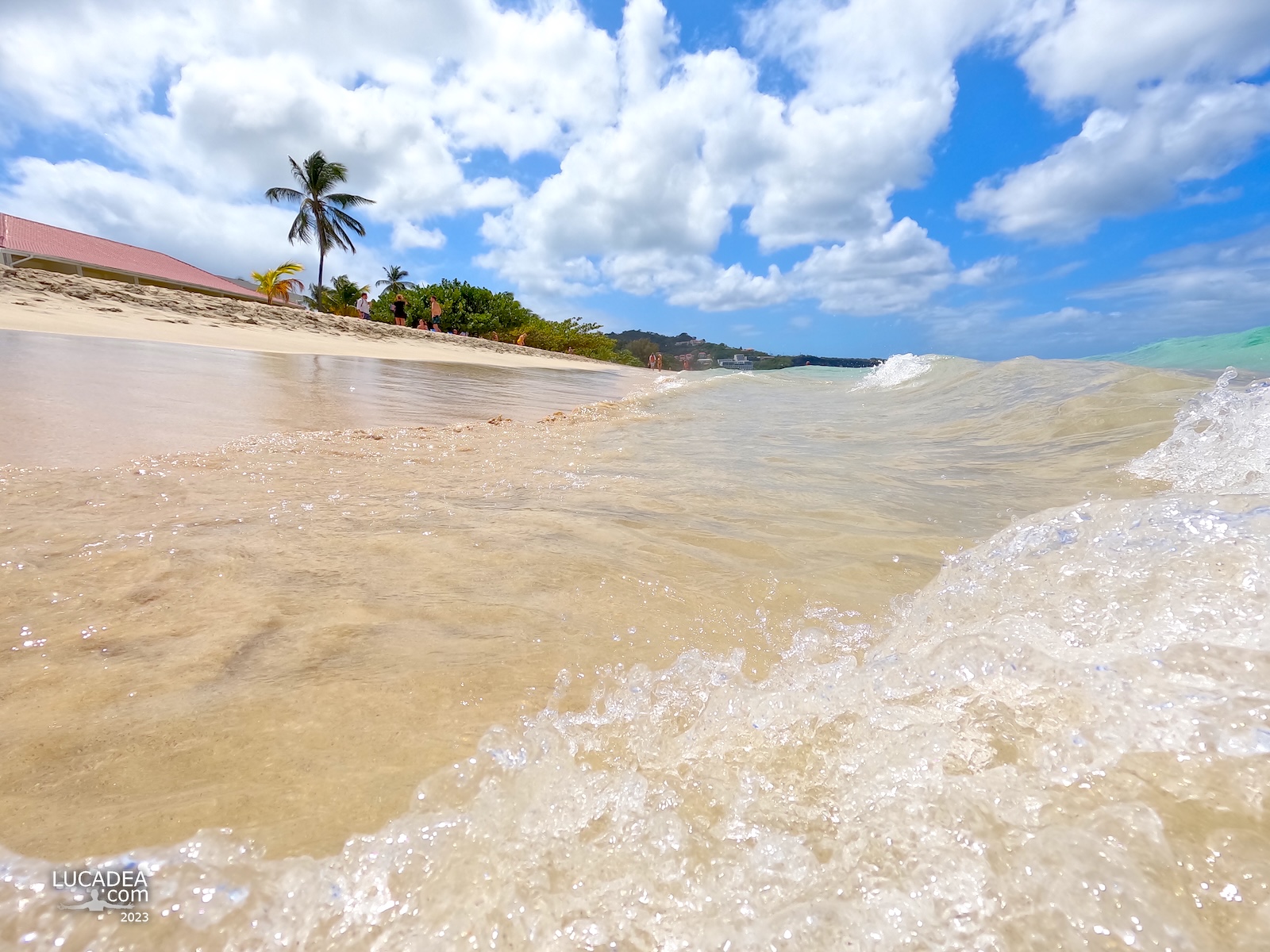
On the island of Grenada in the Caribbean, I was practically standing in the sea when I took this photograph, with my GoPro just skimming the surface as the waves came towards me. It is a completely different viewpoint from watching the water from the shore because the camera is almost inside the movement itself.
I deliberately kept the camera very low, almost at the same level as the waves. I wanted to photograph Grand Anse not simply as a beach seen from a distance, but as a place to physically enter, even if only for the few moments needed to capture the image.
What I remember most clearly is the feeling of being part of the movement. When you are this close to the surface, an approaching wave no longer looks the same as it does from the beach. You see it coming, changing shape, rising and then breaking almost directly in front of the lens. Every small movement completely changes the scene.
The sound of the water was also much more intense from that position. The splashes suddenly became part of the subject, and a slightly larger wave was enough to leave me completely wet. Taking photographs under those conditions also requires a certain amount of attention because there is not always time to wait for the perfect composition.
In fact, I was not thinking too much about composition at that moment. I was mainly trying to follow the rhythm of the sea and press the shutter whenever the shape of a wave seemed particularly interesting. It is a fairly instinctive way of photographing, where you have to accept that the water will partly determine the final result.
If you are wondering what to see in Grenada, Grand Anse is naturally one of the places most closely associated with the island. For me, however, this photograph tells a different story from the usual Caribbean beach image. I was not interested in simply showing the sand and the panorama. I wanted to get close enough to make the wave itself the main subject.
Grand Anse is on the island of Grenada, in the Caribbean country of Grenada, and is one of the island’s best-known beaches. Its long stretch of pale sand and the sea in front of it create a very recognisable landscape, but getting close to the water reveals much less obvious details.
One small curiosity is that the name Grand Anse, which appears in several parts of the Caribbean, refers to the idea of a large bay or large beach. In Grenada, the name suits the long curve of the shoreline particularly well, creating very different views depending on where you stand.
What interested me, though, was not the beach as a whole but the surface of the water itself. From close up, the waves become almost temporary pieces of architecture: transparent crests, broken reflections, splashes and shapes that exist for only a few seconds before disappearing.
That is one of the things I enjoy most about photographing the sea. A seemingly simple landscape is constantly changing, and it is impossible to capture exactly the same wave twice. Even if you remain in exactly the same position, a few seconds are enough to create a completely different scene.
On this occasion, the GoPro allowed me to search for precisely that close perspective that would be difficult to achieve while staying completely dry on the beach. Keeping a camera so close to the water means accepting a certain amount of unpredictability, but it also produces images that can better convey the feeling of actually being inside the scene.
Looking back at the photographs, I realised that I was not simply trying to freeze a wave. What I wanted to preserve was the feeling of being there, with the water practically in front of the camera and the movement of the sea constantly deciding what would enter the frame.
It is a perspective that changes the way you look at Grand Anse. From a distance, the beach is a large landscape. From close up, it becomes a sequence of small events, each one different from the previous one. That difference is exactly what I like remembering through photography.
In other stories on my photo blog I have also photographed places from unusual perspectives, trying to move beyond the classic panoramic view. Here, instead of moving away from the subject, I chose to get as close to it as possible.
In the end, I think that is why I like this photograph. For a few moments, the sea was no longer something I was simply watching. I was inside its movement, with the camera only a few centimetres above the surface.

Would you have dared to take your camera this close to the waves? Add a comment or go to the bottom of the site to read what other visitors have written.

Photos taken with Gopro Hero 10 black.

Add one  comment to this article or read  here what other visitors have written.
 
Adv
 
Disclamer

The rights on images, videos, choruses, text and all other material on the LUCADEA.com website are governed as per  Copyright page.

This page has been viewed 5 times today.
This month it has been viewed 5 times.
In total it has been viewed 5 times.
 

Dream beaches on Catalina Island

Spiaggia di Catalina Island nei Caraibi al mattino, ancora tranquilla prima dell’arrivo dei passeggeri

Dream beaches on Catalina Island. In the morning, before the passengers had arrived, the beach looked completely different from how it would appear a few hours later. Catalina Island is one of the Caribbean places I remember most fondly, especially because of the contrast between the quiet beginning of the day and all the work taking place behind the scenes to prepare everything for the arriving passengers.
With this photograph, I wanted to keep that feeling of calm before the day really started. The water, sand and open spaces made it feel as though there was a small corner of the island entirely to myself. Yet behind that apparently peaceful scene, there was already plenty of activity: people were working to organize the beach and get everything ready for the visitors who would soon arrive.
That is actually what I remember most when I look at the photograph. From a visitor’s point of view, a Caribbean beach can seem almost magically ready to welcome everyone. In reality, behind the sun loungers, facilities, services and neatly arranged spaces, there is a great deal of daily work that usually remains outside the frame.
Catalina Island, in the Caribbean, was a particularly pleasant discovery for me. After seeing many different places while working on cruise ships, some landscapes stay in my memory longer than others, and this is certainly one of them. Not only because of the beach itself, but also because of the particular moment when I was able to see it.
Sometimes finding an interesting photograph is simply a matter of waiting. Instead of photographing the beach once it was filled with people, I liked capturing the moment just before that happened, when everything still seemed quiet and the day had not yet begun. The image therefore tells a small part of the story that visitors do not normally see.
If you are wondering what to see on Catalina Island, the beaches and Caribbean waters are obviously among the main attractions. But looking at this scene also makes me think about the relationship between the natural landscape and the activities that make it possible for visitors to enjoy it. The beauty in the photograph is accompanied by a considerable amount of everyday work.
One small curiosity about the island is that Catalina is known not only for its coastline but also for its distinctive vegetation and wildlife. The landscape is therefore much more than a Caribbean beach, with natural areas that give the island a character of its own.
For me, though, the memory remains tied to that particular morning. Few people, a quiet beach and the feeling that the whole day was still waiting to begin. It is quite different from the image usually associated with a busy Caribbean destination.
After sharing other photographs of Caribbean beaches and coastal scenes, this image adds another small perspective to the journey: not only the paradise seen by visitors, but also the moments before their arrival, when someone is already working to make everything ready.
That is perhaps the detail I like most when I look back at the photograph. The beach appears completely peaceful, but I know that behind that calm scene, a working day had already begun.

Have you ever seen a tourist beach before the visitors arrived, when everything was still being prepared? Add a comment or go to the bottom of the site to read what other visitors have written.

Catalina Island beach in the Caribbean on a quiet morning before the passengers arrived

Here are a couple of videos I recorded during my 2022 visit:

Videos recorded with GoPro Hero 10 Black.

Catalina Island (Isla Catalina) is a tropical island in the Caribbean Sea, located approximately 2 km off the southeastern coast of the Dominican Republic; it is part of the country and belongs to the La Romana province.
Read more on Wikipedia

Kenting Beach, a dream shore in Taiwan

Kenting Beach a Taiwan con sabbia dorata, mare limpido e vegetazione tropicale sulla costa

Kenting Beach, a dream shore in Taiwan.
Among the beaches I photographed during my journey through Taiwan, Kenting Beach remains one of the places that impressed me the most. The golden sand, the clear sea and the tropical vegetation created a landscape that was very different from the coastal views I usually see. This beach in Kenting was not the typical white sand destination with coral reefs, but its natural colors gave it a unique character.
I remember being attracted by the combination of the shoreline, the mangrove plants and the palm trees behind the beach. I wanted to capture that balance between sea and vegetation with my camera because it showed a quieter side of Taiwan’s coast. Sometimes the places that look different from our expectations are the ones that create the strongest memories.
This photograph was taken in Kenting, Pingtung County, Taiwan, in the southern part of the island. The area is known for its natural landscapes, where beaches, rocky coastlines and tropical environments come together. While many visitors search for the most famous seaside locations, I found this view interesting because it showed a more natural and less crowded side of the coast.
The beach looked perfect for swimming, but at that moment it was not possible to enter the water in the area I photographed, probably because of environmental protection rules. The landscape seemed to have priority over tourism, with nature remaining the main element of the scene.
Later, I went to a nearby beach where the atmosphere was completely different. There were many Taiwanese visitors enjoying their day, with people swimming and riding jet skis. That contrast was also part of the experience: one beach preserved a quieter natural environment, while another showed the more lively way locals enjoy the sea.
If you are visiting Taiwan and looking for interesting places beyond the cities, Kenting is certainly a place worth seeing because it offers different landscapes in a relatively small area. The coast is not only about relaxing on the sand, but also about discovering how nature shapes the identity of a place.
A small curiosity about Kenting is that the region includes several different ecosystems, from tropical forests to marine environments. This variety is one of the reasons why the southern coast of Taiwan is considered one of the island’s most interesting natural areas.
This photo also connects with other travel stories I have shared on the blog, where I tried to capture places far from home through personal impressions rather than only famous attractions.

Looking at this image again, I still remember the feeling of standing in front of a coastline so different from the ones I know. Would you choose a beach like this even if swimming was not allowed? Add a comment or go to the bottom of the site to read what other visitors have written.

Kenting Beach in Taiwan with golden sand, clear sea and tropical vegetation along the coast

There is also a nice official website for the National Park, available in English.

Here is where the beach is located:

The beach near the bunker in Riva Trigoso

Spiaggia dal Bunker a Riva Trigoso con ombrelloni e bagnanti durante una giornata estiva sulla costa ligure

The beach near the bunker in Riva Trigoso.
Among my photographs of the Ligurian coast, this image captures a simple summer moment at Riva Trigoso beach, where the sea, the promenade and everyday life meet in a familiar seaside atmosphere.
During one of my walks along the western promenade, I reached the area near the Bunker Bar and stopped to photograph the scene in front of me. The beach was already full of people enjoying the summer, with umbrellas and sun loungers spread out along the shore and the typical relaxed feeling of a July day by the sea.
Riva Trigoso beach is located in Sestri Levante, Liguria, Italy, and it is a place where the relationship between the village and the sea is still very visible. Unlike some more crowded tourist destinations, this part of the coast has always maintained a more authentic character, with local life continuing alongside visitors who come to enjoy the water and the landscape.
I took this photograph because I liked the contrast between the peaceful atmosphere of the beach and the presence of the industrial area in the background. For many years the shipyard and its surroundings have been an important part of Riva Trigoso’s identity, creating a unique landscape where the maritime tradition and everyday life are closely connected.
One small detail that caught my attention was the change in the view compared with previous years. The old structure known locally as the “Cantierino” was no longer there, allowing the coastline to appear more open and giving the sea a stronger presence in the composition.
If you are visiting Liguria and looking for places to see near Sestri Levante, Riva Trigoso is an interesting stop because it offers a different perspective from the more famous nearby locations. The beach, the promenade and the connection with the sea make it a place worth seeing, especially for those who enjoy photographing coastal landscapes.
This picture is part of my wider collection of images from Liguria, including the nearby photographs of the Bay of Silence in Sestri Levante, another place where I tried to capture the atmosphere of this beautiful coastline.
Looking back at this photo, I remember a quiet summer afternoon spent watching people enjoy the beach and the simple pleasure of being close to the sea.

Have you ever visited Riva Trigoso or discovered this corner of the Italian coast? Add a comment or go to the bottom of the site to read what other visitors have written.

Riva Trigoso beach near the bunker with umbrellas and swimmers during a summer day on the Ligurian coast

Photo taken with Canon EOS M100 and lens Canon EF-M 22.

Here is where this beach is located:

Jolly Beach on the shores of Antigua

Spiaggia di Jolly Beach ad Antigua con sabbia chiara, onde leggere e mare turchese sotto un cielo azzurro con nuvole

Jolly Beach on the shores of Antigua.
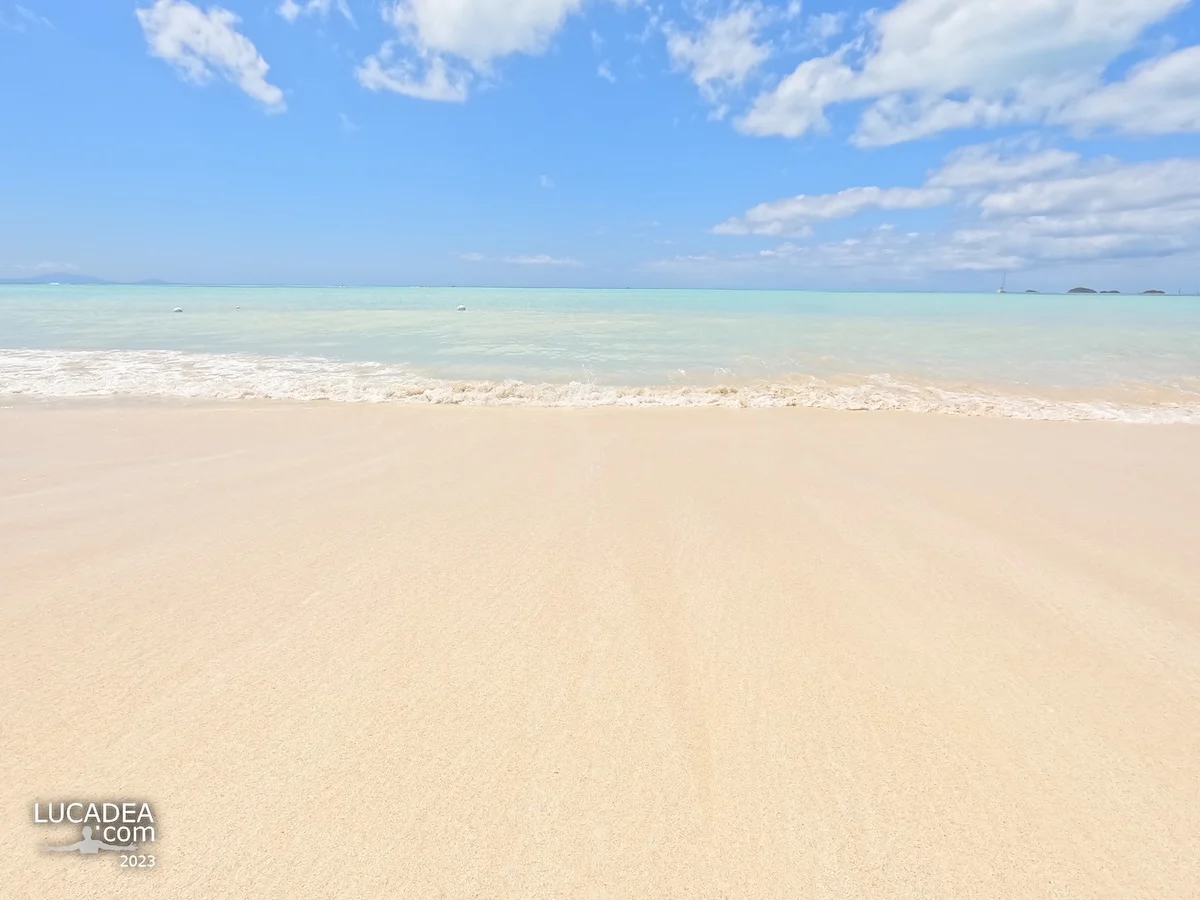
I step onto the sand at Jolly Beach and immediately feel how open everything is, with nothing interrupting the view between me and the horizon. The water has a pale, almost unreal color, and the line where the sea meets the sky feels soft and blurred, as if the two are gently blending into each other.
I walk slowly toward the shoreline, letting my steps sink slightly into the sand. It’s fine and compact, leaving only faint marks that disappear almost instantly as the water reaches them. At Jolly Beach, there’s no need to search for the perfect spot. The scene presents itself naturally, without effort, and all I have to do is pay attention.
The waves roll in quietly, never aggressive, just enough to create a steady rhythm. I watch how they form, lift slightly, and then dissolve on the shore. It’s a repetitive motion that somehow never feels monotonous. Above, the sky is wide and calm, with scattered clouds drifting slowly, adding just a hint of movement to the stillness.
I try to take a few photos, but I quickly realize that capturing this place isn’t as easy as it seems. Jolly Beach is one of those locations that feels complete in person, yet difficult to frame. The reflections on the water shift constantly, the colors change subtly, and what I see never fully translates into the image.
A small detail comes to mind while I stand there: Antigua is often said to have “a beach for every day of the year,” and looking at Jolly Beach, it doesn’t feel like an exaggeration.
I stay for a while longer, doing nothing in particular, just letting the place settle in.

Have you ever stood in front of a landscape so simple that it felt almost perfect? Add a comment or go to the bottom of the site to read what other visitors have written.

Spiaggia di Jolly Beach ad Antigua con sabbia chiara, onde leggere e mare turchese sotto un cielo azzurro con nuvole

Spiaggia di Jolly Beach ad Antigua con sabbia chiara, onde leggere e mare turchese sotto un cielo azzurro con nuvole

Spiaggia di Jolly Beach ad Antigua con sabbia chiara, onde leggere e mare turchese sotto un cielo azzurro con nuvole

Photos taken with Gopro Hero 10 black.

Here’s where the beach is:

Antigua is an island in the Lesser Antilles, belonging to the state of Antigua and Barbuda. It has a surface area of ​​280 km² and a population of approximately 80,161. The island’s capital is Saint John’s, which is also the national capital.
Continue and learn more at Wikipedia

Jolly Beach in Antigua – Plage de Jolly Beach à Antigua – Playa Jolly Beach en Antigua – Praia Jolly Beach em Antigua – Jolly Beach auf Antigua – Bãi biển Jolly Beach ở Antigua – 安提瓜乔利海滩 – アンティグアのジョリービーチ

The text of this post was written with the help of ChatGPT, a language model from OpenAI.

Great Bay in Sint Maarten, a dream beach

Spiagge da sogno: Great Bay a Sint Maarteen

Great Bay in Sint Maarten, a dream beach.
Standing in front of the clear waters of Great Bay in Sint Maarten, I found one of those Caribbean places where time seems to slow down naturally. This dream beach in the Caribbean is one of my personal favorites, not only because of the golden sand and transparent water, but also because of the immediate feeling of relaxation it can offer.
Arriving in Philipsburg, the capital of Sint Maarten, the connection between the cruise ship and the beach is what makes this place so special. A short taxi boat ride is enough to leave the port behind and step directly onto the sand. This easy access is one of the reasons why Great Bay is such a popular stop for cruise passengers looking for a simple way to enjoy the island.
The photograph was taken in Philipsburg, Sint Maarten, Caribbean, during a cruise stop. Looking at this image brings back the feeling of arriving at the beach and seeing the contrast between the deep blue water, the warm color of the sand and the ships resting nearby. If you are visiting Sint Maarten and wondering what to see, Great Bay is certainly one of the most recognizable places on the island.
Of course, this is not a completely deserted beach. When cruise ships arrive, there can be many visitors, but I have never considered that a negative aspect. For me, it is part of the atmosphere of the place and part of the special relationship between this bay and the world of cruising.
One interesting detail about Great Bay is its location directly in front of Philipsburg, making it one of the most accessible urban beaches in the Caribbean. Its position allows visitors to combine a relaxing day by the sea with a walk through the streets, shops and local atmosphere of the town.
In my photographic stories, I often share places discovered during journeys by ship, where the sea connects different landscapes and cultures. This image comes from that same desire to preserve not only a beautiful view, but also the feeling of a particular moment.
For me, Great Bay represents the perfect balance between convenience and Caribbean atmosphere. It is easy to reach, lively without being overwhelming, and still able to offer the relaxation people search for when they arrive on an island.

Have you ever visited a famous beach that still managed to give you a peaceful and memorable experience? Add a comment or go to the bottom of the site to read what other visitors have written.

Spiagge da sogno: Great Bay a Sint Maarteen

Spiagge da sogno: Great Bay a Sint Maarteen

Photos taken with Gopro Hero 10 black.

Here’s where the beach is:

Sint Maarten is a constituent nation of the Kingdom of the Netherlands, which includes three other nations: the Netherlands and the Caribbean states of Aruba and Curaçao. Its territory comprises the southern part of the island of Saint Martin, located in the southern Caribbean Sea. Its capital is Philipsburg. Sint Maarten borders to the north with Saint Martin, an overseas collectivity dependent on France, whose territory forms the northern part of the island.
Continue and learn more at Wikipedia

Great Bay in Sint Maarten, a dream beach – Great Bay à Sint Maarten, une plage de rêve – Great Bay en Sint Maarten, una playa de ensueño – Great Bay em Sint Maarten, uma praia dos sonhos – Great Bay auf Sint Maarten, ein Traumstrand – Great Bay ở Sint Maarten, bãi biển trong mơ – 圣马丁Great Bay,梦想海滩 – シント・マールテンのグレートベイ、夢のビーチ

The text of this post was written with the help of ChatGPT, a language model from OpenAI.

Accra Beach in Barbados between sand and sea

Spiagge da sogno: Accra Beach alle Barbados

Accra Beach in Barbados between sand and sea.
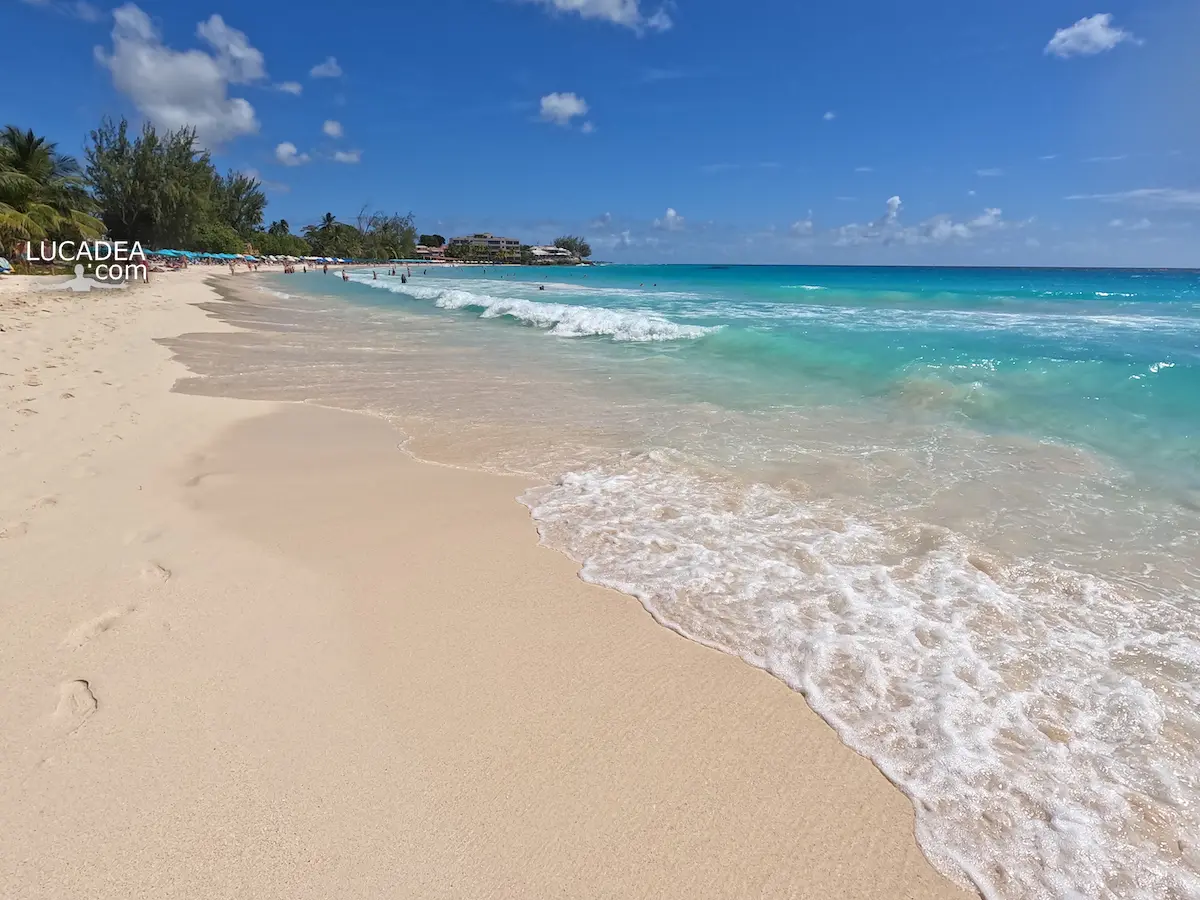
I stopped in front of this Caribbean beach, attracted by the simplicity of the landscape: light sand, clear water, and that feeling of calm often searched for when arriving on an island. Accra Beach in Barbados is one of those places where the sea and the coastline create an image that immediately feels connected to the Caribbean.
Photographing Accra Beach means trying to capture a balance between nature and everyday life. It is not only a postcard beach, but a place experienced by both local residents and visitors discovering this part of Barbados. The movement of people, the colors around the shoreline, and the contrast between golden sand and blue water make every image different.
Accra Beach, also known as Rockley Beach, is located on the south-west coast of Barbados, near the Rockley area, Barbados. It is appreciated because it combines the natural beauty of the Caribbean Sea with comfortable services and spaces where people can enjoy the coast while still feeling the local atmosphere.
What impressed me most was this balance: on one side the tropical landscape, on the other a beach that is part of everyday island life. I enjoy photographing places like this because they tell something more than just the beauty of a view.
A small curiosity is that the name Rockley Beach is often used together with Accra Beach and comes from the nearby Rockley area, known for its shops, restaurants, and lively atmosphere.
This photograph also reminded me of other articles on the site about seaside places I have visited during my travels, because often the smallest details of a beach can bring back memories of an entire experience.

If you had to choose a Caribbean beach to remember forever, which one would you take with you? Add a comment or go to the bottom of the site to read what other visitors have written.

Spiagge da sogno: Accra Beach alle Barbados

Spiagge da sogno: Accra Beach alle Barbados

Spiagge da sogno: Accra Beach alle Barbados

Spiagge da sogno: Accra Beach alle Barbados

Photos taken with Gopro Hero 10 black.

And here are some videos recorded on the beach:

Videos recorded with Gopro Hero 10 Black.

Here’s where the beach is:

The origin of the name “Barbados” is somewhat controversial. The Portuguese, en route to Brazil or the Spanish, are credited with being the first Europeans to name the island.
The name Barbados appears to derive from the Portuguese term os barbados (the bearded ones), given to the island in 1536 by Portuguese explorer Pedro A. Campos because the long, drooping aerial roots of the bearded fig trees (Ficus citrifolia), native to the island, resembled “beards.” The name the Arawak indigenous people gave to the island was Ichirouganaim.
Continue and learn more at Wikipedia

Accra Beach in Barbados between sand and sea – La plage d’Accra à la Barbade entre sable et mer – La playa Accra en Barbados entre arena y mar – A praia Accra em Barbados entre areia e mar – Accra Beach auf Barbados zwischen Sand und Meer – Bãi biển Accra ở Barbados giữa cát và biển – 巴巴多斯阿克拉海滩的沙滩与海洋 – バルバドスのアクラビーチ、砂浜と海

The text of this post was written with the help of ChatGPT, a language model from OpenAI.

The Caribbean sea at Jolly Beach in Antigua

Mare da sogno: Jolly Beach nell'isola di Antigua

The Caribbean sea at Jolly Beach in Antigua.
There are places that seem to answer by themselves the question of what to see in Antigua Jolly Beach, and this stretch of coastline is definitely one of them. Among the most beautiful beaches in Antigua and Barbuda, Jolly Beach immediately stands out as a wide, bright shoreline where soft white sand meets water in shifting shades of turquoise and emerald.
As soon as I arrive, the light catches my attention. It’s not just strong, it wraps around everything, enhancing every detail. I walk slowly along the shore, watching how the sea constantly changes color. If you are visiting and wondering what to see in Antigua Jolly Beach, you might already have seen perfect photos, but being here feels different, more immersive, almost impossible to fully capture.
Antigua and Barbuda, Caribbean: thinking about it while standing here makes it feel real. Some people are simply relaxing under the sun, others move gently through the calm water. The sea is quiet, almost flat, perfect if you just want to float and disconnect. It reminds me of another scene I shared on my site, far from here but similar in its peaceful rhythm—because certain landscapes speak the same language no matter where you are.
One interesting detail is that Antigua is known for having 365 beaches, one for every day of the year, and Jolly Beach is among the most popular thanks to its size and accessibility. Knowing this adds a layer to the experience, making you realize how central the sea is to life here.
I keep walking, noticing people snorkeling or trying windsurfing, while others stop at small beach bars for a drink. Everything feels unhurried. It’s one of those places where you can choose to do something or nothing at all, and both feel equally right.
If you are thinking about what to see in Antigua Jolly Beach, this is one of the most interesting places in Antigua simply because it allows you to slow down and take it all in.

Have you ever been somewhere that truly made time slow down? Add a comment or go to the bottom of the site to read what other visitors have written.

Photos taken with Gopro Hero 10 black.

Here’s where the beach is:

Antigua is an island in the Lesser Antilles, belonging to the state of Antigua and Barbuda. It has a surface area of ​​280 km² and a population of approximately 80,161. The island’s capital is Saint John’s, which is also the national capital.
Continue and learn more at Wikipedia

Caribbean sea at Jolly Beach in Antigua – Mer des Caraïbes à Jolly Beach à Antigua – Mar Caribe en Jolly Beach en Antigua – Mar do Caribe em Jolly Beach em Antigua – Karibisches Meer am Jolly Beach in Antigua – Biển Caribe tại Jolly Beach ở Antigua – 安提瓜乔利海滩的加勒比海 – アンティグアのジョリービーチのカリブ海

The text of this post was written with the help of ChatGPT, a language model from OpenAI.

Lambert Bay, shell and sand beach in Tortola

Sabbia e conchiglie a Lambert Bay a Tortola nelle British Virgin Islands con spiaggia chiara composta da frammenti di coralli

Lambert Bay, shell and sand beach in Tortola.
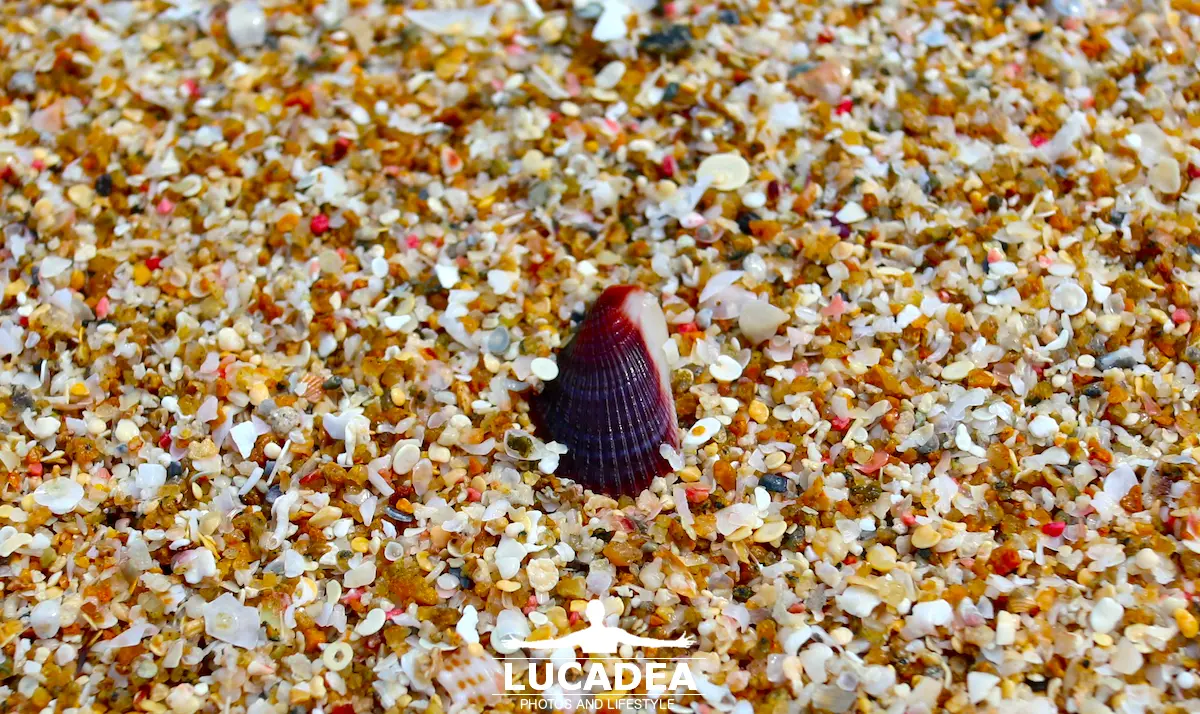
The Caribbean light in Tortola has a way of revealing details that usually go unnoticed, especially in the sand itself. At Lambert Bay I found myself looking down more than out, studying what the beach was actually made of. Among the beaches of Tortola, this one is particularly interesting because it clearly shows its own natural origin.
Walking slowly along the shoreline, I noticed a small shell resting almost invisibly on the sand. That simple detail made me think about how thin the boundary is between the ocean and the land it creates. Here, the sand is not just sand, but the result of constant transformation: broken coral, worn shells, and fragments endlessly reshaped by the sea.
We are in Tortola, British Virgin Islands, in the heart of the Caribbean Sea, where coastlines are never completely still. Lambert Bay is one of those places where the beauty is not only in the water, but also in the material that forms the beach itself.
I couldn’t help but connect this scene to other coastal landscapes I have shared on the blog, where sand comes from different geological processes and the sea behaves in completely different ways. Here everything feels lighter, almost powdery, as if light itself is part of the composition.
An interesting fact is that many tropical beaches owe their bright color to coral and shell fragmentation, a process that can take centuries before becoming what we see today.
In the end, Lambert Bay is not just a beach, but a living example of how the sea continuously reshapes the world it touches.

Have you ever stopped to think about how much history is hidden in a single grain of sand? Add a comment or go to the bottom of the site to read what other visitors have written.

Sabbia e conchiglie a Lambert Bay a Tortola nelle British Virgin Islands con spiaggia chiara composta da frammenti di coralli

Photo taken with Canon EOS M100 camera and Canon EF-M 11-22 lens.

In mollusks, the shell has a different shape depending on the class. It is composed of inorganic constituents such as calcium carbonate (CaCO3) or calcium phosphate (Ca3(PO4)2) that the animals extract from seawater and which are supplemented by organic substances (usually a set of complex proteins secreted by the mantle).
Continue and learn more on Wikipedia

Lambert Bay shell and sand tropical beach – Lambert Bay plage tropicale sable et coquillages – Lambert Bay playa tropical arena y conchas – Lambert Bay praia tropical areia e conchas – Lambert Bay Tropenstrand Sand und Muscheln – Bãi biển nhiệt đới Lambert Bay cát và vỏ sò – 兰伯特湾热带海滩的沙子与贝壳 – ランバート湾の砂と貝殻のトロピカルビーチ

The text of this post was written with the help of ChatGPT, a language model from OpenAI.

🏠
  • Italiano