The Ducal Court of Milan’s Sforza Castle

Corte Ducale del Castello Sforzesco a Milano con il colonnato del Portico dell'Elefante

The Ducal Court of Milan’s Sforza Castle.
During my last visit to Milan, I finally spent much more time walking around the city with my camera, and the Ducal Court of Sforza Castle was one of the places I wanted to photograph. Milan, Lombardy, Italy, is only a couple of hours away from where I live by train, yet I had not visited the city as a tourist nearly as often as I might have expected.
This time was different. I walked a lot, took plenty of photographs and tried not to concentrate only on the places I already knew from photographs or guidebooks. Sforza Castle was an obvious stop, but once inside I found myself paying more attention to its courtyards and architectural details than to the fortress as a whole.
This photograph shows the Ducal Court and the famous colonnade known as the Elephant Portico. What attracted me was the way the arches create a strong perspective across the open space of the courtyard. The architecture naturally guides the eye through the image, while the surrounding walls give the scene a sense of depth.
I took this photograph because I liked the composition rather than because I was trying to create a conventional picture of the castle. From outside, Sforza Castle is mainly perceived as a massive fortified complex, with its towers, walls and imposing entrances. Once inside, however, the atmosphere changes and the courtyards reveal a much more detailed architectural side.
If you are wondering what to see inside Sforza Castle, the Ducal Court is one of the spaces I would take time to look at rather than simply crossing on the way to another room. For a photographer, there are plenty of perspectives created by the arcades, columns and walls, and the architecture changes considerably depending on where you stand.
One small curiosity about the photograph is the name Elephant Portico. It comes from a fresco depicting an elephant, which gave the portico its traditional name. It is an interesting detail because the first thing most people notice when looking at the structure is its elegant colonnade rather than the decorative element behind the name.
Sforza Castle has undergone many changes throughout its history. It began as a military stronghold and later became associated with the ruling Sforza family and the ducal court. The complex we see today therefore contains different layers of Milan’s history, something that becomes particularly apparent when moving from the massive exterior fortifications into the more refined interior spaces.
For me, the Ducal Court is interesting precisely because it brings these different aspects together. The walls still suggest the original defensive role of the castle, while the arcades and architectural details remind us of its later role as a ducal residence.
I like photographs where the subject is not necessarily one isolated object. Here, the entire court became the subject. The columns, arches, walls and open space all contribute to the composition, and I spent some time looking for a viewpoint that made those elements work together.
That is one of the advantages of visiting a familiar city with more time than usual. During a quick visit, I might have entered the castle, looked around and moved on. On this occasion I had my camera with me and was paying attention to details, so I noticed several views that I would probably otherwise have overlooked.
Milan surprised me in that respect. Although it is relatively close to home, I had never really explored it at this pace. The last visit gave me the chance to walk much more extensively and photograph both the well-known landmarks and the smaller architectural details.
Sforza Castle was particularly rewarding because there are so many different photographic possibilities within the same complex. The exterior, towers, courtyards and arcades all offer completely different subjects, even though they belong to the same historic building.
The Ducal Court was one of the views that stayed with me. I liked the rhythm of the columns and the way the perspective leads through the courtyard. It is a relatively quiet architectural composition compared with the imposing appearance of the castle from outside.
I also like the fact that the photograph records something about my visit rather than simply documenting a famous Milan landmark. I was actually there, walking through the courtyard with my camera, looking for details that interested me. That personal connection is what I want to preserve when I add photographs to Lucadea.
For anyone visiting Milan, Sforza Castle is naturally one of the city’s major historic sights, but I think the experience becomes more interesting when you allow yourself enough time to look beyond the most obvious views. The courtyards are part of that experience, and the Ducal Court offers several perspectives that work particularly well through a camera lens.
This photograph is therefore less about presenting the castle as a tourist attraction and more about remembering a particular moment of my last visit to Milan. I had finally taken the time to explore the city properly, and the camera helped me notice details that might otherwise have passed unnoticed.
Looking back at the image, what I remember most is the perspective created by the Elephant Portico and the feeling of standing inside such a large historic complex after seeing the castle from the outside.

Have you visited Sforza Castle, and which part of the complex did you enjoy photographing the most? Add a comment or go to the bottom of the site to read what other visitors have written.

Ducal Court of Sforza Castle in Milan with the historic Elephant Portico and its columns

Photo taken with a Canon EOS M100 camera and a Canon EF-M 11-22 lens.

To see all the photos I took in Milan, click here:

This is the official website of the Castle: milanocastello.it.

Add one  comment to this article or read  here what other visitors have written.
 
Adv
 
Disclamer

The rights on images, videos, choruses, text and all other material on the LUCADEA.com website are governed as per  Copyright page.

This page has been viewed 1 times today.
This month it has been viewed 1 times.
In total it has been viewed 1 times.
 

The Filarete Tower at Sforza Castle

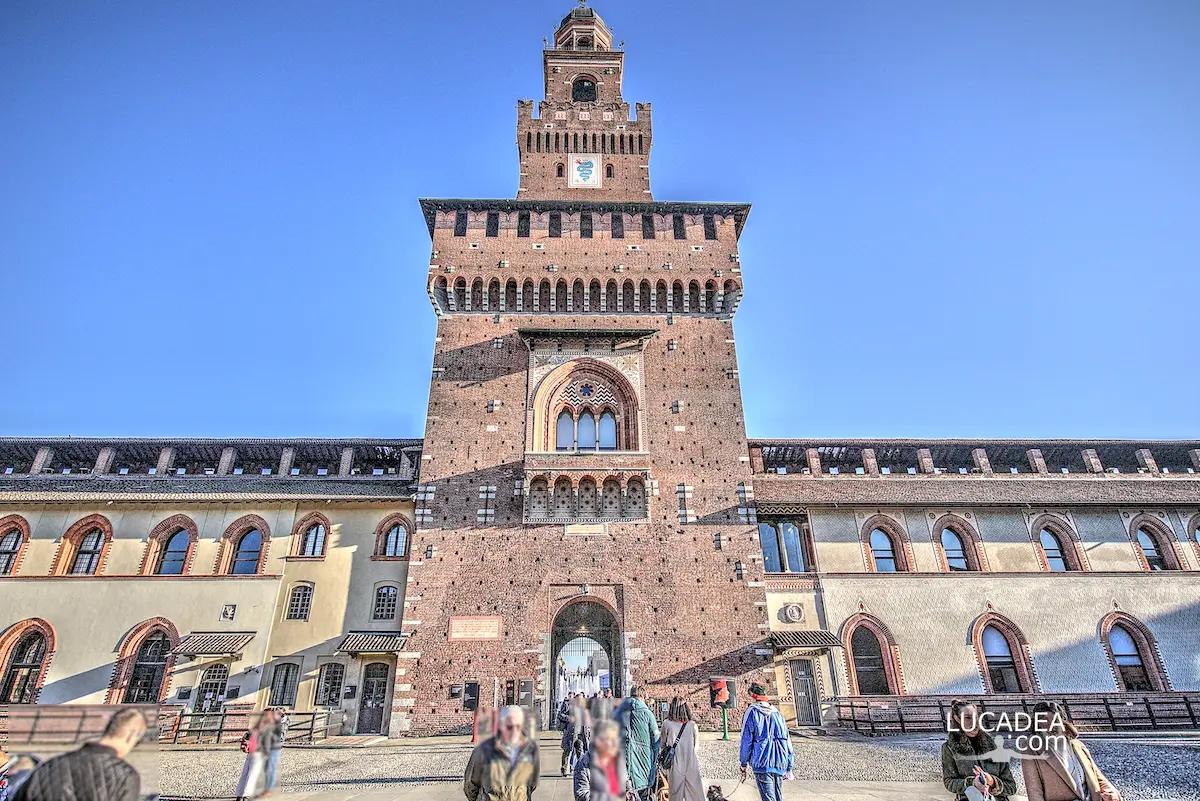
Torre del Filarete del Castello Sforzesco fotografata dalla Piazza d'Armi interna a Milano

The famous Filarete Tower of Sforza Castle in Milan.
In the heart of Milan, Lombardy, Italy, stands one of the city’s most representative monuments: Sforza Castle. Although it is not Milan’s main symbol, like the Cathedral or other iconic landmarks, its main tower, known as the Filarete Tower, is certainly one of the most recognizable and photographed elements.
The photograph I am sharing today has a particular feature: unlike many images that are taken from outside the castle walls, this one was captured from inside the complex, precisely from the castle’s Parade Ground. This viewpoint allows the tower to be seen from a different perspective, surrounded by the monumental spaces and historic architecture of the castle.
The Filarete Tower takes its name from the Tuscan architect Antonio Averlino, known as Filarete, who designed the original tower in the fifteenth century for Francesco Sforza. However, the tower had a troubled history: the sixteenth-century structure was destroyed in 1521 due to a gunpowder explosion and disappeared from the castle’s skyline for centuries.
At the beginning of the twentieth century, it was rebuilt by architect Luca Beltrami, who based his work on historical documents and period evidence. The new tower, inaugurated in 1905, is now one of the most photographed parts of Sforza Castle and represents the connection between Renaissance Milan and the modern city.
Walking inside the castle, visitors can feel the historical importance of this place, originally built as a military fortress and later transformed into one of Milan’s most important cultural complexes. Today it houses museums and important art collections while preserving the charm of its centuries-old history.
I always enjoy looking for unusual viewpoints when photographing famous monuments: sometimes simply changing perspective reveals new details even in the most well-known places.

Do you know the Filarete Tower and have you ever visited Sforza Castle in Milan? Add a comment or go to the bottom of the site to read what other visitors have written.

Filarete Tower of Sforza Castle photographed from the internal Parade Ground in Milan

Photo taken with a Canon EOS M100 camera and a Canon EF-M 11-22 lens.

To see all the photos I took in Milan, click here:

This is the official website of the Castle: milanocastello.it.

The central tower—the castle’s tallest and its main entrance—is known as the Filarete Tower, named after the Tuscan architect commissioned to design it by Duke Francesco I. Destroyed by an explosion in the early 16th century[18], it was rebuilt in the early 20th century on the site of the original, which had been lost.
Read more on Wikipedia

Add one  comment to this article or read  here what other visitors have written.
 
Adv
 
Disclamer

The rights on images, videos, choruses, text and all other material on the LUCADEA.com website are governed as per  Copyright page.


This page has been viewed 0 times today.
This month it has been viewed 0 times.
In total it has been viewed 0 times.
 

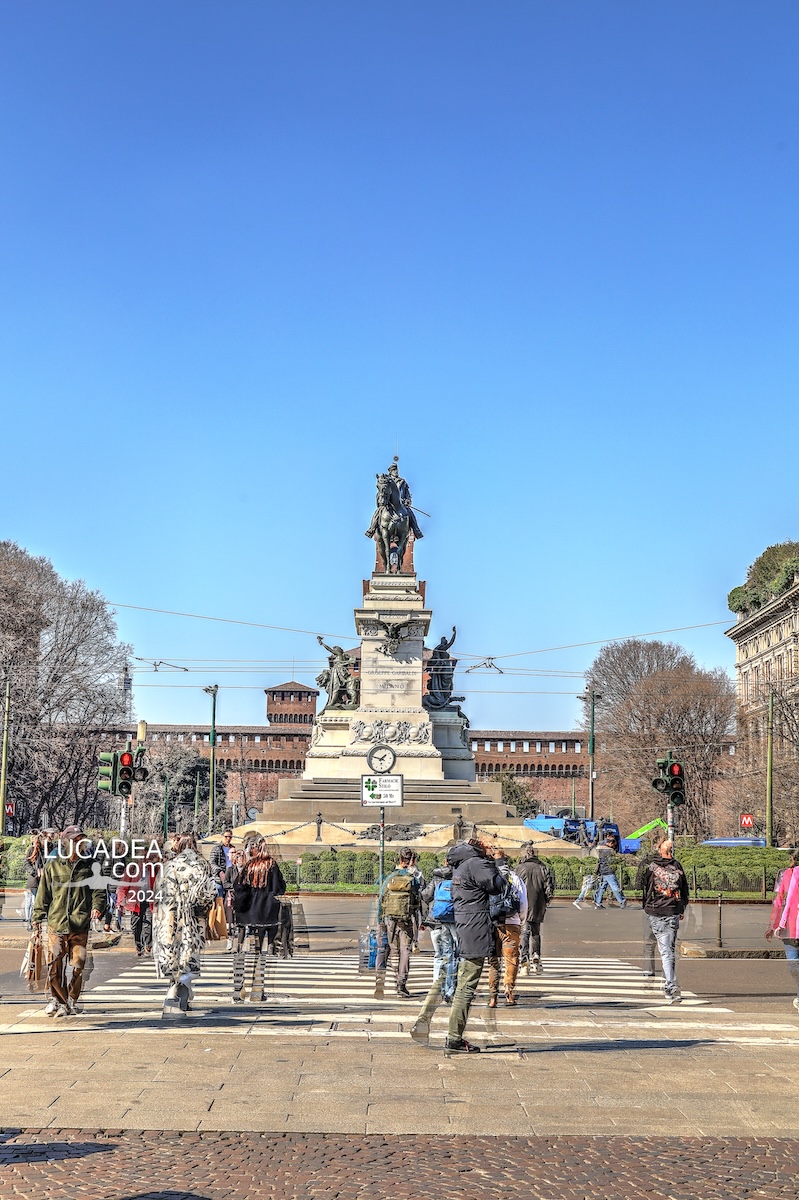
The statue of Garibaldi in Cairoli Square in Milan

La statua di Garibaldi in largo Cairoli a Milano

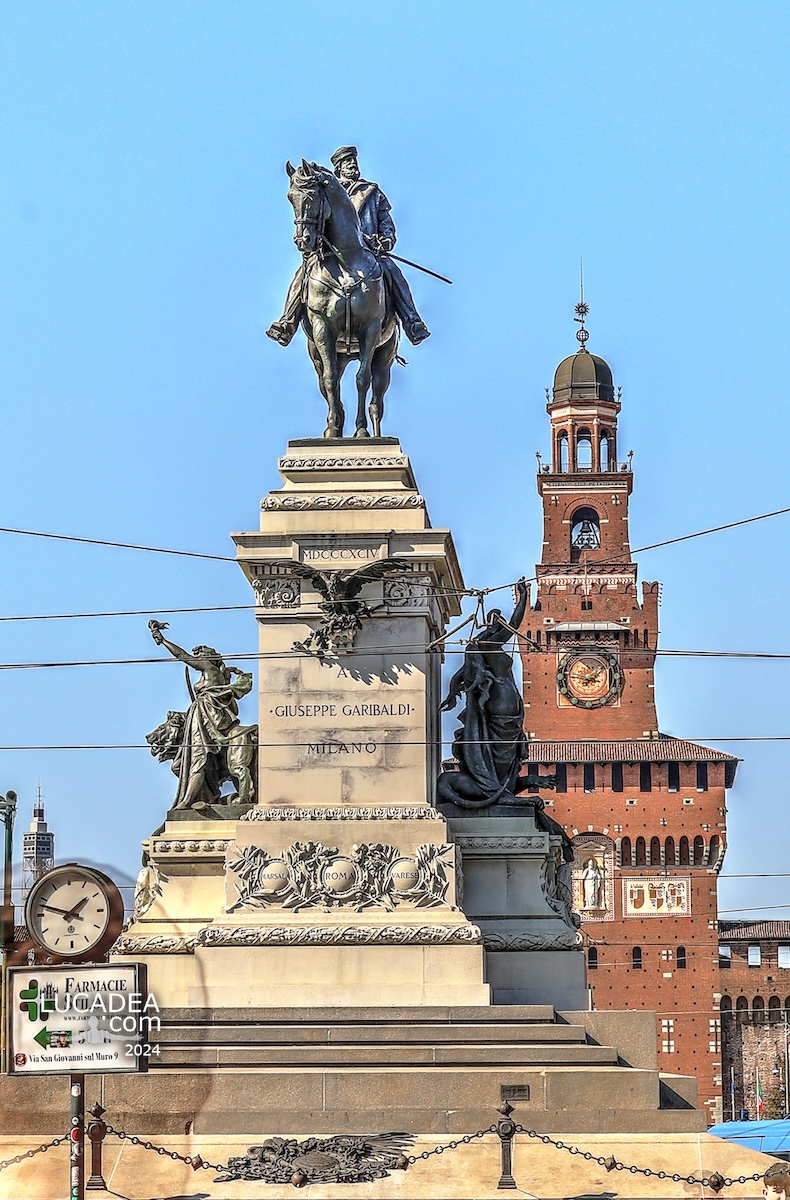
The statue of Garibaldi in Cairoli Square in Milan.
Walking along Dante Street, the road that connects Milan Cathedral to Sforza Castle, you reach a wide open space known as Cairoli Square. It is one of those places where the constant flow of people meets history, creating a lively atmosphere that still preserves a strong connection with the past.
At the center of the square stands the equestrian statue dedicated to Giuseppe Garibaldi, one of the most important figures in Italian history. The monument shows him on horseback in a strong and dynamic pose, overlooking the surrounding space. It is a landmark that many people pass by every day, often without realizing its historical significance.
Milan, in Lombardy, Italy, is a city where modern life blends with historical heritage, and routes like the one between the Cathedral and Sforza Castle offer many interesting details to discover. Cairoli Square is both a crossing point and a place where visitors can stop and observe the city.
The statue was created by the sculptor Ettore Ximenes and inaugurated at the end of the nineteenth century. It celebrates Garibaldi’s role in the unification of Italy, especially his leadership during the Expedition of the Thousand and other military campaigns that contributed to the creation of the Italian state.
Photographing this monument means capturing not only the sculpture itself but also the urban environment around it. What struck me most was the contrast between the historical figure represented and the everyday movement of people in the square.
On lucadea.com I have often shared photos of monuments and historical places, because I believe that even a simple image can preserve the memory of a place and tell part of its story.
Milan is full of interesting views, and sometimes it is enough to stop for a moment along a busy street to notice a detail that deserves attention.

Have you ever noticed this statue while walking between the Cathedral and Sforza Castle? Add a comment or go to the bottom of the site to read what other visitors have written.

Photos taken with Canon EOS RP and Canon RF 24-50 lens.

Click here if you want to see all the photos I took:
foto gallery

Here’s where the statue is located:

Considered by 20th-century historiography and popular culture as Italy’s foremost national hero, he began his travels around the world as a merchant ship’s officer, later becoming a sea captain. His most famous exploit was the victorious Expedition of the Thousand, which led to the annexation of the Kingdom of the Two Sicilies to the nascent Kingdom of Italy, a pivotal episode in the unification process of the new nation.
Continue and learn more at Wikipedia

The statue of Garibaldi in Cairoli Square in Milan – La statue de Garibaldi sur la place Cairoli à Milan – La estatua de Garibaldi en la plaza Cairoli de Milán – A estátua de Garibaldi na praça Cairoli em Milão – Die Garibaldi-Statue auf dem Cairoli Platz in Mailand – Tượng Garibaldi tại quảng trường Cairoli ở Milan – 米兰开罗利广场的加里波第雕像 – ミラノのカイローリ広場にあるガリバルディ像

The text of this post was written with the help of ChatGPT, a language model from OpenAI.

The beautiful and famous Dante Street in Milan

La bella e famosa via Dante a Milano

The beautiful and famous Dante Street in Milan.
When visiting Milan, you almost always first go to see the Duomo and then walk toward the Sforza Castle.
To follow this route, you pass through the beautiful straight street dedicated to Dante Alighieri.

Have you ever walked this street in Milan? Add a comment or go to the bottom of the site to read what other visitors have written.

Photos taken with Canon EOS RP camera and Canon RF 24-50 lens.

Click here if you want to see all the photos I took:
foto gallery

Here’s where the road is:

Via Dante was opened in 1888 as a road link to the Sforza Castle, concurrently with the massive demolition work carried out in Piazza Duomo and the Cordusio that reshaped the city center. The new road was built according to the specifications of the 1884 Beruto Plan, which in turn drew on previous projects from the Napoleonic era. Initially, with the various building transformations of those years, the artery under construction was intended to be the ideal central extension of the Simplon axis, built in the early 19th century, which would have passed over the Castle, whose demolition was prevented by Luca Beltrami. Following Beltrami’s extensive restoration of the Castle, starting in 1905 the road was blocked in perspective by the reborn Filarete Tower, erected in memory of King Umberto I and whose original structure had collapsed following an explosion several centuries earlier.
Continue and learn more on Wikipedia

The beautiful and famous street dedicated to Dante in Milan – La belle et célèbre rue dédiée à Dante à Milan – La hermosa y famosa calle dedicada a Dante en Milán – A bela e famosa rua dedicada a Dante em Milão – Die schöne und berühmte Straße in Mailand, die Dante gewidmet ist – Con đường xinh đẹp và nổi tiếng dành riêng cho Dante ở Milan

One of the corners of the walls of Sforza Castle in Milan

Uno degli angoli delle una del Castello Sforzesco di Milano

One of the corners of the walls of Sforza Castle in Milan.
Another photo from my last, and not recent, visit to the city of Milan.
In this post I’m sharing a photo of the walls of Sforza Castle.

Do you know Milan? Add a comment or go to the bottom of the site to read what other visitors have written.

Uno degli angoli delle una del Castello Sforzesco di Milano

Photo taken with Canon EOS M100 and lens Canon EF-M 11-22.

To see all the photos I took in the Milanese city click here:

This is the Castle’s official website: milanocastello.it.

Significantly transformed and modified over the centuries, the Sforza Castle was one of Europe’s main military citadels between the 16th and 17th centuries. Restored in historicist style by Luca Beltrami between 1890 and 1905, it is now home to cultural institutions and important museums. It is one of the largest castles in Europe and one of the main symbols of Milan and its history.
Continue and learn more at Wikipedia

One of the corners of the walls of the castle which is called Sforzesco of Milan – Un des coins des murs du Castello Sforzesco à Milan – Una de las esquinas de las paredes del Castello Sforzesco en Milán – Um dos cantos das paredes do Castello Sforzesco em Milão – Eine der Ecken der Mauern des Castello Sforzesco in Mailand – Một trong những góc tường của Castello Sforzesco ở Milan – 米兰斯福尔扎城堡墙角之一 – ミラノのスフォルツェスコ城の壁の一角

The Filarete Tower of Sforza Castle in Milan

La Torre del Filarete del Castello Sforzesco a Milano

The Filarete Tower of Sforza Castle in Milan.
It is one of the most recognizable symbols of Sforza Castle in Milan. This tall and majestic tower stands at the main entrance of the castle and represents an important piece of the city’s architectural and cultural history.
The tower is named after the Florentine architect Antonio di Pietro Averlino, known as Filarete, who designed the original structure in 1452. Unfortunately, the original tower was destroyed by an explosion in 1521. The tower we see today is a reconstruction built between 1900 and 1905 by architect Luca Beltrami, based on historical drawings and documents.
The Filarete Tower is a perfect blend of Gothic and Renaissance elements, with an imposing red brick structure and intricate decorative details. The tower is topped with battlements and a statue of Saint Ambrose, the patron saint of Milan. The mechanical clock on the façade is a fascinating addition that draws the attention of visitors.
The tower is not only an architectural feature of great beauty but also a symbol of Milan’s strength and resilience. During the Second World War, Sforza Castle suffered severe damage, but it was fully restored, including the Filarete Tower, to preserve the city’s historical heritage.
Today, the Filarete Tower and Sforza Castle are open to the public and represent a must-see stop for anyone visiting Milan. The castle also hosts numerous museums and exhibitions that offer an overview of Milan’s history and art.
Visiting the Filarete Tower at Sforza Castle is a journey through the history and architecture of Milan. Its majesty and historical significance make it one of the city’s most fascinating attractions. Do not miss the opportunity to admire this iconic tower and explore everything Sforza Castle has to offer.

Do you know Sforza Castle? Add a comment or go to the bottom of the site to read what other visitors have written.

La Torre del Filarete del Castello Sforzesco a Milano

La Torre del Filarete del Castello Sforzesco a Milano

La Torre del Filarete del Castello Sforzesco a Milano

Photos taken with Canon EOS RP camera and Canon RF 24-50 lens.

Click here if you want to see all the photos I took in Milan:
foto gallery

Where is the tower located:

The Sforza Castle is a large fortified complex located in Milan just outside the city’s historic center. It was built in the 15th century by Francesco Sforza, recently appointed Duke of Milan, on the ruins of a previous 14th-century medieval fortification known as Castello di Porta Giovia (or Zobia). In the same area where the medieval Castello di Porta Giovia once stood, during Roman times, there was the Castrum Portae Jovis, one of the four defensive fortifications of Roman Milan.
Continue and learn more at Wikipedia

The Filarete Tower of the Sforza Castle in Milan – La tour Filarete du château des Sforza à Milan – La Torre Filarete del Castillo Sforzesco de Milán – A Torre Filarete do Castelo Sforzesco em Milão – Der Filarete-Turm des Castello Sforzesco in Mailand – Tháp Filarete của Lâu đài Sforzesco ở Milan

The text of this post was written with the help of Copilot, an artificial intelligence-based virtual assistant.
References:
– https://www.milanocastello.it/it

🏠
  • Italiano