
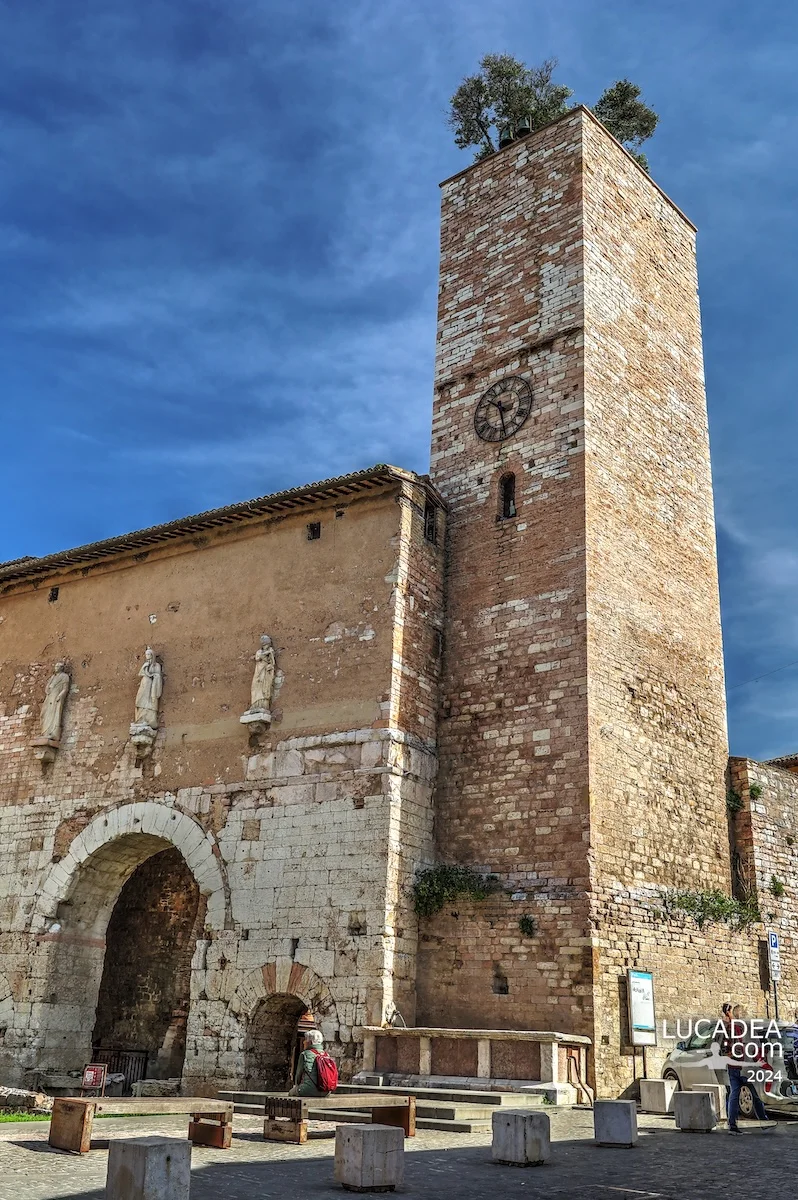
The Consular Gate of Spello between history and symbols

Porta Consolare di Spello con torre annessa, orologio e albero sulla sommità in Umbria

The Consular Gate of Spello between history and symbols.
Arriving in Spello, one of the most charming villages in Umbria, the Consular Gate stands as one of the most iconic entrances to the town. The Consular Gate of Spello between history and symbols, in Spello, Umbria, Italy, is a place where elements from different historical periods coexist in a fascinating balance.
Looking at the Consular Gate of Spello between history and symbols, the eye is drawn to the tower attached to the gate, where both the clock and the tree are located at the top. These details make the scene unique and instantly recognizable, creating an interesting contrast between the solid stone structure and the presence of nature.
The large stones of the gate clearly reveal its Roman origins, dating back to when Spello was known as Hispellum. The adjacent tower adds a vertical element that enriches the architectural composition and changes its visual perception.
Walking around the Consular Gate of Spello between history and symbols, you can feel how representative this place is of the village. It is one of those spots that easily answers the question of what to see in Spello, as it brings together history, identity, and unique details.
Thinking back to other Umbrian villages I have shared on lucadea.com, I realize that it is precisely these unusual elements – like a tree on top of a tower or a clock seemingly frozen in time – that make a place truly memorable.
An interesting fact: the structure of the gate also features Roman funerary statues, adding further historical and symbolic value to this monumental entrance.

I stand there for a moment, wondering how many people have walked under this arch over the centuries without noticing all these details. Would you have noticed them right away? Add a comment or go to the bottom of the site to read what other visitors have written.
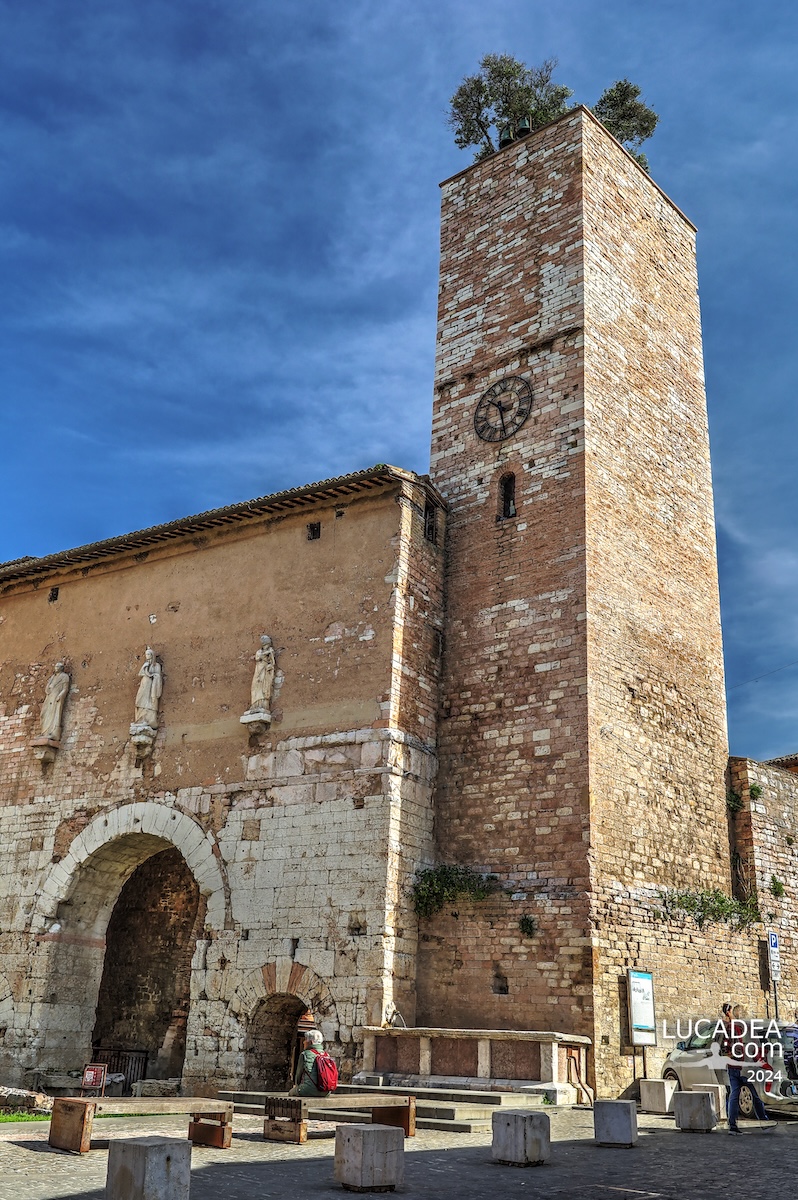
Porta Consolare di Spello con torre annessa, orologio e albero sulla sommità in Umbria

Photo taken with Canon EOS RP and Canon RF 24-50 lens.

To see all the photos I took in the village, click here:

Here’s where the door is:

Add one  comment to this article or read  here what other visitors have written.
 
Adv
 
Disclamer

The rights on images, videos, choruses, text and all other material on the LUCADEA.com website are governed as per  Copyright page.


This page has been viewed 1 times today.
This month it has been viewed 1 times.
In total it has been viewed 2 times.
 

A red Fiat 500 in Spello’s stone alleys

Fiat 500 rossa parcheggiata in un vicolo di Spello in Umbria tra case in pietra del borgo storico

A red Fiat 500 in Spello’s stone alleys.
Among the things to see in Spello, Umbria, Italy, there are not only historic monuments and famous viewpoints, but also the small everyday details that give a village its unique character. Walking through the stone alleys of Spello, I found this red Fiat 500 parked between old houses, a simple element that transformed an ordinary street scene into a photograph with a strong Italian identity.
During my last holiday in Umbria, I visited several of the most beautiful villages in the region, and Spello was certainly one of the places that impressed me the most. I wanted to capture this moment with my camera because the combination of the car, the narrow street and the ancient stone buildings perfectly represented the atmosphere I was experiencing while walking through the village.
The Fiat 500 is more than just a small car. Over time, it has become one of the most recognizable symbols of Italian culture and everyday life. Seeing one parked in a historic alley of Spello creates an interesting contrast between the old stones of the village and an object that belongs to more recent memories. This meeting between history and daily life is often what makes a photograph more personal and memorable.
Spello, located in the province of Perugia, Umbria, Italy, still preserves the charm of a historic center shaped by narrow streets, arches and stone houses. The ancient Roman town of Hispellum left important traces through its walls and monumental gates, while the medieval village remains a place best explored slowly on foot.
A small historical detail about the Fiat 500 is that the modern version was introduced in 1957 and became one of the vehicles that represented Italy’s economic growth after the Second World War. It quickly became a familiar presence in towns and villages throughout the country.
This photograph connects naturally with my other stories about Spello, from the alleys with support arches to Consolare Gate, Urbica Gate and the Baglioni Chapel. Through these images, I have tried to tell not only the famous attractions of the village but also those small details that reveal its everyday personality.
If you are visiting Spello and wondering what to see, remember to look beyond the main landmarks. An old doorway, an architectural detail or even a colorful car can become the most memorable image of your walk.

Have you ever photographed an everyday object that, placed in a historic setting, became the true subject of your picture? Add a comment or go to the bottom of the site to read what other visitors have written.

Red Fiat 500 parked in a stone alley of Spello, Umbria among historic village houses

Photo taken with Canon EOS RP and Canon RF 24-50 lens.

To see all the photos I took in the village, click here:

Here’s where the village is located:

Spello (Hispellum in Latin) is an Italian municipality in the province of Perugia in Umbria. It is part of the circuit of the most beautiful villages in Italy and boasts the Orange Flag tourism and environmental quality mark, awarded by the Italian Touring Club. Spello was founded by the Umbrians and later named Hispellum in Roman times; it was later registered with the Lemonia tribe. It was later declared a “Colonia Giulia” by Caesar and a “Splendidissima Colonia Julia” by Augustus, because it supported him in the wars of Perugia. After Augustus’ victory, he himself ceded to Hispellum a large part of the territories governed by Perusia, and the dominion of the city of Spello extended to the sources of the Clitunno River, which had previously been under the control of Mevania. It was later called “Flavia Costante” by Constantine. Ancient Spello was considered one of the most important cities in Roman Umbria.
Continue and learn more on Wikipedia

Add one  comment to this article or read  here what other visitors have written.
 
Adv
 
Disclamer

The rights on images, videos, choruses, text and all other material on the LUCADEA.com website are governed as per  Copyright page.


This page has been viewed 1 times today.
This month it has been viewed 1 times.
In total it has been viewed 2 times.
 

A glimpse of the historic village of Spello

Uno scorcio del borgo di Spello in Umbria

A glimpse of the historic village of Spello.
Among the things to see in Spello, Umbria, Italy, the small streets and everyday views of the village are some of the best ways to understand its authentic character. This photograph captures one of those quiet moments when walking without a precise destination allows you to discover corners made of stone, narrow passages and old architecture shaped by centuries of history.
When I visited Spello with my wife some time ago, I spent time looking for these less obvious details. I wanted to capture this scene with my camera because it represents the way I experience travel photography: not only through famous monuments, but also through the streets and spaces that reveal the daily life of a place.
Walking through the historic center of Spello means constantly finding new perspectives. Stone houses, streets following the natural shape of the hill and small passages between buildings create different views at every turn. This is what makes photographing a village like Spello so interesting: even a simple street can become a visual story about the connection between people, landscape and architecture.
Spello, located in the province of Perugia, Umbria, Italy, still preserves important traces of its Roman and medieval past. The ancient town of Hispellum was an important Roman settlement, and today the village continues to show this heritage through its walls, monumental gates and historic buildings.
A small historical detail about Spello is its Roman name: Hispellum was known as Splendidissima Colonia Julia, a title that reflected its importance during the imperial period. Today, this ancient history lives together with the medieval appearance of the village, creating a unique combination of different eras.
Besides the quiet views of its streets, Spello offers remarkable places such as Santa Maria Maggiore Church with the Baglioni Chapel decorated by Pinturicchio, Consolare Gate, Venere Gate and the other historic entrances I have photographed in previous stories about the village. Each image adds another piece to the visual journey through this Umbrian town.
One of the most famous events in Spello is the Infiorata festival, when the streets are decorated with flower carpets created for Corpus Christi celebrations. However, this photograph was taken away from that event and shows another side of the village: a quieter atmosphere made of ancient stones, simple streets and everyday beauty.
If you are visiting Spello and wondering what to see, take time to explore the smaller streets as well as the main attractions. Often, the simplest views are the ones that create the strongest memories.

Which Italian village has made you stop most often to photograph small details? Add a comment or go to the bottom of the site to read what other visitors have written.

Historic village view of Spello in Umbria with narrow streets and old stone houses

Photo taken with Canon EOS RP and Canon RF 24-50 lens.

To see all the photos I took in the village, click here:

Here’s where the village is located:

Spello (Hispellum in Latin) is an Italian municipality in the province of Perugia in Umbria. It is part of the circuit of the most beautiful villages in Italy and boasts the Orange Flag tourism and environmental quality mark, awarded by the Italian Touring Club. Spello was founded by the Umbrians and later named Hispellum in Roman times; it was later registered with the Lemonia tribe. It was later declared a “Colonia Giulia” by Caesar and a “Splendidissima Colonia Julia” by Augustus, because it supported him in the wars of Perugia. After Augustus’ victory, he himself ceded to Hispellum a large part of the territories governed by Perusia, and the dominion of the city of Spello extended to the sources of the Clitunno River, which had previously been under the control of Mevania. It was later called “Flavia Costante” by Constantine. Ancient Spello was considered one of the most important cities in Roman Umbria.
Continue and learn more on Wikipedia

The Kisses Alley in the heart of Spello

Vicolo dei Baci a Spello in Umbria con case in pietra, archi e dettagli del borgo storico

The Kisses Alley in the heart of Spello.
Among the things to see in Spello, Umbria, Italy, the historic alleys are some of the most fascinating places to discover. The Kisses Alley, located on Via Sant’Angelo, is one of the most characteristic corners of the village, where stone houses, narrow passages and small architectural details create a view that represents the authentic atmosphere of Spello.
This photograph comes from my attention to these quieter parts of historic towns. Some time ago I visited Spello with my wife, and I still have several photographs from that trip. While walking through the village streets, I wanted to capture with my camera a view that could tell the more intimate side of the town, made of small passages, old walls and details that are discovered slowly.
The charm of the Kisses Alley comes from the combination of architecture and atmosphere. Its name suggests a romantic and welcoming place, while the stone buildings, arches and flowers that often decorate this corner make it one of the most recognizable views in Spello. However, this photograph is not only about a beautiful location, but also about the pleasure of exploring a village where every turn can reveal a different perspective.
Spello, located in the heart of Umbria, Italy, still preserves important traces of its Roman and medieval past. During Roman times it was known as Hispellum, the Splendidissima Colonia Julia, and today the historic center still shows evidence of this long evolution through ancient walls, monumental gates and historic buildings.
A small historical detail concerns the city gates: Consolare Gate and Venere Gate are among the most important remains of Roman Spello and represent the ancient entrances that connected the town with the surrounding territory.
Beyond the Kisses Alley, a walk through Spello offers many opportunities to discover places such as Santa Maria Maggiore Church, where the Baglioni Chapel houses frescoes by Pinturicchio, or the other hidden views I have photographed, including Urbica Gate, Venere Gate and the stone arches found along the village streets.
What I appreciate most about Spello is its ability to surprise visitors through simple details. An alley is not just a passage between buildings, but a part of the everyday history of the village, shaped by stones, homes and the marks left by time.
If you are visiting Spello and wondering what to see, take your time to explore its smaller streets. Often, these hidden corners are the places where the most personal photographs and memories are created.

Which small corner discovered during a trip has ever made you stop and look more carefully? Add a comment or go to the bottom of the site to read what other visitors have written.

Kisses Alley in Spello, Umbria with stone houses, arches and details of the historic village

Photo taken with Canon EOS RP and Canon RF 24-50 lens.

To see all the photos I took in the village, click here:

Here’s where the village is located:

Spello (Hispellum in Latin) is an Italian municipality in the province of Perugia in Umbria. It is part of the circuit of the most beautiful villages in Italy and boasts the Orange Flag tourism and environmental quality mark, awarded by the Italian Touring Club. Spello was founded by the Umbrians and later named Hispellum in Roman times; it was later registered with the Lemonia tribe. It was later declared a “Colonia Giulia” by Caesar and a “Splendidissima Colonia Julia” by Augustus, because it supported him in the wars of Perugia. After Augustus’ victory, he himself ceded to Hispellum a large part of the territories governed by Perusia, and the dominion of the city of Spello extended to the sources of the Clitunno River, which had previously been under the control of Mevania. It was later called “Flavia Costante” by Constantine. Ancient Spello was considered one of the most important cities in Roman Umbria.
Continue and learn more on Wikipedia

A historic alley with arches in Spello

Un vicolo con diversi archi nel borgo di Spello

A historic alley with arches in Spello.
Among the things to see in Spello, Umbria, Italy, there are also the narrow streets where small architectural details reveal the history of the village. Walking through the historic center, you can discover support arches and archivolts connecting old buildings, creating unique views where architecture and time seem to meet.
This photograph comes from my passion for these hidden details. When I photograph a historic village, I am not only looking for famous landmarks or the most recognizable views, but also for those small elements that can easily be missed. An arch between two houses, a narrow passage or a particular perspective can often tell the story of a place in a more personal way.
Some time ago I visited Spello with my wife, and I still have several photographs from that trip. This alley caught my attention because of the combination of architectural elements visible in the same view: a support arch, built to strengthen the connection between nearby buildings, and an archivolt that follows the shape of the passage and adds depth to the scene.
I wanted to capture this moment with my camera because it represents an everyday part of the village. It is not a place designed to attract visitors, but a detail created by the practical needs of people who lived and built here through the centuries.
Spello, located in the heart of Umbria, Italy, still preserves a rich urban landscape shaped by Roman, medieval and Renaissance influences. Its narrow streets, stone houses and covered passages show how the village developed around the available spaces, creating functional solutions that today have become part of its charm.
A small historical detail about these support arches is that they were often used in Italian historic towns to reinforce buildings constructed close together. Over time, these practical structures became distinctive features loved by photographers because they create strong lines, depth and character in urban scenes.
After sharing other details of Spello, such as the Baglioni Chapel, Venere Gate and the village alleys, this photograph continues the same visual journey based on observation and curiosity. Sometimes the smallest elements are the ones that create the strongest memories.
If you are visiting Spello and wondering what to see, remember to look above your eye level while walking through the streets. You may discover a hidden piece of history between two buildings.

What is the most curious architectural detail you have ever photographed during a walk? Add a comment or go to the bottom of the site to read what other visitors have written.

Alley in Spello, Umbria with a support arch and archivolt between old stone buildings

Photo taken with Canon EOS RP and Canon RF 24-50 lens.

To see all the photos I took in the village, click here:

Here’s where the village is located:

Spello (Hispellum in Latin) is an Italian municipality in the province of Perugia in Umbria. It is part of the circuit of the most beautiful villages in Italy and boasts the Orange Flag tourism and environmental quality mark, awarded by the Italian Touring Club. Spello was founded by the Umbrians and later named Hispellum in Roman times; it was later registered with the Lemonia tribe. It was later declared a “Colonia Giulia” by Caesar and a “Splendidissima Colonia Julia” by Augustus, because it supported him in the wars of Perugia. After Augustus’ victory, he himself ceded to Hispellum a large part of the territories governed by Perusia, and the dominion of the city of Spello extended to the sources of the Clitunno River, which had previously been under the control of Mevania. It was later called “Flavia Costante” by Constantine. Ancient Spello was considered one of the most important cities in Roman Umbria.
Continue and learn more on Wikipedia

Arches in the historic alleys of Spello

Gli archi nei vicoli del borgo di Spello in Umbria

Arches in the historic alleys of Spello.
Among the things to see in Spello, Umbria, Italy, there are not only famous landmarks and artistic treasures, but also small architectural details hidden along the village streets. Walking through the alleys of Spello, you can often find stone arches connecting old buildings, quiet elements that reveal how historic villages have developed and adapted through the centuries.
This photograph comes from my fascination with these particular structures. I have always been attracted by arches that cross narrow streets in old towns because they combine a practical purpose with a strong visual character. In architecture, these structures are known as flying buttress arches or support arches, created to reinforce the connection between buildings. For me, however, they are much more than a technical solution: they are signs of time, details that give personality to a simple street.
This was a small alley in the village of Spello, and I wanted to capture with my camera one of those details that can easily be missed when walking too quickly. The shape of the arch, the relationship between the stone walls and the narrow perspective of the street create a simple but meaningful composition. It is not a major monument marked on every map, but a discovery made by slowing down and observing.
Spello, located in the heart of Umbria, Italy, still preserves the atmosphere of a village shaped by centuries of history. Its streets reflect Roman origins, medieval transformations and Renaissance influences, with buildings that often reveal how architecture adapted to limited urban spaces.
A small historical detail about these arches is that they were often built when houses expanded closer together and needed additional structural support. Today, they have become one of the most recognizable features of many Italian historic villages because they add depth, character and a unique rhythm to the streets.
After sharing photographs of other details of Spello, such as the Baglioni Chapel, Venere Gate and the village alleys, this image represents another part of the same photographic journey: not the most famous symbol of the town, but a small element that helps define its identity.
If you are visiting Spello and wondering what to see, remember to look above eye level as well. Sometimes the most interesting discoveries are not the largest ones, but the small architectural details that quietly tell the story of a place.

Which architectural detail from a journey has ever made you stop and take a photograph? Add a comment or go to the bottom of the site to read what other visitors have written.

Support arch in an alley of Spello, Umbria between old stone houses in the historic village center

Photo taken with Canon EOS RP and Canon RF 24-50 lens.

To see all the photos I took in the village, click here:

Here’s where the village is located:

Spello (Hispellum in Latin) is an Italian municipality in the province of Perugia in Umbria. It is part of the circuit of the most beautiful villages in Italy and boasts the Orange Flag tourism and environmental quality mark, awarded by the Italian Touring Club. Spello was founded by the Umbrians and later named Hispellum in Roman times; it was later registered with the Lemonia tribe. It was later declared a “Colonia Giulia” by Caesar and a “Splendidissima Colonia Julia” by Augustus, because it supported him in the wars of Perugia. After Augustus’ victory, he himself ceded to Hispellum a large part of the territories governed by Perusia, and the dominion of the city of Spello extended to the sources of the Clitunno River, which had previously been under the control of Mevania. It was later called “Flavia Costante” by Constantine. Ancient Spello was considered one of the most important cities in Roman Umbria.
Continue and learn more on Wikipedia

A Spello alley among history and Umbrian charm

Un vicolo del borgo di Spello in Umbria

A Spello alley among history and Umbrian charm.
Among the things to see in Spello, Umbria, Italy, the narrow streets of the village are some of the most authentic places to discover. Walking through the historic center, you find quiet passages where stone houses, ancient walls and small architectural details reveal the character of a town shaped by centuries of history.
This photograph comes from one of those simple moments that often become the most memorable parts of a journey. Some time ago I visited Spello with my wife, and I still have several photographs from that visit. Looking back at this image, I remembered the calm atmosphere of the village streets and the pleasure of walking without a precise destination, simply observing the details around me. I wanted to capture this everyday view with my camera, showing a side of Spello that does not need a famous landmark to be interesting.
A Spello alley tells the story of the village through its smallest elements. The uneven stone surfaces, the old walls and the narrow paths create a connection between architecture and daily life. These streets are not just routes to reach another place; they are part of the experience itself.
Spello preserves important traces of its Roman and medieval past. Among its most recognizable landmarks are Venere Gate, with the Towers of Propertius, and Consolare Gate, ancient entrances that still welcome visitors today. Another remarkable place to see is Santa Maria Maggiore church, where the Baglioni Chapel houses Renaissance frescoes painted by Pinturicchio.
What I appreciate most about Spello is the balance between history and everyday life. It is not only a destination for monuments, but a village to explore slowly, allowing unexpected details to become part of the journey. After sharing photographs of places such as the Baglioni Chapel and Venere Gate, this alley represents another chapter of the same photographic story: a quieter and more personal view of the town.
Even outside the famous Infiorata period, when the streets are decorated with extraordinary flower compositions, Spello keeps its charm through its architecture, atmosphere and timeless streets.
If you are visiting Spello and wondering what to see, take some time to explore the smaller alleys away from the main routes. Often, these hidden corners reveal the true personality of a place.

Which hidden street or small corner of a village has stayed in your memory after a trip? Add a comment or go to the bottom of the site to read what other visitors have written.

Alley in Spello, Umbria with old stone houses and a view of the historic village center

Photo taken with Canon EOS RP and Canon RF 24-50 lens.

To see all the photos I took in the village, click here:

Here’s where the village is located:

Spello (Hispellum in Latin) is an Italian municipality in the province of Perugia in Umbria. It is part of the circuit of the most beautiful villages in Italy and boasts the Orange Flag tourism and environmental quality mark, awarded by the Italian Touring Club. Spello was founded by the Umbrians and later named Hispellum in Roman times; it was later registered with the Lemonia tribe. It was later declared a “Colonia Giulia” by Caesar and a “Splendidissima Colonia Julia” by Augustus, because it supported him in the wars of Perugia. After Augustus’ victory, he himself ceded to Hispellum a large part of the territories governed by Perusia, and the dominion of the city of Spello extended to the sources of the Clitunno River, which had previously been under the control of Mevania. It was later called “Flavia Costante” by Constantine. Ancient Spello was considered one of the most important cities in Roman Umbria.
Continue and learn more on Wikipedia

A characteristic alley in the heart of Spello

Un vicolo caratteristico del borgo di Spello

A characteristic alley in the heart of Spello.
Among the things to see in Spello, Umbria, Italy, there are also the small streets and quiet alleys where stone, architecture and everyday details reveal the most authentic side of the village. Walking through the historic center of Spello means discovering views that may seem simple at first, yet often preserve the strongest connection with the atmosphere of the place.
This photograph comes from one of those moments when a normal passage became something worth remembering. Some time ago I visited Spello with my wife, and while looking again through my photo archive I found this view that immediately brought back the peaceful feeling of walking through its streets. I wanted to capture a small part of the village with my camera, focusing not on a famous landmark, but on a corner that represents the character of everyday Spello.
A characteristic alley in Spello may appear less impressive than the churches, Roman gates or artistic treasures found throughout the town, but these smaller spaces are essential to understanding its identity. The stone walls, old houses and narrow paths create a natural composition that changes with every step and invites you to slow down and observe.
Spello is also known for the Infiorata, the traditional event that transforms the streets with beautiful flower artworks, but the charm of the village is not limited to this celebration. Its beauty can also be found during ordinary walks, when it is possible to discover quieter corners and architectural details shaped by centuries of history.
One historical detail that adds depth to Spello is its Roman origin. The ancient town of Hispellum still preserves important traces of that period, including parts of its walls and monumental gateways that surround the historic center.
After photographing iconic places such as the Baglioni Chapel and Venere Gate, this alley represents another chapter of the same photographic journey. It is not only about the monuments themselves, but also about the atmosphere around them and the streets that connect one place to another.
If you are visiting Spello and wondering what to see beyond the main attractions, exploring its smaller streets is a rewarding experience. Sometimes the most personal photographs are found in places where you simply stop because something catches your attention.

What small detail from a village has ever made you stop and take a photograph? Add a comment or go to the bottom of the site to read what other visitors have written.

Characteristic alley in Spello, Umbria with stone houses and a view of the historic village center

Photo taken with Canon EOS RP and Canon RF 24-50 lens.

To see all the photos I took in the village, click here:

Here’s where the village is located:

Spello (Hispellum in Latin) is an Italian municipality in the province of Perugia in Umbria. It is part of the circuit of the most beautiful villages in Italy and boasts the Orange Flag tourism and environmental quality mark, awarded by the Italian Touring Club. Spello was founded by the Umbrians and later named Hispellum in Roman times; it was later registered with the Lemonia tribe. It was later declared a “Colonia Giulia” by Caesar and a “Splendidissima Colonia Julia” by Augustus, because it supported him in the wars of Perugia. After Augustus’ victory, he himself ceded to Hispellum a large part of the territories governed by Perusia, and the dominion of the city of Spello extended to the sources of the Clitunno River, which had previously been under the control of Mevania. It was later called “Flavia Costante” by Constantine. Ancient Spello was considered one of the most important cities in Roman Umbria.
Continue and learn more on Wikipedia

The Baglioni Chapel in Spello, art in silence

L’arte nascosta della Cappella Baglioni a Spello

The Baglioni Chapel in Spello, art in silence.
Stepping inside the Church of Santa Maria Maggiore in Spello, Umbria, Italy, I found myself drawn toward a small yet captivating space: the Baglioni Chapel. Among the places to see in Spello, this chapel feels almost hidden, quietly holding one of the most interesting examples of Renaissance art in the town. It’s not something that overwhelms you at first glance, but rather something that slowly reveals itself.
I took this photograph trying to capture that exact feeling—the moment when your eyes adjust and details begin to emerge from the walls. The Baglioni Chapel in Spello doesn’t demand attention; it rewards it. The frescoes unfold like a visual story, where light and color work together in a way that feels both delicate and intentional.
Walking through Spello earlier that day, I had already been fascinated by its narrow stone streets and flower-filled balconies, something I’ve explored in other posts on this site. But here, everything changes. The lively atmosphere of the town gives way to a more intimate and reflective environment. It’s the kind of place where you instinctively lower your voice and take your time.
The chapel takes its name from the Baglioni family, once powerful rulers in the region. A small historical note that stayed with me is how their patronage allowed talented Renaissance artists to transform this modest space into something extraordinary. You don’t need to know the names or dates to appreciate it—the expressions, the gestures, the textures of painted fabrics are enough to tell the story.
What struck me most while composing the shot was the balance. Nothing feels excessive, nothing out of place. Even the silence becomes part of the experience. This image is not just about documenting a location, but about holding onto that quiet moment of observation.
If you are visiting Spello and wondering what to see beyond the obvious landmarks, this chapel is definitely worth your time. It’s not about ticking a box—it’s about slowing down and really looking.

Have you ever paused in front of a small artistic detail that unexpectedly stayed with you long after you left? Add a comment or go to the bottom of the site to read what other visitors have written.

Interior of the Baglioni Chapel in Spello with Renaissance frescoes inside Santa Maria Maggiore church

Photo taken with Canon EOS RP and Canon RF 24-50 lens.

To see all the photos I took in the village, click here:

Here’s where the village is located:

The Baglioni Chapel is located in the collegiate church of Santa Maria Maggiore in Spello and is famous for its fresco cycle by Pinturicchio, dating from around 1500 to 1501. The decoration was commissioned by Prior Troilo Baglioni (died 1506), later Bishop of Perugia, and is dated 1501, indicating the completion of the work (though construction may have already begun in July 1496). The project was Pinturicchio’s last major commission in Umbria, before leaving for Rome and Siena. The project, as was customary for the Perugian painter, was completed with remarkable speed thanks to the use of a well-organized workshop, with the employment of other masters who painted from his designs.
Continue and learn more at Wikipedia

Venere Gate in Spello between stone and time

La monumentale Porta Venere a Spello in Umbria

Venere Gate in Spello between stone and time.
Arriving in Spello, Umbria, Italy, one of the first sights that immediately stands out is Venere Gate, one of the most iconic places to see in Spello. Its Roman structure rises from the ancient walls with a quiet authority, something that doesn’t just belong to the past but still shapes the way you enter the town today. Visiting Spello almost always means passing through this gateway, whether physically or visually.
When I took this photograph, I paused for a while in front of it, trying to frame both the arches and the towering presence above them. Venere Gate in Spello feels more like a threshold than a simple entrance. There’s a clear sense of transition: outside and inside, movement and stillness. The travertine stones carry the marks of time, worn yet incredibly solid, as if they have absorbed centuries of footsteps.
The three arches are easy to distinguish, with the central one naturally drawing your gaze inward. The smaller side arches seem to support that movement, almost guiding you through. Above them, the Towers of Propertius rise with a geometry that immediately catches attention. Their symmetry creates a balance that feels deliberate and carefully designed.
Earlier that day, walking through Spello’s narrow streets filled with flowers, I had already noticed how much care goes into every detail, something I’ve also shared in other posts on this site. But everything seems to start here. Venere Gate acts as a visual anchor, a point that defines the rhythm of the town.
One small historical detail I find fascinating is the name of the towers. They are traditionally linked to the Roman poet Sextus Propertius, who is believed to have been born in this area, although there is no definitive proof. It’s one of those elements that adds depth without needing full certainty.
The light passing through the arches changes throughout the day, creating different contrasts every time you look at it. In that moment, I tried to capture the balance between shadow and light, between solid stone and open space. This image comes from that exact feeling.
If you are visiting Spello and wondering what to see beyond the usual viewpoints, this is definitely a place worth experiencing from up close.

Have you ever walked through an ancient gate and felt like you were stepping into another time? Add a comment or go to the bottom of the site to read what other visitors have written.

Venere Gate in Spello with Roman arches and Propertius towers seen from below in the historic town center

Photo taken with Canon EOS RP and Canon RF 24-50 lens.

To see all the photos I took in the village, click here:

Here’s where the village is located:

Spello (Hispellum in Latin) is an Italian municipality in the province of Perugia in Umbria. It is part of the circuit of the most beautiful villages in Italy and boasts the Orange Flag tourism and environmental quality mark, awarded by the Italian Touring Club. Spello was founded by the Umbrians and later named Hispellum in Roman times; it was later registered with the Lemonia tribe. It was later declared a “Colonia Giulia” by Caesar and a “Splendidissima Colonia Julia” by Augustus, because it supported him in the wars of Perugia. After Augustus’ victory, he himself ceded to Hispellum a large part of the territories governed by Perusia, and the dominion of the city of Spello extended to the sources of the Clitunno River, which had previously been under the control of Mevania. It was later called “Flavia Costante” by Constantine. Ancient Spello was considered one of the most important cities in Roman Umbria.
Continue and learn more on Wikipedia

🏠
  • Italiano