
The spires of Milan Cathedral

Guglie e statue del Duomo di Milano viste da vicino, tra pinnacoli e dettagli dell’architettura gotica

The spires of Milan Cathedral.
Whenever I stop to look at Milan Cathedral, I often find my attention moving upward from the huge façade towards the spires, statues and countless details that shape the skyline of the building. In this photograph, I wanted to focus on that upper part of the cathedral, where the architecture seems to turn into an almost endless combination of shapes, points and carved decorations.
Milan Cathedral, in Lombardy, Italy, is one of those monuments that is difficult to take in all at once. Its size and the sheer number of architectural details mean that even after seeing it several times, there always seems to be another element worth noticing. The spires are among the features that define its appearance most strongly, especially when the eye moves away from the main façade and follows the highest parts of the cathedral.
That abundance of detail is what I enjoy photographing. I was not trying to show the cathedral through its most familiar overall view. Instead, I wanted to isolate part of the structure and let the spires and decorations become the main subject of the image. When photographing such a famous monument, I find it interesting to avoid repeating the obvious view and look for a smaller detail within the much larger architectural composition.
The spires are tall, pointed architectural elements that contribute strongly to the silhouette of Milan Cathedral. Together with the statues, pinnacles and ornamental details, they create the distinctive texture that makes the building recognizable even from a distance. Up close, however, the experience is completely different. There are so many sculptures and shapes that it becomes difficult to keep your eyes on just one detail.
The construction of Milan Cathedral began at the end of the fourteenth century and continued for many centuries, involving different phases of work and generations of architects, artists and craftsmen. One detail I find particularly interesting is this extraordinary continuity of construction and restoration. The cathedral we see today is the result of a very long architectural history, in which the original Gothic project was followed by later interventions and restorations that helped shape its present appearance.
The spires should therefore not be considered simply as decoration placed on top of a large church. They are an essential part of the cathedral’s identity and of the way it rises above Milan. Their vertical lines emphasize the upward movement that is so characteristic of Gothic architecture, creating a strong relationship between the stone structure and the sky above it.
If you are visiting Milan and wondering what to see, the cathedral is naturally one of the places that comes first to mind. Yet even people who have already visited it can discover something new by changing the way they look at it. Looking closely at the spires reveals details that can easily disappear when the cathedral is viewed only from the square. Statues, pinnacles, arches and carved decorations form a complex composition that rewards a slower look, especially when photography is involved.
This photograph came from exactly that kind of observation. I wanted to capture a detail of the monument that is often perceived only as part of the cathedral’s enormous silhouette. Once you look closer, however, every element seems to have its own shape and position within the larger structure.
There are already other photographs on the blog exploring Milan Cathedral, including views of its façade and earlier images focusing on its arches and spires. This photograph naturally continues that small visual exploration, with the intention of finding another detail rather than simply repeating the same familiar image.
That is one of the things I enjoy about photographing famous monuments. The more recognizable they are, the more interesting it becomes to look for something that usually escapes attention. With Milan Cathedral, the spires offer almost endless possibilities. A different viewpoint, a closer look at the sculptures or simply raising the camera towards the roof can completely change the way the same monument appears.
For anyone searching for photographs of Milan Cathedral or wondering what makes it so distinctive, the spires are perhaps one of the best places to start looking beyond the familiar postcard view. They are not just part of the skyline: they are a collection of individual details that together create one of Milan’s most recognizable architectural profiles.

Have you ever looked closely at the spires of Milan Cathedral and tried to pick out their individual details? Add a comment or go to the bottom of the site to read what other visitors have written.
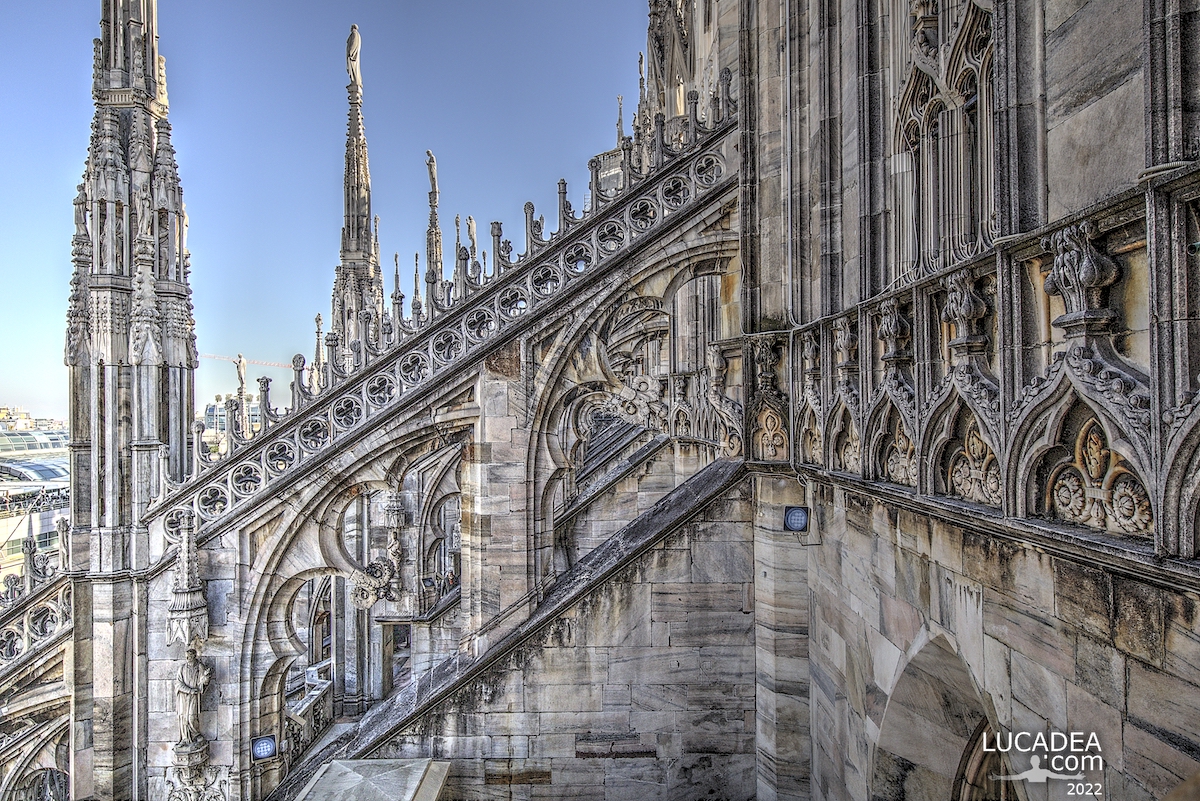
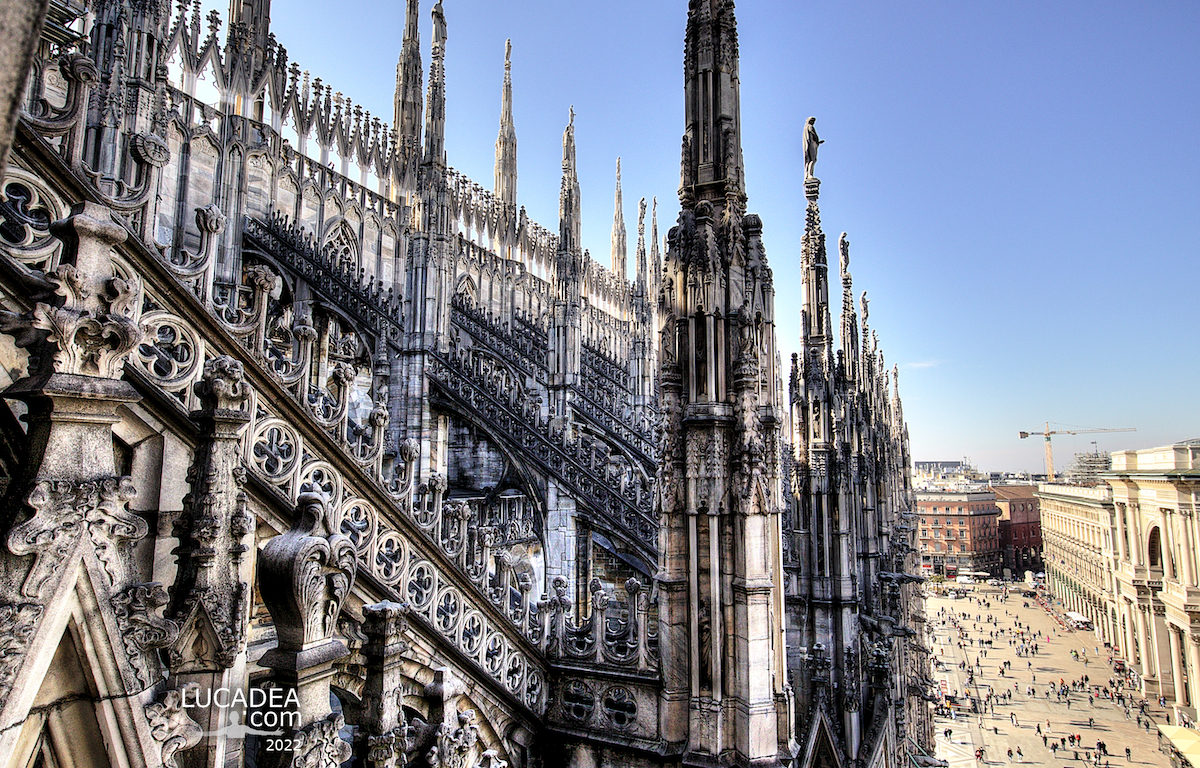
Milan Cathedral spires and statues seen up close, with pinnacles and detailed Gothic architectural decorations

Milan Cathedral spires and statues seen up close, with pinnacles and detailed Gothic architectural decorations

Photos taken with a Canon EOS M100 camera and a Canon EF-M 11-22 lens.

This is the official website of the cathedral: duomomilano.it.

Click here if you would like to see all the photos I’ve taken:
foto gallery

Here is where the cathedral is located:

Add one  comment to this article or read  here what other visitors have written.
 
Adv
 
Disclamer

The rights on images, videos, choruses, text and all other material on the LUCADEA.com website are governed as per  Copyright page.


This page has been viewed 1 times today.
This month it has been viewed 2 times.
In total it has been viewed 3 times.
 

Spikes and arches on Milan Cathedral

Guglie e archi in pietra sulle terrazze del Duomo di Milano, tra le intricate decorazioni della cattedrale

Spikes and arches on Milan Cathedral.
Standing on the rooftop terraces of Milan Cathedral, I found myself surrounded by an extraordinary amount of carved stone, with arches, spires and decorations appearing in almost every direction. It is a completely different perspective from the one you get from the square below, because here you are almost inside the architecture itself.
The main subject of this photograph is the collection of spires and arches on Milan Cathedral, but deciding what to include in the frame was not easy. Every time I moved my eyes, another detail appeared: a statue, a decorative element or a new overlapping arrangement of lines. Photographing such a dense architectural scene without losing the balance of the composition felt like a small challenge.
What struck me most was the feeling of being surrounded by a kind of stone maze. From street level, we are used to seeing the Duomo as one enormous cathedral, while from the rooftops the perception changes completely. The shapes become closer, the proportions are harder to read and the sheer number of architectural elements makes it difficult to understand where one structure ends and another begins.
I took this photograph while visiting the cathedral terraces. I was not trying to make another general picture of Milan Cathedral. Instead, I wanted to preserve the sensation of standing among all those arches and spires, with the carefully worked stone surrounding me.
If you are wondering what to see at Milan Cathedral, the terraces offer a particularly interesting perspective. They are not only a place from which to look across Milan from above, but also an opportunity to get close to architectural details that remain distant and difficult to distinguish from the street.
Milan Cathedral is one of the major examples of Gothic architecture in Italy, and its construction developed over several centuries. One of its most recognisable characteristics is the extraordinary number of spires, pinnacles and decorative elements that shape its silhouette. The famous Madonnina, standing on the highest spire, has also become one of the enduring symbols of Milan.
For this photograph, however, I wanted to stay much closer to the architecture. Rather than looking for the classic image of the cathedral, I chose to concentrate on a small section of the rooftops. Sometimes a detail can tell the story of a building more effectively than a complete view, especially when the architecture is as complex as this.
The biggest difficulty for me was finding a composition that did not become visually confusing. The terraces are filled with architectural elements, and moving only a little can completely change the image. Arches and spires overlap, creating depth while also producing an enormous number of lines that the camera has to organise.
That is one of the things that makes photographing Milan Cathedral so interesting from close range. It is not simply about photographing a famous monument. It is about constantly searching for another point of view. The same building can look completely different depending on the distance, height and portion of the architecture included in the frame.
Standing on the rooftops also makes you realise how much work lies behind the seemingly continuous surface of the cathedral. From a distance, the stone appears almost uniform. Up close, countless details emerge, each with its own shape and position.
I wanted this photograph to retain some of that sensation. I was not simply trying to show that I had visited the terraces. I wanted the image to communicate what it felt like to stand inside that extraordinary collection of forms.
This photograph also connects naturally with other images I have taken over the years of Milan and its landmarks. I enjoy returning to familiar places and looking for a different detail each time, because even a building we know well can reveal an entirely new perspective when we change the way we observe it.
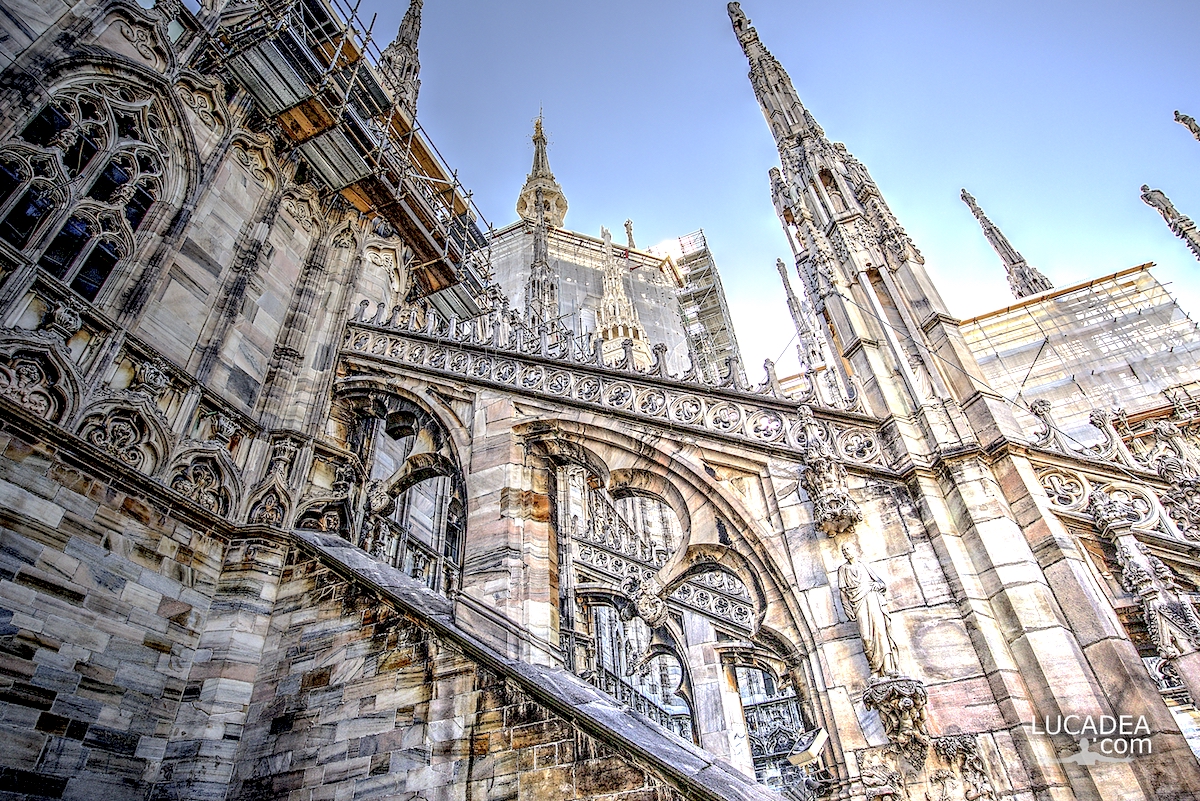
Here, it was the spires and arches that caught my attention. Together they create an almost abstract scene, even though every shape belongs to one of the most recognisable monuments in Italy.
Perhaps that is the real challenge, and also the pleasure, of photographing Milan Cathedral. When there is so much architectural richness in front of the camera, the difficult part is deciding what not to include.

Which detail of Milan Cathedral’s rooftops would have caught your eye first? Add a comment or go to the bottom of the site to read what other visitors have written.

Stone spires and arches on the rooftops of Milan Cathedral, surrounded by intricate Gothic architectural details

Photo taken with a Canon EOS M100 camera and Canon EF-M 11-22 lens.

To see all the photos I took on the roof and inside the Duomo, click here:

This is the official website of the Duomo: duomomilano.it.

Here is where the Duomo is located:

Add one  comment to this article or read  here what other visitors have written.
 
Adv
 
Disclamer

The rights on images, videos, choruses, text and all other material on the LUCADEA.com website are governed as per  Copyright page.

This page has been viewed 1 times today.
This month it has been viewed 1 times.
In total it has been viewed 1 times.
 

The spires of the Sagrada Familia in Barcelona

Le guglie della Sagrada Familia di Barcellona

The spires of the Sagrada Familia in Barcelona.
Looking upward between the streets of Barcelona, the basilica’s spires are among the first details that catch my attention, with their unusual shapes making Gaudí’s work immediately recognizable. They are the kind of subject I enjoy photographing because even a familiar landmark can look completely different when seen from another position.
When I took this photograph, I was not looking for the usual view of the entire Sagrada Familia. I wanted to look upward and isolate the towers, allowing their shapes and vertical lines to become the main subject of the image. When I photograph famous monuments, I often prefer this approach: instead of simply recording the whole building, I try to stop when a particular detail catches my eye.
The Sagrada Familia stands in Barcelona, Catalonia, Spain, and is naturally one of the city’s most recognizable landmarks. If you are visiting Barcelona and wondering what to see, it is almost impossible to overlook Antoni Gaudí’s basilica. During my visit, however, I was also interested in the smaller details that can easily disappear when the building is viewed only as a whole.
The spires are an essential part of the basilica’s distinctive appearance. From below, their height becomes especially noticeable, while a closer look reveals different shapes, openings and decorative elements. From a distance they can almost appear to form one large structure, but looking carefully shows how many individual parts come together.
One small detail that helps explain the design is the symbolism of the towers. The Sagrada Familia has eighteen towers in the overall project: twelve dedicated to the Apostles and six central towers dedicated to Jesus Christ, the Virgin Mary and the four Evangelists. The spires are therefore not simply architectural decoration but part of the broader symbolic idea behind the basilica.
That is also what interested me when I made this photograph. I wanted to capture a fragment of the Sagrada Familia rather than explain the entire building in a single image. With my camera, I concentrated on the lines rising above me and deliberately left much of the basilica outside the frame. In a city as full of recognizable subjects as Barcelona, narrowing the view can sometimes lead to a more personal photograph.
I have already shared several other photographs of the Sagrada Familia on the site. There is the Nativity façade, as well as the more recent Passion façade. I have also photographed details of the Sagrada Familia and another façade of the basilica. Together, these photographs reflect the same curiosity I had while walking around the building and noticing how many different subjects it offers.
All the photographs I took there can also be found in my Sagrada Familia photo gallery. I like having the images together because different viewpoints can change the appearance of the same monument considerably, even when the photographs are taken during the same visit.
If you are visiting Barcelona and want to photograph the Sagrada Familia, I would not concentrate only on the complete view. Looking upward and spending a little time with the spires can reveal shapes and details that are easy to miss from the street, especially when the scale of the whole building is competing for your attention.

Looking at this photograph again, what I like most is that it does not try to show everything. It keeps only one part of the Sagrada Familia in the frame, preserving the detail that caught my eye at that particular moment. Which detail of the Sagrada Familia would you photograph first? Add a comment or go to the bottom of the site to read what other visitors have written.

Photo taken with Canon EOS RP and Tamron 16-300 lens.

To see all the photos I took of the church, click here:
photo gallery

Where is the cathedral located?

🏠
  • Italiano