
Spikes and arches on Milan Cathedral

Guglie e archi in pietra sulle terrazze del Duomo di Milano, tra le intricate decorazioni della cattedrale

Spikes and arches on Milan Cathedral.
Standing on the rooftop terraces of Milan Cathedral, I found myself surrounded by an extraordinary amount of carved stone, with arches, spires and decorations appearing in almost every direction. It is a completely different perspective from the one you get from the square below, because here you are almost inside the architecture itself.
The main subject of this photograph is the collection of spires and arches on Milan Cathedral, but deciding what to include in the frame was not easy. Every time I moved my eyes, another detail appeared: a statue, a decorative element or a new overlapping arrangement of lines. Photographing such a dense architectural scene without losing the balance of the composition felt like a small challenge.
What struck me most was the feeling of being surrounded by a kind of stone maze. From street level, we are used to seeing the Duomo as one enormous cathedral, while from the rooftops the perception changes completely. The shapes become closer, the proportions are harder to read and the sheer number of architectural elements makes it difficult to understand where one structure ends and another begins.
I took this photograph while visiting the cathedral terraces. I was not trying to make another general picture of Milan Cathedral. Instead, I wanted to preserve the sensation of standing among all those arches and spires, with the carefully worked stone surrounding me.
If you are wondering what to see at Milan Cathedral, the terraces offer a particularly interesting perspective. They are not only a place from which to look across Milan from above, but also an opportunity to get close to architectural details that remain distant and difficult to distinguish from the street.
Milan Cathedral is one of the major examples of Gothic architecture in Italy, and its construction developed over several centuries. One of its most recognisable characteristics is the extraordinary number of spires, pinnacles and decorative elements that shape its silhouette. The famous Madonnina, standing on the highest spire, has also become one of the enduring symbols of Milan.
For this photograph, however, I wanted to stay much closer to the architecture. Rather than looking for the classic image of the cathedral, I chose to concentrate on a small section of the rooftops. Sometimes a detail can tell the story of a building more effectively than a complete view, especially when the architecture is as complex as this.
The biggest difficulty for me was finding a composition that did not become visually confusing. The terraces are filled with architectural elements, and moving only a little can completely change the image. Arches and spires overlap, creating depth while also producing an enormous number of lines that the camera has to organise.
That is one of the things that makes photographing Milan Cathedral so interesting from close range. It is not simply about photographing a famous monument. It is about constantly searching for another point of view. The same building can look completely different depending on the distance, height and portion of the architecture included in the frame.
Standing on the rooftops also makes you realise how much work lies behind the seemingly continuous surface of the cathedral. From a distance, the stone appears almost uniform. Up close, countless details emerge, each with its own shape and position.
I wanted this photograph to retain some of that sensation. I was not simply trying to show that I had visited the terraces. I wanted the image to communicate what it felt like to stand inside that extraordinary collection of forms.
This photograph also connects naturally with other images I have taken over the years of Milan and its landmarks. I enjoy returning to familiar places and looking for a different detail each time, because even a building we know well can reveal an entirely new perspective when we change the way we observe it.
Here, it was the spires and arches that caught my attention. Together they create an almost abstract scene, even though every shape belongs to one of the most recognisable monuments in Italy.
Perhaps that is the real challenge, and also the pleasure, of photographing Milan Cathedral. When there is so much architectural richness in front of the camera, the difficult part is deciding what not to include.

Which detail of Milan Cathedral’s rooftops would have caught your eye first? Add a comment or go to the bottom of the site to read what other visitors have written.
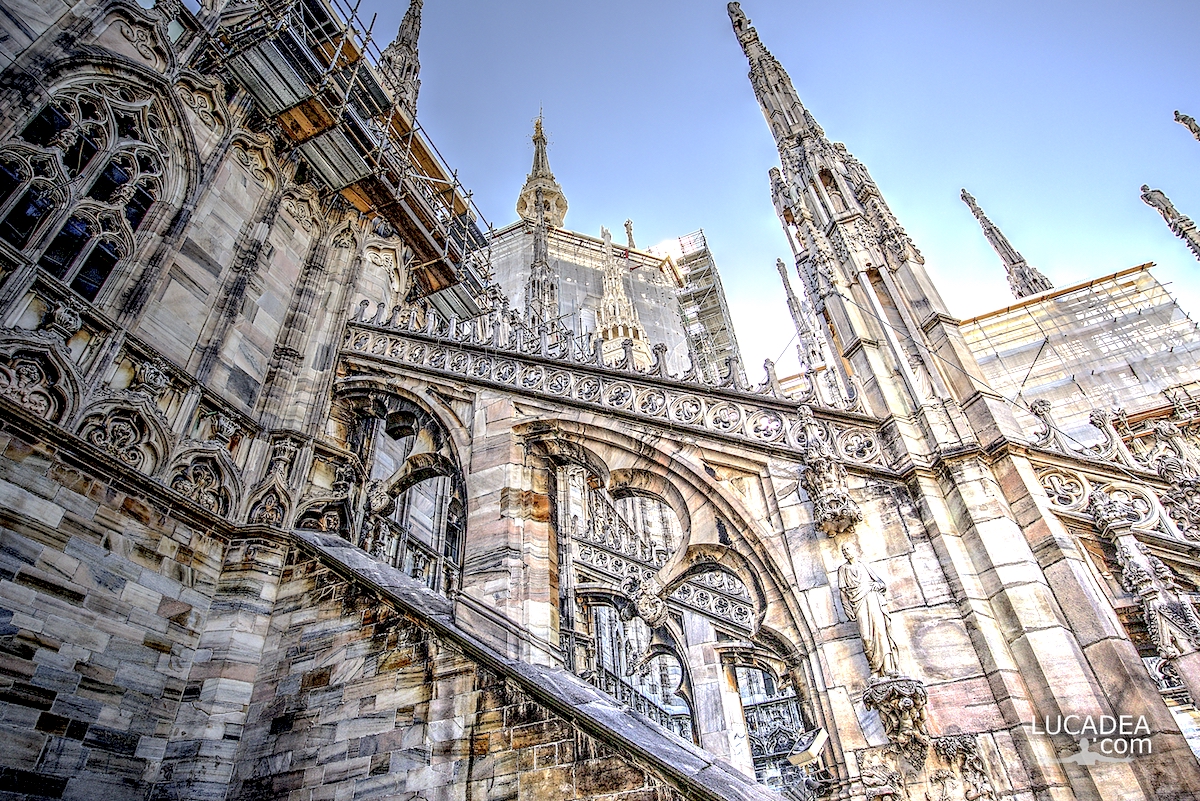
Stone spires and arches on the rooftops of Milan Cathedral, surrounded by intricate Gothic architectural details

Photo taken with a Canon EOS M100 camera and Canon EF-M 11-22 lens.

To see all the photos I took on the roof and inside the Duomo, click here:

This is the official website of the Duomo: duomomilano.it.

Here is where the Duomo is located:

Add one  comment to this article or read  here what other visitors have written.
 
Adv
 
Disclamer

The rights on images, videos, choruses, text and all other material on the LUCADEA.com website are governed as per  Copyright page.


This page has been viewed 1 times today.
This month it has been viewed 1 times.
In total it has been viewed 1 times.
 

An alley in the historic center of Perugia

Un vicolo del centro storico di Perugia

Walking through the beautiful historic center of the Umbrian town of Perugia, you encounter a maze of streets and alleys that are perfect for photography. The stone walls and streets are spectacular! Like in this photo.

Do you know the beautiful city of Perugia? Add a comment or go to the bottom of the site to read what other visitors have written.

Un vicolo del centro storico di Perugia

Photo taken with Canon EOS RP and Canon RF 24-50 lens.

To see all the photos of Perugia, click here:

Where is the point, more or less, where I took the shot:

From the main square in the center, the five royal roads branched off, connecting—and still partially connect—the city of Perugia with Cortona (today the Via Cortonese overlaps with the Trasimeno state road), Orvieto (Via Marscianese), Gubbio (Via Eugubina), Città di Castello, and the Via Flaminia (Foligno), which led from Rome to Ariminium (now Romagna).
Continue and learn more at Wikipedia

An alley in the historic center of Perugia – Une ruelle dans le centre historique de Pérouse – Un callejón en el centro histórico de Perugia – Um beco no centro histórico de Perugia – Eine Gasse im historischen Zentrum von Perugia – Một con hẻm ở trung tâm lịch sử của Perugia
Add one  comment to this article or read  here what other visitors have written.
 
Adv
 
Disclamer

The rights on images, videos, choruses, text and all other material on the LUCADEA.com website are governed as per  Copyright page.


This page has been viewed 1 times today.
This month it has been viewed 1 times.
In total it has been viewed 7 times.
 

Flying buttress arches in the alleys of Spoleto

Gli archi di un vicolo di Spoleto, il borgo in Umbria

Flying buttress arches in the alleys of Spoleto.
Walking through the narrow alleys of Spoleto, in Umbria, Italy, I discovered one of those small details that reveal what to see in Spoleto beyond the most famous landmarks: the flying buttress arches connecting the old buildings of the historic center. These structures are easy to overlook, yet they give the streets a unique character and tell a story about how the town developed over the centuries.
This photograph comes from my attention to those hidden architectural details that often become the most interesting subjects. I wanted to capture this scene with my camera because in a place like Spoleto, history is not only found in large monuments but also in the everyday elements built into the streets. An arch between two houses is not just a beautiful composition; it is a visible sign of the relationship between architecture and the needs of the people who lived there.
Flying buttress arches were created to connect and support buildings, helping to counter structural pressure and maintain the stability of old constructions. Beyond their practical purpose, today they are among the most recognizable features of historic Italian villages, where stone walls, narrow passages, and ancient houses create constantly changing perspectives.
Walking through Spoleto’s historic center means discovering a place where the past and present exist together. The small streets, stairways, and covered passages create an atmosphere where every turn can reveal another interesting view. What attracted me most was exactly this quiet aspect: not a famous monument, but a simple architectural detail capable of expressing the identity of the town.
A short historical curiosity is that many of these arches became common during medieval times, when buildings in growing towns were built closer together and additional support was needed to preserve stability while making the most of the available space.
Spoleto is also known for important landmarks such as the Cathedral, Albornoz Fortress, and the Bridge of Towers, but these less obvious corners are what make exploring the city rewarding. They remind me of other old villages I have photographed, where a doorway, a stone detail, or an unusual perspective can become the real focus of an image.
If you are visiting Spoleto and looking for places to see, taking time to wander through the historic alleys can reveal details that are often more memorable than expected.

What small architectural detail has surprised you most while walking through an old town? Add a comment or go to the bottom of the site to read what other visitors have written.

Flying buttress arches in the alleys of Spoleto, Umbria, between old stone houses in the historic village center

Photo taken with Canon EOS RP and Canon RF 24-50 lens.

To see all the photos I took in the city, click here:

Where is Spoleto located:

The toponym of Spoleto is thought to derive from the conjunction of the Greek words Spao and Lithos (Σπαω-λιθος), meaning detached stone. In other words, the Sant’Elia hill (meaning “the hill of the sun”) on which the city arose was interpreted as the remains of a landslide that broke away from Monteluco, but this theory has never been confirmed. Spoleto has been inhabited since prehistoric times. The first evidence of settlements dates back at least to the Late Bronze Age (12th-11th century BC): the most interesting finds were discovered at the summit and on the slopes of Sant’Elia hill, where the Rocca Albornoziana would rise many centuries later.
Continue and learn more on the Municipal website

The archivolt leading to the central square of Trevi

L'archivolto che porta alla piazza centrale di Trevi

The archivolt leading to Trevi’s central square.
To reach Trevi’s central square (Piazza Mazzini), you must pass under this archivolt beneath the Town Hall.

Do you know or have you ever visited the village of Trevi? Add a comment or go to the bottom of the site to read what other visitors have written.

L'archivolto che porta alla piazza centrale di Trevi

Photo taken with Canon EOS RP and Canon RF 24-50 lens.

To see all the photos I took in the village, click here:

Here’s where the village is located:

During the late Middle Ages and the Renaissance, Trevi experienced its golden age, characterized by extraordinary trade that fostered its economic prosperity (it was called “the dry port”), evidenced even today by the numerous palaces in the historic center, worthy of being found in much larger cities. Economic growth was accompanied by lively cultural and social activity. As early as 1469, a Jewish banker, one of the few professions such men were authorized to practice, was called upon to facilitate the circulation of money. Despite this, he was persecuted and subsequently one of the very first pawnshops was established, followed by the Monte Frumentario and various other charitable and welfare institutions.
Continue and learn more at Wikipedia

The archivolt that leads to the central square of Trevi – L’archivolte qui mène à la place centrale de Trevi – La arquivolta que conduce a la plaza central de Trevi – A arquivolta que conduz à praça central de Trevi – Die Archivolte, die zum zentralen Platz von Trevi führt – Archivolt dẫn đến quảng trường trung tâm Trevi

The characteristic Vico del Bottone in Sestri Levante

Il caratteristico Vico del Bottone a Sestri Levante

The quaint Vico del Bottone in Sestri Levante.
In the picturesque historic center of Sestri Levante, a small and charming passageway is known as Vico del Bottone. This narrow alley, steeped in history and character, offers an authentic glimpse into the life and traditions of this charming Ligurian town.
Vico del Bottone likely owes its name to a local legend or perhaps to an old button shop that once stood here. Artisan workshops were common in the narrow alleys of Italian towns, and this small shop may have served both locals and passing sailors. Over time, the name “Vico del Bottone” has become a testament to the daily life and economic activities that characterized Sestri Levante in the past.
Vico del Bottone is a perfect example of traditional Ligurian architecture. Its narrow walls, pastel-colored facades, and flower-filled balconies create an intimate and welcoming atmosphere. The solid wood arches and doorways tell stories of times gone by, while details like the slate doorposts lend the alley a touch of romance and mystery.
Walking through Vico del Bottone, you can admire the simple yet charming beauty of the historic houses, many dating back centuries. The narrow alleys invite visitors to slow down and enjoy the tranquil pace of life in a Ligurian town. Despite its central location, Vico del Bottone remains a place of peace and tranquility. Far from the hustle and bustle of the main streets, this hidden corner offers the perfect refuge for those seeking a moment of serenity. Here, you can find a bench to sit and reflect, enjoying the beauty and calm of the alley.
In conclusion, Vico del Bottone is one of the many hidden gems of Sestri Levante, a place worth discovering and appreciating for its beauty and timeless charm. Strolling through this alley, you can soak up the authentic Ligurian atmosphere and discover a piece of the history of this enchanting coastal town.
From Vico del Bottone, one of the most panoramic trails on the Riviera di Levante begins, leading to Punta Manara. This well-marked route begins right in the historic center of Sestri Levante and winds through vegetable gardens, gardens, and orchards. The first section of the trail, known as Salita della Mandrella, is uphill but alternates with flatter sections, making it a pleasant and accessible hike for many.
The trail is marked by two red squares and offers numerous panoramic viewpoints from which to admire the beauty of the Ligurian landscape. After about an hour’s walk, you reach the summit of Punta Manara, where you can enjoy a spectacular view stretching from Portofino to Punta Mesco. This route is ideal for those who want to immerse themselves in nature and discover breathtaking panoramas.

Have you ever hiked this trail? What impressed you most about the hike to Punta Manara? Add a comment or go to the bottom of the site to read what other visitors have written.

Il caratteristico Vico del Bottone a Sestri Levante

Photo taken with Honor 20.

Where is the alley located:

The characteristic Vico del Bottone in Sestri Levante – Le caractéristique Vico del Bottone à Sestri Levante – El característico Vico del Bottone en Sestri Levante – O característico Vico del Bottone em Sestri Levante – Der charakteristische Vico del Bottone in Sestri Levante – Nét đặc trưng Vico del Bottone ở Sestri Levante

This post was written with the help of Copilot, an AI-powered virtual assistant.

Arches in the historic alleys of Spello

Gli archi nei vicoli del borgo di Spello in Umbria

Arches in the historic alleys of Spello.
Among the things to see in Spello, Umbria, Italy, there are not only famous landmarks and artistic treasures, but also small architectural details hidden along the village streets. Walking through the alleys of Spello, you can often find stone arches connecting old buildings, quiet elements that reveal how historic villages have developed and adapted through the centuries.
This photograph comes from my fascination with these particular structures. I have always been attracted by arches that cross narrow streets in old towns because they combine a practical purpose with a strong visual character. In architecture, these structures are known as flying buttress arches or support arches, created to reinforce the connection between buildings. For me, however, they are much more than a technical solution: they are signs of time, details that give personality to a simple street.
This was a small alley in the village of Spello, and I wanted to capture with my camera one of those details that can easily be missed when walking too quickly. The shape of the arch, the relationship between the stone walls and the narrow perspective of the street create a simple but meaningful composition. It is not a major monument marked on every map, but a discovery made by slowing down and observing.
Spello, located in the heart of Umbria, Italy, still preserves the atmosphere of a village shaped by centuries of history. Its streets reflect Roman origins, medieval transformations and Renaissance influences, with buildings that often reveal how architecture adapted to limited urban spaces.
A small historical detail about these arches is that they were often built when houses expanded closer together and needed additional structural support. Today, they have become one of the most recognizable features of many Italian historic villages because they add depth, character and a unique rhythm to the streets.
After sharing photographs of other details of Spello, such as the Baglioni Chapel, Venere Gate and the village alleys, this image represents another part of the same photographic journey: not the most famous symbol of the town, but a small element that helps define its identity.
If you are visiting Spello and wondering what to see, remember to look above eye level as well. Sometimes the most interesting discoveries are not the largest ones, but the small architectural details that quietly tell the story of a place.

Which architectural detail from a journey has ever made you stop and take a photograph? Add a comment or go to the bottom of the site to read what other visitors have written.

Support arch in an alley of Spello, Umbria between old stone houses in the historic village center

Photo taken with Canon EOS RP and Canon RF 24-50 lens.

To see all the photos I took in the village, click here:

Here’s where the village is located:

Spello (Hispellum in Latin) is an Italian municipality in the province of Perugia in Umbria. It is part of the circuit of the most beautiful villages in Italy and boasts the Orange Flag tourism and environmental quality mark, awarded by the Italian Touring Club. Spello was founded by the Umbrians and later named Hispellum in Roman times; it was later registered with the Lemonia tribe. It was later declared a “Colonia Giulia” by Caesar and a “Splendidissima Colonia Julia” by Augustus, because it supported him in the wars of Perugia. After Augustus’ victory, he himself ceded to Hispellum a large part of the territories governed by Perusia, and the dominion of the city of Spello extended to the sources of the Clitunno River, which had previously been under the control of Mevania. It was later called “Flavia Costante” by Constantine. Ancient Spello was considered one of the most important cities in Roman Umbria.
Continue and learn more on Wikipedia

An enchanting corner of Trevi: where time turns to stone

Un angolo incantato di Trevi: dove il tempo si fa pietra

An enchanted corner of Trevi: where time turns to stone.
In the heart of Umbria, nestled among centuries-old olive trees and painted hills, the village of Trevi holds glimpses that tell silent stories. One of these reveals itself suddenly as you walk down one of its typical cobblestone streets: a narrow, winding lane that winds between ancient buildings with warm colors and weathered facades.
Above this street, like a suspended bridge between past and present, stands a stone archivolt connecting two buildings, one to the right and one to the left. It is a simple yet powerful architectural element: a passage that not only unites, but also frames. Crossing it, you feel like you’re crossing an invisible threshold, as if entering another era.
The archivolt, with its time-worn stones, speaks of a village that has managed to preserve its soul. It’s a sign of continuity, a dialogue between the houses, between the people who once lived there and still live there today. Beneath it, the light changes: it becomes softer, more intimate, as if the village wishes to whisper its secrets only to those who know how to observe.
This glimpse is one of the many reasons why Trevi enchants. It’s not just beauty: it’s identity, it’s memory, it’s the poetry of small things. Stopping here, even for just a moment, means being enveloped in an unforgettable atmosphere.

Do you know or have you ever visited the village of Trevi? Add a comment or go to the bottom of the site to read what other visitors have written.

Un angolo incantato di Trevi: dove il tempo si fa pietra

Photo taken with Canon EOS RP and Canon RF 24-50 lens.

To see all the photos I took in the village, click here:

Here’s where the village is located:

During the late Middle Ages and the Renaissance, Trevi experienced its golden age, characterized by extraordinary trade that fostered its economic prosperity (it was called “the dry port”), evidenced even today by the numerous palaces in the historic center, worthy of being found in much larger cities. Economic growth was accompanied by lively cultural and social activity. As early as 1469, a Jewish banker, one of the few professions such men were authorized to practice, was called upon to facilitate the circulation of money. Despite this, he was persecuted and subsequently one of the very first pawnshops was established, followed by the Monte Frumentario and various other charitable and welfare institutions.
Continue and learn more at Wikipedia

An enchanting corner of Trevi: where time turns to stone – Un coin enchanteur de Trevi : là où le temps se transforme en pierre – Un rincón encantador de Trevi: donde el tiempo se convierte en piedra – Um canto encantador de Trevi: onde o tempo se transforma em pedra – Eine bezaubernde Ecke von Trevi: wo die Zeit zu Stein wird

This post was written with the help of Copilot, an AI-powered virtual assistant.

Macelli Alley: the ancient heart of Sestri Levante

Vico dei Macelli: il cuore antico di Sestri Levante

Macelli Alley: the ancient heart of Sestri Levante.
In the maze of narrow streets that make up the historic center of Sestri Levante, Vico dei Macelli stands out for its discreet charm and profound historical identity. This alley, which connects the church of San Pietro in Vincoli to the small square dedicated to the painter Dina Bellotti, is much more than a simple passageway: it is a place that tells the story of daily life in a village that grew between the sea and commerce.
The name “Macelli” immediately evokes the ancient city market. Here, in medieval times, activities related to the sale of meat and fish took place, in a context that was not a slaughterhouse, but rather a bustling commercial center. The Latin term macellum, in fact, meant a covered market, and Vico dei Macelli was the beating heart of this local economy.
Even the word vico, often understood simply as alley, has deeper roots. In ancient Rome, vicus was a neighborhood, an urban unit with its own function and identity. Vico dei Macelli was once a small neighborhood, bustling with shops, artisans, and merchants, where work marked the rhythm of the day.
Today, strolling through this alley is like immersing yourself in an atmosphere suspended between past and present. The time-worn stones, the narrow facades that seem to touch, the architectural details that resist modernity: everything contributes to creating a place that preserves its soul intact.
Vico dei Macelli is one of those places that aren’t visited, but experienced. An authentic corner, where history isn’t written on the walls, but whispered by the silence of its stones.

Do you know this alley in Sestri? Add a comment or go to the bottom of the site to read what other visitors have written.

Vico dei Macelli: il cuore antico di Sestri Levante

Here’s where the alley is:

Alley of the Macelli in the historic center of Sestri Levante – Vico dei Macelli dans le centre historique de Sestri Levante – Vico dei Macelli en el centro histórico de Sestri Levante – Vico dei Macelli no centro histórico de Sestri Levante – Vico dei Macelli im historischen Zentrum von Sestri Levante – Vico dei Macelli ở trung tâm lịch sử của Sestri Levante

The text of this post was written with the help of Copilot, an artificial intelligence-based virtual assistant.
References:
– https://www.effecimmobiliare.com/news/sestri-levante-in-pillole-vico-macelli/

The Old Town Gate of Portovenere

La Porta del Borgo di Portovenere

The Old Town Gate of Portovenere.
The Old Town Gate of Portovenere, in Liguria, in the province of La Spezia, Italy, is one of the most charming entrances to the historic centre of this beautiful village overlooking the Gulf of Poets. I find it fascinating to imagine how many people have passed beneath its arch over the centuries and how many stories these ancient stones could tell. It is a place where medieval architecture remains part of everyday life in the village.
The gate stands within the old defensive walls and opens onto Giovanni Capellini Street, the characteristic narrow lane that runs through the heart of the historic centre. Beyond the entrance, a maze of narrow alleys, stairways, arches and tall, colourful houses invites visitors to explore. Every turn seems to reveal another interesting view. This is more than a simple passage into the village: walking through it feels like stepping into another period of history.
The Old Town Gate is closely connected to Portovenere’s medieval past and its relationship with the Republic of Genoa. During the twelfth century, Genoa developed the village into an important fortified settlement on the eastern Ligurian coast. Above the entrance, the historic inscription “Colonia Ianuensis 1113” recalls the village’s connection with Genoa. The gate and the surrounding walls formed part of a defensive system designed to protect a strategically important settlement for trade and coastal control.
What catches my attention most is the imposing simplicity of the stone structure. Elaborate decoration is not necessary to make this entrance impressive. The strength of the arch, the uneven surfaces of the stone blocks and the contrast with the buildings around it give the gate its distinctive character. Imagining Portovenere as it might have appeared centuries ago makes it easier to appreciate how important this entrance must have been for both residents and visitors arriving at the village.
Once through the gate, I can follow the narrow main lane and explore at my own pace, passing shops, small restaurants and picturesque corners along the way. The streets also lead towards some of Portovenere’s best-known landmarks, including the Church of San Pietro and Doria Castle, both important features of the village’s historic landscape.
On Lucadea.com, I enjoy sharing architectural details like this because small features often reveal something special about a place. The Old Town Gate is more than an ancient entrance: it is a tangible reminder of Portovenere’s past and an invitation to discover its historic streets.

When you visit a historic village, do you stop to admire its old gates and defensive walls, or do you prefer to wander straight into the narrow streets? Add a comment or go to the bottom of the site to read what other visitors have written.

The Old Town Gate of Portovenere, a medieval stone archway set within the historic defensive walls of this Ligurian village in Italy

Photo taken with Canon EOS RP camera and Canon RF 24-50 lens.

At another time, I also recorded a short video of me walking around the village:

Video recorded with GoPro Hero5.

Click here to see all the photos of the village:
foto gallery

Where is Portovenere?

🏠
  • Italiano