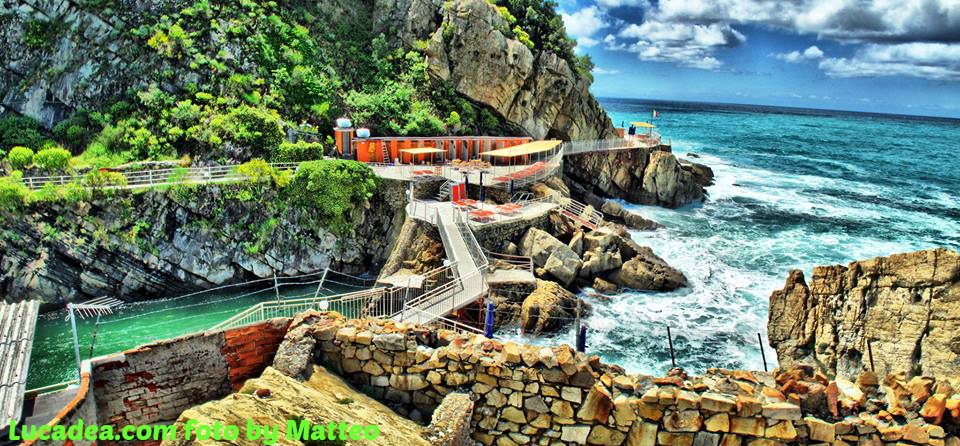
Piscina dei Castelli in Sestri Levante.
I took this photograph in 2013 from the harbour of Sestri Levante, stopping to look toward the coastline and the unusual seaside structure that had long been part of the town’s summer life. When I think about photos of Sestri Levante and what to see along this part of Liguria, Piscina dei Castelli is one of those places that immediately brings me back to a particular period in the town’s history.
At the time, the nightclub was closed. In my original article, I mentioned that closure almost as a hope for the future. Looking at the photograph now, that detail makes the image even more interesting because we know that the story of Piscina dei Castelli did not end there.
The photograph came from simply observing the landscape. From the harbour I had a wide enough viewpoint to avoid photographing the structure in isolation and instead include it within its natural setting, together with the sea and the coastline. That is why I preferred a slightly distant composition: I wanted to preserve not only Piscina dei Castelli itself, but also the surroundings that make this location so distinctive.
The setting is one of the most unusual features of the place. Piscina dei Castelli is located in the tourist harbour of Sestri Levante, Liguria, Italy, and the venue follows the edges of a natural seawater pool carved into the rocky coastline. Rock, water and architecture are therefore closely connected, and that relationship can already be appreciated from the harbour.
In my original article, I focused mainly on the seaside establishment and its connection with the historic nightclub of the same name. During its active years, the beach in front of the pool and the concrete platforms became part of the spaces used during summer nights. It was an unusual way of experiencing a nightclub, with music and the sea occupying almost the same space.
The history of Piscina dei Castelli, however, began long before I took this photograph. According to the official Piscina dei Castelli website, its story dates back to 1968, when Tino Barbera and Rudy Ciuffardi created a venue combining music and live concerts with a seaside setting. Over the following years, many well-known Italian and international performers appeared there, helping the venue become part of the cultural and nightlife history of Sestri Levante.
One detail I found particularly interesting is connected with 1987, when several themed parties were introduced and later became strongly associated with the name Piscina dei Castelli. They included the Festa in Bianco, the Full Moon Party and the Hawaiian-themed Hanoa Hanoa. The venue also recalls its Halloween Party as one of the earliest events of its kind in Italy.
In 1985, the owners had decided to focus more strongly on the nightclub side of the business after a long period characterised by live performances. This transition helps explain how Piscina dei Castelli evolved over the decades while maintaining its identity around music and its unusual position beside the sea.
When I took the photograph in 2013, however, all of that belonged to the history of the venue. Piscina dei Castelli was going through a period of closure, yet its distinctive structure was still clearly visible from the harbour. That contrast is what strikes me most today: a place created for music, dancing and crowds, photographed during a quiet chapter of its story.
The story would eventually continue. After eight years of closure, Piscina dei Castelli reopened in 2015 and returned to activity as a club and event venue. The official location page still describes the venue through its relationship with the natural seawater pool, the rocky shore and the spaces overlooking the water.
Knowing this now inevitably changes the way I look at the photograph. In 2013 I had no way of knowing that the venue would reopen only two years later. To me, it was simply a familiar place that deserved another photograph from the harbour.
This image also connects with another photograph I had published a few years earlier, showing Piscina dei Castelli as it looked in 2009. That photograph also came from a period when the nightclub was closed. Looking at the two images today, I almost feel as though I unintentionally followed a small part of the venue’s history through my camera.
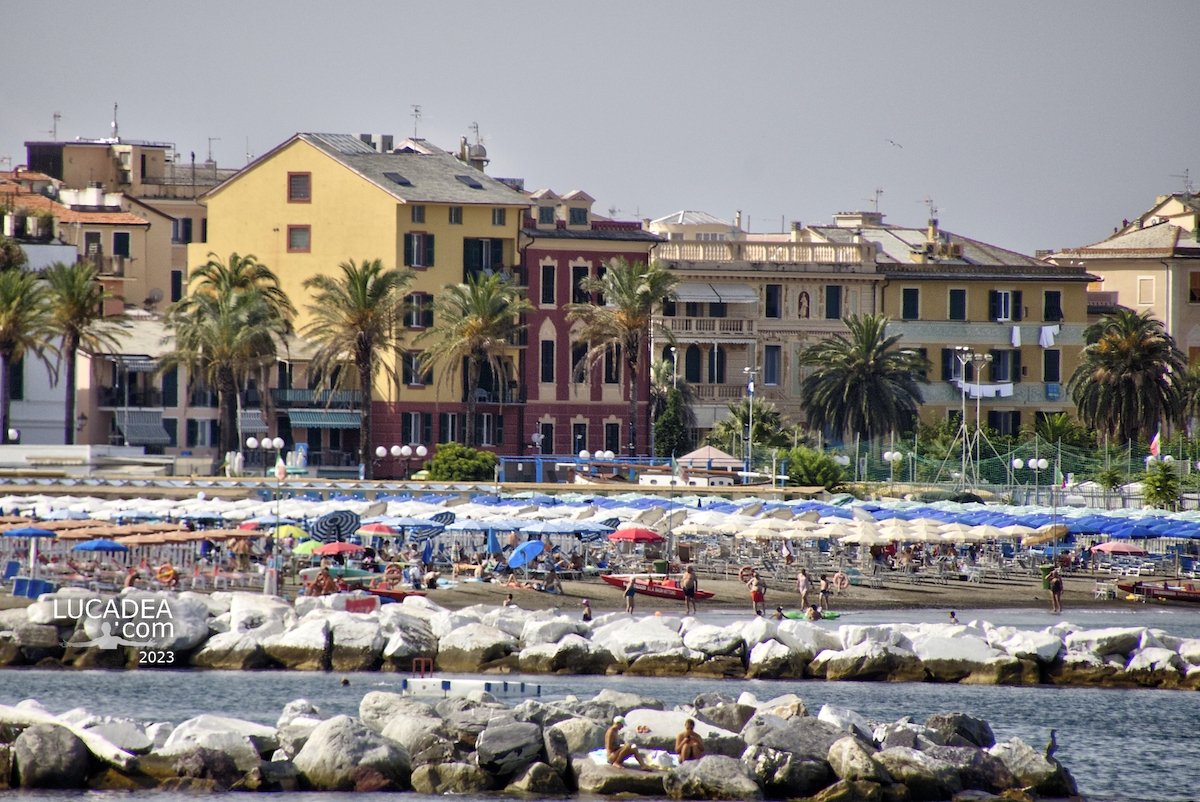
There are other photographs of Sestri Levante on the site as well, including the Bay of Silence at night. They are very different images, but they belong to the same idea of documenting the town through personal viewpoints and different moments. I am more interested in preserving what I actually saw than in turning the photograph into a conventional travel guide.
If you are wondering where Piscina dei Castelli is in Sestri Levante, the reference point is the tourist harbour. The official contact page gives the address as Piazzale Mariani d’Italia 3, Sestri Levante. For current events, opening times and activities, the official website is naturally the best place to check because those details can change over time.
What remains constant, however, is the relationship with the sea. That is the detail that first caught my attention when I took the photograph and that I still consider the real subject of the image. The structure does not simply stand beside the coastline: it follows the shape of the rock and the natural seawater pool, becoming almost part of the landscape.
Looking at this photograph many years later, I realise that its value is not only in showing Piscina dei Castelli. It shows Sestri Levante at a particular moment, when the venue was closed and its future was uncertain. What was once simply a personal memory has become a way of comparing two different chapters in the history of this place.
That is also why I think it is worth photographing the things we encounter during an ordinary walk, even when they do not seem especially important at the time. Buildings change, venues close or reopen, people’s habits evolve and, years later, a simple photograph can become a way of remembering how a familiar place once looked.
Piscina dei Castelli is now once again part of Sestri Levante’s life, while this photograph remains connected with 2013 and that period of waiting. For me, that is precisely why I wanted to update this old article without losing its connection with the original photograph.
Do you also have an old photograph that, years later, made you realise how much the place in front of your camera had changed? Add a comment or go to the bottom of the site to read what other visitors have written.