
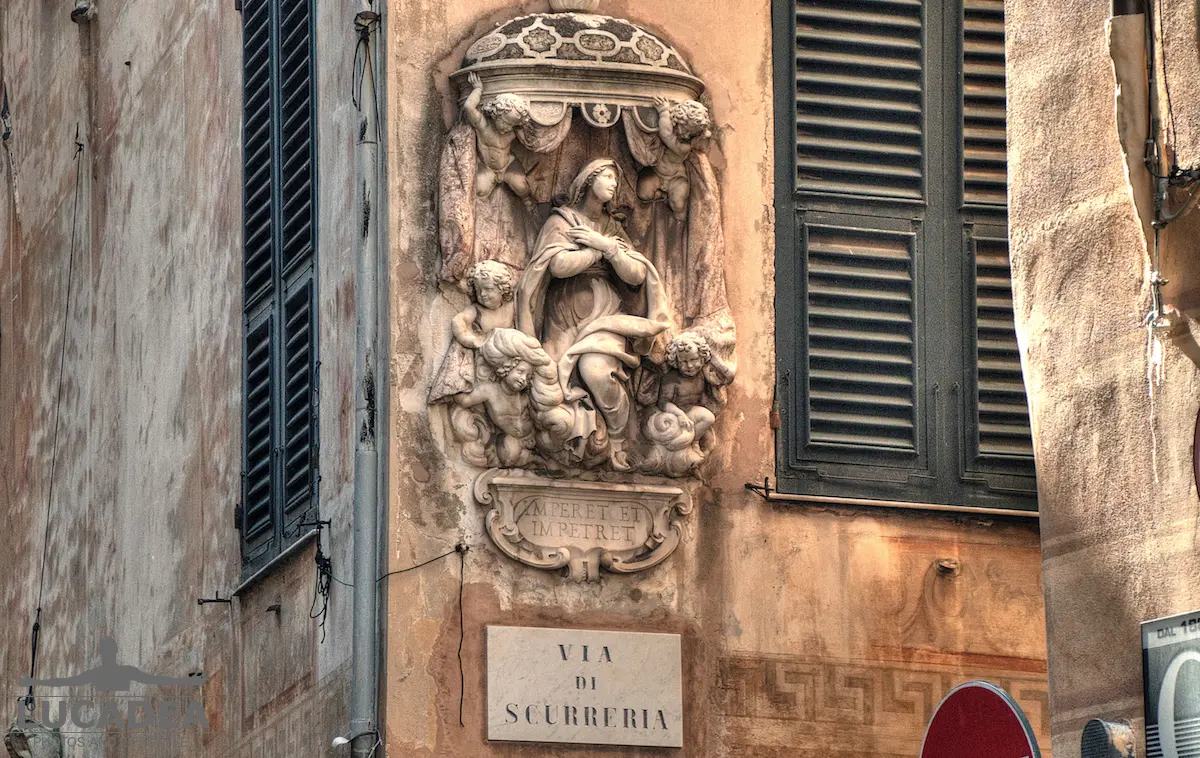
A Votive Shrine in Genoa’s Historic Old Town

Edicola di via di Scurreria a Genova

A Votive Shrine in Genoa’s Historic Old Town.
In the historic centre of Genoa, between Piazza Campetto and Via di Scurreria, this small shrine is a reminder of Liguria’s tradition of popular religious devotion. Votive shrines are a familiar feature of the region’s streets and villages, often found on building façades, at street corners or along the narrow lanes of old neighbourhoods.
These small niches containing sacred images reflect an aspect of everyday history in Ligurian towns and cities. Some are simple and understated, while others have decorated frames and architectural details that make them stand out. They can easily be overlooked by people walking through the old town without stopping, yet a closer look often reveals details that contribute to the character of the surrounding streets.
The shrine on Via di Scurreria is part of a distinctive corner of Genoa, in Liguria, Italy. Narrow streets, closely spaced buildings and passages connecting small squares create a dense urban landscape shaped by different periods of history. Between Piazza Campetto and Via di Scurreria, even a modest religious feature adds another detail to the story of the city and its relationship with the people who live and move through it.
In the past, votive shrines often served as familiar points of reference for local religious life. Sacred images could be cared for by families and neighbourhood residents, particularly during religious celebrations. This tradition has left visible traces throughout Liguria, where many shrines remain part of the region’s historical and cultural heritage.
I took this photograph to focus on one of those small details that help define Genoa’s historic centre. It may not have the imposing presence of a grand palace or church, but it offers a quieter way to appreciate the character of the old town. I enjoy noticing features like this while walking through historic streets, because they encourage me to look beyond the main landmarks and pay attention to places that might otherwise go unnoticed.
The same curiosity can lead to the discovery of other corners of Genoa’s old town, where architecture, tradition and everyday life come together along streets that have connected the city’s neighbourhoods for generations.

Have you ever noticed a votive shrine while walking through Genoa or another town in Liguria? Add a comment or go to the bottom of the site to read what other visitors have written.

Votive shrine on Via di Scurreria, between Piazza Campetto and the narrow streets of Genoa’s historic centre in Liguria, Italy

Photo taken with Canon EOS M100 camera and Tamron 16-300 lens.

Where is it located:

Add one  comment to this article or read  here what other visitors have written.
 
Adv
 
Disclamer

The rights on images, videos, choruses, text and all other material on the LUCADEA.com website are governed as per  Copyright page.


This page has been viewed 0 times today.
This month it has been viewed 0 times.
In total it has been viewed 0 times.
 

The beautiful building in Ruggero Small Square in Assisi

Il bel palazzo in piazzetta Ruggero ad Assisi

The beautiful building in Ruggero Small Square in Assisi.
One of the iconic images of Assisi, apart from the Basilica of Saint Francis, is certainly this building located at the intersection of two streets: Piaggia di Porta San Pietro and Via Fontebella.
It is home to this beautiful votive shrine featuring a Madonna and Child, about which I have not been able to find much information.

Do you know Assisi? Add a comment or go to the bottom of the site to read what other visitors have written.

Il bel palazzo in piazzetta Ruggero ad Assisi

Photo taken with Canon EOS RP and Canon RF 24-50 lens.

To see all the photos of Assisi, click here:

Here’s where this building is located:

The beautiful palace in Piazzetta Ruggero in Assisi – Le magnifique palais de la Piazzetta Ruggero à Assise – El hermoso palacio de la Piazzetta Ruggero en Asís – O belo palácio da Piazzetta Ruggero em Assis – Der wunderschöne Palast auf der Piazzetta Ruggero in Assisi – Cung điện xinh đẹp ở Piazzetta Ruggero ở Assisi
Add one  comment to this article or read  here what other visitors have written.
 
Adv
 
Disclamer

The rights on images, videos, choruses, text and all other material on the LUCADEA.com website are governed as per  Copyright page.


This page has been viewed 1 times today.
This month it has been viewed 1 times.
In total it has been viewed 2 times.
 

A votive shrine at the entrance to the Rocca Park

Una edicola votiva all'ngresso del Parco Rocca a Chiavari

A votive shrine at the entrance to Rocca Park in Chiavari.
At the entrance to the gate leading to the garden and park of Villa Rocca, there’s this beautiful icon in this shrine that appears very ancient.

Do you know the palace and park of Villa Rocca?
Add a comment or go to the bottom of the site to read what other visitors have written.

Una edicola votiva all'ingresso del Parco Rocca a Chiavari

Photo taken with Canon EOS RP camera and Tamron 16-300 lens.

Where to find this newsstand:

Palazzo Rocca is a museum complex in Chiavari, located on Via Costaguta. The building is located in the immediate vicinity of the historic “Piazza delle Carrozze” in the old town, named after Giacomo Matteotti, and is entirely surrounded by the prized Rocca Botanical Park. The former stables house the local archaeological museum, and the civic gallery is located on the upper floors.
Continue and learn more at Wikipedia

A votive shrine at the entrance to the Rocca Park in Chiavari – Un sanctuaire votif à l’entrée du Parco Rocca de Chiavari – Un santuario votivo a la entrada del Parco Rocca en Chiavari – Um santuário votivo à entrada do Parco Rocca em Chiavari – Ein Votivschrein am Eingang zum Parco Rocca in Chiavari – Một ngôi đền tạ ơn ở lối vào Parco Rocca ở Chiavari

The Votive Shrine in Vico San Pietro della Porta, Genoa

L'Edicola di Vico San Pietro della Porta a Genova

The Votive Shrine in Vico San Pietro della Porta, Genoa.
While walking through the historic centre of Genoa, I came across this small votive shrine tucked into a corner of Vico San Pietro della Porta, just a short walk from Piazza Banchi. It is the kind of detail I enjoy discovering in the city’s narrow alleys: a small religious structure that can easily go unnoticed if you are concentrating only on the streets and buildings around you.
Genoa’s old town is full of unexpected details. Beyond its palaces, churches and famous landmarks, the caruggi reveal a more intimate side of the city, where historic doorways, stone walls and small religious images form part of the everyday streetscape. I often explore these lanes with my camera, stopping whenever something catches my attention. On this occasion, it was this votive shrine that made me pause and take a closer look.
The shrine stands at the corner of Vico San Pietro della Porta and Via dei Conservatori del Mare, in Genoa, Liguria, Italy. Its location is part of what makes it interesting. Rather than occupying a large square or a prominent position in front of a church, it is incorporated into the urban fabric of the old town. You encounter it while moving through the narrow streets, almost as if it belongs to the rhythm of the neighbourhood rather than being a monument set apart from it.
The shrine is dedicated to Madonna della Guardia and dates back to the eighteenth century. Votive shrines like this one have long been part of popular religious life in Liguria and other parts of Italy. They were placed along streets, on building façades and at crossroads as expressions of devotion, gratitude or a request for protection. Many became familiar reference points for the people who lived nearby, linking religious traditions with ordinary journeys through the city.
What interests me most about these small structures is their scale. They are usually modest compared with the grand churches and palaces that attract most visitors, yet they offer a different way of understanding a historic neighbourhood. A sacred image placed on a street corner can tell us something about the beliefs and customs that shaped everyday life, even when the original circumstances behind its installation are no longer widely remembered.
I took this photograph with my Canon EOS M100 and a Canon EF-S 10–18 mm lens. I wanted to record the shrine as I encountered it, within its actual urban setting rather than treating it as an isolated object. When photographing details in the caruggi, I find it important to preserve some of the surrounding context. The relationship between the shrine and the narrow street is part of what makes this particular subject meaningful.
If you are exploring Genoa and wondering what to look for beyond the main attractions, these small religious landmarks are worth keeping an eye out for. They do not always appear on the usual sightseeing itineraries, and finding them often depends on taking your time and looking carefully at the buildings around you. The area near Piazza Banchi is particularly interesting for this kind of exploration, with its network of historic streets and passages.
The shrine also connects naturally with other photographs I have taken around Genoa. I have documented another votive shrine at Ponte Reale, where a similar expression of popular devotion appears within a different part of the historic centre. Comparing these small landmarks is a reminder that they are not isolated curiosities, but part of a wider tradition that can be discovered throughout the city. You can find more examples in my collection of photographs dedicated to shrines and small religious landmarks.
I like returning to familiar streets because there is always the possibility of noticing something new. A doorway, an inscription or a small image above a passage can become the subject of a photograph simply because I happened to look up at the right moment. These details do not necessarily demand attention, but they reward anyone willing to slow down and observe the surroundings.
For me, this is one of the pleasures of photographing Genoa. The city can be appreciated through its major monuments, but it can also be understood through the smaller elements woven into its streets. This votive shrine is a modest example, yet it preserves a visible connection between the city’s architectural heritage and the religious traditions of its inhabitants.

Have you ever noticed a votive shrine hidden among the narrow streets of Genoa, or is this a detail you would probably walk past without seeing? Add a comment or go to the bottom of the site to read what other visitors have written.

Votive shrine dedicated to Madonna della Guardia at the corner of Vico San Pietro della Porta in Genoa's historic centre

Photo taken with Canon EOS M100 and Canon EF-S 10-18 lens.

Here’s where this glimpse of Genoa is located:

Votive shrine at Ponte Reale in Genoa today

Edicola votiva in marmo e nicchie illuminate nel vicolo di Ponte Reale a Genova, dettagli urbani dei carruggi, luce naturale morbida tra edifici storici e passaggio pedonale in contesto cittadino.

Votive shrine at Ponte Reale in Genoa today.
Walking through the alleys of Genoa, I once again found myself at Ponte Reale, a place that many people cross without really stopping to look around. Between the rhythm of the city and the constant movement of people, my attention is drawn to a detail that resists time: an edicola votiva genova set into the stone, discreet yet present, almost guarding the memory of the place. The afternoon light slips between the narrow buildings, creating a soft contrast between shadows and worn surfaces, typical of the carruggi.
In moments like this, I like to pause and observe how the city tells its story through small signs rather than grand monuments. The edicola votiva nei carruggi di Genova becomes a visual resting point, a fragment of popular spirituality that coexists with everyday life, shops, quick passages, and overlapping voices. It is precisely this layering of worlds that makes the historic center so alive.
I often wonder how many of these details are truly noticed by those who are in a hurry: have you ever stopped to look at something like this while walking through the city? comment or go to the lower part of the site to read what other visitors have written.
There is something deeply human in these small shrines, a silent presence accompanying people as they pass by. Even for a few seconds, stopping in front of this glimpse of ponte reale genova vicoli storici means entering a slower, almost suspended dimension. And while the city keeps moving, there remains the feeling of having noticed a detail that often goes unseen, yet tells far more than it first appears.

Edicola votiva in marmo e nicchie illuminate nel vicolo di Ponte Reale a Genova, dettagli urbani dei carruggi, luce naturale morbida tra edifici storici e passaggio pedonale in contesto cittadino.

Photo taken with Canon EOS M100 and Canon EF-S 10-18 lens.

Browsing online, I also found a brief description of this sacred monument. Since I don’t want to copy it, I invite you to read it at amezena.net.

Votive shrine at Ponte Reale in Genoa today – Sanctuaire votif à Ponte Reale à Gênes aujourd’hui – Santuario votivo en Ponte Reale en Génova hoy – Santuário votivo em Ponte Reale em Génova hoje – Votivschrein bei Ponte Reale in Genua heute – Đền thờ votive ở Ponte Reale tại Genova hôm nay – 热那亚 Ponte Reale 的还愿神龛 今日 – ポンテ・レアーレの奉納祠 ジェノヴァ 今日

The text of this post was written with the help of ChatGPT, a language model from OpenAI.

🏠
  • Italiano