
Seaside houses in Little Venice Mykonos

Case sul mare a Little Venice Mykonos con balconi colorati affacciati sull’acqua limpida e passeggiata con persone

Seaside houses in Little Venice Mykonos.
There is a very specific feeling when you walk through Little Venice Mykonos, where the seaside houses seem to touch the water and instantly show what to see in Mykonos without any effort. This part of Little Venice in Mykonos is one of the most iconic places in the Greek islands, where architecture and sea blend into a single दृश्य.
I found myself moving slowly along the edge of the walkway, my attention shifting between the crystal-clear water and the bright facades. Some balconies extend so close to the sea that they almost feel like they belong to it. The colors kept changing subtly, with blues and greens reflecting light in a way that felt alive but never overwhelming.
This view is located in Mykonos, Cyclades, Greece, where the sea is not just a backdrop but a constant presence in daily life. If you are visiting this island, Little Venice is definitely a place worth seeing in Mykonos, especially if you are looking for something that captures both history and atmosphere. These houses were historically used by merchants, allowing direct access to boats, which adds a deeper meaning to what you see today.
While taking this shot, I was reminded of another scene I had shared on my site from Liguria, Italy. The connection between buildings and water felt similar, yet here everything seemed brighter and more open, almost floating between land and sea.
People sitting along the waterfront added movement to the scene without breaking its balance. It’s one of those places where you can stay for a long time, just watching the interaction between waves and buildings.

Have you ever been somewhere where the sea feels like it becomes part of the houses themselves? Add a comment or go to the bottom of the site to read what other visitors have written.

Case sul mare a Little Venice Mykonos con balconi colorati affacciati sull’acqua limpida e passeggiata con persone

Photo taken with Canon EOS M100 and Canon EF-M 11-22 lens.

To see all the photos of the town, click here:
foto gallery

Mykonos (Greek: Μύκονος) is a Greek island in the Cyclades, located near Tinos, Syros, and Naxos. It has an area of ​​96 km² and its highest point reaches 341 m above sea level. At the 2001 census, it had 9,320 inhabitants, most of whom live in the town of Mykonos (also known as Chora), which is located on the western coast.
Continue on Wikipedia

Where is Mykonos located?

Le case sul mare a Little Venice Mykonos – The seaside houses in Little Venice Mykonos – Les maisons en bord de mer à Little Venice Mykonos – Las casas junto al mar en Little Venice Mykonos – As casas à beira-mar em Little Venice Mykonos – Die Häuser am Meer in Little Venice Mykonos – Những ngôi nhà bên biển ở Little Venice Mykonos – 小威尼斯米科诺斯的海边房屋

The text of this post was written with the help of ChatGPT, a language model from OpenAI.

Add one  comment to this article or read  here what other visitors have written.
 
Adv
 
Disclamer

The rights on images, videos, choruses, text and all other material on the LUCADEA.com website are governed as per  Copyright page.


This page has been viewed 1 times today.
This month it has been viewed 1 times.
In total it has been viewed 1 times.
 

The yellow house with lanterns in Hoi An

Casa gialla a Hoi An con lanterne e piante sospese, edificio tradizionale trasformato in café nel centro storico vietnamita

The yellow house with lanterns in Hoi An.
The yellow house with lanterns in Hoi An immediately draws my attention as I walk through the old streets, where every building seems layered with color, plants, and soft light. The yellow house with lanterns in Hoi An, Vietnam, stands out not because it breaks the rhythm of the town, but because it fits so naturally into it.
As I move closer, the yellow house with lanterns in Hoi An reveals itself as more than just a house. Like many buildings in the historic center, it has been transformed into a café or a small multi-level restaurant, blending daily life with architectural heritage in a seamless way.
I stop for a moment and observe the hanging plants, the lanterns swaying gently, and the worn yellow paint reflecting the humid light of central Vietnam. In Hoi An Ancient Town, Vietnam, this combination of nature and architecture is not decorative but essential to the identity of the place.
If you are visiting Hoi An in central Vietnam, you will quickly notice how many of these old merchant houses have been adapted over time while still preserving their original wooden structure. One of the most interesting aspects of Hoi An is how it maintains its historic atmosphere while remaining fully alive and functional.
There is a quiet connection here with other travel memories I have shared on the site, such as the elegant seafront buildings in Rapallo, where architecture feels more formal and structured. In Hoi An, everything is more organic, more layered, and more visually dense.
A small historical detail often mentioned is that many of these houses were originally part of a busy trading port network, which explains their narrow shape and deep interior layout, still visible today.

The yellow house with lanterns in Hoi An stays with me as a place where architecture and daily life merge without boundaries. What would it feel like to sit inside that light and watch the street go by? Add a comment or go to the bottom of the site to read what other visitors have written.

Casa gialla a Hoi An con lanterne e piante sospese, edificio tradizionale trasformato in café nel centro storico vietnamita

Photo taken with Canon EOS RP and lens Canon RF 28.

Click here to see all the photos of the town:
foto gallery

The former Champa port city, located on the Thu Bon estuary, was an important center of Vietnamese trade during the 16th and 17th centuries, when Japanese and Chinese from various provinces, as well as Dutch and Indians, settled there. During this period of trade with China, the city was called Hai Pho (City on the Sea) in Vietnamese.
Continue and learn more at Wikipedia

The yellow house with lanterns in Hoi An – La casa gialla con lanterne nel cuore di Hoi An – La casa amarilla con faroles en Hoi An – A casa amarela com lanternas em Hoi An – Das gelbe Haus mit Laternen in Hoi An – Ngôi nhà vàng với đèn lồng ở Hội An – 会安带灯笼的黄色房子 – ホイアンの提灯がある黄色い家

The text of this post was written with the help of ChatGPT, a language model from OpenAI.

Add one  comment to this article or read  here what other visitors have written.
 
Adv
 
Disclamer

The rights on images, videos, choruses, text and all other material on the LUCADEA.com website are governed as per  Copyright page.

This page has been viewed 1 times today.
This month it has been viewed 1 times.
In total it has been viewed 1 times.
 

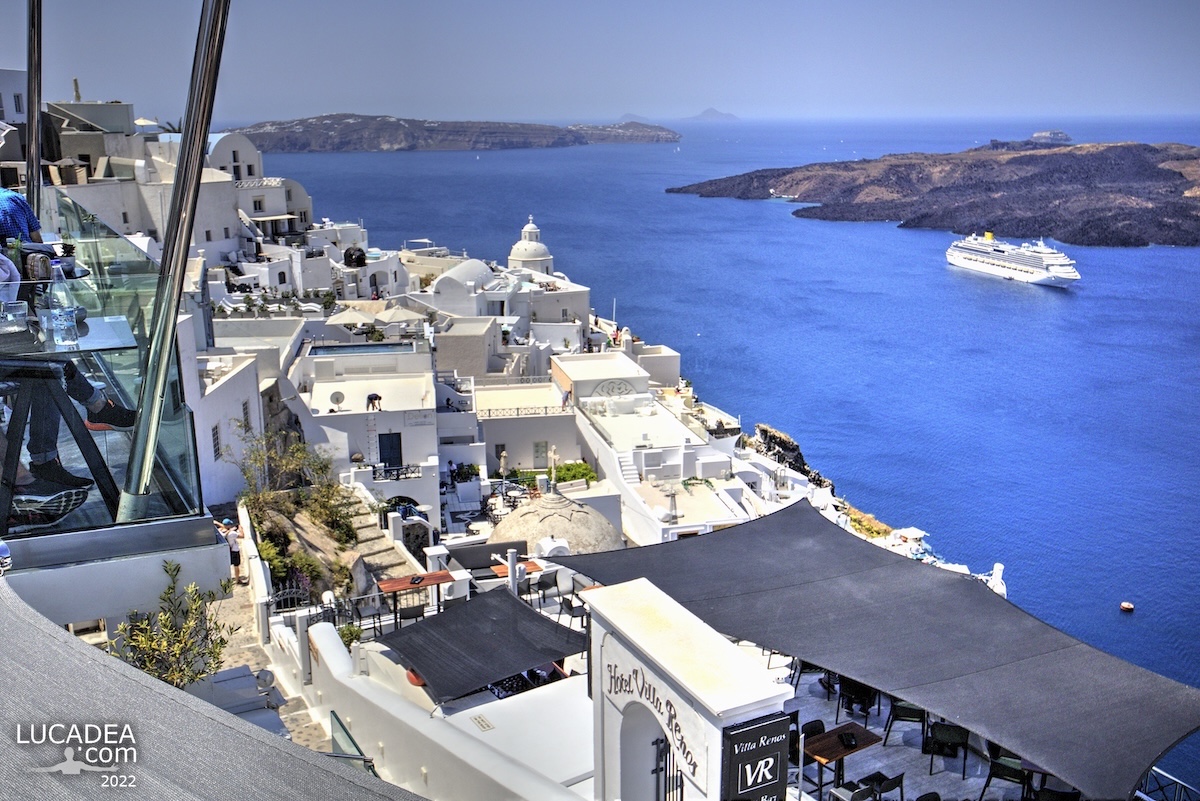
A view over Santorini caldera with a ship

Vista sulla caldera di Santorini con case bianche e nave da crociera nel mare blu intenso delle Cicladi

A view over Santorini caldera with a ship.
I still remember the exact moment I took this photo overlooking the Santorini caldera, one of those scenes that stays with you long after you leave. The view over the Santorini caldera, with its deep blue sea and white houses climbing the cliffs, is far more than just another idea of what to see in Greece—it’s something you feel all around you.
I was standing there, leaning slightly over the terrace, while the Costa Pacifica rested quietly in the bay, almost as if it had stopped just to admire the same view. In that moment, being in Santorini, Cyclades, Greece felt almost unreal, like everything had aligned perfectly between light, sea, and silence.
The white buildings reflected the sunlight so brightly that they almost blended into the sky, while the shadows carved sharp, geometric shapes across the landscape. If you are visiting Santorini and wondering what to see, this is one of the most iconic views you can experience, yet it still manages to feel personal and intimate.
It reminded me of another photo I shared on the site, also focused on a seaside landscape, but with a completely different mood. Here, everything felt open and radiant, filled with that unmistakable Mediterranean light.
An interesting fact is that the Santorini caldera was formed by one of the largest volcanic eruptions in history, and what we see today is actually the rim of a massive submerged crater.
If you are looking for what to see in Santorini, this is definitely a place worth seeing—not just for its beauty, but for the feeling it leaves behind.

Have you ever stood in front of a view so perfect it almost didn’t feel real? Add a comment or go to the bottom of the site to read what other visitors have written.

Vista sulla caldera di Santorini con case bianche e nave da crociera nel mare blu intenso delle Cicladi

Photo taken with Canon EOS M100 camera and Canon EF-M 11-22 lens.

Santorini (also Santorino in Italian; Modern Greek: Σαντορίνη, Santoríni; Ancient Greek: Θήρα, Thera) is the southernmost island of the Cyclades archipelago in the Aegean Sea.
Continue and learn more on Wikipedia

View over the Santorini caldera with a ship – Vue sur la caldeira de Santorin avec un navire – Vista sobre la caldera de Santorini con un barco – Vista sobre a caldeira de Santorini com um navio – Blick auf die Caldera von Santorini mit einem Schiff – Quang cảnh miệng núi lửa Santorini với con tàu – 圣托里尼火山口与船只的景色 – サントリーニのカルデラと船の眺め

The text of this post was written with the help of ChatGPT, a language model from OpenAI.

Modernist building on La Rambla in Barcelona

Palazzo modernista sulla Rambla a Barcellona con facciata ornamentale curva, dettagli decorativi e atmosfera urbana vivace nel centro città

Modernist building on La Rambla in Barcelona.
I find myself standing in front of a striking modernist building on La Rambla in Barcelona, where the curved façade and ornate stone details immediately draw my attention upward. The modernist building on La Rambla in Barcelona feels like a living part of the street, blending into the constant movement of people and city life.
I am in Barcelona, Catalonia, Spain, right along one of the most vibrant urban corridors of the city, where historic architecture and daily life overlap in a continuous flow. The modernist building on La Rambla in Barcelona shows how strongly the Catalan modernism tradition shaped the identity of the city, turning even ordinary streets into open-air galleries.
As I walk slowly, I notice how the light changes the perception of the structure, highlighting its curves, balconies, and decorative elements. The street below is full of motion, with pedestrians, small shops, and kiosks creating a layered urban rhythm. I remember another article from the blog about Barcelona architecture, where similar buildings told stories of artistic ambition and urban transformation, and this place feels like a continuation of that journey.
If you are visiting Barcelona, this is one of those areas where looking up becomes just as important as looking forward. It is a place worth seeing in Spain, especially if you are interested in architecture that blends art and function in a seamless way.
A lesser-known detail is that many buildings along this area were constructed during the height of Catalan Modernism, when architects aimed to express cultural identity through highly decorative and innovative forms, making the city visually unique in Europe.

And as I stand here a moment longer, I wonder how many stories are hidden above the street level, waiting to be noticed by someone who simply decides to look up? Add a comment or go to the bottom of the site to read what other visitors have written.

Palazzo modernista sulla Rambla a Barcellona con facciata ornamentale curva, dettagli decorativi e atmosfera urbana vivace nel centro città

Photo taken with Canon EOS RP and Canon RF 28 lens.

To see all the photos of Barcelona, ​​click here:
foto gallery

Mosaic signs inside Khai Dinh tomb in Hue

Dettaglio decorativo a mosaico nella tomba di Khai Dinh a Hue, Vietnam, con segni artistici e simbolici in ceramica colorata

Mosaic signs inside Khai Dinh tomb in Hue.
I find myself standing in front of a fragment of decorative art inside the Khai Dinh tomb Hue Vietnam, where every surface seems to carry a hidden rhythm that is both visual and symbolic. This mosaic detail inside the Khai Dinh tomb Hue Vietnam immediately pulls me closer, as if the material itself is trying to speak through its colors and broken lines.
I am in Hue, Thừa Thiên Huế province, Vietnam, inside the imperial complex of Emperor Khải Định, and the atmosphere feels layered with history and crafted intention. The piece I photographed shows abstract forms that resemble stylized calligraphy, almost like a forgotten script embedded in ceramic skin. Light reflects unevenly across the surface, giving depth to shapes that constantly shift depending on where I stand.
What makes the Khai Dinh tomb Hue Vietnam so striking is how different it feels from other imperial sites in Vietnam. There is a fusion of traditional Vietnamese aesthetics with European artistic influence, resulting in something almost theatrical and deeply expressive. Another similar sign nearby repeats this visual language, reinforcing the idea that these motifs are not isolated decorations but part of a larger symbolic system.
While exploring the site, I remember another article on the blog about mosaic patterns in historical Vietnamese architecture, and this detail feels like a continuation of that visual journey. It is not just ornamentation; it is communication through material, a way of embedding meaning into architecture.
A lesser-known fact is that many of the ceramic fragments used in this tomb were imported or recycled from European sources, especially France, reflecting the colonial interactions of that period and shaping the unique appearance of the mausoleum.

Standing here, I wonder if these signs were meant to be read as a language or simply felt as an atmosphere that surrounds every visitor who enters this space. Add a comment or go to the bottom of the site to read what other visitors have written.

Photos taken with Canon EOS R50 V and Tamron 16-300 lens.

To see all the photos I took of the tomb, click here:
foto gallery

Khải Định (8 October 1885 – 6 November 1925) was a Vietnamese emperor. He visited France in 1922, and in 1923 he built the Tứ Phương Vô Sự Pavilion in Huế. Khải Định suffered from health problems like his father and became a drug addict. He died of tuberculosis in the Forbidden Purple City in Huế, according to his concubine Ba Phi, who described him as “not interested in sex” and “physically weak”.
Continue and learn more at Wikipedia

The windmills of Mykonos under the sea wind

Mulini a vento di Mykonos affacciati sul mare delle Cicladi, simbolo dell’isola tra le cose da vedere a Mykonos

The windmills of Mykonos under the sea wind.
Arriving on the island of Mykonos, trying to figure out what to see in Mykonos beyond its beaches and nightlife, I found myself standing in front of the famous windmills overlooking Chora. Among the places to see in Mykonos, these windmills are the most recognizable symbol, the image that defines the island in countless photographs.
The wind is constant here, almost like a language of its own. The windmills of Mykonos were built to work with this force, using it to grind grain and sustain life on the island long before tourism became its main identity. When you search for what to see in Mykonos, you might expect only beaches and sunsets, but this place adds a deeper layer to that expectation.
We are in Mykonos, in the Cyclades, Greece, where whitewashed structures stand against the blue of the Aegean Sea. From this elevated point, the view opens wide, and the horizon feels endless. Historically, there were around sixteen windmills on the island, built between the 16th and 19th centuries, many of which still survive as cultural landmarks.
Standing there, I noticed how the silence of the windmills contrasts with the constant movement of the air. If you are visiting Mykonos and wondering what to see, this is one of those places that naturally becomes part of every journey, because it captures the essence of the island in a simple form.
It reminded me of another photo I shared on my site from a different island landscape, where wind shaped everything around it, but here the atmosphere feels lighter, almost suspended between sky and sea.
A small interesting fact: the windmills were mainly used for milling wheat into flour, forming an essential part of the island’s economy before tourism reshaped its identity.
If you’re exploring what to see in Mykonos, this is one of those views that stays with you long after you leave.

Have you ever stood somewhere where the wind felt like part of the place itself? Add a comment or go to the bottom of the site to read what other visitors have written.

Mulini a vento di Mykonos affacciati sul mare delle Cicladi, simbolo dell’isola tra le cose da vedere a Mykonos

Mulini a vento di Mykonos affacciati sul mare delle Cicladi, simbolo dell’isola tra le cose da vedere a Mykonos

Photos taken with Canon EOS M100 and Canon EF-M 11-22 lens.

To see all the photos of the town, click here:
foto gallery

Mykonos (Greek: Μύκονος) is a Greek island in the Cyclades, located near Tinos, Syros, Greece, and Naxos. It has an area of ​​96 km², and its highest point reaches 341 m above sea level. At the 2001 census, it had 9,320 inhabitants, most of whom live in the town of Mykonos (also known as Chora), which is located on the western coast.
Continue on Wikipedia

Where is Mykonos located:

The windmills of Mykonos under the sea wind – Les moulins à vent de Mykonos face à la mer – Los molinos de viento de Mykonos frente al mar – Os moinhos de vento de Mykonos diante do mar – Die Windmühlen von Mykonos am Meer – Những cối xay gió Mykonos bên biển – 米科诺斯风车在海风中 – ミコノスの風車と海の風

The text of this post was written with the help of ChatGPT, a language model from OpenAI.

Hanoi cathedral between faith and urban chaos

Cattedrale cattolica di Hanoi con facciata gotica tra traffico e vita urbana, meta tipica per chi cerca cosa vedere a Hanoi

Hanoi cathedral between faith and urban chaos.
Walking through the center of Hanoi, trying to figure out what to see in Hanoi among the constant motion of the streets, I suddenly found myself standing in front of the Catholic cathedral of Hanoi. Among the places to see in Hanoi, this one stands out immediately, almost unexpectedly, as if it belonged somewhere else entirely.
The noise doesn’t stop. Motorbikes flow around you, people talk, sit, move, live their routines. And right in the middle of it all, the cathedral rises with its Gothic lines and weathered facade. When you search for what to see in Hanoi, you might expect temples or lakes, but this building tells a different story, one shaped by history and contrast.
Here we are in Hanoi, in northern Vietnam, where the cathedral becomes part of everyday life rather than something separated from it. I stood there for a while, watching how people interacted with the space. No one seemed particularly impressed, and that made it even more interesting. It felt real, not staged.
If you are visiting Hanoi and wondering what to see, this is definitely a place worth seeing, not just for its architecture but for the atmosphere around it. It shows how different layers of history can coexist naturally, without needing explanations.
It reminded me of another photo I shared on my site from a nearby street, where colonial buildings and modern life blend in a similar way. Hanoi has this ability to surprise you quietly, without trying too hard.
A small interesting fact: St. Joseph’s Cathedral was built in 1886 during the French colonial period and remains one of the oldest churches in the city, inspired by the famous Notre-Dame in Paris.
If you’re exploring what to see in Hanoi, you might realize that some of the most memorable places are the ones that don’t try to stand out, but simply exist within the rhythm of the city.

Have you ever found something unexpected right in the middle of the chaos? Add a comment or go to the bottom of the site to read what other visitors have written.

Cattedrale cattolica di Hanoi con facciata gotica tra traffico e vita urbana, meta tipica per chi cerca cosa vedere a Hanoi

Photo taken with Canon EOS RP and Canon RF 28 lens.

To see all the photos I took in Hanoi, click here:
foto gallery

Frigate Bay, a dream beach that stays with you

Spiaggia da sogno a Frigate Bay a Basseterre con sabbia chiara e mare caraibico in Saint Kitts e Nevis atmosfera naturale

Frigate Bay, a dream beach that stays with you.
The sand of Frigate Bay moves softly under my steps, and this dream beach in Frigate Bay immediately creates a feeling that is hard to place but easy to remember. I walk slowly, letting this dream beach in Frigate Bay unfold without expectation, just presence, just the steady rhythm of water and shore.
In Basseterre, Saint George Basseterre Parish, Saint Kitts and Nevis, the coastline feels layered, as if the island itself is divided into different emotional tones. Frigate Bay is one of those places where the idea of a dream beach is not about perfection, but about contrast and movement. This dream beach in Frigate Bay shifts constantly between calm and energy, and that balance is what makes it stay in memory.
If you are visiting Saint Kitts and Nevis and wondering what to see near Basseterre, this stretch of coast often appears in travel searches, but being here is different from reading about it. The sound of the sea replaces any explanation, and the landscape becomes something you interpret rather than simply observe. I recall a similar feeling from another post on the blog about Caribbean shores, where every coastline seemed to hold its own identity.
A small detail often mentioned by locals is that Frigate Bay has two distinct sides, one more sheltered and one facing the open Atlantic Ocean, creating completely different moods within a short walking distance.

And as I stand here, I keep thinking: can a single beach really hold two completely different worlds at once? Add a comment or go to the bottom of the site to read what other visitors have written.

Photos taken with Gopro Hero 10 black.

Here’s where the beach is:

The Cathedral of Cadiz from the slow sea

La Cattedrale di Cadice dal mare lento vista dalla nave con la città di Cadice sullo sfondo e il profilo urbano costiero

The Cathedral of Cadiz from the slow sea.
The ship moves gently across the water, and the Cathedral of Cadiz from the slow sea slowly emerges along the coastline of Cadice, becoming the first clear shape that defines the arrival. The Cathedral of Cadiz from the slow sea feels distant yet central, as if the entire city is organizing itself around its silhouette.
From the deck, I watch how the harbor gradually opens and how the urban edge becomes more defined with every meter. The Cathedral of Cadiz from the slow sea anchors my attention repeatedly, standing above the pale rooftops like a calm landmark that guides orientation. It is not just architecture; it is a visual signal that the transition from open sea to city has begun.
There is a quiet continuity in this approach that reminds me of other coastal journeys described on this site, where cities are first perceived as outlines and only later become fully readable spaces. Here, the Cathedral of Cadiz from the slow sea plays that exact role, bridging water and land in a single uninterrupted gesture.
If you are traveling through southern Spain and wondering what makes Cádiz unique, this kind of arrival by sea is one of the most memorable experiences you can have. The Cathedral of Cadiz from the slow sea is both a landmark and a reference point, helping the eye settle into the geometry of the city.
Cadice has a strong maritime identity, and its cathedral, built over the 18th and 19th centuries, combines baroque and neoclassical elements. Even from a distance, this mixture can be perceived as subtle shifts in shape and brightness.

As the ship continues forward, I find myself wondering how many cities change completely when seen from the water instead of the land. Have you ever experienced a city arriving like this? Add a comment or go to the bottom of the site to read what other visitors have written.

La Cattedrale di Cadice dal mare lento vista dalla nave con la città di Cadice sullo sfondo e il profilo urbano costiero

Photo taken with Canon EOS RP and Tamron 16-300 lens.

To see all the photos of the Spanish city, click here:
foto gallery

Here’s where the cathedral is located:

The long stairway to Ong Nui Buddha

Ripida scalinata di Ong Nui Pagoda in Vietnam con grande statua del Buddha bianco in cima e simbolo dorato all’ingresso

The long stairway to Ong Nui Buddha.
In this image taken during my trip to Vietnam in Binh Dinh, the complex of Ong Nui Pagoda reveals itself through an extremely long and steep staircase leading directly toward a massive white Buddha statue at the top of the hill. The The long stairway to Ong Nui Buddha immediately becomes the dominant visual and symbolic element of the scene, turning the ascent into something far more meaningful than a simple climb.
At the base of the staircase there is a golden symbol shaped like a wheel. This is most likely the Dharma Wheel, one of the most important symbols in Buddhism, representing the teachings of the Buddha and the cycle of spiritual law. It marks the beginning of a journey that is both physical and symbolic.
The staircase rises sharply and disappears into perspective, drawing the eye all the way up to the white Buddha statue that overlooks the entire landscape. Ong Nui Pagoda is known for this sense of gradual ascent, where each step creates a stronger feeling of separation from the everyday world and a closer connection to silence and reflection.
Looking at this scene, I naturally start wondering what to see in Vietnam beyond its cities and coastal areas. Places like this reveal another dimension of the country, where spirituality is deeply embedded in the landscape itself.
I have seen similar hilltop temples in other parts of Southeast Asia, but the scale and intensity here feel particularly striking. The climb becomes an experience of rhythm and focus, where movement itself becomes part of the meaning.

And as I imagine walking those steps, I wonder how different the experience must feel when lived slowly, one step at a time. Add a comment or go to the bottom of the site to read what other visitors have written.

Ripida scalinata di Ong Nui Pagoda in Vietnam con grande statua del Buddha bianco in cima e simbolo dorato all’ingresso

Photo taken with Canon EOS R50 V and Tamron 16-300 lens.

To see all the photos of the temple, click here:
foto gallery

Stairway to Ong Nui Pagoda Buddha – Escalier vers le Bouddha de la pagode Ong Nui – Escalinata hacia el Buda de Ong Nui – Escadaria para o Buda da Pagode Ong Nui – Treppe zum Buddha der Ong Nui Pagode – Cầu thang lên tượng Phật chùa Ông Núi – 通往翁努寺佛像的阶梯 – オンヌイ寺の仏陀へ続く階段

The text of this post was written with the help of ChatGPT, a language model from OpenAI.

🏠
  • Italiano