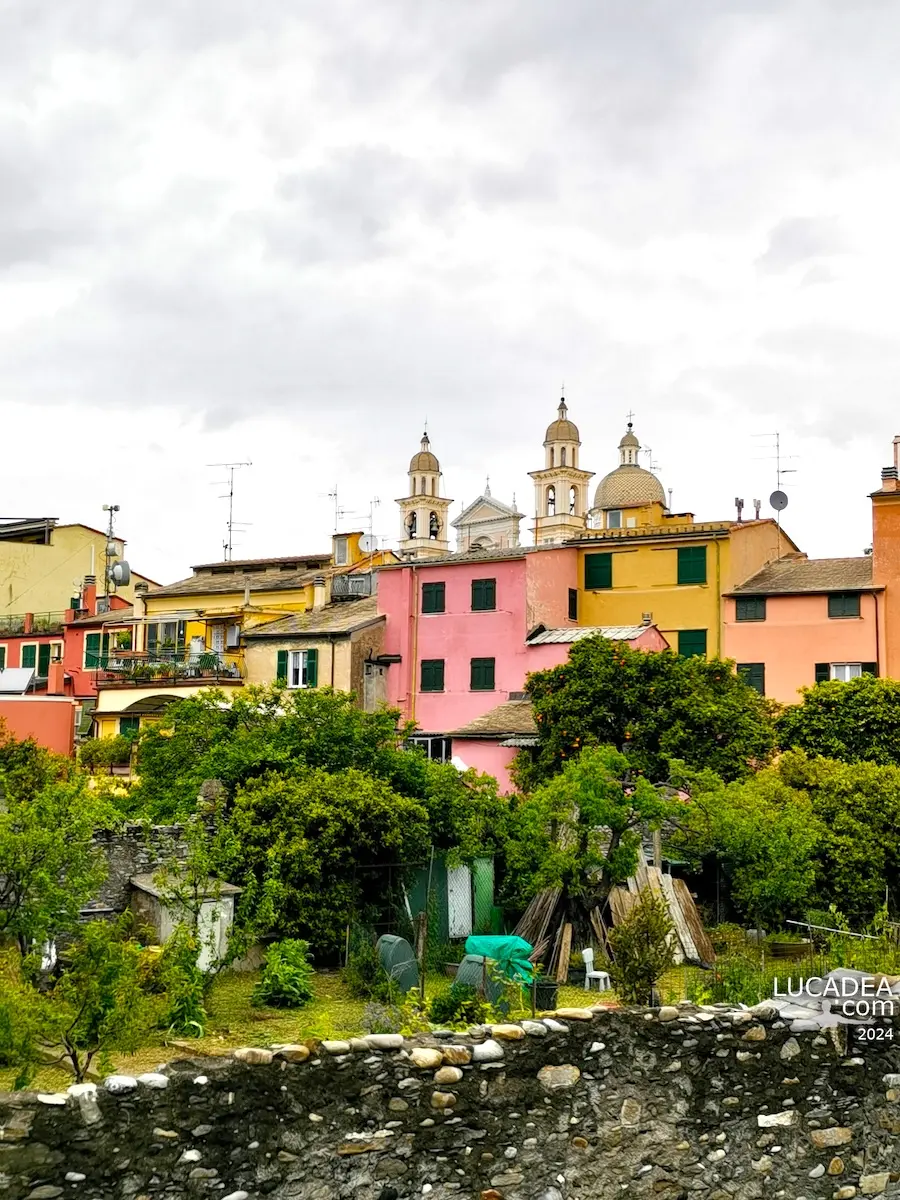
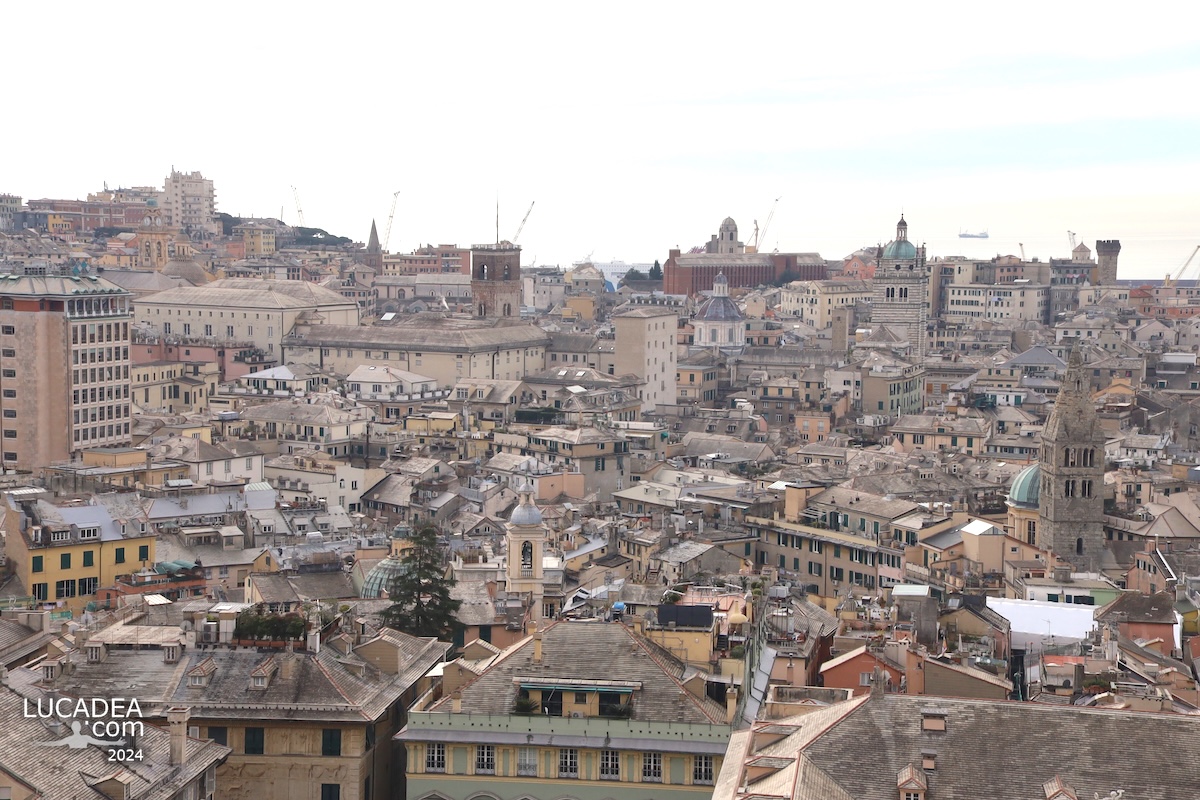
A View of Genoa from Spianata Castelletto.
From this viewpoint in the Castelletto district of Genoa, Liguria, Italy, the city opens out below in a dense pattern of rooftops, church towers, domes and historic buildings. This view of Genoa from above immediately shows what makes the city so distinctive: an urban landscape compressed between the hills and the sea, with buildings occupying almost every available space.
I took this photograph some time ago from Spianata Castelletto, one of the places I particularly like for looking at Genoa as a whole. When I stand here, I do not always look for one specific landmark. Instead, I let my eyes move across the rooftops and follow the different shapes and lines. Almost every time, another detail seems to emerge from the dense urban landscape.
What strikes me most is the compactness of the city. Genoa does not spread evenly across a broad plain. It climbs the hills and stretches toward the sea, creating an unusually dense arrangement of buildings. From this viewpoint, that characteristic becomes immediately visible. Roofs seem to overlap, while church towers and domes rise above them and provide recognizable points within the wider composition.
If you are wondering what to see in Genoa from above, Spianata Castelletto offers a particularly useful perspective because the city itself becomes the subject. There is no need to focus on a single monument. The urban fabric tells the story through its many layers, with buildings of different periods and proportions standing close together.
Spianata Castelletto, also known as Belvedere Montaldo, lies on the hillside immediately behind Genoa’s historic center. Its position makes it possible to look across a large section of the city. Standing here for a few minutes is enough to understand how strongly Genoa’s geography has influenced its architecture and development.
There is a small historical detail behind the name. Spianata Castelletto takes its name from the former Castelletto fortress, an important defensive structure that once stood on this hillside above the city. The fortress was demolished between the late nineteenth and early twentieth centuries, and the area was subsequently transformed into the viewpoint and urban space visible today.
What interests me in this photograph is the way the viewpoint turns Genoa into something resembling a large mosaic. There is no single dominant element. Instead, different details take over as the eye moves around the image. A dome catches my attention, then a bell tower, a row of buildings or a particular section of rooftops.
That is why I see this as an image to study rather than simply glance at. The longer I look, the more the compact mass of the city begins to separate into recognizable streets, buildings and neighborhoods. From ground level, many of these places seem completely independent. From above, they become parts of one continuous urban landscape.
I do not want to add conditions to the photograph that I cannot remember with certainty, but what remains with me is the impression of a particularly quiet and collected Genoa. From above, the city seems temporarily removed from the noise and movement of the narrow streets. Yet the life of the city is still clearly suggested beneath those rooftops.
That contrast is one of the reasons I enjoy this viewpoint. From Spianata Castelletto, Genoa can appear almost still, while below the roofs everyday life continues through the alleys, squares and buildings that we normally experience at street level.
As I have shown in other photographic stories about Genoa, I like finding viewpoints that allow me to read the city differently. A photograph taken in the caruggi brings me close to the architecture and everyday details, while a view from Spianata Castelletto gives me enough distance to understand the larger structure without losing the irregular character of the historic center.
For me, this is what makes the view from Spianata Castelletto worth photographing. It does not focus on a single monument. Instead, it presents an entire city through its architecture, its geography and the accumulation of buildings created over centuries.
When I look at this photograph again, I naturally start with the details rather than the whole composition. Every rooftop seems to hide another street, and every church tower suggests a precise point somewhere below. You do not need to know Genoa well to appreciate the view, but knowing the city makes it even more enjoyable because familiar places can gradually be identified.
That may be why I continue to consider Spianata Castelletto one of the best places to observe Genoa. The city does not reveal everything at once. You have to let your eyes wander and give the view a little time.
Which detail do you notice first when looking at Genoa from Spianata Castelletto? Add a comment or go to the bottom of the site to read what other visitors have written.

Photo taken with Canon EOS RP and Tamron 16-300 lens.
Here’s where the viewpoint is located:
Add one
comment to this article or read
here what other visitors have written.
The rights on images, videos, choruses, text and all other material on the LUCADEA.com website are governed as per Copyright page.
This page has been viewed 0 times today.
This month it has been viewed 0 times.
In total it has been viewed 23 times.