Trigoso, a small village near Sestri Levante.
A few days ago I went for a walk in this small hamlet belonging to the municipality of Sestri Levante, and I realized that it had been several years since my last visit. I had forgotten how pleasant it can be to rediscover such simple corners, especially when a small local road takes you away from the main route for a while.
Trigoso lies along the Aurelia, the historic road that leaves Sestri Levante, crosses the Bracco Pass and continues towards La Spezia before eventually becoming part of the long route leading south towards Rome. This is an area where the road and the Ligurian landscape constantly meet, but stepping into one of the smaller internal lanes quickly creates a completely different atmosphere.
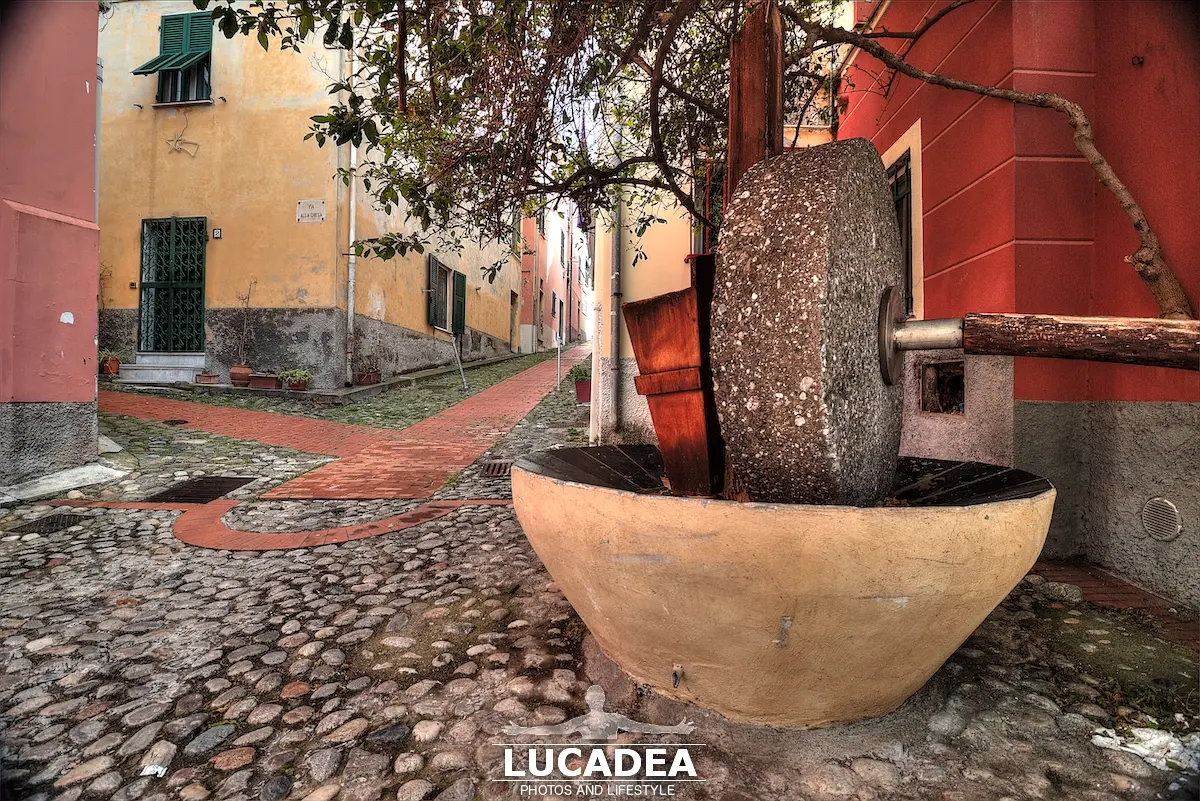
I took this photograph at the beginning of a small lane that immediately caught my attention because of its traditional appearance. The paving of stone and bricks is typical of a Ligurian creuza, the narrow paths that historically connected villages, houses and countryside while following the natural shape of the hills.
The detail that really holds my attention here, however, is the old stone millstone. It is a simple object, but within this setting it becomes surprisingly prominent. These are exactly the kinds of details that make me stop with my camera, especially when they appear almost naturally within an old village environment.
I was not looking for a carefully staged image. I simply wanted to photograph what I found while walking through Trigoso. After several years away, it was nice to discover that this small village still had corners capable of catching my eye.
If you are looking for things to see around Sestri Levante, Trigoso can be an interesting little detour precisely because of its quiet, local character. There is no need to search for a famous monument here. Sometimes entering a small lane, looking at traditional buildings and noticing old materials and objects is enough to understand something about the place.
The creuza is perhaps one of the details most strongly associated with the traditional landscape of Liguria. Stone, bricks, walls and changes in elevation are part of a way of building that developed around the geography of the region, where paths had to adapt to the hills rather than follow perfectly straight routes.
The old stone millstone adds another small reference to everyday life in the past. Objects like this once had a practical purpose and could remain in use for many years, eventually becoming part of the landscape and a quiet reminder of how different daily life once was.
I liked photographing this particular combination: a modest lane, its stone paving and an old object that seems almost to have remained there while generations of people passed by.
This is also one of the reasons I enjoy returning to places I already know. After several years, familiar surroundings can look different, and small details that once went unnoticed can suddenly become interesting. Trigoso gave me exactly that kind of small surprise this time.
As in some of my other photographs from the lesser-known corners of Sestri Levante and its surroundings, it was not a famous landmark that made me stop, but an everyday detail that seemed capable of saying something about the character of the place.
The photograph therefore came from a simple walk with no particular plan, from the curiosity of revisiting a small hamlet I had not seen for years, and from finding a scene that felt particularly representative of the quieter side of Liguria.
Have you ever walked through Trigoso and followed this little creuza? Add a comment or go to the bottom of the site to read what other visitors have written.
Photo taken with a Canon EOS M100 camera and a Canon EF-S 10-18 lens.
Click here if you want to see all the photos I took in the village:

Here is where the small village is located:
The two place names, Riva and Trigoso, were combined for the first time in 1874 in the name of the “Riva-Trigoso” railway station, which was then located halfway between the two villages. This combined name gradually came into common use, though it was often—and incorrectly—used to refer solely to the hamlet of Riva.
Read more on Wikipedia
The rights on images, videos, choruses, text and all other material on the LUCADEA.com website are governed as per Copyright page.