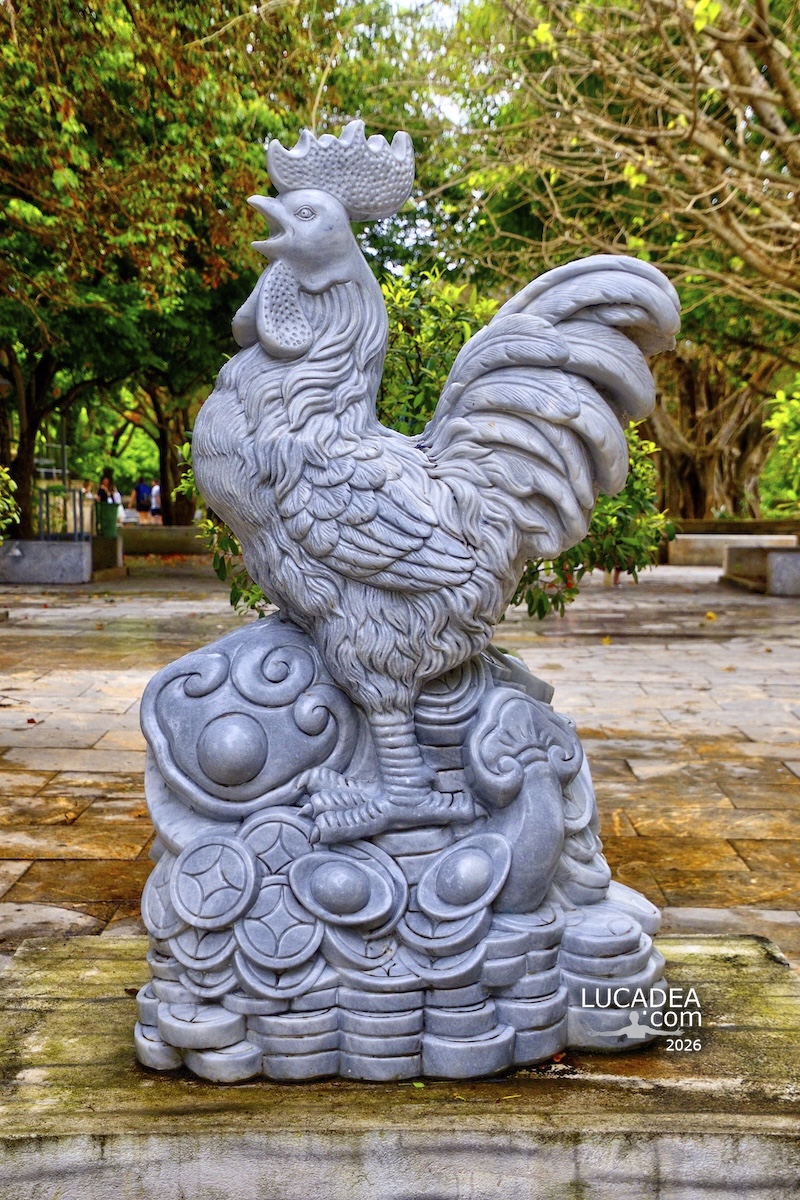
Da Nang, stone rooster at Linh Ung Pagoda

Statua del gallo a Linh Ung Pagoda a Da Nang in Vietnam con base decorata e contesto naturale del tempio buddhista

Da Nang, stone rooster at Linh Ung Pagoda.
The stone rooster at Linh Ung Pagoda Da Nang immediately stands out as a quiet but powerful detail within the temple complex, and the stone rooster at Linh Ung Pagoda Da Nang feels like one of those small elements that carries symbolic weight beyond its size. The stone rooster at Linh Ung Pagoda Da Nang sits on an ornate base, surrounded by greenery and the calm atmosphere of the sacred site.
I am in Da Nang, Vietnam, inside the Linh Ung Pagoda area, a place where religious architecture blends naturally with landscape and open space. The stone rooster at Linh Ung Pagoda Da Nang appears almost unexpectedly among the larger structures, yet it contributes to the visual and symbolic rhythm of the temple.
In Vietnamese and broader Asian tradition, the rooster is often associated with vigilance, protection, and the transition between darkness and light. This makes its presence in a spiritual context particularly meaningful, even when it is not the central monument of the site.
If you are visiting Da Nang, Vietnam, Linh Ung Pagoda is widely known for its monumental statues and panoramic views over the coastline, but details like this stone rooster reveal a more intimate layer of the place, where craftsmanship and symbolism coexist in quieter forms.
I have already mentioned similar observations in other travel stories on this site about Southeast Asian temples, where small sculptural elements often carry as much meaning as the main structures.
Standing here for a moment, I watch how the stone rooster at Linh Ung Pagoda Da Nang interacts with the surrounding space, not by dominating it, but by completing it in a subtle way. It makes me think about how many visitors might pass without noticing it at all.

Have you ever discovered a place’s meaning through a single small detail rather than its main landmark? Add a comment or go to the bottom of the site to read what other visitors have written.
Statua del gallo a Linh Ung Pagoda a Da Nang in Vietnam con base decorata e contesto naturale del tempio buddhista

Photo taken with Canon EOS R50 V and Tamron 16-300 lens.

To see all the photos I took in the pagoda, click here:
foto gallery

Where is the pagoda located:

Add one  comment to this article or read  here what other visitors have written.
 
Adv
 
Disclamer

The rights on images, videos, choruses, text and all other material on the LUCADEA.com website are governed as per  Copyright page.


This page has been viewed 0 times today.
This month it has been viewed 0 times.
In total it has been viewed 1 times.
 

Thien Mu Pagoda and Hue’s Seven-Tiered Tower

La torre a sette piani della Thien Mu Pagoda a Hue si erge sopra il complesso buddhista con vegetazione e atmosfera tranquilla sul fiume dei Profumi

Thien Mu Pagoda and Hue’s Seven-Tiered Tower.
I approach the banks of the Perfume River with a clear thought in mind: Thien Mu Pagoda is not a place to be seen quickly, and especially Thien Mu Pagoda feels like it breathes together with the landscape around it. The first impression is never only visual, but almost physical, as if the air itself changes density while the seven-storey tower of Thien Mu Pagoda rises in front of me.
The structure emerges with a strong vertical presence, and the seven-storey tower of Thien Mu Pagoda immediately becomes the focal point guiding my gaze. I walk slowly, without a precise direction, letting the architectural lines lead me instead. The surface of the complex is never uniform: there are corners, openings, passages that suddenly appear, and within all this Thien Mu Pagoda maintains a quiet and steady calm. It is interesting to know that this tower, called Phuoc Duyen, is one of the most recognizable symbols of Hue and was built in the 19th century to honor the Buddhist tradition of the city.
I stop for a few minutes at the base of the seven-storey tower of Thien Mu Pagoda, watching how its octagonal shape seems to interact with the surrounding space. It is not just an architectural element, but a presence that seems to hold time and memory. Around it, silence is broken only by distant small sounds, and this makes Thien Mu Pagoda even more intense in perception.
As I continue exploring the complex, I am struck by the simplicity of the contrast between vegetation and the tower’s lines. Nothing feels excessive; everything seems naturally balanced, almost spontaneous. Thien Mu Pagoda does not impose itself, it accompanies you instead. And this is exactly what makes it so memorable.
A small curiosity: the seven-storey tower is often considered the unofficial symbol of Hue because it represents the city’s historical and spiritual continuity, visible from afar along the river and used for centuries as a landmark for those arriving by boat.

As I stand there a little longer, I wonder how much a place can change depending on a single iconic structure. And you, what would you notice first when arriving at Thien Mu Pagoda? Add a comment or go to the bottom of the site to read what other visitors have written.

Photos taken with Canon EOS RP camera and Tamron 16-300 lens.

To see all the photos of the pagoda, click here:
foto gallery

La Thien Mu Pagoda e la torre a sette piani di Hue – Thien Mu Pagoda and the seven-storey tower of Hue – La pagode Thien Mu et la tour à sept étages de Hué – La pagoda Thien Mu y la torre de siete pisos de Hue – A Pagoda Thien Mu e a torre de sete andares de Hue – Die Thien Mu Pagode und der siebenstöckige Turm von Huế – Tháp bảy tầng của chùa Thiên Mụ ở Huế – フエのティエンムー寺と七層の塔 – 顺化天姥寺与七层塔 – フエのティエンムー寺と七層の塔

The text of this post was written with the help of ChatGPT, a language model from OpenAI.

Add one  comment to this article or read  here what other visitors have written.
 
Adv
 
Disclamer

The rights on images, videos, choruses, text and all other material on the LUCADEA.com website are governed as per  Copyright page.


This page has been viewed 1 times today.
This month it has been viewed 1 times.
In total it has been viewed 1 times.
 

The Great Buddha at Ngoc Hoa Monastery

Grande statua dorata del Buddha nel monastero Ngoc Hoa nella zona di Qui Nhon, Vietnam

The Great Buddha at Ngoc Hoa Monastery.
During a trip to Vietnam last year, my wife and I travelled around the Qui Nhon area and, during one of our excursions, visited Ngoc Hoa Monastery. Among the things that immediately caught my attention was the huge golden Buddha statue standing within this small spiritual centre.
This photograph comes directly from that visit. I wanted to capture the Buddha with my camera because its size made it dominate the surrounding scene. The golden surface also made the statue particularly noticeable, creating a very clear focal point even when viewed from some distance.
When I think about what to see around Qui Nhon, this is one of the visits I remember with particular curiosity. The area is not only about beaches and the sea. There are also religious and cultural places that offer a completely different perspective on the region and on everyday spiritual life in Vietnam.
Ngoc Hoa Monastery is in the Qui Nhon area, in Binh Dinh Province, Vietnam. Visiting a place like this means stepping away for a while from the more urban side of the destination and entering an environment where the religious character of the site becomes immediately apparent.
The Buddha statue was clearly the main subject I wanted to photograph. Its scale naturally draws the eye upwards and gives the image a very precise focal point. I enjoy this kind of photography because the composition does not always need to be complicated. Sometimes the proportions of the subject itself are enough to create the structure of the photograph.
There is also an interesting detail behind Buddhist representations: Buddha statues can look very different depending on the artistic tradition and cultural setting in which they are created. Body position, hand gestures and facial expression can carry symbolic meanings, so even a seemingly simple statue can offer many details to observe.
During the visit I looked at more than just the statue, of course, but it was definitely the element that stayed with me most strongly. Its scale, colour and position within the monastery made it the dominant feature of the whole setting.
That is one of the things I enjoy about travel photography. You do not always have to search for the most famous monument or the most recognisable viewpoint. Sometimes you simply encounter a subject whose proportions, position or relationship with the surrounding space immediately catches your eye.
My camera allowed me to preserve that particular impression. Looking at the image again today brings back the excursion I made with my wife and, above all, the surprise of finding such an imposing statue in a place that was completely new to me.
If you are wondering what to see around Qui Nhon, places like this can add another dimension to a visit. It is not simply about photographing a large Buddha statue, but about experiencing a setting where architecture, spirituality and the surrounding landscape come together.
The golden Buddha remains the strongest visual memory I have of Ngoc Hoa Monastery. This photograph belongs to that journey through Vietnam and, rather than trying to explain the entire place, it allows me to remember one specific moment from our excursion.
As with other travel photographs I have shared, I like this image because there is a real experience behind it. I was there, I saw the statue with my own eyes and I chose to photograph it because something about its presence immediately caught my attention.
This is one of the reasons I continue to keep and publish photographs that might seem simple at first glance. Years later, a single image can bring back not just the subject itself, but an entire journey, a particular day and the feeling of discovering somewhere completely new.

Have you ever come across such an imposing Buddha statue while travelling through Vietnam? Add a comment or go to the bottom of the site to read what other visitors have written.

Large golden Buddha statue at Ngoc Hoa Monastery near Qui Nhon, Vietnam

Photo taken with Canon EOS RP and lens Canon RF 24-50.

Here’s where the statue is located:

According to Buddhism, a Buddha, also known as budda in Italian, is a being who has reached the highest level of enlightenment (bodhi). Buddha is the past participle of the Sanskrit budh, meaning to become aware, to awaken. Buddha therefore means “awakened,” referring to the passage of consciousness from the state of sleep (ὕπνος, hypnos) to the state of full realization.
Continue and learn more at Wikipedia

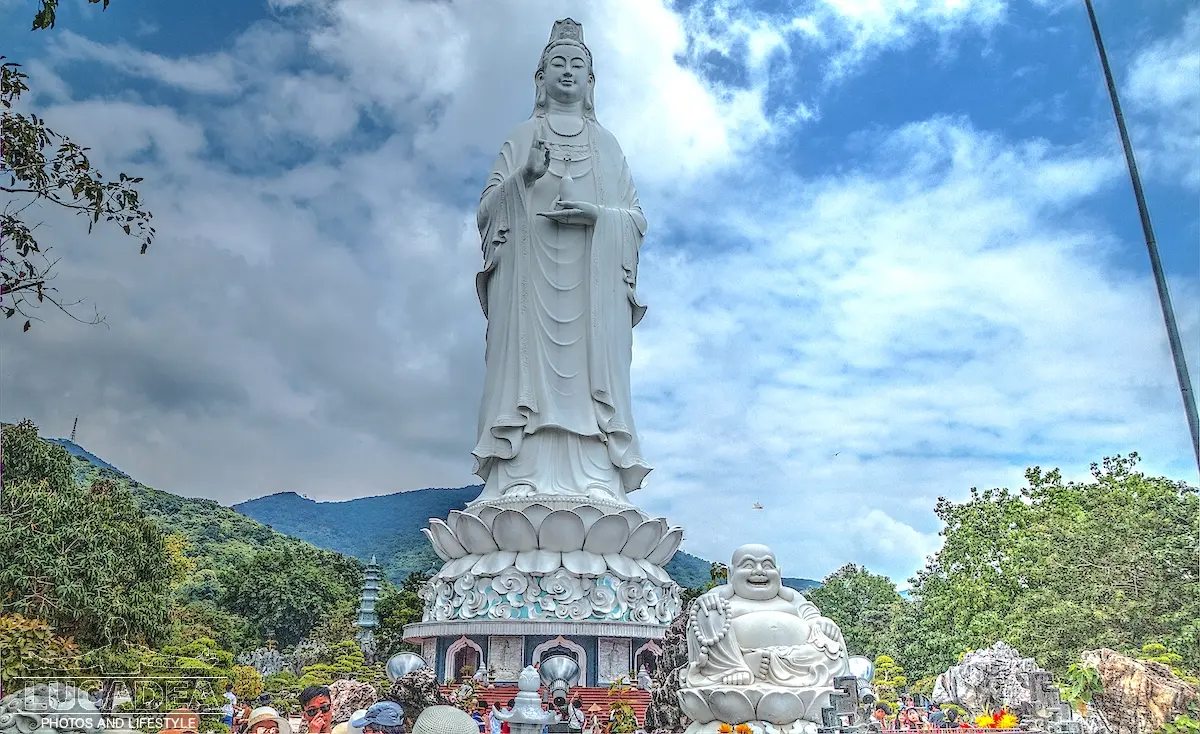
Linh Ung Pagoda and the Lady Buddha

La pagoda Linh Ung vicino a Da Nang in Vietnam

Linh Ung Pagoda and the Lady Buddha. On the Thọ Quang peninsula, northeast of Da Nang, Linh Ung Pagoda caught my attention from the moment I arrived, surrounded by mountains, temples and large statues overlooking the sea. It is one of the places worth seeing near Da Nang if you want to leave the city behind for a while and reach a completely different setting without travelling far.
These photographs come from a visit in which I slowly walked through the whole pagoda complex, stopping whenever a detail caught my eye. The first view is the impressive entrance with its three gates, which gives the first of my photographs a strong sense of scale. Once through the entrance, the space opens up and the atmosphere changes.
In the main square I found the temple and, in front of it, a remarkable collection of carefully arranged bonsai trees. This contrast between religious architecture and the small, precisely shaped trees was one of the details I enjoyed photographing. The bonsai make the scene feel more intimate, while the buildings and statues immediately reveal the religious character of the place.
The walk continues through a fairly large area where smaller temples, statues and decorative trees appear one after another. There is no single element dominating the entire visit. Instead, the experience is made up of many smaller views, and each turn offers something different to look at. For me, that succession of details is part of what makes Linh Ung Pagoda interesting beyond its most famous landmark.
The setting of the Thọ Quang peninsula adds another important part to the experience. This mountainous area lies close to Da Nang, Vietnam, making it possible to move from the urban environment to a much quieter and more scenic landscape in a relatively short time. If you are visiting Da Nang and wondering what to see beyond the central areas, this is one of the places I would remember for the combination of nature and religious architecture.
Then comes the most recognizable sight of the entire complex: the Lady Buddha statue, a large representation of Quan Âm that dominates the area. At 67 metres high, it is impossible to overlook, and its position makes it visible from a considerable distance, including from parts of Da Nang itself.
One small curiosity is that this particular Linh Ung Pagoda complex on the Sơn Trà Peninsula is not an ancient temple in the traditional sense. Its development belongs to the contemporary era, which makes its monumental appearance even more interesting when compared with the much older Buddhist sites found elsewhere in Asia.
What I wanted to capture in these photographs was not simply the main monument, but the progression of the visit: the imposing entrance, the square with the bonsai, the smaller buildings and statues, and finally the enormous Lady Buddha. Three different moments that together give a better sense of how varied the complex is.
Linh Ung Pagoda stayed in my memory because of that variety. You do not have to stand in front of one single monument to appreciate it. Walking slowly, looking around and paying attention to the smaller details gradually builds a much more complete picture of the place. It reminds me of other walks I have photographed and shared on the blog, where a simple route became a collection of small scenes worth remembering.

Which of these three views would you most like to see in person? Add a comment or go to the bottom of the site to read what other visitors have written.

Linh Ung Pagoda near Da Nang with its grand entrance, bonsai trees and Lady Buddha statue

Linh Ung Pagoda near Da Nang with its grand entrance, bonsai trees and Lady Buddha statue

Linh Ung Pagoda near Da Nang with its grand entrance, bonsai trees and Lady Buddha statue

Photos taken with Canon EOS M100 camera and Tamron 16-300 lens.

I searched online, but there’s very little in Italian; there is the official tourism page of the city of Da Nang describing the area danangfantasticity.com and also on Wikipedia, in English, there is very little.

Click here to see the other images I took on the Thọ Quang Peninsula:
foto gallery

Here’s where the pagoda is located:

🏠
  • Italiano