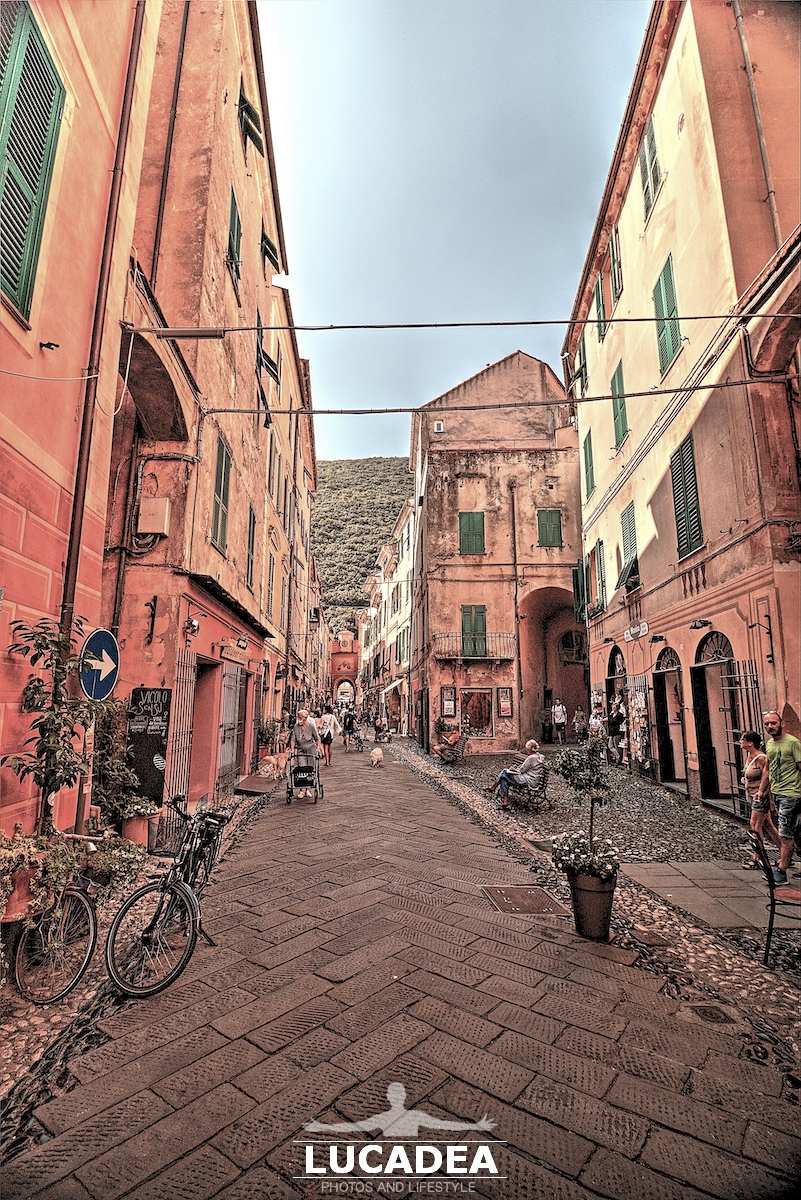
In the carrugio of Sestri Levante toward the church.
Walking through the carrugio of Sestri Levante, I feel how the narrow stone passage slowly compresses perspective until everything converges toward the church of Santa Maria di Nazareth in the background. This carrugio of Sestri Levante is not just a corridor, but a visual transition where street photography becomes a matter of patience and timing rather than action.
I am in Sestri Levante, Liguria, Italy, and the atmosphere here is shaped by the way the old town opens and closes in sudden rhythm. The carrugio of Sestri Levante guides my movement almost instinctively, as if every step is already part of an invisible composition. On the left side, the restaurant tables sit quietly aligned along the passage, still empty, waiting for the evening life to begin.
The church of Santa Maria di Nazareth remains a constant visual anchor, appearing and disappearing between architectural gaps as I move forward. It makes me think about what to see in the carrugio of Sestri Levante, where the experience is less about landmarks and more about how light and structure interact in such a compressed space. I also recall another post on this site about the narrow alleys of Genoa, where the density feels similar but the rhythm is completely different.
A small historical curiosity: Sestri Levante developed between two bays, the Bay of Silence and the Bay of Fables, and this unique geography influenced the way the historic center grew, creating passages like this carrugio that naturally connect land and sea.
As I continue walking, the carrugio of Sestri Levante toward the church becomes a quiet sequence of frames, each one slightly different but connected by the same slow rhythm of the town.
Have you ever followed a narrow street just to see where it leads? Add a comment or go to the bottom of the site to read what other visitors have written.
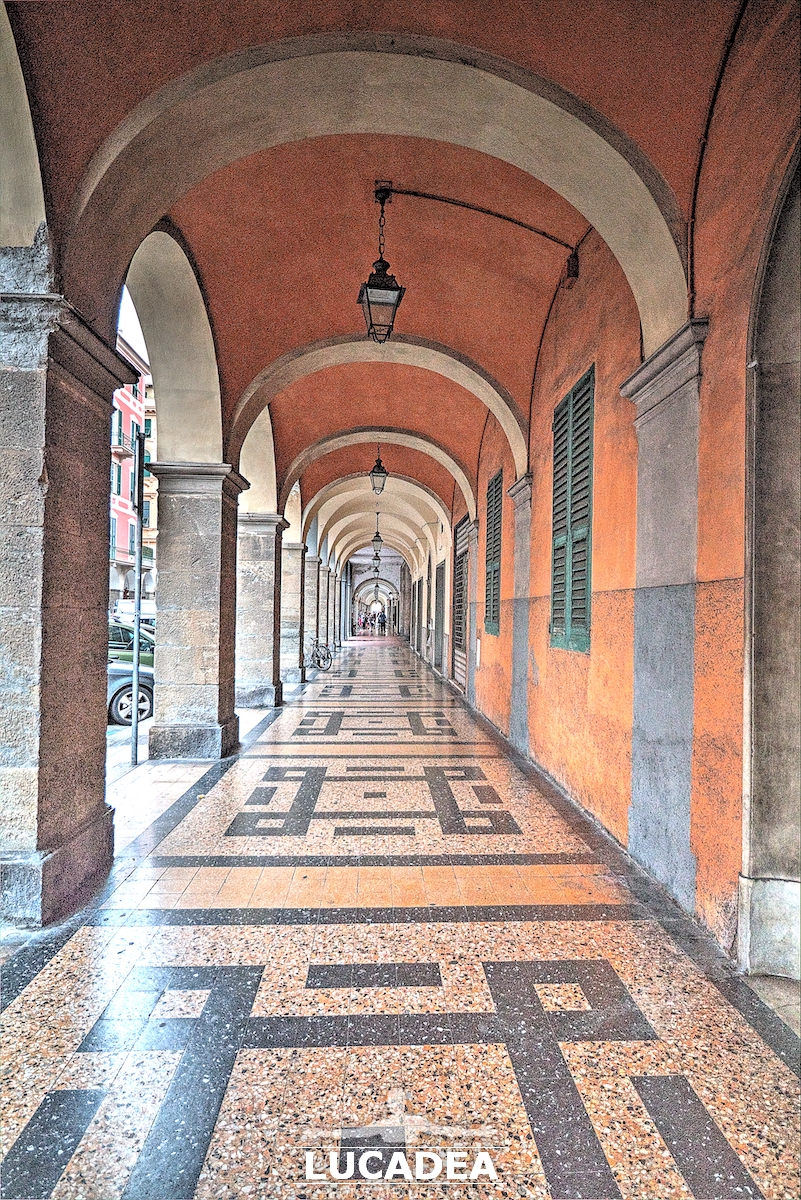
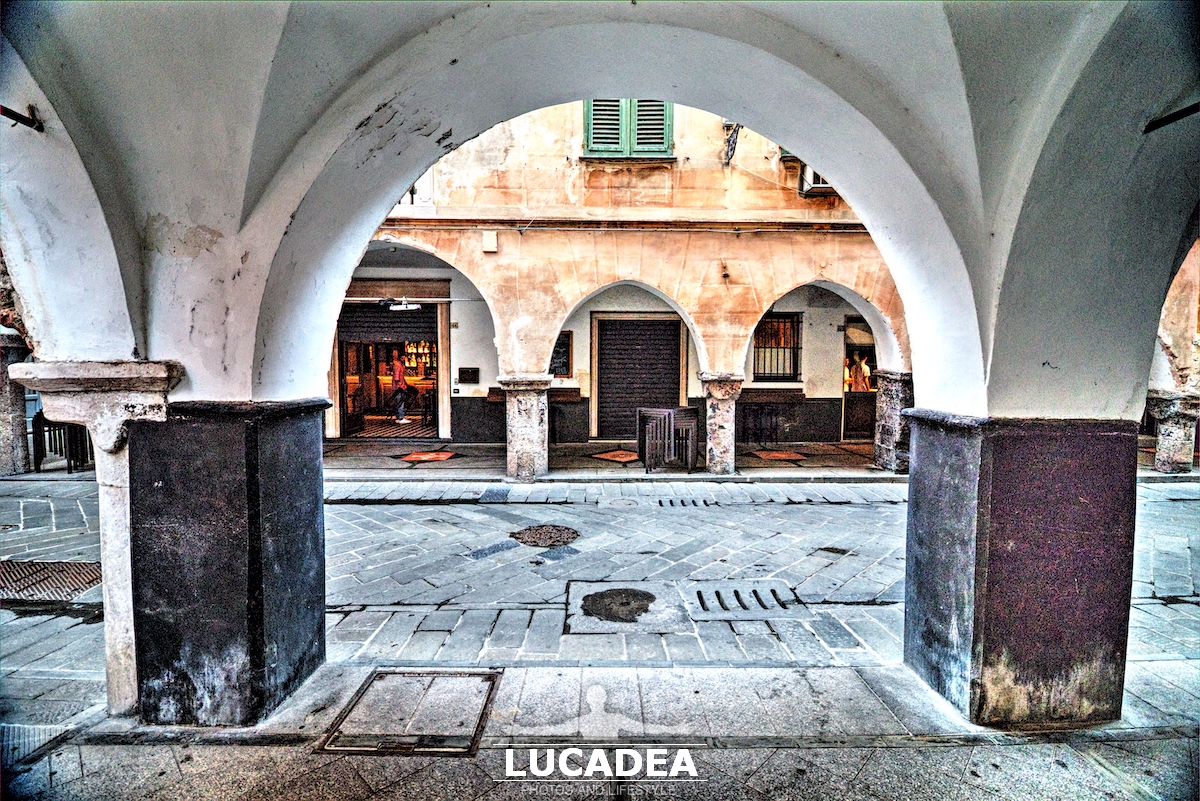
The arcades of Garibaldi avenue in Chiavari.
After photographing Carrugio Dritto, I continued through this part of central Chiavari, which has a somewhat different and, at first glance, more modern character. Here the arcades become broader and the buildings larger, creating a very different urban perspective from the narrower streets and older buildings nearby.
The difference becomes especially noticeable when looking at the buildings along the street. Carrugio Dritto is strongly associated with traditional shops and historic businesses, while Garibaldi avenue has more offices and homes. The buildings also seem larger and taller, perhaps because they belong to a more recent phase of urban development.
That contrast was exactly what I wanted to photograph. There is no need to decide which part is more beautiful. Carrugio Dritto has the charm of its tighter proportions and historic shops, while Garibaldi avenue offers a more spacious scene, with taller arches and arcades that give the street a greater sense of openness.
In this photograph, I wanted to capture that feeling rather than focus on a single architectural detail. The arcades create a continuous sequence along the street, while the arches provide a natural rhythm and perspective. Even without a famous monument in the frame, a repeated architectural element like this can become a very interesting photographic subject.
In Chiavari, Liguria, Italy, arcades are an important part of the character of the central streets. They create a sheltered passage between the buildings and the public space, allowing people to walk along the street with some protection from the weather. This practical function is part of what makes them such an important element of traditional urban architecture.
What I particularly notice here is the change in proportions. The taller arches and larger buildings make Garibaldi avenue feel more open than the Carrugio Dritto. It is not simply a question of building height. The entire relationship between the street, the arcades, and the façades changes, and that is what I wanted the photograph to preserve.
There is also a small architectural curiosity behind the word “arcade” itself. Covered walkways have historically served a very practical purpose, providing shelter from rain and sun while keeping a direct connection between buildings and the street. Over time, that everyday function also became an important part of the architectural identity of many Italian towns.
What I like about Chiavari is that this architecture is not separated from everyday life. The arcades are part of the way people move through the town, alongside shops, homes, offices, and other ordinary activities. They are not simply decorative elements added to make a street look attractive; they are part of how the street works.
I wanted to photograph these arcades because I enjoy comparing different views of the same town. My photograph of Carrugio Dritto shows a more intimate side of Chiavari, closely connected with historic shops and narrow proportions. This image shows another side, with larger buildings and a more spacious architectural rhythm.
If you are looking for what to see in central Chiavari, Garibaldi avenue offers a different perspective from the streets best known for their historic shops. It may not be more interesting, but it is interesting for different reasons: the size of the buildings, the height of the arches, and the continuity of the arcades completely change the way the street feels.
That variety is one of the reasons I enjoy photographing towns like Chiavari. A city is not made only of its most famous corners. The differences between one street and the next can be just as revealing, and sometimes moving only a few steps is enough to find an entirely different perspective.
These arcades have a character of their own. They are less intimate than those around the Carrugio Dritto, taller and more imposing, but those very proportions give this part of Chiavari a different kind of beauty.
This photograph therefore becomes another small part of my personal visual record of Chiavari, alongside the other images I have published from the town center and its architecture. I like having different kinds of photographs together because they gradually create a broader portrait of the city rather than repeating the same familiar view.
Do you prefer the more intimate arcades around Carrugio Dritto, or do you like these wider perspectives along Garibaldi avenue? Add a comment or go to the bottom of the site to read what other visitors have written.
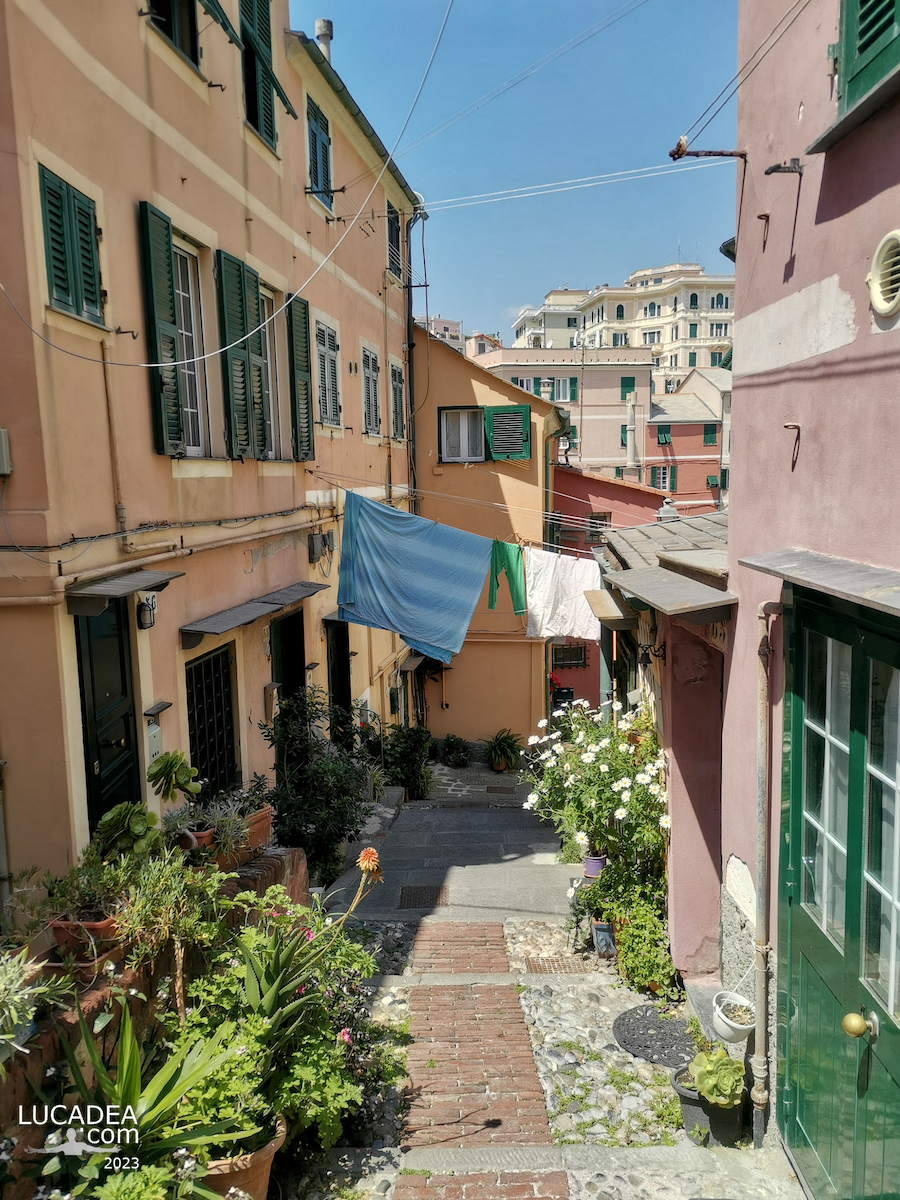
A glimpse of Boccadasse on Genoa’s coast.
Among the houses facing the sea in eastern Genoa, Liguria, Italy, Boccadasse still preserves the compact character that I enjoy finding when photographing the city, even though the old fishing village has long been absorbed into the urban fabric of Genoa. In this photograph, what caught my attention was one of those quiet corners that can briefly make the city feel much smaller.
Boccadasse is one of those places in Genoa that I can recognize immediately, even through a photograph. The colorful houses, narrow streets leading toward the sea and small beach create a very distinctive setting. Yet just a short distance away, the urban character of Genoa returns, with its streets, buildings and everyday city life.
I do not always look for the classic view when I photograph Boccadasse. I often prefer the side streets, partial views of the houses and compositions where the sea appears only between buildings rather than filling the entire frame. That was the kind of detail I wanted to capture with my camera here.
Looking at the photograph, what I remember most is the sense of calm that Boccadasse can offer when the village happens to be less crowded. It is a very well-known place and naturally attracts visitors, but it does not always have to feel busy. On a quieter day, simply walking between the houses can bring back something of the atmosphere of a small fishing village.
If you are wondering what to see in Genoa beyond the historic center and its grand buildings, Boccadasse is one of the places worth seeing along the eastern side of the city. There is no need to look for a major monument here. The interest comes from the combination of houses, sea, beach and narrow streets that still form the structure of the old village.
One of the most interesting things about Boccadasse is precisely its history as a small maritime settlement that became part of a much larger city. Genoa expanded around it, but the village retained much of the appearance and layout that make it recognizable today. It is a good example of how an older settlement can preserve its identity while becoming part of a modern urban environment.
That contrast is particularly interesting to me as a photographer. On one side there is Genoa, with its dense urban landscape and neighborhoods stretching along the coast. On the other there is Boccadasse, with a much smaller scale and a strong connection with the sea.
I did not try to explain all of this directly through the photograph. I was simply interested in the view in front of me and in the way the buildings seemed to create a protected space around the street. These are often the images that come from an ordinary walk, when something unexpectedly makes me slow down and look more carefully.
Boccadasse is also one of those places where the atmosphere can change considerably depending on the moment. A crowded day produces a very different photograph from a quieter one. That is another reason I find it worth returning to places I already know: the same street corner can feel completely different from one visit to another.
I also like the fact that Boccadasse is not an isolated village preserved under glass. It remains part of contemporary Genoa. The houses, businesses and people belong to the present city, while the layout of the old fishing settlement continues to reveal something about its maritime origins.
This photograph naturally connects with another story on my blog about Genoa, the view from Castelletto Esplanade. There, I photographed the city from above, with its rooftops, church towers and domes stretching toward the sea. Here the viewpoint is completely different, much closer to the houses and streets of the old village. Together, the two photographs show two very different sides of the same city.
That is perhaps what makes Genoa such an interesting place to photograph. It does not have a single face. The city changes as you move from the narrow streets of the historic center to the hills, and then toward the sea, where a place like Boccadasse suddenly feels almost separate from the metropolis around it.
When I look at this photograph now, I therefore think less about the beauty of the location and more about that particular feeling of finding a quiet corner in a very well-known place. Even in a city as familiar and visited as Genoa, there are still views that can feel unexpectedly private when the timing is right.
Have you ever found a corner of Boccadasse that looked completely different once the village became quiet? Add a comment or go to the bottom of the site to read what other visitors have written.
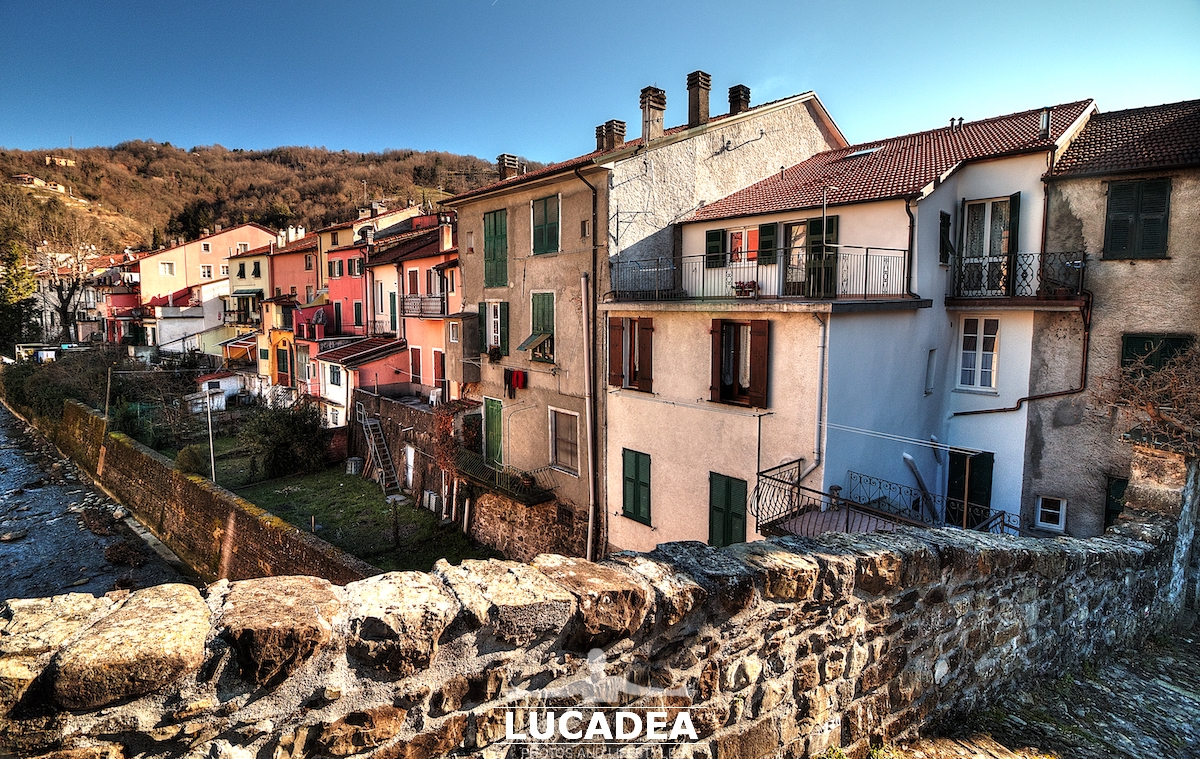
Varese Ligure seen from Grecino Bridge.
From Grecino Bridge in Varese Ligure, Liguria, Italy, I photographed the houses of the village as they face the Vara river, showing a side of the historic center that is normally hidden from view. This different perspective was what made me stop and take the photograph.
When walking through Varese Ligure, it is natural to follow the streets of the historic center and look at the houses from their more familiar side. From Grecino Bridge, however, the view changes completely. The photograph shows what could almost be called the back of the buildings along the carrugio, facing the river and forming a much quieter view of the village.
I wanted to capture this particular angle because it offered a different way of looking at Varese Ligure. It is not necessarily the image most people associate with the village, but that is exactly what I like about it. The houses appear different when seen from the opposite side, and details that are easy to miss while walking through the main street suddenly become visible.
Grecino Bridge is one of the historic elements worth noticing when exploring Varese Ligure. Crossing the Vara river, it provides a distinctive viewpoint over the village and makes it easier to understand the relationship between the houses, the river and the surrounding landscape. If you are looking for things to see in Varese Ligure beyond its famous square, this is a small but interesting place to stop.
Piazza Fieschi is probably the most recognizable image of the village. Its unusual elliptical shape gives it a very distinctive appearance and is also connected with Varese Ligure’s nickname, the “round village”. But there is much more to photograph here than the famous square.
I am particularly interested in these less obvious viewpoints. When I photograph a village, I do not necessarily look for the classic postcard composition. I like walking around, changing direction and seeing how the buildings change when viewed from another position. Sometimes crossing a bridge is enough to reveal an entirely different side of a place.
Here the Vara river almost becomes a line separating two ways of seeing the village. From the streets, the houses are part of the everyday walking experience. From the bridge, the secondary façades, walls and architectural details become the main subject instead.
That is what caught my attention. The back of a building may not have the same formal appearance as its main façade, but it can reveal how the houses are actually connected to the landscape. In Varese Ligure, the river is an important part of that relationship.
A small historical detail I find interesting is the distinctive planning of Piazza Fieschi. Its regular elliptical form is one of the defining features of the village, while the surrounding historic buildings preserve traces of different periods of development. The result is a place where the shape of the streets, the architecture and the presence of the river all contribute to its identity.
Looking at this photograph, though, I am less interested in turning the scene into a historical explanation and more interested in the effect of perspective. The same building can look completely different from a street, a square or the opposite bank of a river.
This is something I often notice when photographing villages and narrow streets in Liguria. An earlier photograph might show a familiar façade, while moving only a few dozen meters can reveal another composition entirely. That is one reason I enjoy returning to places I have already photographed: there is no guarantee that I will see them in the same way twice.
Grecino Bridge therefore seems interesting to me not only as a way of crossing the Vara river, but also as a small viewpoint over Varese Ligure. The photograph came from that simple observation, away from the better-known image of the village.
If I return here, I would probably look for more views along the river, following its course and seeing how the houses change from one position to another. These small changes of perspective often lead to the photographs that stay in my memory longest.
This image also connects naturally with other stories on my blog about Ligurian villages, where I have tried to photograph not only the most famous views but also narrow streets, bridges and architectural details encountered while walking. Over time, these photographs become a kind of visual diary of Liguria, made up of well-known places as well as quieter corners.
For anyone wondering where to look for a different view of Varese Ligure, Grecino Bridge offers exactly that kind of opportunity. It does not compete with Piazza Fieschi; instead, it shows another side of the same village and makes the relationship between the historic buildings and the river easier to appreciate.
Have you ever stopped on Grecino Bridge to look at the hidden side of the houses along Varese Ligure’s carrugio? Add a comment or go to the bottom of the site to read what other visitors have written.
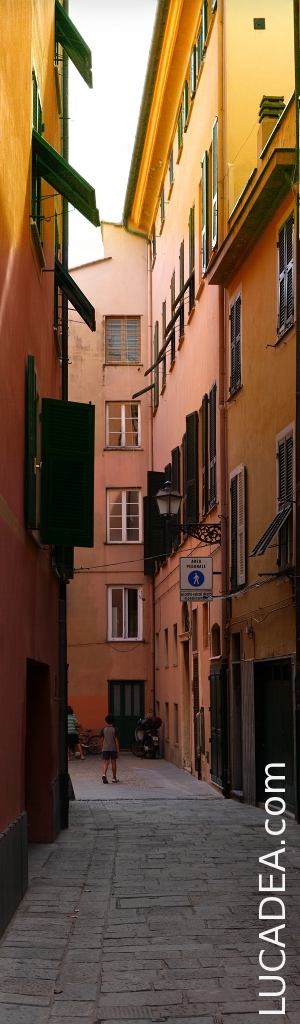
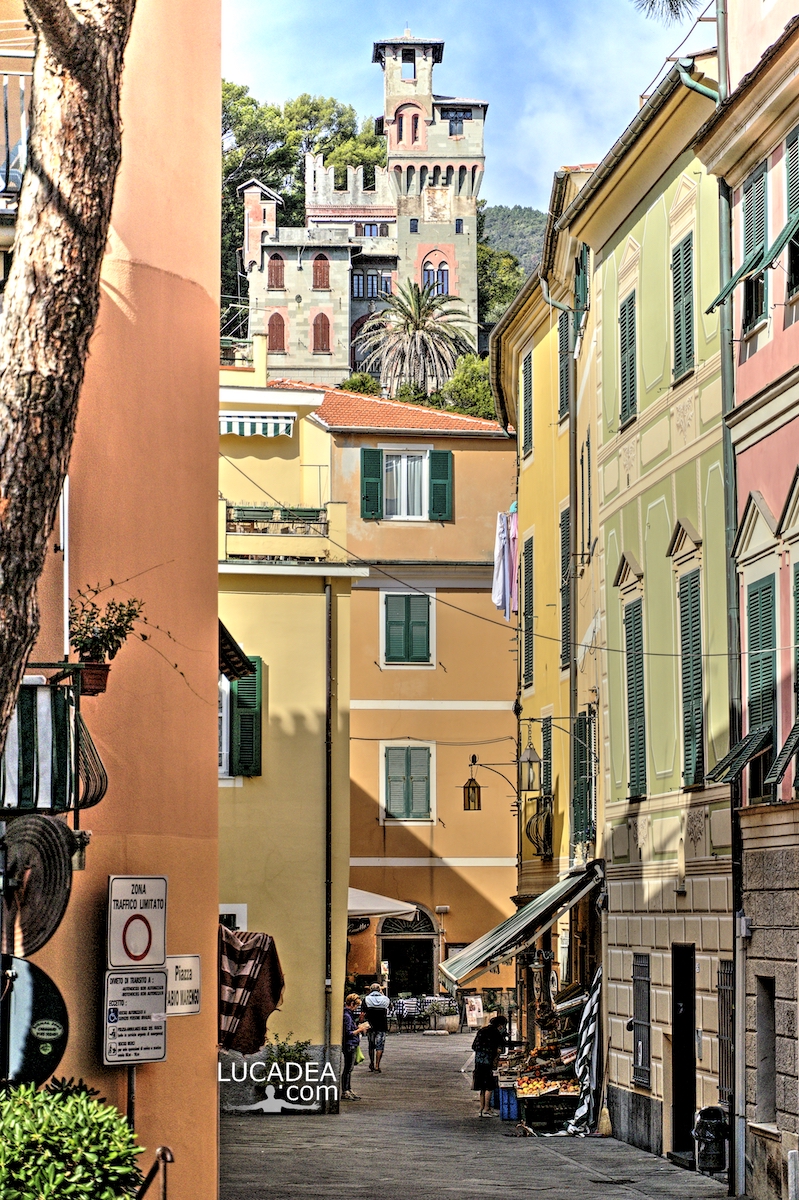
The Maina quarter of Sestri Levante.
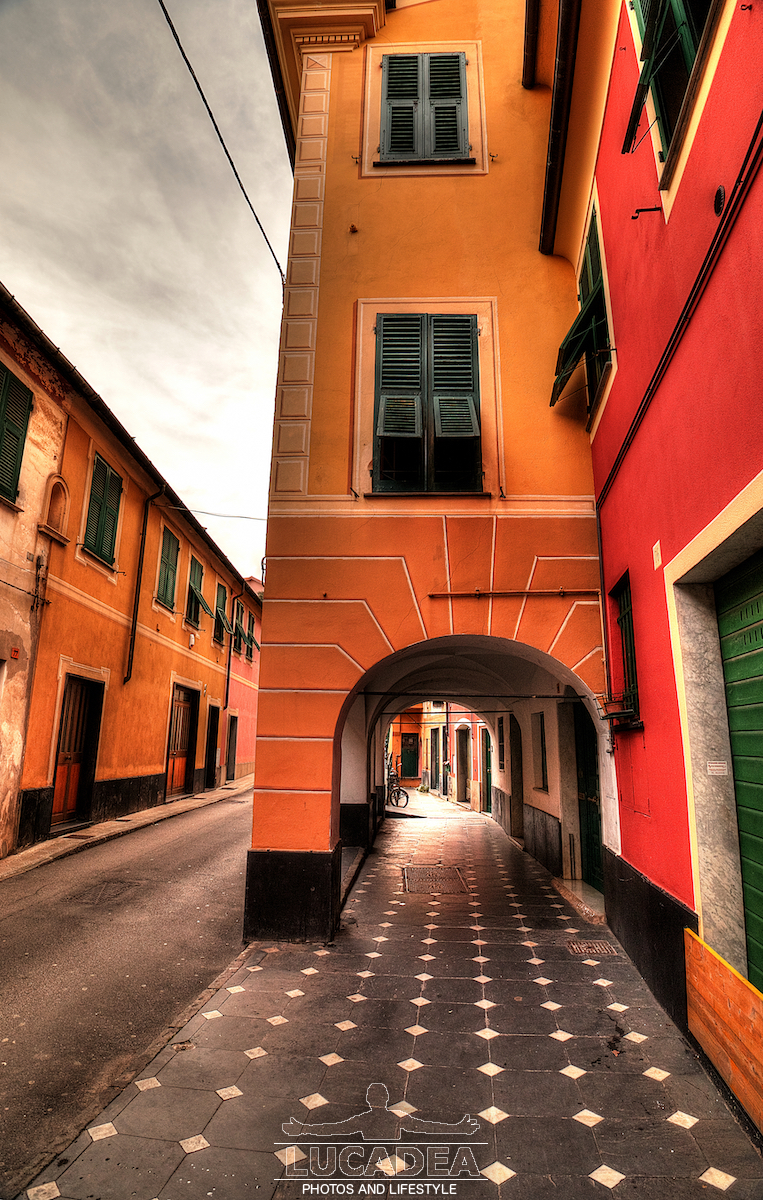
Among the narrow lanes of Sestri Levante, Liguria, Italy, there is a small alley leading towards the Bay of Silence that captures the more intimate character of the town. It is one of those streets that can easily be crossed without much thought, yet becomes much more interesting when you stop and look around.
This area is known as Maina and has a very distinctive appearance. The houses are small, narrow and, above all, built upwards, a feature that becomes immediately visible when looking along the alley. The buildings seem to reach towards the sky while the street remains tightly enclosed between their façades.
I wanted to photograph this particular view because, to me, it tells the story of Sestri Levante in a different way from the more familiar photographs of its bays. When thinking about what to see in Sestri Levante, it is natural to focus on the sea and the Bay of Silence, but only a few steps away you can find an entirely different atmosphere.
This alley connects two of the main entrances to the Bay of Silence and almost becomes a small gateway towards the sea. Walking through it feels like gradually moving from the historic centre towards the bay, with the houses framing the street and the water waiting just beyond the end of the passage.
The shape of the buildings is what caught my attention most. They are not large palaces, but relatively small structures that make particular use of their vertical space. In such a narrow urban setting, this allows more homes to fit into a limited area without making the streets wider.
Maina is one of those places where you do not need a famous monument to find something worth photographing. The proportions of the houses, the narrow street, the façades and the perspective of the alley are enough to create the image.
There is also a small local curiosity behind the name Maina, which is connected with the traditional relationship between this part of Sestri Levante and the sea. The name reflects the maritime character that has long been part of the identity of this area.
While photographing this corner, I found myself looking at something very simple, but that simplicity is precisely what makes it interesting. Nothing needs to be added to the scene: the narrow street and tall houses already create the composition.
I also like the fact that this kind of photograph shows a more everyday side of Sestri Levante. The Bay of Silence is naturally the place that attracts most visitors, but the route leading towards it is part of the same experience. For anyone interested in photographing historic centres, the smaller lanes often provide the more personal views.
I took this photograph myself during one of my walks through the town centre. I return to Sestri Levante often, and that familiarity makes me look for small details that might otherwise disappear when simply walking through the streets.
Maina is also a good example of how closely the historic centre of Sestri Levante is connected to the shape of the peninsula. The spaces are compact and the streets follow an urban structure that makes each passage slightly different. Turning a corner or simply looking upwards can reveal another perspective.
In this photograph, I particularly like the sense of verticality. The houses almost seem to close around the alley and guide the eye towards the point where the street continues. It is a very simple composition, but I think it conveys the character of this part of Sestri Levante quite well.
It is also the kind of view that can easily be overlooked precisely because it does not have the fame of the bay at the end of the route. Yet if you are looking for characteristic corners of Sestri Levante, Maina is one of those areas worth walking through slowly.
I have already shared other photographs of the narrow lanes and historic corners of Sestri Levante on the photo blog. This image fits naturally into that personal collection of streets I know well, where I keep trying to find another detail or another way of looking at a familiar place.
What I enjoy about these places is that they do not have to be spectacular in the traditional sense. A narrow street, a group of houses built closely together and a connection with the bay can be enough to reveal something important about a town.
Maina, with its small vertically built houses, is exactly that: a simple but immediately recognisable corner. And when I reach the end of the alley and find myself looking towards the Bay of Silence, I am reminded once again how close the world of the old lanes and the world of the sea are in Sestri Levante.
Have you ever walked through Maina on your way to the Bay of Silence? Add a comment or go to the bottom of the site to read what other visitors have written.
Slate Portals in Sestri Levante’s Old Town.
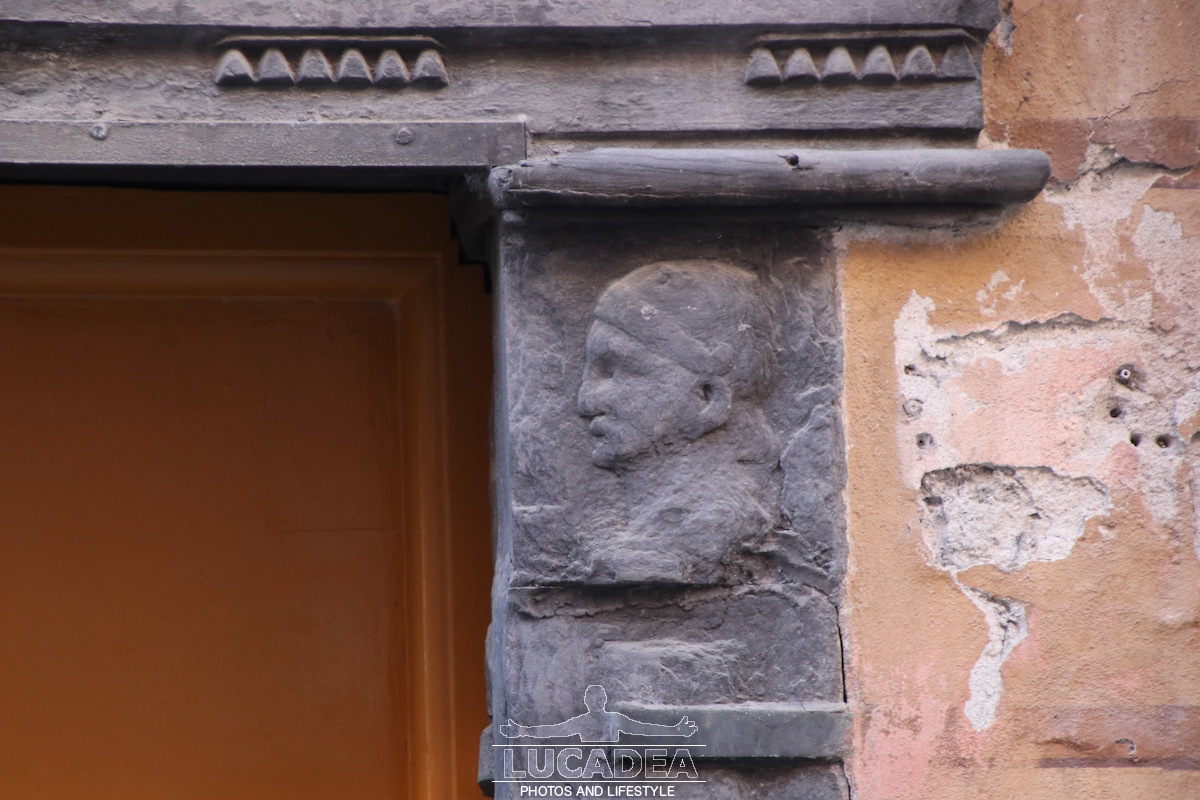
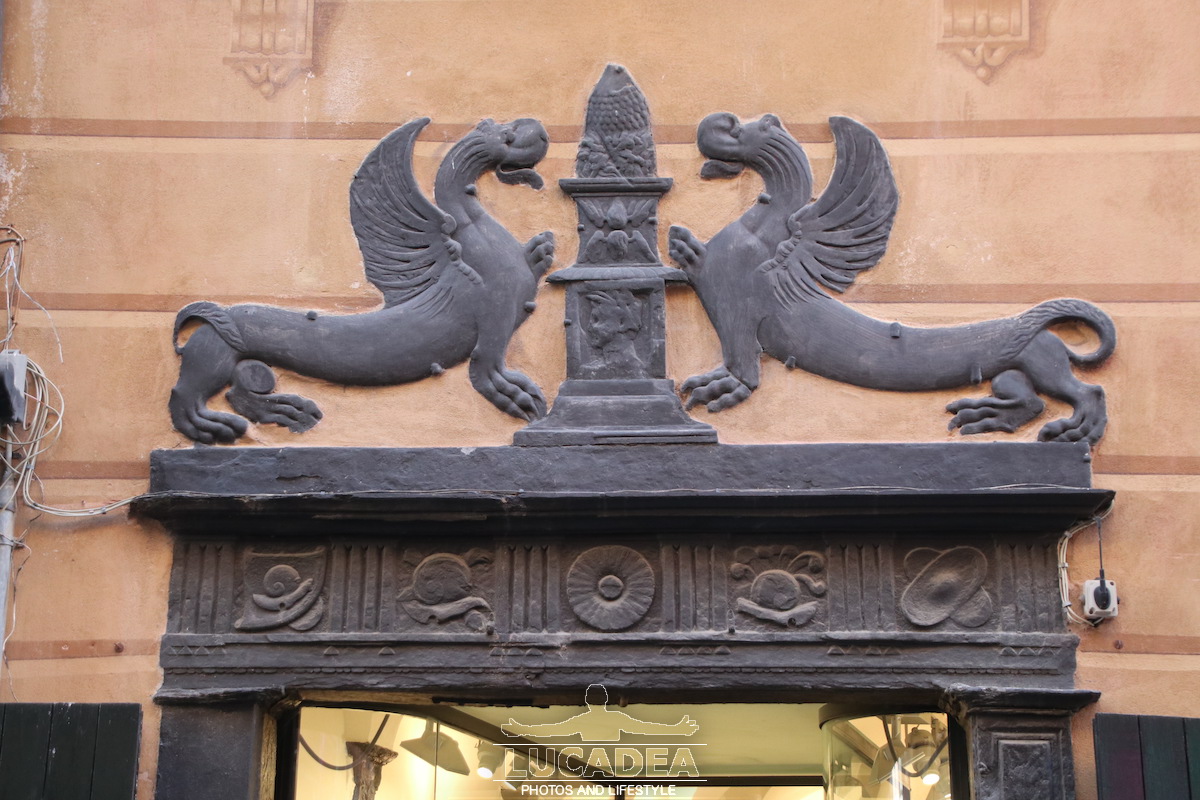
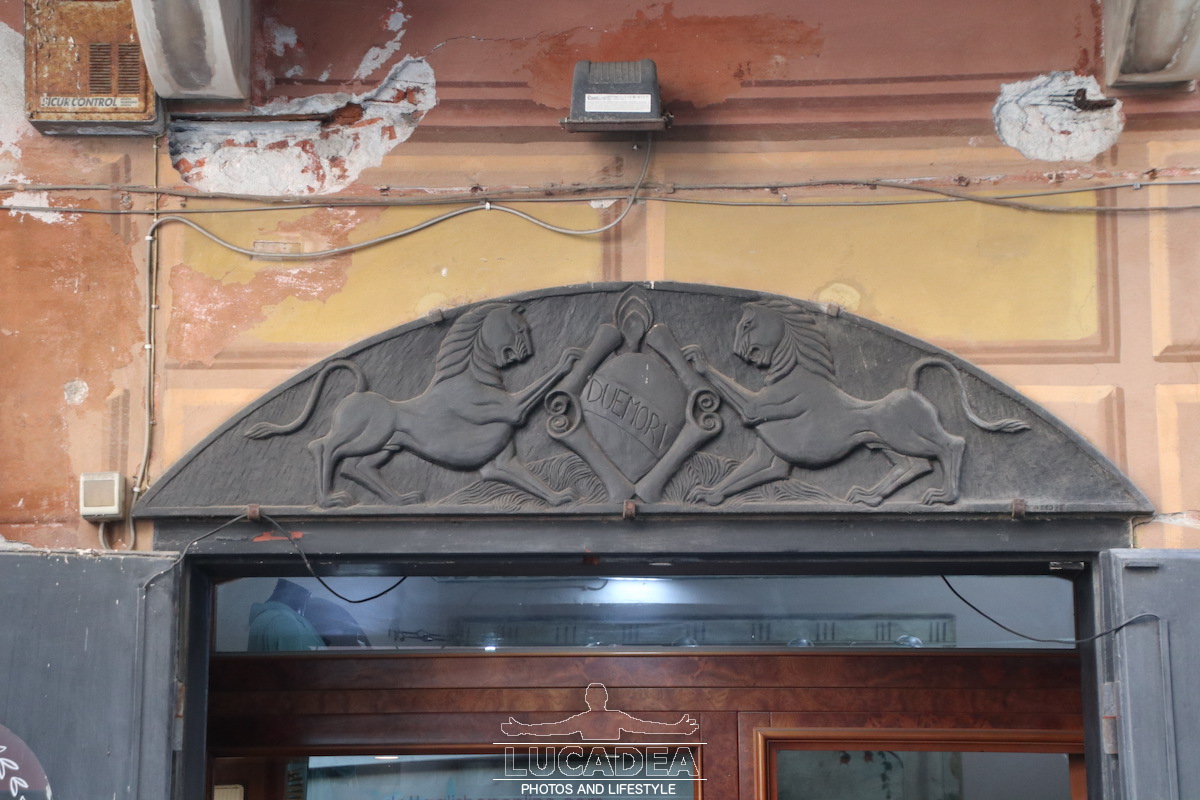
While walking along XXV April street, right in the historic center of Sestri Levante, I stopped in front of these portals because the carved details in the slate deserved to be photographed. We are almost at the Bay of Silence, and among the surrounding façades these stone elements still manage to catch the eye.
The photograph shows exactly the kind of detail I enjoy looking for when walking through Ligurian old towns: not necessarily a famous monument or a large square, but something that can easily be missed unless you slow down and pay attention. Here, the carved coats of arms and heraldic decorations immediately become the main attraction.
Slate portals are a distinctive feature of historic architecture in Liguria. In Sestri Levante, several can still be found along the old streets, and some feature remarkably elaborate decoration. Slate has a particularly strong connection with the Tigullio area and has long been used by local craftsmen, making it a recurring material in the architecture of the region.
What interests me most in this particular photograph are the coats of arms. I do not know their exact origin, so I would rather not associate them with a specific family without reliable evidence. It is certainly possible that they are connected with the history of the building and with the people who lived there in the past. It is the kind of detail that makes me curious, and I would genuinely like to hear from someone who knows more about the historic families and buildings of Sestri Levante.
The location makes these portals even more interesting. XXV April street is the main old-town street and leads towards one of the best-known places in the town, the Bay of Silence. While walking this route, it is therefore easy to focus on reaching the seafront and overlook architectural details along the way.
That is one of the reasons I enjoy photographing Sestri Levante even though I know the town quite well. There are always small views that look different from another angle, and details that we may have passed dozens of times without really stopping to examine them.
I wanted to capture these portals with my camera because they seemed particularly beautiful and because they represent the kind of small-scale heritage that gives an old town its character. This is not a photograph built around a spectacular panorama. The subject is an architectural detail, but that detail still says something about the place.
If you are wondering what to see in Sestri Levante beyond the Bay of Silence and its famous sea views, it is worth paying attention to the historic buildings and portals along XXV April street. There is no complicated route to follow. Walking slowly and looking carefully at the façades is often enough.
This photograph also connects with another post on the blog about slate details and porticoes in Lavagna, where I found a portal that immediately reminded me of these examples in Sestri Levante. It is interesting how, after travelling only a few kilometres through the Tigullio area, similar materials and decorative traditions appear again.
Looking at this photograph today, I still find something appealing in not knowing the entire story behind the details. The camera preserves what I can see, while the unanswered questions remain open and perhaps can be completed by someone who knows more than I do.
Do you know the history behind the coats of arms and slate portals on this building in Sestri Levante? Add a comment or go to the bottom of the site to read what other visitors have written.
It is believed that slate was originally used around two thousand two hundred years ago in the Tigullio area (i.e. in the area between the municipality of Sestri Levante and the Fontanabuona Valley), formerly a basin of the Ligurian-Piedmont paleo-ocean. Its use as a roof covering material dates back to ancient times and had its apogee in the medieval era and then in the Renaissance. Today it is mainly extracted from quarries located in Val Fontanabuona.
Continue and learn more on Wikipedia
Lavagna’s Slate Porticoes in the Old Town.
While walking through the historic center of Lavagna, I stopped to photograph one of the details that most clearly characterizes the town’s streets: the porticoes decorated with slate. It is a simple view, but that is exactly what I like about it, because it captures a very recognizable part of this corner of the Tigullio.
I took this photograph a few months ago in Lavagna, Liguria, Italy, in the Metropolitan City of Genoa, during a day spent photographing the historic center. I had started walking without a precise plan for the images I wanted to take and, as often happens to me, it was a small architectural detail that eventually made me stop.
The porticoes are one of the elements that make walking through the old streets so enjoyable. As I move beneath them, my attention keeps shifting between columns, doorways, façades and, above all, the slate. This dark stone is deeply connected with the building tradition of Liguria. In this photograph I wanted to capture that combination of materials and shapes without making the scene feel overly arranged.
Slate has a long history in Ligurian architecture, and it has a particularly strong connection with Lavagna and the surrounding area. Local slate quarries played an important role in the development of the material, which was used for centuries not only in architectural details and porticoes but also for roofs, paving and decorative elements.
It is the kind of feature that may not immediately stand out when visiting a town, but becomes much more obvious once you start paying attention to buildings. A dark stone panel, a column or a small decorative element can tell you something about a place beyond its appearance.
If you are wondering what to see in Lavagna, the porticoes of the old town are worth observing slowly. They are not necessarily something you visit as a single landmark, but they are part of the experience of walking through the historic streets. It is often while passing underneath them that some of the most interesting photographic details appear.
That is exactly how this image came about. I did not need a panoramic viewpoint or a famous monument. I simply had to look carefully at what was in front of me. The camera allowed me to stop and preserve a detail that would have been very easy to walk past without giving it much thought.
I took several other photographs in Lavagna on the same day. Some show different parts of the historic center, while others focus on buildings and architectural details that caught my attention during the walk. I like thinking of these images as a small collection from the same afternoon because, when seen together, they give a fuller impression of the town.
One of the photographs I have published over time also shows Santo Stefano Basilica, one of the buildings that most naturally draws attention in the center of Lavagna. The porticoes tell a quieter and more everyday story: they are the kind of architecture you encounter simply by walking through the town.
That is precisely the kind of photograph I enjoy adding to the blog. It does not necessarily need a monumental subject. It can simply preserve the memory of a walk and a detail that made me stop for a moment.
Lavagna is particularly well suited to this way of photographing. Walking slowly through the center reveals new compositions all the time, often created by the materials, colors and shapes of the buildings rather than by a single landmark.
Perhaps that is why, even months after taking this photograph, I still enjoy looking at it. It brings back that walk and the other images I made on the same day.
Which architectural detail in Lavagna do you most enjoy photographing? Add a comment or go to the bottom of the site to read what other visitors have written.
The town is divided into several districts, named after the ancient *sestieri* (wards) into which the town was split during the era of the Fieschi family.
These are: the Borgo district, corresponding to the historic center; the Scafa district, located in the harbor area and bordering Chiavari; the Moggia district, in the inland part of the city; the Ripamare district in the east; and the Cavi district, which includes the hamlet of Cavi di Lavagna and the hillside hamlets of Santa Giulia, Sorlana, and Barassi.
Read more on Wikipedia
Giovanni Nicotera Street in Finalborgo.
Among the places to see in Finalborgo, Liguria, walking along Giovanni Nicotera Street means entering the heart of this medieval village and discovering one of its most characteristic views. This photograph shows one of the main streets of Finalborgo, in Finale Ligure, Liguria, Italy, where historic buildings and carefully preserved façades still create the atmosphere of an ancient Ligurian town.
This is not the first time I have photographed this street, but every walk offers a different perspective. Moving slowly through the village, it is easy to notice new details: the colours of the houses, the architectural elements and the way the street guides the eye towards the historic centre. This is exactly what I enjoy capturing in my photographs of villages: places that do not need spectacular scenery because their beauty is already present in everyday details.
I wanted to capture this view with my camera because Giovanni Nicotera Street represents the true character of Finalborgo. It is not just a road connecting different parts of the village, but a place where the structure of the old town is still clearly visible, with buildings that maintain their relationship with local life and history.
If you are visiting Finalborgo, this street is definitely one of the places worth seeing while exploring the village. Finalborgo is considered one of the most beautiful historic towns in Italy and offers many interesting corners, from squares and churches to medieval gates and narrow streets full of atmosphere.
Finalborgo is located in Finale Ligure, in the province of Savona, and is one of the most important fortified villages in Liguria. A short historical curiosity is that it was once the capital of the Marquisate of Finale, ruled for centuries by the Del Carretto family, a period when the village became an important political and commercial centre.
This photograph comes from my passion for Liguria and from the pleasure of walking without rushing, looking for views to share. As with my other photographs of Finalborgo published on Lucadea.com, including Garibaldi Square and San Biagio Basilica, this image focuses on the simple details that make this village unique.
Giovanni Nicotera Street is one of those places where a normal walk can turn into a photographic discovery. The charm of Finalborgo comes from the balance between history and present life: an ancient village that is still alive and continues to surprise those who explore it.
If you have the chance to visit Liguria, I recommend spending some time in Finalborgo and walking through its streets, allowing the village itself to reveal its hidden details.
Which street or alley of an Italian village has remained in your memory? Add a comment or go to the bottom of the site to read what other visitors have written.
I took dozens of photos in this beautiful town in Western Liguria; click here to see them all:
He joined Giuseppe Mazzini’s Young Italy movement; he fought in Naples on May 15, 1848, and later alongside Garibaldi during the Roman Republic in 1849. After the fall of Rome, he took refuge in Piedmont, where he organized the ill-fated Sapri expedition with Carlo Pisacane in 1857.
Read more on Wikipedia
The arches of Rivarola Street in Chiavari.
Walking under the porticoes of Rivarola Street in the historic centre of Chiavari, I often stop to look at the architectural details that make this part of the town so interesting. The arches of Chiavari are one of those small details that reveal the character of Ligurian streets, where every building has its own shape, colour and history.
This photograph was taken while walking through the centre of Chiavari, in Liguria, Italy. Looking carefully at the sequence of arches, it is easy to notice that they are never exactly the same. At first glance they may seem repetitive, but each one has different proportions, different columns and different decorative elements that make every section of the street unique.
I like photographing places like this because they do not need spectacular landscapes to tell a story. A simple passage under a portico can show the identity of a town through materials, colours and architectural choices. In this case, the dark tones of slate create a strong contrast with the lighter walls and help define the typical appearance of Ligurian buildings.
Chiavari is a town where these details can be discovered while simply walking through its streets. If you are visiting Liguria and looking for places worth seeing beyond the most famous coastal views, exploring the historic centre and its porticoes is a good way to understand the local atmosphere.
The slate visible in the columns and architectural elements is a typical material of the region. This stone, extracted in different areas of Liguria, has been used for centuries in buildings and decorations because of its strength and distinctive dark colour.
Among the streets I have photographed in Liguria, Rivarola Street remains one of the most interesting because it combines everyday life with historical architecture. After sharing images of the caruggi and details of other Ligurian villages, this photograph continues the same search for small elements that often go unnoticed.
For me, this image represents the pleasure of observing familiar places with a different eye. Even when returning to the same street, there is always a new perspective, a different detail or a particular combination of shapes that catches my attention.
Have you ever stopped to look closely at the arches and columns of an old street? Add a comment or go to the bottom of the site to read what other visitors have written.
Moneglia’s caruggio and Monleone Fortress.
Using my telephoto lens, I managed to capture a particular view of Moneglia, Liguria, Italy, where the narrow caruggio of the village stretches towards the western side and the Monleone Fortress appears above the houses. This photograph brings together two elements I always enjoy looking for in Ligurian villages: the intimate streets of the historic centre and the old defensive structures that still overlook the landscape.
When I photograph places like this, I often try to find a viewpoint that connects different parts of the scene. In this case, the telephoto lens helped me compress the perspective and bring the street and the fortress closer together, creating a composition where the everyday life of the village meets its historical background.
Moneglia is one of those coastal villages in Liguria where a short walk can reveal many different views. This photograph was taken in Moneglia, in the Liguria region of Italy, showing the relationship between the historic streets below and the fortification positioned above the town.
The caruggio is one of the most recognizable features of traditional Ligurian villages. I enjoy photographing these narrow streets because every turn creates new perspectives, with old buildings, arches and passages forming natural frames. After the previous photographs I shared of the supporting arches in Moneglia, this image continues my exploration of the same village from another point of view.
The Monleone Fortress was built during the sixteenth century as a defensive structure against attacks coming from the sea. Over time, its role changed, but it remains an important reminder of the strategic position that Moneglia had along the Ligurian coast.
I wanted to take this photograph because the telephoto lens allowed me to tell a different story. Instead of a wide coastal view, I focused on the connection between architectural details, the narrow street and the fortress above. The result is a more compact image where the eye naturally moves from the caruggio towards the higher part of the village.
If you are visiting Liguria and looking for places worth seeing beyond the most famous destinations, Moneglia offers the chance to discover a historic centre where daily life and traces of the past still coexist. Walking through the village streets and looking upwards is often enough to find interesting photographic subjects.
For me, this image is another small piece of a larger collection of photographs dedicated to Ligurian villages, where every corner can reveal a different story.
Have you ever walked through Moneglia and noticed the Monleone Fortress above the village streets? Add a comment or go to the bottom of the site to read what other visitors have written.
I took several photos in the village, and if you’d like to see them all, click here:
The Monleone Fortress was an ancient defensive and lookout outpost commissioned by the Republic of Genoa in the 12th century, situated on the lower slopes just west of the town of Moneglia.
Read more on Wikipedia