The War Memorial in Villa Square, Genoa

Monumento ai Caduti di piazza Villa a Genova

The War Memorial in Villa Square, Genoa.
While walking through Castelletto, one of Genoa’s hillside neighbourhoods, I stopped to look at this memorial dedicated to those who lost their lives during the First World War. Located in Villa Square, it is closely connected to the history of the local community and to the memory of two different periods in Italian history. It is a quieter corner of Genoa, away from the city’s most familiar landmarks, but one that deserves attention.
The story behind the memorial is particularly interesting because getting it installed in its present location was far from straightforward. The original idea came from the desire to honour the people from the neighbourhood who never returned from the Great War. For the local community, the monument was not simply a public sculpture: it was a way of preserving the memory of those who had made the ultimate sacrifice.
The project was entrusted to Francesco Messina, who would later become one of the most recognised Italian sculptors of the twentieth century. However, the proposed location became the subject of disagreement with the city authorities. They preferred to concentrate the commemoration of Genoa’s fallen soldiers in Piazza della Vittoria, rather than allowing individual neighbourhoods to create their own memorials.
The dispute did not end there. The monument was initially installed, but its bronze sculptural group was later removed by order of the Prefect and transferred to the courtyard of Palazzo Rosso. Local residents strongly opposed this decision and continued to support the project. Eventually, the monument was returned and permanently installed in Villa Square, where it was officially inaugurated with a ceremony and military honours.
Knowing this history changes the way I look at the monument. What might appear to be a relatively ordinary memorial in a neighbourhood square is actually the result of a long effort by local residents to preserve their own way of remembering the First World War. I find this connection between public art and community identity particularly interesting.
The name of the square adds another historical dimension. Goffredo Villa was an Italian partisan who was killed by Fascists in 1944. The square named after him therefore recalls another difficult chapter in the country’s history, following the events of the First World War. Two different periods of conflict and sacrifice are remembered in the same small urban space.
If you would like to learn more about the complicated history of this memorial, I recommend reading the article published by A Me Zena, which explores the story of the monument and its installation. It offers useful background to understand why the memorial stands in this particular location today.
I took this photograph because I enjoy documenting the less obvious aspects of Genoa. The city has plenty of famous sights, but I often find just as much photographic interest in smaller squares, historic details and neighbourhood landmarks. Genoa, in Liguria, Italy, has a rich history that can be discovered far beyond the traditional routes through the old town and the harbour.
Castelletto is a particularly interesting area to explore on foot. Its hillside position creates different perspectives across the city, and its streets reveal a mixture of historic buildings, public spaces and unexpected views.
Just behind Villa Square lies Spianata Castelletto, one of Genoa’s best-known panoramic viewpoints. From there, the rooftops, harbour and surrounding urban landscape open up in front of you. I like the contrast between these two nearby places: the memorial invites reflection on the past, while the panoramic terrace offers a broad view of the city as it exists today.
I have also photographed Spianata Castelletto, and those images provide a natural continuation of this photographic walk through the neighbourhood. I enjoy showing different sides of the same place, moving from its historical details to its wider views rather than focusing exclusively on the landmarks that are already familiar to everyone.
The War Memorial in Villa Square is worth discovering if you are interested in what to see in Castelletto beyond its famous viewpoints. It does not require a long visit, but understanding its background makes the experience more meaningful. For me, taking this photograph was a way of preserving a small piece of Genoa’s history and sharing a detail that might otherwise go unnoticed.

Had you already noticed this memorial while exploring Castelletto, or did you know the story behind its unusual journey to Villa Square? Add a comment or go to the bottom of the site to read what other visitors have written.

First World War memorial in Villa Square, Castelletto, Genoa, commemorating local soldiers who lost their lives

Photo taken with a Canon EOS M100 camera and Canon EF-S 10-18 lens.

Here’s where the statue is located:

Add one  comment to this article or read  here what other visitors have written.
 
Adv
 
Disclamer

The rights on images, videos, choruses, text and all other material on the LUCADEA.com website are governed as per  Copyright page.


This page has been viewed 1 times today.
This month it has been viewed 1 times.
In total it has been viewed 1 times.
 

Sunset from Montaldo Viewpoint in Genoa

La vista dal belvedere Montaldo a Genova

Sunset from Montaldo Viewpoint in Genoa.
Some places offer a completely different way of seeing a city, and Montaldo Viewpoint in Genoa’s Castelletto district is certainly one of them. It was quite some time ago that I first visited this part of the city. I had wanted to explore the area for a while, having heard about the beautiful panorama from this elevated spot overlooking Genoa.
Castelletto lies on the hills above the historic centre of Genoa, in Liguria, northwestern Italy. From here, the view opens across the city’s rooftops, tightly packed buildings and the urban landscape stretching towards the sea. It is a very different perspective from the narrow streets and alleyways below. Looking out from above makes it easier to appreciate the way Genoa has developed between the hills and the harbour, with buildings following the slopes of a landscape that is far from flat.
Montaldo Viewpoint is one of the district’s best-known panoramic spots, and it is easy to understand why. The view brings together layers of rooftops, streets and distant hills, offering a broad impression of the city. Depending on the weather and the time of day, the same scene can look remarkably different. Light, haze and cloud cover all influence the colours and the visibility of the landscape.
On the day I visited, there was quite a lot of haze. The distant buildings were not as sharply defined as they might have been on a clear day, and the horizon appeared softened by the atmospheric conditions. At first, this might seem like a disadvantage for landscape photography, but the sunset made the scene especially attractive. The warm light brought out beautiful colours, giving the photographs a mood that I still remember.
One of the things I enjoy about photography is discovering that imperfect conditions can sometimes produce the most interesting results. A clear sky reveals every detail, while haze creates depth and softens the outlines of buildings in the distance. As the sun gets lower, warm tones spread across rooftops and façades, contrasting with cooler shades in the shadowed parts of the city. This combination can give an urban panorama a distinctive and almost painterly quality.
That visit helped me appreciate another side of Genoa. The city is often associated with its harbour, historic alleyways, grand palaces and famous waterfront attractions, but the views from Castelletto reveal how closely the urban landscape is connected to the surrounding hills. From an elevated viewpoint, the relationship between the old city, its buildings and the sea becomes easier to understand.
Montaldo Viewpoint is worth visiting whether you are discovering Genoa for the first time or simply looking for a fresh perspective on a familiar place. It is a good spot to pause, take in the scenery and watch the changing light. If you enjoy photography, it is worth allowing enough time to see how the panorama transforms as the sun approaches the horizon. Even when haze reduces visibility, the colours and atmosphere can make the experience worthwhile.
Although my visit took place some time ago, the photographs bring back the memory of that evening and the beautiful shades that appeared across the city. I enjoy sharing images like these because they show that a familiar urban landscape can offer something new every time we look at it under different conditions.

Have you ever watched the sunset over Genoa from Montaldo Viewpoint? Do you prefer crisp, clear panoramas or the softer colours and atmospheric mood created by a hazy evening? Add an comment or go to the bottom of the site to read what other visitors have written.

View of Genoa from Montaldo Viewpoint in the Castelletto district, with the city's rooftops softened by haze in the evening light

View of Genoa from Montaldo Viewpoint in the Castelletto district, with the city's rooftops softened by haze in the evening light

Photos taken with a Canon EOS M100 camera and Canon EF-S 10-18 lens.

Here’s where the viewpoint is located:

Add one  comment to this article or read  here what other visitors have written.
 
Adv
 
Disclamer

The rights on images, videos, choruses, text and all other material on the LUCADEA.com website are governed as per  Copyright page.


This page has been viewed 0 times today.
This month it has been viewed 0 times.
In total it has been viewed 0 times.
 

Genoa from above among rooftops and buildings

Il centro di Genova visto dall'alto

Genoa from above among rooftops and buildings.
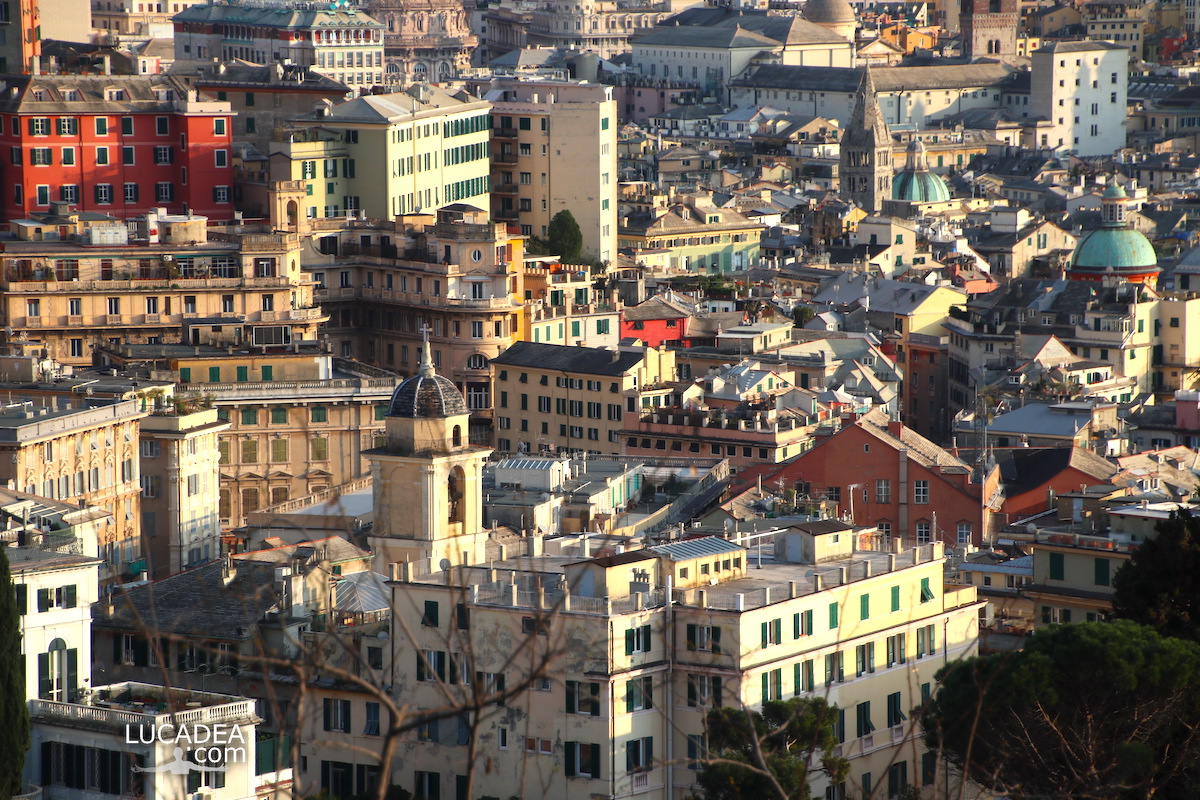
I always enjoy photographing Genoa from above, especially when the atmosphere is clear enough to reveal the details of the city. From a higher viewpoint, central Genoa takes on a completely different appearance, with buildings, rooftops and streets forming a pattern that is difficult to appreciate while walking through the narrow lanes.
This is exactly the kind of photograph I keep looking for whenever I have my camera with me. Genoa is full of details, and many of them remain hidden when seen only from street level. From above, however, it becomes possible to follow the lines of the rooftops, recognise different buildings and understand just how dense and compact the city centre really is.
In this image, I wanted to focus mainly on the buildings in central Genoa. There is no single monument that needs to dominate the composition. The subject is the city itself, made up of overlapping buildings and rooftops that seem to come remarkably close to one another.
When I look for a view of Genoa from above, the sky becomes an important part of the photograph. I do not necessarily need a spectacular day; what matters to me is having enough clarity to read the shapes of the city. A reasonably clear sky helps preserve the attention on the architecture and allows the layers of rooftops and buildings to remain visible.
The vertical character of Genoa is particularly interesting from this perspective. The city stretches between the sea and the hills, and the dense historic centre makes this relationship especially clear. From above, you can better appreciate how little space separates one building from another and how the urban landscape has developed through centuries of changes.
There is a small detail about Genoa that becomes easier to understand from this kind of viewpoint. Its historic centre is one of the largest in Europe, with a dense network of narrow lanes, squares, historic buildings and passages. Seen from above, that complex urban fabric almost becomes a pattern, revealing connections that are much harder to notice from the street.
I have photographed Genoa from several viewpoints, including Castelletto esplanade, where the view opens across a much wider part of the city. This photograph is different because I wanted to concentrate more closely on the buildings and the urban texture rather than creating a traditional panoramic view.
For me, it is also a way of continuing to discover a city I have photographed many times. Even when returning to a familiar viewpoint, different visibility can completely change the result. A clearer sky, a newly noticed detail or simply a different section of rooftops can make the photograph feel new.
If you are looking for a view of Genoa worth seeing from above, these elevated perspectives offer something different from the usual street-level images. They show the city as a dense collection of buildings shaped by its geography and history, while still leaving plenty of room for personal observation.
I have always liked this side of photography: looking at a familiar place from an unfamiliar angle and finding something worth capturing without needing to search for a spectacular subject.

Do you prefer seeing Genoa from above or getting lost in its narrow streets? Add a comment or go to the bottom of the site to read what other visitors have written.

Central Genoa seen from above, with rooftops and historic buildings filling the cityscape

Photo taken with Canon EOS M100 and lens Tamron 16-300.

The Santa Brigida washhouses in Genoa

Truogoli di Santa Brigida a Genova, antico lavatoio pubblico circondato dalle case della caratteristica piazzetta

The Santa Brigida washhouses in Genoa.
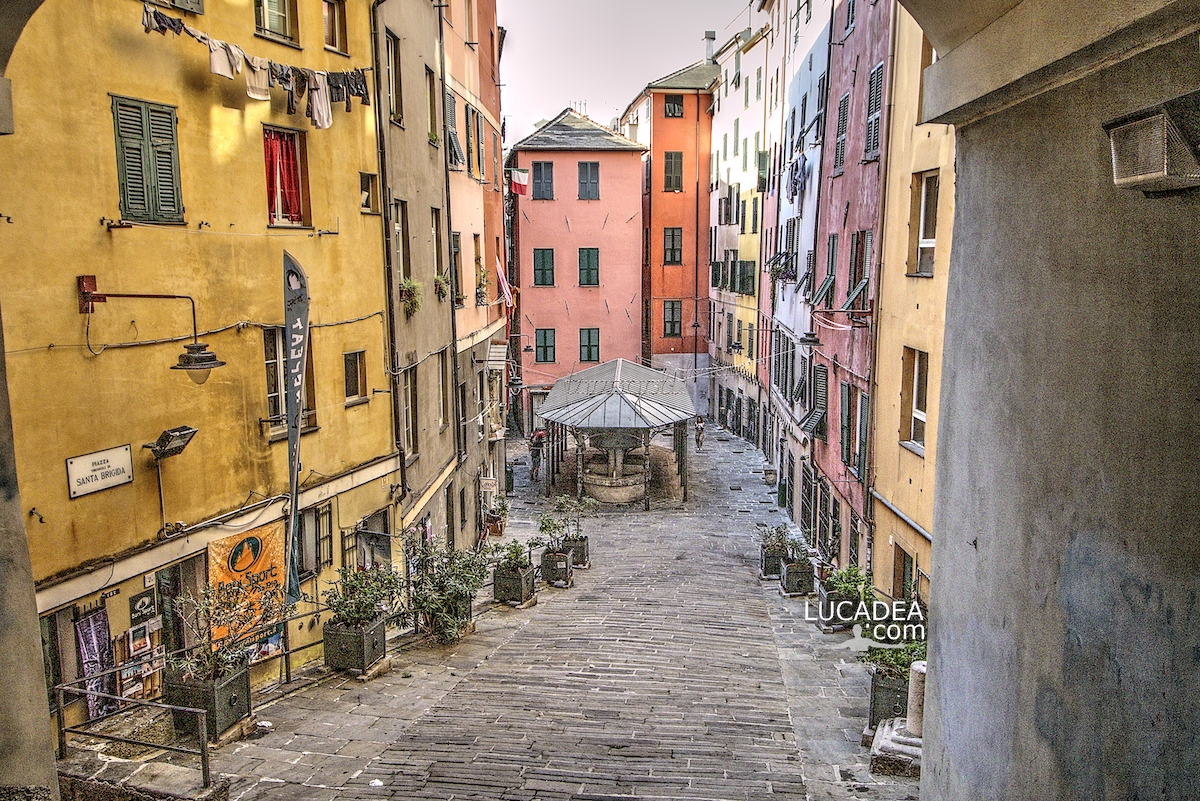
Walking downhill from Genoa Principe station along Balbi street, it only takes a few steps to reach this small square and its old public washhouses. In Genoa, Liguria, Italy, places like this can appear almost unexpectedly between the main streets and the dense buildings of the historic centre, and that is exactly what made me stop and take this photograph.
The Santa Brigida washhouses are one of those urban details that are easy to miss if you are simply heading towards the centre of the city. Balbi street is an important route from the railway station towards the historic centre, the University and the Old Port, but a short detour reveals a much quieter and more intimate space.
What immediately caught my attention was the relationship between the old washhouse and the buildings around the square. The houses create a compact architectural setting, while the washhouse remains a very visible reminder of the everyday life that once took place here.
I took this photograph because I like finding this kind of detail while walking through Genoa. It is not one of the city’s monumental landmarks, but it has something that I find just as valuable for a personal photoblog: it shows how the city was used by ordinary people and how some traces of that past have survived.
The word “truogolo” traditionally refers to a trough or basin, and in this context it is connected with public washing facilities. Before washing clothes at home became the normal solution, public washhouses were important parts of neighbourhood life. They were practical places where people could carry out an everyday task, but they also naturally became places where neighbours met and talked.
That small piece of history is what makes the photograph more interesting to me. The structure we see today is not simply an old feature preserved in an attractive square. It is a reminder of a completely different way of living in the city.
If you are looking for things to see around Genoa Principe station, the Santa Brigida washhouses are an easy place to include in a walk towards the historic centre. They are very close to Balbi street, so visiting them does not require a major detour, and the surrounding buildings make the short walk worthwhile for anyone interested in Genoa’s older urban fabric.
The square itself is also particularly pleasant to photograph. The surrounding façades, the compact layout and the old washhouse create a scene that feels very different from the larger streets nearby. I liked the fact that there was no need to search for a single dominant subject: the whole space worked together.
This is one of the reasons I enjoy photographing Genoa. The city constantly changes scale. A main street can suddenly become a narrow passage, a steep climb or a small square hidden just behind a corner. For a photographer, those transitions can be more interesting than a perfectly planned route.
I also connected this photograph with another image I took very close by, showing Santa Brigida slope. The two locations are practically opposite each other and show different sides of the same small area. One photograph looks towards the steep route climbing towards Castelletto, while this one focuses on the washhouse and the buildings surrounding the square.
That connection is useful because it shows how much can be found within a very small part of Genoa. You do not necessarily have to walk for kilometres to discover different photographic subjects. Sometimes a few metres are enough.
The old washhouses also tell us something about the density of Genoa’s historic neighbourhoods. In a city where buildings stand close together and space has always been valuable, shared facilities had an important practical role. Their survival today gives us a glimpse of that older urban organisation.
For me, this is more interesting than simply knowing that the square is picturesque. The photograph has a story behind it, even though the story is only suggested by what remains.
I like photographing places like this because they add another layer to my photographs of Genoa. The city is full of famous buildings and views, but its character can also be found in small squares, old structures and everyday architectural details.
The Santa Brigida washhouses are a good example. They are close to one of the city’s main routes, yet once you step into the square the atmosphere changes. The old washhouse and the surrounding façades create a small scene that feels separate from the traffic and movement of the nearby streets.
That was enough to make me take out my camera.

Have you ever stopped to look at the Santa Brigida washhouses when walking down from Genoa Principe station? Add a comment or go to the bottom of the site to read what other visitors have written.

Santa Brigida washhouses in Genoa, an old public laundry surrounded by historic buildings in the small square

Photo taken with Canon EOS M100 and lens Canon EF-S 10-18.

Santa Brigida slope, between Principe and Castelletto

Salita Santa Brigida a Genova, ripida strada tra via Balbi e il quartiere di Castelletto

Santa Brigida slope, between Principe and Castelletto.
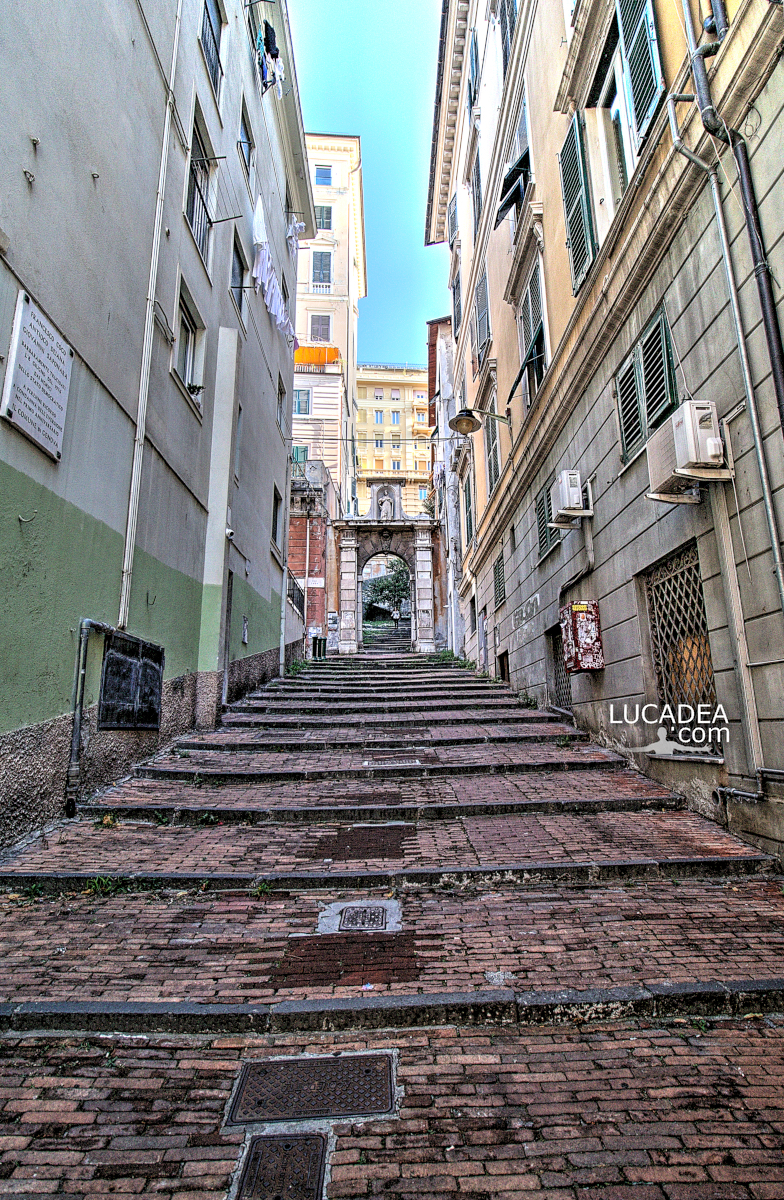
Leaving Genoa Principe station, I only had to walk a short distance along Balbi street before noticing the steep entrance to Santa Brigida slope. It is one of those corners where the urban landscape of Genoa changes almost immediately, with the broad street giving way to a much narrower uphill passage.
The photograph shows this steep climb towards Castelletto, just a few steps from Balbi street. On the opposite side are the historic Santa Brigida washhouses, known as the Truogoli, while this side opens into a very different kind of urban space.
I took the photograph because I liked the sudden change in perspective. From the station, Balbi street feels like a straightforward route towards the historic centre, the University and eventually the Old Port. Then, almost without warning, a steep lane begins to climb into the hills.
This is one of the details I enjoy when walking around Genoa, Liguria, Italy. The city constantly moves between relatively level streets and steep climbs, reflecting its position between the sea and the hills. A route that looks simple on a map can quickly become a staircase, a narrow lane or a demanding uphill walk.
If you are visiting Genoa and wondering what to see around Principe station before reaching the historic centre, this area is worth paying attention to. The most obvious route is Balbi street, but looking into the side streets can reveal a completely different side of the city.
Santa Brigida slope is not the kind of place that needs a long visit. For me, its interest is photographic: the steep perspective, the surrounding buildings and the contrast with the busier street below create a scene that feels very characteristic of Genoa.
The photograph was taken simply because I noticed this particular view while walking. I was not looking for one of the city’s major monuments. Instead, I wanted to record an ordinary urban detail, the kind of place that can easily be overlooked while heading towards somewhere else.
Just across Balbi street are the Santa Brigida Truogoli, which I had already photographed for Lucadea. I like these connections between photographs because they gradually create a more personal record of the city, moving from well-known places to smaller corners nearby.
One small historical curiosity is the way Genoa’s streets preserve names and traces connected with older neighbourhoods and religious institutions. Santa Brigida is one of those names that has remained part of the urban landscape, even as the surrounding city has changed considerably.
The steepness of this street is also a reminder that Genoa cannot really be understood only by following its main roads. The city has developed in layers, with routes climbing away from the waterfront and connecting different levels of the urban fabric.
That is why I often prefer to walk rather than simply move from one destination to another. A short detour can reveal a completely different perspective, and in Genoa there always seems to be another staircase, alley or uphill street waiting around the corner.
For a photographer, this makes the city particularly rewarding. The architecture changes quickly, people move through narrow spaces, and the relationship between the street and the hills is constantly visible.
In this photograph, I was interested in precisely that transition. Santa Brigida slope begins close to one of the city’s important routes and immediately points upwards towards Castelletto. It is a small scene, but it says quite a lot about the physical character of Genoa.
I also like the fact that this photograph can be connected with the nearby Truogoli. Two very different views, only a few metres apart, become part of the same walk through the city.
There is no famous monument in the centre of this image and no spectacular panorama. Instead, it is a photograph of a street that I happened to notice and wanted to remember.
That is often what keeps me interested in photographing Genoa: the city does not need to present its best-known sights every time. Sometimes its character is much easier to find in a steep street, an old building or an unexpected view between two roads.

Have you ever followed one of Genoa’s steep side streets instead of staying on the main route? Add a comment or go to the bottom of the site to read what other visitors have written.

Santa Brigida slope in Genoa, a steep street climbing from Balbi street towards the Castelletto district

Photo taken with a Canon EOS M100 camera and a Canon EF-S 10-18 lens.

Out of curiosity, here is the link to the article about the legend of Saint Bridget’s terrible prophecy, which I found on genovatoday.it.

Paganini Avenue among the trees in Castelletto

Corso Niccolò Paganini a Genova Castelletto con viale alberato e scorci sulla città

Paganini Avenue among the trees in Castelletto.
Walking along Niccolò Paganini Avenue in Genoa, Liguria, Italy, I found myself in one of those places that show a quieter side of the city. This tree-lined avenue crosses the Castelletto district and offers, through the branches, small glimpses of the city below.
When thinking about Paganini, the famous Genoese violinist immediately comes to mind, even though his house in the city no longer exists. His name, however, lives on through this long avenue, which today is one of the most pleasant places to walk in this part of Genoa.
took this photograph because of the balance between the green of the trees and the views that appear between them. It is not a wide open panorama like the one from Castelletto viewpoint, which I have already photographed in other posts, but something more subtle that changes as you move along the street.
If you are visiting Genoa and looking for places to explore beyond the main landmarks, this avenue is worth a walk. It shows a more everyday side of the city, far from the busy historical center, and offers a different way to experience Genoa.
Castelletto has long been one of the most appreciated residential areas of Genoa, partly because of its elevated position overlooking the city. From here you can understand why Genoa is often called “La Superba”.
This photograph reflects my way of telling the story of a city through its less obvious places, focusing on everyday scenes rather than only famous landmarks. Even a simple avenue can reveal a lot about the character of a place.

Have you ever discovered a city through its quieter streets rather than its main attractions? Add a comment or go to the bottom of the site to read what other visitors have written.

Niccolò Paganini Avenue in Castelletto Genoa with trees and partial views of the city

Photo taken with a Canon EOS M100 camera and a Canon EF-S 10-18 lens.

Here is where the course is located:

Niccolò Paganini (Genoa, October 27, 1782 – Nice, May 27, 1840) was an Italian violinist, guitarist, and composer, and one of the most important figures of the Romantic era. To this day, he remains surrounded by legends concerning his prodigious genius—some fueled by the atmosphere of 19th-century Romanticism—and the famous pact with the devil he allegedly made to gain the fame and skill needed to play the violin, all of which have contributed to the mythologizing of his persona.
Read more on Wikipedia

Santa Maria in via Lata Square in Genoa

Facciata bicolore della chiesa di Santa Maria in via Lata nella piazza di Carignano a Genova

Santa Maria in via Lata Square in Genoa.
While wandering through the Carignano district of Genoa, I discovered this beautiful square, a quieter corner of the city that is less famous than other locations but full of history and architectural details. The main element that caught my attention was the facade of Santa Maria in via Lata church, a building that still preserves the character of its past despite the many changes it experienced over time.
This photograph comes from my curiosity for the less obvious parts of Genoa, places where a simple walk can reveal stories hidden behind streets and buildings. Carignano has a particular atmosphere, close to the city centre but with a more peaceful feeling, where historic views appear unexpectedly between modern streets.
Santa Maria in via Lata church was built by the Fieschi family, one of the most important noble families of the Republic of Genoa and a name well known throughout the Ligurian Riviera. The history of the church is closely connected with the political events of the city, especially the famous Fieschi conspiracy against the Doria family in the sixteenth century.
After the failure of the conspiracy, the fate of the church changed significantly. Over the centuries it lost its religious function, was deconsecrated and used for different purposes. Despite these events, its facade remains a fascinating example of Romanesque-Gothic architecture, with its characteristic two-colour stone pattern that gives the building a unique appearance.
One interesting historical detail is the importance of the Fieschi family, which had a major influence on Genoese politics and even gave a pope to the Catholic Church, Innocent IV. Their power was considerable, but their conflict with the Doria family became one of the most dramatic episodes in the history of Genoa.
I wanted to capture this square because it represents one of the aspects I appreciate most about Genoa: the ability of the city to preserve historical traces even away from the most famous routes. Like other views of old Genoa that I have shared on my blog, this place shows how a small architectural detail can become a way to understand the identity of a city.
If you are exploring the Carignano district, Santa Maria in via Lata Square is a small stop worth discovering, where history, architecture and forgotten stories meet in a quiet corner of Genoa.

Did you already know this square and the story of Santa Maria in via Lata church? Add a comment or go to the bottom of the site to read what other visitors have written.

Two-colour Romanesque Gothic facade of Santa Maria in via Lata church in Genoa Carignano

Photo taken with a Canon EOS M100 camera and Canon EF-S 10-18 lens.

Following the failed conspiracy by Gianluigi Fieschi against Andrea Doria, the Fieschi family fell from grace in 1547, and their properties on Carignano Hill were confiscated; the palace was demolished by Senate decree, while the church was spared—though all Fieschi inscriptions and coats of arms were destroyed.
Read more on Wikipedia

A panoramic view of Genoa from Spianata Castelletto

Tutta Genova vista dalla Spianata Castelletto

A panoramic view of Genoa from Spianata Castelletto.
This is probably one of the most beautiful viewpoints to enjoy the view of Genoa, often called “La Superba.” From Spianata Castelletto, you can admire the city from above, with a wide perspective that includes the historic center, the harbor and the sea.
Genoa, in Liguria, Italy, is a city built between hills and the coastline, and this unique geography offers many spectacular viewpoints. Among them, Spianata Castelletto is one of the most famous and appreciated, both by visitors and locals.
One of the most interesting aspects of this place is how easy it is to reach. Despite being located above the city center, it can be accessed comfortably thanks to the public elevator that departs from Portello Square. This makes it an ideal destination for anyone who wants to enjoy a panoramic view without a long uphill walk.
Once at the top, the view is truly impressive. The rooftops of the historic center stretch toward the port, where ships and harbor structures highlight the strong connection between Genoa and the sea. In the background, the horizon opens onto the Ligurian Sea, creating a landscape that changes constantly with light and weather conditions.
Photographing Genoa from this viewpoint means trying to capture a complex and layered scene, full of details and contrasts. Every time I come here with my camera, I try to find a different composition, playing with perspective and light.
On lucadea.com I have shared several photos taken from elevated viewpoints because they offer a better understanding of the structure and character of a city.
Spianata Castelletto is not only a viewpoint, but also a place to stop, relax and enjoy the scenery.
If you are visiting Genoa, this is definitely a spot worth seeing.

Have you ever seen Genoa from this panoramic terrace? Add a comment or go to the bottom of the site to read what other visitors have written.

Tutta Genova vista dalla Spianata Castelletto

Tutta Genova vista dalla Spianata Castelletto

Tutta Genova vista dalla Spianata Castelletto

Photos taken with Canon EOS M100 and lens Tamron 16-300.

Here is where the lookout is located:

The Montaldo viewpoint is connected to Piazza del Portello by a public elevator, which began operating in 1910. The elevator’s station is housed in a characteristic Art Nouveau glass kiosk.
Continue and learn more at Wikipedia

A panoramic view of Genoa from Spianata Castelletto – Une vue panoramique de Gênes depuis Spianata Castelletto – Una vista panorámica de Génova desde la Spianata Castelletto – Uma vista panorâmica de Gênova a partir da Spianata Castelletto – Panoramablick auf Genua von der Spianata Castelletto – Toàn cảnh Genoa từ Spianata Castelletto – 从卡斯特莱托平台俯瞰热那亚全景 – ジェノヴァをスピアナータ・カステレットから望むパノラマ

The text of this post was written with the help of ChatGPT, a language model from OpenAI.

Walking up to Castelletto viewpoint in Genoa

Salita verso Spianata Castelletto a Genova tra vicoli e scale con scorci sulla città, uno dei percorsi da vedere a Genova.

Walking up to Castelletto viewpoint in Genoa.
There is a moment when you truly understand what to see in Genoa Castelletto viewpoint, and it happens while you are still climbing, surrounded by narrow alleys and endless steps. Among the places to see in Genoa, this walk toward Castelletto is already part of the experience, not just a way to reach the top.
I move slowly, letting small details guide me. Worn walls, half-open windows, glimpses of the city appearing suddenly between buildings. If you are visiting and wondering what to see in Genoa Castelletto viewpoint, you might think only about the final panorama, but the real feeling grows along the way. Different paths lead up here, from Portello square or Garibaldi street, and each one carries a slightly different rhythm.
Genoa, Liguria, Italy becomes something tangible as I climb. The city layers itself in front of me, step after step, revealing fragments of its past. It’s hard not to stop often, just to notice how the light shifts across the walls or how the sounds of the city soften as you go higher. In another photo I shared on my site, I explored Genoa from within the narrow alleys; here, everything slowly opens up.
A small historical detail adds depth to this walk: the Castelletto esplanade was created in the 19th century above ancient fortifications, designed specifically as a panoramic terrace over the city. Knowing that gives the climb a quiet sense of purpose.
When I finally reach the top, the view appears almost suddenly. The old town spreads out below, towers rising between rooftops, and in the distance the Old Port and the Lanterna lighthouse come into view. It’s one of those scenes where words feel unnecessary.
If you are looking for what to see in Genoa Castelletto viewpoint, this is one of the most interesting places in Genoa not just for the view, but for the journey itself. The climb becomes part of the memory.

Have you ever discovered that the path can be as meaningful as the destination? Add a comment or go to the bottom of the site to read what other visitors have written.

Salita verso Spianata Castelletto a Genova tra vicoli e scale con scorci sulla città, uno dei percorsi da vedere a Genova.

Photo taken with Canon EOS RP and lens Canon EF-S 10-18.

Here’s where the road is:

The Montaldo viewpoint is connected to Piazza del Portello by a public elevator, which began operating in 1910. The elevator’s station is housed in a characteristic Art Nouveau glass kiosk.
Continue and learn more at Wikipedia

Walking up to Castelletto viewpoint in Genoa – Montée vers l’esplanade Castelletto à Gênes – Subiendo hacia la Explanada Castelletto en Génova – Subida até a Esplanada Castelletto em Gênova – Aufstieg zur Castelletto Esplanade in Genua – Leo lên Spianata Castelletto ở Genoa – 登上热那亚卡斯特莱托观景台 – ジェノヴァのカステレット展望台への登り道

The text of this post was written with the help of ChatGPT, a language model from OpenAI.

San Gerolamo Lane in Genoa

La Salita di San Gerolamo a Genova

San Gerolamo Lane in Genoa.
Visitors arriving in Genoa for the first time usually head towards the city’s best-known attractions, such as the Aquarium, the narrow lanes of the historic centre and Via XX Settembre, one of the main shopping streets. These places are certainly worth seeing, but there is another side of Genoa that many tourists never discover: the steep lanes and pathways that climb through the neighbourhoods surrounding the city centre.
This photograph shows Salita di San Gerolamo, taken from the upper end near Piazza Goffredo Villa, close to the Castelletto viewpoint. It is a glimpse of everyday Genoa, away from the busiest tourist routes. Here, the city’s distinctive geography becomes particularly clear, with streets and stairways following the hillsides and connecting different residential areas.
In Genoa, many of these traditional routes are known as *creuze*. The word is strongly associated with the local landscape and culture. These are not always ordinary streets: some are narrow paved paths bordered by old walls and houses, while others combine slopes, steps and small passages between buildings. They follow the natural shape of the hills and often reveal unexpected views along the way.
Walking along a *creuza* offers a different experience from exploring the historic centre or the waterfront. The pace is slower, the surroundings feel more residential, and the architecture tells the story of how Genoa developed between the sea and the hills. The Castelletto district is especially rewarding for those who enjoy exploring on foot. From the nearby viewpoint, visitors can admire the rooftops and harbour, while the surrounding lanes reveal quieter corners of the city.
I enjoy photographing places like San Gerolamo because they show a less familiar side of Genoa. A famous monument is not always necessary to create an interesting image. Sometimes a steep lane, an old wall or the way a path disappears between buildings can capture the character of a place better than a postcard view. These everyday details are part of what makes Genoa so distinctive.
If you have already visited the Aquarium or wandered through the *caruggi* of the old town, consider exploring the hillside paths around Castelletto on your next visit. They offer a chance to discover the city beyond its main attractions and experience its unique urban landscape at a more relaxed pace.

When you visit Genoa, do you stick to the famous sights, or do you enjoy discovering its hidden lanes and hillside paths as well? Add an comment or go to the bottom of the site to read what other visitors have written.

Salita di San Gerolamo, a traditional hillside lane in Genoa, photographed from Piazza Goffredo Villa near the Castelletto viewpoint

Photo taken with Canon EOS RP camera and Tamron 16-300 lens.

Here’s where the little road is:

🏠
  • Italiano